
Picking the right glass for spotting distant ridges, celestial details, or wildlife across a canyon comes down to more than raw magnification. The best binoculars for long distance balance aperture size, prism quality, optical coatings, and mechanical stability—get any of these wrong and you’ll be staring at a blurry mess beyond 200 yards.
I’m Min — the co-founder and writer behind Gadgets Feed. For this guide I’ve cross-referenced optical specifications, customer reliability data, and real-world test feedback across nine distinct models spanning entry-level to premium tiers to find the pair that delivers the clearest image at maximum range without breaking your budget.
Whether you’re scanning mountain peaks, tracking birds at extreme distances, or exploring deep-sky objects through binoculars, this analysis of the best binoculars for long distance will help you match your specific use case to the right set of optics.
How To Choose The Best Binoculars For Long Distance
Long-distance viewing changes the optical demands significantly. At range, light loss, image shake, and atmospheric haze become punishing. The right pair of binoculars for this job must prioritize light transmission, stability, and magnification without crossing into unusable territory.
Objective Lens Diameter — The True Light Bucket
The number after the magnification—the objective lens diameter in millimeters—determines how much light enters the optical system. For long-distance work, 42mm is the practical minimum, with 50mm and 80mm+ offering dramatically better performance in low-light conditions like dawn, dusk, or overcast days. A 20×80 binocular gathers over three times the light of a 10×42 model, making faint details visible at extreme range.
Magnification and Exit Pupil Trade-offs
Higher magnification magnifies not just the target but also your own hand tremor and atmospheric distortion. For handheld use, 10x to 12x is the realistic ceiling. Beyond that—think 20x or 25x—a sturdy tripod becomes mandatory. The exit pupil, calculated as objective lens diameter divided by magnification, should match your pupil size: 4mm to 5mm for daytime, 7mm for low-light use. A 12×50 binocular delivers a 4.2mm exit pupil; a 25×100 delivers 4mm, which is fine for bright conditions but struggles at night compared to a 7×50.
Prism Quality and Lens Coatings
BaK-4 prisms are essential for high-contrast, sharp images at distance—cheaper BK-7 glass loses edge light and produces a dimmer, less defined picture. Fully multi-coated optics, where every air-to-glass surface receives multiple anti-reflective layers, maximize transmission and reduce glare. Premium models add extra-low dispersion (ED) glass to eliminate chromatic aberration—that purple or green fringing visible on high-contrast edges at long range.
Quick Comparison
On smaller screens, swipe sideways to see the full table.
| Model | Category | Best For | Key Spec | Amazon |
|---|---|---|---|---|
| Celestron SkyMaster 25×100 | Premium | Deep-sky astronomy | 100mm objective, 25x mag | Amazon |
| Canon 12×36 IS III | Premium | Handheld high-mag stability | Image stabilization, 12x | Amazon |
| Maven C1 12×42 | Premium | ED glass clarity at moderate mag | ED glass, 42mm objective | Amazon |
| Vortex Fury HD 5000 10×42 | Premium | Hunting with integrated rangefinder | Laser rangefinder, HD glass | Amazon |
| Carson 3D ED 10×50 | Mid-Range | Color-accurate wildlife viewing | ED glass, 50mm objective | Amazon |
| Celestron SkyMaster Pro 20×80 | Mid-Range | Astronomy and long-range land | 20x mag, 80mm objective | Amazon |
| Bushnell Legacy WP 10-22×50 | Mid-Range | Variable zoom for flexible range | 10-22x zoom, 50mm objective | Amazon |
| Bushnell H2O Xtreme 10×42 | Value | Waterproof all-weather compact use | IPX7 waterproof, 10×42 | Amazon |
| Evil Eye 10-30×50 Zoom | Value | Budget zoom for general use | 30x max zoom, 50mm objective | Amazon |
In‑Depth Reviews
1. Celestron SkyMaster 25×100 Binoculars
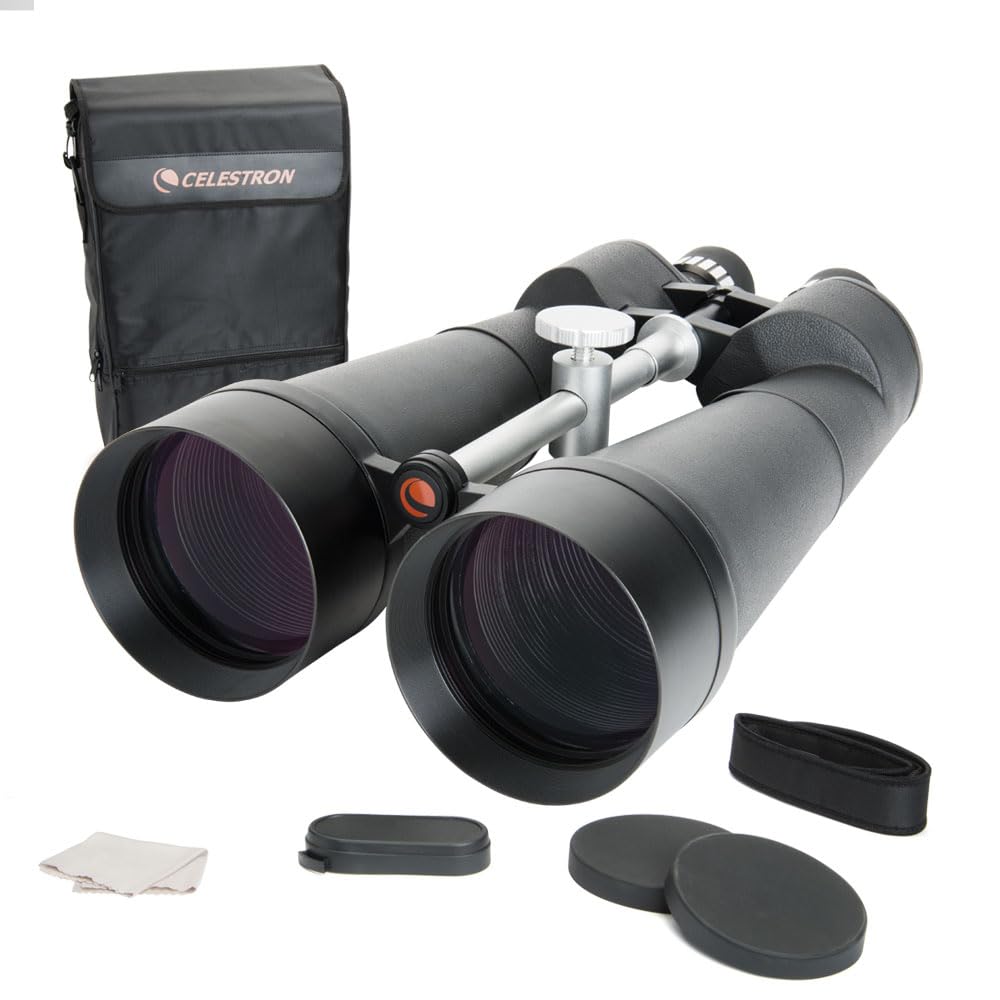
The SkyMaster 25×100 is the heavyweight champion of long-distance binoculars. With 100mm objective lenses and 25x magnification, it collects enough light to resolve Jupiter’s moons, the Orion Nebula’s trapezium, and distant mountain ridges that smaller optics simply cannot see. BaK-4 prisms maximize light transmission through the massive optical path, delivering bright, detailed images even in mediocre conditions.
These binoculars demand a substantial tripod—the included ¼”-20 adapter mounts to standard photo tripods, but the weight and focal length require a sturdy video head to avoid wobble. Individual eyepiece focus replaces the typical center wheel, which is standard for large astronomy binoculars and offers precise per-eye adjustment. The rubber-armored polycarbonate housing provides water resistance and a secure grip in cold weather.
At this price point, no other model offers the combination of raw aperture and magnification for extreme-distance viewing. The included carrying case functions as a backpack for transport, though lens covers are not tethered. For anyone serious about deep-sky astronomy or scanning vast landscapes with tripod-mounted stability, this is the definitive pick.
Why it’s great
- Massive 100mm aperture for extreme low-light performance
- BaK-4 prisms deliver bright, crisp images even at 25x
- Included tripod adapter and backpack-style case
Good to know
- Requires a heavy-duty tripod for steady viewing
- Individual eyepiece focus—not center focus
- Lens covers are not attached to the body
2. Canon 12×36 Image Stabilization III Binoculars

The Canon 12×36 IS III solves the single biggest problem of handheld long-distance viewing: hand shake. Its Vari-Angle Prism image stabilization system effectively cancels out tremor, allowing a 12x magnification to resolve distant details that would otherwise be an unusable blur when held. This makes it the most practical high-magnification binocular for users who do not want to carry a tripod.
Despite the stabilization technology, the unit is remarkably compact—just 36mm objectives keep the weight and bulk down, though this limits low-light performance compared to 50mm+ models. Doublet field-flattener lenses produce sharp, distortion-free images from edge to edge, a rarity at this magnification. Eye relief of 14.5mm works well for eyeglass wearers with folded-down eyecups.
The trade-off is the need to hold the IS button continuously while viewing, which becomes fatiguing over long sessions. Battery life is excellent, and the porro prism design delivers good resolution without excessive light loss. For birders, hunters, and outdoor enthusiasts who need stable handheld magnification without a tripod, this is the category’s standout solution.
Why it’s great
- Image stabilization makes 12x usable handheld
- Compact and lightweight for a stabilized optic
- Doublet field-flattener for edge-to-edge sharpness
Good to know
- IS button must be held continuously—no lock
- 36mm objective limits low-light gathering
- Objective lens caps are not tethered
3. Maven C1 12X42mm ED Binoculars

The Maven C1 12×42 delivers near-alpha-tier optical quality through its extra-low dispersion (ED) glass and fully multi-coated lenses, effectively eliminating chromatic aberration and producing neutral, high-contrast images. At 24.5 ounces, the polymer frame is lighter than equivalent glass-filled models, making it comfortable for extended handheld sessions while offering 12x magnification for reaching out to distant targets.
Waterproof and fogproof construction with scratch-resistant lens coatings ensure this binocular holds up in field conditions. The 15mm eye relief is adequate for glasses, and the close focus distance of about 6.5 feet adds versatility beyond long-distance work. Maven’s direct-to-consumer pricing knocks off typical retail markup, resulting in optics that compare favorably to models costing significantly more.
The soft storage bag is less protective than a hard case, and the diopter ring on some units can feel slightly loose. However, the unconditional lifetime warranty—covering damage regardless of cause—removes long-term risk. For users who prioritize image clarity and color fidelity at long distances without stepping into four-figure pricing, the C1 represents outstanding value.
Why it’s great
- ED glass eliminates color fringing at range
- Lightweight polymer frame reduces fatigue
- Unconditional lifetime warranty
Good to know
- Soft case only—no hard protective case
- Diopter ring can feel slightly loose on some units
- 12x magnification may induce shake without support
4. Vortex Optics Fury HD 5000 10×42 Laser Rangefinding Binoculars

The Fury HD 5000 combines high-definition 10×42 optics with an integrated angle-compensated laser rangefinder that reaches out to 5,000 yards. This eliminates the need for a separate rangefinder, streamlining your gear for hunting or tactical shooting. The HD optical system uses XR fully multi-coated lenses and dielectric phase-corrected prisms to deliver bright, clear images from dawn to dusk.
Two target modes—Best Mode for the strongest return and Last Mode for ranging beyond obstructive brush—give shooters precise control over ranging conditions. The angle-compensated HCD mode calculates true ballistic distance for rifle or bow, while LOS mode handles extreme high-angle shots. Nitrogen purging and O-ring seals provide waterproof and fogproof performance in harsh weather.
At this price, you are paying for the rangefinder integration as much as the optics. If you do not need laser ranging, a pure binocular at the same price point will offer better optical quality. However, for hunters and long-range shooters who want a single optic that handles both observation and distance measurement, the Fury HD 5000 is the most capable tool available.
Why it’s great
- Integrated laser rangefinder accurate to 5,000 yards
- HD optical system with dielectric phase-corrected prisms
- Angle-compensated modes for rifle and bow
Good to know
- Premium price reflects rangefinder integration
- 10x magnification limits extreme long-distance detail
- Heavier than a pure binocular at this size
5. Carson 3D ED Series 10x50mm High Definition Binoculars

The Carson TD-050ED brings true ED glass to the mid-range market at a price that undercuts premium competitors by a wide margin. The 10×50 configuration delivers a 5mm exit pupil, which matches the average human pupil in moderate light and gathers enough light for comfortable viewing at dawn and dusk. Chromatic aberration is virtually nonexistent, producing images with zero visible purple or green fringing even on high-contrast edges at long distance.
Rubberized armor with precisely placed thumb grooves improves ergonomics during extended glassing sessions. At 26.9 ounces, it is lighter than most 50mm roof-prism binoculars, reducing strain during hikes or long sits. The 20mm eye relief is generous for eyeglass wearers, and the close focus of roughly 10 feet adds general-purpose usability.
The included carrying case and shoulder harness are functional rather than luxurious, and the included lens covers are basic. The Carson No Fault warranty covers any defect without hassle. For any serious birder, hunter, or nature enthusiast who demands ED-level clarity at a sensible price, this is the clear winner in the mid-range tier.
Why it’s great
- True ED glass eliminates chromatic aberration
- 5mm exit pupil for excellent low-light performance
- Lightweight at 26.9 oz for a 50mm model
Good to know
- Included case and harness are basic quality
- Eye cups only have one locking position
- 10x magnification limited for extreme distance
6. Celestron SkyMaster Pro 20×80 Binoculars

The SkyMaster Pro 20×80 is purpose-built for tripod-mounted astronomy and extreme long-distance land observation. Its 80mm objectives paired with Celestron’s proprietary XLT fully multi-coated coatings deliver high-contrast, bright images that outperform many beginner telescopes in the same price bracket. BaK-4 prisms ensure the full aperture is utilized for maximum light throughput.
A unique detachable Reflex Sight Ready (RSR) rail allows mounting an optional red dot finderscope, making it dramatically easier to locate dim astronomical targets or distant landmarks. The rubber-armored polycarbonate body is waterproof and nitrogen-purged to prevent internal fogging in humid or cold conditions. The tripod adapter is included, though a sturdy tripod is essential—the 20x magnification amplifies every vibration.
The 15.5mm eye relief is acceptable but not generous for glasses. Some users report mild chromatic aberration at the extreme edges of the field, though the center 70% remains crisp. For the price, this is the best entry into serious tripod-based long-distance binocular viewing without jumping to the 25×100 class.
Why it’s great
- XLT fully multi-coated coatings maximize brightness
- RSR rail for mounting an optional reflex sight
- Waterproof and nitrogen-purged fogproof design
Good to know
- Requires a sturdy tripod—not practical handheld
- Mild chromatic aberration at field edges
- Eye relief is tight for eyeglass wearers
7. Bushnell Legacy WP 10-22×50 Binoculars
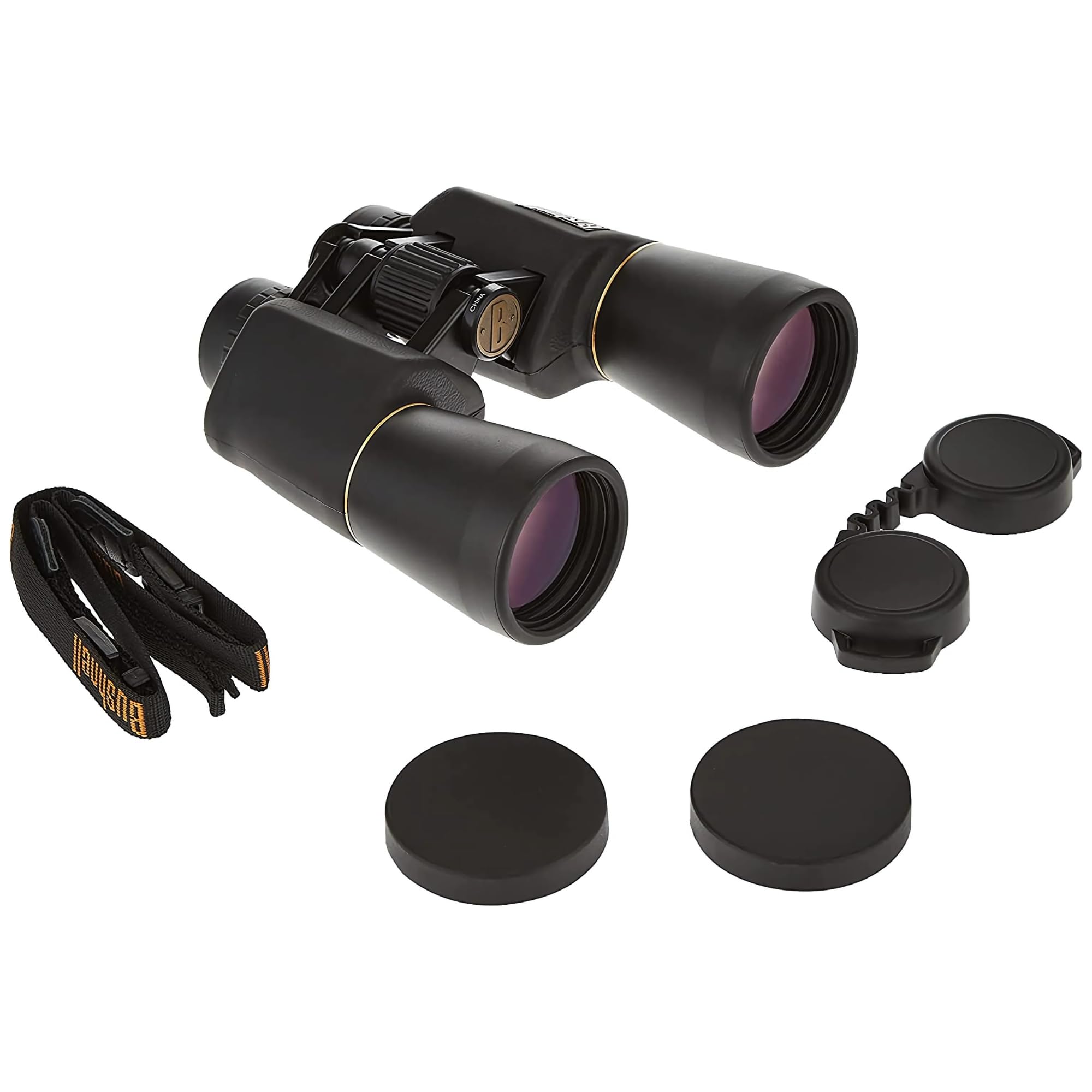
The Bushnell Legacy WP offers a unique value proposition: adjustable magnification from 10x to 22x in a single porro-prism body with 50mm objectives. This means you can scan wide areas at 10x and then zoom in on distant details at 22x without swapping optics. Fully multi-coated lenses and BaK-4 prisms provide respectable brightness and clarity across the zoom range.
At 22x, the image is usable on a tripod and surprisingly sharp for a zoom binocular. The 65-degree apparent field of view at lower magnifications gives a spacious viewing experience. The twist-up eyecups with 14mm eye relief work for most users, and the rubber armoring absorbs minor impacts. Nitrogen purging makes it fully waterproof and fogproof.
The zoom mechanism adds complexity and weight—at higher magnifications, the image dims slightly compared to a fixed-power model with the same aperture. Handholding at 22x is nearly impossible without a tripod. For users who want flexibility across varying distances without carrying multiple binoculars, this is a compelling and affordable option.
Why it’s great
- Adjustable zoom from 10x to 22x in one binocular
- Fully multi-coated optics and BaK-4 prisms
- Waterproof and fogproof construction
Good to know
- Image dims at higher zoom settings
- 22x requires a tripod for steady viewing
- Heavier than fixed-power 10×50 models
8. Bushnell H2O Xtreme 10×42 Binoculars

The Bushnell H2O Xtreme proves that IPX7 waterproofing and decent long-distance performance do not require a large budget. Built with BaK-4 prisms and fully multi-coated glass, this 10×42 roof-prism binocular delivers bright, clear images that handle moderate long-distance work—out to about 300-400 yards—without the color fringing typical of cheaper optics.
The O-ring sealed, nitrogen-purged body is submersible to one meter for 30 minutes, making it ideal for boating, kayaking, or rainy-weather hunting. The rubberized armor with soft-touch grip panels provides a secure hold even when wet. At 17mm eye relief, it is comfortable for eyeglass users, and the compact roof-prism design slips easily into a pack or jacket pocket.
The lack of a tripod adapter socket limits long-duration high-magnification use, and the included neck strap is basic. The 10x magnification is adequate for general long-distance observation but will not resolve fine details at extreme range like 50mm+ models. For wet-weather reliability on a tight budget, this is the waterproof champion.
Why it’s great
- IPX7 submersible waterproof rating
- BaK-4 prisms with fully multi-coated glass
- Compact roof-prism design for easy carry
Good to know
- No tripod adapter socket
- 10×42 limits extreme long-distance detail
- Included neck strap is basic
9. Evil Eye 10-30×50 High Power Military Zoom Binoculars

The Evil Eye 10-30×50 offers the widest zoom range in this roundup—from 10x to 30x—at a very accessible price point. The 50mm objective and BaK-7 prisms with FMC fully multi-coated glass provide adequate brightness for daytime and dusk viewing, though the image quality understandably degrades at the highest zoom settings. The 22mm large eyepiece diameter helps maintain a comfortable field of view even at 30x.
O-ring sealed construction provides water resistance against rain and splashes, though prolonged submersion is not recommended. The silicone protective cover and robust metal structure give it a durable feel that belies the low price. At 1.76 pounds, it is heavy enough to require a tripod attachment at higher magnifications, and the included tripod interface is functional.
The zoom mechanism adds internal complexity that impacts light transmission at 30x compared to fixed-power options. Customer reviews note that the lens covers are loose and the strap is hard to adjust. However, for casual users who want extreme zoom flexibility without a significant investment, this binocular delivers remarkable range—just be prepared to use a tripod beyond 15x.
Why it’s great
- Zoom range from 10x to 30x in one binocular
- Large 22mm eyepiece for comfortable viewing
- Water-resistant and impact-resistant construction
Good to know
- Image quality drops at 30x zoom
- Heavy; requires tripod for steady use at high mag
- Lens covers and strap quality are basic
FAQ
What is the ideal magnification for handheld long-distance binoculars?
Does a larger objective lens always mean better long-distance viewing?
Final Thoughts: The Verdict
For most users, the best binoculars for long distance winner is the Celestron SkyMaster 25×100 because its massive aperture and high magnification provide unmatched detail on distant terrestrial and astronomical targets. If you want handheld stability without a tripod, grab the Canon 12×36 IS III. And for the best overall value in a pure optical system, nothing beats the budget-friendly Carson 3D ED 10×50.