
Our readers keep the lights on and my morning glass full of iced black tea. As an Amazon Associate, I earn from qualifying purchases.
Specs are compiled from manufacturer listings and verified buyer reviews and can change over time — please confirm the key details on the product page before buying.
You want to read the airline logo on a climbing 737 and tell it apart from a 787 at distance, so you need three things from your binoculars: enough magnification, a wide view to catch the aircraft as it enters your sightline, and glass that stays sharp in harsh light. This list ranks the optics that actually deliver on those three jobs, not just promise them. A quick note: the magnification requirement here uses flexible matching, so not every model is the exact power you searched for; the nearest same-type size serves the same spotting purpose.
I’m Min — the founder and writer behind Gadgets Feed. This guide is built by comparing the manufacturers’ published specifications and the patterns across verified customer reviews, so you get each pick’s real strengths and trade-offs instead of marketing spin.
From a palm-sized 10×26 that rides in your jacket to a stabilized 12×36 that holds a distant fuselage rock-steady, these binoculars for plane spotting are ranked on the specs that matter for reading tail numbers and tracking climb-outs.
Our Picks at a Glance


How To Choose The Best Binoculars For Plane Spotting
Plane spotting is unlike birding because your target is small, fast, and often backlit by a bright sky. That combination demands optical choices you would not make for a nature trail, so it pays to match the glass to the sky you will actually be staring into.
Magnification vs. Steadiness
More power brings the aircraft closer, but it also magnifies every tremor in your hands. At 10x you can usually hold a view steady on your own; at 12x you will want to brace against a fence or a car roof; at 15x and above, a tripod becomes almost unavoidable. A 10×42 with a wide field of view is the most forgiving all-rounder for a first spotting pair.
Lens Diameter and Light Gathering
The second number (the objective lens diameter in millimeters) controls how much light reaches your eye. A 42mm objective gathers far more light than a 26mm one, which matters when you are trying to read a livery against a hazy sky or in the low light of an early departure. The trade-off is size and weight: bigger glass means a heavier pair hanging around your neck.
Exit Pupil and Eye Relief
Divide the objective diameter by the magnification and you get the exit pupil, the bright circle of light your eye actually sees. A larger exit pupil keeps the image bright when your eye is not perfectly centered, and it helps a lot in dim conditions. If you wear glasses, check eye relief too — a longer measurement (15mm and up) means you can keep your glasses on and still see the full field of view.
Quick Comparison
| Model | Best For | Magnification | Objective Lens | Eye Relief | Amazon |
|---|---|---|---|---|---|
| Vortex Crossfire HD 10×42★ Best Overall | Best Overall | 10x | 42 mm | 15 mm | Amazon |
| Nikon PROSTAFF P3 10×30Best Value | Travel companion | 10x | 30 mm | 15.4 mm | Amazon |
| Nikon Monarch M7 10×42Top Performer | High-end clarity | 10x | 42 mm | 16.5 mm | Amazon |
| Maven C1 10×42 ED | Premium value | 10x | 42 mm | 16 mm | Amazon |
| ZEISS Terra ED 10×42 | Fast focus | 10x | 42 mm | 18 mm | Amazon |
| Vortex Viper HD 12×50 | Long-range detail | 12x | 50 mm | 16 mm | Amazon |
| Canon 12×36 IS III | Shake-free viewing | 12x | 36 mm | 14 mm | Amazon |
| Leupold BX-4 Pro Guide HD 12×50 | Premium spotting | 12x | 50 mm | — | Amazon |
| Celestron SkyMaster Pro 20×80 | High-power tripod use | 20x | 80 mm | 15.5 mm | Amazon |
| Celestron SkyMaster 25×100 | Maximum reach | 25x | 100 mm | 15 mm | Amazon |
| Compact Binoculars 10×26 | Pocket portability | 10x | 26 mm | 10 mm | Amazon |
In‑Depth Reviews
1. Vortex Crossfire HD 10×42 Binoculars
Our pick — over 4.5★ from 3,500+ verified ratings; the strongest balance of quality and price.
The all-around spotting workhorse with a 15mm eye relief that keeps glasses-wearers in the frame.
For most spotters, the balance is a 10×42 like this Vortex: 10x power brings a climbing airliner close enough to read the livery, while the 42mm objective lens gathers enough light to keep the image clear against a bright or hazy sky. The fully multi-coated lenses (multiple anti-reflective layers on every air-to-glass surface) cut glare, and the roof prism design keeps the body compact and durable. It is also tripod adaptable, so you can mount it on a car window bracket for a long afternoon at the fence.
Owners consistently rank build quality and clarity as the two things that win them over, and the rubber armor gives you a secure grip even with cold or damp hands. The nitrogen purging and o-ring seals mean no internal fogging when you move from a warm car to a chilly observation point. The center focus wheel adjusts both barrels at once, and the twist-up eyecups let you dial in comfortable viewing with or without glasses.
On the optics front, some side-by-side testing against pricier rivals in overcast conditions found the Crossfire’s resolution slightly behind a few competitors when reading a distant license plate. But for sheer balance of price, warranty, and everyday performance, the unlimited unconditional lifetime VIP Warranty makes this the safest buy in the list — if it breaks, Vortex repairs or replaces it, no questions asked.
What wins spotters over
- 10x power with a 42mm light-gathering objective
- 15mm eye relief for comfortable wear with glasses
- Unconditional lifetime warranty with full transfer
Fair trade-offs
- Resolution trails a few higher-tier rivals in poor light
- Not the brightest glass at dawn or dusk
Reach for these if: you want one reliable pair for spotting, hiking, and travel while staying affordable.
Look elsewhere if: you demand maximum edge-to-edge sharpness in the worst light — that calls for a step up in price.
2. Nikon PROSTAFF P3 10×30 Binocular
A featherweight 10×30 with a 346-foot field of view that catches fast-moving jets easily.
If you want a pair that travels everywhere without weighing you down, the PROSTAFF P3 is a smart pick. The 10×30 configuration (10x power with a 30mm objective) trades a little light gathering for genuine portability, and the fiberglass-reinforced polycarbonate body with rubber armor keeps it light yet rugged. The wide 346-foot field of view at 1,000 yards is a real asset for plane spotting — it gives you more room to pick up an aircraft as it crosses your line of sight.
Multilayer coatings on the lenses minimize reflections and boost brightness and contrast, while the silver-alloy prism coating delivers vivid, lifelike color. O-ring seals and nitrogen gas purging make it waterproof and fogproof, so a sudden rain shower at the observation deck will not ruin your afternoon. The turn-and-slide eyecups and 15.4mm eye relief make it comfortable whether or not you wear glasses.
The main trade-off is the smaller 30mm objective, which means less brightness in dim conditions than a 42mm pair — early-morning departures might look a bit darker. Owners also note the eyecup cover can pop off easily on the first walk, so treat it gently. For daylight spotting and travel, though, this is a genuinely portable companion that delivers sharp views.
Best travel glass: the lightest full-featured pick here, ideal for spotters who want quality in a compact body.
Keep in mind: a 30mm lens gathers less light, so expect dimmer views at dawn or dusk.
3. Nikon Monarch M7 10×42 Binoculars
Extra-low-dispersion glass delivers razor-sharp edges across a wide 362-foot field.
The Monarch M7 is where Nikon’s serious optical engineering kicks in. Its ED (extra-low-dispersion) glass elements correct color fringing, so the edge of a white fuselage against a blue sky stays crisp instead of showing a purple halo. With 10x magnification and 42mm objectives, it offers a field of view up to 357 feet at 1,000 yards (the spec sheet lists 362 feet) — wide enough to track a banking aircraft without losing it.
The build quality gets high marks from owners, with a rubber-armored body that holds up in rain and a smooth central focus knob that lets you dial in sharpness quickly as a plane moves through your view. The twist-up click-stop eyecups provide a customizable fit, and the 16.5mm eye relief is generous for glasses wearers. Phase-corrected dielectric-coated prisms boost brightness and resolution, and the oil- and water-repellent lens coatings shrug off fingerprints from constant handling.
A few owners note the pair has some heft, so you need a reasonably steady hand, and one buyer found the step up from a much cheaper pair less dramatic than the price difference suggests. But for long-range observation where detail matters — reading registration letters on a distant tail — the M7 is a clear step above budget glass.
Why it earns the price
- ED glass kills color fringing on bright skies
- Wide 362-foot field keeps fast movers in frame
- Dielectric-coated prisms for maximum brightness
Weighing the cost
- Heftier than smaller compacts — needs a steady hand
- A premium price for a modest gain over budget tiers
Choose this if: you want near-flawless clarity for serious long-range identification.
Consider a cheaper pair if: you only spot casually in good daylight — the extra cost may not show.
4. Maven C1 10X42 mm ED Binocular

Alpha-class sharpness from a direct-to-consumer brand that skips the retail markup.
Maven’s C1 punches well above its price tier, and owners are quick to compare its optics to binoculars costing two to three times more. The extra low-dispersion (ED) glass and fully multi-coated lenses deliver an exceptionally clear, bright image with excellent color reproduction — one owner says they could see individual pine needles at distance, which says a lot about resolution. For plane spotting, that means registration letters stay readable even on a hazy horizon.
The polymer frame keeps the pair well-balanced and lightweight, and the 16mm eye relief works well for glasses wearers. It focuses down to 5.9 feet, which is handy if you want to double as a close-up viewer. Waterproof, fogproof, and scratch-resistant lens coatings ensure the optics stay clear through a day at a windy viewpoint, and the unconditional lifetime warranty covers repair or replacement regardless of where or when you bought it.
The trade-offs are minor: the included pouch is soft rather than a hard case, so you may want to add your own protection for travel, and a few owners mention the diopter ring can have a little play. None of that dims the core appeal — this is the best pure image quality per dollar in the lineup.
Optics-first pick: the sharpest, brightest image you can get without stepping into true alpha pricing.
Minor gripes: a soft pouch instead of a hard case, and occasional diopter ring looseness.
5. ZEISS Terra ED Binoculars 10×42
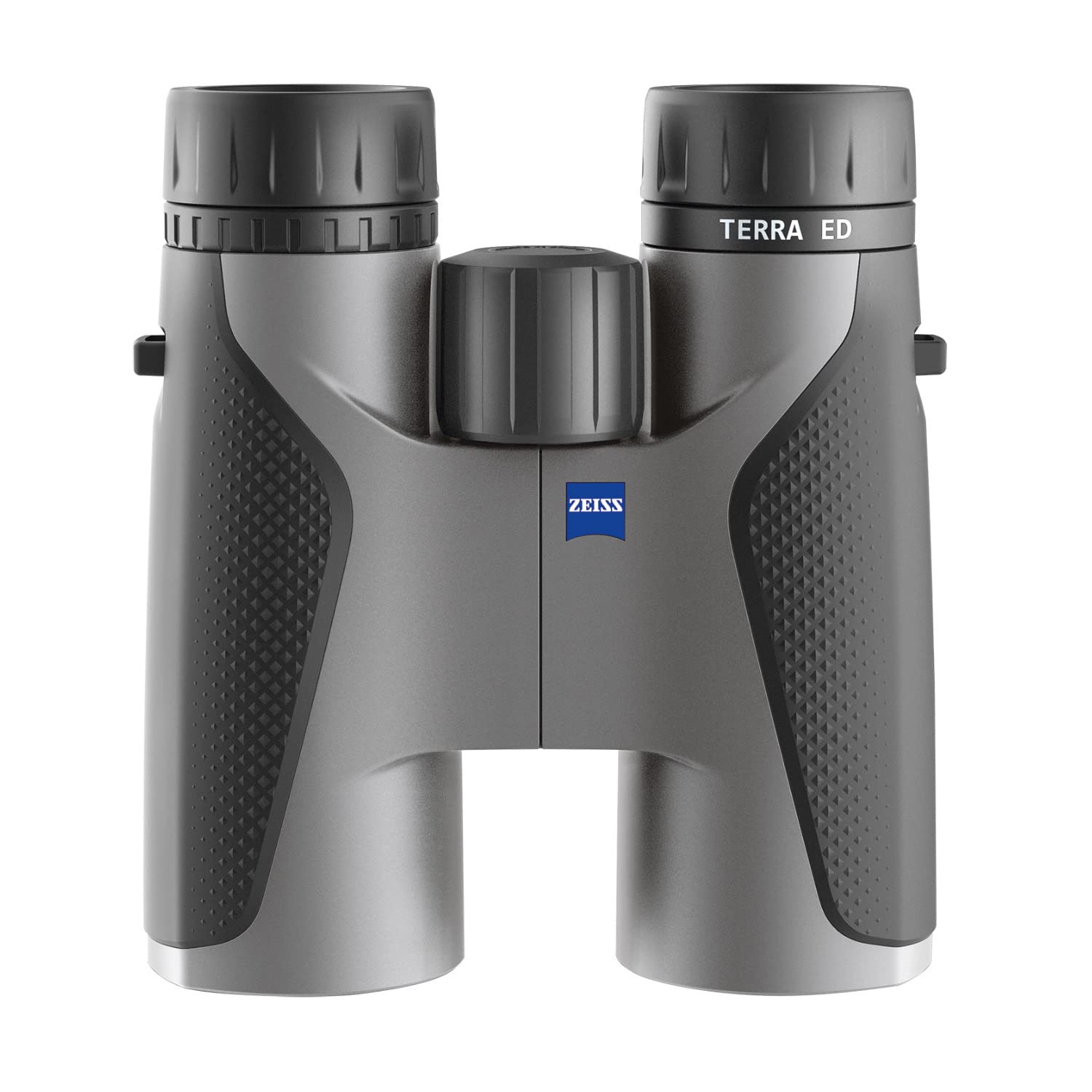
A ZEISS badge with an 18mm eye relief and a focus wheel your finger finds instantly.
The ZEISS Terra ED brings the German optical giant’s pedigree to a price that serious hobbyists can justify. Its Schmidt-Pechan ED glass with a hydrophobic multi-coating delivers 88% light transmission, which keeps the view bright and high-contrast even in adverse light and twilight. For spotting, that means a white aircraft against a bright overcast sky remains clearly defined rather than washed out.
The large, easy-to-grip focus wheel is the standout ergonomic feature — your index finger lands on it naturally, and its fast focusing lets you snap onto a moving target quickly when a plane suddenly enters your frame. The fiberglass-reinforced casing is waterproof and nearly indestructible, and it fits easily into any bag. The generous 18mm eye relief is among the longest here, a genuine comfort win for glasses wearers who spend long sessions scanning the sky.
Owners consistently praise the clarity and depth of field, with one calling it the best they now own. The recurring note is that the neck strap does not store neatly in the case, a small annoyance given the otherwise polished package. The ZEISS anti-reflective coating ensures brilliant, high-contrast images even in challenging light, making this a superb all-weather spotting companion.
The ZEISS advantage
- 88% light transmission for bright, contrast-rich views
- 18mm eye relief — the best here for glasses wearers
- Fast, ergonomic focus wheel for tracking movers
Small flaws
- Neck strap is awkward to store in the case
- A touch pricey for the feature set
Grab these if: you wear glasses and want a rugged, fast-focusing pair from a legendary brand.
Think twice if: budget is your top concern — the Maven C1 offers similar glass for less.
6. Vortex Viper HD Roof Prism Binoculars 12×50

12x magnification with 50mm objectives for pulling distant tail numbers into crisp view.
When 10x is not enough reach for the long final approach, the Viper HD steps up to 12x magnification paired with 50mm objective lenses. That combination delivers a high-density optical system with exceptional resolution and edge-to-edge clarity, letting you read details on aircraft that are still several miles out. The XR anti-reflective lens coatings keep the view bright even in low-light conditions — useful for spotting the first departures of the day.
The ergonomics are a highlight: an easy-to-grip rubber-armored chassis with perfectly placed thumb indents, and a locking right-eye diopter that tailors each barrel’s focus to your eyes and stays put once set. The smooth center focus wheel provides fine control, and the twist-up eyecups rest comfortably against your face. Argon purging and o-ring seals deliver a lifetime of waterproof and fogproof performance, and the ultra-hard, scratch-resistant Armortek coating protects the exterior lenses from oil and dirt.
The included GlassPak chest harness makes all-day carry comfortable and strain-free, which matters for long spotting sessions. Owners say the pair is heavier and larger than smaller 10x42s — that is the price of more glass — but the clarity and low-light performance justify the weight for dedicated long-range spotters. A few note a slight loss of focus at the extreme outer edge, but it is barely noticeable in practice.
The reach advantage
- 12x power with 50mm light-gathering objectives
- Locking diopter stays tuned to your eyes
- Comfortable GlassPak chest harness included
The weight cost
- Heavier than 10x42s — noticeable on long sessions
- Slight edge softness at the outermost field
Pick this if: you want maximum hand-held reach for distant aircraft and can handle the extra weight.
Choose a 10×42 instead if: you prefer a lighter pair for all-day scanning.
7. Canon 12×36 Image Stabilization III Binoculars

Superb image stabilization makes a hand-held 12x view feel like it is on a tripod.
Canon’s Image Stabilization (IS) technology, borrowed from its EF lenses, holds the 12x view rock-steady even with unsteady hands. At 12x magnification, that is transformative — a distant airliner stays locked in your view instead of bouncing around, letting you read airline logos and even spot stars and fine details that standard binoculars simply cannot hold still. Owners describe the stability as like viewing off a tripod.
The 36mm objective lens keeps the body compact and portable while still delivering clear, bright images. Porro II prisms minimize light loss, and the doublet field-flattener keeps the image sharp edge-to-edge. The 14mm eye relief suits glasses wearers, and the low-reflective exterior works well outdoors.
The IS system runs on batteries and requires holding a button — a few owners wish it had a timer or lock. Eyepiece caps are untethered and objective caps are not included, so you may want to add your own. The 14mm eye relief is shorter than some rivals, but the stability more than compensates for most spotting needs.
The stability win
- IS tech eliminates hand-shake at 12x power
- Compact and lightweight for a 12x pair
- Sharp, distortion-free images edge-to-edge
Things to know
- IS requires holding a button — no timer or lock
- Caps not tethered; objective caps not included
Reach for these if: hand-shake ruins high-power views for you and you want tripod-like stability in your hands.
Skip them if: you dislike managing batteries and a hold-button during every viewing session.
8. Leupold BX-4 Pro Guide HD Binoculars 12×50

A 12×50 that owners say beats a spotting scope thanks to a huge 65.2-degree apparent field.
For the spotter who wants the most detail per dollar, the BX-4 Pro Guide HD is the pick. The 12×50 configuration delivers the reach for serious identification, and owners say the optics are sharper than a spotting scope because you use both eyes. One owner notes the view stays sharp even out to 400 yards, which is exactly the kind of performance you want when reading registration numbers on a taxiing jet.
Leupold’s Elite Optical System delivers what the brand calls outstanding light transmission and glare reduction, and the Guard-ion lens coating sheds water, dirt, and fingerprints so your view stays clear even after a light rain. The open-bridge, dual-hinge design keeps the pair extremely lightweight and ergonomic despite the large objectives — the 1.8-pound weight is impressive for a 12×50. The 65.2-degree apparent angle of view gives you a genuinely rich field that makes tracking a moving aircraft feel natural.
It is waterproof and fogproof, backed by Leupold’s legendary customer care. The main consideration is the premium price and a slightly larger, heavier body than a compact 10×42 — the extra glass is worth the clarity, as some owners put it. For dedicated spotters who want the finest image quality available without stepping into true alpha pricing, this is a strong contender.
The clarity benchmark
- Sharper than a spotting scope — full binocular vision
- Lightweight 1.8 pounds for a 12×50
- Wide 65.2-degree apparent field for easy tracking
Considerations
- Premium price tag for the top-tier experience
- Larger body than compact 10x42s
Choose this if: you want the finest 12×50 image quality and use both eyes to read distant details.
Look elsewhere if: portability and a smaller footprint rank above pure optical reach.
9. Celestron SkyMaster Pro 20×80 Astronomy Binoculars

A 20×80 giant that turns a tripod-mounted setup into a serious long-range identification station.
When a 10x or 12x pair is not enough, the SkyMaster Pro jumps to 20x magnification with massive 80mm objective lenses. This is a different class of instrument — one that demands a sturdy tripod but rewards you with views of distant aircraft that are simply impossible with hand-held optics. The large objectives and BaK-4 prisms, combined with Celestron’s proprietary XLT fully multi-coated optics, deliver bright, sharp images even in dim lighting conditions.
The unique detachable RSR (Reflex Sight Ready) rail lets you mount an optional red dot finderscope or reflex sight, making it far easier to point the binoculars at a moving target high in the sky. This is a genuine advantage for tracking aircraft that are hard to locate at 20x power. The rubber-armored, polycarbonate housing is durable and fully waterproof, with nitrogen purging to prevent internal fogging.
The honest trade-off is weight and focus: owners are clear that this is heavy and needs a good tripod, and the focus quality receives mixed feedback — some report chromatic aberration (color fringing) and occasional alignment issues that need adjusting. This is not a grab-and-go pair, but for a dedicated spotting setup at a fixed vantage point, it delivers enormous reach for the price. Nobody should buy this expecting hand-held use.
The raw reach
- 20x power with 80mm objectives for extreme detail
- RSR rail mounts a red dot finder for easy targeting
- Fully waterproof and nitrogen-purged
The heavy price
- Demands a sturdy tripod — not for hand-held use
- Mixed focus quality; some chromatic aberration
Best for: the serious spotter with a fixed vantage point and a solid tripod who wants maximum reach.
Skip if: you want a portable pair to carry around — this stays on a mount.
10. Celestron SkyMaster 25×100 Giant Astronomy Binoculars
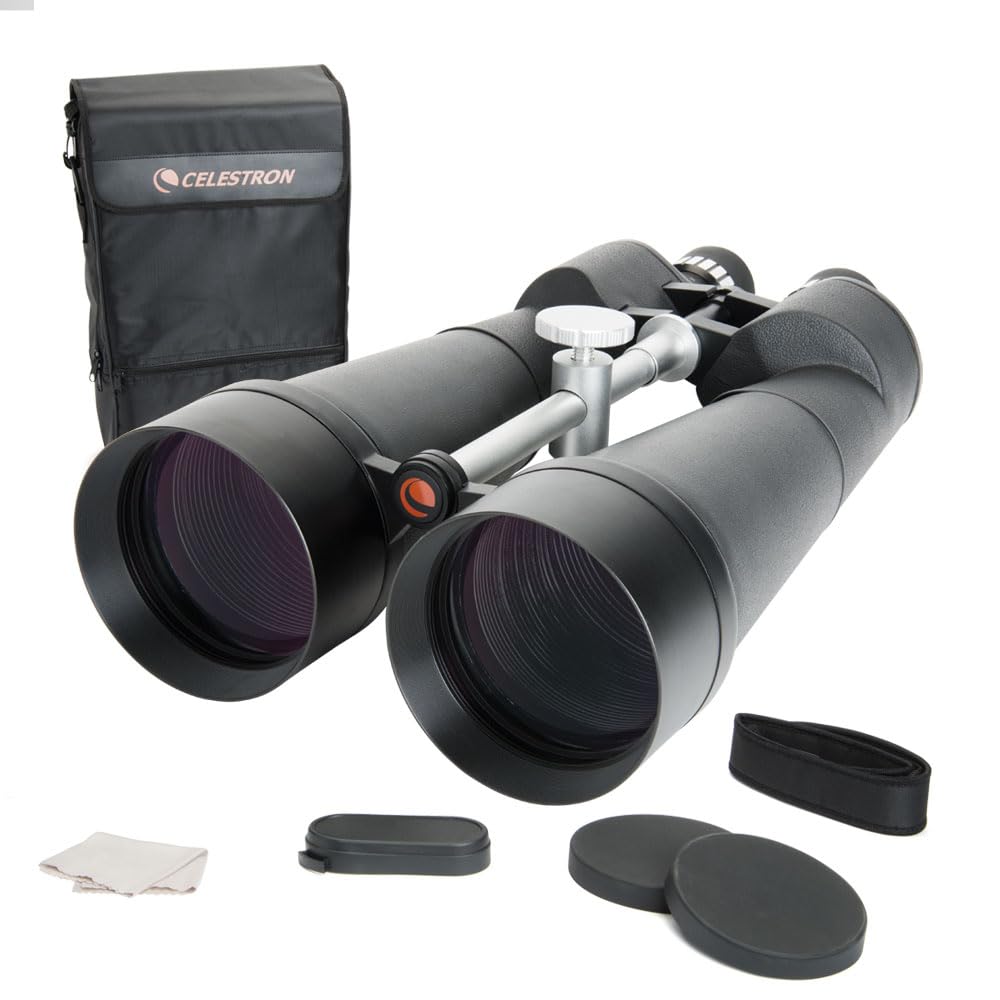
The largest pair here — 25x power and 100mm objectives for deep-sky and extreme long-range views.
At the very top of the reach ladder sits the SkyMaster 25×100, a giant instrument with massive 100mm objective lenses and powerful 25x magnification. This is Celestron’s largest tripod-mounted binocular, built for deep-sky astronomy and long-distance land viewing. The BaK-4 prisms boost light throughput so you see brighter, more detailed images, and the 25x power brings distant aircraft close enough to count rivets on the fuselage — if you can hold them steady, which means a quality tripod is non-negotiable.
Due to its size and weight, mounting it on a traditional photo tripod is essential; the built-in ¼”-20 adapter attaches to most tripods in seconds. The rubber-armored housing provides a secure grip and a water-resistant exterior that handles unexpected rain. The per-eye focus (there is no center focus) takes a little getting used to, but owners who embrace it find the views of the moon, Jupiter, and distant land targets genuinely stunning.
Honest feedback is mixed on optical quality — while many praise the excellent views, some report double images or alignment issues that require careful setup. The weight (around 10 pounds) makes this strictly a tripod instrument, and the included case is described as tedious and offering poor protection, so a hard case is a wise addition. This is a specialized tool for the dedicated observer, not a casual spotting pair.
The sheer power
- 25x magnification with 100mm objectives
- BaK-4 prisms boost light throughput
- Built-in ¼”-20 adapter for easy tripod mounting
The practical costs
- Around 10 pounds — tripod mandatory, no hand-held use
- Mixed reports of alignment or double images
Reach for this if: you run a fixed spotting station and want the absolute maximum magnification available in binocular form.
Look elsewhere if: you want any portability — this is a permanent tripod resident.
11. Compact Binoculars for Adults 10×26 High Powered
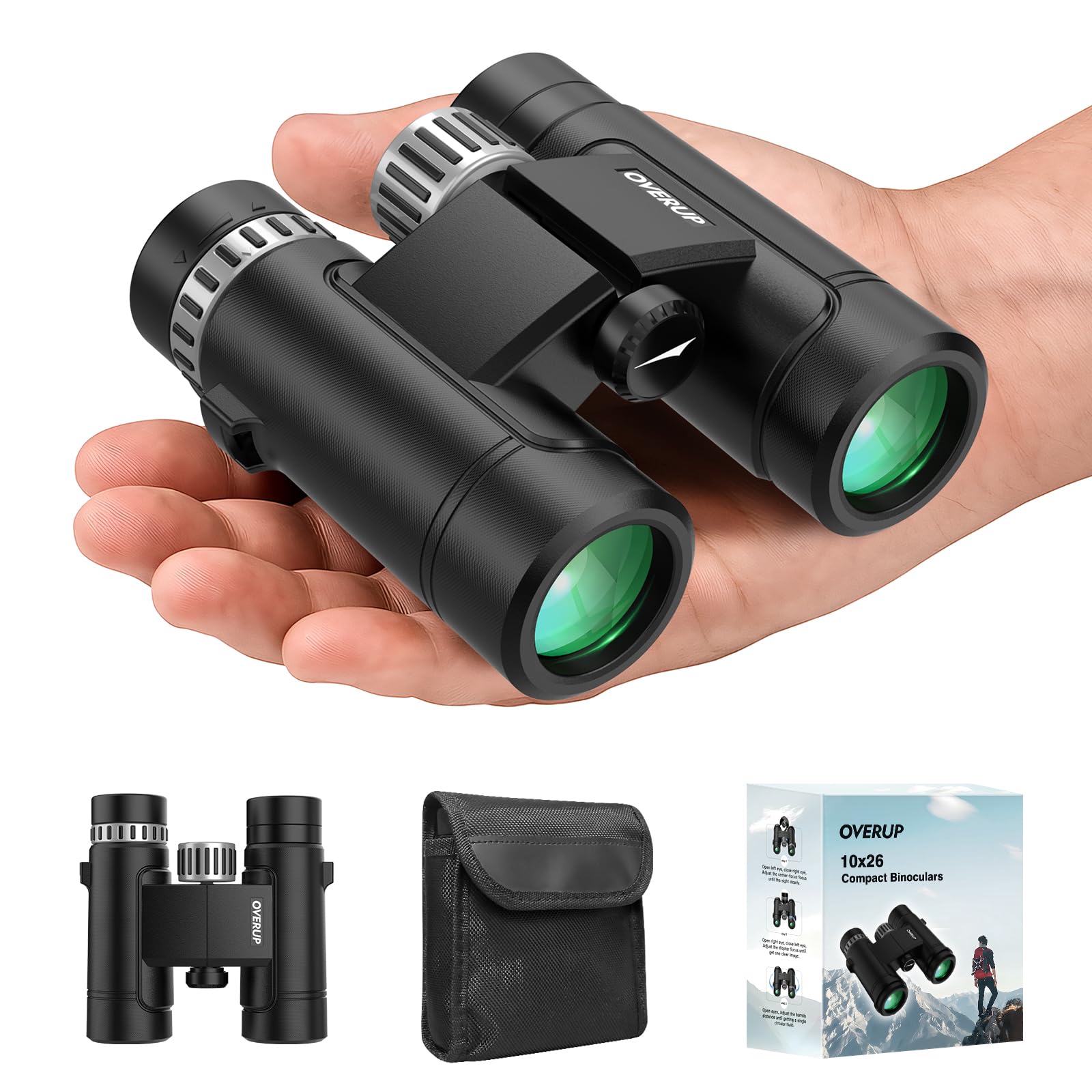
A 0.6-pound pocket pair you can grab and focus one-handed in seconds.
Not every spotting session is a planned expedition. Sometimes you just want a pair that lives in the truck console or a jacket pocket, ready the moment a contrail catches your eye. This compact 10×26 fits that role perfectly — it is small enough to fit in your palm, light enough at 0.6 pounds to forget you are carrying it, and simple enough for one-hand use. The 10x power brings distant aircraft 10x closer with clarity that defies the small size.
The BAK4 prisms and fully multi-coated (FMC) lenses deliver sharp, high-contrast images even in the early morning or late evening, minimizing color fringing so you can identify aircraft by their paint scheme. The IPX7 waterproof rating means it can survive an accidental drop in a stream or heavy rain, and the anti-fog coating keeps the view clear when you move between temperature extremes — whether that is a cold spotting deck or a warm vehicle. Owners note the rubberized grip feels rugged and the anti-fog coating performs flawlessly even in a hot car.
The trade-off is physics: a 26mm objective lens gathers far less light than a 42mm one, so views will be dimmer in low light, and the 10mm eye relief is short for glasses wearers. The 4.6-inch body is genuinely pocket-sized, and the simple 3-step focus makes it easy for older kids to use too. For spontaneous spotting and travel, this is the easiest pair on the list.
Always with you
- 0.6 pounds and palm-sized for true portability
- IPX7 waterproof — survives rain and dunkings
- One-hand use with a smooth center-wheel focus
Size limits
- 26mm lens is dim in low light — a daylight pair
- 10mm eye relief is tight for glasses wearers
Grab these if: you want a rugged, pocket-sized spare that is always within reach for casual spotting.
Choose a 42mm pair if: you mainly spot in early or late light and need maximum brightness.
Understanding the Specs
Magnification and Objective Lens
The two numbers on every binocular (like 10×42) tell you two things: the first is how many times closer the object appears, and the second is the diameter of the front lens in millimeters. Higher magnification brings aircraft closer but magnifies hand-shake, while a bigger objective lens gathers more light for brighter views. For plane spotting, a 10×42 strikes the best balance, while 12x and above demand a steadier hand or a tripod.
Exit Pupil and Eye Relief
The exit pupil is the diameter of the bright circle of light your eye sees, calculated by dividing the objective lens size by the magnification. A larger exit pupil (4mm or more) keeps the image bright even when your eye is slightly off-center, which helps in dim conditions. Eye relief is the distance your eye can sit from the eyepiece while still seeing the full field — 15mm or more is essential for comfortable viewing with glasses.
FAQ
What magnification is best for plane spotting?
Why is a larger objective lens better for spotting aircraft?
Do I need image stabilization for plane spotting?
Can I use a tripod with any binoculars for spotting?Most full-sized binoculars are tripod adaptable if they have a mounting point, but not all models include the adapter. The Vortex Crossfire HD and Celestron SkyMaster models explicitly mention tripod adaptability or include adapters, while the giant 20×80 and 25×100 Celestron models essentially require one because of their weight.?
What is eye relief and why does it matter if I wear glasses?
Is a wider field of view better for tracking moving aircraft?
How heavy is too heavy for a spotting binocular?
Are waterproof and fogproof binoculars worth it for spotting?
Can I use astronomy binoculars like the SkyMaster for plane spotting?
What does ED glass mean for spotting performance?
Which is better for a beginner spotter, 10×42 or 10×30?
Final Thoughts: The Verdict
For most buyers, the binoculars for plane spotting winner is the Vortex Crossfire HD 10×42 because it pairs a 42mm light-gathering objective with a 15mm eye relief and an unconditional lifetime warranty, making it the most forgiving, reliable all-rounder for spotters of every level. If you want premium edge-to-edge clarity with ED glass and a wide field, grab the Nikon Monarch M7. And for the spotter who absolutely cannot tolerate hand-shake at high power, the Canon 12×36 IS III is the one to reach for — its stabilization turns a shaky 12x view into a tripod-steady one.
How We Picked
We do not accept paid placement. Every pick is matched to a real buyer and a real use-case; we do not hands-on test units.
Sources & Methodology
Specifications: manufacturer listings and product documentation. Review insights: verified customer reviews, as of August 2026. Pricing: not shown on this page (it changes often); check the current price via the retailer link.
As an Amazon Associate, Gadgets Feed earns from qualifying purchases. This does not affect which products we feature.