
Our readers keep the lights on and my morning glass full of iced black tea. As an Amazon Associate, I earn from qualifying purchases.
Specs are compiled from manufacturer listings and verified buyer reviews and can change over time — please confirm the key details on the product page before buying.
Shaky binoculars can turn a great seat into a frustrating blur when the action moves fast. The trick is matching the pair to the sport you watch most: some use electronics to cancel shake, others lock focus so you never touch a wheel, and a few pull in so much light that the game stays bright at dusk. Here is how to pick the one that fits your viewing style.
I’m Min — the founder and writer behind Gadgets Feed. This guide is built by comparing the manufacturers’ published specifications and the patterns across verified customer reviews, so you get each pick’s real strengths and trade-offs instead of marketing spin.
binoculars for sports work best when you match their magnification, stability, and field of view to the venue you actually sit in, so here are the pairings that hold up in practice.
Our Picks at a Glance


How To Choose The Best Binoculars For Sports
Before you pick a pair, think about where you will actually sit. A 12x pair is great for a stadium, but it magnifies your heartbeat into a jumpy image unless something steadies it. A 7x or 8x pair gives a steadier, wider view that is easier on the eyes for long stretches.
Match magnification to the venue size
For a big arena, 10x to 12x brings the far sideline close. For a small field or close courts, 7x to 8x is often more pleasant because the field of view is wider, so you can track the ball without hunting for it. High magnification on a shaky hand is the most common beginner mistake.
Decide how much fiddling you want to do
Some sports binoculars are fixed-focus, meaning you set them once and never touch the wheel again, which is ideal when the action moves constantly. Others use a manual center focus wheel for precise control at different distances. There is no universal right answer — it depends on whether you prefer no-fuss convenience or maximum sharpness control.
Check the numbers that matter for your eyes
Eye relief is the distance your eye can sit from the lens while still seeing the full image. A larger eye relief number (roughly 15mm or more) is what you want if you wear glasses, because it lets you keep them on. Exit pupil, which is the objective lens diameter divided by magnification, tells you how bright the image will be in low light — a bigger exit pupil means a brighter view at dusk.
Quick Comparison
| Model | Best For | Magnification | Objective Lens | Eye Relief | Amazon |
|---|---|---|---|---|---|
| Vortex Fury HD 5000★ Best Overall | Rangefinding power | 10x | 42 mm | 16 mm | Amazon |
| 12×50 UHD IBQBest Value | Budget clarity | 12x | 50 mm | — | Amazon |
| 12×42 AdasionTop Performer | Value bundle | 12x | 42 mm | 13.6 mm | Amazon |
| Bushnell Spectator Sport | No-focus simplicity | 12x | 50 mm | 14 mm | Amazon |
| Bushnell Engage X | Mid-range hunting | 10x | 42 mm | 18 mm | Amazon |
| Nikon Monarch M5 | Low-light quality | 8x | 42 mm | 19.5 mm | Amazon |
| Steiner Military-Marine | Steady wide view | 7x | 50 mm | — | Amazon |
| ZEISS Terra ED | Fast focusing | 10x | 42 mm | 18 mm | Amazon |
| Canon 12×36 III | Shake elimination | 12x | 36 mm | 14.5mm | Amazon |
In‑Depth Reviews
1. Vortex Fury HD 5000 10×42 Laser Rangefinding Binoculars
Our pick — over 4.5★ from 350+ verified ratings; the strongest balance of quality and price.
The do-everything optic that measures the distance and shows you the play.
The Fury HD 5000 is the one pair that does double duty: it is a sharp 10×42 binocular and a laser rangefinder in the same body. Walk up to the line, press a button, and an angle-compensated distance appears in the display, which is a huge help for archers and shooters judging tricky uphill or downhill shots. The “Best” mode locks onto the strongest returning signal, so you get a reliable number even when branches and brush sit in the way.
The XR fully multi-coated lenses and dielectric phase-corrected prisms deliver crisp, clear images from dawn to dusk. XR fully multi-coated lenses and dielectric phase-corrected prisms hold the image clear from first light to last, and the nitrogen-purged, rubber-armored body shrugs off rain and drops. Buyers report the rangefinder reads out to 2010 yards in practice, and the crowd favorite here is the build quality — owners who have carried it for two seasons call it durable and dependable.
You get a steadier handheld view than the 12×42 Adasion lower in this list, because the Fury drops to 10x magnification, which is easier to hold still. It also gives you 16mm eye relief (the distance from the lens to your eye) versus the Adasion’s 13.6mm, so if you wear glasses, you see the full view without crowding. The premium price tier makes it a serious investment for dedicated hunters and shooters.
What It Wins On
- Built-in laser rangefinder with angle-compensated modes for hunters and shooters.
- Excellent glass quality that owners praise for crisp, clear images.
- Fully transferable lifetime warranty, no questions asked.
The Trade-Offs
- Sits in the premium price tier, so it is a big commitment.
- Rangefinder electronics add weight and complexity versus plain sports binoculars.
Your call: hunters, archers, and shooters who want one optic for measuring and viewing.
A fair warning: if you only watch games and never range a target, the simpler picks below save you a lot of money.
2. 12×50 UHD Binoculars for Adults High Powered with Upgraded Phone Adapter
The budget-friendly 12×50 that punches absurdly above its weight class.
The single most repeated thing owners say about this IBQ pair is how clear things look for the money — the clarity is the #1 praise by a landslide, with quality close behind. A 12x magnification and a 50mm objective lens give it real reach, and the bigger glass pulls in enough light that one owner noted it handles low-light scenes well. That 50mm front lens is 8mm wider than the 42mm on the Vortex Fury, which is why it feels bright for its size.
An IPX7 waterproof rating and fog-proof body keep the view clear in rain and humidity. A 22mm eyepiece keeps the image comfortable, and the included universal phone adapter lets you snap photos of the action through the lens. One buyer summed it up bluntly: “Comparable to binoculars except slight brightness difference.”
At 0.72 kg it is genuinely lightweight, which matters when you are holding it up for the whole fourth quarter. The trade-offs are minor: the phone adapter takes a little fiddling to align, and there is no tripod adapter in the box, so for steady hands-free shots you would need to buy one separately.
Smart money move: if you want big magnification and a wide 50mm view without spending premium dollars, this is the crowd favorite.
Reality check: it is a value pick, not a top-tier optic — the glass is good, not flawless, and brightness trails far pricier pairs.
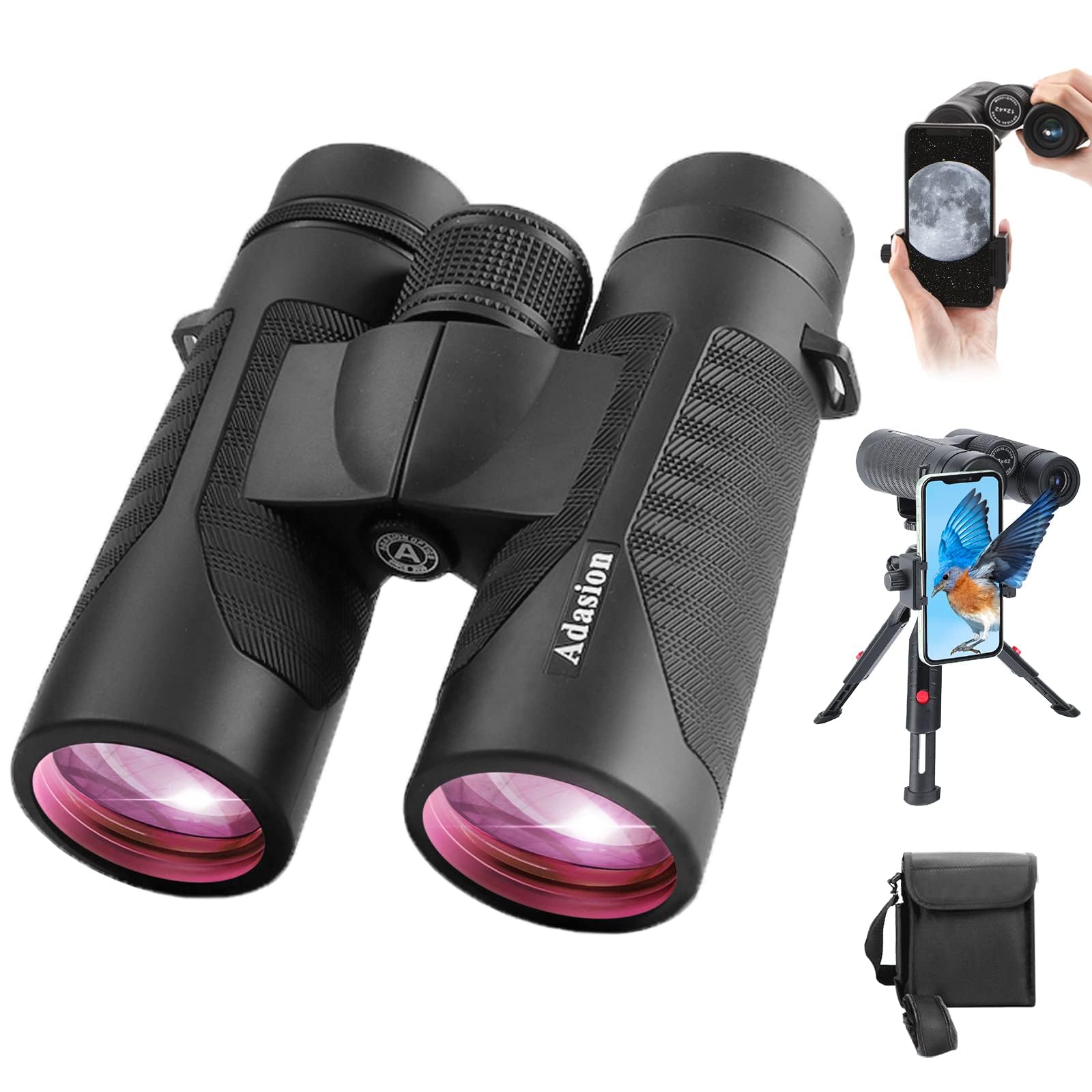
3. 12×42 Binoculars for Adults High Powered with Phone Adapter & Tripod
The all-in-one kit for the fan who wants sharp views, photos, and a steady mount.
The Adasion is the rare sports binocular that arrives with everything you need in the box: the 12×42 binocular, a universal phone adapter, and a small extendable tripod with a 360° swivel. That makes it the easiest way to film the action hands-free, and the 2026-style upgraded phone adapter fits all smartphones. The 42mm objective lens with BAK4 prisms and fully multi-coated lenses keeps colors accurate and edges clear even as the light fades.
At only 1.25 lbs and with a 367/1000yds field of view, it is light enough to hold for long stretches and wide enough to track a ball across the field. The field of view here is actually broader than the 5.8-degree figure on the 12×50 IBQ above, which makes it easier to follow fast-moving play without losing it. Twist-up eyecups let you adjust for glasses, with an eye relief range of 13.6mm to 19.6mm.
Owners are clear that the binocular itself is the star, describing it as solid, sharp, and easy to focus, and the included bag has a handy phone pocket. The part that draws the occasional grumble is the phone attachment — some find it fiddly to keep aligned, and the tiny tripod can shake if you try to pan video. Treat the bundle as a great starting point rather than pro video gear.
Best for the money: the beginner or day-tripper who wants optics plus a mount plus phone compatibility in one box.
Keep it in perspective: the accessories are handy, not heirloom-grade; the binocular is the real keeper here.
4. Bushnell Spectator Sport Binoculars – 12×50 with PermaFocus Technology
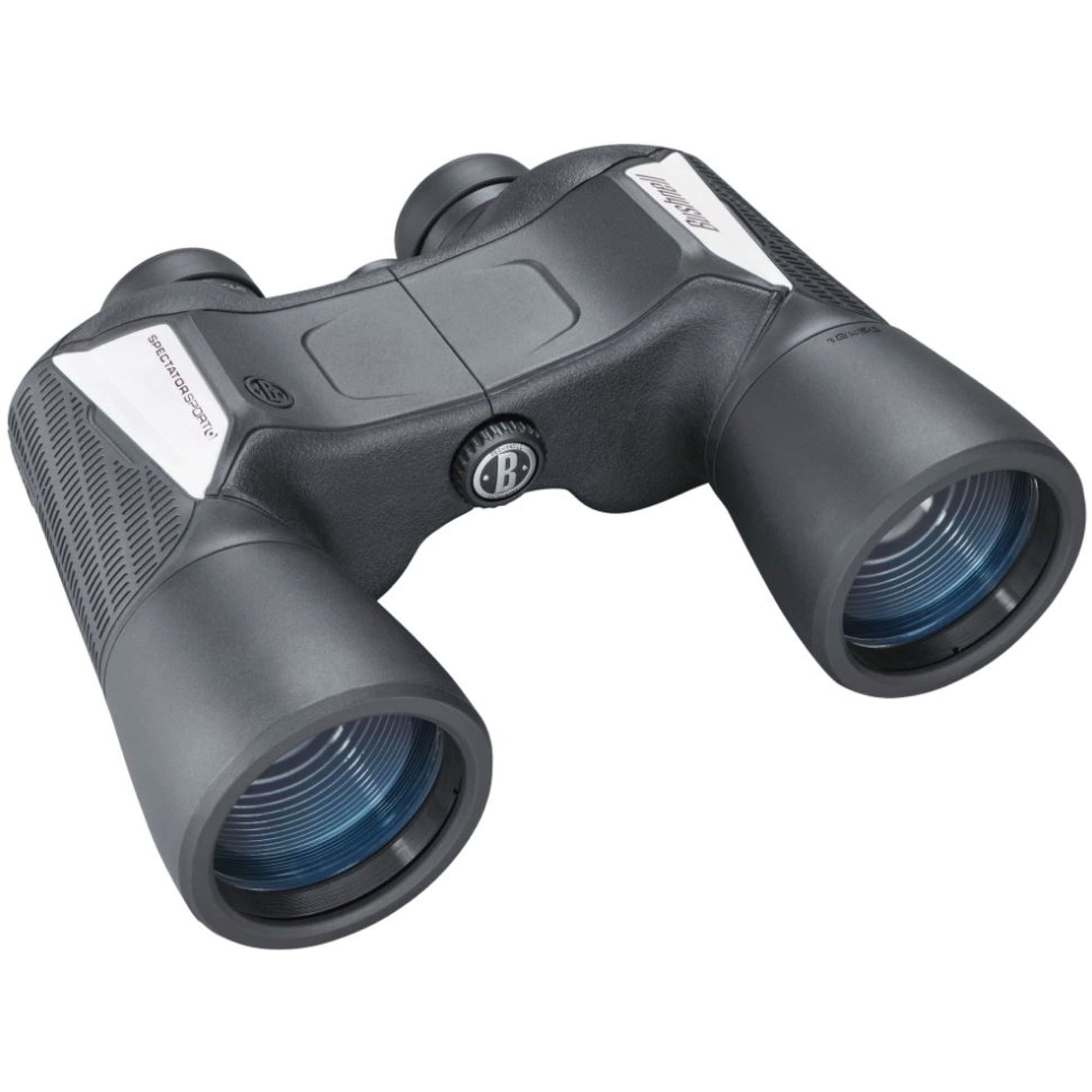
The pass-it-around pair that never needs a focus wheel.
The whole point of the Spectator Sport is simplicity: PermaFocus technology means you never touch a focusing wheel, because the binocular keeps players sharp as they move. That is the defining feature for a live game, where the action shifts from the 50-yard line to the end zone in seconds and you do not want to be fiddling with a dial. It is also the perfect pair to hand to a friend or a kid, since it is always in focus and ready.
The 12×50 combination gives you serious reach into a big stadium, with 273 feet of field of view at distance so you can still find the ball. Multi-coated optics boost light transmission for a brighter image, and it is waterproof and fog-proof for drizzly kickoffs. The aluminum chassis keeps it light enough to carry all day, and a set of interchangeable color tiles — blue, red, black, and white — lets you rep it for your team.
Fixed-focus optics can’t fine-tune like a manual wheel, so edge sharpness gets mixed feedback. Some owners love the grab-and-go ease; others wish it were sharper at the edges. Owners who pass it around at the game rave about never having to refocus, while perfectionists who want to dial in a precise image at very close range might hit its limit.
Why it shines: the purest no-fuss sports binocular you can buy — pick it up, look, done.
Who might hesitate: anyone who wants manual focus control for close-up or fine detail work.
5. Bushnell Engage X 10x42mm Binoculars

The rugged 10×42 with long eye relief for glasses wearers and tough weather.
The Engage X leads with Bushnell’s EXO Barrier, a permanent outer-lens coating that repels water, oil, fog, dust, and debris on contact, so your view stays clear when a mist rolls in or sweat hits the glass. That coating sits on top of all-glass, fully multi-coated lenses, and the result — according to owners — is the standout trait: image quality is the #1 praise, with quality itself close behind. It is a pair that hunters and birders both swear by for its clarity.
At 18mm, the eye relief here is generous, so eyeglass wearers get the full view without pressing the lens into their frames, and twist-up eyecups make the fit easy either way. The whole body is IPX7 waterproof, so it will not fog up in the moments that matter, and it weighs only 2 lbs. The 10×42 format is also a steadier handheld choice than a 12x for long stretches of viewing.
Weight draws mixed reactions: some call it lightweight, others find it heavy for bag access. A couple of reviewers also note the focus is a touch stiff. If you want a go-anywhere mid-range pair with excellent glass and a comfortable fit for specs, this one delivers.
Strongest suit: superb all-weather clarity with a glass-first design that owners genuinely love.
Fit note: if you pack ultra-light, test the 2 lb weight first; if you wear glasses, the extra eye relief is a real win.
6. NIKON Monarch M5 Binoculars, 8×42
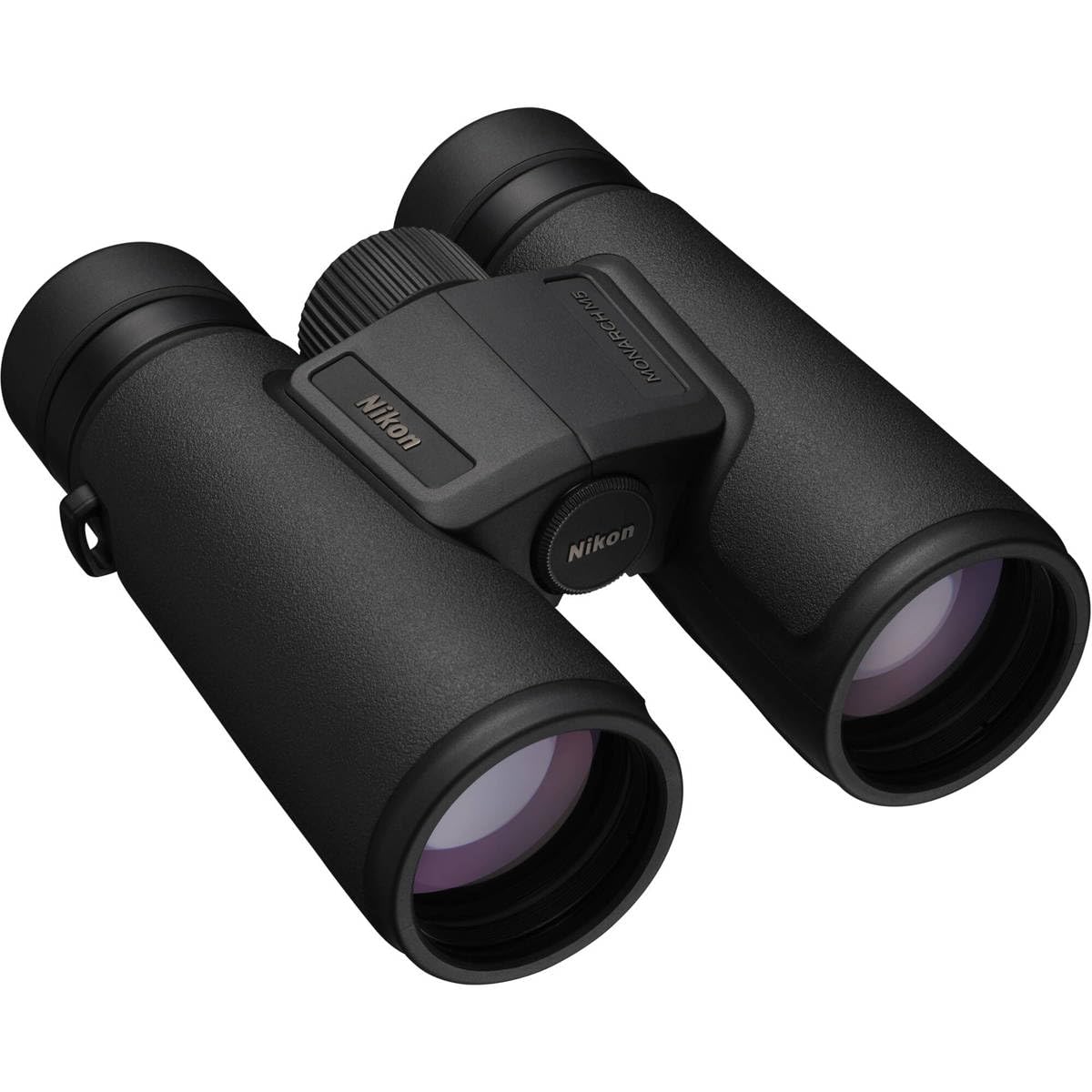
The 8×42 that goes bright where other binoculars go dark.
The Monarch M5 is built around Extra-low Dispersion (ED) glass, which cuts chromatic aberration — the purple fringing that shows up on high-contrast edges — for true-to-life colors. Pair that with dielectric high-reflective prism coatings, and you get the brightness that owners rave about at dawn, dusk, and in shaded forests. Optical quality is the #1 thing people single out, and the low-light performance is what makes it a favorite for late games and twilight viewing.
You get the steadiest handheld image in this lineup with the 8×42 format: the 8x magnification keeps the view calm in your hands, while the 42mm objective lens (the front lens that gathers light) and a large 5.3mm exit pupil (the bright circle you see) pull in plenty of light. The 19.5mm eye relief is the longest here, so it is exceptionally comfortable if you wear eyeglasses. You can focus as close as 8.2 feet, which helps when you want to spot details up close, and the large center knob makes adjustment smooth.
Owners note one quibble: the field of view is on the narrower side, so tracking an extremely fast-moving ball takes a touch more scanning. The body is nitrogen-purged and waterproof, with a rubber-armored grip that feels secure, and the lead- and arsenic-free eco-glass is a thoughtful bonus. It is a premium-tier pick that earns its keep on pure optical quality.
The takeaway: buy this for the brightest, most color-accurate view in low light, with class-leading eye relief.
One thing to know: that gorgeous brightness comes with a narrower field of view, so it favors precision over panoramic scanning.
7. Steiner Military-Marine 7x50mm Binoculars

The tank-like 7×50 that stays sharp from 20 yards to infinity, no refocusing.
The Steiner Military-Marine is a legend for a reason. Its Sports-Auto-Focus system works like this: you calibrate each eyepiece to your own vision once, and from then on the image stays razor-sharp from 20 yards to infinity with no focus wheel. That is a genuine advantage at a live event where targets keep moving — you raise it, you see it, done. The 7x magnification is deliberately low to keep the image steady even when your hands shake or you are viewing from a moving boat.
Inside, a floating prism system mounts the glass on a flexible silicone base that absorbs heavy impact without losing alignment, so your view stays zeroed after a drop. The 50mm objective lenses and a massive 7.1mm exit pupil pull in maximum light, making it superb in deep timber, fog, and at dawn or dusk. The polycarbonate chassis is built to withstand 11 Gs of impact, wrapped in NBR rubber that stays grippy and noise-dampening.
Owners are split only on size: some love the wide 7×50 build, others find it bulky. Some call the 387-foot field of view and 7×50 build perfect for astronomy and steady viewing, while others find the body too bulky for a hike. The recurring positives — German-made optics, clarity edge-to-edge, and that true auto-focus — far outweigh the heft for most. It is a premium-tier pair backed by a lifetime “No Questions Asked” warranty.
Who it suits: fans who prize a steady, wide, ultra-bright view and never want to touch a focus dial again.
Consider this: the rugged build and 7×50 glass make it heavier, so it is a car, boat, or sideline companion more than a neck-strap hiker.
8. ZEISS Terra ED Binoculars 10×42
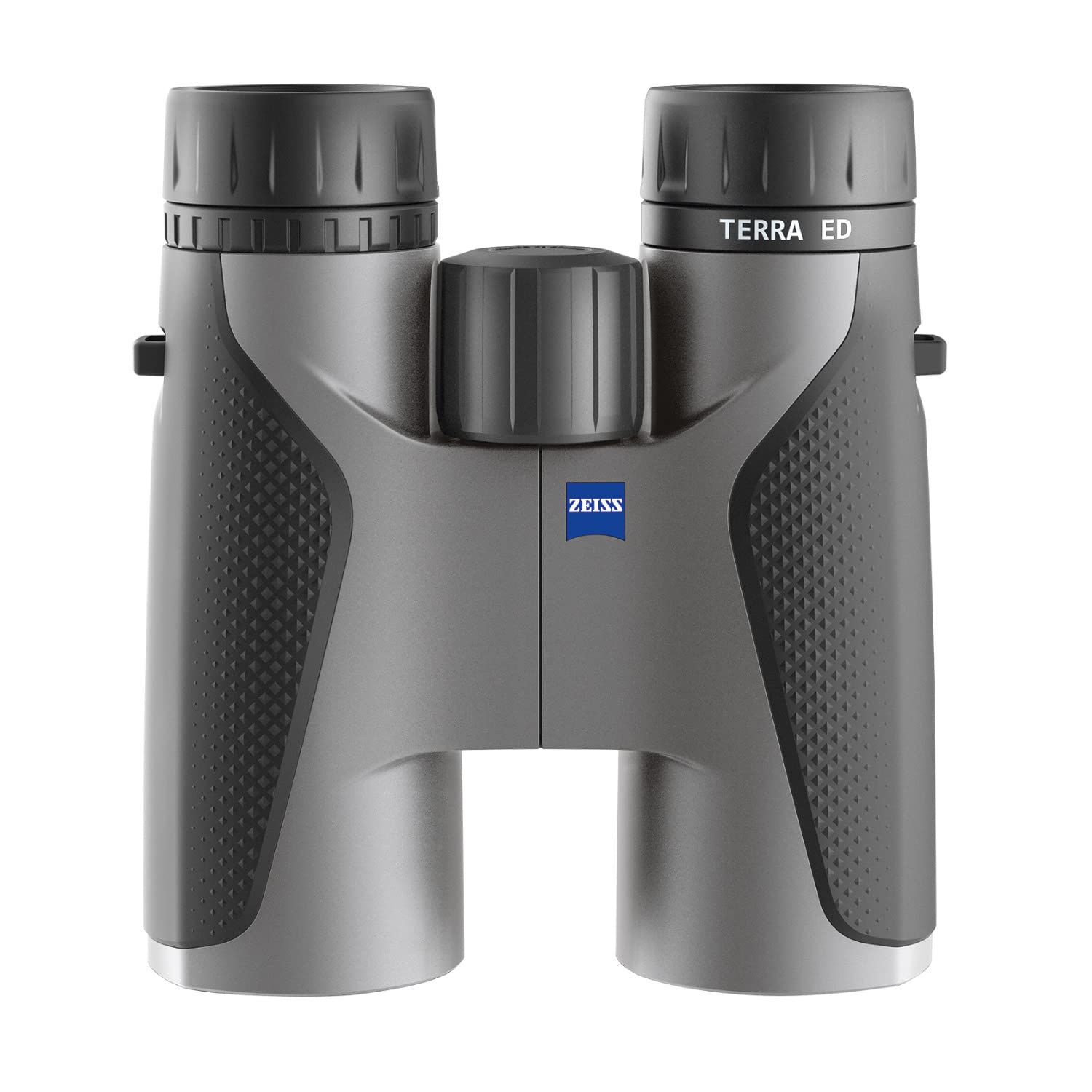
The ZEISS 10×42 that snaps focus the instant the play starts.
The ZEISS Terra ED is engineered around one thing for sports: speed. Its large, easy-to-grip focus wheel sits exactly where your index finger naturally falls, and it turns fast — so when a receiver suddenly breaks open, you are on him before the throw. Owners consistently praise the fast focusing and the clarity, which is the #1 aspect people mention, alongside strong optical quality. The 10x magnification gives a reach that suits most stadium seats without the shake of a 12x.
The image stays brilliant and high-contrast even in twilight or rain, because the glass transmits 88% of available light, using Schmidt-Pechan ED glass (a prism design with extra-low dispersion glass) and a hydrophobic multi-coating that repels water. ZEISS’s anti-reflective coating keeps stray glare out of your view, and the fiberglass-reinforced casing is waterproof and rugged enough to toss in any bag. At an apparent field of view of 60 degrees, it feels wide and rich when you scan the field.
It is the lightest-feeling premium pair here, and the 18mm eye relief keeps it glasses-friendly. Owners call it a great mid-level upgrade that brings real ZEISS quality without the flagship price, and the included hard case and harness strap add to the value. The price tier is the main hesitation, but the legendary glass and lightning-fast focus justify it for serious fans.
Bottom line: pick this for its instant focus and 88% light transmission — a professional feel at a mid-premium price.
Worth noting: it competes with the Engage X on reach and eye relief, but the ZEISS name and focus speed are the real differentiators.
9. Canon 12×36 Image Stabilization III Binoculars

The 12x pair that holds steady like a tripod, even in your hands.
The Canon 12×36 III solves the biggest problem with high magnification: shake. Its Image Stabilization system, borrowed from Canon EF lens technology, actively cancels out hand tremor so the view stays steady — owners describe it as “steady like viewing off a tripod.” That makes it the standout choice for anyone who wants 12x reach but cannot hold a 12x pair still. Stability is the #1 thing people praise, with optics right behind.
Inside, Porro II prisms and a doublet field-flattener deliver sharp, virtually distortion-free images from edge to edge, so you can read a jersey number at 12x without wobble. The 36mm objective lens and 14.5mm eye relief keep it compact and comfortable, even for glasses wearers. It is also lightweight for a stabilized pair, which is exactly what you want when holding it up for the entire game.
Stabilization runs only while you hold the button, which some find tiring, and the eyepiece caps aren’t tethered. But the trade-off is obvious: at 12x with stabilization, you see fine detail — a bird’s leg, an airline logo, a player’s face — that ordinary handheld binoculars simply cannot hold still enough to reveal. For sports where the action never stops moving, this is the most forgiving pair on the list.
Perfect for: fans who want tripod-steady 12x viewing without carrying a tripod.
The catch: you hold the stabilizer button to keep it active, so it rewards short, deliberate looks over constant scanning.
Understanding the Specs
Magnification and Objective Lens
The first number in a pair like “10×42” is magnification — how many times closer the subject appears. The second is the objective lens diameter in millimeters, which controls how much light enters. A bigger lens means a brighter image, which matters in late-afternoon games, but it also adds weight and size. For sports, 8x to 12x covers most needs; anything higher gets hard to hold steady without stabilization.
Eye Relief and Exit Pupil
Eye relief is the distance from the lens to your eye where you still see the full image. A larger number, around 15mm or more, lets glasses wearers see everything without pressing glasses into the eyecup. Exit pupil is the objective lens diameter divided by magnification — it tells you how bright the view will be in low light. A higher exit pupil, like 5mm or more, gives a brighter image at dusk.
FAQ
What magnification is best for watching sports?
Can I use binoculars while wearing glasses?
What does a fixed-focus binocular mean for sports?
Is image stabilization worth it for sports binoculars?
How do I know if binoculars will be bright in low light?
What is the difference between 10×42 and 12×50 binoculars?
Do I need waterproof binoculars for outdoor sports?
Can I take photos through sports binoculars?
Final Thoughts: The Verdict
If you want one dependable pick, the binoculars for sports winner is the Vortex Fury HD 5000 because it combines superb 10×42 glass with a built-in laser rangefinder, covering both viewing and distance-measuring in one rugged package. If you want budget-friendly 12x reach with bright 50mm glass, grab the IBQ 12×50. And for stadium simplicity where you never touch a focus wheel, the Bushnell Spectator Sport is the one to reach for. The crowd favorite across all picks is the Adasion 12×42, a 4.6-rated pair with thousands of happy owners, if you want proven value with a phone adapter and tripod thrown in.
How We Picked
We do not accept paid placement. Every pick is matched to a real buyer and a real use-case; we do not hands-on test units.
Sources & Methodology
Specifications: manufacturer listings and product documentation. Review insights: verified customer reviews, as of July 2026. Pricing: not shown on this page (it changes often); check the current price via the retailer link.
As an Amazon Associate, Gadgets Feed earns from qualifying purchases. This does not affect which products we feature.