
Holding a pair of 10x50s under a moonless sky reveals the Milky Way as a granular river of unresolved suns, but the wrong exit pupil turns that river into a dim, washed-out trickle. The gap between a decent terrestrial binocular and a genuine stargazing instrument comes down to light transmission, collimation, and how well the prism geometry matches your eyes’ dilation in the dark.
I’m Min — the co-founder and writer behind Gadgets Feed. I’ve spent countless hours comparing aperture diameters, exit pupil math, and glass coatings across the mid-range and premium binocular market to isolate the pairs that actually resolve faint deep-sky objects rather than just looking expensive on a shelf.
After sorting through dozens of optical reviews and user field reports, the Celestron SkyMaster 12×60 earns its spot in the conversation around the best binoculars for stargazing because its 60mm aperture and BaK-4 prisms deliver a bright enough image of the Orion Nebula to make out structural detail without immediately forcing you to buy a tripod.
How To Choose The Best Binoculars For Stargazing
Stargazing binoculars live and die by light-gathering capability, which is governed by aperture (objective lens diameter) and exit pupil size. A 10×50 model produces a 5mm exit pupil, matching the average adult pupil’s dilation in darkness; larger apertures at moderate magnifications keep that beam fat enough to see faint nebulae. Coatings matter as well — multi-coated or fully multi-coated optics suppress glare and boost contrast on dim targets like the Andromeda Galaxy.
Aperture and Exit Pupil
The objective lens diameter (50mm, 60mm, 70mm, 80mm, or 100mm) directly determines how much light enters the system. Divide that diameter by the magnification to get the exit pupil — the beam of light that reaches your eye. A 7×50 pair gives a 7.1mm exit pupil, ideal for fully dark-adapted eyes, while a 20×80 yields 4mm, better for older eyes that don’t dilate as wide. For serious deep-sky work, aim for an exit pupil no smaller than 4mm.
Prism Type and Glass Quality
BaK-4 glass has a higher refractive index than BK-7, translating to a rounder, brighter exit pupil and sharper edge-to-edge clarity on stars. Porro prisms (the classic offset-barrel shape) generally offer better depth perception and light transmission than roof prisms at the same price point, which matters when you’re scanning rich star fields near the Milky Way core.
Quick Comparison
On smaller screens, swipe sideways to see the full table.
| Model | Category | Best For | Key Spec | Amazon |
|---|---|---|---|---|
| Pentax Jupiter 10×50 | Mid-Range | Budget stargazing entry point | 50mm aperture, 5mm exit pupil | Amazon |
| Bushnell Legacy WP 10×50 | Mid-Range | Waterproof/fogproof all-rounder | BaK-4 prisms, 5mm exit pupil | Amazon |
| Celestron SkyMaster 12×60 | Mid-Range | Wide-field handheld astronomy | 60mm aperture, 5mm exit pupil | Amazon |
| Celestron SkyMaster 15×70 | Mid-Range | Tripod-based deep-sky scanning | 70mm aperture, 4.67mm exit pupil | Amazon |
| Celestron SkyMaster Pro ED 7×50 | Premium | Wide-field with ED glass | ED glass, XLT coatings, 7.1mm exit pupil | Amazon |
| Celestron SkyMaster Pro ED 20×80 | Premium | High-power deep-sky detail | ED glass, 80mm aperture, 4mm exit pupil | Amazon |
| Celestron SkyMaster 25×100 | Premium | Giant aperture deep-space | 100mm aperture, 4mm exit pupil | Amazon |
In‑Depth Reviews
1. Celestron SkyMaster 12×60

The 12×60 configuration splits the difference between reach and steadiness — you get a 5mm exit pupil that matches dark-adapted pupils while the extra 10mm of aperture over a standard 50mm pulls in enough light to reveal Jupiter’s Galilean moons and the oval silhouette of Saturn. Users consistently report crisp pinpoint stars across a wide field of view, with the BaK-4 prisms keeping the edges sharp during Milky Way scans.
Handheld use is possible but the 2.4-pound weight introduces shake at 12x, making a basic photo tripod a worthwhile investment for long sessions. The rubber-armored body resists light rain, and the included carrying case and neck strap are functional if not luxurious. The focus wheel turns smoothly with enough resistance to avoid accidental drift during cold nights.
Where the SkyMaster 12×60 truly earns its place is in value math: the 60mm objective delivers noticeably brighter views than 10×50 models at a similar price, while the 12x magnification resolves detail that justifies the step up from entry-level binoculars. The lack of a tripod adapter in the box is the only notable omission for a unit this capable.
Why it’s great
- Wide 5.3-degree field of view reveals large nebulae and star clusters
- BaK-4 prisms and multi-coated optics produce bright, contrasty images
- Comfortable center focus mechanism with smooth adjustment
Good to know
- Neck strap is thin and better replaced with a wider padded strap
- Tripod adapter sold separately — budget for one if you plan long sessions
2. Bushnell Legacy WP 10×50

The Bushnell Legacy WP 10×50 delivers fully multi-coated optics and BaK-4 prisms in a nitrogen-purged, rubber-armored body that laughs off dew and light rain. Stargazers have consistently reported that this pair resolves the Orion Nebula, the Pleiades, and even the Andromeda Galaxy with impressive clarity, producing images that rival binoculars costing significantly more.
The 5mm exit pupil is ideal for all-night observing sessions, and the 18mm of eye relief gives eyeglass wearers enough clearance to take in the full field of view. The twist-up eyecups lock into place firmly, and the center focus wheel is damped well enough to hold position during temperature drops. The 341-foot field of view at 1,000 yards is generous for scanning the summer Milky Way.
Weight is the primary trade-off — these binoculars are noticeably heavier than compact 10×42 birding models, though the rubber armor provides a solid grip that compensates during handheld sessions. The included case is basic but functional, and the limited lifetime warranty adds a layer of long-term confidence that most entry-level units lack.
Why it’s great
- Fully multi-coated optics maximize light transmission for dim targets
- 100% waterproof and fogproof — no risk of internal condensation on dewy nights
- 18mm eye relief accommodates eyeglass wearers comfortably
Good to know
- Heavier than some 10×50 competitors at just over 2 pounds
- Lens caps and strap are functional but not premium in feel
3. Celestron SkyMaster Pro ED 7×50
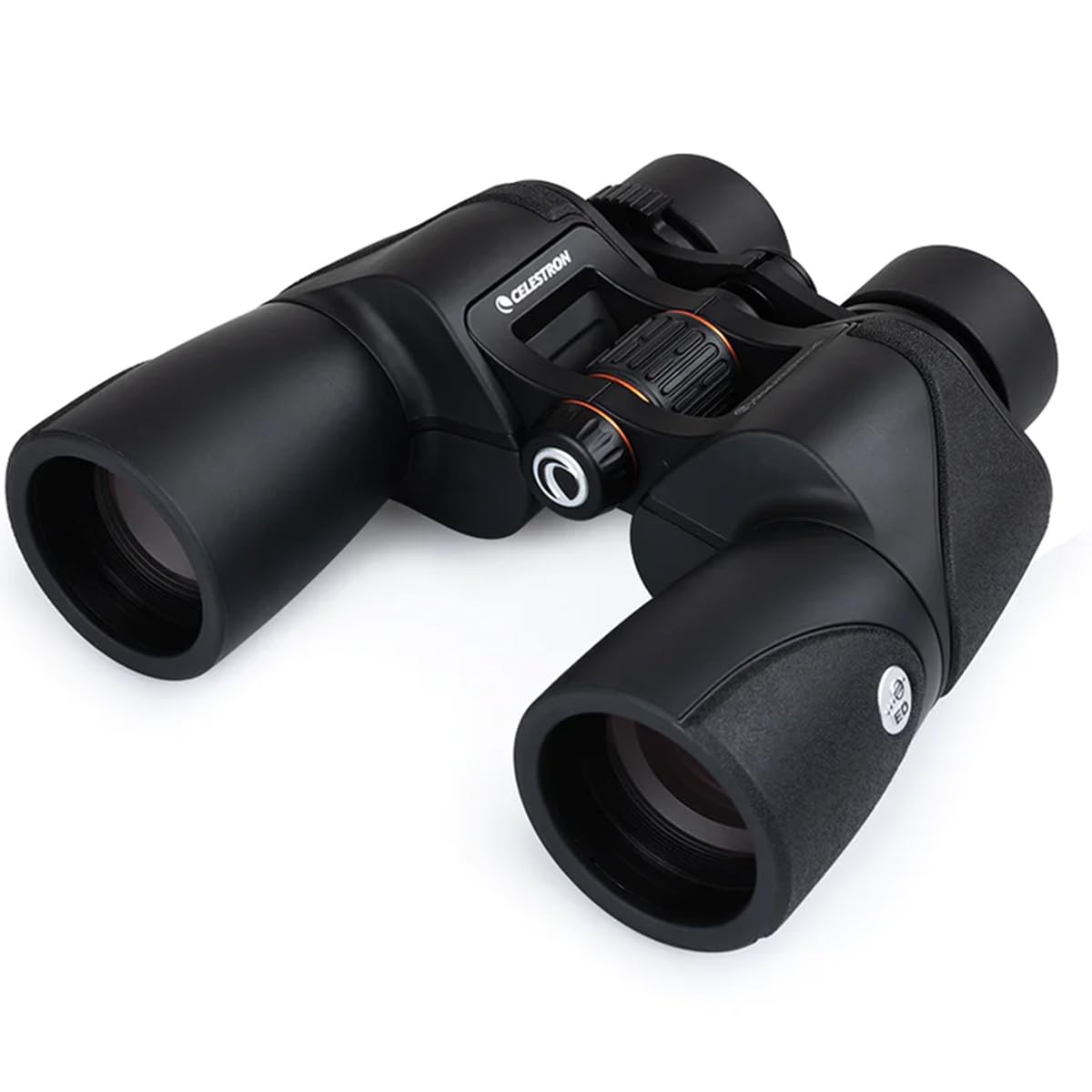
The SkyMaster Pro ED 7×50 uses Extra-Low Dispersion (ED) glass to virtually eliminate chromatic aberration — the purple fringing that plagues most binoculars around bright stars and the lunar terminator. Combined with Celestron’s proprietary XLT coatings (the same multi-layer anti-reflective coatings used on their Schmidt-Cassegrain telescopes), this pair delivers an ink-black sky background with stars that snap into focus as sharp, colorless pinpoints.
The 7.1mm exit pupil is the largest on this list, making it the best match for observers in truly dark skies whose pupils dilate fully. The 409-foot field of view at 1,000 yards is wide enough to capture the entirety of the Pleiades cluster or the Double Cluster in Perseus within a single field. The individual eyepiece focus system requires initial calibration but stays locked once set, eliminating drift from center-focus mechanisms during long sessions.
The aluminum housing feels substantially more rigid than polycarbonate alternatives, and the waterproof, nitrogen-purged construction means no fogging even during humid summer nights. Some users find the eyecups oversized, but the 20.8mm of eye relief provides enough working distance to adjust viewing position. This is a purpose-built astronomy instrument that prioritizes optical fidelity over casual versatility.
Why it’s great
- ED glass eliminates chromatic aberration for true-color star views
- XLT coatings maximize light throughput beyond standard multi-coatings
- 7.1mm exit pupil matches fully dark-adapted pupils for maximum brightness
Good to know
- Individual focus system is slower to adjust between different users
- Eyecup size may feel awkward for some face shapes
4. Celestron SkyMaster Pro ED 20×80
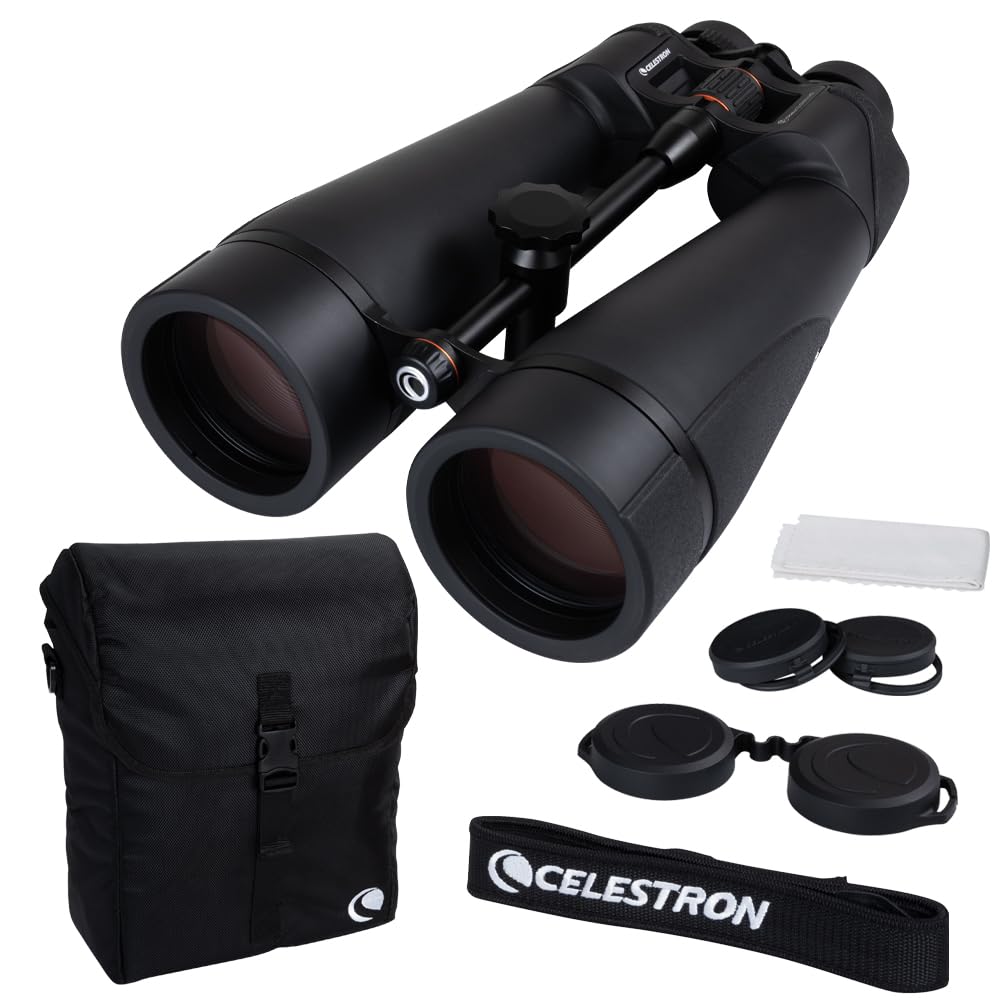
The 20×80 Pro ED is a tripod-only instrument that rewards steady mounting with breathtaking views of globular clusters, planetary nebulae, and the richly detailed tapestry of the Milky Way. The 80mm aperture gathers over 2.5 times the light of a standard 50mm binocular, while the ED glass keeps color fringing to an absolute minimum even on bright targets like Jupiter.
The 4mm exit pupil is well-suited for older eyes or observers in moderately light-polluted skies where the pupil can’t dilate beyond 4-5mm anyway. The multi-coated XLT optics produce an exceptionally clean image with minimal internal reflections, and the center focus wheel is large enough to operate with gloves on cold nights. The tripod adapter is included, and the ¼-inch-20 thread mount standard on most photo tripods works without issue.
At over 5 pounds, this is not a binocular you carry casually — the included padded case is necessary for transport, and a fluid pan head tripod is strongly recommended over a basic ball head for smooth sky tracking. Some users report that the eyecups feel oversized, similar to the 7×50 Pro ED, but the generous eye relief provides flexibility in positioning.
Why it’s great
- ED glass and XLT coatings deliver zero chromatic aberration at 20x
- 80mm aperture reveals faint deep-sky objects invisible in smaller binoculars
- Large focus wheel with smooth dampening for precise adjustments
Good to know
- Requires a sturdy tripod — unsuitable for handheld use
- Eyecup design may not fit all face shapes comfortably
5. Celestron SkyMaster Giant 15×70

The SkyMaster 15×70 bundles a classic giant-aperture binocular with a basic smartphone adapter, letting you capture moon shots and star cluster images directly through the eyepiece without a separate camera rig. The 70mm objective and 4.67mm exit pupil provide substantial light-gathering capacity for deep-sky objects, revealing the Andromeda Galaxy’s core and the Orion Nebula’s bright inner regions with ease.
The multi-coated optics and BaK-4 prisms produce a view that is noticeably brighter than handheld 10×50 units, though the 15x magnification makes steady handheld observation difficult — a tripod is recommended for anything beyond a quick glance. The included carrying case and tripod adapter make setup straightforward, and the smartphone adapter clamps securely enough for casual astrophotography.
The accessory quality does not match the binocular itself — the smartphone adapter is functional but plasticky, and the neck strap is thin. For the price, you’re getting the optical performance of a dedicated astronomy binocular plus the convenience of digiscoping, making this a compelling option for beginners who want to share their views without investing in a full imaging setup.
Why it’s great
- 70mm aperture gathers enough light for reliable deep-sky observation
- Smartphone adapter included for easy digiscoping of the moon and bright clusters
- Tripod adapter and case included for immediate tripod mounting
Good to know
- Accessories (phone adapter, strap) feel lower quality than the optics
- Heavy unit — tripod is nearly mandatory for comfortable use
6. Pentax Jupiter 10×50

The Pentax Jupiter 10×50 offers a no-fuss entry point into astronomical binoculars with its large 50mm aperture and classic Porro prism design that provides excellent depth perception. The multi-coated optics reduce reflections and keep the image bright enough to resolve the moon’s major craters, the Pleiades, and the brighter deep-sky objects visible from suburban skies.
The rubber-coated exterior provides a secure grip even with cold or gloved hands, and the center focus wheel is positioned for quick access during scanning sessions. The 5mm exit pupil is right in the sweet spot for general astronomy use, and the 13mm of eye relief is adequate for most users, though eyeglass wearers may need to experiment with positioning to see the full field.
The optional TP-3 tripod adapter adds flexibility for long-duration viewing, but the binocular is light enough for handheld use when observing bright targets. Build quality feels robust for the price tier, with solid hinge tension and a focus mechanism that holds alignment well. While the relative brightness of 25 is lower than higher-end units, it represents genuine value for someone testing the astronomy waters without a large commitment.
Why it’s great
- Lightweight enough for extended handheld scanning sessions
- Multi-coated optics and Porro prism design deliver bright, clear images
- Rubber armoring provides secure grip in damp conditions
Good to know
- 13mm eye relief is tight for users who wear glasses
- Tripod adapter sold separately for tripod mounting
7. Celestron SkyMaster 25×100
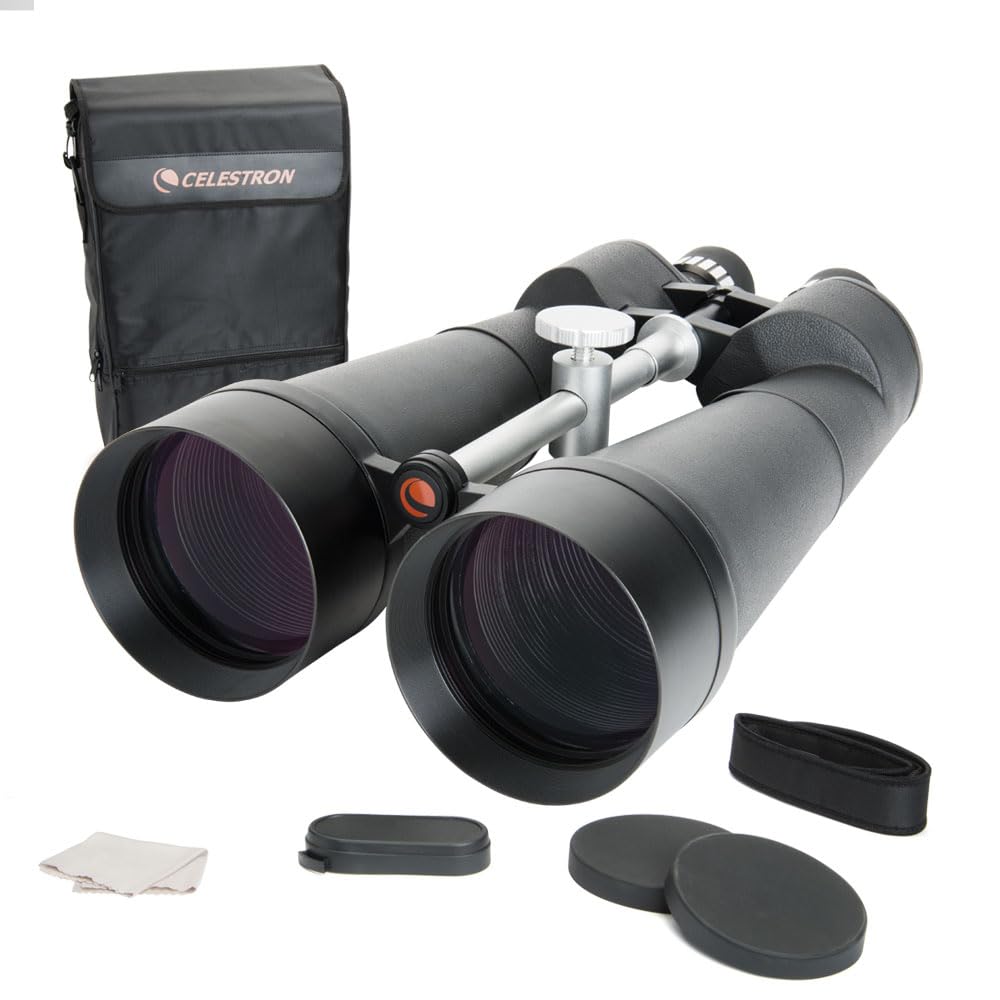
The SkyMaster 25×100 is the largest binocular on this list, with 100mm objective lenses that capture over four times the light of a 50mm unit. This aperture class transforms deep-sky observing — globular clusters resolve into fields of individual stars, and the brighter galaxies appear as distinct, textured forms rather than faint smudges. The BaK-4 prisms ensure that every photon makes it to your eye with minimal internal scatter.
The individual eyepiece focus system holds calibration once set, and the built-in ¼-inch-20 adapter attaches to standard tripod plates without additional hardware. The water-resistant rubber armor adds a degree of weather protection, though the scale of this instrument means it stays inside or on a deck rather than in a pack on the trail.
At over 9 pounds, this is the farthest thing from a grab-and-go binocular. Users consistently report that the views of the Milky Way are transformative, revealing detail that telescopes in the same price range cannot match due to their narrower fields of view. The included case functions adequately for storage, though the lens covers and strap feel like afterthoughts relative to the optical quality of the main unit.
Why it’s great
- 100mm aperture reveals faint galaxies and globular clusters in stunning detail
- BaK-4 prisms maximize light throughput for bright, high-contrast images
- Individual focus system holds calibration for long observing sessions
Good to know
- Requires a heavy-duty tripod — adds significant setup time and cost
- Very heavy — not suitable for portable or handheld use of any kind
FAQ
What magnification is best for stargazing binoculars?
Can I use regular binoculars for astronomy?
Do I need a tripod for astronomy binoculars?
Final Thoughts: The Verdict
For most users, the best binoculars for stargazing winner is the Celestron SkyMaster 12×60 because its 60mm aperture and 12x magnification strike the ideal balance between light-gathering power and handheld usability, delivering bright, sharp views of the moon, planets, and deep-sky objects without immediately requiring a tripod investment. If you want waterproof durability and superior contrast in a 10×50 format, grab the Bushnell Legacy WP 10×50. And for serious deep-sky observing with premium ED glass, nothing beats the Celestron SkyMaster Pro ED 20×80 for pulling galaxies and globular clusters out of the void.