
Our readers keep the lights on and my morning glass full of iced black tea. As an Amazon Associate, I earn from qualifying purchases.
Specs are compiled from manufacturer listings and verified buyer reviews and can change over time — please confirm the key details on the product page before buying.
The best small binoculars are the ones you actually carry with you — in a jacket pocket, on a daypack, or in the glovebox. But squeezing powerful optics into a palm-sized chassis usually means a trade-off: blurry edges, poor low-light performance, or a flimsy build that falls apart after one hike. This guide cuts through the noise to find compact models that deliver clear, bright views without the weight of full-size binoculars.
I’m Min — the founder and writer behind Gadgets Feed. This guide is built by comparing the manufacturers’ published specifications and the patterns across verified customer reviews, so you get each pick’s real strengths and trade-offs instead of marketing spin.
Whether you are heading to a concert, scanning the treeline on a hunting trip, or spotting whales from a cruise ship deck, the right pair of binoculars small can make the difference between a blurry mess and a memory that stays crisp for years.
Our Picks at a Glance


How To Choose The Best Binoculars Small
Buying a compact binocular is not the same as buying a full-size pair. The smaller package forces trade-offs between wider views and more reach. How much light can you sacrifice before the image goes dark at dusk? Here are the three specs that matter most when the binocular must fit in your hand.
Decode the two numbers: magnification x objective lens
The first number is the magnification power — how many times closer an object appears. A 10x binocular makes a bird at 100 yards look like it is 10 yards away. The second number is the diameter of the objective lens (the big lens at the front) in millimeters. A 25mm lens lets in less light than a 42mm lens, which is why compact binoculars can look dimmer in the early morning or late evening. For most general use with small binoculars, 8x or 10x magnification with a 25mm to 32mm objective lens strikes the right balance between reach and portability.
Exit pupil and eye relief — the fit factors
The exit pupil is the circle of light that reaches your eye, calculated by dividing the objective lens size by the magnification (25mm ÷ 10x = 2.5mm). A larger exit pupil means a brighter image, especially in low light, which is why the 6.5×32 Vortex Bantam HD has a notably bigger exit pupil at 4.92mm than most compact models. Eye relief is the distance your eye can be from the eyepiece while still seeing the full image. If you wear glasses, look for an eye relief of at least 15mm — otherwise you will see a cropped or darkened picture.
Prism type: Porro vs. Roof
Porro prism binoculars (the classic zigzag shape that looks wider at the objective end) generally offer better image quality for the price in compact sizes. Roof prism binoculars are straighter and more streamlined but cost more to build to the same optical standard. In this guide, the Leupold BX-1 Rogue uses an inverted Porro prism design that keeps the body tiny without sacrificing clarity — a smart engineering trade-off for a small binocular.
Quick Comparison
| Model | Best For | Magnification | Exit Pupil | Eye Relief | Amazon |
|---|---|---|---|---|---|
| Leupold BX-1 Rogue 10×25★ Best Overall | All-round clarity & build | 10x | 2.5mm | 15mm | Amazon |
| Vortex Vanquish 10×26Premium Compact | Premium portability | 10x | 2.6mm | 16mm | Amazon |
| Vortex Bantam HD 6.5×32 | Youth & low-light use | 6.5x | 4.92mm | 18.7mm | Amazon |
| ZEISS Terra ED 8×25 | Premium optics in a pocket | 8x | 3.1mm | 16mm | Amazon |
| OPAITA 20×32 | Maximum reach on a budget | 20x | 1.6mm | 13mm | Amazon |
| OCCER 15×30 | Compact sport & travel value | 15x | 2mm | 16mm | Amazon |
| Nikon ACULON T02 10×21 | Ultra-light everyday carry | 10x | 2.63mm | — | Amazon |
In‑Depth Reviews
1. Leupold BX-1 Rogue Binoculars, 10x25mm (59225)
Our pick — over 4.5★ from 750+ verified ratings; the strongest balance of quality and price.
The Leupold BX-1 Rogue proves you can have gorgeous clarity in a pocket-sized binocular.
This is the pair that hunters, hikers, and concert-goers consistently rave about — and for good reason. The 10x25mm inverted Porro prism design keeps the body remarkably compact without the image degradation that plagues cheap roof-prism models. Buyers report that “these are great for the deer stand, you will even be able to see longer at last shooting hours,” and the 5.6-degree field of view is wider than many rivals at this size, giving you a generous slice of the landscape without needing to sweep constantly.
The build quality is where Leupold earns its reputation. A rubber armor coating gives you a confident grip even in rain or cold, and the housing is both waterproof and fogproof — rare for a binocular this small. With an exit pupil of 2.5mm and 15mm of eye relief, it works well for glasses wearers too, though you will notice the image dims a bit earlier at dusk compared to larger-lensed binoculars.
What wins people over
- Exceptional optical clarity — the most-praised feature by far, even against far pricier models.
- Truly compact and lightweight, so you actually bring it along on every hike.
- Rugged waterproof and fogproof construction backed by Leupold’s legendary warranty.
The honest trade-off
- The 2.5mm exit pupil means low-light performance is decent but not outstanding.
- A few owners found the diopter adjustment a bit stiff initially.
Your everyday companion: If you want one small binocular that nails the basics — sharp image, easy carry, serious durability — and you do not need extreme low-light reach, this is the pair to buy.
Not for you if: You primarily glass at dawn or dusk and need every photon of light; look at a larger objective lens instead.
2. Vortex Vanquish Reverse Porro Prism Binoculars, 10×26
One of the smallest, lightest binoculars Vortex makes, with optics that punch well above its size.
The Vanquish takes everything buyers love about Vortex — crisp fully multi-coated lenses, a rock-solid build, and that unlimited VIP warranty — and shrinks it down to a 10×26 package that slips into a pocket. The 2.6mm exit pupil edges out the Leupold by a tiny margin, and the 16mm eye relief is generous enough for most eyeglass wearers. Owners describe the image as “crisp” with no chromatic aberration, and the twist-lock eyecups let you dial in a comfortable view quickly.
What makes the Vanquish stand out in the compact category is the combination of waterproof, fogproof performance and Vortex’s unconditional lifetime warranty. You can drop it in a creek, leave it in a hot car, or pass it down to your kids — Vortex will repair or replace it if anything goes wrong. For the price, the build quality and optical clarity represent a significant step up from the budget-tier competition.
Pocket powerhouse: A near-perfect travel binocular that delivers premium optics, a lifetime warranty, and a weight that disappears in your bag. The only real sacrifice versus a full-size set is low-light brightness — but that is the nature of any compact.
Reach for this if: You want the confidence of a no-questions-asked warranty in a binocular that is genuinely easy to carry every day.
Look elsewhere if: You need a wider field of view for scanning large landscapes quickly; the Vanquish is sharp but not exceptionally wide.
3. Vortex Bantam HD 6.5×32 Youth Binoculars

The 6.5×32 Bantam HD is the small binocular that defies the low-light limits of its class.
At first glance, the 6.5x magnification might seem modest compared to the 10x and 15x options on this list. But that lower magnification combined with a relatively large 32mm objective lens delivers a 4.92mm exit pupil — nearly double that of the 10×25 competition. That means noticeably brighter, steadier images at dawn and dusk, and a much easier view for anyone with shaky hands or younger eyes learning to focus. The 18.7mm eye relief is the longest on this list, making it a fantastic pick for eyeglass wearers.
Vortex designed the Bantam specifically for youth and smaller faces, but owners quickly discovered its wider audience: adults with unsteady hands love the stable image, and backpackers appreciate its light weight and shockproof, rubber-armored build. The HD optical system and XR anti-reflective lens coatings produce edge-to-edge sharpness and rich color that rivals binoculars costing twice as much.
What makes it special
- Massive 4.92mm exit pupil for a small binocular — superior low-light performance.
- Stable 6.5x magnification is ideal for kids, beginners, and anyone prone to hand shake.
- Long 18.7mm eye relief is a blessing for eyeglass wearers.
The honest trade-off
- The 6.5x magnification means less reach than a 10x; not ideal for long-distance birding or hunting.
- A few owners noted the compact body felt slightly small for larger adult hands.
Best for the whole family: If you want a small binocular that works brilliantly for kids, glasses wearers, and low-light scenes while staying affordable, this is your pick.
Not for you if: You need maximum reach for open-country spotting; the 6.5x magnification will leave objects feeling too far.
4. ZEISS Terra ED Pocket Binoculars, 8×25

Zeiss optical pedigree in a package small enough for any jacket pocket.
The Terra ED brings the German brand’s renowned glass technology — SCHOTT ED glass with a hydrophobic multi-coating — to a compact 8×25 format. The result is 88% light transmission and images that owners describe as having “natural color, sharp, bright, good contrast.” The 3.1mm exit pupil is respectable for a 25mm objective, and the 16mm eye relief works for most glasses wearers, though the right-eye diopter is noted as a bit stiff by some users.
What improve the Terra ED above other compacts is the sheer optical refinement. The Zeiss T* coating and LotuTec weather coating combine to give you bright, high-contrast views even in tricky light or rain. The magnesium-alloy body is sturdy yet light, and the fast-focus wheel is intuitively placed — your index finger lands on it naturally every time. Yes, it costs more, but for someone who wants pocket-sized performance that approaches full-size quality, the Terra ED is a serious step up.
Optical luxury: The Terra ED delivers the closest thing to alpha-tier image quality in a palm-sized binocular. The stiff focus wheel is a minor annoyance, and the 3.1mm exit pupil means it is not a true low-light specialist, but for daytime hiking, travel, and sightseeing, the clarity is stunning.
Grab this for: Travelers and nature lovers who want the best possible image from a binocular that fits in a coat pocket and do not mind paying for German optical engineering.
skip it if: You need a waterproof, fogproof binocular with a relaxed focus feel — the Terra ED’s wheel is on the stiffer side.
5. Compact Binoculars for Adults High Powered – OPAITA 20×32

A 20x magnification in a compact body that fits in a coat pocket — ideal for concert seats and cruise ship decks.
The OPAITA 20×32 is for the buyer who wants maximum reach without carrying a full-sized spotting scope. At 20x magnification, you can read a stage performer’s expression or scan distant ridgelines on an Alaskan cruise. Owners say “I used them for a concert and they were lightweight and easy to use with a wonderful outcome.” The 32mm objective lenses gather enough light for daytime use, and the BAK4 prisms and fully multi-coated lenses deliver surprisingly vivid images for the price point.
The trade-off for that high magnification is clear: the exit pupil is only 1.6mm, which means the image gets dim quickly in low light, and the 13mm eye relief is tight for glasses wearers. You also need a steady hand or a brace point at 20x, as any shake is magnified. But for bright-day scenarios — sporting events, whale watching, theater balconies — the OPAITA pulls in details that 8x or 10x compacts simply cannot reach.
What you get for the money
- High 20x magnification that brings far-off details into clear view.
- Compact and lightweight build with included carry bag and strap.
- Solid clarity and color for the price point.
The honest limit
- Very small 1.6mm exit pupil struggles in low light; best for bright conditions.
- 20x magnification shows every hand tremor — use a rest or brace when possible.
- Eyepieces are small, making it tricky for glasses wearers.
Best for well-lit venues: If you sit in the back row at concerts, sports arenas, or on cruise ships and need to see detail far away, this budget-friendly option gets you there.
Not for you if: You glass at dawn or dusk, or you wear glasses and need generous eye relief.
6. 15×30 Binoculars for Adults Kids – OCCER Easy Focus

The OCCER 15×30 offers a long reach in a pocket-friendly package that hides in a coat pocket.
With 15x magnification and a 30mm objective lens, this binocular strikes a middle ground between the moderate 10x options and the extreme 20x OPAITA. The 16mm eye relief is decent for glasses users, and the large 16mm eyepiece makes for a comfortable viewing experience. Owners praise the “easy operates with one hand” focus dial and describe the glass as “super clear” and “bright” even in low light, thanks to the BAK4 prism and FMC broadband coating that achieves 96.48% light transmission.
Where the OCCER differs from the OPAITA is in practical use. Several buyers noted that the magnification seems closer to 8x or 10x than the stated 15x, and that the image is not tack-sharp edge-to-edge. The loose diopter can drift during use, and the included strap is reportedly not great. But at the price, the OCCER delivers a light, compact binocular with good general-purpose performance for hiking, whale watching, and stadium events.
Pocket reach: A good value compact for anyone who wants more reach than 10x without going to the extremes of 20x. The magnification is likely overstated, but the package is light, comfortable in the hand, and bright enough for most daytime adventures.
Grab these if: You want a budget-friendly compact with decent reach and a comfortable grip for family outings, sports, and travel.
Think twice if: You need precise magnification claims or sharp edge-to-edge optics — the OCCER is best as an affordable companion, not a precision instrument.
7. Nikon ACULON T02 Compact Binoculars, 10×21
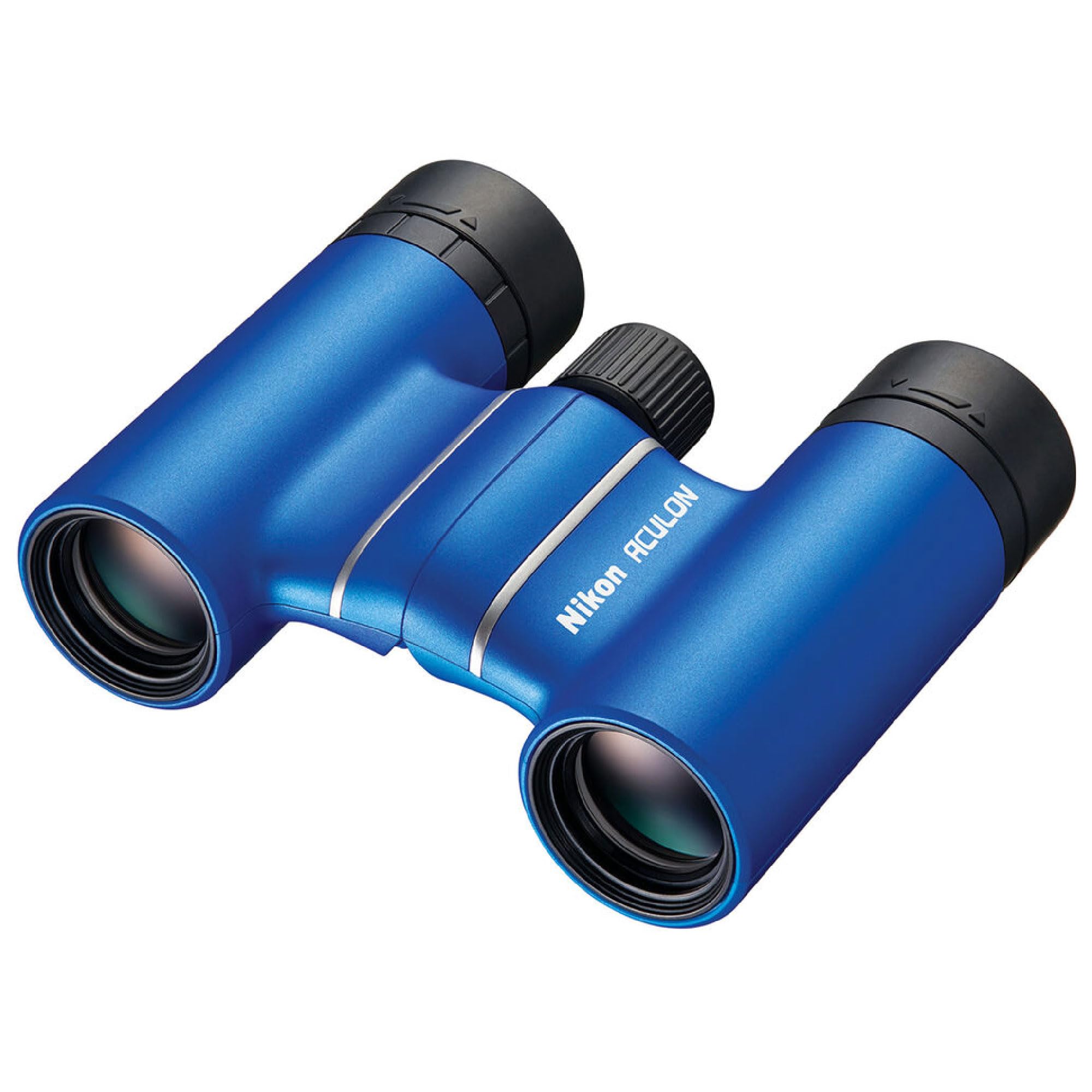
The lightest binocular on this list — under 7 ounces — for quick grabs and bag tosses.
Nikon’s ACULON T02 is engineered for the traveler who values portability above all else. At just 195 grams (under 7 oz), it is the featherweight of this roundup, with a compact foldable design that truly disappears into a backpack or daypack. The fully multicoated lenses and lead- and arsenic-free glass deliver bright, vivid images that owners describe as “sharp” with “good sharpness to the image and good focus knob.” The turn-and-slide rubber eyecups accommodate both glasses and naked-eye users.
The catch is the 21mm objective lens. That tiny front element leaves you with a dimmer image in anything but full daylight, and the individual focus design means you adjust each eyepiece separately rather than using a central focus wheel. Some owners also reported build quality concerns — one mentioned the rubber eyepiece grip twisting off, and the included case and strap feel cheap. For the price, the Nikon delivers iconic brand optics in an ultra-light package, but you are making clear trade-offs in low-light performance and build refinement.
What makes it unique
- Extremely light at under 7 oz — you will forget it is in your bag.
- Nikon’s multicoated lenses deliver good clarity and color for the size.
- Compact folding design fits easily in a small pocket or purse.
The honest trade-off
- The 21mm objective lens means poor low-light performance; best for bright days.
- Build quality and included accessories feel lower-grade than the price suggests.
- Some units arrive with loose parts; quality control is a concern.
Your go-to for: Minimalist travel where every ounce matters — throw them in a daypack for a sunny afternoon hike or a stadium event.
Not for you if: You need a rugged, waterproof binocular or do consistent viewing in low light; look at the bigger objective lens options above.
Understanding the Specs
Magnification (the first number)
This tells you how many times closer the object will appear. A 10x binocular makes a bird 100 yards away look like it is 10 yards away. In small binoculars, higher magnification like 15x or 20x sounds notable, but it also amplifies every hand shake and reduces the brightness of the image. For most casual use — hiking, concerts, sightseeing — 8x to 10x is the balance that balances reach with a steady, bright view.
Objective Lens Diameter (the second number)
The second number (such as 25mm, 30mm, or 32mm) is the size of the front lens in millimeters. A larger objective lens gathers more light, which gives you a brighter image in low-light conditions like dawn, dusk, or cloudy days. In compact binoculars, you usually see 21mm to 32mm. The trade-off is that a bigger lens also means a bigger, heavier binocular — so you are balancing portability against how well the binocular performs when the light gets dim.
Exit Pupil
The exit pupil is the bright circle of light you see when you hold the binoculars at arm’s length. You get it by dividing the objective lens size by the magnification (25mm ÷ 10x = 2.5mm). A larger exit pupil (over 4mm) means the binocular stays bright in low light and is more forgiving if your eyes move slightly off-center. Small binoculars often have exit pupils around 2mm to 3mm, which is fine for daytime but can look dim and cramped at dusk.
Eye Relief
This is the distance in millimeters your eye can be from the eyepiece while still seeing the full image. If you wear eyeglasses, you typically need at least 15mm of eye relief, because your glasses push your eye farther from the lens. Short eye relief (under 13mm) forces you to mash your glasses against the eyepiece or to take them off to see the whole picture.
Field of View
Field of view is the width of the scene you can see at a fixed distance — usually measured in degrees or in feet at 1,000 yards. A wider field of view helps you track moving objects like birds or athletes without having to sweep the binoculars as much. In small binoculars, the field of view tends to be narrower than in full-size models, making it one of the specs worth checking if you plan to use them for wildlife watching or sports.
Prism Type: Porro vs. Roof
Porro prism binoculars have the classic offset shape where the objective lenses are wider apart than the eyepieces. This design is easier and cheaper to manufacture to high optical standards, so you tend to get better image quality for the money. Roof prism binoculars are straighter and more streamlined, but achieving the same clarity costs more. Many of the best compact binoculars use a reverse Porro design that keeps the body narrow while maintaining the optical advantages of the Porro system.
FAQ
What does 10×25 mean on a compact binocular?
Is a higher magnification always better for small binoculars?
Can I use compact binoculars with glasses?
What is the difference between Porro prism and roof prism binoculars?
Are waterproof small binoculars worth the extra cost?
What is a good exit pupil number for a compact binocular?
Will a 10×25 binocular fit in my pocket?
What is field of view and why does it matter?
Final Thoughts: The Verdict
For most people, the binoculars small winner is the Leupold BX-1 Rogue 10×25 because it combines exceptional optical clarity and rugged waterproof build with a truly pocketable size — no other compact at this level matches its all-around performance. If you want the stability and low-light reach of a larger exit pupil for the whole family, grab the Vortex Bantam HD 6.5×32. And for maximum reach without blowing the budget on a concert or cruise trip, the OPAITA 20×32 delivers a surprising view from the back row.
How We Picked
We do not accept paid placement. Every pick is matched to a real buyer and a real use-case; we do not hands-on test units.
Sources & Methodology
Specifications: manufacturer listings and product documentation. Review insights: verified customer reviews, as of July 2026. Pricing: not shown on this page (it changes often); check the current price via the retailer link.
As an Amazon Associate, Gadgets Feed earns from qualifying purchases. This does not affect which products we feature.