
Our readers keep the lights on and my morning glass full of iced black tea. As an Amazon Associate, I earn from qualifying purchases.
Specs are compiled from manufacturer listings and verified buyer reviews and can change over time — please confirm the key details on the product page before buying.
You do not need to spend a fortune to see a warbler’s eye stripe or pick a buck out of the treeline. the balance for binoculars sits below the mid-range ceiling, where fully multi-coated glass (every air-to-glass surface has multiple anti-reflective layers, so more light reaches your eye), nitrogen purging (the inside is filled with dry nitrogen gas so fog cannot form), and a real lifetime warranty all show up together. This guide walks through nine picks that earn their place — from budget workhorses to premium glass that outperforms its price.
I’m Min — the founder and writer behind Gadgets Feed. This guide is built by comparing the manufacturers’ published specifications and the patterns across verified customer reviews, so you get each pick’s real strengths and trade-offs instead of marketing spin.
Every pick here is a genuinely strong option among binoculars under $300.
Our Picks at a Glance


How To Choose The Best Binoculars Under $300
The first number on a binocular box tells you how much closer the image gets. The second number tells you how much light the front glass pulls in. Get those two right for your terrain, and everything else — coatings, prisms, eye relief — is refinement on top of a solid foundation.
Match magnification and objective lens to your terrain
A 10×42 binocular magnifies an image ten times and uses a 42mm front lens to gather light. That pairing is the all-purpose standard for open fields, lakes, and treelines. A 12×50 steps up to twelve times magnification with a 50mm lens, which brings distant ridgelines closer but also amplifies every hand tremor. An 8×42 is steadier in the hand and gives a wider view, which is why it dominates among birders who follow fast-moving subjects through branches.
Understand coatings and prism glass
Fully multi-coated lenses carry anti-reflective treatment on every air-to-glass surface, so more of the light that enters actually reaches your eye instead of bouncing off. That is what makes a dawn hunt or a dusk scan usable. BaK-4 prisms — a barium crown glass — produce a rounder, cleaner exit pupil than cheaper prism glass, which shows up as less distortion at the edges of the view. Phase coating on those prisms boosts contrast further.
Check eye relief before you commit
Eye relief is the distance between the eyepiece lens and your eye where the full image is visible. If you wear glasses, you need enough of it that your lenses do not block the view. Look for twist-up or turn-and-slide eyecups that let you extend or retract the rubber to match your face. A diopter adjustment ring lets you correct for a difference between your two eyes so both barrels focus equally.
Quick Comparison
| Model | Best For | Magnification | Objective Lens | Eye Relief | Amazon |
|---|---|---|---|---|---|
| Vortex Copperhead HD 10×42★ Best Overall | All-around field use | 10x | 42 mm | 17 mm | Amazon |
| Bushnell PowerView 10×42 BoneCollectorCamo Classic | Hunting and camo cover | 10x | 42 mm | 17.5 mm | Amazon |
| Vortex Triumph HD 12×50Long-Reach Pick | Long distance and open country | 12x | 50 mm | 16 mm | Amazon |
| Celestron Outland X 10×50 | Low-light wildlife viewing | 10x | 50 mm | 17.4 mm | Amazon |
| Celestron Nature DX 8×42 | Bird watching and hiking | 8x | 42 mm | 17.5 mm | Amazon |
| Nikon PROSTAFF P3 8×42 | Stable birding and astronomy | 8x | 42 mm | 20.2 mm | Amazon |
| Bushnell Engage X 10×42 | Wet-weather hunting | 10x | 42 mm | 18 mm | Amazon |
| Nikon PROSTAFF P3 10×42 | Birding and stadium viewing | 10x | 42 mm | 15.7 mm | Amazon |
| Leupold BX-1 McKenzie HD 10×42 | Lightweight backcountry carry | 10x | 42 mm | 17 mm | Amazon |
In‑Depth Reviews
1. Vortex Copperhead HD 10×42 Binoculars
Our pick — over 4.5★ from 450+ verified ratings; the strongest balance of quality and price.
The 10×42 that covers woods, water, and open country in one body.
What makes the Copperhead the pick of the group is the combination of an HD optical system with fully multi-coated glass in a body that handles weather without fuss. That HD glass is what keeps colours true and edges sharp across the view, and the fully multi-coated treatment — anti-reflective layers on every air-to-glass surface — pushes more light through to your eye. In plain terms: you see more detail at first light and last light, and the picture stays clean right out to the edges of the frame instead of fuzzing up at the rim.
The 10x magnification and 42mm objective lens is the all-purpose pairing for a reason. It is enough reach to pick out a loon on open water or a buck across a cut field, while the 42mm front glass pulls in enough light to stay useful well past sunset. Field of view comes in at 334 feet, which gives you a wide enough window to follow moving subjects without constantly sweeping the barrel. The 17mm eye relief works comfortably with or without glasses, and the adjustable eyecups plus diopter let you dial in a custom fit for your face.
Build quality is what owners praise most, by a wide margin over every other trait. The rubber armor gives a secure, non-slip grip, and the whole thing is waterproof, fogproof, and shockproof. It is also tripod adaptable and comes with a glasspak harness and a comfort neck strap, so you have two real carry options in the field. You are covered by Vortex’s unlimited, unconditional, lifetime VIP warranty, which transfers to any future owner. The honest catch is that it carries a bit of heft — a couple of owners note the weight, though most say it is absolutely worth it and one even confesses getting upset when they forget to bring it along.
What Owners Highlight
- HD glass with fully multi-coated lenses keeps colours true and edges sharp from corner to corner
- Waterproof, fogproof, and shockproof build survives weather and terrain
- Tripod adaptable with a glasspak harness and comfort neck strap both included
- Unlimited lifetime VIP warranty that transfers to a new owner
Trade-Offs To Weigh
- A touch heavy for all-day neck carry
- A few owners find the included straps awkward
Reach for it if: you want one binocular that covers woods, water, and open country without compromise.
Think again if: you plan to hike twenty miles with it dangling from your neck all day.
2. Bushnell PowerView 10×42 BoneCollector Binoculars, Realtree Edge Camo
A camo-wrapped 10×42 built for hunters who need to dial in a target with gloved hands.
The oversized focus wheel is the headliner here, and it is more practical than it sounds. Bushnell cuts diamond grips into the focus wheel and the diopter (the adjustable ring that corrects for any difference between your two eyes) so your fingers can fine-tune the image even through gloves — the difference between getting a shot off and missing it when a deer steps into a clearing. Quick-adjusting twist-up eyecups mean fast target acquisition, and the diamond-cut easy grip texture along the sides gives you a secure hold.
Multi-coated optics pull in a lot of light for clear, vibrant images even in low light, and the camo finish keeps the whole thing quiet in the field. At 5.5 inches long it slips into a pack or rides around your neck without obvious bulk. Bushnell has been serving outdoor and wildlife enthusiasts for more than 70 years, and this comes from that trusted Bone Collector line. Field of view comes in at 293 feet — narrower than the Vortex Copperhead’s 334 feet, so you will sweep a little more to cover the same ground. The apparent angle of view is also tighter at 5.4 degrees versus the Copperhead’s 6.4 degrees. Where it edges ahead is eye relief: 17.5 millimeters against the Triumph’s 16 millimeters, so glasses wearers get a little more room.
Quality is the thing hunters rave about most, and it shows in the feedback. The honest trade-off is durability, and it is genuinely mixed. Most owners find them rugged enough, but a dissenting voice reported a pair that would not focus properly and later leaked grease onto the outer glass. Bushnell’s warranty replacement handled it well, which is worth knowing. There is also a real ergonomic split on focus: some find the mechanism confusing to dial in when scanning across changing distances, while others find it perfectly smooth. On the whole it is a dependable hunting optic with a camo edge, not a top-tier optical instrument.
Best-fit verdict: hunters who want a camouflaged, gloved-hand-friendly 10×42 with strong low-light glass.
Before you buy: if buttery, instinctive focus is your priority when sweeping across yardage, test this one in hand first — a handful of owners found the adjustment fussy.
Suits the deer-stand sitter who wants camo and cold-hands control.
Look elsewhere if you insist on a razor-quick focus sweep across shifting distances.
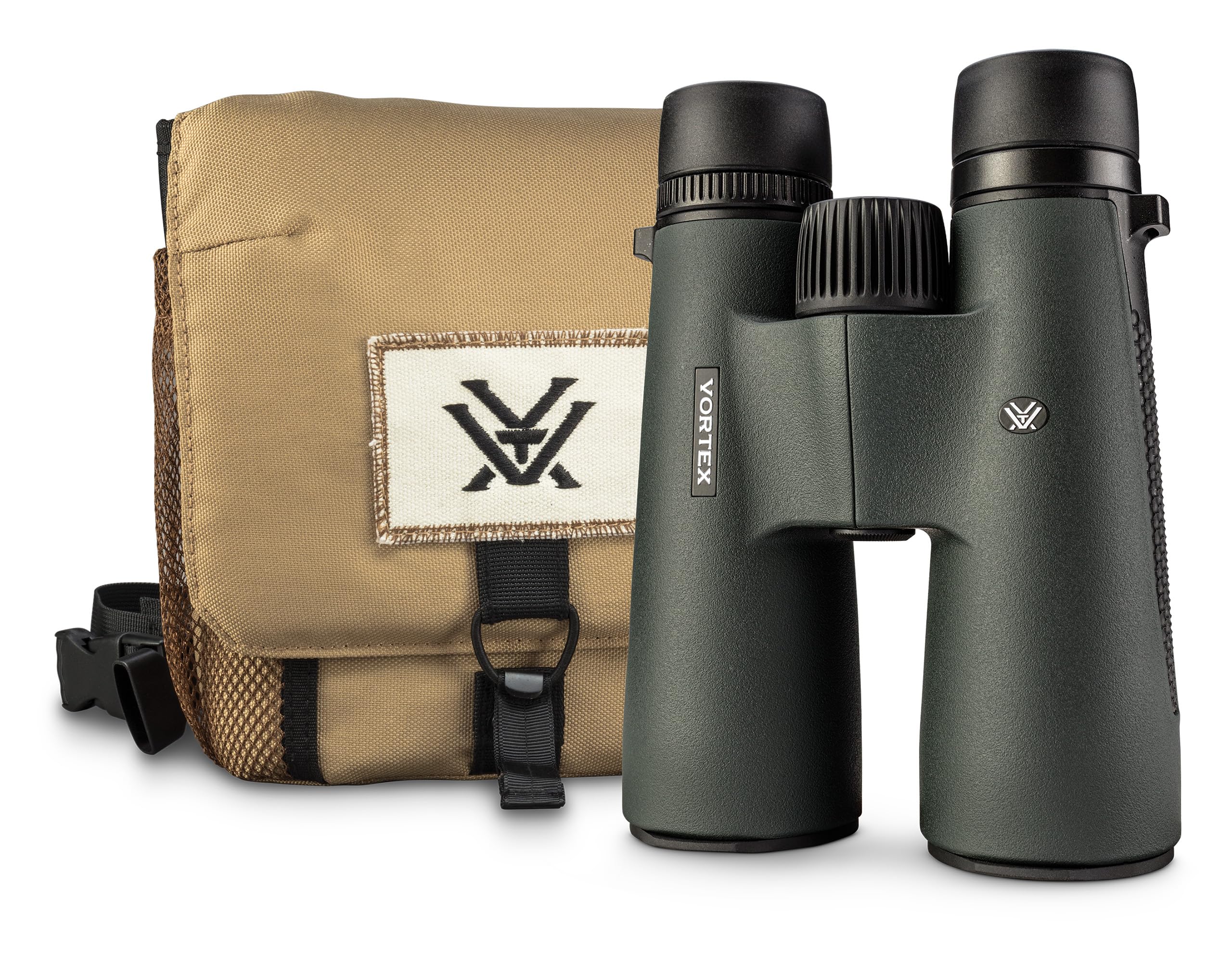
3. Vortex Triumph HD 12×50 Binoculars
Twelve times magnification and a 50mm lens for reaching across ridges and open basins.
When you need the extra reach, the 12×50 Triumph is the answer. That 12x magnification against a 10x glass is a meaningful jump in how close you can pull a distant ridgeline, and the 50mm objective lens steps up from a 42mm for more light-gathering punch. Compared with the Vortex Copperhead HD 10×42, this one delivers 12x versus 10x and a 50 mm objective versus 42 mm — a real step up when the terrain opens out. The HD optical system and fully multi-coated lenses cut chromatic aberration and hold colour fidelity and edge-to-edge sharpness, so the reach does not come at the cost of a clean image.
For durability, the polycarbonate chassis carries full rubber armor, making it shockproof and giving a better grip. It is nitrogen purged, so it stays waterproof and fogproof through rain and rapid temperature swings. Adjustable rubber eyecups and an adjustable diopter let you find your most comfortable viewing position, and it is tripod adaptable for extended glassing sessions. A neck strap and an adjustable GlassPak harness come in the box for fast access and easy carry.
Owners praise the optical quality first and the value for money second. Owners compare the glass to optics costing far more, with several calling it as good as thousand-dollar binoculars. The catch is real: with 12x magnification, hand tremor is amplified, and the strap buckles have drawn complaints that they do not hold securely. Extended viewing sessions really want a tripod under them. The 16mm eye relief is also shorter than the Copperhead’s 17mm and the Bushnell Bone Collector’s 17.5mm, so glasses wearers should check the fit.
Why It Earns The Label
- 12x magnification and 50mm objective for serious distance
- HD glass with fully multi-coated lenses cuts chromatic aberration
- Nitrogen purged, waterproof, fogproof, and shockproof via full rubber armor
- Backed by Vortex’s unlimited lifetime VIP warranty
Where It Demands Care
- 12x amplifies hand shake — a tripod helps for long looks
- Strap buckles have drawn complaints about holding securely
The call: buy this if your glassing happens across big country where 10x just is not enough reach.
The reason to hesitate: if your hands are unsteady or you refuse to mount a tripod, the shake will fight you.
4. Celestron Outland X 10×50 Binoculars for Low-Light Wildlife Views

A 50mm front lens built to pull wildlife out of the gloom at first and last light.
The 50mm objective lens is the reason to look here. Bigger front glass gathers more light, and that is what makes a dusk scan of a field edge or a shadowed treeline actually work. Celestron pairs it with high-quality BaK-4 prisms — barium crown glass that produces sharp, colour-accurate images — plus multi-coated lenses that boost light transmission to your eye across a range of lighting conditions. In practical terms, the view stays bright and high-contrast when the light is fading.
The 10x magnification holds a steady image while tracking movement, so you follow a subject without losing it. Field of view sits at 289 feet, which is narrower than some of the 8x options here, and the 5.6 degree angular view is built for scanning broad areas while staying on a moving target. The housing is rubber-armored polycarbonate, waterproof and nitrogen-purged against fogging in rain, snow, or humidity, and the whole thing is compact enough to be called pocket-friendly. Built-in tripod adapter threads let you mount it steady for long sessions, though the adapter itself is not included. A carrying case, lens cloth, neck strap, objective lens caps, and a rainguard all come in the box.
Image quality and value both land high with owners, and the build holds up. The honest caveat is the eyepiece: several buyers report the right eyepiece not twisting up or down properly, which is the kind of thing worth checking on arrival. Others find the field of view narrower than expected and the sharp balance a little hard to hit. None of that stops the Outland X from being a genuinely capable low-light glass — an Alaskan cruise pair, a backyard bird pair, and a long-distance scanner all turn up in the same feedback.
What it is: a 10×50 with BaK-4 prisms and multi-coated lenses tuned for dim conditions.
Test on arrival: extend both eyecups through their full range before you rely on it, since the right eyepiece has been a recurring adjustment complaint.
Buy it for: low-light wildlife viewing where a brighter 50mm view beats a wider one.
Pass if: you mainly glass wide open country and want the broadest window your money can buy.
5. Celestron Nature DX 8×42 Waterproof Binoculars for Bird Watching & Outdoors
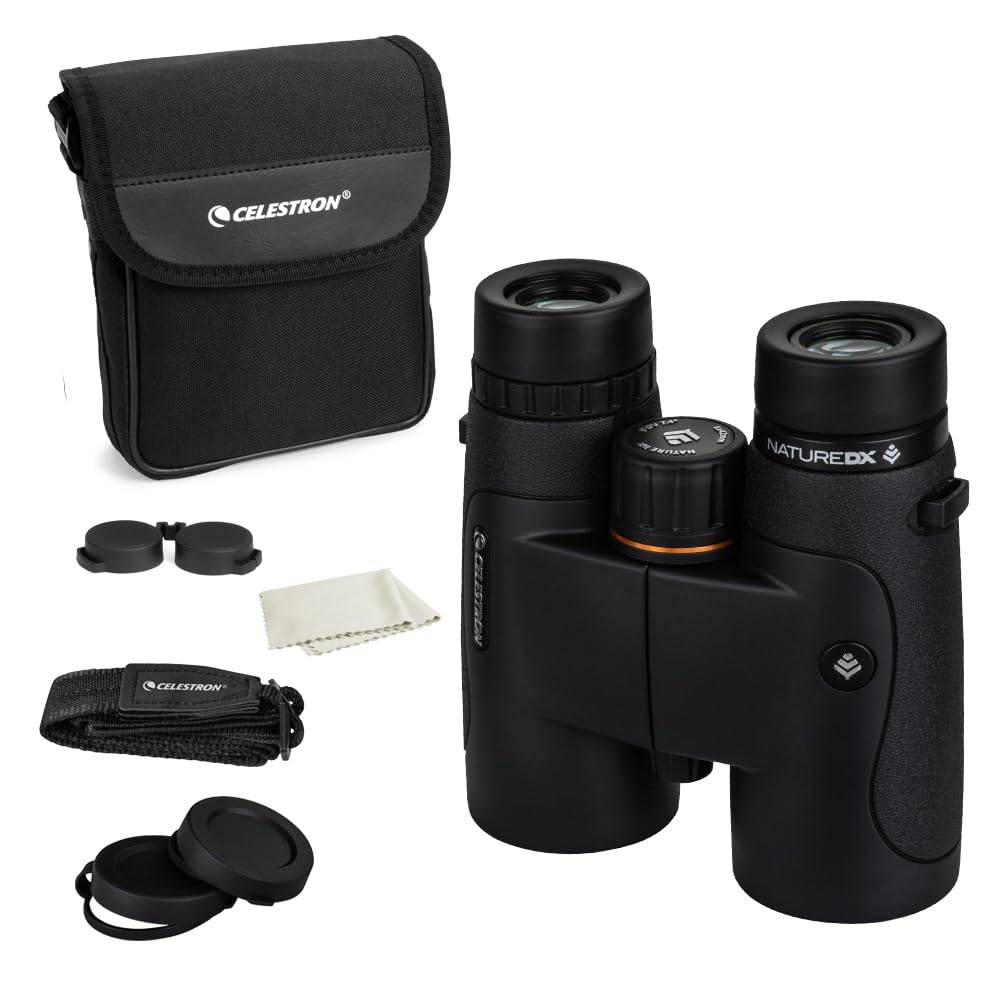
The widest window in this lineup — 388 feet of view for pulling birds out of the branches.
Field of view is the whole story with the Nature DX. Its 388 feet of view is the broadest here, and that matters when a warbler flits from limb to limb and you need to stay on it instead of scanning around trying to reacquire. The 7.4° angular field of view is the widest of any glass listed in this guide. Combine that with an 8x magnification — which keeps the image steadier than a 10x and gives you more space to track movement — and you have a binocular built specifically for following fast subjects.
Fully multi-coated lenses maximise light transmission, and the phase-coated BaK-4 prisms enhance contrast and resolution for crisp, colour-accurate images. In plain language, the colours look true and the image stays crisp across a range of lighting. The rubber-armored polycarbonate housing is waterproof and nitrogen-purged to resist fogging in rain, snow, or humidity, and the whole package is compact and light enough to fit a hiking backpack. A built-in tripod adapter socket lets you mount it steady, though the adapter is not included. A carrying case, lens cloth, neck strap, objective lens caps, and a rainguard round out the box. Celestron has been a California optics brand since 1960, and it backs the Nature DX with a limited lifetime US warranty and US-based tech support.
Owners describe it as great for birdwatching from the yard or on the trail, with sharp colour and a clear view that fits easily in a pack. One note of honesty: it reads as pricey for what it is if you are a casual user, but enthusiasts tend to find it worth it, and it holds its own against far more expensive glass. It is also the steadiest all-day option in this lineup because of the 8x magnification.
Standouts For Birders
- 388 feet field of view — the widest in this lineup
- 7.4° angular field of view with 8x magnification keeps the image steady
- Phase-coated BaK-4 prisms plus fully multi-coated lenses for contrast and colour
- Compact and light enough to live in a hiking backpack
Know Before You Buy
- Feels pricey for casual users
- You need to check the tripod adapter separately, since it is not included
Perfect for the birder who wants the widest possible view and a rock-steady 8x image.
Not the best fit for someone chasing distance — the 8x reach favours close and mid-range framing.
6. Nikon PROSTAFF P3 8×42 Binocular

Longest eye relief of the whole group — 20.2mm that keeps glasses wearers comfortable.
If you wear glasses, start here. The 20.2mm eye relief is the longest in this lineup, and longer eye relief means you can keep your glasses on and still see the full image without pushing the barrels against your face. The turn-and-slide eyecups and a smooth central focus wheel make adjustment quick, and the ergonomic shape stays balanced during extended use. The 8x magnification with a 42mm lens keeps the image steady — a real advantage for watching birds in motion — and the apparent angle of view comes in at 53.4 degrees with a 377-foot field of view.
Optics are multilayer-coated to minimise reflections and boost brightness and contrast, and a silver-alloy prism coating ensures vivid, lifelike colour across the visible spectrum. For weather, O-ring seals and nitrogen gas purging keep fog and water out through rain, snow, humidity, and rapid temperature shifts. The fiberglass-reinforced polycarbonate body carries rubber armor for durability and a secure, non-slip grip, and the glass is lead- and arsenic-free eco-glass. A case, eyepiece cap, objective cap, and neoprene neck strap are all included.
Quality is the runaway winner here, and birding is a close second in owner satisfaction. The one recurring nit is the diopter, which some find stiff to turn. For night-sky scanning, the 5mm exit pupil serves well, and the featherweight feel is a comfortable counterpoint to the heavier 50mm options above. What stands out is how much of the view stays in focus all the way to the edge — owners describe bright images with no edge fringing to distract from the subject.
The short version: an 8×42 with the longest eye relief here and eco-glass construction, built for long comfortable viewing sessions.
One quibble to note: the diopter ring can feel stiff, so give it a turn before you settle in.
Fit for: glasses wearers and casual-to-serious birders who value long eye relief above all.
Skip if: you need 10x reach — this one trades magnification for stability.
7. Bushnell Engage X 10x42mm Binoculars, IPX7 Waterproof

Bushnell’s permanent EXO Barrier coating keeps grime and water off the glass in brutal conditions.
EXO Barrier is the differentiator. It is a permanent coating on the exterior lens surfaces that repels water, oil, fog, dust, and debris, so you get a clear, vibrant image even when the elements are doing their worst. Underneath, all-glass fully multi-coated lenses deliver exceptional clarity and brightness. The IPX7 rating on top means it will not fog up when the weather turns — a meaningful edge over lighter seals when you are sitting in a downpour waiting on a target. With a 2-pound body and an aluminum shell, it stays comfortable to carry, and the twist-up eyecups make it easy to get the right image with or without glasses.
Enhanced low-light performance gives you an edge for hunting in dim conditions, and a full lifetime Ironclad Warranty stands behind it. A comfortable neck strap, carrying case, and quick start guide all come in the box, and the whole thing is tripod compatible. Eye relief sits at 18mm, giving you more room than the shorter 15.7mm eye relief of the Nikon PROSTAFF P3 10×42. The 10x magnification pairs with a 42mm objective and a 4.2mm exit pupil, which is the steady middle ground for tracking a moving target.
Image quality is the thing owners rave about, and the 10x reach serves hunting and cruising alike — from deer stands to Alaskan decks. The honest catch: the focus mechanism splits feedback, with some owners finding it quick and precise and others finding it confusing to dial in properly. A couple of birders also note it is not the sharpest option for fine feather detail at a distance. On balance this is a rugged, weather-beating hunting optic with dependable glass, not a delicate one-season tool.
Built For The Field
- Permanent EXO Barrier coating repels water, oil, fog, dust, and debris off the glass
- IPX7 waterproof rating with 2-pound aluminum body
- All-glass fully multi-coated lenses for clarity and brightness
- Full lifetime Ironclad Warranty, strap, and case included
Points To Note
- Focus mechanism splits opinion — some find it confusing to dial in
- Not the go-to for fine feather detail at extended range
The pick for: wet-weather hunters who want a light 10×42 that sheds grime and water from the glass.
Consider something else if: you want the crispest possible resolution for distant birding rather than raw field toughness.
8. Nikon PROSTAFF P3 10×42 Binocular

Ten times magnification and silver-alloy prisms that make individual details pop.
The 10×42 PROSTAFF P3 pairs reach with serious optical hardware. Silver-alloy prism coating on top of multilayer-coated lenses delivers vivid, lifelike colour across the entire visible spectrum, and the 62.9-degree apparent angle of view with a 367-foot field of view gives you a broad, bright window at full magnification. Birders describe seeing individual feather detail at distance, and one owner used them from the nosebleed section of an NFL game and had no trouble reading the field. Lead- and arsenic-free eco-glass runs through the whole optical train.
Nikon builds the body from fiberglass-reinforced polycarbonate with rubber armor for durability and a secure, non-slip grip, and O-ring seals plus nitrogen purging keep fog and water out through rain, snow, humidity, and abrupt temperature changes. Turn-and-slide eyecups and long eye relief help whether you wear glasses or not — though the 15.7mm eye relief here is shorter than the 20.2mm on the 8×42 version above, so if you are a glasses wearer who prizes comfort, that other model may suit better. A camera, case, eyepiece cap, objective cap, and neoprene neck strap round out the kit.
Owners consistently praise the quality and clarity, and one recurring gripe is the lens covers — described as not much use. A small amount of fringing shows up in some reports, but it stays unnoticeable in normal use. If you want sheer magnification for birding from a fixed spot or a stadium seat, this one earns its place.
Where it wins: 10x magnification with silver-alloy prism coating for vivid colour and crisp, individual-detail rendering.
The minor gripes: the included lens covers are widely called useless, and eye relief is shorter than the 8x variant if you wear glasses.
Ideal for: a birder or spectator who wants maximum magnification and razor-sharp detail.
Reconsider if: you wear glasses and want the longest eye relief Nikon offers — the 8×42 fares better.
9. Leupold BX-1 McKenzie HD Binoculars, 10x42mm

An open-bridge aluminum 10×42 that stays light on a long backcountry haul.
The open-bridge roof prism design is the Leupold signature here, and it is not just cosmetic. That layout takes weight out of the frame and improves ergonomics, which is what you want when the binocular lives on a harness for a full day of walking. BaK-4 prisms deliver a perfectly round exit pupil with virtually no edge distortion, so the image stays crisp all the way out — a cut above cheaper prism glass that softens at the rim. The fully multi-coated lens system maxes out brightness for clarity, contrast, and colour fidelity.
At 10x magnification with a 42mm objective and a 4.2mm exit pupil, the McKenzie sits in the all-purpose range. It is 100% waterproof and fogproof and backed by Leupold’s customer care. Eye relief is 17mm, the same as the Vortex Copperhead above, and the 5.7-degree apparent angle of view with a 304-foot field of view keeps the framing reasonable for tracking subjects. Diopter adjustment runs to ±5 diopters, so you can correct for a difference between your two eyes.
Owners rave about the lens quality and the brightness of the optics — the glass outperforms its price class. The one consistent annoyance lives in the strap: the included neck strap connects to the case in an awkward way, and there are no independent neck straps in the box. The fix is simple — plenty of owners just buy a spare strap. If you value a light aluminum body and crisp edge-to-edge glass and can spend a few bucks on a better strap, the McKenzie delivers.
Why It Works
- Open-bridge aluminum roof prism design keeps it light and ergonomic
- BaK-4 prisms give a round exit pupil with virtually no edge distortion
- Fully multi-coated lens system for brightness, contrast, and colour fidelity
- 100% waterproof and fogproof
What To Expect
- Included strap is awkward and connects to the case — no independent neck strap
- Field of view is narrower than the widest options here
Reach for this if: you want a light, ergonomic 10×42 with crisp BaK-4 glass for backcountry carry.
Plan around it if: you like an out-of-the-box neck strap — budget for a spare one alongside.
Understanding the Specs
Magnification And Objective Lens
The two numbers in a name like 10×42 tell you almost everything. The first — 10x — is how many times closer the image appears. Higher magnification pulls distant subjects in tighter, but it also magnifies every shake in your hands, so a 10x glass is easier to hold steady than a 12x. The second number — 42 — is the diameter of the front lens in millimeters. A larger front lens gathers more light, which is why a 50mm objective can perform better in dim conditions, while a 42mm stays lighter on your neck.
Eye Relief And Field Of View
Eye relief is the distance from the eyepiece where the full view is visible. Get it right and you can keep glasses on while using the binoculars comfortably; get it too short and your glasses will cut off the edges. Field of view is how much of the landscape the glass shows at a fixed distance — a wider field is easier to scan with when tracking a moving subject, while a narrower field trades some width for more magnification. Both numbers matter for how the glass actually handles in the field.
FAQ
Is 10×42 better than 8×42 for bird watching?
Will binoculars work if I wear glasses?
What does waterproof and fogproof actually mean for binoculars?
Does magnification make binoculars harder to hold steady?
What is the difference between fully multi-coated and multi-coated lenses?
Should I mount binoculars on a tripod?
Will a 10×42 work for deer hunting or is a 12×50 worth it?
How does eye relief affect whether I can use binoculars all day?
Can I use binoculars for astronomy as well as daytime viewing?
Do these binoculars come with a case and strap in the box?
Final Thoughts: The Verdict
For most buyers chasing binoculars under $300, the winner is the Vortex Copperhead HD 10×42 because it nails the all-purpose formula — HD glass, fully multi-coated lenses, a weatherproof build, and a glasspak harness and neck strap both in the box, all backed by Vortex’s unlimited lifetime VIP warranty. If reaching far across open country matters more than anything, grab the Vortex Triumph HD 12×50. And for pulling wildlife out of fading light, the Celestron Outland X 10×50 is the one to reach for.
If you wear glasses, the decision changes — the Nikon PROSTAFF P3 8×42 gives you the longest eye relief in this lineup at 20.2mm. And if you just want a light, steady, wide-view birding glass that fits in a hiking bag, the Celestron Nature DX 8×42 earns its place. Any of the nine here will serve you well for years — the Copperhead just covers the most ground.
How We Picked
We do not accept paid placement. Every pick is matched to a real buyer and a real use-case; we do not hands-on test units.
Sources & Methodology
Specifications: manufacturer listings and product documentation. Review insights: verified customer reviews, as of September 2026. Pricing: not shown on this page (it changes often); check the current price via the retailer link.
As an Amazon Associate, Gadgets Feed earns from qualifying purchases. This does not affect which products we feature.