
Hand shake is the silent killer of image clarity at any magnification above 10x. Once you exceed that threshold, the natural tremors in your hands transform a crisp scene into a blurry, frustrating mess. Stabilized binoculars solve this with internal gyros or vari-angle prisms that cancel out movement, letting you hold 16x or 18x glass steady without a tripod.
I’m Min — the co-founder and writer behind Gadgets Feed. I’ve spent many hours analyzing optical specifications, stabilization mechanisms, and battery management systems across dozens of models to isolate the true performance leaders.
If you want optics that eliminate wobble and deliver sharp, detailed views in any handheld scenario, this evaluation of the best binoculars with stabilization will direct you to the models that actually deliver on their promise.
How To Choose The Best Binoculars With Stabilization
Stabilized binoculars are a high-investment purchase that pays off in real-world usability. Before committing, you need to weigh magnification against objective lens size, understand the two dominant stabilization technologies, and confirm the device fits your intended environment.
Stabilization Technology: Gyro vs. Vari-Angle Prism
Gyro-based systems, like those in Fujinon models, use a spinning gyroscope sensor to detect movement and physically adjust an internal prism. These handle larger correction angles — up to ±6 degrees — making them ideal for boats and vehicles. Vari-angle prism systems, used by Canon and Nikon, rely on electromagnets to tilt a prism in response to shake. They are lighter and more compact but typically correct a narrower range of motion, usually under ±1 degree.
Objective Lens Diameter and Exit Pupil
A larger objective lens (the number after the magnification, e.g., 42mm or 50mm) gathers more light. The exit pupil, calculated by dividing objective diameter by magnification, determines brightness in low light. For stabilized binoculars, a 42mm objective paired with 16x magnification gives a 2.6mm exit pupil — usable in daylight but dim at dusk. A 50mm objective at 18x delivers a 2.8mm exit pupil, slightly better for twilight sessions.
Battery Life and Power Management
All stabilized binoculars require batteries to run the stabilization mechanism. Look for models that offer at least 10 hours of runtime on a standard set of AA batteries. Auto shut-off features, like Nikon’s 60-minute inactivity timer or Kite Optics’ motion-sensing sleep, prevent accidental drain. Some units, like the Canon 12×36 III, only activate stabilization while you hold a button, extending battery life at the cost of constant finger pressure.
Quick Comparison
On smaller screens, swipe sideways to see the full table.
| Model | Category | Best For | Key Spec | Amazon |
|---|---|---|---|---|
| Nikon STABILIZED 12×25 | Mid-Range | Ultra-portable everyday carry | 12-hour battery on AA | Amazon |
| Canon 12×36 IS III | Mid-Range | Sharp optics at a lower weight | Vari-angle prism IS | Amazon |
| Bushnell Match Pro ED 15×56 | Mid-Range | Long-range precision shooting | MRAD reticle + ED glass | Amazon |
| Nikon Monarch HG 10×42 | Premium | Wide-field birdwatching | Field flattener lens system | Amazon |
| SIG SAUER Zulu6 HDX 16×42 | Premium | Dual-mode stabilization scanning | 2-mode OIS + HDX glass | Amazon |
| Canon 18×50 IS All-Weather | Premium | Astronomy and long-range hunting | 18x magnification, 50mm lens | Amazon |
| Fujinon Techno-Stabi TS-X 14×40 | Premium | Maximum correction angle | ±6° gyro stabilization | Amazon |
| Kite Optics APC Stabilized 16×42 | Premium | Military-grade stability in tactical use | 2°/3° correction, IPX7 | Amazon |
| Fujinon Techno Stabi TS1440 | Premium | Marine and heavy-duty observation | 5° stabilization center focus | Amazon |
In‑Depth Reviews
1. Nikon STABILIZED 12×25 Binoculars
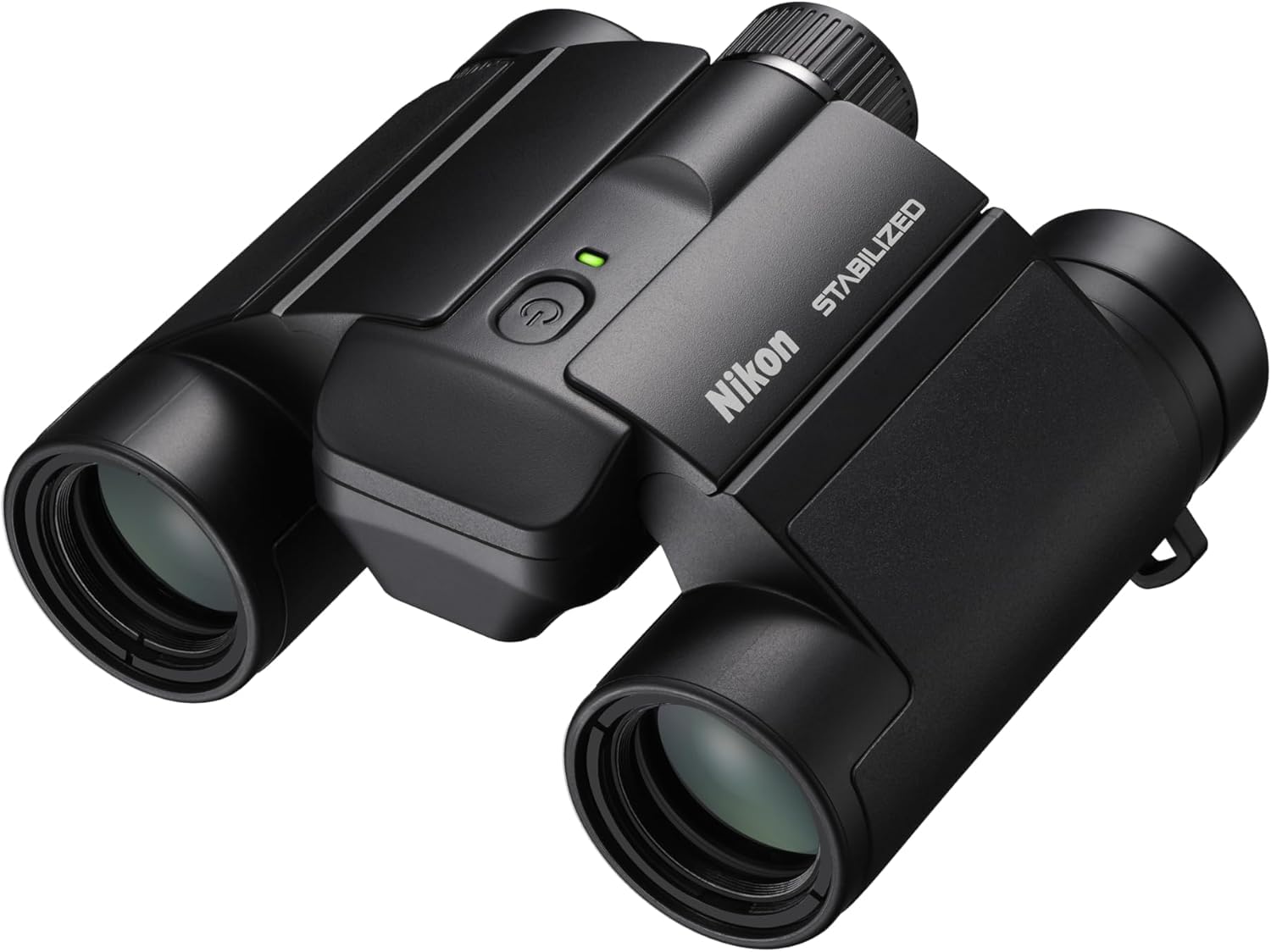
Nikon packs its proven electronic image stabilization into the most compact roof-prism body in this class. At 12×25, the objective lens is small, but the trade-off is a unit that fits in a jacket pocket and weighs less than 15 ounces. The stabilization system runs for up to 12 hours on standard AA batteries and includes an automatic shut-off after 60 minutes of inactivity, so you never return to dead batteries after leaving them on.
The multicoated lenses and silver alloy prism coatings deliver true-to-life colors with sharp contrast, even as light fades toward dusk. The 236-foot field of view at 1,000 yards is generous for a 12x optic, making it practical for tracking birds or athletes. Users consistently report that the stabilization locks on immediately with a simple on/off switch — no button holding required.
The downside is the accessory package: the included carrying pouch is flimsy, the lens caps are inadequate, and there is no rain guard. Serious buyers will want to invest in third-party caps and a better case. The diopter adjustment range of +/-5 is generous, but some users find the on/off button placement awkward during rapid deployment.
Why it’s great
- Extremely compact and lightweight for a stabilized model
- 12-hour runtime on AA batteries with auto shut-off
- Excellent optical clarity with high-contrast coatings
Good to know
- Accessories (pouch, caps) are poor quality
- Small 25mm objective limits low-light performance
- Stabilization button location can be awkward
2. Canon 12×36 Image Stabilization III Binoculars

Canon’s third-generation 12×36 IS binoculars leverage the same vari-angle prism technology found in the company’s EF lens lineup. The Porro II prism design minimizes light loss, while doublet field-flattener lenses deliver sharp, virtually distortion-free images from edge to edge.
Image stabilization is excellent, but it only activates while you hold the button down. This design choice extends battery life — a single set of batteries lasts for many outings — but requires constant finger pressure, which can become tiresome during extended glassing sessions. The 14.5mm eye relief is comfortable for eyeglass wearers, and the low-reflective exterior coating reduces glare in bright conditions.
Some missing accessories frustrate out of the box: the eyepiece caps are not tethered, and there are no objective lens covers included. The rubberized coating holds up well over time according to long-term owners, but the lack of a lanyard for the caps is a minor annoyance. For the price, the optical quality and stabilization performance are exceptional.
Why it’s great
- Sharp edge-to-edge optics with field-flattener lenses
- Lightweight and compact for a 12x stabilized model
- Long battery life due to on-demand stabilization
Good to know
- Stabilization requires continuous button holding
- No tethered or included objective lens caps
- Rubber coating durability questioned by some users
3. Bushnell Match Pro ED 15×56 Binoculars

The Bushnell Match Pro ED is not a traditional stabilized binocular — it uses a BridgeSet IPD Stabilizer that locks the barrel spacing rather than an internal gyro. This is a precision long-range observation tool built for PRS shooters. The Shot-Call MRAD reticle features a 2/10-style grid inside 3 MRAD and .5 MRAD stadia lines out to 20 MRAD, with independent reticle focus for sharpness.
The ED Prime glass with Ultrawideband coatings delivers light transmission and color fidelity that reviewers compare favorably to Zeiss and Swarovski optics at a fraction of the cost. The rotating reticle adjustment keeps the grid plumb regardless of how wide the barrels are set. The magnesium chassis and IPX5 water resistance make it rugged enough for match days in wet conditions.
This is a specialized tool — left-eye dominant shooters may struggle since the reticle is fixed in the right barrel. The 3.8mm exit pupil is adequate for daytime use but limits low-light performance compared to 50mm competitors. The twin diopter adjustments provide fine focus, but the fixed-focus eyepieces require patience to dial in perfectly.
Why it’s great
- Exceptional ED glass quality rivals premium European optics
- Rotating MRAD reticle with independent focus
- BridgeSet stabilizer locks barrel spacing perfectly
Good to know
- Reticle is fixed in right barrel only
- Not suited for left-eye dominant users
- Low-light performance limited by 3.8mm exit pupil
4. Nikon Monarch HG 10x42mm Binoculars
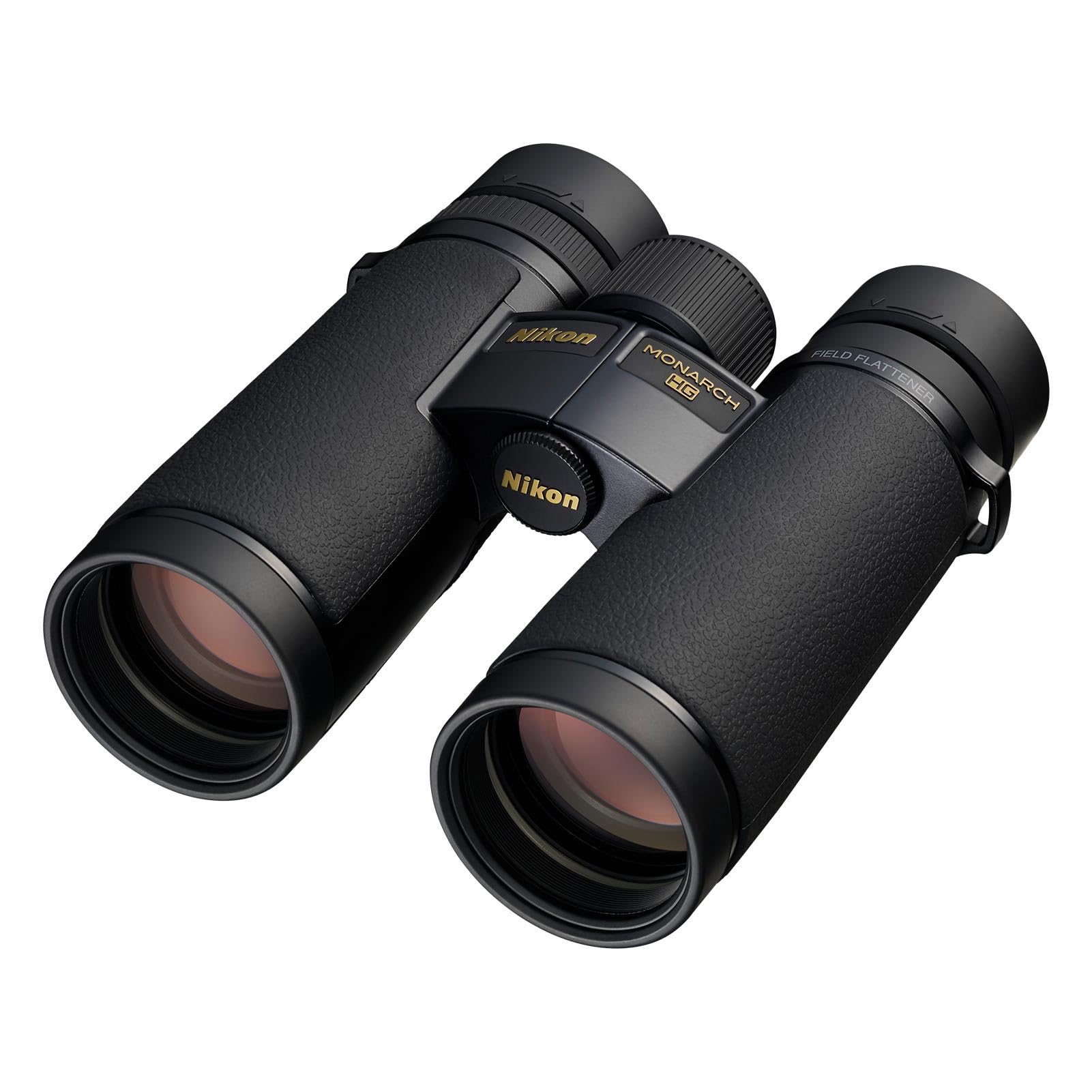
Nikon’s Monarch HG series represents the pinnacle of non-stabilized consumer binoculars, but its field-flattener lens system and ED glass deserve consideration for buyers who prioritize optical purity over electronic assistance. The 10×42 configuration delivers a 121-meter field of view at 1,000 meters — exceptionally wide for a 10x optic — with edge-to-edge sharpness that eliminates the peripheral blur common to lesser glasses.
Dielectric and phase-correction coatings on the prisms maximize light transmission, producing bright, color-accurate images from dawn to dusk. The magnesium alloy body is lightweight and impact-resistant, while the nitrogen-filled, O-ring sealed construction provides waterproofing to 5 meters for 10 minutes. The locking diopter ring prevents accidental adjustments, a thoughtful touch for field use.
The rubber objective covers are a common point of criticism — they do not stay on securely during transport. Some users replace them with aftermarket rings. At this price point, the competing Zeiss Conquest HDX offers slightly sharper center resolution, but the Monarch HG wins on overall immersive viewing experience thanks to its expansive, distortion-free field.
Why it’s great
- Industry-leading wide field of view with flat edges
- Excellent light transmission with dielectric coatings
- Locking diopter and waterproof to 5 meters
Good to know
- Objective lens covers do not stay attached
- Slightly heavier than competitor roof prisms
- No electronic image stabilization
5. SIG SAUER Zulu6 FDE HDX OIS 16x42mm Binoculars

SIG Sauer enters the stabilization arena with a unique dual-mode optical image stabilization system. Scan Mode is designed for general observation — gridding hillsides or tracking movement — while Target Mode increases stability by up to 50%, locking onto a specific subject for detailed inspection. The 16×42 configuration is exceptionally compact, roughly the size of a standard 8×42 binocular, making it one of the most portable high-magnification stabilized options available.
The HDX glass lenses deliver enhanced light transmission and resolution, though the 2.63mm exit pupil at 16x means the image dims noticeably in twilight conditions. The IPX-7 waterproof rating provides protection from heavy rain and submersion up to 1 meter for 30 minutes. The ergonomics require some adjustment — the focus knob placement and button logic have a learning curve — but once dialed in, the performance is phenomenal.
Some buyers have reported receiving units that appeared used, with batteries already installed and missing packaging materials. The stabilization is transformative for users prone to motion sickness on boats or in vehicles, as the image remains crisp even when the platform is moving. The color rendition is slightly cooler than Fuji or Vixen alternatives, but the size-to-stabilization ratio is unmatched.
Why it’s great
- Two stabilization modes for scanning and target lock
- Remarkably compact for 16x magnification
- IPX-7 waterproof rating
Good to know
- Small exit pupil limits low-light performance
- Ergonomic controls have a learning curve
- Color rendition slightly cooler than competitors
6. Canon 18×50 Image Stabilization All-Weather Binoculars

Canon’s 18×50 IS binoculars have been a staple for serious observers since 2009, and for good reason — the 18x magnification paired with a 50mm objective creates a 2.8mm exit pupil that delivers enough brightness for astronomy and long-range hunting. The vari-angle prism stabilization removes all hand shake, making the 18x power usable without a tripod. At this magnification, even minor tremors become major blur, so the stabilization is not a luxury — it is essential.
The multi-coated lenses produce excellent contrast and color fidelity. Users report being able to count stitches on a football from the stands or spot Jupiter’s moons in suburban skies. The body is shock-resistant and weather-sealed, though not fully waterproof. Battery life is reasonable with auto shut-off, and the system runs on standard AA batteries.
The eyecups are the single biggest complaint — they are uncomfortable, requiring users to either jam them into their eye sockets or fold them back, which lets in stray light. Many owners modify them with Sugru putty or substitute telescope eyepiece guards. The included accessories are also lacking: there are no front lens covers, and the case is more of a dust cover than a padded protective bag.
Why it’s great
- 18x magnification makes distant details accessible
- 50mm objective gathers ample light for astronomy
- Proven stabilization system with auto shut-off
Good to know
- Eyecups are uncomfortable and poorly designed
- No front lens covers included
- Heavy compared to compact stabilized models
7. Fujinon Techno-Stabi TS-X 14×40 Image Stabilization Binocular

Fujinon’s TS-X 14×40 uses a gyro sensor-based stabilization system derived from broadcast and cinema lenses, offering the widest correction angle in this roundup at ±6 degrees. This means it can compensate for severe shake on a rolling boat deck, a bumpy vehicle ride, or even in moderate wind. The 40mm objective lenses with Fujinon’s EBC multi-coating control flare and ghosting while maximizing light transmittance for low-light observation.
The optical design places four objective elements in three groups and six ocular elements in four groups to control chromatic aberration, delivering edge-to-edge sharpness. The rubber-armored body is nitrogen-purged and O-ring sealed for waterproof and fog-proof performance. The unit runs on four AA batteries, which provide good battery life with an auto-off feature when not in use.
The downsides are practical: the TS-X 14×40 is heavy and large, making it unsuitable for hiking or backpacking. It is best suited for boat, car, or stationary use. The focus ring is positioned near the front, which some users find awkward, and the eye cups are difficult to adjust. A small number of buyers have reported warranty issues, so verify the seller’s return policy before purchasing.
Why it’s great
- Industry-leading ±6 degree stabilization correction
- Excellent clarity with minimal chromatic aberration
- Waterproof and fog-proof construction
Good to know
- Very heavy; not practical for hiking
- Focus ring position is awkward
- Warranty service reports are mixed
8. Kite Optics APC Stabilized 16×42 Binoculars
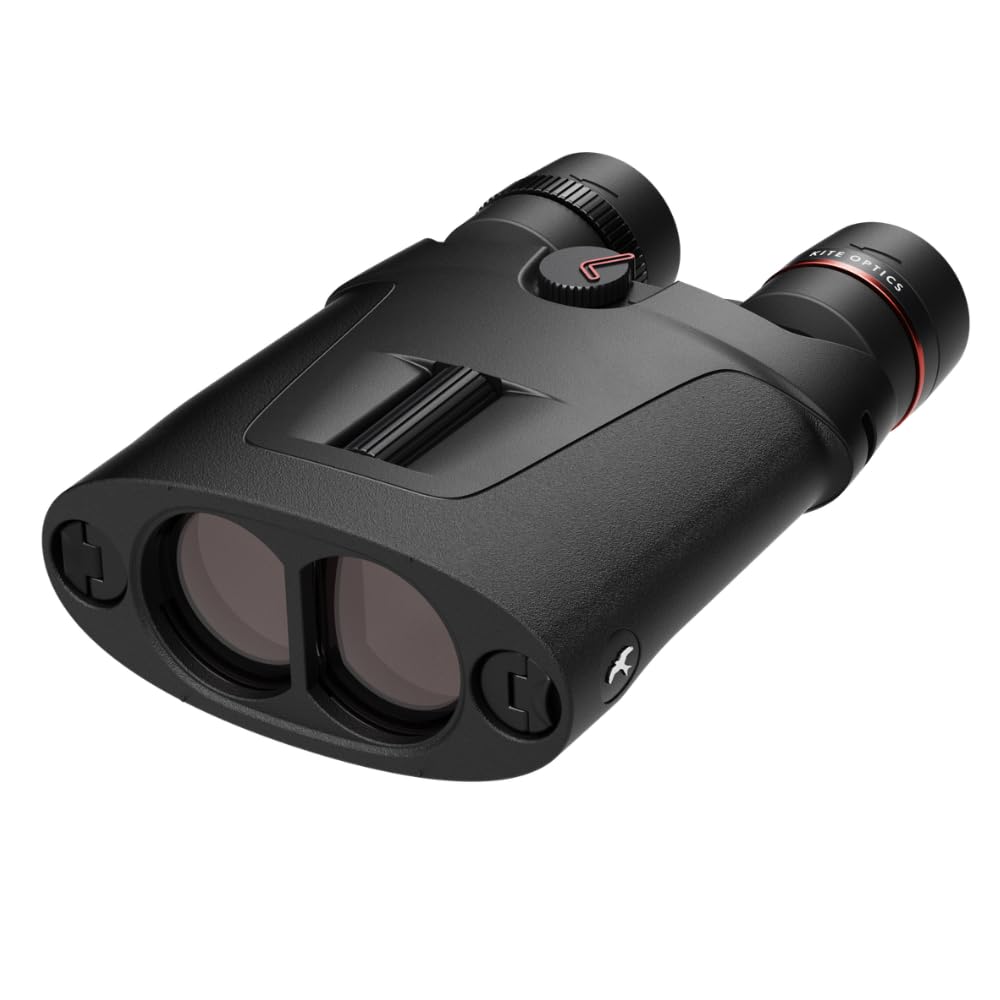
Kite Optics’ APC Stabilized binocular offers military-grade stabilization with 2° and 3° correction angles, optimized for use in strong winds, on vehicles, boats, and aircraft. The 16×42 roof prism design delivers sharp, bright images with 16x magnification. Users report that the stabilization is the best they have ever used, beating even Canon’s 15×50 IS in stability performance.
The IPX7 waterproof rating means it can withstand submersion up to 1 meter for 30 minutes, and nitrogen gas filling prevents internal fogging in cold or humid conditions. The unit runs on two AA batteries with an auto shut-off that triggers when pointed downward, extending battery life significantly. Weighing just 25 ounces, it is remarkably light for a 16x stabilized model.
The ergonomics are divisive — the interpupillary adjustment is made through the eyepieces rather than the barrels, which feels stiff, and the focus dial can be awkward for users with smaller hands. The standby mode times out too quickly according to some users, requiring a full power cycle to reactivate. These are design quirks rather than deal-breakers, but they affect rapid deployment in tactical situations.
Why it’s great
- Military-grade stabilization with multi-angle correction
- IPX7 waterproof and fog-proof construction
- Lightweight at 25 ounces for 16x magnification
Good to know
- Stiff interpupillary adjustment mechanism
- Standby mode times out too quickly
- Focus dial geometry favors medium-to-large hands
9. Fujinon Techno Stabi TS1440-14×40 Image Stabilization Binocular
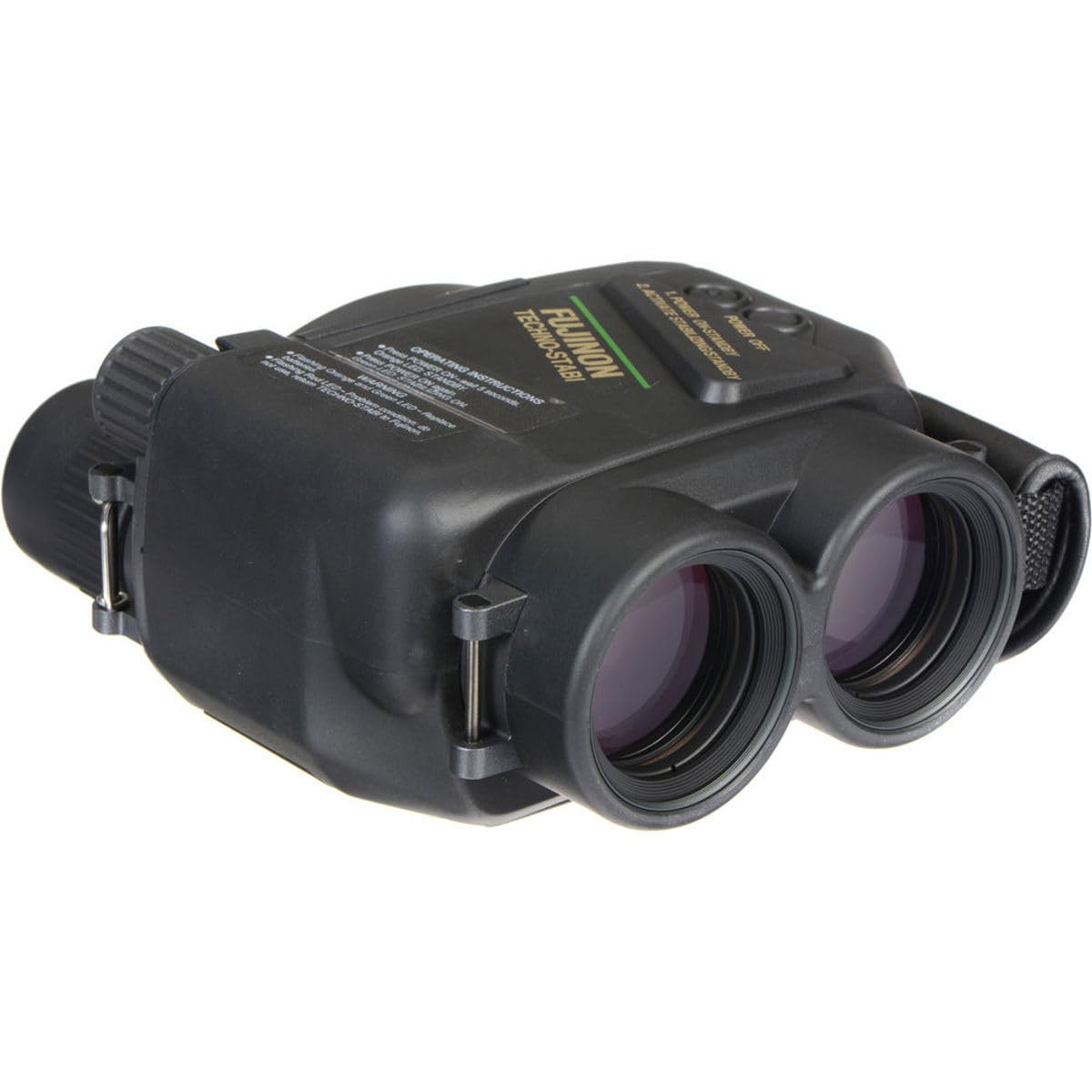
The Fujinon Techno Stabi TS1440 is a legend among mariners and serious wildlife observers. Its 5-degree gyro stabilization system far exceeds the ±1 degree correction of vari-angle prism competitors, making it the go-to option for use on small boats, in aircraft, or any unstable platform. The 14×40 configuration with phase-coated prisms and multi-layer coatings delivers a bright, crisp image that reveals details invisible through conventional binoculars at the same magnification.
The fiberglass-reinforced plastic body is surprisingly durable for its weight class, and the rubber armor provides a secure grip even in wet conditions. The unit uses four AA batteries and ships in a high-quality Pelican-style case that provides serious protection during transport. Users consistently describe the stabilization as “magical” — at 14x, you can read distant boat names or identify wildlife at extreme range without any image wobble.
The trade-offs are bulk and weight — this is not a binocular you carry on a hike. It also lacks objective lens caps, requiring aftermarket 48mm filters or covers for protection. The center focus design is smooth but slow compared to individual focus systems. Some users note that the stabilization requires a brief moment to lock in after pressing the button, which can be disorienting during rapid panning.
Why it’s great
- 5-degree stabilization ideal for boats and vehicles
- Excellent optical clarity with phase-coated prisms
- Comes with a high-quality Pelican protective case
Good to know
- Heavy and bulky; not for hiking
- No objective lens caps included
- Stabilization has a slight delay on activation
FAQ
Does image stabilization work for astronomy with handheld binoculars?
Why do some stabilized binoculars require holding a button while others have a toggle?
Final Thoughts: The Verdict
For most users, the best binoculars with stabilization winner is the Nikon STABILIZED 12×25 because it delivers reliable electronic stabilization in the most portable, pocket-friendly form factor with excellent battery life. If you want the best optical clarity and value at 12x, grab the Canon 12×36 IS III. And for maximum correction angle on unstable platforms like boats, nothing beats the Fujinon Techno-Stabi TS-X 14×40.