
Our readers keep the lights on and my morning glass full of iced black tea. As an Amazon Associate, I earn from qualifying purchases.
Specs are compiled from manufacturer listings and verified buyer reviews and can change over time — please confirm the key details on the product page before buying.
You want finches and chickadees, not a mob of starlings and a squirrel that treats your yard like a buffet. The feeder on your pole right now is probably the reason the little birds are losing. Ports that are too wide, perches that are too long, and tube walls a squirrel can chew through all add up to the wrong crowd. The feeders below are all built around one idea: make the small birds comfortable and make everyone else work for it.
I’m Min — the founder and writer behind Gadgets Feed. This guide is built by comparing the manufacturers’ published specifications and the patterns across verified customer reviews, so you get each pick’s real strengths and trade-offs instead of marketing spin.
You will see the difference between a feeder with small-bird-only ports and one with a wraparound cage, and you will know which suits a balcony or a backyard full of squirrels. This breakdown of the best bird feeders for small birds covers port size, perch length, seed capacity, and the real gripes owners raise.
Our Picks at a Glance

How to Choose the Best Bird Feeders For Small Birds
Start with the birds you want, then work backward. A feeder that welcomes everything is a feeder where the pushy birds win. Small-bird feeding is a filtering job, and every spec on the box is a filter.
Port size is the first filter
A feeding port is the opening a bird pushes its head through to reach seed. A port with a 1.5-inch perch paired to it lets a goldfinch, siskin, or house finch settle in. A mourning dove cannot balance on that perch long enough to feed. Look for the perch measurement in the listing, because that number is doing more work than any badge on the package.
Mesh tube versus caged tube
A mesh tube is a cylinder of fine metal mesh, usually sized for Nyjer and thistle seed. Finches cling to the mesh and pick seed through the openings rather than sitting on a perch. A caged tube is a standard seed tube wrapped in an outer metal grid. The grid sets the gap a bird must slip through, so a wider gap lets cardinals and jays in while a narrower gap shuts them out. Both designs work, but they suit different birds and different yards.
Seed capacity and how often you refill
Capacity in pounds tells you how long you can go between refills. A large capacity also lowers the crowding at the ports, because more seed means more feeding time before the feeder runs dry. In a wet climate, though, a big hopper of seed sitting for weeks is a mold risk. Drainage holes and a weather-resistant lid matter as much as the capacity number.
What squirrels really do to a feeder
Squirrels chew. Metal bodies, metal lids, and metal seed trays survive better than plastic. A closed metal hanging ring with a solid hook holds a feeder steady in wind, which keeps birds calm enough to land. No feeder in this list claims to be completely squirrel-proof, and you should treat any such badge with suspicion.
Quick Comparison
Every feeder below uses the same three measurements so you can scan the trade-offs at once: seed capacity, the birds it is built for, and the design feature that filters out the big birds.
| Model | Best For | Seed Capacity | Small-Bird Design | Construction | Amazon |
|---|---|---|---|---|---|
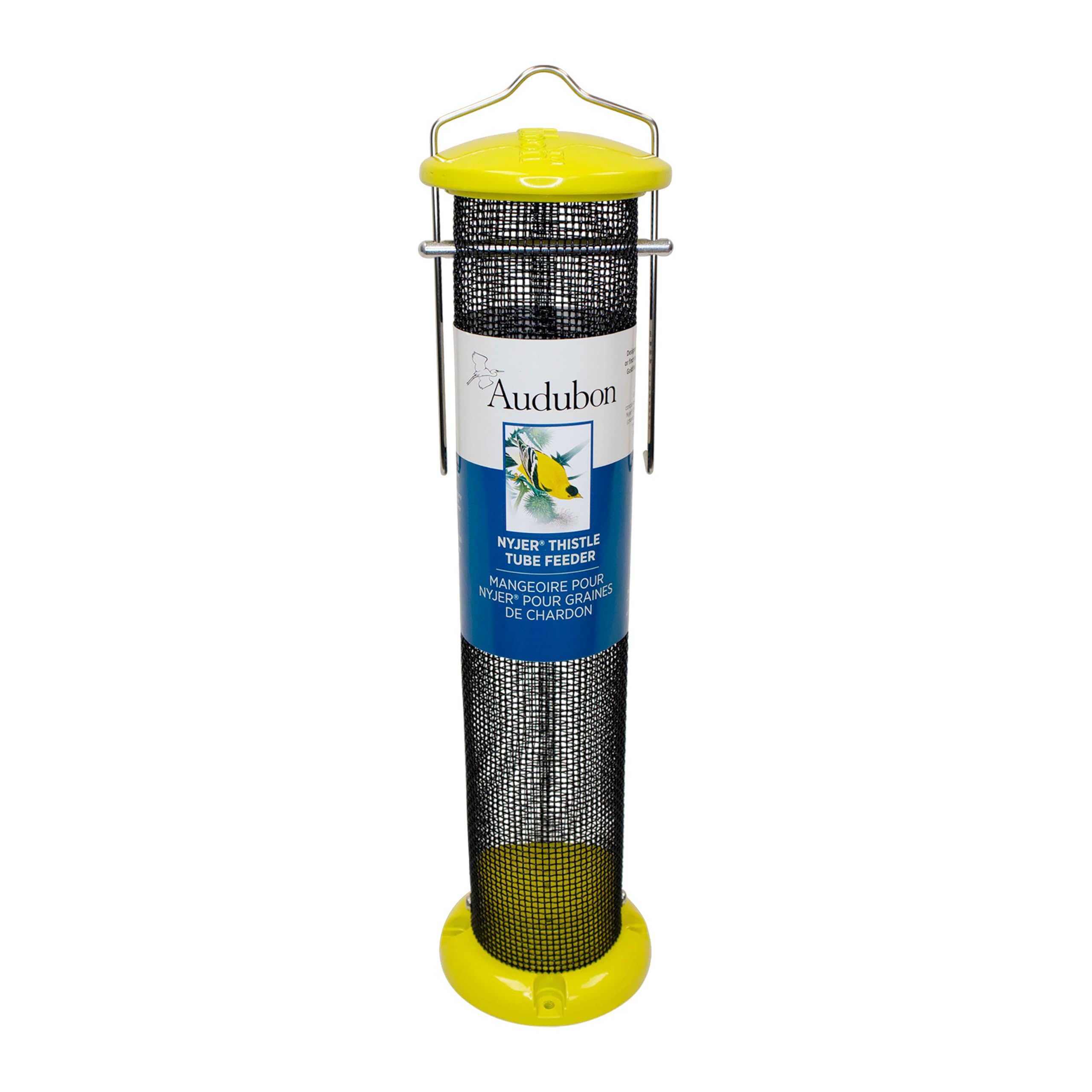
| Woodlink NAWLNT Audubon Finch Screen Tube★ Best Overall | All-round finch feeding | 16 ounces | Fine screen tube | Die-cast aluminum | Amazon |
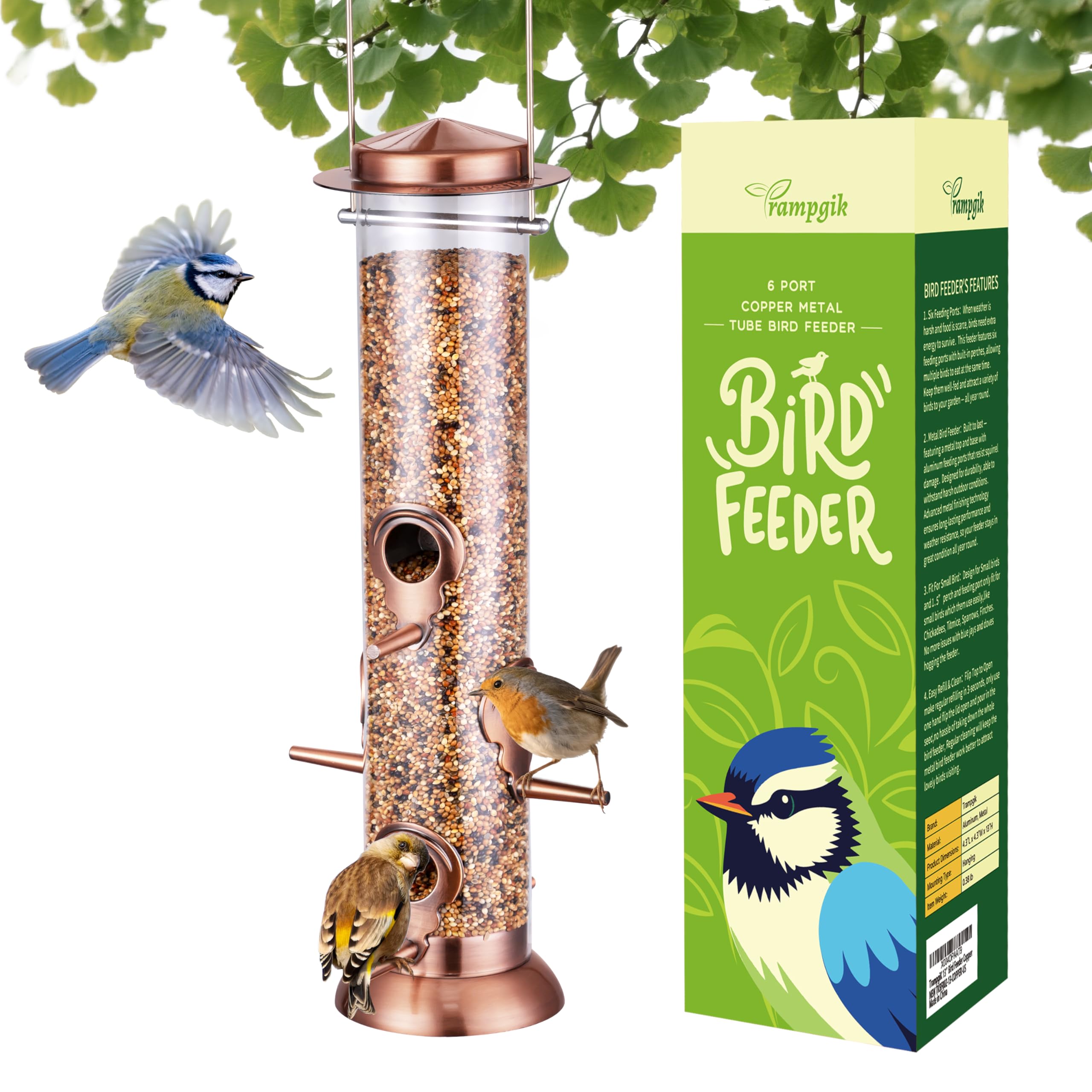
| TrampgiK 13-Inch Metal Tube FeederBest Value | Balcony and gift buyers | Not stated | 1.5-inch perches, 6 ports | Aluminum and metal | Amazon |
| Meleave Finch Feeder for NyjerGoldfinch Magnet | Big goldfinch flocks | 2.5 pounds | Mesh tube, 360-degree perch | Coated metal | Amazon |
| Gtongoko All Metal Mesh Tube | Nyjer and thistle purists | 2.5 pounds | 0.24-inch mesh openings | All-metal | Amazon |
| iBorn 15-Inch Thistle Tube | Busy multi-bird stations | Not stated | 12 small ports, 8 perches | All-metal, yellow finish | Amazon |
| Kingsyard Metal Finch Feeder | Weatherproof everyday hanging | 2 lb seed capacity | 1.5-inch perches, 6 ports | Metal and plastic | Amazon |
| SEWANTA Squirrel Resistant Caged Feeder | Squirrel-heavy yards | 22 oz (1.4 pounds) | Cage bars sized for tiny birds | Alloy steel, rustproof coating | Amazon |
| Kingsyard Tube Caged Feeder | Year-round covered feeding | 1.5 pounds | 1.5-inch by 1.5-inch mesh cage | Metal and plastic | Amazon |
| Mosloly Adjustable Caged Feeder | Mixed flocks and tuning | 3 pounds | Adjustable 1.12-inch to 1.58-inch grille | Powder-coated steel | Amazon |
In‑Depth Reviews
1. Woodlink NAWLNT Audubon Die Cast Aluminum Finch Screen Tube Wild Bird Feeder, 13-Inch, beige
Our pick — 4.0+★ from 900+ verified ratings; the strongest balance of quality and price.
A die-cast aluminum finch tube that arrives assembled and hangs straight from the box.
There is nothing to put together before the first fill. The Woodlink arrives fully assembled and ready to fill with thistle or a finch seed mix, so there is no bracket to fit and no cage to line up. That no-assembly build is why it takes the top slot for a first small-bird feeder. It holds one pound of seed, which is 16 ounces, and the die-cast aluminum body shrugs off weather without rusting away.
It sits at 4.0+ stars across 900+ ratings, and the reviews repeat the same routine: fill the screen tube, hang it, and finches arrive. Buyers single out the fill-and-clean routine as the easiest part of owning it. The seed goes in the top, the tube comes clean, and the harness does not fight you. Compared with the Meleave mesh tube below, this one is the smaller hopper at 16 ounces against 2.5 pounds, but it wins on the material and the finish.
The catch is spill. Seed escapes the screen more than owners of solid tubes expect, so you will be sweeping under the feeder or moving it over a planting bed. Bird traffic is also a split verdict in the feedback — some yards get a rush of finches, others stay quiet for a while. Give it a couple of weeks before you decide the location is wrong.
What earns it first place
- No assembly at all — it hangs and feeds the same afternoon
- Die-cast aluminum body that does not rust away season after season
- Simple to fill and clean, which is the thing buyers talk about most
Where it asks for patience
- Seed drops through the screen, so keep it over soil or a tray
- One pound of seed means more frequent refills than a 2.5-pound tube
Hang it if: you want a finch feeder that needs zero setup and looks tidy on a pole.
Pick something else if: you hate sweeping seed off a patio — the screen spills by design.
2. TrampgiK 13 Inch 6 Ports Squirrel Proof Metal Hanging Finch Feeder, Copper
Six 1.5-inch perches and a flip top you can open with one hand in the cold.
Six feeding ports paired with 1.5-inch perches is the whole argument for this feeder. That perch length lets chickadees, titmice, sparrows, and finches settle in comfortably. It also makes the feeder physically awkward for a blue jay or a dove, which is exactly the filtering you want. The brushed copper finish is a bonus that buyers notice — it looks like a garden ornament rather than a plastic tube.
The flip top is the feature that earns its keep. The flip top lifts with one hand, and you pour straight in without unhooking the feeder. In a January wind, lifting a flip top one-handed beats unhooking and unscrewing a tube in the cold. The aluminum and metal body takes a squirrel’s teeth far better than plastic, and there is a 12-month warranty covering a broken metal part.
Two honest notes. The maker’s own wording says it is not 100% squirrel-proof, so expect a determined squirrel to get some seed. And a share of buyers report it lasting well while others see it wear out faster than they hoped. If you have a heavy squirrel population, the caged feeders further down this list are the safer buy. For a gift or a low-traffic yard, this one is the affordable entry point.
Small-bird fit: the 1.5-inch perches do the work, and the six ports keep a small flock from queuing up and shoving.
The real-world brake: durability is a split story and squirrel defense is partial, so treat it as a starter feeder rather than a forever one.
Reach for this if: you want small-bird-only perches and a one-hand refill without spending much.
Look elsewhere if: your yard is a squirrel superhighway — go caged instead.
3. Meleave Finch Feeders for Outside, Nyjer/Thistle Seed, 2.5 lbs Seed Capacity
A 2.5-pound Nyjer hopper that keeps a flock fed without a daily refill.
A weekend fill lasts through the week. The 2.5-pound seed capacity is the headline — it is one of the largest hoppers here, and it means you are not topping up every morning during goldfinch season. The mesh tube lets finches cling and pick through the gaps instead of balancing on a perch, and a 360-degree perch ring means birds can work the tube from any angle. Bright yellow, which is what draws the eye and apparently the finches.
Attracting birds is the strength here by a wide margin. Goldfinches in particular find it, and the yellow finish keeps it visible from a kitchen window. Setup takes seconds and the coated metal resists rust, so it holds up across seasons rather than one.
Here is the mismatch to check before you buy. The mesh openings are small, which is the point for finches but too tight for some buyers who expected bigger birds to feed. If cardinals or jays are part of your wish list, this is the wrong feeder. Compared with the Gtongoko below, the Meleave carries the same 2.5-pound capacity in a taller 15-inch frame, and it is the lighter of the two at 0.37 kg against 0.45 kg.
Why the finches find it: a big yellow mesh target with seed for days and a perch that wraps all the way around.
Check before buying: the openings suit finches and small songbirds, not cardinals — and the mesh means some seed fines reach the ground.
Built for: goldfinch watchers who want a big hopper and a feeder that reads clearly through a rainy window.
Wrong pick for: anyone hoping to feed cardinals or jays — the mesh gaps lock them out.
4. Gtongoko Finch Feeders for Outside All Metal Mesh Tube Bird Feeder, Green
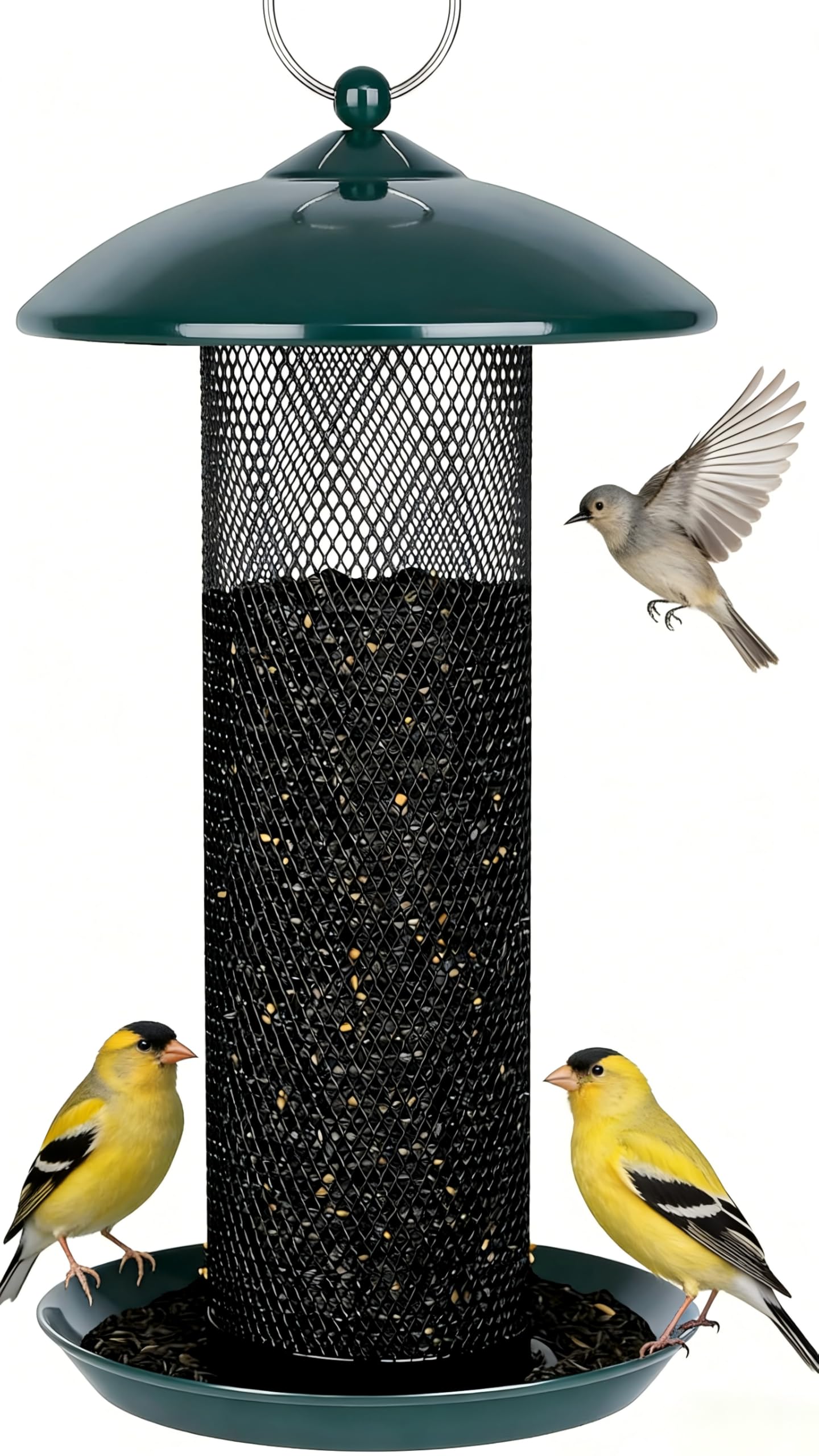
The 0.24-inch mesh that is sized almost exactly for Nyjer and clinging finches.
Mesh openings of 0.24 inches are not an accident. That gap is narrow enough to hold Nyjer and thistle seed inside the tube while finches cling to the outside and pick. Goldfinches, house finches, and other small clinging birds take to it naturally because clinging is what they already do on a thistle head. The all-metal build runs through the mesh body, lid, and seed tray, so there is no plastic corner for a squirrel to work on.
The practical bits are well thought out. A 6-inch weather-resistant lid shields the seed, and a matching 6-inch round seed tray gives clinging birds a landing zone and catches what falls. Multiple drainage holes in the tray keep water moving instead of pooling. The wide opening and removable lid mean a refill takes no tools, and the tray detaches for cleaning. That is a genuine upgrade over mesh feeders where you are scraping out a fixed base.
The durability and value scores here are split, and the complaint that recurs is a tube that fails sooner than expected for some owners. Spill is the other thing: the mesh lets seed fines through, and the ground under it shows it. Compare the size side by side and the Gtongoko sits at 6 by 6 by 13 inches against the Woodlink’s 3.5 by 3.5 by 13 inches — a substantially bigger footprint in the same hanging tube shape.
What makes it a Nyjer feeder
- 0.24-inch mesh keeps thistle seed in and lets finches cling and feed
- Removable lid and detachable tray make cleaning a no-tool job
- 2.5-pound capacity cuts refill frequency through the season
- Drainage holes and a 6-inch lid keep seed dry in rain
What to weigh up
- Spill under the tube is a recurring note — expect seed on the ground
- Some units wear out faster than the metal body suggests
Your feeder if: you are running a dedicated Nyjer setup and want the seed to stay in the tube.
Keep looking if: spilled seed under the feeder would bother you or a neighbor.
5. iBorn 15 Inch Nyjer/Thistle Tube Feeder with 12 Small Ports and 8 Metal Perches, Yellow
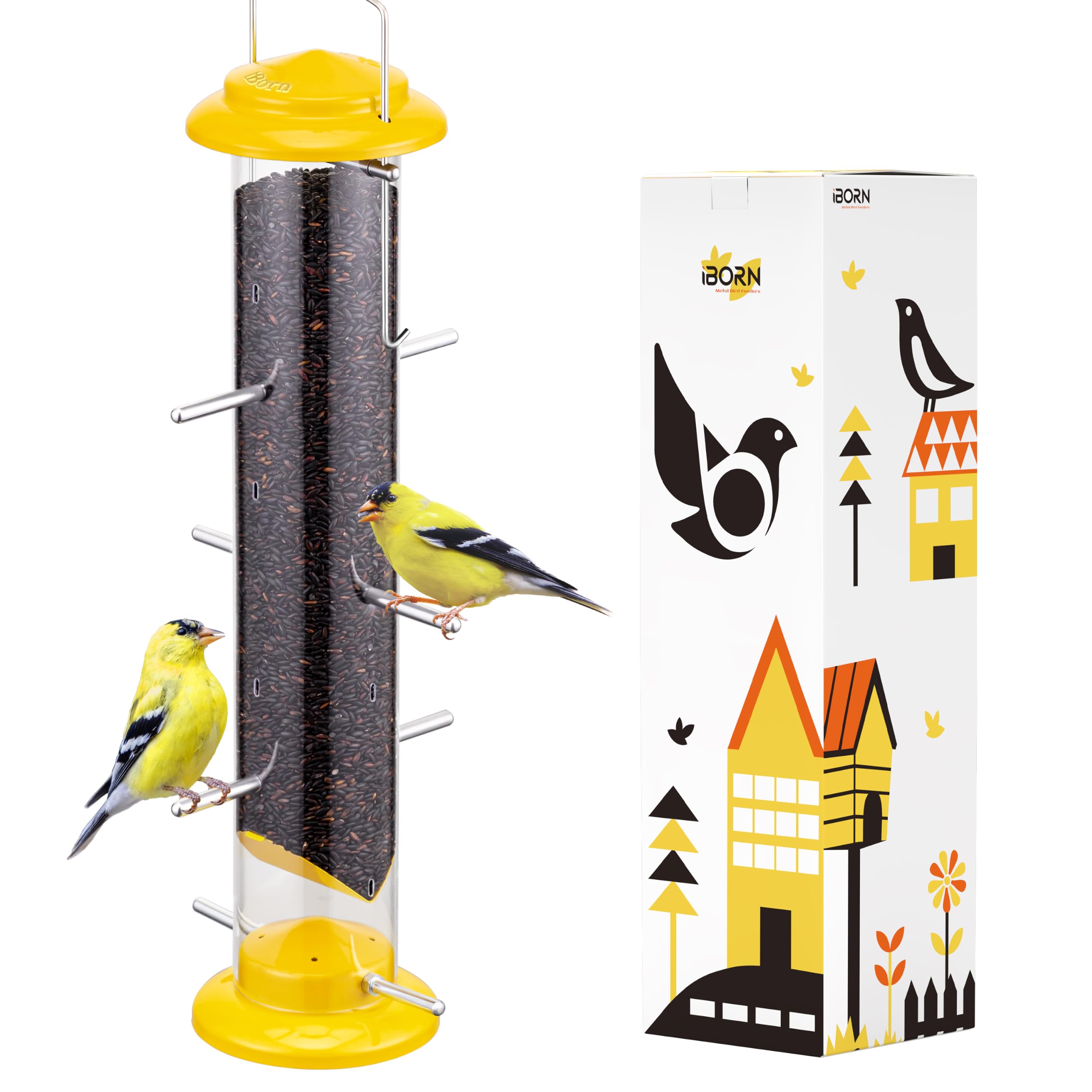
Twelve ports and eight perches turn one hanging spot into a full feeding station.
Twelve small ports and eight metal perches is a lot of landing space in a 15-inch tube. Goldfinches, finches, chickadees, redpolls, and siskins can all feed at once instead of jockeying for one perch. That is the core value of this feeder: it converts a single hook into something closer to a station. The all-metal top, base, ports, and perches carry a yellow finish that stays put through the year.
The hanging hardware is where this one differs from most. A reinforced metal hook closure means the feeder does not swing in wind the way a string-hung tube does. Four drainage ports at the base move water out, and a V-shaped spacer inside stops seed from building up and rotting at the bottom.
Now the honest limit. The holes are small, and that is a recurring frustration for buyers who find refilling fiddly or who wanted a bigger bird to feed. For a finch-only station, that is a feature. Cleaning regularly is genuinely required here, because a 12-port tube collects a lot of traffic and seed debris. Quality is what buyers talk about most in a good way — the metal build is the reason this one holds its score after heavy use.
The case for twelve ports: a small flock feeds without conflict, and the fixed hook keeps the whole station steady in wind.
The friction: those small openings are fiddly at refill time, and the tube rewards a regular cleaning habit.
Suits you if: you want one hanging spot that keeps a busy goldfinch flock fed at once.
Think twice if: you dislike small openings or want a feeder you can clean rarely.
6. Kingsyard Metal Finch Feeder for Outdoors Hanging, Yellow
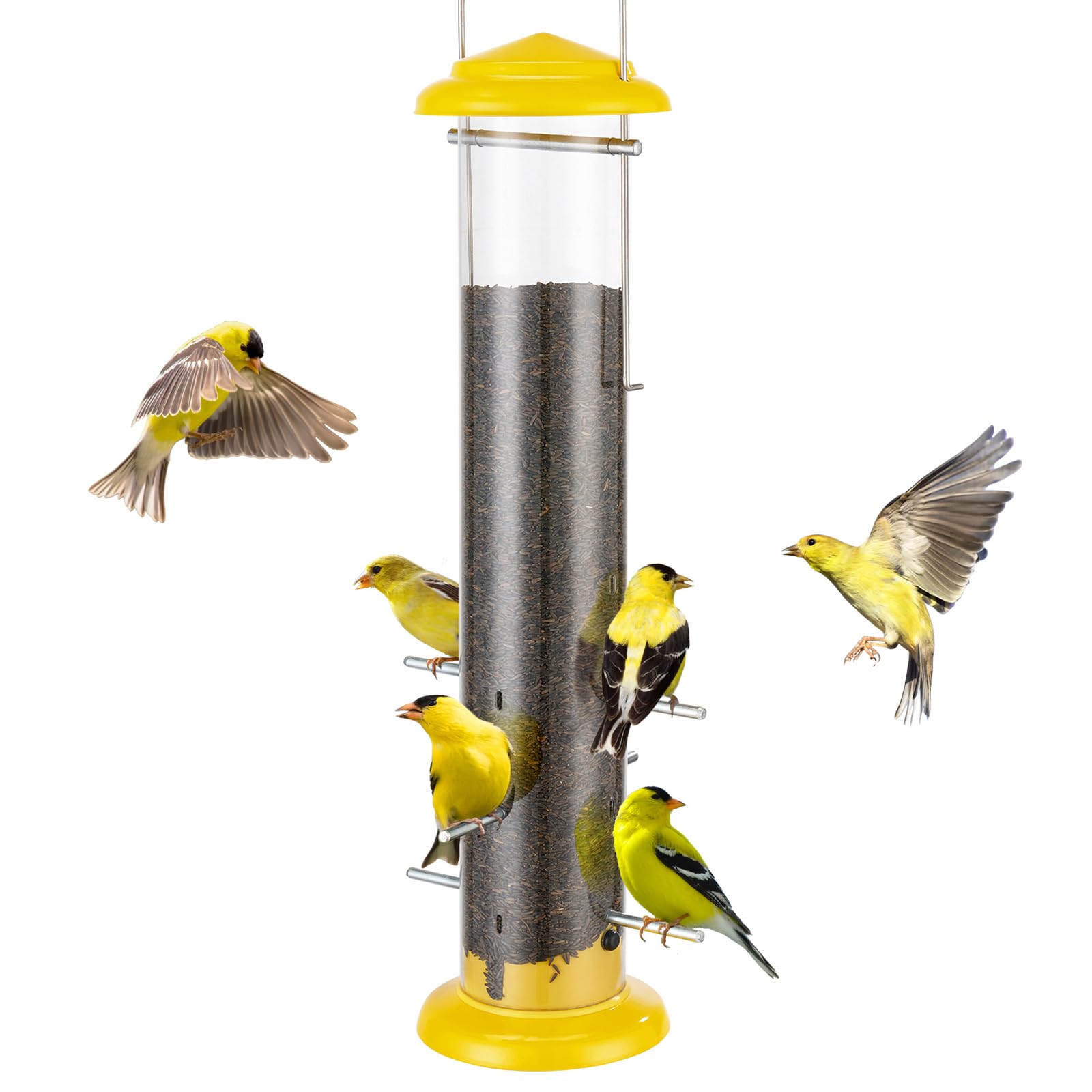
A 1.5-inch perch tube built to keep rain out of the seed, not just the seed in.
Rain is the quiet killer of Nyjer feeders. Seed that gets wet clumps, molds, and stops flowing. This Kingsyard tube attacks that directly: the enclosed seed compartment and narrow feeding ports are shaped to stop rainwater entering, and drainage holes in the base clear whatever gets past. Combined with a 2-pound seed capacity, that means the seed in the tube stays usable rather than turning into a damp plug.
The small-bird filtering is the same 1.5-inch perch approach used elsewhere on this list, and it does the same job — goldfinches, siskins, juncos, sparrows, and house finches fit, mourning doves do not. Six ports keep a small group feeding together. The lid lifts off for refills, and a quick-release button drops the base for cleaning, so the maintenance routine is a button press rather than a screwdriver hunt. Powder-coated metal resists rust through winter.
Where this one differs from the TrampgiK is the metal-and-plastic build rather than all-metal, so the plastic components are the part to keep an eye on over years. Finch attraction is strong and functionality in winter weather is a highlight. Pick this if rain more than squirrels is your problem.
Rain-first design: narrowed ports and base drainage keep Nyjer flowing instead of clumping after a wet week.
Know the build: a mix of metal and plastic, so the plastic parts are what you watch over time.
Best for: damp climates where wet, clumped seed is the recurring headache.
Not your pick if: you want an all-metal body and nothing else.
7. SEWANTA Squirrel Resistant Caged Bird Feeder, 22 oz with 4 Perches
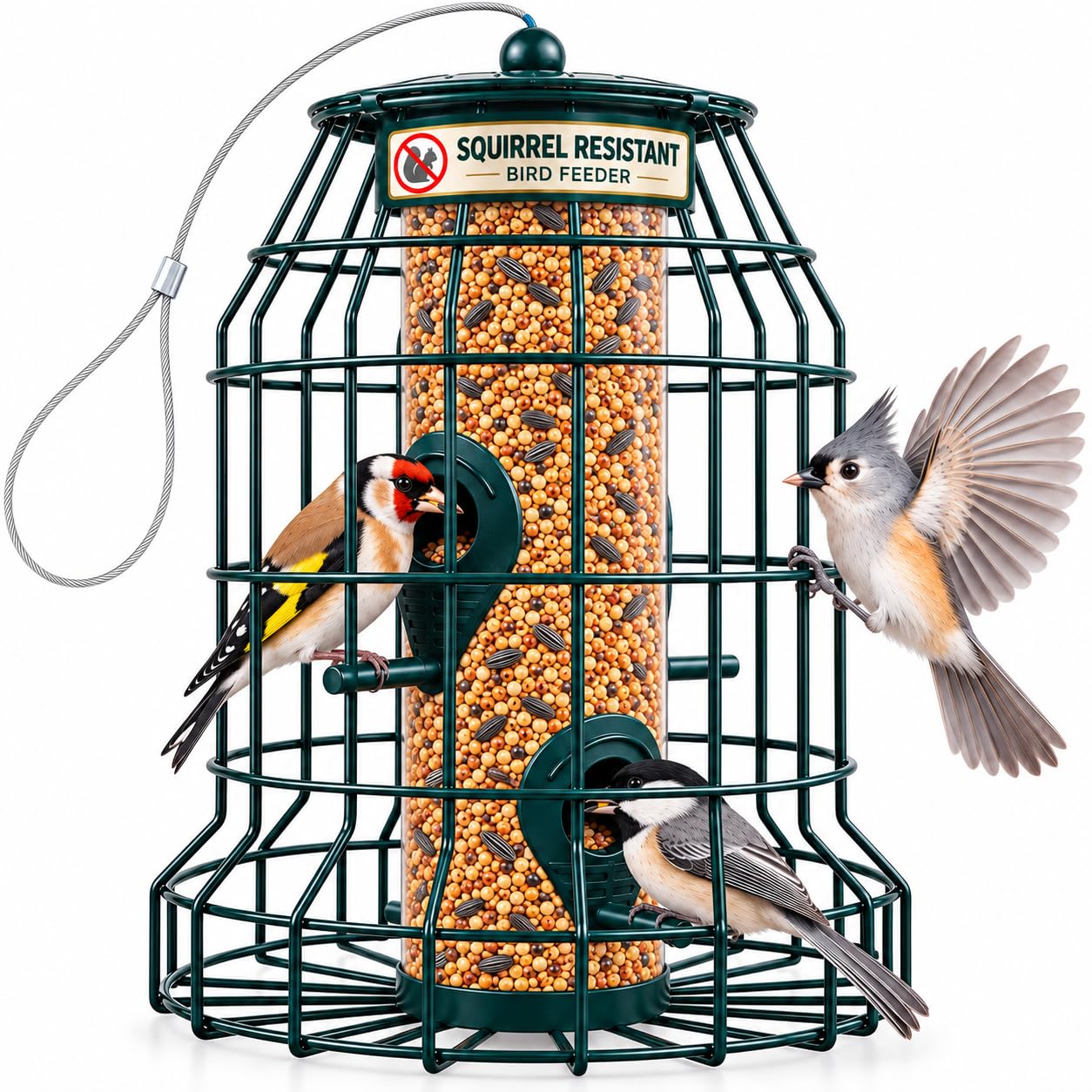
Cage bars wide enough for a chickadee and too narrow for a squirrel to squeeze through.
The gap between cage bars is the whole design here. It is sized so tiny birds slip in comfortably and a squirrel cannot pass — a physical barrier rather than a spring-loaded trick. Four feeding ports sit on multiple levels around the tube so birds can reach seed from all angles, which suits goldfinches, sparrows, and chickadees. The steel body carries a green rustproof plastic coating, and the lid screws down into a locking seal that also keeps rain out.
A 22-ounce tube with a wide mouth makes filling fast, and the transparent hopper shows you the level without opening anything. It handles a range of feed — sunflower seeds, milo, peanuts, and mealworms — so it is not locked to Nyjer the way a fine mesh tube is. Hanging is by a wire loop at the top, and the whole thing requires no tools.
Two things to size up honestly. The cage does slow larger birds, but squirrel resistance is genuinely a mixed record, so a determined squirrel still finds a way. The tube is also smaller than some buyers picture, and the lid mechanism needs a gentle hand. For a yard where small birds are getting bullied off an open feeder, this cage is the practical answer.
Why the cage works
- Bar spacing lets tiny birds in and keeps squirrels out physically
- Four ports on multiple levels mean birds feed from every angle
- Locking screw lid seals out rain and keeps feed dry
- Works with sunflower, milo, peanuts, and mealworms, not just Nyjer
What to expect
- Squirrel resistance is partial — some still get through
- 22 ounces runs out faster than a big 2.5-pound tube
- The lid thread rewards a light touch rather than force
Buy this when: bigger birds and squirrels have taken over your current hanging feeder.
Skip it when: you want a big hopper for a heavy goldfinch flock — the 22-ounce tube is modest.
8. Kingsyard Tube Squirrel Proof Caged Bird Feeder, Metal, Green

A 1.5-inch mesh cage under a wide metal roof that keeps the seed dry and the big birds out.
The cage is the story: a 1.5-inch by 1.5-inch mesh that goldfinches, chickadees, and house finches pass through with ease while pigeons and starlings cannot follow. That is a design that saves seed and keeps the small flock calm. Around the tube sits 4 feeding ports at 360 degrees, and the whole cage is rust-resistant metal rather than plastic or wood, so squirrel chewing meets steel instead of flaking apart.
The roof is what separates this from a bare cage. A wide protective metal lid shields the seed from rain and moisture, keeping food dry and cutting waste. Under the tube, an extended metal platform catches falling seed and gives birds extra perch space, which turns a spill problem into a feeding tray. Capacity is 1.5 pounds, enough for a mixed seed, sunflower, peanut, or mealworm fill.
Squirrel resistance is the number that gets discussed most, and it is a mixed verdict — the cage helps a great deal against pigeons and starlings, but squirrels are persistent. The cage mesh does block larger birds from the seed port entirely, which is a deliberate trade-off. In a yard where small birds are being crowded out, that trade is one most people are glad to make.
what separates it: seed stays dry in the rain, because a wide roof sits over a caged tube while the small birds keep feeding.
Fair warning: the 1.5-inch mesh shuts out bigger birds by design, and squirrels can still test the cage.
The right call for: an exposed yard where rain and pigeons both ruin a feeder.
Not the right call for: mixed-bird watchers who want cardinals at the same station.
9. Mosloly Upgraded Caged Bird Feeder with Adjustable Grille, 3 lbs Capacity, Deep Green

A sliding grille you can set to three gaps, so you choose exactly which birds get in.
Most cages lock you into one bar gap. This one slides. The grille has three positions: 1.12-inch gaps for small birds only, 1.35-inch spacing for cardinals and jays, and 1.58-inch openings for doves and woodpeckers. That is a genuinely different idea in a category where most feeders make you pick a gap and live with it. Set it to 1.12 inches and the listing says it blocks all squirrels and birds larger than sparrows.
You refill less often, because a 3-pound capacity is the biggest hopper on this list. That seed sits inside a crisp polycarbonate tube (a tough clear plastic), so you can check the seed level without lifting the lid. Birds get a secure landing zone from three extended aluminum perches. The steel cage is powder-coated (a baked-on protective finish) to shrug off chewing and weather. The twist-lock parts come apart without tools, so cleaning and refilling take minutes. UV-stabilized tubing (plastic treated against sunlight) keeps the clear tube from clouding in sun.
The trade-off is that adjustability cuts both ways. Push the grille wide and juvenile squirrels can find their way in, and some buyers find that larger birds still cannot reach the seed port even at a wider setting. Set it narrow and you have a strict small-bird feeder. That flexibility is worth the fiddling if you are tuning a mixed yard — just accept that one gap setting will not suit every bird all season.
Why it is different: a sliding grille with 1.12-inch, 1.35-inch, and 1.58-inch gaps lets you change the guest list without buying a new feeder.
The trade-off: wider settings let bigger birds in and can let a young squirrel through, so you are always balancing.
Made for: yards where the bird mix changes through the season and you want control over it.
Overkill if: you only ever want finches — a fixed narrow-gap cage does the same job with less adjusting.
Understanding the Specs
Port Size and Perch Length
A perch is the bar a bird stands on while it feeds, and its length sets who can balance there. A 1.5-inch perch is right for a goldfinch or a chickadee and awkward for a dove. The feeding port is the opening the bird reaches through, and narrow ports on a rain-proof design also stop water getting in. When you see a perch length and a port count in a listing, those two numbers tell you roughly which birds a feeder is built for.
Mesh Gaps, Capacity, and Drainage
Mesh openings are measured across the gap in the metal screen — 0.24 inches is a size that holds Nyjer seed in while a finch clings outside and picks. Caged feeders use a bar or mesh gap around a seed tube instead, and that gap sets the size of bird that can slip through. Capacity in pounds tells you how long seed lasts between refills. Drainage holes matter as much: they let water escape the base so seed does not sit wet and spoil.
FAQ
What size perch keeps larger birds off a finch feeder?
Will a mesh tube feeder work with sunflower seeds?
How often do I need to refill a small-bird feeder?
Is any of these feeders truly squirrel-proof?
Do I need to clean a Nyjer feeder regularly?
Can I hang this feeder on a balcony or a pole?
What is the difference between a mesh tube and a caged feeder?
Will seed get wet in the rain and spoil?
Can I change the grille on a caged feeder to let cardinals in?
Do these feeders arrive assembled?
Final Thoughts: The Verdict
For most yards, the feeder to start with is the Woodlink NAWLNT Audubon Finch Screen Tube, because it hangs with no assembly, holds a pound of thistle, and its die-cast aluminum body does not rust away — and it carries the highest rating climb of any metal tube here at 4.0+ stars. If you want a bigger hopper and a perch that wraps all the way around, the Meleave 2.5-pound Nyjer feeder holds more seed and costs little more. And when squirrels and starlings are the real problem, the SEWANTA caged feeder builds a physical barricade around the seed while still letting the small birds in.
One nudge worth acting on: the Woodlink sits at 4.0+ stars and the Meleave is close behind, so the deciding factor is really your squirrel pressure and seed choice, not the star count. Start with the feeder that matches your yard, not the loudest badge on the box.
How We Picked
We do not accept paid placement. Every pick is matched to a real buyer and a real use-case; we do not hands-on test units.
Sources & Methodology
Specifications: manufacturer listings and product documentation. Review insights: verified customer reviews, as of November 2026. Pricing: not shown on this page (it changes often); check the current price via the retailer link.
As an Amazon Associate, Gadgets Feed earns from qualifying purchases. This does not affect which products we feature.