
A pair of binoculars that fails to deliver crisp, bright images in low light or won’t track a moving bird smoothly can turn a morning of birdwatching into a frustrating squint-fest. The problem often isn’t price—it’s picking the wrong optical formula for the terrain you’re watching.
I’m Min — the co-founder and writer behind Gadgets Feed. I spend hundreds of hours every quarter cross-referencing lens coatings, prism types, and exit-pupil calculations against real user feedback to separate genuine optical value from marketing hype.
This guide dissects magnification power, objective lens diameter, glass quality, and weather sealing across the market to help you find a pair that fits your specific birding style. Let’s lock onto the best bird watching binoculars that actually deserve a spot in your pack.
How To Choose The Best Bird Watching Binoculars
Selecting the right pair for birding comes down to a balance between magnification, objective lens size, and the optical quality of the glass inside. Too much magnification, and you introduce shake; too small an objective, and the image dims in twilight. Here’s what to prioritize.
Magnification and Objective Lens: The 8×42 Sweet Spot
The most versatile birding format is 8×42. The 8x magnification provides a stable, wide field of view that makes tracking fast-moving warblers easy. The 42mm objective lens gathers enough light for sharp detail from dawn to dusk, keeping you in the field longer without needing a tripod. The 10×42 is excellent for open-field birding where extra reach matters, but handheld shake becomes more noticeable.
Optical Coatings: It’s What’s on the Glass That Counts
Fully multi-coated lenses apply anti-reflective layers to all air-to-glass surfaces, dramatically increasing light transmission. BaK-4 prisms, typically used in premium models, produce a round exit pupil and sharper edges than BK-7 prisms. Dielectric coatings on prisms push light reflection above 99%, giving you a noticeably brighter view in shadowed forest floors or overcast skies.
Build Durability: Waterproofing and Fog-proofing
Birding happens in rain, humidity, and sudden temperature shifts—look for nitrogen-purged or argon-purged binoculars with O-ring seals. These prevent internal fogging and keep moisture out, ensuring the optics stay clear when weather turns. Rubber armoring protects the chassis and provides a secure grip in wet hands.
Quick Comparison
On smaller screens, swipe sideways to see the full table.
| Model | Category | Best For | Key Spec | Amazon |
|---|---|---|---|---|
| Nikon MONARCH 7 8×42 | Premium Roof Prism | Wide-FOV birding with low-light advantage | ED Glass + Dielectric Coating | Amazon |
| Athlon Optics Midas UHD 8×42 | Premium ED Glass | Color-accurate viewing, mid-range price | ED Glass + Argon Purged | Amazon |
| Bushnell H2O Xtreme 10×42 | Waterproof Roof Prism | All-weather performance in wet environments | Fully Multi-Coated + BaK-4 Prisms | Amazon |
| GLLYSION 12×50 HD | High Magnification | Long-distance stargazing and open-field scanning | 12x Magnification + Phone Adapter | Amazon |
| Nikon TRAVELITE EX 8×25 | Compact Porro Prism | Ultra-light packing for hikes and travel | Multilayer Coated + Waterproof | Amazon |
| Vortex Triumph HD 10×28 | Compact HD | Backyard viewing and casual use on a budget | HD Optics + VIP Warranty | Amazon |
In‑Depth Reviews
1. Nikon 7548 MONARCH 7 8×42

The Nikon MONARCH 7 8×42 delivers an exceptionally wide 420-foot field of view at 1,000 yards, making it one of the easiest binoculars to track birds through dense foliage. Extra-low dispersion (ED) glass paired with dielectric high-reflective multilayer prism coatings produces high-contrast images with minimal chromatic aberration, even in harsh side-lighting conditions.
With 5.25mm of exit pupil, the MONARCH 7 excels in dawn and dusk scenarios where bird activity peaks. The rubber-armored magnesium body keeps weight manageable, and the 17.1mm eye relief ensures full-frame visibility for eyeglass wearers. The focus knob is smooth and precise, allowing quick adjustments as birds move between branches.
Some users report a “rolling ball” effect when panning quickly, but the sheer optical clarity and generous field of view make this a favorite among serious birders who need to cover territory rapidly. At this performance level, the close focus of roughly 8 feet is a welcome bonus for studying roosting birds or insects in the understory.
Why it’s great
- Wide 420-foot FOV improves fast bird tracking
- ED glass and dielectric coatings provide exceptional low-light brightness
- Magnesium chassis keeps weight low for extended use
Good to know
- Rolling ball effect can be disorienting during rapid panning
- Stock eyepiece cap and case feel less premium than the optics deserve
2. Athlon Optics 8×42 Midas UHD

The Athlon Midas UHD 8×42 brings Extra-low Dispersion (ED) glass to a mid-range price point, effectively eliminating chromatic fringing for razor-sharp images across the entire field of view. The ESP dielectric coating reflects over 99% of light, delivering a view that rivals optics priced two to three times higher. Color reproduction is neutral and punchy, essential for identifying subtle plumage differences.
Argon purging provides better thermal stability than nitrogen, preventing internal fogging in rapid temperature changes common in early-morning birding. The 8.1-degree angular field of view is generous, and the 17.2mm eye relief accommodates glasses easily. The magnesium housing feels solid without being heavy.
At roughly 25 ounces, this is not a featherweight pair, but the optical performance per dollar is hard to beat. The included soft case is serviceable, and the focus wheel has a smooth, damped action that holds position without drifting. For users who want near-alpha-level sharpness without breaking the bank, the Midas UHD is a standout choice.
Why it’s great
- ED glass virtually eliminates chromatic aberration for crisp feather detail
- Dielectric prism coating yields bright, true-to-life colors
- Argon purged for superior fog-proofing in temperature swings
Good to know
- Weight can cause hand fatigue during extended standing sessions
- Accessories are functional but not premium-grade
3. Bushnell H2O Xtreme 10×42

Bushnell’s H2O Xtreme 10×42 is built for the worst weather your birding trip can throw at it. The IPX7 rating means it can withstand submersion in water up to 1 meter for 30 minutes, and the O-ring-sealed, nitrogen-purged housing guarantees zero fogging in humid coastal marshes or rainy woodlands. The fully multi-coated lenses and BaK-4 prisms produce a bright, clear image with good contrast.
With 10x magnification, this pair is suited for open environments like lakeshores or fields where birds are 100 to 300 yards away. The 17mm eye relief is comfortable for glasses, and the rugged rubber grip remains secure even when wet. The central focus knob is fast and precise, important for locking onto a moving heron or hawk.
One critical detail: this specific model lacks a tripod adapter socket, so if you plan to stabilize for long scan sessions, look elsewhere. At roughly 25 ounces, it’s slightly heavier than compact travel bins but feels substantial for its price class. The included case and tethered lens covers are basic but durable.
Why it’s great
- IPX7 waterproof rating handles full submersion and heavy rain
- Fully multi-coated lenses and BaK-4 prisms deliver bright, clear views
- Rubber armor provides a reliable wet-grip surface
Good to know
- No tripod adapter socket for stable long-range scanning
- Weight is manageable but not the lightest in this category
4. GLLYSION 12×50 Professional HD

The GLLYSION 12×50 packs serious reach into a package that includes a universal phone adapter, making it a compelling set for birders who want to digiscope without buying extra gear. The 12x magnification combined with 50mm objectives provides a massive light-gathering ability, producing bright images even in heavy canopy or overcast conditions. The BaK-4 prisms are dielectric-coated to boost light reflection above 99%.
At 12x magnification, handheld shake is noticeable—this pair is best used with a tripod for steady viewing. The included phone adapter mounts most smartphone models and works well for capturing distant raptors or waterfowl. The IPX7 waterproofing and rubber-armored body provide reliable all-weather protection.
The field of view is narrower than an 8x or 10x model at 273 feet per 1,000 yards, so tracking a bird in motion requires more deliberate panning. For stationary birds at range or for stargazing between birding seasons, this set delivers excellent value with the added phone photography feature.
Why it’s great
- 12x magnification reaches distant birds other bins miss
- Included universal phone adapter enables instant digiscoping
- Dielectric-coated BaK-4 prisms keep the image bright at high power
Good to know
- 12x power introduces shake; a tripod is strongly recommended
- Narrower field of view makes tracking moving birds more challenging
5. Nikon TRAVELITE EX 8×25

The Nikon TRAVELITE EX 8×25 is the go-to option for birders who prioritize packability. The 8x magnification provides a stable image with a wide field of view, while the 25mm objectives keep the weight low enough for a jacket pocket. Nikon’s multilayer-coated optics deliver bright, sharp images, and the aspherical eyepiece lenses reduce distortion at the edges for a flatter viewing field.
Despite its small size, the TRAVELITE EX is built rugged with a die-cast aluminum body and protective rubber armor. It is nitrogen-purged and O-ring sealed, making it waterproof up to 2 meters for 5 minutes and fully fog-proof. The high-eyepoint design and turn-and-slide eyecups are comfortable for eyeglass wearers.
Performance in very low light is naturally limited by the 25mm objective, but for daytime birding, forest canopy viewing, or travel use, these are exceptional. The 8×25 configuration is notably steadier than the 10×25 version, making it the better choice for extended handheld sessions. The included case is compact and protective.
Why it’s great
- Ultra-compact design fits easily in a pack or large pocket
- 8x magnification provides a steady, wide field of view
- Nitrogen purged and O-ring sealed for waterproof/fogproof performance
Good to know
- 25mm objective limits performance in dawn/dusk conditions
- Porro prism design is slightly more delicate than roof prism models
6. Vortex Triumph HD 10×28
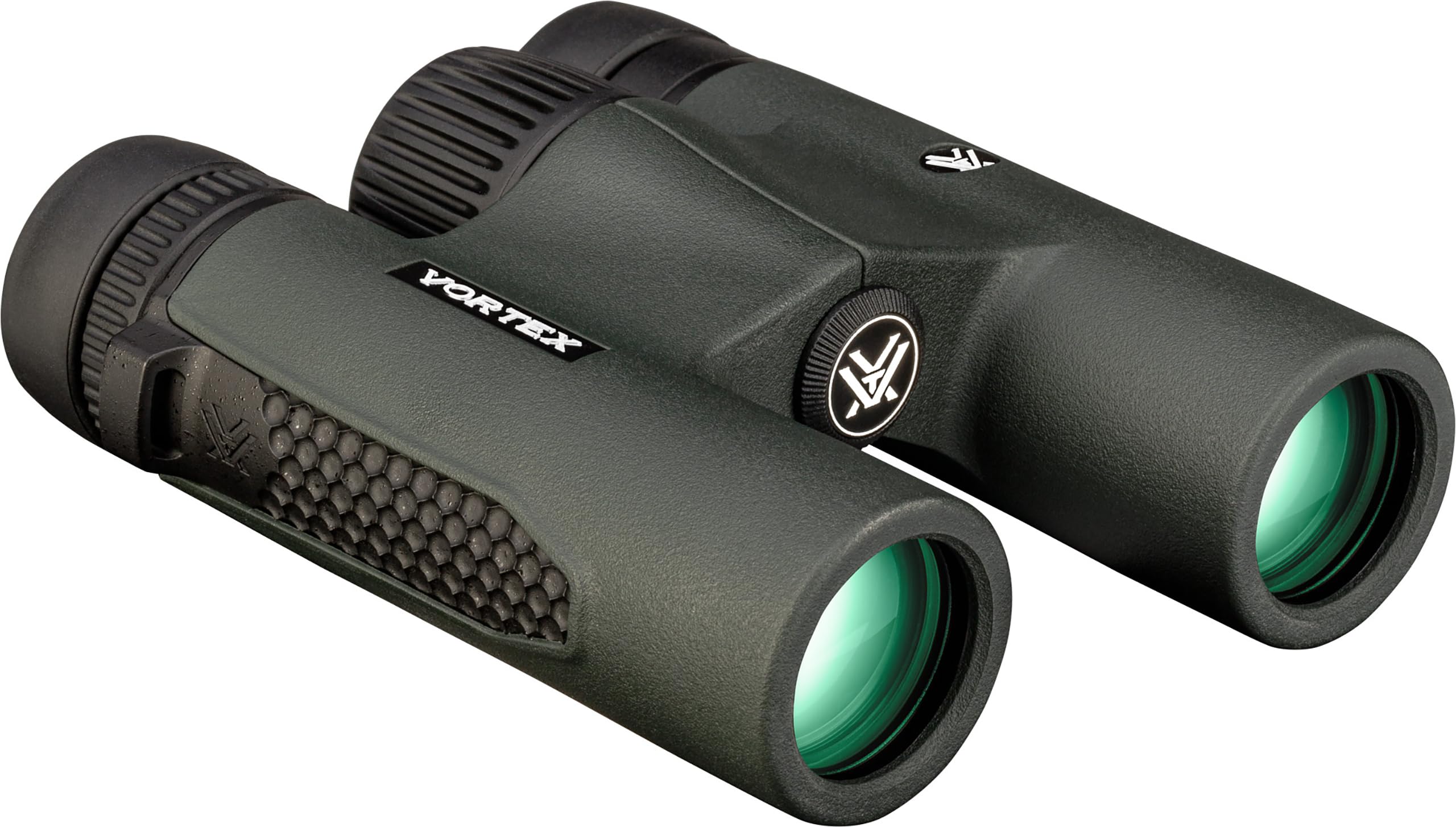
The Vortex Triumph HD 10×28 is an entry-level optic that punches above its weight class, especially for the backyard birder or casual trail user. The HD optical system uses optimized glass elements to cut chromatic aberration and improve resolution, and the fully multi-coated lenses boost light transmission for a bright image in its class. The 10x magnification gives good reach, though the 28mm objective limits low-light use.
What sets this model apart is Vortex’s VIP lifetime warranty—unlimited, unconditional, and fully transferable. If the binoculars break or become damaged, Vortex will repair or replace them, dramatically reducing long-term risk. The polycarbonate chassis is rubber-armored for shock resistance and provides a useful grip in damp conditions. It’s also tripod adaptable for stable long-range viewing.
The compact 5-inch length makes it easy to stow in a daypack, and the included deluxe carry case provides quick access. The 28mm objective prevents this from being a dawn-to-dusk performer, but for midday birding, hiking, or as a reliable backup pair, the Triumph HD and its unbeatable warranty are hard to beat.
Why it’s great
- VIP unlimited lifetime warranty provides peace of mind on a budget
- HD optics deliver better color fidelity than typical entry-level glass
- Compact and lightweight for easy daily carry
Good to know
- 28mm objective is best suited for bright-weather birding
- Higher shake at 10x requires steady hands or tripod support
7. SWAROVSKI OPTIK NL Pure 10×52

The SWAROVSKI OPTIK NL Pure 10×52 represents the pinnacle of production binocular engineering. The 52mm objective lenses paired with field flattener optics deliver a breathtakingly wide and edge-to-edge sharp field of view, with zero perceptible curvature. The SWAROVISION technology ensures color fidelity and contrast that reveal every feather texture, even in the dim light of dense forests or at dawn.
The ergonomic wasp-waist design allows the NL Pure to nestle into the hand in a way that feels almost intuitive, reducing fatigue during prolonged glassing sessions. The 5.2mm exit pupil provides an exceptionally forgiving viewing sweet spot, making it easy to acquire and hold a bird even with slight head movement. The chassis is tripod mountable for extended periods of scanning.
At this tier, every flaw is microscopic: the diopter does not lock, the objective caps can pop off on flat surfaces, and the FRP forehead rest is sold separately but transforms stability. For birders who demand absolute optical perfection and spend hours each day identifying species in challenging light, the NL Pure justifies its reputation as the benchmark.
Why it’s great
- Outstanding edge-to-edge sharpness with field flattener technology
- Exceptional twilight performance with 52mm objectives
- Ergonomic wasp-waist design reduces hand strain during long use
Good to know
- Diopter does not lock into position
- Forehead rest is required for peak stability but sold separately
FAQ
Is 8×42 or 10×42 better for bird watching?
What does “ED glass” mean in binoculars?
How do I choose the right eye relief for glasses?
What is the practical difference between BaK-4 and BK-7 prisms?
Do I need a tripod adapter for bird watching binoculars?
Final Thoughts: The Verdict
For most birders, the best bird watching binoculars overall is the Nikon MONARCH 7 8×42 because its combination of ED glass, dielectric prism coatings, and a class-leading 420-foot field of view delivers professional-grade performance at a price real enthusiasts can reach. If you want the best color fidelity and value, grab the Athlon Midas UHD 8×42. And for absolute optical perfection in the field, nothing beats the SWAROVSKI OPTIK NL Pure 10×52.