
Our readers keep the lights on and my morning glass full of iced black tea. As an Amazon Associate, I earn from qualifying purchases.
Specs are compiled from manufacturer listings and verified buyer reviews and can change over time — please confirm the key details on the product page before buying.
Spotting a rare warbler three hundred yards across a marsh isn’t about luck—it’s about matching the right magnification, lens size, and weather sealing to the way you actually bird. The best bird watching spotting scopes balance raw reach against portability and low-light brightness, and this guide cuts through the spec sheets to tell you which one earns its place in your pack.
I’m Min — the founder and writer behind Gadgets Feed. This guide is built by comparing the manufacturers’ published specifications and the patterns across verified customer reviews, so you get each pick’s real strengths and trade-offs instead of marketing spin.
You will learn what magnification range suits marsh and forest birding, why the objective lens diameter controls your dawn-and-dusk visibility, and which of these bird watching spotting scopes owners actually trust for identifying distant species.
Our Picks at a Glance


How To Choose The Best Bird Watching Spotting Scopes
Birding places unique demands on a scope: you need enough magnification to identify a distant shorebird, enough light gathering to see it at dawn, and a body tough enough for a damp trail. Start by thinking about the environments you bird in most, then let the specs follow your routine.
Match magnification to your terrain
A 20-60x zoom range covers most birding needs—it gives you a wide view to find a bird and then the power to zoom in for feather details. Past 60x, the image often shakes on a lightweight tripod and atmospheric haze softens fine detail, so high zoom numbers alone don’t guarantee a usable view.
Let the objective lens size set your brightness
The objective lens—the big glass at the front—collects light, and larger diameters like 80mm or 85mm give you a brighter image in the dim light of early morning. If you only bird in open daylight, a smaller 70mm aperture saves weight without a big penalty, but twilight birders should favor the bigger glass.
Decide between angled and straight eyepieces
Angled eyepieces let you look down into the scope while it sits low on a tripod, which is kinder on your neck during long sessions and easier when sharing a scope with taller companions. Straight eyepieces feel more intuitive for quick target acquisition, but they force you to crouch or raise the tripod to eye level.
Quick Comparison
| Model | Best For | Magnification | Objective Lens | Weatherproofing | Amazon |
|---|---|---|---|---|---|
| Athlon Talos 20-60×80★ Best Overall | Best Overall Value | 20-60x | 80mm | Waterproof | Amazon |
| Barska Benchmark 25-125×88High Zoom Range | High Zoom Range | 25-125x | 88mm | Waterproof | Amazon |
| Celestron C70 Mini MakBudget Compact Pick | Budget Compact Pick | 25-75x | 70mm | Fogproof | Amazon |
| WOZEL 25-75×80 | Complete Kit | 25-75x | 80mm | Waterproof | Amazon |
| GOSKY 20-60×80 HD | Digiscoping | 20-60x | 80mm | Waterproof | Amazon |
| Bushnell Trophy Xtreme | First Scope | 20-60x | 60mm | Waterproof | Amazon |
| Celestron C90 Mak | Day & Night Use | Varied | 90mm | Fogproof | Amazon |
| Athlon Argos HD 20-60×85 | Hunting/Birding Combo | 20-60x | 85mm | Argon Purged | Amazon |
| Vortex Diamondback HD 20-60×85 | Premium Build | 20-60x | 85mm | Argon Purged | Amazon |
| Nikon Prostaff 5 82mm | Optical Fidelity | 20-60x | 82mm | Waterproof | Amazon |
| Vortex Viper HD 20-60×85 | Top Performer | 20-60x | 85mm | Argon Purged | Amazon |
In‑Depth Reviews
1. Athlon Optics Talos 20-60×80 Spotter Scope
Our pick — over 4.5★ from 500+ verified ratings; the strongest balance of quality and price.
The 80mm scope that reads distant signs and.22-caliber holes without a premium price tag.
You get the clearest views for the money with the Athlon Talos, thanks to its 80mm objective lens (the front lens that gathers light) and 20-60x magnification range—enough reach to scan a treeline without dragging you down. The aluminum body keeps it light enough to sling over your shoulder for a morning hike, and the price leaves room for a better tripod.
Owners consistently report sharp views at 300+ yards and crisp detail out to 200 yards, with one buyer summing up the reach: “Sees.17HMR hits at 100yds,.22-250 at 200yds, bolts at 1/4 mile.” The fully multi-coated lenses (layers that reduce glare and boost brightness) make this possible. Nitrogen purging—an inert gas that forces moisture out of the tube—keeps fog and water out even in a sudden downpour. The included tabletop tripod is the weak link; several owners found it too short for standing use and swapped in a full-size camera tripod.
As a pure birding tool, the 1.57-degree field of view is wide enough to track a moving bird, though the image does soften past 40x. That is a fair trade for a scope this affordable. Across the hundreds of owners who have rated it, the overwhelming consensus is that it outperforms pricier rivals for both target work and general wildlife watching.
What wins people over
- crisp views of distant targets—one owner read signs at a half-mile on 60x magnification
- Sturdy, lightweight aluminum construction that shrugs off years of drops
- Fully multi-coated lenses deliver bright images even in flat light
Where it asks a compromise
- Included tripod is too short for comfortable standing use—plan on a camera tripod
- Image clarity drops above 40x magnification
- Short eye relief means glasses wearers must press in closer
Reach for it if: you want a first serious scope that handles both birding and range days while staying affordable.
Look elsewhere if: you bird exclusively from a standing position and refuse to buy a separate tripod—the bundled one will frustrate you.
2. Barska Benchmark Waterproof Straight Spotting Scope
An 88mm scope with a 25-125x zoom range that rewards patient, well-supported viewing.
The Barska Benchmark is the scope for anyone who wants the most magnification and the biggest objective lens for the money. Its 88mm objective lens is a full 26% larger than the Celestron C70’s 70mm glass, which means noticeably more light hitting your eye in the gray hour before sunrise. The 25-125x zoom range is the widest on this list, and the rubber armor exterior seals it against water, fog, and the occasional knock against a tree trunk.
Buyers report that the view is genuinely clear from 25x to 50x at distances up to 75 yards, with one buyer noting it “sees moss/humans/bears ~2 miles” in good light. But there is an honest catch: at 125x, the image darkens and softens to the point of being nearly unusable, and the high magnification demands a rock-steady tripod. The bundled tabletop tripod is on the flimsy side and slightly short for prone shooting, so a quality camera tripod dramatically improves the experience.
This is a scope with a specific personality: it rewards the patient observer who stays at moderate magnification and punishes anyone expecting crisp 125x views. For the price, the huge light-gathering lens and included hard case make it a compelling pick for open-water scanning where you need maximum reach to spot distant birds before zooming in at a more sensible power.
Why it stands out
- 88mm objective lens gathers exceptional light for dim conditions
- Wide 25-125x zoom range gives extreme flexibility
- Hard and soft carrying cases protect the glass in transit
Know before you buy
- Sharpness fades badly past 75x magnification
- Front focus ring is stiff and fiddly to adjust
- Head-heavy balance makes a solid tripod essential
Best when paired with: a sturdy full-size tripod and realistic expectations that the balance sits between 25x and 50x—beyond that, image quality drops off.
It’s not the one if: you need crisp high-power detail for identifying distant shorebirds at 100x-plus—this glass can’t hold that.
3. Celestron C70 Mini Maksutov Spotting Scope
A 2-pound Maksutov-Cassegrain that slips into a daypack and still finds Saturn’s rings at night.
The C70 is proof that a spotting scope doesn’t need to be a back-breaking tube of glass. Weighing just 2 pounds and measuring 11 inches long, it is dramatically easier to carry than the larger 80mm and 90mm scopes on this list. Its 70mm aperture and 25-75x zoom make it a genuinely versatile tool, and the Maksutov-Cassegrain design—which folds the light path internally—is what lets it deliver 700mm of focal length in such a compact body.
Owners love its dual personality, calling it “rugged, attractive” and noting the “best celestial at 25x” when they turn it skyward after sunset. On the trail, it handles birding and nature observation with ease, and the included tabletop tripod has slow-motion controls for fine adjustments. The honest trade-offs: the plastic tripod can be shaky at high magnification, and the focusing mechanism draws mixed feedback—some find it easy, others call it imprecise. Several owners recommend pairing it with a full-size camera tripod for serious sessions.
If you want a scope that vanishes into your pack until you need it, the Celestron C70 is the one—it weighs just 2 pounds. Its 25-75x zoom gives you more reach than the Athlon Talos’s 20-60x range, so you can spot distant birds without hauling a heavy tube.
The hiking-friendly verdict: the C70 trades a little tripod stability and low-light brightness for a portability that no 80mm scope can match, making it ideal for trail birding where every ounce counts.
Where it fits: it shines for casual birders and hikers who want one optic for both daytime wildlife and night-sky curiosity—just budget for a sturdier tripod if you plan to push past 40x.
4. WOZEL 25-75×80 Spotting Scope
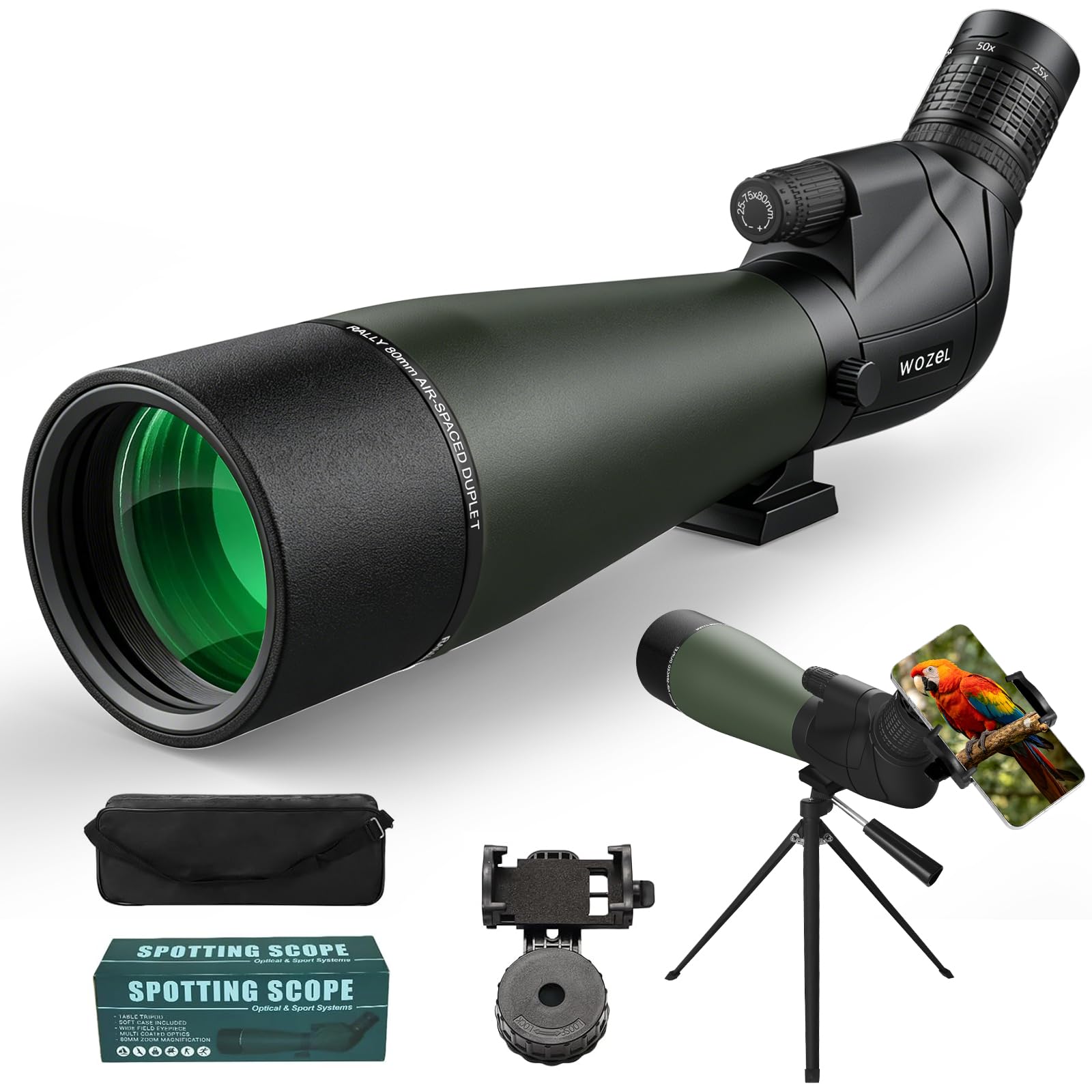
A complete kit pairing 80mm light-gathering with a phone adapter for instant digiscoping.
The WOZEL 25-75×80 is the scope for the birder who wants everything in the box before the first trip out. Beyond the 25-75x zoom and 80mm fully multi-coated green-film objective lens, you get a tripod, a phone adapter, lens covers, a cleaning cloth, and a large carrying case that fits it all. The BAK4 prism (a high-quality glass prism that transmits more light than basic BK-7) sharpens the image edge-to-edge, and the retractable sunshade cuts glare on bright marsh days.
Owners consistently call the clarity “crisp,” with one noting it captured a sharp photo of the moon across a lake and another praising its stability for spotting hits at 500 yards. The O-ring seals and nitrogen-filled housing make it fully waterproof and fogproof, so a sudden rain shower won’t end your session. The one recurring gripe is the phone holder—it works but allows the phone to shift slightly over time, so you’ll want to re-check your alignment before each shot.
Compared to the Athlon Talos, the WOZEL offers a wider 25-75x zoom range and a more complete accessory kit from the start. If you want to start digiscoping (taking photos through the eyepiece with your phone or camera) immediately, this saves you from buying adapters separately.
The kit’s strengths
- Everything included—tripod, phone adapter, bag, and cleaning kit
- Sharp, bright BAK4 prism images praised for clarity
- Waterproof, fogproof nitrogen-filled body for all-weather use
The kit’s quirks
- Phone holder lets the phone drift over time
- Tripod is adequate but not premium—worth an upgrade later
- Bulky when fully packed for a long hike
Grab it if: you want one box that starts both birding and phone photography immediately, without extra adapter purchases.
Think twice if: you’re a weight-conscious hiker—the full kit laughs at ultralight packing lists.
5. GOSKY 20-60×80 HD Spotting Scope

An angled 80mm that turns your smartphone or Nikon DSLR into a long-lens bird camera.
The GOSKY is built for the modern birder who wants proof of the sighting, not just a memory. Its 20-60×80 optics use a BAK4 Porro prism (a glass type that boosts brightness and sharpness) to deliver crisp images, and the real standout is the accessory bundle: a phone digiscoping adapter, a T-ring and M42 T mount for Nikon cameras, a tripod, a carry case, and lens caps. You can mount your phone for a quick record shot or attach a DSLR for a serious telephoto photo of a distant raptor.
Owners describe the view as “crisp,” with one capturing the Jupiter-Saturn conjunction and another identifying bird feeder seeds at 25 feet. The 60x top magnification requires a steady tripod—the included one is acceptable but basic—and the angled eyepiece takes a moment to learn but is far more comfortable for long sessions. The Nikon adapter works but draws some grumbling for being fiddly to attach, and the lens caps have no tethers, so they’re easy to lose on the trail.
Where the GOSKY wins over the WOZEL is camera flexibility: it serves both smartphone and SLR shooters, while the WOZEL is phone-only. If digiscoping is your priority, that flexibility is worth the trade-off of a slightly tighter zoom range.
The photographer’s angle: the GOSKY’s dual phone-and-SLR mounting makes it the most camera-friendly scope here, letting you graduate from phone snaps to real telephoto shots without buying a new scope.
The honest caveat: both included camera mounts work, but owners warn the SLR adapter is fiddly—plan a practice session at home before your first field trip.
6. Bushnell Trophy Xtreme Spotting Scope

A 20-60x straight scope with a 3.1mm exit pupil for bright dawn views and intuitive aiming.
The Bushnell Trophy Xtreme is the classic “first scope” for the shooter-turned-birder, offering familiar straight-through viewing with a fully multi-coated optical path. Its 3.1mm exit pupil—the circle of light that reaches your eye—is the largest on this list, which translates directly to a brighter view in the low-light moments when birds are most active. Owners call the glass “excellent with exceptional clarity,” and it performs admirably at 600 yards.
The package includes a 1/4-inch-20 tripod mounting shoe, a tabletop tripod, and a window mount, so you can set up at a blind or lean out of a car. The hard case draws consistent praise as “really nice.” The trade-offs are typical of the price tier: the eye box is finicky (you need to position your eye precisely), and the clarity is good but not Leupold-grade, as one owner honestly noted. It’s a scope that rewards realistic expectations.
For the birder who also targets, or the beginner who wants a dependable, no-surprises optic, the Trophy Xtreme is a safe, proven choice that the review pages consistently describe as a reliable performer.
The starter’s verdict: this is the scope that teaches you what you need without punishing your wallet—the bright exit pupil and straight eyepiece make first-time aiming easy.
Set your expectations here: clarity is strong but not premium-tier, so don’t expect to resolve fine feather detail at extreme ranges.
7. Celestron C90 Maksutov Spotting Scope

A 90mm Maksutov that doubles as a telephoto lens and finds bears at two miles.
The Celestron C90 is the scope for the observer who wants one serious instrument that does double duty across day and night. Its 90mm aperture and 1250mm focal length make it the most powerful light-gatherer here, and the Maksutov-Cassegrain design keeps it far smaller than a comparable refractor. Owners have used it to spot grizzlies and cubs at two miles and wolves at one mile, and at night it resolves Jupiter’s bands and moons with surprising ease.
What makes the C90 special is its camera-readiness: it’s designed for photography, and with the correct optional T-adapter and T-ring, it becomes a fully functional telephoto lens for your DSLR. The package includes a 32mm eyepiece, a 45° erect-image diagonal, an 8×21 finderscope, and a nylon backpack for transport. The 9.7-degree field of view with the stock eyepiece is generous for finding targets.
The honest drawbacks: at 2.1 kg, it’s heavier than the smaller Celestron C70, and it demands a quality tripod to hold it steady. The stock eyepiece and finder draw mixed reviews, with several owners upgrading to a 24mm widefield for a better view. If you want a scope that transitions from dawn birding to dusk astronomy without compromise, the C90 delivers.
What the 90mm buys you
- Huge light-gathering power for both low-light birding and astronomy
- Fully camera-adaptable for telephoto photography
- Compact Maksutov design for the focal length
What it asks in return
- Heavier than smaller scopes—needs a sturdy tripod
- Stock eyepiece is underwhelming; owners recommend an upgrade
- Eyepieces lack protective caps
Choose it if: you want a single high-quality instrument for serious daytime birding and night-sky observing, and you already own or will buy a solid tripod.
skip it if: you need an ultralight pack scope—the C90’s weight and tripod demands suit stationary setups better than long hikes.
8. Athlon Optics Argos HD 20-60×85

An 85mm HD-glass scope with a 45° eyepiece that spares your neck during long glassing sessions.
The Argos HD is where Athlon’s mid-range line steps up with advanced HD glass—glass formulated to reduce color fringing and deliver true color—and a 45° angled eyepiece that changes how comfortable a long session can be. The angled design lets you look comfortably downward while the scope sits low on a tripod, a genuine relief for your neck during extended scans. Its 20-60x magnification and 85mm objective lens put it at the top of the mid-range tier for light gathering.
Owners are emphatic about the value: “At over 500yds can still clearly see.22cal holes in paper targets,” one wrote, and others note it rivals higher-priced competitors. The argon-purged, waterproof body shrugs off weather, and the rubber-armored exterior absorbs bumps. The rotating tripod ring lets you reposition the scope without loosening the mount.
The catch is weight—at 4.3 pounds, it’s one of the heaviest picks here, and one owner says it’s “VERY HEAVY” and needs a strong tripod to hold steady. Low-light performance is excellent in bright conditions but limited in dusk. Compared to the Vortex Diamondback HD, the Argos offers similar specs with a heavier body—but at a significantly friendlier price, making it the smart pick for hunters and birders who want HD quality without the flagship cost.
Why it’s a favorite
- HD glass delivers sharp, color-accurate images at long range
- 45° angled eyepiece with rotating ring for comfortable viewing angles
- Argon-purged and waterproof for all-weather reliability
The weight penalty
- 4.3 pounds—heavy enough to demand a sturdy tripod
- Low-light brightness fades at dusk past 40x magnification
- Focus is sensitive at 60x, needing a steady hand
Pick it for: extended hunting or birding sessions where neck comfort matters and you want HD glass quality without flagship prices.
It’s not for: backpackers counting ounces or anyone who expects twilight performance to match the afternoon view.
9. Vortex Diamondback HD 20-60×85 Angled

An 85mm angled scope with a helical focus wheel and Arca-Swiss mount that hunters and birders both trust.
The Vortex Diamondback HD is the scope for the enthusiast who wants proven optical performance wrapped in a streamlined, premium-feeling package. Its HD optical system cuts chromatic aberration (the purple fringing on high-contrast edges) and delivers edge-to-edge sharpness with outstanding color fidelity. The built-in helical focus wheel (a focus ring that turns around the body axis) allows fast, fine adjustments without hunting for a separate knob, and the built-in sunshade slashes glare while shielding the lens from drizzle and snow.
The specs read like a birding wish list: 20-60x magnification, an 85mm objective lens for low-light performance, adjustable twist-up eyecups for glasses wearers, and an exit pupil that keeps the view bright. The Arca-Swiss compatibility means it mounts directly to premium tripod heads without extra plates, and it also accepts standard 1/4-20 threads. It’s O-ring sealed and argon purged for waterproof, fogproof performance, and the Armortek coatings protect the glass from oil, scratches, and dirt.
Owners are split on one point: the image is “crisp across zoom” and can “clearly spot deer and elk 7 miles away,” but some report significant purple fringing and note it’s “not a K glass” at full magnification. At 3.8 pounds, it’s heavy and needs a strong tripod. The deciding factor is quality and value: this is a premium-tier scope at a mid-premium price, backed by Vortex’s unlimited, unconditional, lifetime VIP Warranty.
The premium perks
- HD optics with exceptional resolution and low chromatic aberration
- Arca-Swiss and 1/4-20 mounting for flexible tripod setups
- Unlimited, unconditional lifetime warranty
Before you commit
- Some owners mention purple fringing at full magnification
- Heavy at 3.8 pounds—a solid tripod is mandatory
- Field of view narrows more than expected at 60x
Invest in it if: you want a serious, durable birding scope with a premium feel and a warranty that follows you for life.
Reconsider if: your budget is tight or you plan to hike miles with it—this scope’s weight and price suit dedicated birding setups.
10. Nikon Prostaff 5 Proscope 82mm Angled
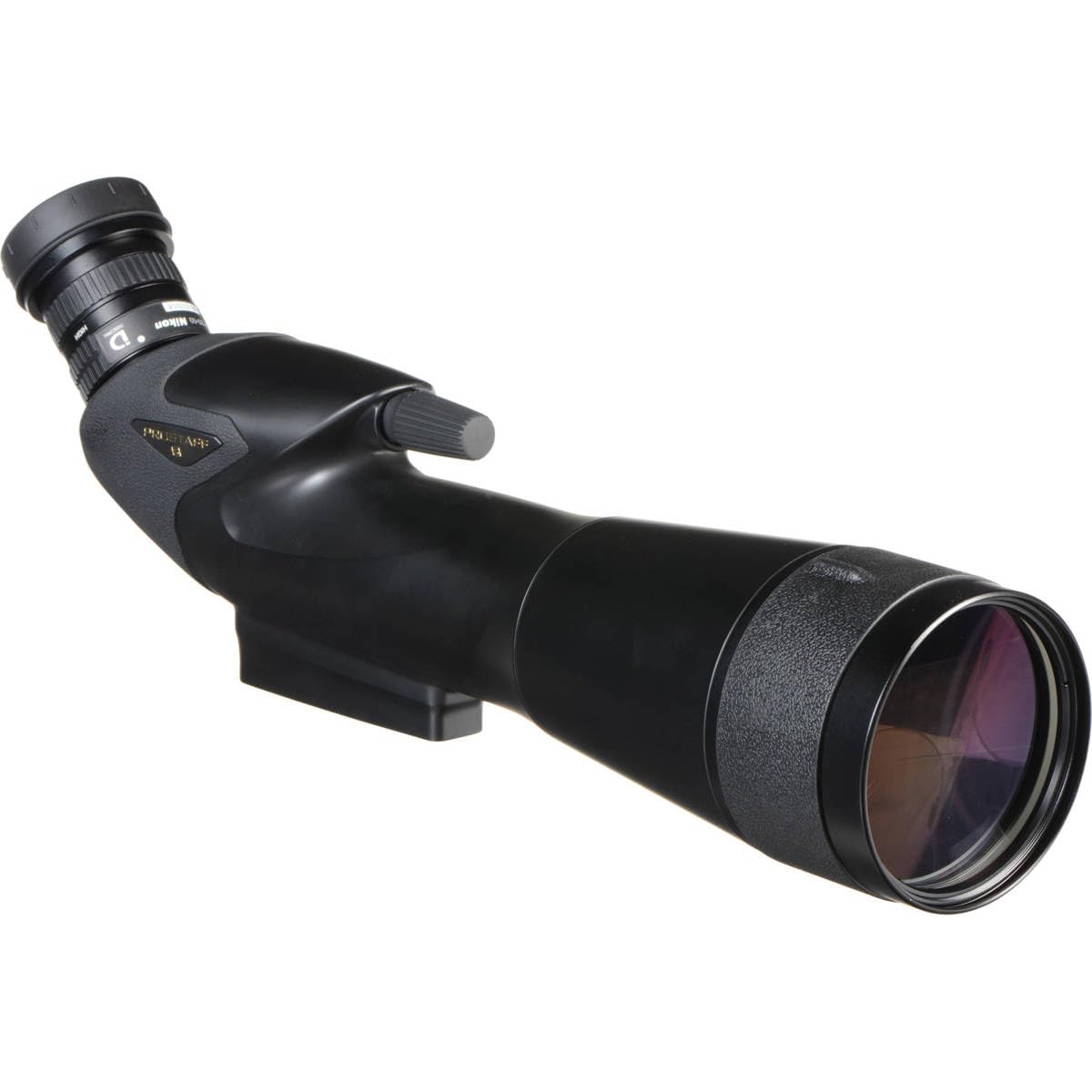
The 82mm angled scope that delivers Nikon’s famous contrast and color in a birding-oriented body.
The Nikon Prostaff 5 is the “glasses you can trust” of spotting scopes—it puts Nikon’s renowned optical engineering into a package designed specifically for birders. Its 82mm objective lens strikes what the maker calls an ideal balance of size and brightness, and the multicoated optics produce a bright, high-contrast image with true color rendition. The 20-60x zoom is smooth and adjustable, and the internal surface texturing minimizes reflective light loss inside the scope.
Owners consistently describe the view as “excellent optics with high contrast,” and one notes it “beats Bushnell HD, Celestron 20×60 80mm, C90 in clarity, power, edge sharpness, no fringing.” The built-in sliding sunshade eliminates glare and keeps dust and rain off the objective lens. It’s nitrogen-purged and O-ring sealed for waterproof, fogproof performance, and the ergonomic, lightweight Porro prism design makes it comfortable to handle.
The honest trade-offs: it’s “too long/heavy for birding” according to one owner, and the zoom loses focus requiring refocus after zooming—though that may be copy-specific. The objective cover is easy to lose, and one owner reported a waterproofing failure when the scope was floated, though Nikon’s warranty covered it with only shipping cost. At 4.7 stars from a smaller sample, it’s the highest-rated scope here, and it earns that score with genuine optical fidelity.
Why Nikon glass stands out
- Superior contrast, color, and edge sharpness with minimal fringing
- 82mm lens balances size and low-light brightness
- Sliding sunshade cuts glare and shields the lens
The small print
- Longer and heavier than ideal for hiking birders
- Zoom may require refocusing after adjustment
- Objective lens cover is easy to misplace
Choose it for: serious birders who prioritize image fidelity and contrast over portability and already have a stable tripod.
Look past it if: you need a compact scope for trail hiking or demand perfect zoom focus retention on every unit.
11. Vortex Viper HD Spotting Scope

The flagship 85mm angled scope with XR coatings and a 4.25mm exit pupil for low-light mastery.
The Vortex Viper HD is the scope you buy when you want the best image quality this category can deliver without stepping into the ultra-premium stratosphere. Its 4.25mm exit pupil (the circle of light your eye sees) is the largest here, and combined with the 85mm objective lens and XR anti-reflective coatings, it produces “extremely clear views” that let you see “for miles.” The HD optical system generates vivid, high-definition images, and the smooth helical focus dials in ultra-sharp focus while maintaining a trim profile for packability.
Owners are nearly unanimous in their praise: one called it “Best value scope; performance rivals 2x price,” while a Yellowstone visitor reported seeing 13 bears, 3 wolves, 2 eagles, and bull elk, with clear cell phone photos at 400 yards. The multi-position eyecup provides proper eye relief for glasses wearers, and the locking collar lets the scope rotate into different viewing positions. It’s O-ring sealed and argon purged for waterproof, fogproof performance, with Armortek coatings protecting the lenses.
The trade-offs are minimal but real: at 2.2 kg, it’s “a bit heavy” as the owners note, and the magnesium construction—while durable—contributes to that weight. The built-in sunshade pulls out to reduce glare on bright water. Where the Vortex Diamondback HD is the premium-value pick, the Viper HD is the outright performance pick for those who want the best view money can buy in the high-end tier.
The flagship edge
- Vivid HD images with exceptional low-light performance
- 4.25mm exit pupil among the brightest views available
- Unlimited lifetime VIP warranty with full transferability
The only compromises
- Noticeably heavy at 2.2 kg for extended carrying
- Premium price point suits dedicated enthusiasts
Step up for it if: you want the sharpest, brightest birding views in this lineup and are willing to carry a heavier scope and invest in top-tier glass.
It’s overkill if: you’re a casual birder or hiker—the Diamondback HD or Athlon Argos delivers most of the performance for less weight and cost.
Understanding the Specs
Magnification Range
The first number (like 20x) is your wide view for finding birds; the second (like 60x) is your close-up power for identifying feathers. Real-world usability caps around 60x on portable tripods—past that, the image shakes and haze softens detail.
Objective Lens Diameter
This is the front glass size (70mm, 80mm, 85mm, 88mm). Bigger means more light collected, so you see birds more clearly at dawn and dusk. It also means more weight, so balance brightness against how far you’ll carry it.
FAQ
What magnification is best for bird watching?
What does the objective lens size do for birding?
Should I choose an angled or straight spotting scope?
Can I take photos through a spotting scope?
What is the exit pupil and why does it matter?
Is a waterproof or fogproof scope necessary?
What is a BAK4 prism and is it better?
Do I need a separate tripod or is the included one fine?
What is digiscoping?
Final Thoughts: The Verdict
For most people, the bird watching spotting scopes winner is the Athlon Talos 20-60×80 because it delivers the best balance of crisp optics, a bright 80mm lens, and a budget-friendly price that leaves room for a better tripod. If you want maximum reach for open-water scanning, the Barska Benchmark brings an 88mm light cannon at a remarkable value. And for the hiker who needs a scope that disappears into a daypack, the Celestron C70 offers 25-75x reach at just 2 pounds—the crowd favorite for portability with over 700 owners rating it solidly.
How We Picked
We do not accept paid placement. Every pick is matched to a real buyer and a real use-case; we do not hands-on test units.
Sources & Methodology
Specifications: manufacturer listings and product documentation. Review insights: verified customer reviews, as of August 2026. Pricing: not shown on this page (it changes often); check the current price via the retailer link.
As an Amazon Associate, Gadgets Feed earns from qualifying purchases. This does not affect which products we feature.