
The difference between a smudge and a sharp feather edge at 500 yards comes down to the glass in your spotting scope. Birding at dawn or dusk demands high light transmission, true color fidelity, and a magnification range that brings distant warblers into clear view without washing out in low light. An entry-level scope with poor coatings will leave you guessing at every silhouette.
I’m Min — the co-founder and writer behind Gadgets Feed. I’ve spent hundreds of hours cross-referencing manufacturer spec sheets, decoding lens coatings, exit pupil math, and real-world field reviews to separate the true optical performers from the marketing noise in this specific category.
Whether you need maximum low-light performance for forest canopies or a lightweight kit for remote trails, finding the best birding spotting scopes means matching objective diameter, prism quality, and zoom range to your specific birding habitat.
How To Choose The Best Birding Spotting Scopes
Selecting a spotting scope for birding isn’t about picking the highest magnification number. Real-world performance depends on how much light the objective lens gathers, how well the prism transmits that light to your eye, and whether the zoom range stays sharp across the entire spectrum. The wrong choice means frustratingly dim images at dusk or chromatic aberration that turns white egrets into purple smudges.
Objective Lens Diameter: 65mm vs 80mm vs 85mm
The objective lens (the front glass) determines light-gathering capability. A larger diameter produces a brighter image, especially in low-light conditions like forest understory or early morning marshes. A 65mm scope is lighter and more packable for long hikes, but an 80mm or 85mm scope delivers significantly more detail at dawn and dusk. For dedicated birders who glass during prime low-light hours, 80mm is the practical minimum.
Glass Types: ED vs Standard Optical Glass
Extra-low Dispersion (ED) glass is the single most important upgrade for birding. ED glass reduces chromatic aberration — the purple or green fringing along high-contrast edges like a white bird against dark foliage. Standard glass will show color fringing, especially at higher magnifications. Fully multi-coated lenses (anti-reflective coatings on every air-to-glass surface) further boost light transmission and contrast, making feather detail pop even in overcast conditions.
Magnification Range: 20-60x in Practice
A 20-60x zoom is the standard for birding scopes, but not all 60x views are equal. At 60x, image quality depends heavily on the prism, coatings, and atmospheric conditions. Most mid-range scopes deliver good clarity from 20x to 40x, with noticeable softness beyond 50x. Premium ED scopes maintain sharpness across the entire zoom range. Also consider your typical birding distances — 20x is sufficient for many wetland and field scenarios, while 60x helps with shorebirds at extreme range.
Angled vs Straight Eyepiece
Angled eyepieces dominate the birding world for good reason. An angled body lets you position the eyepiece at a comfortable height regardless of tripod leg extension, making it far easier to share the view with others. Straight eyepieces are simpler for quick acquisition but force awkward crouching or excessive tripod adjustment. For all-day birding sessions, an angled eyepiece with a rotating tripod ring is the ergonomic winner.
Dual Focus Mechanism and Tripod Compatibility
A dual focus system (coarse and fine adjustment rings) allows precise focusing at high magnification. Single-focus scopes often require tiny movements that are hard to make without overshooting at 60x. Look for a rotating tripod collar that lets you reposition the scope without moving the tripod head, and an Arca-Swiss compatible foot for quick mounting on modern tripods.
Quick Comparison
On smaller screens, swipe sideways to see the full table.
| Model | Category | Best For | Key Spec | Amazon |
|---|---|---|---|---|
| Celestron Regal M2 80ED | Premium | Serious birding & digiscoping | ED glass, 20-60x, XLT coatings | Amazon |
| Nikon Prostaff 5 Proscope 82mm | Premium | Crisp low-light birding | 82mm objective, multi-coated | Amazon |
| Vanguard Endeavor HD 82mm | Premium | ED glass on a mid-range budget | ED glass, 20-60x, 66.7 oz | Amazon |
| Celestron Regal M2 65ED | Mid-Range | Lightweight travel & bird ID | ED glass, 16-48x, 4.5 lb | Amazon |
| Vortex Diamondback HD 85mm | Mid-Range | Harsh weather reliability | HD optics, argon purged, 3.8 lb | Amazon |
| Athlon Argos HD 20-60×85 | Mid-Range | Long-range target & birding | HD glass, 85mm, 45° angled | Amazon |
| Gosky 20-60×80 | Value | New birders & digiscoping | BAK4 prism, IPX7, phone adapter | Amazon |
| Bushnell Trophy Xtreme 20-60x | Budget | First-time scope buyers | Fully multi-coated, 1.7° FOV | Amazon |
| Athlon Talos 20-60×80 | Budget | Value-conscious beginners | Fully multi-coated, nitrogen purged | Amazon |
In‑Depth Reviews
1. Celestron Regal M2 80ED Spotting Scope
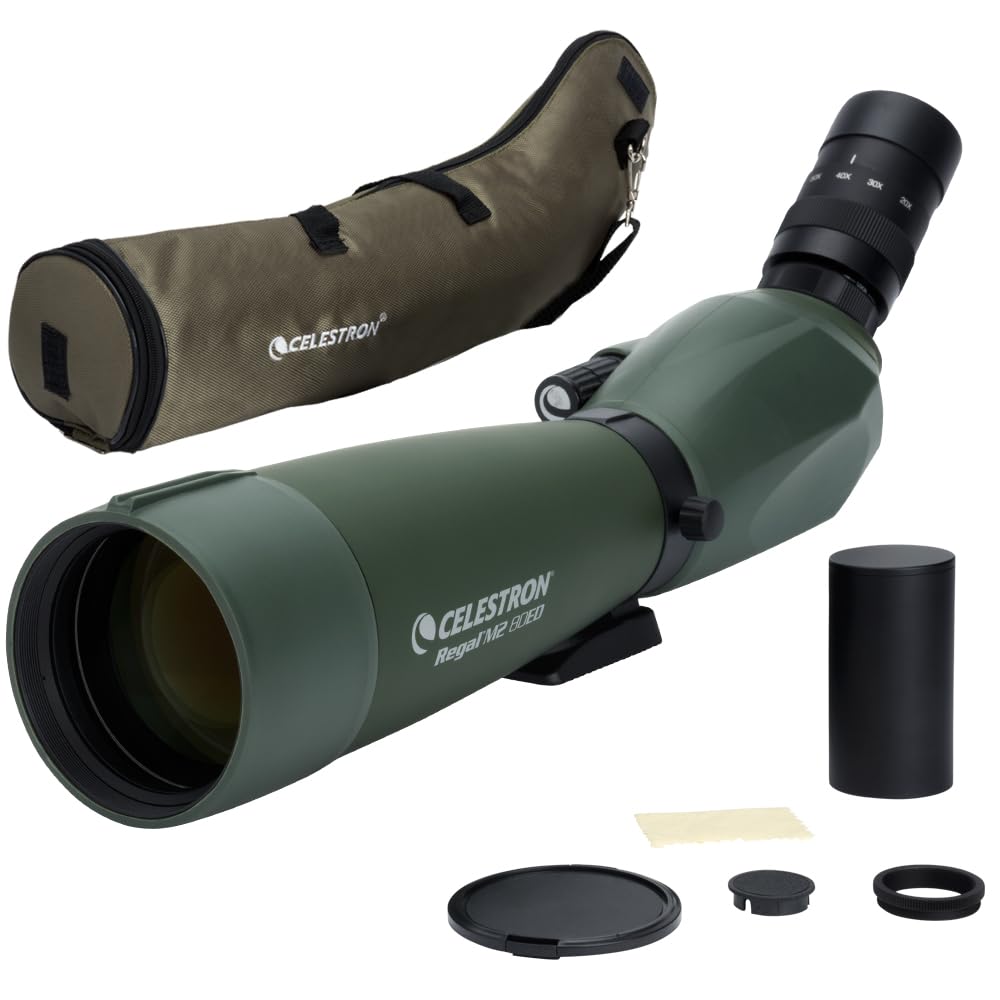
The Celestron Regal M2 80ED combines extra-low dispersion glass with Celestron’s proprietary XLT coatings — the same anti-reflective technology used on their observatory-class telescopes. This delivers exceptional color correction, minimal chromatic aberration even at 60x, and high light transmission that makes early-morning birding sessions productive. The 80mm objective lens gathers enough light for crisp views in deep forest shade without adding excessive weight.
The rotating tripod ring with click stops lets you reposition the eyepiece quickly to accommodate different viewing angles or share the scope with a companion. The included 20-60x zoom eyepiece is fully multi-coated and produces sharp images from edge to edge, with usable clarity all the way to 60x — a rare feat in this price tier. The dual focus mechanism (coarse and fine adjustment) allows precise focusing at maximum magnification, essential for picking out feather detail on distant raptors.
This scope also includes a T-mount adapter for digiscoping, letting you attach a DSLR for recording sightings. The padded view-through case provides protection without requiring removal during use. For birders who demand true color fidelity, excellent low-light performance, and reliable construction, the Regal M2 80ED sets the standard in its category.
Why it’s great
- ED glass with XLT coatings virtually eliminates color fringing
- Rotating tripod ring with click stops for flexible viewing angles
- Dual focus system enables precise high-magnification adjustments
Good to know
- Weight distribution is back-heavy, requiring a sturdy tripod
- Eyepiece cover is a metal screw-on design, slower to operate
2. Nikon Prostaff 5 Proscope 82mm

The Nikon Prostaff 5 Proscope 82mm delivers the optical signature that Nikon is known for — high contrast, true color rendition, and excellent edge-to-edge sharpness. The 82mm objective lens provides a meaningful brightness advantage over smaller 65mm scopes, making it a strong contender for birding in low-light conditions like dense canopy or overcast coastal marshes. The multi-coated optics minimize internal reflections that can wash out detail in bright midday sun.
Its Porro prism design with internal surface texturing reduces reflective light loss, a detail that directly translates to brighter images at dawn and dusk. The built-in sliding sunshade cuts glare and protects the objective lens from rain and dust. At just 4.1 pounds, it’s remarkably light for an 82mm scope, making it feasible for longer hikes to remote birding spots without sacrificing optical performance.
Nitrogen-purged and O-ring sealed, this scope is fully waterproof and fogproof, which is critical for birders who operate in humid wetlands or sudden rain. Users report that image quality rivals scopes costing significantly more, with very low chromatic aberration and a wide field of view at 20x. The center focus mechanism is smooth and responsive, though some units may require refocusing after zoom adjustment — something to check upon arrival.
Why it’s great
- Exceptional contrast and true-to-life color for feather identification
- Lightweight (4.1 lb) for an 82mm scope
- Built-in sliding sunshade and full waterproofing
Good to know
- Does not consistently hold focus when changing magnification
- Objective lens cover design can be prone to loss
3. Vanguard Endeavor HD 82mm
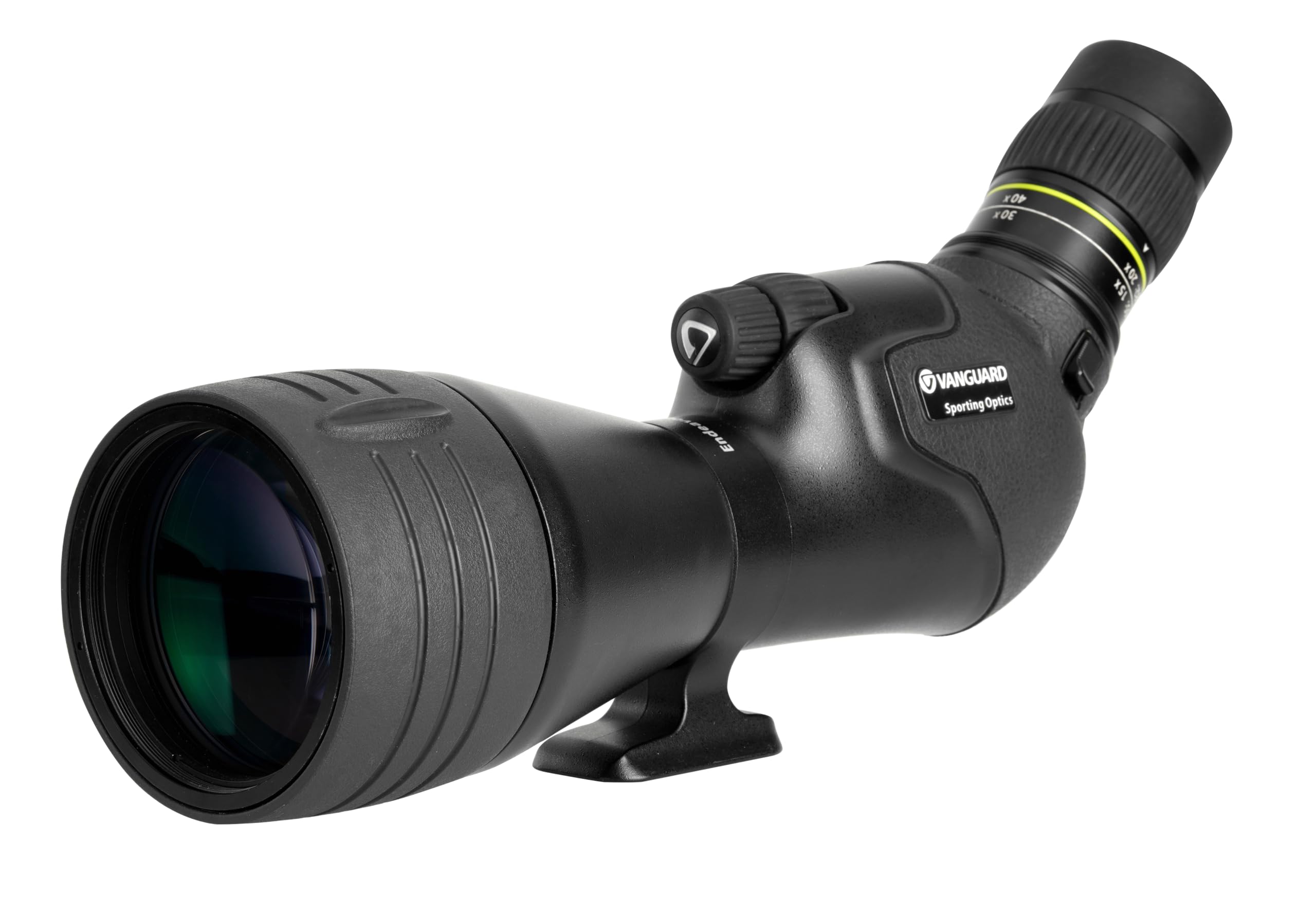
The Vanguard Endeavor HD 82mm brings ED glass into the premium value category, dramatically reducing chromatic aberration compared to standard glass scopes. The 82mm objective lens coupled with BaK-4 phase-coated prisms and fully multi-coated optics produces images that rival scopes priced two to three times higher. Birders transitioning from entry-level glass will immediately notice the difference in color fidelity and contrast when scanning for warblers in deep foliage.
The dual focus wheel (coarse and fine adjustment) allows micro-adjustments at high magnification, which is essential when trying to resolve fine feather details at 60x. The rubber-armored magnesium body is durable without being excessively heavy at 66.7 ounces. The detachable angled eyepiece with long 19-20mm eye relief makes extended glassing comfortable, especially for eyeglass wearers who need that extra distance from the lens.
A built-in sunshield eliminates glare in direct sunlight, and the waterproof, fogproof construction ensures reliable performance in all weather. The included custom raincoat carrying case protects the scope during transport without requiring full removal during setup. Users consistently report that this scope performs close to the Zeiss and Swarovski level at a fraction of the cost, making it a smart investment for serious birders who aren’t ready to spend flagship prices.
Why it’s great
- ED glass delivers near-flagship image quality at a mid-range price
- Long eye relief (19-20mm) comfortable for eyeglass wearers
- Rubber-armored magnesium body is tough and weather-sealed
Good to know
- Heavier than some competitors at 66.7 oz
- Poor tripod balance due to forward-mounted foot
4. Celestron Regal M2 65ED Spotting Scope

The Celestron Regal M2 65ED offers the same ED glass and XLT coatings as its larger 80ED sibling in a lighter, more packable form. The 65mm objective lens keeps the scope to just 4.5 pounds, making it ideal for birders who hike long distances or need a secondary scope for travel. The 16-48x zoom range is narrower than the standard 20-60x but remains sharp across the entire range thanks to the ED glass.
Users consistently praise this scope for its rapid image acquisition — the eyepiece design forgives imperfect eye placement, letting you find birds faster than many competitors. The included 1.25-inch astronomical eyepiece compatibility opens up digiscoping possibilities with standard T-ring adapters. The rotating tripod mount with click stops and four mounting holes allows for precise balance adjustment, which helps compensate for the scope’s back-heavy nature.
Waterproof and fogproof construction handles humid coastal birding and rainy mornings without issue. The padded view-through case provides protection without needing removal, and the metal screw-on eyepiece cover is more secure than rubber caps. For birders who prioritize portability without sacrificing ED glass quality, the Regal M2 65ED hits the sweet spot.
Why it’s great
- Excellent image acquisition speed with forgiving eye placement
- ED glass and XLT coatings in a compact 4.5 lb package
- Compatible with 1.25-inch astronomical eyepieces for digiscoping
Good to know
- Back-heavy design requires careful tripod balancing
- Zoom range limited to 16-48x instead of standard 20-60x
5. Vortex Diamondback HD 85mm

The Vortex Diamondback HD 85mm is built for the birder who operates in extreme conditions. Its HD optical system delivers exceptional resolution and edge-to-edge sharpness, with multiple anti-reflective coatings on all air-to-glass surfaces that boost light transmission in low light. The 85mm objective lens is one of the largest in this price tier, giving you a measurable brightness advantage over 80mm competitors during the critical dawn and dusk windows when birds are most active.
The scope is O-ring sealed and argon purged — argon is a larger molecule than nitrogen, which slows gas migration over time and extends the fogproof lifespan. The Armortek lens coating protects against oil, scratches, and dirt that inevitably accumulate during field use. At just 3.8 pounds, it’s lighter than many 80mm scopes, and the Arca-Swiss compatible foot lets you mount directly to modern tripod heads without additional plates.
The built-in helical focus wheel provides fast and fine adjustments, and the twist-up adjustable eyecup accommodates eyeglass wearers. Vortex backs this scope with an unlimited, unconditional, lifetime VIP warranty — transferable and no receipt required. Some users note noticeable chromatic aberration on high-contrast edges (purple fringing), but the overall clarity and build quality make this a top contender for serious birding.
Why it’s great
- Exceptional low-light performance with 85mm objective
- Argon purging for longer-lasting fogproof performance
- Lifetime VIP warranty with no questions asked
Good to know
- Chromatic aberration visible at high-contrast edges
- Requires a robust tripod for stability at 60x
6. Athlon Argos HD 20-60×85

The Athlon Argos HD 20-60×85 packs an 85mm objective lens and HD glass into a package that competes directly with scopes costing hundreds more. The advanced HD glass delivers bright, sharp images with true color accuracy even in low-light conditions. The 45-degree angled eyepiece with a rotating tripod ring provides comfortable viewing positions for prolonged glassing sessions, which is critical when scanning for elusive species.
Waterproof, fogproof, and argon-purged, this scope is built to withstand the elements birders face in coastal marshes, rainforests, and alpine environments. The rubber-armored body absorbs impacts and provides a secure grip in wet conditions. At 68 ounces, it’s not the lightest, but the large objective lens rewards you with a wide, clear field of view that makes locating birds faster.
Users report excellent clarity when reading signs at half a mile and spotting Jupiter’s moons, which speaks to the resolving power of the HD glass. The twist-up eyepiece and large focus ring make adjustments easy, even with gloves. Some users note that image clarity degrades slightly above 40x in low light, but for general birding in good conditions, this scope delivers well above its price point.
Why it’s great
- 85mm objective provides excellent light gathering
- Argon-purged and fully weather-sealed
- HD glass delivers sharp, accurate color at long range
Good to know
- Image clarity drops above 40x in low light
- Narrow depth of field makes focusing critical at 60x
7. Gosky 20-60×80 Spotting Scope
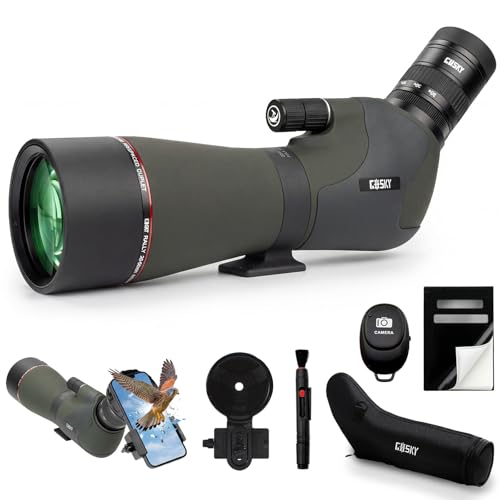
The Gosky 20-60×80 is designed with digiscoping in mind, including a dedicated smartphone adapter that makes recording bird sightings straightforward. The upgraded 55mm extra-large eyepiece provides a wider and clearer field of view compared to standard models, reducing eye fatigue during extended observation. The 80mm objective lens with BaK-4 prism delivers bright images that serve well for bird identification and documentation.
The IPX7 waterproof rating means this scope can withstand submersion in up to 1 meter of water for 30 minutes, which is overkill for rain but gives confidence in downpours. The dual-focus system (coarse and fine) helps dial in sharpness at high magnification, and the angled eyepiece with a rotating ring makes sharing the view easy. The zoom ring and focus knobs operate smoothly, allowing quick transitions between scanning and detailed observation.
Users praise the clarity at 20x for general birding, with decent performance up to 60x for closer subjects. The included carrying case is compact and protective, though it’s tight when the scope is attached to the tripod plate. Some users report that the fine focus knob can feel loose, and the phone adapter requires practice to align properly. For the birder who wants to capture smartphone photos and videos through the scope without buying separate digiscoping gear, this package delivers strong value.
Why it’s great
- Includes smartphone adapter for digiscoping out of the box
- Large 55mm eyepiece reduces eye strain
- IPX7 waterproof rating for all-weather use
Good to know
- Fine focus knob can feel loose and unstable
- Phone adapter alignment requires practice
8. Bushnell Trophy Xtreme Spotting Scope

The Bushnell Trophy Xtreme is the entry point for birders who want a dedicated spotting scope without a significant investment. It features fully multi-coated optics that provide adequate brightness for daytime birding, and the 20-60x zoom range gives flexibility for different viewing distances. The straight eyepiece design is simpler for quick target acquisition — you look straight through, making it intuitive for first-time scope users.
This scope comes with a hard case, soft case, and a tabletop tripod with a window mount, making it a complete kit for someone setting up their first birding station. The 1/4-20 tripod mounting shoe is a standard interface that works with most photography tripods. At 20x, the image quality is respectable, with decent color and sharpness for the category. The built-in sunshade extends to block glare, and the tethered objective lens cover prevents loss.
Users note that image quality drops noticeably above 30x, with the exit pupil becoming small and the image washing out at 60x. This scope performs best for birding at moderate distances (50-150 yards) and in good light. The waterproof construction provides peace of mind in wet conditions. For the budget-conscious birder or someone introducing a child to birding, this scope offers a functional starting point without the risk of a large investment.
Why it’s great
- Complete kit with hard case, soft case, and tabletop tripod
- Intuitive straight eyepiece design for new users
- Fully multi-coated optics for decent daytime brightness
Good to know
- Image quality degrades quickly above 30x magnification
- Tabletop tripod is adequate but not stable for field use
9. Athlon Talos 20-60×80

The Athlon Talos 20-60×80 delivers surprising optical quality at an entry-level price point. Fully multi-coated lenses provide good light transmission for an 80mm scope, producing bright images that let you identify birds at moderate distances. The nitrogen purging seals moisture out of the tube, giving you reliable waterproof and fogproof performance that’s uncommon at this tier. The aluminum body is lightweight without feeling fragile.
The scope includes a tabletop tripod and protective case, making it a complete setup for someone buying their first birding scope. Users consistently report clear glass out to significant distances, with the ability to see feather detail on perched birds at 100+ yards. The dual-knob design (one for focus, one for zoom) is intuitive, and the sunshade helps reduce glare in bright conditions. The eye relief is adequate but on the shorter side, which eyeglass wearers should note.
At 20x, the image is impressively crisp, but detail begins to soften after 40x, and the exit pupil becomes quite small at 60x, making eye placement critical. This is typical for scopes in this price tier. For the birder who needs a functional scope for daytime viewing and isn’t ready to invest in HD glass, the Talos provides a reliable entry point that won’t frustrate you with immediate optical shortcomings.
Why it’s great
- Nitrogen-purged waterproofing at an entry-level price
- Lightweight aluminum body with good durability
- Complete with tabletop tripod and case
Good to know
- Image quality drops noticeably after 40x magnification
- Short eye relief can be challenging for eyeglass wearers
FAQ
Is a 65mm objective lens enough for birding or do I need 80mm?
What magnification range is most practical for bird watching?
What does ED glass actually do for birding scopes?
Should I get an angled or straight eyepiece for birding?
Final Thoughts: The Verdict
For most users, the best birding spotting scopes winner is the Celestron Regal M2 80ED because its ED glass and XLT coatings deliver exceptional color fidelity and low-light performance at a price that doesn’t require selling your gear bag. If you want maximum portability without sacrificing ED glass, grab the Celestron Regal M2 65ED. And for smartphone digiscoping straight out of the box, nothing beats the Gosky 20-60×80.