
Our readers keep the lights on and my morning glass full of iced black tea. As an Amazon Associate, I earn from qualifying purchases.
Specs are compiled from manufacturer listings and verified buyer reviews and can change over time — please confirm the key details on the product page before buying.
The biggest mistake new backpackers make is hauling a two-person tent for one person. A bivy tent (a waterproof shelter that fits just you and your sleeping bag) slashes pack weight and lets you sleep anywhere a tent can’t go. This guide breaks down the real trade-offs — weight versus room, waterproofing versus breathability — so you can pick the right one for your trips.
I’m Min — the founder and writer behind Gadgets Feed. This guide is built by comparing the manufacturers’ published specifications and the patterns across verified customer reviews, so you get each pick’s real strengths and trade-offs instead of marketing spin.
You want a bivy tent that keeps you dry and fits your sleeping pad, whether you’re thru-hiking, hunting, or just tired of fiddling with tent poles. This guide focuses on the waterproofing specs that matter and the interior dimensions that actually accommodate a standard pad.
Our Picks at a Glance

How To Choose The Best Bivy Tent
Buying a bivy tent means balancing three things: weight, weather protection, and interior space. You rarely get all three at once, so knowing which one matters most for your type of camping is the real trick.
Weight vs. Durability
The lightest bivies use thin nylon that saves ounces but demands careful ground placement. Heavier models use tougher fabrics and stronger poles that shrug off rough terrain but add noticeable pounds to your pack. Look at the packed size too — a shelter that compresses small frees up room for food and water.
Waterproofing vs. Breathability
A fully sealed shelter keeps rain out, but your body’s moisture has to escape somewhere. If it can’t, it condenses on the walls and drips on you at night. The best bivies use breathable fabrics and mesh panels that balance rain protection with airflow.
Setup Complexity
Some bivies pop open instantly, while others need trekking poles or careful staking to reach full shape. Think about where you’ll pitch it — a rocky ridge, a tent site, or under a tarp — and decide if you want a freestanding frame or are fine using your hiking poles as support.
Quick Comparison
| Model | Best For | Weight | Floor Area | Waterproof Rating | Amazon |
|---|---|---|---|---|---|
| Snugpak Ionosphere★ Best Overall | All-round backpacking | ~2 lbs | 3270 sq in | 5000mm | Amazon |
| USGI Industries BivyFastest Setup | Instant bug-proof sleep | Not specified | 2490 sq in | Not specified | Amazon |
| Easy Set Up Pop UpCompact Pop-Up | Solo bike packers | 2.2 lbs | 19 sq ft | 2000-3000mm | Amazon |
| GEERTOP Bivy Tent | Budget backpacking | 2.9 lbs | ~2100 sq in | PU5000mm | Amazon |
| Sierra Designs Bivy | Ultralight minimalists | 16 oz | Not specified | Not specified | Amazon |
| Ammo Can Man Bivy | Military-grade toughness | ~2.5 lbs | Not specified | Gore-Tex | Amazon |
| onewind A-Frame | Ventilation-focused hikers | 2.3 lbs | Not specified | 3000mm | Amazon |
| MT Hideaway Bivy | Budget camo shelter | 2.5 lbs | Not specified | Not specified | Amazon |
| Mil-Tec Recom | Storm-resistant camping | 2,400g | 5065 sq in | 1000mm | Amazon |
In‑Depth Reviews
1. Snugpak Ionosphere 1 Person Tent
Our pick — over 4.5★ from 700+ verified ratings; the strongest balance of quality and price.
The rare bivy that adds real floor space without turning into a heavy tent.
Its 210T polyester ripstop shell carries a 5000mm waterproof PU coating, so heavy rain runs right off, and every seam is taped and sealed so you stay dry from drips and drafts alike.
The layout is what wins people over. With a floor measuring 94 inches long and 35 inches wide, it offers about 31% more sleeping area than the USGI Industries model’s 2490 square inches, giving you real room for gear at your feet. A 6’1″ owner fits comfortably, and the porch-style front entry keeps your pack dry while you sleep.
With 4.6 stars across 700+ owners, it’s a field-proven crowd favorite. Buyers report staying bone-dry on a “6-day CO hunt at 11k ft, 20s-30s°F, rain, high winds,” with stakes holding firm on rocky ground. The honest trade-off is the zippers, which a few owners say catch on the tie unless you handle them gently.
What wins people over
- Spacious 3270 square inch floor fits tall sleepers and gear
- Lightweight anodized aluminum poles with pressfit connectors
- Waterproof coating and taped seams shrug off storms
- Includes 14 stakes, 2 spares, and a basic repair kit
The trade-offs
- Zippers can catch on the tie if rushed
- Entry requires a feet-first crawl for taller users
Your best all-rounder: This suits solo hikers and hunters who want a true storm-proof shelter with room to breathe.
Who might pass: If you’re counting every gram for a thru-hike, there are lighter non-freestanding options below.
2. USGI Industries Bivy Tent
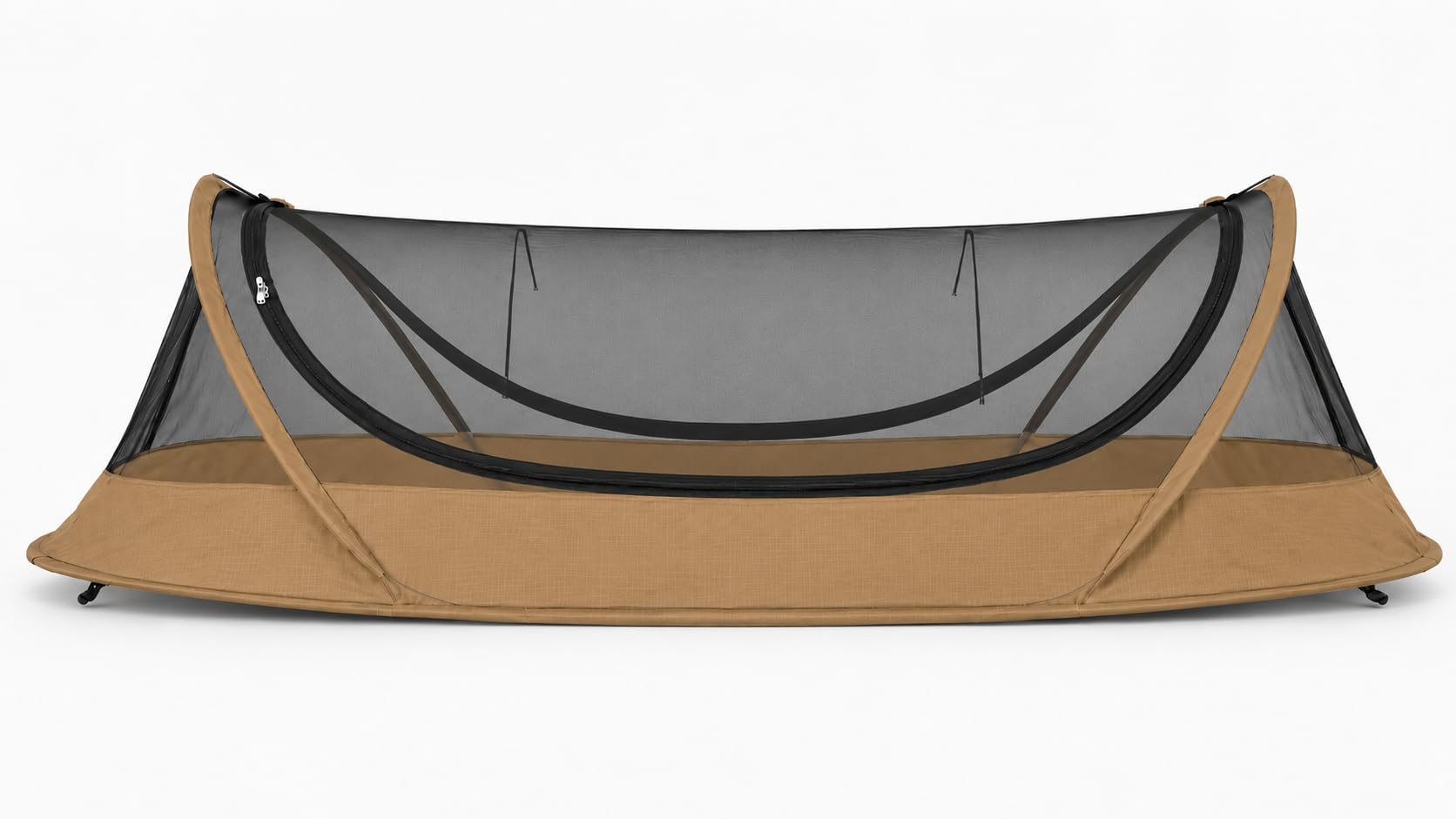
Throw it in the air and it’s already pitched before you drop your pack.
If setup speed matters more than peak height, this is the shelter to beat. The instant self-deploying frame goes from bag to standing in seconds — just toss it skyward, let it snap open, and stake it down. Inside, the 84-inch length and 30-inch width give you a low-profile bed with a mesh ceiling for airflow.
What it lacks in floor space — 2490 square inches versus the Snugpak’s 3270 — it makes up in pure simplicity. The oval form factor packs into an 18-inch storage bag that slips into most suitcases, and the dual-slider zipper lets you reach out to grab water without unzipping the whole entrance.
The recurring gripes are about durability. Owners mention a “6-inch sewing defect at zipper required hand repair” on one unit, and thin rods can break if not refolded exactly as shipped. The folding technique takes practice — worth running through it at home before your first trip.
Instant shelter: For bug country or quick overnight stops, this is the fastest way to a mosquito-free bed you’ll find.
Handle with care: The spring-loaded frame and thin rods demand gentle folding, and there’s no sit-up room inside.
Reach for this if: You want to set up faster than your friends can find flat ground.
Look elsewhere if: You need a bivy that survives being crammed carelessly into a pack for years.
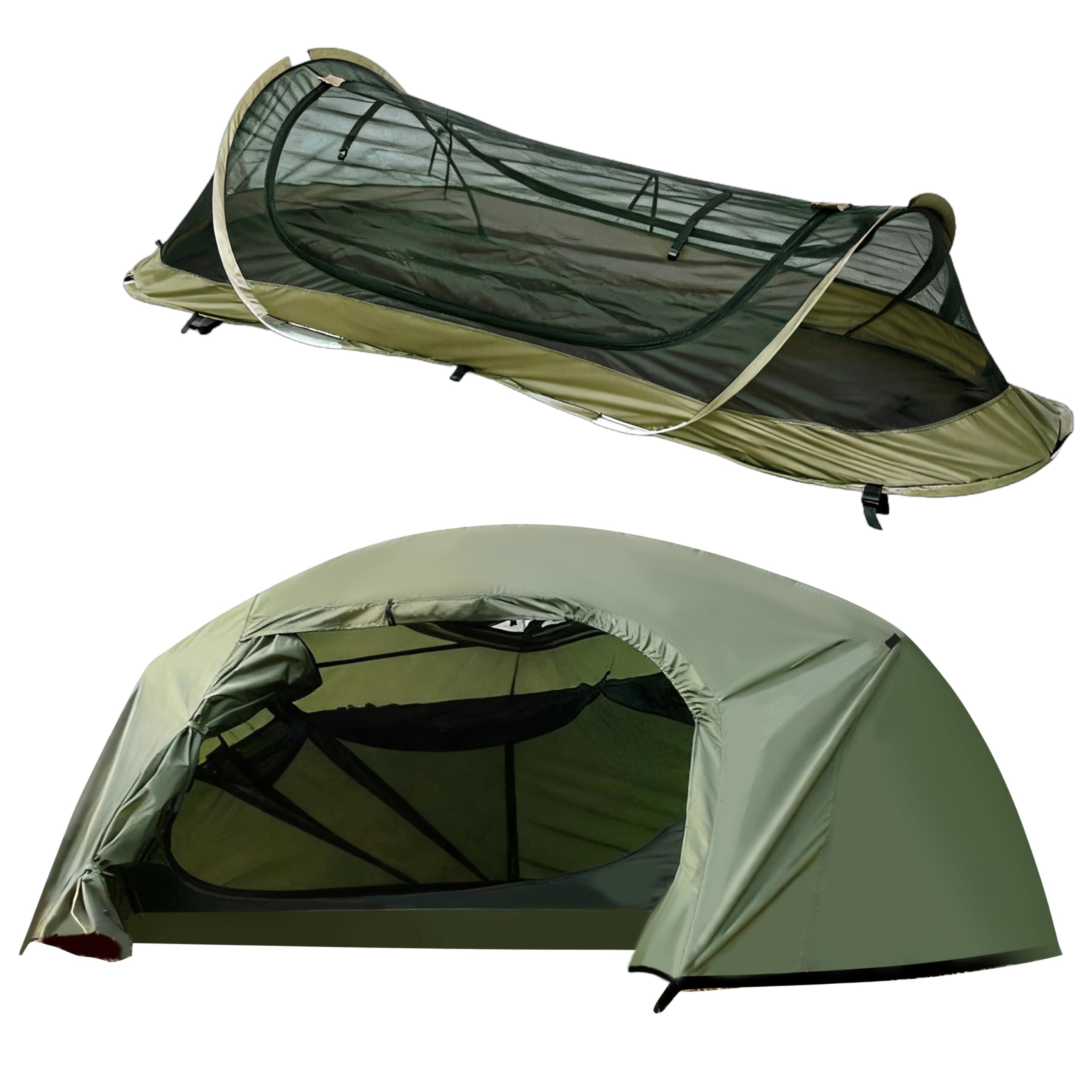
3. Easy Set Up Ultralight Bivy Tent
A pop-up that packs small enough to live in your bike bag.
Bikepackers and bike tourers, this one’s aimed at you. At just 2.2 lbs with 7001 aluminum poles, it fits in a backpack’s side pocket and sets up in about 2 minutes. The dome shape gives you 19 square feet of floor — enough for a 5’9″ rider to stretch out fully, with the double-layer design offering room to sit up straight.
Weather protection comes from a 2000-3000mm waterproof outer with a PU2000mm base, which handled a full day of rain without letting a drop through. The B3 mesh inner stops mosquitoes while the reflective guy line keeps you visible at night.
A few taller users hit a wall — A 6’4″ owner found head and toes brushing the screens, so it’s best for folks under 6’2″. There’s also no stake loop at the ends, which means you’ll want to guy it out well in strong wind.
Bike-first design: This is the rare pop-up that doesn’t punish you with bulk — it earns its spot on a packed rack.
Watch the zippers: They need a gentle hand, and the end stake loops are missing for extra storm security.
Best for: Solo cyclists and hikers who want ultralight weight with real mesh bug protection.
Not for: Anyone north of 6’2″ or trips expecting strong ridge-line winds.
4. GEERTOP Ultralight Bivy Tent
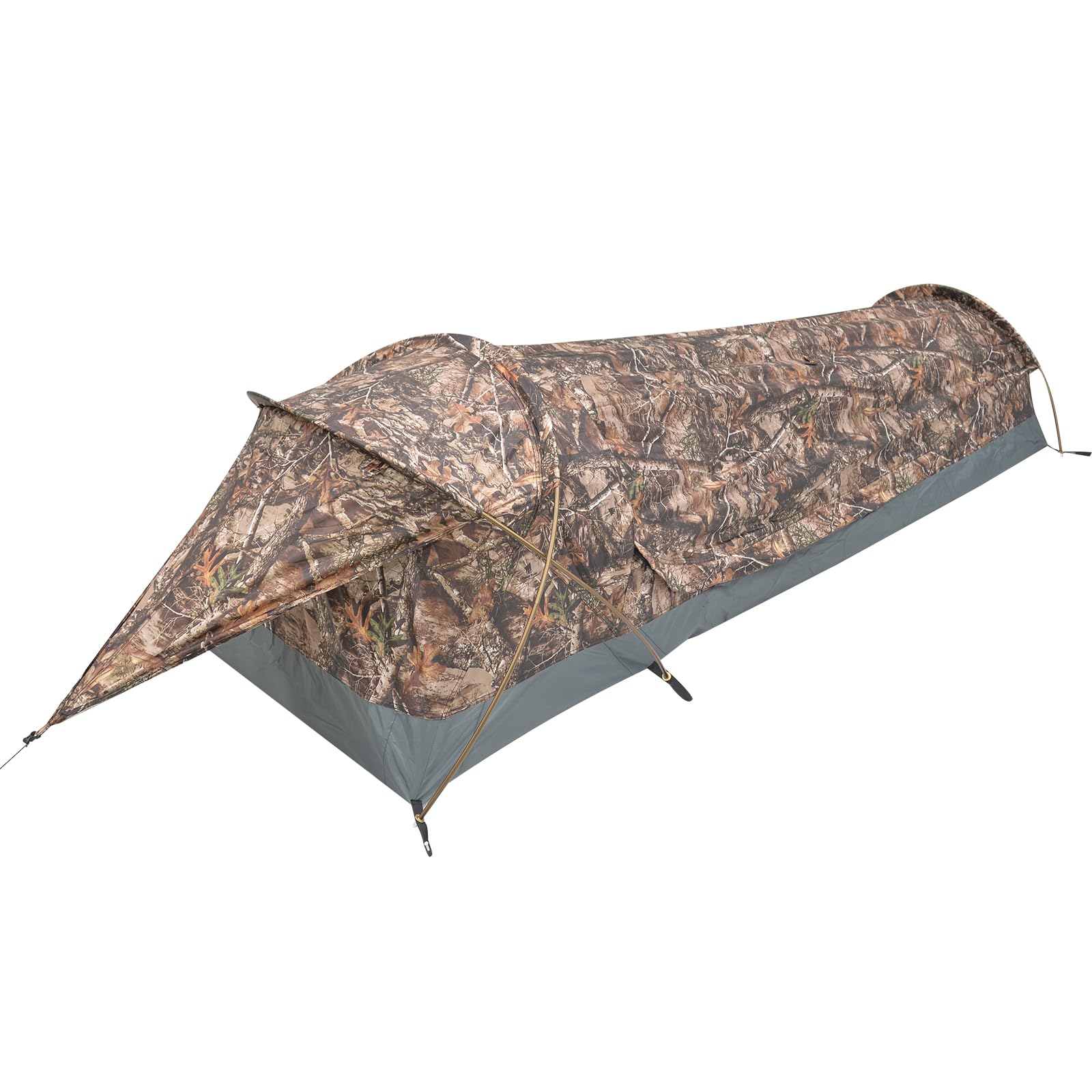
Serious waterproof specs on a budget shell that won’t wreck your pack.
For budget shoppers who refuse to compromise on rain protection, this is the value play. It packs a PU5000mm rainfly and PU8000mm floor, both seam-taped, which is more waterproofing than many tents twice the price. At 2.9 lbs and 17 x 5 x 5 inches packed, it disappears into a backpack’s main compartment.
The 3-pole shock-corded aluminum frame sets up in about 2 minutes, and the 84.6 x 29.5-inch floor with a 24-inch height fits a 5’11” sleeper with room for a head pocket and foot storage. The top mesh panel and two windows handle ventilation in mild weather.
The honest catch is that customers note the seams need a silicone spray treatment to reach full rainproofing — without it, some woke to puddles inside. It’s a small extra step that turns a decent shelter into a dry one, but you should budget for it.
The strong points
- PU8000mm floor and PU5000mm rainfly beat the price tier
- Compact 17-inch packed length fits standard packs
- Shock-corded poles mean fast, tool-free setup
Know before you buy
- Seams need waterproofing spray for heavy rain
- No rainfly included, so condensation needs venting
Grab it if: You want premium-level waterproof ratings without paying premium prices.
Think twice if: You’d rather not do extra seam treatment before your first rain trip.
5. Sierra Designs Backcountry Bivy Bag

A bivy bag that stuffs down smaller than your water bottle.
This is the shelter for the weight-obsessed. At just 16 ounces, it’s nearly two pounds lighter than the GEERTOP above, and owners say it packs down to the size of a 1-liter water bottle. The 80 x 36-inch interior fits a full mummy bag, pillow, and sleeping pad — a 6’3″ owner had no trouble laying out flat.
The design centers on the large U-shaped opening, which makes getting in and out far easier than most bivy sacks. The mesh window panel adds ventilation in good weather, and the guy line loop lets you prop up the peak for more headroom when you want it.
The real trade-off shows up in wet weather. Buyers call the 20D nylon ripstop “water-resistant” rather than truly waterproof, and condensation builds up on the walls when it’s closed up tight. It’s best paired with a small tarp overhead, which the manufacturer practically suggests with the guy line loop.
Pure ultralight: This saves real weight and packs absurdly small, making it perfect for fast-and-light missions.
Plan for weather: The thin material offers little warmth and modest rain protection, so carry a tarp for storm nights.
Best for: Thru-hikers and bikepackers counting every ounce who sleep in dry climates.
Skip if: You camp in sustained rain and don’t want to rig extra overhead cover.
6. Ammo Can Man Woodland Camouflage Waterproof Bivy Cover

Military-spec Gore-Tex armor that adds warmth and shrugs off rock and cactus.
For anyone sleeping rough on granite, this is the bivy that treats your sleeping bag like armor. Built with genuine Gore-Tex and made in the USA, the 83 x 34-inch shell survived 20+ nights in the Grand Canyon with no condensation below freezing. The camouflage pattern keeps you discreet while the durable face fabric protects against punctures.
Reviewers point out a 5-10 degree warmth boost, letting you swap in a lighter sleeping bag for colder nights. The roomy cut fits a Klymit pad and a 5° bag with a 6’1″ occupant — and it’s dry after morning dew that would soak a bare bag.
The honest catch is weight and rain coverage. At roughly 2.5 lbs it’s about double the weight of a civilian bivy, and the top uses velcro rather than a full zipper, so horizontal rain calls for a tarp overhead. For dry conditions and rough terrain, though, it’s the most durable shelter here.
Built to last
- Genuine Gore-Tex fabric with excellent condensation control
- Roomier than most bivies — fits large pads and tall sleepers
- Adds 5-10 degrees of warmth to your sleeping bag
The weight cost
- Around 2.5 lbs, double a civilian ultralight bivy
- Velcro top lacks a full zipper for heavy rain
Pick this if: You sleep in rough, dry terrain and want a shelter that outlasts you.
Pass if: You’re racing a clock on trail weight or camp in horizontal rain.
7. onewind Ultralight One Person Bivy Tent
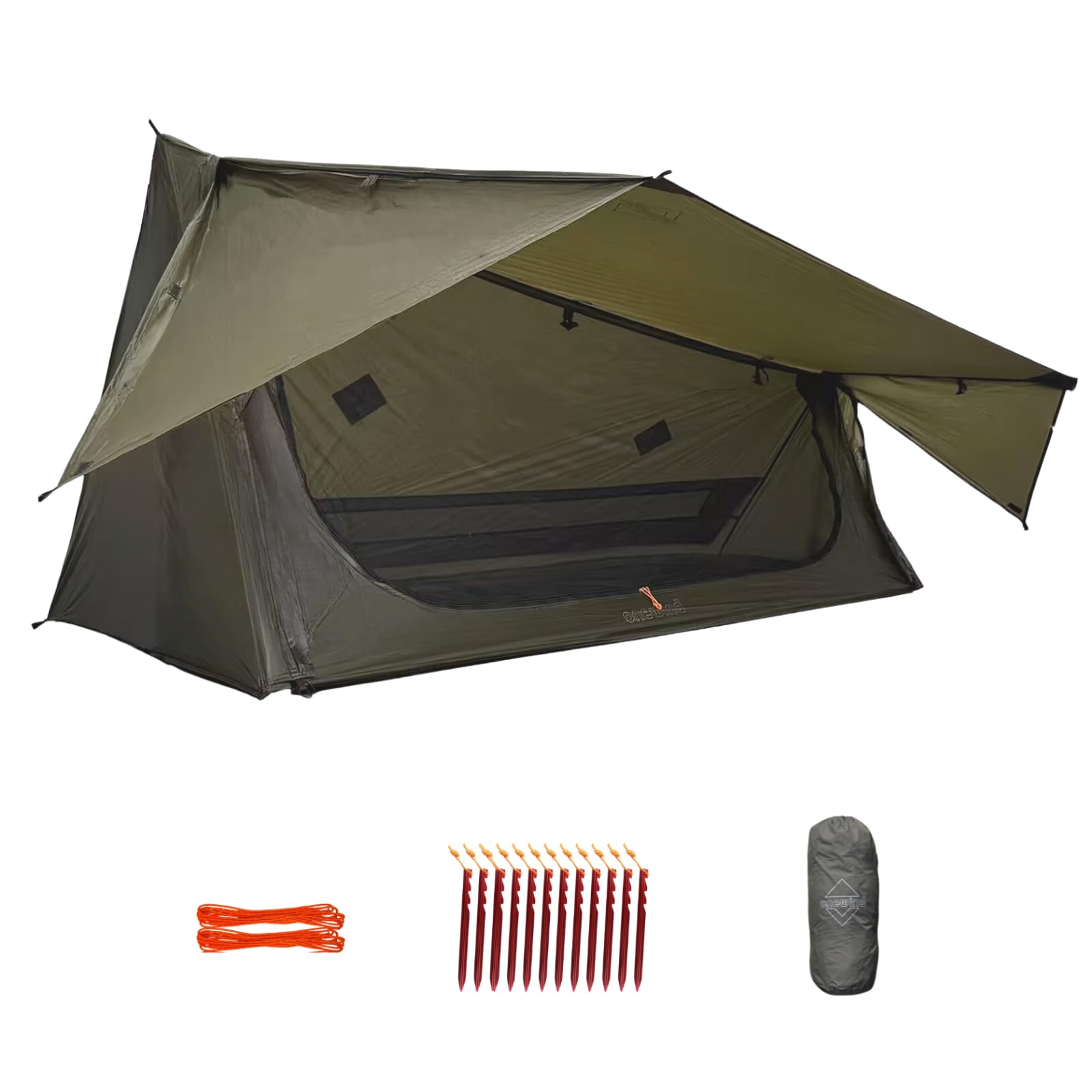
A trekking-pole shelter with a ventilation system that actually breathes.
If condensation is your nemesis, this A-frame is the answer. It uses a no-see-um mesh door with 1600 holes per square inch, plus a lower rear mesh door and a vent window, creating a cross-breeze that keeps the walls dry. One owner survived heavy monsoon rain in Puerto Rico with zero water ingress and superb airflow.
The ultralight 1.1oz silnylon body carries a 3000mm waterproof rating, while the 40D nylon floor bumps up to 5000mm. The interior measures 82.7 x 39.4 x 39.4 inches, giving you generous space and the ability to sit up without brushing the sides — a 39.4-inch height that most bivies simply don’t offer.
The catch is setup. This is a trekking-pole shelter with no rigid poles, so it needs your hiking poles or a ridgeline, and first-timers report a steep learning curve. It also ships without a rainfly or footprint, so a ground tarp and some paracord are worth adding to your kit.
Breathes like a tent: The multi-point mesh system keeps the interior dry and bug-free.
Practice at home: The pole-less setup demands patience and a ridgeline for full support.
Best for: Experienced hikers who carry trekking poles and hate waking up in a condensation shower.
Not for: Beginners who want a pop-up-and-go solution on their first night.
8. MT Military Hideaway Bivy Cover

A low-profile camo bivy that disappears into the woods while you sleep.
Built on the U.S. Army modular sleeping bag system, this bivy is designed to envelope your bag and pad in a waterproof-breathable shell. The woodland camo pattern and 82-inch length with a 23.6-inch peak keep you hidden in brush while still letting you roll over without feeling like a cocoon.
Solo hikers praise the quick 5-minute setup and the storm protection it offers in a pinch. The single-pole hoop design frees up interior space, and the zipper closure keeps bugs out when you’re zipped in.
Waterproofing is where opinions split. Some owners say it does fine in moderate rain after a silicone spray treatment, while others report condensation buildup and leaks in heavy weather. It’s a shelter that works best as part of a system — pair it with a tarp or poncho above for serious storms.
Good bones: The camo, quick setup, and storm resistance make it a solid budget option.
Weather-dependent: Waterproofing varies unit to unit, so treat the seams and pack a tarp for rain.
Reach for it if: You want an affordable camo bivy for discreet, dry-weather camping.
Look elsewhere if: Heavy rain is a regular part of your trips and you want guaranteed waterproofing.
9. Mil-Tec Recom 1-Person Tent
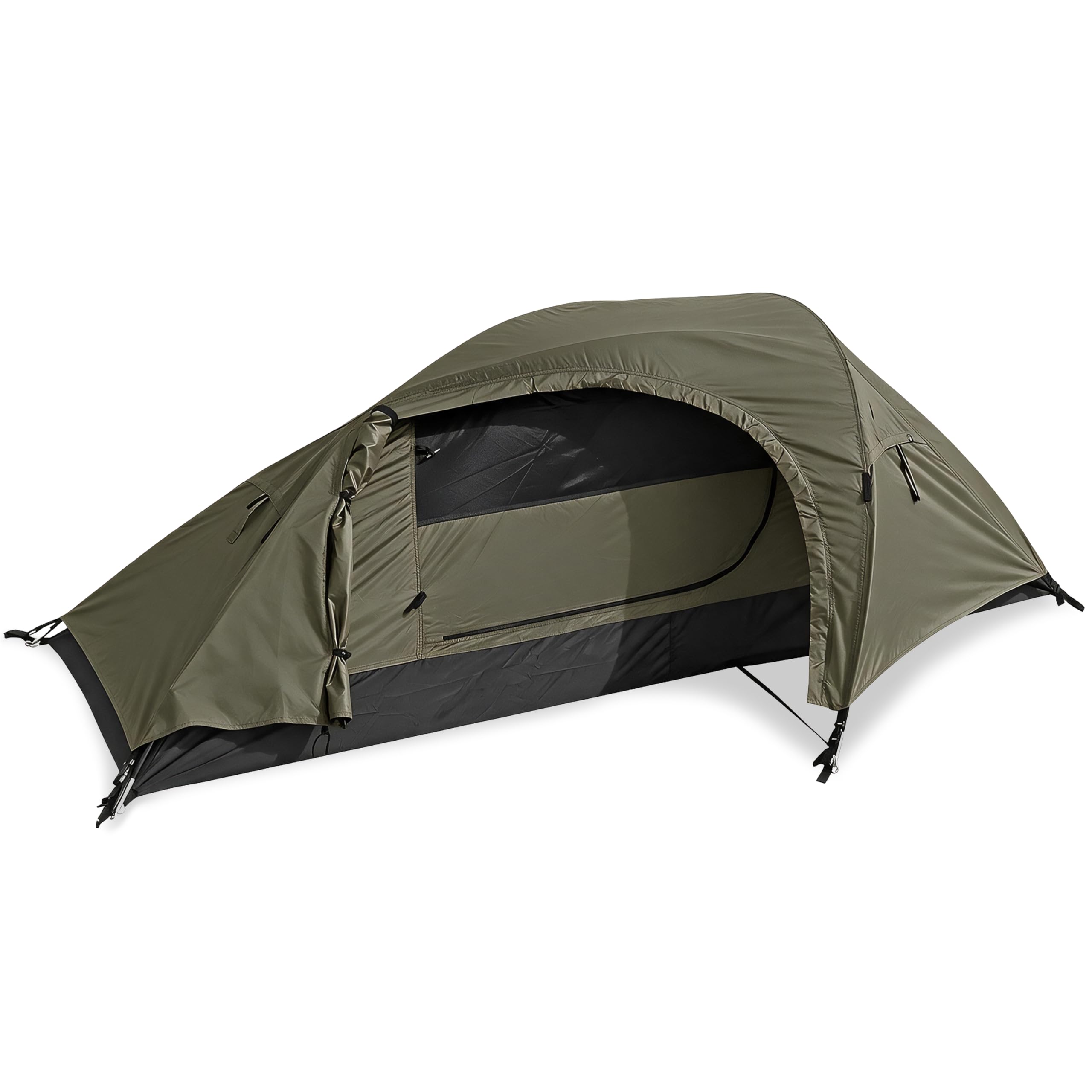
The storm-rated one-man tent with an anteroom that holds all your gear.
For campers who prioritize storm survival over pack weight, this is the most substantial shelter here. With a 1000mm water column flysheet and 2000mm groundsheet, it’s built for wind and rain resistance, and the 95 x 53 x 34-inch interior is the roomiest of the bunch at 5065 square inches. The anteroom gives you a dry spot to stash your pack and boots overnight.
Owners who survived rain, snow, and 0°F temperatures came out dry and warm, with the extractor fans on both sides cutting down condensation. The fiberglass frame and well-stitched polyester body feel solid, and the olive drab color blends into the woods.
The weight is the story here — at 2,400g it’s a full pound-plus heavier than the ultralight picks above. You also can’t sit up inside, and the stock pegs and guylines are the first thing owners replace with something sturdier.
Built for weather
- Biggest interior at 5065 square inches with a gear anteroom
- Storm-tested in rain, snow, and freezing temps
- Extractor fans manage condensation in wet weather
Where it falls short
- Heaviest pick here at 2,400g — not for ultralight hikers
- No sit-up height and frail stock stakes
Choose this if: You want a true storm shelter with room for gear and don’t mind the extra pounds.
Pass if: You’re thru-hiking and every ounce matters more than interior comfort.
Understanding the Specs
Waterproof Rating (mm)
This number tells you how tall a column of water the fabric can hold back before leaking. A 1000mm rating handles light rain, while a 5000mm rating shrugs off heavy downpours. But remember — a fully sealed shelter traps your body’s moisture, so breathable panels matter just as much for staying dry from the inside.
Floor Area & Length
Floor area in square inches tells you how much room you get to stretch out. Floor length matters most for tall sleepers — a 94-inch floor fits a 6’1″ person, while an 84-inch floor requires a bit of diagonal positioning. Look for a floor that’s at least a few inches longer than you are, and check the width to make sure your sleeping pad fits flat.
FAQ
What is the difference between a bivy tent and a bivy sack?
Will a 6-foot-tall person fit in a bivy tent?
Why does condensation build up inside bivy tents?
Can I use trekking poles with a bivy tent instead of the included poles?
How much weight do I really save with a bivy tent?
Is a bivy tent warm enough in winter?
How do I stop bugs from getting in at night?
What is the best way to pack a bivy tent?
Should I use a footprint or tarp with my bivy tent?
Can a bivy tent fit two people in an emergency?
Final Thoughts: The Verdict
Across the board, the bivy tent winner is the Snugpak Ionosphere because it balances a 5000mm waterproof shell, a spacious 94-inch floor, and fast aluminum-pole setup into the most complete single-person shelter. If you want the lightest possible setup, the Sierra Designs at 16 ounces is the one to grab. And for storm-prone trips where gear storage matters, the Mil-Tec Recom offers the roomiest interior with a dedicated anteroom.
How We Picked
We do not accept paid placement. Every pick is matched to a real buyer and a real use-case; we do not hands-on test units.
Sources & Methodology
Specifications: manufacturer listings and product documentation. Review insights: verified customer reviews, as of August 2026. Pricing: not shown on this page (it changes often); check the current price via the retailer link.
As an Amazon Associate, Gadgets Feed earns from qualifying purchases. This does not affect which products we feature.