
The difference between a clean, fast cut through reinforced concrete and a blade that bounces, binds, and burns out in minutes comes down to one decision: the bond matrix and segment design of your blade. A 14-inch segmented blade chews through a 6-inch slab differently than a 7-inch turbo rim slices through brick veneer, and choosing wrong means wasting time, material, and your saw’s motor.
I’m Min — the co-founder and writer behind Gadgets Feed. After spending dozens of hours analyzing segment heights, arbor sizes, and bond compositions across dozens of models, I’ve mapped exactly which blade specs deliver the cleanest finish and longest life for each concrete-cutting scenario.
This guide breaks down the seven best contenders by cut type, saw compatibility, and material toughness so you can confidently pick the right blade for concrete cutting without burning through your budget on the wrong bond.
How To Choose The Best Blade For Concrete Cutting
Matching a concrete cutting blade to your saw and material is about three interconnected specs: diameter, arbor, and rim style. A blade that’s too small for the cut depth binds; a blade with the wrong arbor won’t even mount; and a continuous rim on rebar-heavy concrete overheats and glazes in minutes.
Segment Height and Bond Matrix
Segment height, measured in millimeters, directly dictates usable blade life. Budget blades often use 8mm or 10mm segments; premium options like the Makita B-69624 push that to 13mm for up to 4x longer cutting. The bond matrix — the metallic binder holding diamond grit — determines whether the blade cuts fast in soft brick or survives hard aggregate concrete without dulling.
Rim Style: Segmented, Turbo, or Continuous
Segmented rims feature slots between segments that cool the blade and clear slurry, making them ideal for deep, fast cuts in reinforced concrete. Turbo rims add a serrated edge for a smoother finish with moderate speed, best for general masonry. Continuous rims deliver chip-free edges on tile and thin stone but overheat quickly in thick concrete.
Arbor Size and RPM Ratings
Most angle grinders use a 7/8″ or 5/8″ arbor, while larger walk-behind saws require 1″ or 20mm arbors. Every blade has a max RPM stamped on the core — exceeding it risks catastrophic failure. Always confirm your saw’s RPM rating before selecting a blade diameter.
Quick Comparison
On smaller screens, swipe sideways to see the full table.
| Model | Category | Best For | Key Spec | Amazon |
|---|---|---|---|---|
| Makita B-69624 | Premium | Long life in cured concrete | 13mm segment height | Amazon |
| Diablo DMADT0700 | Premium | Fast, smooth cuts on brick/block | Turbo rim design | Amazon |
| Delta Diamond Boss Hog | Mid-Range | Dry cutting pavers & stone | 7″ diameter, 0.09″ kerf | Amazon |
| ORIXTREME 10″ | Mid-Range | Masonry saw & circular saw cuts | 10″ x 0.090″ x 10mm segment | Amazon |
| ORIXTREME 14″ | Mid-Range | Deep cuts in reinforced concrete | 14″ x 0.125″ x 15mm segment | Amazon |
| MASTER DEPOT 3-Pack | Budget | DIY paver & block projects | 1.2mm ultra-thin core | Amazon |
| Diamond Extreme Metal | Premium | Cutting rebar & steel in concrete | 0.110″ vacuum-brazed core | Amazon |
In‑Depth Reviews
1. Makita B-69624 7″ Diamond Blade

The Makita B-69624 sets the benchmark with a 13mm segment height — 50% taller than typical budget blades — which translates directly into dramatically extended cutting life before the diamond layer wears flat. Users report slicing through 2-inch concrete pavers with cooling water and no heat buildup, binding, or warping even during extended runs on a 15-amp saw.
Makita’s optimum bond matrix strikes a rare balance: it cuts up to 40% faster than turbo blades while still leaving a finished edge on masonry and hard stone. The 7-inch diameter with 7/8″-5/8″ arbor fits most handheld angle grinders and circular saws, and the 8,730 RPM max rating matches professional-grade saws without risk.
Owners consistently note the blade still looks new after cutting concrete and stone well past the point where lesser blades would be glazed or worn down. For anyone who cuts concrete regularly and values reduced downtime from blade changes, this is the long-term value winner.
Why it’s great
- Tall 13mm segments deliver exceptional lifespan
- Cuts up to 40% faster than standard turbo blades
- Leaves a smooth, finished edge on masonry and stone
Good to know
- Premium price point reflects the engineering investment
- Not intended for single-pass cuts deeper than 4 inches
2. Diablo Diamond Turbo DMADT0700
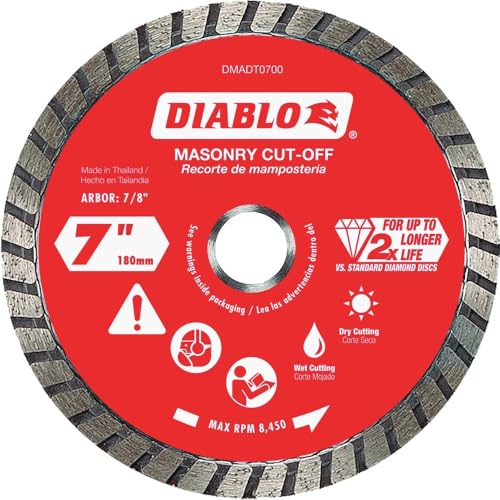
The Diablo DMADT0700 uses a continuous turbo rim design that delivers fast, precise cuts with a cleaner finish than segmented blades, making it the top choice for cutting brick, cinder block, and thin veneer stone where chipping is unacceptable. Its ultra-thin kerf of 0.09 inches reduces material waste and motor strain, while the hardened body absorbs vibration to prevent deflection in tough materials.
Engineered with a superior diamond edge bond, this blade lasts up to twice as long as standard diamond cut-off discs according to user reports — one reviewer cut through 1940s mud-set tile with thick mortar and the blade showed no signs of wear. The 7-inch diameter handles 13,280 RPM max, making it compatible with both corded and high-torque cordless angle grinders.
It ships with bushings for 7/8″, 20mm, and 5/8″ arbors, so it fits virtually any grinder on the market. For contractors cutting masonry all day who need a reliable, fast-cutting blade that won’t overheat, this is the professional standard.
Why it’s great
- Turbo rim produces clean, chip-free cuts in brick and block
- Up to 2x longer life than standard diamond discs
- Includes three arbor bushings for universal fit
Good to know
- Continuous rim can overheat in thick reinforced concrete
- Not ideal for deep, rapid cuts in heavy aggregate
3. Delta Diamond Boss Hog 7″ Turbo

The Delta Diamond Boss Hog is a 7-inch turbo blade that punches well above its price tier, with cooling holes that keep the blade running cool during continuous dry cutting — a feature usually reserved for blades costing twice as much. Users report cutting granite slab, stone veneer, and retaining wall blocks dry like “a hot knife through butter” with no deflection and minimal heat transfer to the material.
Its 0.09-inch kerf and DM-7/8″-5/8″ arbor fit standard angle grinders, and the 8,730 RPM max rating is safe for most masonry saws. One contractor noted it outperformed two other brands and lasted roughly 6 hours of continuous hard stone cutting before needing edge sharpening, which is exceptional for a mid-range blade.
Delta backs it with a lifetime warranty against warping, cracking, and separation — a confidence signal rare at this price point. For the homeowner or small contractor who needs one reliable blade for pavers, brick, and general concrete work, this is the smart mid-range buy.
Why it’s great
- Cooling holes enable extended dry cutting without overheating
- Lifetime warranty against defects and separation
- Cuts granite and hard stone with minimal chipping
Good to know
- Turbo rim can leave slight edge chipping on very thin veneer
- Some users report needing edge sharpening after 6 hours of hard stone
4. ORIXTREME 10″ Segmented Diamond Blade

The ORIXTREME 10-inch segmented blade fills the gap between small angle grinder discs and full-size 14-inch walk-behind blades, making it ideal for circular saws and masonry saws that need a general-purpose cutter for concrete, brick, block, and stone. Its 10mm segment height and premium diamond bond deliver fast cutting speed with low vibration, and users report it stays sharp for roughly 80 cuts through 2 5/8-inch brick before slowing.
The blade runs both wet and dry, and the slotted design improves airflow to clear dust and dissipate heat, preventing the glaze that kills cheaper blades. At a fraction of the cost of comparable blades from big-box retailers, the value proposition is clear — multiple customers confirm it performs as well as blades from Home Depot.
It operates on angle grinders and circular saws, though the 10-inch diameter means you need a saw rated for that size. For anyone cutting masonry with a larger saw who wants professional-level results without the professional price tag, this is a standout choice.
Why it’s great
- Outperforms blades costing 4x as much from big-box stores
- Low vibration and clean, chip-free cuts in brick and block
- Wet and dry compatible with good heat dissipation
Good to know
- Segment height is 10mm, shorter than premium 13mm blades
- Not recommended for cutting asphalt or green concrete
5. ORIXTREME 14″ Segmented Diamond Blade

When the job calls for deep cuts through reinforced concrete, the ORIXTREME 14-inch blade steps up with a 15mm segment height — 5mm taller than the 10-inch version — and a thicker 0.125-inch core that resists deflection under heavy load. Designed for circular saws, masonry saws, table saws, handheld electric saws, and road cutting machines, it handles the toughest materials with a 1″-20mm arbor bushing system.
The segmented rim design with 24 teeth clears slurry efficiently during wet cutting, and the premium bond matrix ensures fast cutting speed even when hitting rebar or aggregate. Users consistently report that it cuts as well as expensive alternatives for roughly half the price, with one reviewer noting it lasted through an entire job of 80+ cuts in 2 5/8-inch brick without needing replacement.
It is not recommended for asphalt or green concrete, but for cured concrete, block, brick, and stone, this blade delivers professional-grade performance at a mid-range cost. For anyone running a 14-inch saw regularly, this is the budget-savvy choice that doesn’t compromise on cut quality.
Why it’s great
- 15mm segment height offers long life in thick materials
- Thick 0.125-inch core resists wobble in deep cuts
- Compatible with multiple saw types via included bushings
Good to know
- Heavier than smaller blades at 1.75 kg
- Not suited for walk-behind saws with non-standard arbors
6. MASTER DEPOT 4-1/2″ Diamond Blade 3-Pack
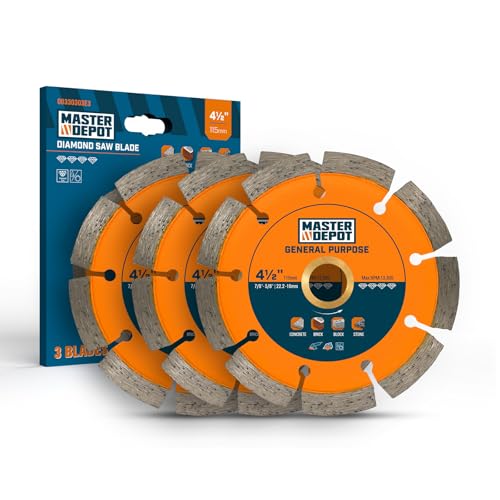
The MASTER DEPOT 3-pack of 4-1/2-inch segmented blades is the entry-level solution for DIYers and light contractors who need to cut concrete pavers, masonry, terrazzo, and stone with a standard angle grinder. The ultra-thin 1.2mm core reduces cutting resistance and motor strain, delivering fast, precise cuts with minimal vibration — ideal for the weekend paver project or small repair job.
Each blade uses a segmented rim with 10mm segment height and runs at a maximum of 13,300 RPM, fitting 7/8″-5/8″ arbors common on handheld grinders. Users report the blades cut concrete like butter when used with water, and one reviewer noted excellent control and smooth cuts on both soft and hard stones, with the first blade still going strong after multiple uses.
The three-pack means you have spares on hand when one eventually dulls, and the spark-free cutting with no burn marks is a safety bonus. For the occasional user who doesn’t want to invest heavily in a single premium blade, this pack offers tremendous utility at a fraction of the cost.
Why it’s great
- Ultra-thin 1.2mm core for fast, low-resistance cuts
- Three blades for the price of one premium option
- Spark-free with no burn marks during dry cuts
Good to know
- 10mm segments wear faster than taller premium options
- 4-1/2″ size limits cut depth to roughly 1.5 inches
7. Diamond Extreme Metal Cut Off Wheel 7″
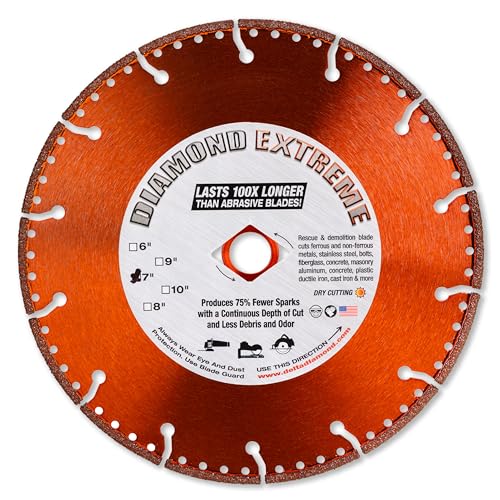
The Diamond Extreme Metal wheel is a specialty blade engineered for cutting through rebar, angle iron, steel conduit, and other metals embedded in concrete, using a vacuum-brazed diamond coating permanently bonded to a solid steel core. Unlike abrasive wheels that shrink as they wear, this blade maintains a consistent 0.110-inch kerf from start to finish, producing far fewer sparks and zero dust compared to traditional cut-off wheels.
Users report it outlasts up to 100 standard cut-off wheels — one reviewer used it for 8+ hours cutting 1/2-inch mild steel and grade 8 bolts, and the blade survived binding, drops, and aluminum use without damage. The 7-inch diameter with 7/8″-5/8″ arbor fits most angle grinders, and the 8,700 RPM max rating is standard for metal-cutting applications.
The trade-off is that it cuts slower initially than an abrasive wheel on thin material, but the durability means you only buy it once. For demolition work, property cleanup, or any job where you’re hitting rebar, pipes, or embedded steel, this blade eliminates the frustration of burning through consumables.
Why it’s great
- Lasts up to 100x longer than abrasive cut-off wheels
- Solid steel core won’t shatter like traditional wheels
- Constant depth of cut — does not shrink with use
Good to know
- Slower initial cut speed on thin metals compared to abrasives
- Higher upfront investment for a specialized use case
FAQ
Can I use a concrete cutting blade on a circular saw?
What’s the difference between wet and dry concrete cutting blades?
How do I know when to replace a concrete cutting blade?
Final Thoughts: The Verdict
For most users, the blade for concrete cutting winner is the Makita B-69624 because its 13mm segment height and optimized bond matrix deliver the best balance of speed, finish, and longevity for general concrete and masonry work. If you want a smoother, chip-free cut on brick and block, grab the Diablo DMADT0700. And for demolition work involving rebar or embedded steel, nothing beats the Diamond Extreme Metal blade.