
Our readers keep the lights on and my morning glass full of iced black tea. As an Amazon Associate, I earn from qualifying purchases.
Specs are compiled from manufacturer listings and verified buyer reviews and can change over time — please confirm the key details on the product page before buying.
Cutting composite decking isn’t like cutting wood. Use the wrong blade, and you will get melted, frayed edges that look terrible and waste expensive material. The secret is a blade with enough teeth and the right grind to slice through plastic and wood fibers without building up heat — that is exactly what each pick here does.
I’m Min — the founder and writer behind Gadgets Feed. This guide is built by comparing the manufacturers’ published specifications and the patterns across verified customer reviews, so you get each pick’s real strengths and trade-offs instead of marketing spin.
After comparing tooth counts, kerf designs, and buyer feedback across six models, here are the real-world picks for a blade for cutting composite decking that deliver clean edges without burn marks or premature dulling.
Quick Picks
- Diablo TrexBlade D0744CD — Top Performer
- Bosch DCB1072CD 10 In. 72 Tooth — Miter Saw Champ
- Norske Tools NCSBP226 7-1/4″ x 48T — Budget Champion
- Bosch DCB1284CD 12 In. 84 Tooth — Large Saw Specialist
- Norske Tools NCSBP228 10″ x 64T — 10-Inch Value
- DEWALT DWA31740 7-1/4″ 40 Tooth — Entry Level
How To Choose The Best Blade For Cutting Composite Decking
Composite decking is a mix of plastic and wood fibers, which means it melts under friction instead of splintering. The wrong blade gums up, burns the board, or leaves a rough edge you will have to sand. Here is what separates a great cut from a melted mess.
Tooth Count and Grind Type
You want at least 40 teeth on a 7-1/4 inch blade; more teeth mean more cutting edges touching the material at once, which reduces heat per tooth. A modified triple chip grind (MTCG) has alternating beveled and flat teeth that shear the plastic cleanly rather than tearing it. Blades below 40 teeth often leave a ragged finish on composites.
Kerf Thickness and Coating
A thin kerf (under about 0.080 inches) removes less material, which means less friction and cooler cuts. That matters because hot plastic re-welds itself behind the blade. A non-stick coating (often called Perma-SHIELD or Protection coating on these blades) stops the hot plastic resins from gluing themselves to the tooth faces, keeping cuts clean for the life of the blade.
Hook Angle and Blade Body
A negative or neutral hook angle (-3° to 0°) stops the blade from grabbing the material and pulling itself forward, which gives you more control on a miter or circular saw. An extra-hard steel body resists bending and deflection, keeping your cuts straight and true through long deck boards.
Quick Comparison
| Model | Best For | Diameter / Teeth | Arbor | Kerf | Amazon |
|---|---|---|---|---|---|
| Diablo TrexBlade D0744CD | Cleanest melt-free finish | 7-1/4″ / 44 | 5/8″ | 0.065″ | Amazon |
| Bosch DCB1072CD | High-tooth miter saw cuts | 10″ / 72 | 5/8″ | Thinner kerf | Amazon |
| Norske NCSBP226 | Budget-friendly 7-1/4″ performance | 7-1/4″ / 48 | 5/8″ | Ultra-thin kerf | Amazon |
| Bosch DCB1284CD | Large 12″ miter saws | 12″ / 84 | 1″ | Thinner kerf | Amazon |
| Norske NCSBP228 | 10″ saw with 64-tooth density | 10″ / 64 | 5/8″ | Ultra-thin kerf | Amazon |
| DEWALT DWA31740 | Entry-level composite cutting | 7-1/4″ / 40 | 5/8″ | Laser-cut plate | Amazon |
In‑Depth Reviews
1. Diablo TrexBlade D0744CD

The blade that buyers report cuts composite “like a hot knife through butter” — with zero melted edges.
This is the one that keeps coming up in buyer reviews as the go-to for clean finish cuts on composite decking. It uses a modified triple chip grind (MTCG) — alternating beveled and flat teeth that shear the plastic cleanly rather than dragging. The thin kerf is 0.065 inches, which means less material removed per pass and less friction, so the composite stays cool and you avoid the melted edge you see with standard wood blades.
One reviewer noted using it on Wear Deck composite dock material and said it leaves “perfect smooth edges.” A TiCo Hi-Density Carbide tip formulation resists wear from the abrasive glass fibers in composite boards, and the Perma-SHIELD non-stick coating stops the plastic resin from gumming up the tooth faces over time. At 9.6 ounces, it is light enough for an underpowered circular saw on a job site.
This Diablo has 44 teeth and a 0.065 kerf, designed for a 7-1/4 inch circular saw.
Why it wins
- 44 MTCG teeth give a melt-free finish on Trex and similar composites
- 0.065″ thin kerf reduces friction and saves saw power
- Perma-SHIELD coating prevents gumming from plastic resins
- Buyers consistently call it the “best blade for Trex”
What to know
- Fine plastic dust is heavy — one buyer mentioned it “makes one helluva mess” and says you need a vacuum plan
- 7-1/4″ size limits you to circular saws and smaller miter saws
Best for any composite deck job: If you want the cleanest possible cut on Trex, Fiberon, or Wear Deck composite boards, especially from a circular saw, this is the blade buyers swear by.
One real caveat: The ultra-thin kerf means the blade is more flexible than a thicker plate — keep your saw feed steady to avoid deflection on long cuts.
2. Bosch DCB1072CD 10 In. 72 Tooth

72 teeth per blade for butter-smooth miter-sawn ends.
If you are cutting composite on a 10-inch miter saw, this Bosch packs more teeth than any other blade on this list at the same diameter. More teeth mean more contact points and a lower chip load per tooth, which translates to a finer finish and less heat buildup. The triple chip grind tooth geometry specifically targets highly abrasive materials like composite decking.
A buyer who used it on a 360-square-foot Trex deck says they had “zero problems with any cut” and that the ends came out “smooth” with “no fraying of edges.” The Brute Carbide tip formulation, an upgraded C3/C4 micrograin carbide blend, resists impact damage from the occasional hidden nail or screw embedded in old framing. The extra-hard steel blade body resists bending so your cuts stay square on tight miters and riser cuts.
The Bosch has 72 teeth on a 10-inch blade, which gives it a fine finish on miter saws — but it demands a saw with a 10-inch capacity and more torque to spin that many teeth through dense material.
The big advantages
- 72 teeth produce the smoothest cut on 10″ miter saws
- Brute Carbide C3/C4 tips last longer in abrasive composites
- Thinner kerf design wastes less material per cut
- Owners mention clean edges with no fraying
Know this
- 10″ size only works on miter/table saws with a 10″ capacity — not on a 7-1/4″ circular saw
- High tooth count requires a saw with enough power to avoid bogging down
Perfect for miter-saw precision: Grab this if you want the finest possible finish on Trex boards cut on a 10-inch miter saw — it leaves edges so clean you won’t need to hit them with a router.
skip it if: You primarily cut with a circular saw — the 72 teeth will slow your feed rate and may bog a smaller saw.
3. Norske Tools NCSBP226 7-1/4″ x 48T

48 teeth at a budget-friendly price that gets the job done.
This Norske blade gives you 48 teeth on a 7-1/4 inch blade for roughly the same job. The modified triple chip grind (MTCG) tooth profile is designed specifically for composite decking and cellular PVC — the ultra-thin kerf removes less material, keeping the plastic content from melting during the cut.
One buyer wrote a detailed review saying they got “beautiful cuts on trex deck” for a 380-square-foot deck plus a 13-tread stair with fascia and edge boards, and the blade “was still like new” after all that work. That is a solid run for a budget-priced blade. The Protection Non-Stick coating reduces drag and protects against heat and gumming, so the teeth stay clear of melted plastic residue that would otherwise ruin the cut quality.
It weighs only 0.5 pounds, so it will not add noticeable vibration to your saw, and it fits any tool with a standard 5/8 inch bore — circular saws, jigsaws, and miter saws.
What works
- 48 MTCG teeth give clean cuts on Trex and composite
- Weighs just 0.5 lb — minimal vibration on any saw
- Customers note a full deck build with no visible wear afterward
- Non-stick coating protects against heat and gumming
One concern
- A small number of reviewers point out a carbide tooth detaching during use — inspect the blade before each job
Best entry-level composite blade: If you are doing one deck and don’t want to spend premium money, this Norske handles a 380-square-foot job and still looks fresh — real buyer experience backs that up.
What to watch: A few buyers had a tooth let go on new plastic lumber; inspect after each heavy cutting session to catch early damage.
4. Bosch DCB1284CD 12 In. 84 Tooth
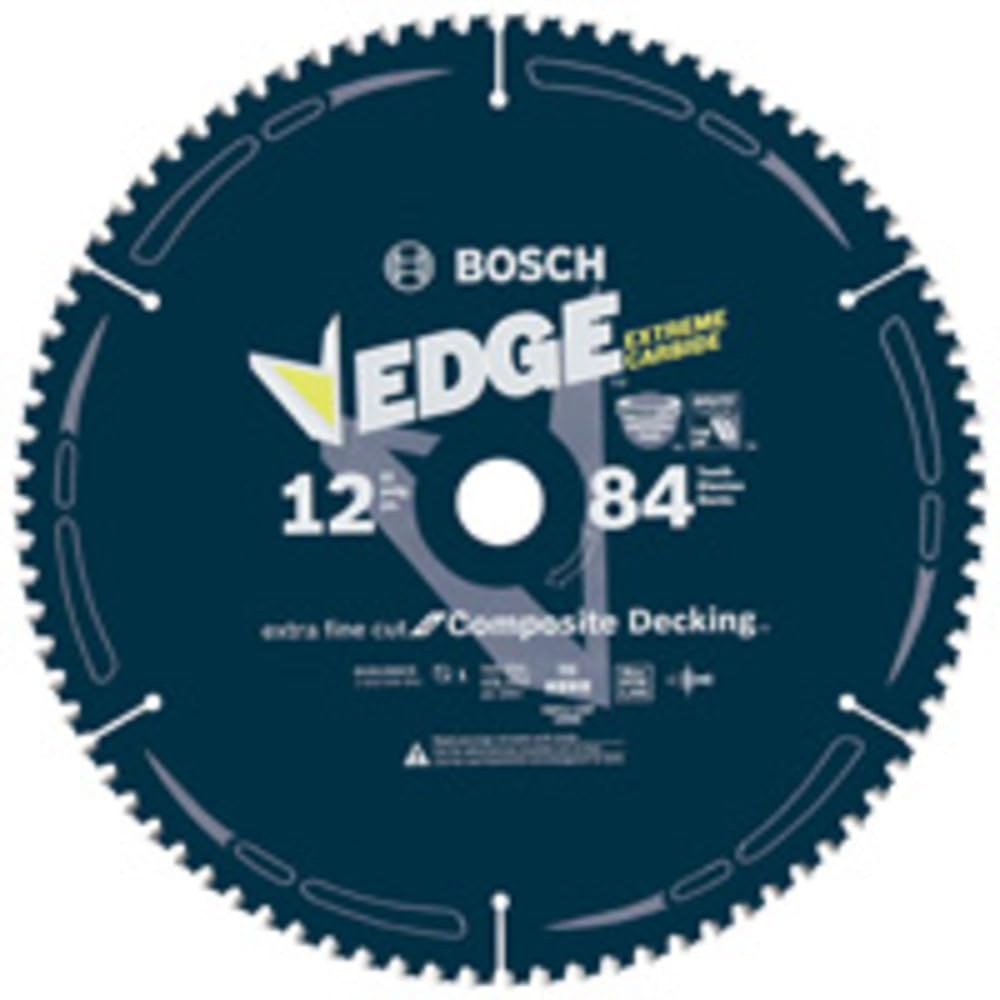
84 teeth on a 12-inch plate — designed for the specific demands of composite decking on large miter saws.
This is the largest-diameter blade in the lineup, with 84 teeth tune for 12-inch miter saws. It uses the same Brute Carbide C3/C4 micrograin tip formulation and triple chip grind tooth geometry as the 10-inch Bosch, but sized for bigger cuts. The extra-hard steel blade body resists bending and deflection, which matters when you are cross-cutting wide composite planks.
A buyer who used it on Trex Transcend decking reported “nice clean cuts” and said the blade “keeps a sharp edge after many cuts.” Another user noted the blade worked great for box joints, which shows the smooth cut quality extends beyond decking to other composite and plastic materials. The thinner kerf design means less waste and faster cuts even on a 12-inch saw.
On the other hand, one owner reported the blade dulled after approximately 100 cuts on a 350-square-foot deck, leaving rough edges toward the end — a reminder that even premium carbide needs a sharpening service or replacement after heavy use on abrasive composites.
Why it stands out
- 84 teeth deliver an exceptionally smooth finish on wide composite boards
- Brute Carbide tips offer impact resistance on framing nail encounters
- tune for 12″ miter saws — fits professional-grade saws
- Buyers praise clean cuts on Trex Transcend
Consider this
- One customer observed dulling after around 100 cuts on a 350-sq-ft deck — rough edges at the end
- 2.7 lb adds some weight; your saw must handle 12″ blades with a 1″ arbor
A solid match for 12-inch miter saws: If you already own a 12-inch miter saw and want a dedicated composite blade, this Bosch gives you 84 teeth for the smoothest possible finish on wide boards.
Heads up: On dense composite decks over 350 square feet, the edge may fade before the job finishes — keep a spare or plan a mid-job sharpening on very large builds.
5. Norske Tools NCSBP228 10″ x 64T

64 teeth on a 10-inch blade at a noticeably lower entry point.
This is the 10-inch big brother to the Norske NCSBP226, stepping up from 48 to 64 teeth while keeping the same modified triple chip grind profile. It is designed for composite decking materials and cellular PVC, and the ultra-thin kerf is designed to keep cuts cool and melt-free. The Protection Non-Stick coating fights heat and corrosion the same way the 7-1/4 inch model does.
A buyer who used this blade on a Trex deck with a miter saw reported “beautiful cuts” across 380 square feet and a 13-tread staircase, saying “not one bad cut” and the blade was “still like new.” The same positive feedback appears across multiple buyers who call it perfect for composite decking boards. It fits a standard 5/8 inch bore and is compatible with 10-inch miter saws and table saws.
This Norske has 64 teeth, and the price gap is noticeable. Both use MTCG geometry, but the Bosch uses a Brute Carbide tip that may hold an edge longer on very abrasive materials.
What it delivers
- 64 MTCG teeth for clean, melt-free cuts on 10″ saws
- Ultra-thin kerf reduces waste and friction
- Non-stick coating protects against gumming
- Buyers praise it for full-deck builds with no cut damage
Consider
- Some shoppers say a detached carbide tooth on new plastic lumber — inspect before heavy use
- Not as proven in extended longevity as the Bosch equivalent
A strong mid-range pick for 10-inch saws: If you want 64 teeth on a 10-inch blade without paying premium prices, this Norske has the right grind and buyers confirm it handles a full deck build.
Watch for: Like its 7-1/4 inch sibling, a small number of teeth have detached during use; check the blade before starting each day on a large job.
6. DEWALT DWA31740 7-1/4″ 40 Tooth
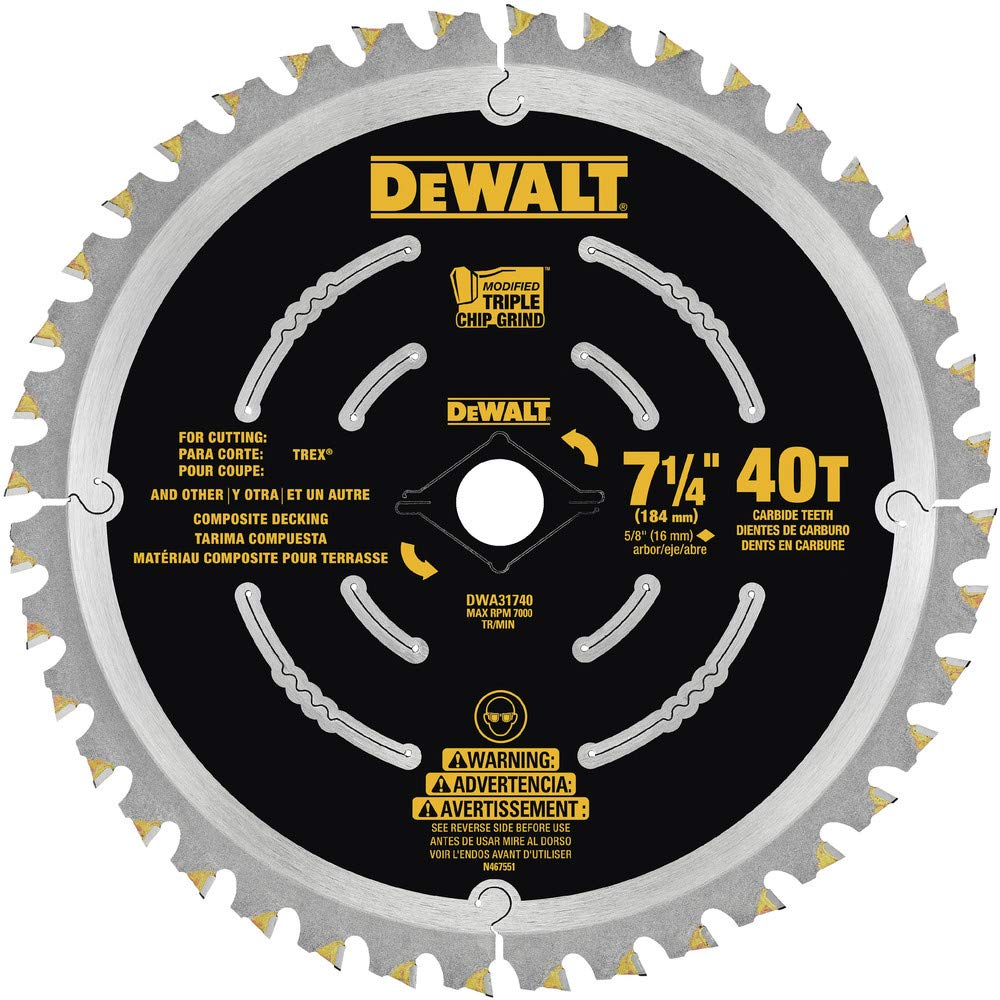
40 teeth — the lowest count here — but a reliable starting point if you already own DEWALT tools.
This DEWALT blade uses a modified triple chip grind tooth design and a laser-cut plate that is supposed to run cool for metal-free cuts. It has the fewest teeth of any blade on this list — 40 on a 7-1/4 inch blade — which means each tooth removes more material per pass, generating more heat. On thin composite boards that can mean a slightly rougher edge than the 44-tooth Diablo above.
Buyers report it works well on Trex planks and Race Deck plastic tiles. One reviewer called it a “great blade for cutting composite board.” However, a separate buyer noted it “did not stay sharp for very long” and said they “wish the blade was made better” — suggesting longevity is not its strong suit compared to the Diablo or Boschs. The laser-cut plate design is meant to reduce vibration, but with only 40 teeth the cut quality is a step below the higher-count options.
This DEWALT has 40 teeth and uses an MTCG profile, but lacks the non-stick coating that prevents gumming. If you already own DEWALT tools and need a blade now, it will cut composite, but the 48-tooth Norske NCSBP226 costs less and gives you a cleaner finish.
The positives
- MTCG tooth profile is correct for composite decking
- Laser-cut plate for cooler operation
- Fits any 7-1/4″ saw with a 5/8″ arbor
- Buyers confirm it works for Trex
The downsides
- 40 teeth produce a rougher edge than 44- to 72-tooth alternatives
- Does not have a non-stick coating, risking gumming on long cuts
- One user highlighted the edge dulled quickly
Only if you need a fast replacement: If you have a DEWALT circular saw and need a composite blade immediately, this will work — but it is the lowest-tooth option here and multiple competitors cut cleaner and last longer for similar money.
Look elsewhere if: Cut quality and longevity matter more than brand loyalty — the Diablo and Norske 48T both outperform this DEWALT at or near the same price.
Understanding the Specs
Modified Triple Chip Grind (MTCG)
This tooth pattern alternates between a beveled tooth and a flat tooth. The beveled tooth scores the plastic first, then the flat tooth shears the remaining material cleanly. Without MTCG, a standard blade tends to melt or chip composite decking because the plastic content re-welds behind the cut. Every blade on this list uses MTCG — that is the first thing to verify on any composite blade.
Kerf and a Non-Stick Coating
The kerf is the width of the cut the blade makes. A thinner kerf (like Diablo’s 0.065 inches) removes less material, so the saw needs less power and friction stays low — the plastic stays solid rather than melting. A non-stick coating (called Perma-SHIELD by Diablo, Protection by Norske) keeps the hot plastic resin from gluing itself to the carbide tips mid-cut. Without it, gummy residue builds up over the first few cuts and the blade starts burning instead of slicing.
FAQ
Can I use a regular wood-cutting blade on composite decking?
Why do composite blades need a high tooth count?
What does the non-stick coating actually do?
Will a 10-inch blade fit my circular saw?
How long does a composite decking blade typically last?
Why is my composite blade leaving melted edges?
Can composite blades be resharpened?
What is the difference between a composite blade and a plastic-cutting blade?
Final Thoughts: The Verdict
For most people building a composite deck, the best blade for cutting composite decking is the Diablo TrexBlade D0744CD because its 44 MTCG teeth, 0.065-inch thin kerf, and Perma-SHIELD coating give you the cleanest melt-free cut on a 7-1/4 inch saw at a price that undercuts most competitors. If you cut mostly on a 10-inch miter saw and want a finer finish, grab the Bosch DCB1072CD with 72 teeth. And for a one-deck project where you want to save money, the Norske NCSBP226 has 48 teeth and a non-stick coating that customers note still looks new after a full deck build.
How We Picked
We do not accept paid placement. Every pick is matched to a real buyer and a real use-case; we do not hands-on test units.
Sources & Methodology
Specifications: manufacturer listings and product documentation. Review insights: verified customer reviews, as of July 2026. Pricing: not shown on this page (it changes often); check the current price via the retailer link.
As an Amazon Associate, Gadgets Feed earns from qualifying purchases. This does not affect which products we feature.
Related Guides
Product prices and availability are accurate as of the date/time indicated and are subject to change. Any price and availability information displayed on Amazon at the time of purchase will apply to the purchase of this product. As an Amazon Associate I earn from qualifying purchases.
CERTAIN CONTENT THAT APPEARS ON THIS SITE COMES FROM AMAZON. THIS CONTENT IS PROVIDED "AS IS" AND IS SUBJECT TO CHANGE OR REMOVAL AT ANY TIME.
Amazon and the Amazon logo are trademarks of Amazon.com, Inc. or its affiliates.