
Cutting even a single piece of hardened steel can destroy a standard bi-metal blade in seconds, leaving you frustrated, wasting money, and breathing toxic fumes from burnt coatings. The difference between a clean, fast cut and a ruined workpiece is determined before you pull the trigger — by the exact blade geometry and carbide formulation designed for ferrous metals.
I’m Min — the co-founder and writer behind Gadgets Feed. I’ve spent hundreds of hours analyzing carbide-tipped tooth geometries, coating technologies, and real-world cutting data to separate the blades that deliver consistent burr-free cuts from those that disintegrate on the first pass through schedule-40 pipe.
The search for the right tool ends with this guide, which methodically dissects the construction, tooth count, and material compatibility of the best blade for cutting steel across every major saw platform and budget tier.
How To Choose The Best Blade For Cutting Steel
Selecting a steel-cutting blade is not about brand loyalty — it is about matching the tooth material, tooth count, and arbor size to your saw’s RPM and the thickness of the metal you are cutting. A blade optimized for 1/4-inch angle iron will fail on thin-gauge sheet metal and burn up on 1/2-inch rebar.
Carbide vs. Bi-Metal: The Tooth Material Decision
The single most important spec is the cutting-edge material. Standard bi-metal blades use high-speed steel teeth welded to a flexible back. Carbide-tipped blades use a much harder, wear-resistant carbide formulation that withstands the friction and heat generated when cutting stainless steel, cast iron, or hardened alloys. For any steel over 1/8-inch thickness, carbide is the only durable choice.
Tooth Count and Tooth Geometry (TPI and Grind)
Lower tooth counts (3 to 8 TPI) remove material fast and clear chips efficiently from thick stock but leave a rougher finish. Higher tooth counts (24 to 66 teeth) deliver burr-free edges suitable for welding prep but generate more heat and require slower feed rates. The grind also matters: a Triple-Chip Grind (TCG) fractures the material rather than scraping it, making it ideal for ferrous metals and long blade life.
Blade Body and Arbor Compatibility
Your saw’s arbor size and maximum RPM dictate what blades you can safely use. A 14-inch blade with a 1-inch arbor only fits a cold saw running at 1,300–1,800 RPM. A 4-1/2-inch cutoff wheel runs at 13,300 RPM on an angle grinder. Using a blade rated for a lower RPM on a high-speed saw creates a catastrophic failure risk. Always verify the blade’s max RPM against your tool’s no-load speed.
Quick Comparison
On smaller screens, swipe sideways to see the full table.
| Model | Category | Best For | Key Spec | Amazon |
|---|---|---|---|---|
| Diablo Steel Demon DS0608CF3 | Reciprocating Blade | Thick metal & hardened alloys | 3 TPI, 6” length, carbide-tipped | Amazon |
| DeWalt DWA7747 | Cold Saw Blade | Production fab shop cutting | 66 teeth, 14”, 1” arbor | Amazon |
| Evolution RAGE255Blade | Multi-Purpose Blade | Steel, wood, aluminum versatility | 28 teeth, 10”, 5/8” arbor | Amazon |
| Makita A-95037 | Circular Saw Blade | Cordless circular saw metal cutting | 30 teeth, 5-3/8”, thin kerf | Amazon |
| Makita A-96095 | Circular Saw Blade | General purpose metal cutting | 32 teeth, 5-7/8”, thin kerf | Amazon |
| Oshlun SBF-080048 | Cold/Miter Saw Blade | Mild steel & ferrous bar stock | 48 teeth, 8”, 5/8” arbor | Amazon |
| Lincoln Abrasives 100-Pack | Cut-Off Wheel | Angle grinder steel cutting | 4.5”, 0.040” thick, 13,300 RPM | Amazon |
In‑Depth Reviews
1. Diablo Steel Demon DS0608CF3
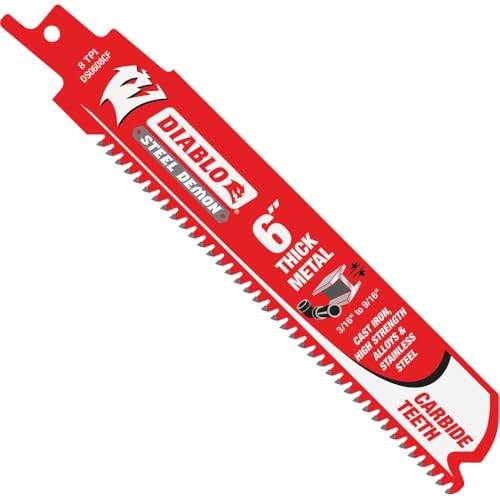
The Diablo Steel Demon is built around its TiCo Hi-Density Carbide formulation, which creates an ultra-hardened cutting edge capable of slicing through hardened steel sleeves, grade 8 bolts, and cast iron pipe that destroys bi-metal blades in seconds. Real users report cutting seized control arm bushing sleeves and multiple grade 8 bolts on a single blade — a testament to its 50X longer cutting claim over standard bimetal in extreme applications between 3/16 and 9/16 inch thickness.
The blade’s 1-inch oversized body reduces vibration and chatter, producing straighter cuts with less operator fatigue. A Perma-SHIELD non-stick coating resists heat buildup and prevents gumming, which is critical when you are plunging into thick steel where friction spikes instantly. Each pack includes three 6-inch blades with 3 TPI, optimized for aggressive material removal rather than finish quality.
If your daily reality involves cutting bolts, thick pipe, or automotive suspension components with a reciprocating saw, this is the only blade that delivers consistent results without requiring a break-in period or water cooling. It earns the top spot because it solves the specific pain of ruining blade after blade on hardened fasteners.
Why it’s great
- TiCo carbide tip cuts hardened steel and stainless that destroys bimetal blades
- Wide body and non-stick coating reduce vibration and heat for straighter cuts
- Multiple real-world user reports confirm 4–8 cuts on grade 8 bolts with a single blade
Good to know
- Designed specifically for reciprocating saws, not for circular or cold saw applications
- 3 TPI leaves a rougher cut surface compared to higher-tooth-count options
2. DeWalt DWA7747

The DeWalt DWA7747 is the heavyweight champion for production fab shops using a dry-cut cold saw. With 66 teeth on a 14-inch stiff plate and a tri-foil braze that absorbs cutting stress, this blade delivers burr-free cuts on 1/4-inch steel angle and square tubing straight out of the box. Professional fabricators report 500+ cuts per blade before needing a resharpening, and the blade can be resharpened multiple times until tooth loss occurs — giving it a longevity that disposable abrasive disks cannot touch.
The modified ATB tooth geometry ensures clean edges that require no secondary deburring before welding or riveting. This is not a blade for high-RPM abrasive saws — it is designed specifically for low-speed cold saws running around 1,300–1,800 RPM. Users also report excellent results on aluminum extrusions when lubricated with WD-40, making it a versatile shop workhorse despite its steel-focused design.
If you are cutting 1/8-inch to 3/8-inch steel tube, angle iron, or channel on a daily basis, the DWA7747 will pay for itself in reduced consumable costs and eliminated cleanup time. It is the closest thing to a permanent blade solution for a dry-cut metal saw.
Why it’s great
- 66-tooth stiff plate delivers clean, burr-free cuts ready for immediate welding
- Tri-foil braze technology extends tip retention and blade life through multiple sharpening cycles
- Proven 500+ cuts per blade in heavy 1/4-inch steel angle and tubing
Good to know
- Only compatible with low-speed cold saws (max 1,800 RPM); do not use on abrasive chop saws
- Premium pricing requires the saw platform investment; not for occasional home use
3. Evolution RAGE255Blade
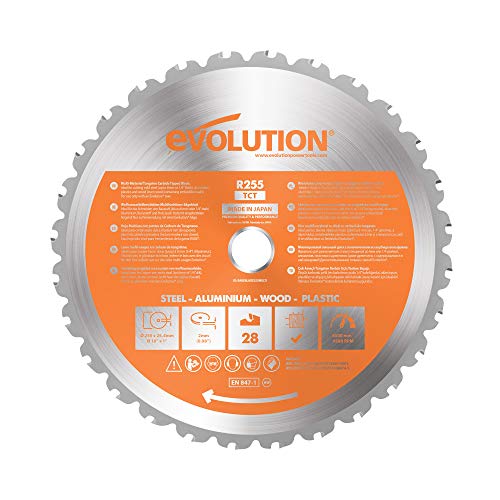
The Evolution RAGE255Blade is the oddball that actually works: a 10-inch, 28-tooth blade that cuts steel, aluminum, wood, and plastic without requiring coolant, producing virtually no sparks or burrs. Its dry-cut design means you can swap between framing lumber and schedule-40 steel pipe on the same saw without changing blades or dealing with messy cutting fluid. Users report 459 cuts through 2.5-inch oak followed by clean cuts through 3x3x3/16 carbon steel angle the next day on the same blade.
The key to its versatility is the carbide-tipped tooth geometry that delivers a cold cut — the blade stays cool enough to handle ferrous materials without the heat that normally destroys multi-purpose blades. It is designed for the Evolution RAGE3 saw but fits any 10-inch miter or chop saw with a 5/8-inch arbor. The trade-off is that the cutting edge does not hold sharpness as long as a dedicated steel-only blade, particularly on thicker wall material.
For the home shop or job site where you need one saw to cut everything without switching blades, this is the most economical path to clean steel cuts. Just accept that you will replace it more often than a dedicated ferrous-metal blade.
Why it’s great
- True dry-cut design cuts steel, wood, and aluminum without coolant or sparks
- 28-tooth geometry produces clean edges on tubing and angle iron with minimal burr
- Eliminates need for abrasive disks and the associated dust and noise
Good to know
- Edge sharpness does not last as long as dedicated ferrous-metal blades
- Best results require a slower feed rate on thick steel to prevent heat buildup
4. Makita A-95037

The Makita A-95037 is built for the specific scenario of cutting metal with a cordless circular saw. Its ultra-thin kerf design — 0.06-inch body thickness — reduces the cutting load on the motor, permitting more cuts per battery charge than standard metal-cutting blades. Real users confirm it cuts unistrut, all-thread rod, EMT conduit, and 26-gauge steel roofing with minimal heat, sparks, and dust compared to abrasive wheels, and it fits the Makita BCS550 and Milwaukee 18V circular saws without modification.
The 30-tooth carbide configuration strikes a balance between cut speed and finish quality on thin-gauge materials. Users report the blade lasts 2–3 months in daily construction use and 4–6 months in less intensive applications. The one catch: if the blade is not at full RPM when you start the cut, or if you bind it, carbide teeth can chip. This is also not a blade for masonry — impact with concrete will dull it instantly.
If you are a commercial electrician, plumber, or roofer cutting metal on ladders or in tight spaces with a battery saw, this blade transforms your cordless circular saw into a precision metal cutter that is far faster and cleaner than any abrasive wheel.
Why it’s great
- Thin kerf maximizes cuts per charge on cordless saws — ideal for battery efficiency
- Dry cuts on EMT, unistrut, and sheet metal with minimal heat and no sparks
- Individually hand-hammered steel plate ensures true, flat cuts
Good to know
- Carbide teeth can chip if blade is not at full RPM or if bind occurs mid-cut
- Only 5-3/8 inch size; not compatible with standard 7-1/4 inch circular saws
5. Makita A-96095

The Makita A-96095 is a 5-7/8-inch, 32-tooth carbide-tipped blade optimized specifically for Makita’s cordless metal cutting saw (XSC04Z). Its ultra-thin kerf design — 0.04-inch body thickness — minimizes material loss and motor drag while producing smooth cuts in 1/4-inch angle iron, steel sheet, and even 1/2-inch rebar. One professional roofer reported using just two of these blades to cut 3,000 square feet of heavy-gauge steel roofing, significantly outperforming composite blades that burn up and produce toxic fumes.
The modified triple-chip grind (TCG) increases cutting efficiency and blade life, and the fully hardened steel plates are individually hand-hammered for flatness and tension. The blade handles 1/4-inch hardened steel with ease, though like all thin-kerf carbide blades, it has a finite life and will eventually dull with extensive use on thick material. It is also worth noting that the 5-7/8-inch size limits aftermarket options, but for dedicated users of Makita’s metal saw platform, it is the correct factory fitment.
This is the blade to grab if you own the Makita cordless metal saw and need a reliable, long-lasting factory solution for cutting angle iron, sheet, and rebar all day on the job site.
Why it’s great
- Factory-optimized for Makita cordless metal saws for perfect RPM match and arbor fit
- Thin-kerf and TCG grind provides fast, clean cuts through 1/2-inch rebar and sheet metal
- Long lifespan on heavy-gauge roofing; proven 3,000 sq ft on two blades
Good to know
- 5-7/8 inch size limits compatibility to specific Makita saws and aftermarket options
- Will dull faster on very thick or hardened steel than a larger cold saw blade
6. Oshlun SBF-080048

The Oshlun SBF-080048 is a budget-friendly 8-inch, 48-tooth cold cut blade that punches above its price point for mild steel and ferrous materials. It uses professional-grade C-6 carbide with a triple-chip tooth grind and laser-cut expansion slots to manage heat, and it fits both Milwaukee and 8-1/4-inch saws with a 5/8-inch arbor. A user cutting 60 linear feet of 1/4-inch steel found it outperformed the stock Milwaukee blade in both cut quality and edge retention.
Where this blade saves you money is on applications where you need clean cuts on mild steel bar stock, angle, and tube without the premium price tag of a DeWalt or Evolution blade. The trade-off is that quality control can be hit-or-miss — one user reported a tooth shedding early on a first blade, while a second unit held up well. The good news is that resharpening the blade costs around , which transforms it into a phenomenal value with extended life.
If you are equipping a cold saw for a home shop or small fabrication business and need a capable steel blade without spending top dollar, the Oshlun delivers 80% of the performance at a fraction of the cost of premium competitors.
Why it’s great
- C-6 carbide and TCG grind produce clean cuts on mild steel and ferrous bar stock
- Laser-cut expansion slots manage heat for longer blade life during extended cuts
- Resharpening at transforms it into a long-term value blade
Good to know
- Quality control can vary — some users report early tooth loss
- Edge retention is good but not at the level of premium blades for heavy daily use
7. Lincoln Abrasives 100-Pack

The Lincoln Abrasives 100-pack of 4.5-inch cut-off wheels is the go-to solution when you need a high-volume, disposable blade for angle grinder steel cutting. Each wheel has a 0.040-inch thickness, a 7/8-inch arbor, and a maximum RPM of 13,300, making it compatible with standard 4.5-inch angle grinders. The aluminum oxide abrasive is fiberglass-reinforced for durability, and the wheels meet MPA-Hannover and EN 12413 quality certifications, providing a safety baseline that cheap unbranded wheels lack.
Users report that these wheels cut faster and cleaner than standard 1/16-inch discs, requiring less deburring on mild steel plate and old welds. The trade-off is that the thinner material is more fragile — some users experienced cracking when tightening the flange nut, though the wheels survived side-loading without exploding. For cutting 1/2-inch plate, light construction steel, and rusty salvage metal, these wheels deliver excellent longevity at a cost per disc that makes them nearly disposable.
If you burn through cut-off wheels on a weekly basis and need a reliable bulk supply that balances cutting speed, safety, and price, this 100-pack is the most practical entry-level option for angle grinder steel cutting.
Why it’s great
- 0.040-inch thin kerf cuts faster and cleaner than standard 1/16-inch discs
- Fiberglass-reinforced aluminum oxide construction meets EN 12413 safety standards
- Bulk pack of 100 reduces per-wheel cost for high-volume cutting
Good to know
- Thinner material is more susceptible to cracking during flange nut tightening
- Best suited for angle grinders; not a substitute for carbide-tipped circular saw blades
FAQ
Can I cut hardened steel with a standard bi-metal blade?
Why do my abrasive cut-off discs wear out so fast on steel?
What is the difference between a cold cut blade and an abrasive blade?
Final Thoughts: The Verdict
For most users, the best blade for cutting steel winner is the Diablo Steel Demon DS0608CF3 because its TiCo carbide tip and non-stick coating deliver unmatched longevity on hardened steel and thick alloys in a reciprocating saw. If you need burr-free, production-ready cuts from a cold saw, grab the DeWalt DWA7747. And for a cordless circular saw setup that maximizes battery life, nothing beats the Makita A-95037.