
The blade that came with your miter saw is a compromise—a concession to manufacturing costs, not to your craftsmanship. It can cut, sure, but it leaves rough edges, burns hardwoods, and wears out before you’ve finished the baseboards in a medium-sized house. Upgrading to a purpose-built blade is the single highest-return improvement you can make to your saw’s performance.
I’m Min — the co-founder and writer behind Gadgets Feed. My research process for this guide involved cross-referencing hundreds of verified buyer experiences against material-specific tooth geometry data, carbide tip formulations, and arbor compatibility specs to separate true performers from marketing claims.
Whether you need razor-sharp crosscuts for crown molding or a non-ferrous specialist for aluminum storefronts, the right blade for miter saw transforms a rough cut into a near-sanded finish. This guide breaks down the best options by tooth count, material, and real-world job site demands.
How To Choose The Best Blade For Miter Saw
The single biggest mistake beginners make is buying a general-purpose blade for everything. A 40-tooth ATB blade is fantastic for framing and rough crosscuts, but it will tear out veneers on plywood. A 96-tooth blade gives you a glassy finish but bogs down on thick pressure-treated 4x4s. The key is matching tooth count and grind type to your primary material.
Tooth Count and Grind Geometry
For pure crosscutting in hardwoods and softwoods, an Alternate Top Bevel (ATB) geometry with 60 to 80 teeth delivers the cleanest edges. If you need to rip as well, a hybrid ATB with 40 to 50 teeth is a better balance. For non-ferrous metals like aluminum, a Triple Chip Grind (TCG) with 80 to 96 teeth prevents burrs and extends blade life. A TCG blade on aluminum can last years if lubricated with WD-40 during cuts.
Carbide Tip Quality and Blade Body
The carbide grade matters more than the brand name. TiCo (titanium-cobalt) carbide blends like Freud’s Hi-Density formula hold an edge longer on abrasive materials such as MDF and particleboard. A hardened steel body with proper tensioning slots reduces vibration, which directly translates to straighter cuts and less binding. Look for a plate thickness of at least .071 inches on a 12-inch blade to prevent deflection under load.
Quick Comparison
On smaller screens, swipe sideways to see the full table.
| Model | Category | Best For | Key Spec | Amazon |
|---|---|---|---|---|
| Makita B-66977 10″ 80T | Premium | Ultra-smooth crosscuts in hardwoods | 80-tooth ATAFR grind | Amazon |
| DEWALT DWA112100 12″ 100T | Premium | Fine finish on trim and LVP flooring | 100-tooth ATB grind | Amazon |
| Freud LU85R012 12″ 96T | Premium | Flawless crosscuts, minimal tear-out | 96-tooth ATB 38-degree hook | Amazon |
| Diablo D1040X 10″ 40T | Mid-Range | General purpose, all-around work | 40-tooth ATB TiCo carbide | Amazon |
| Bosch DCB1244 12″ 44T | Mid-Range | Fast crosscuts, trim work | 44-tooth ATB Brute Carbide | Amazon |
| WEN BL1232-2 12″ Set | Value | Two-blade set for varied tasks | 32T & 80T combo pack | Amazon |
| Diablo D1296N 12″ 96T | Specialty | Non-ferrous metal cutting | 96-tooth TCG, -5° hook | Amazon |
In‑Depth Reviews
1. Makita B-66977 10″ 80T Carbide-Tipped Max Efficiency Miter Saw Blade
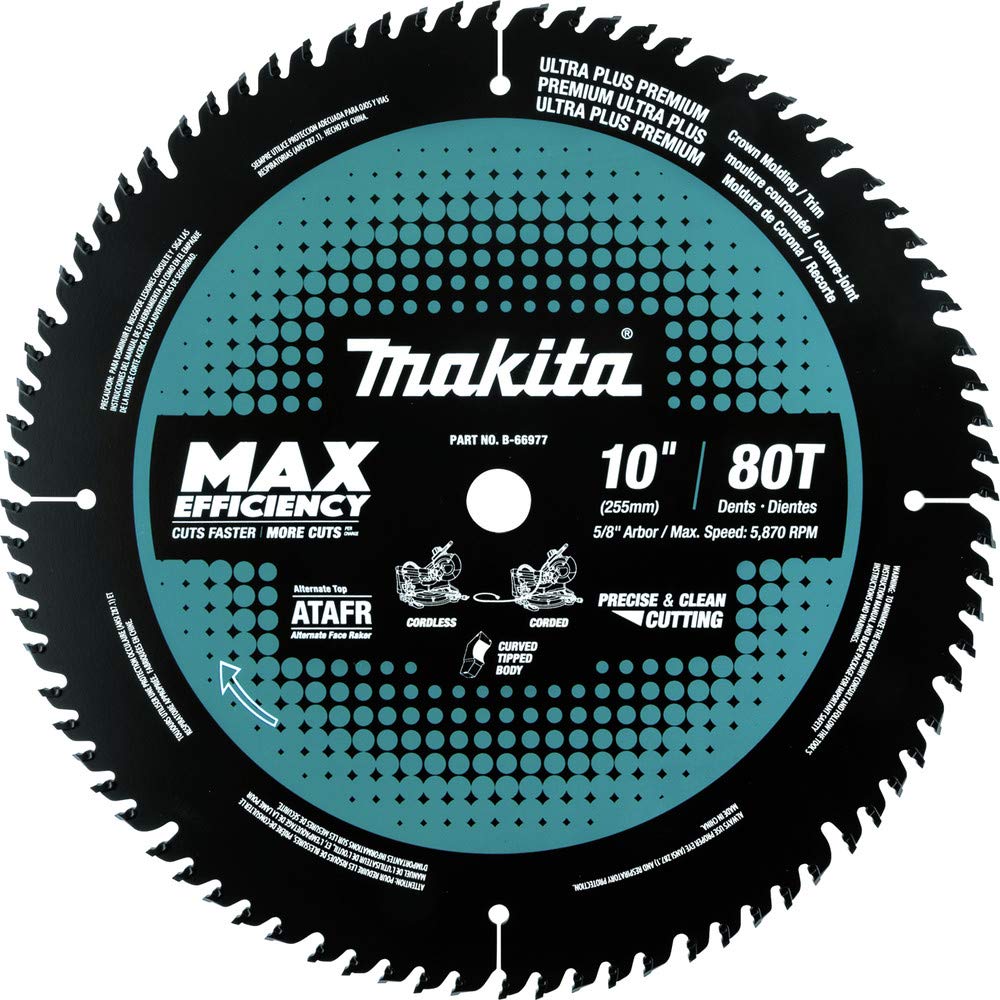
The Makita B-66977 uses an ATAFR (Alternate Top Alternate Face with Raker) carbide tip geometry that provides up to 100% faster cutting than standard blades while reducing motor load. Professional cabinet installers report that it cuts maple without visible blade marks, outperforming even 90-tooth competitors from other brands. The thin kerf design reduces drag on battery-powered miter saws, giving up to 30% more cuts per charge.
Users who upgraded from factory Milwaukee blades on the M18 10-inch miter saw found they could eliminate painter’s tape on plywood crosscuts—the finish was that clean. The blade handles 8/4 cherry and 1.75-inch butcher block with zero tear-out and minimal gumming, even after extended use.
At 0.75 kilograms, it’s lighter than many 80-tooth blades, which reduces strain on the saw’s arbor and bearings. The pre-applied T-9 treatment offers corrosion resistance out of the box. This is the blade for anyone who finishes hardwood trim daily.
Why it’s great
- ATAFR grind delivers mirror-smooth crosscuts on hard maple and cherry
- Thin kerf extends battery runtime significantly on cordless miter saws
- Outperforms 90-tooth Diablo with far less gumming and pitch buildup
Good to know
- 10-inch only; not available in 7-1/4″ or 12″ variants
- Not recommended for ripping thick stock—ATAFR geometry is crosscut-optimized
2. DEWALT Miter Saw Blade, 12 inch, 100 Tooth, Fine Finish (DWA112100)
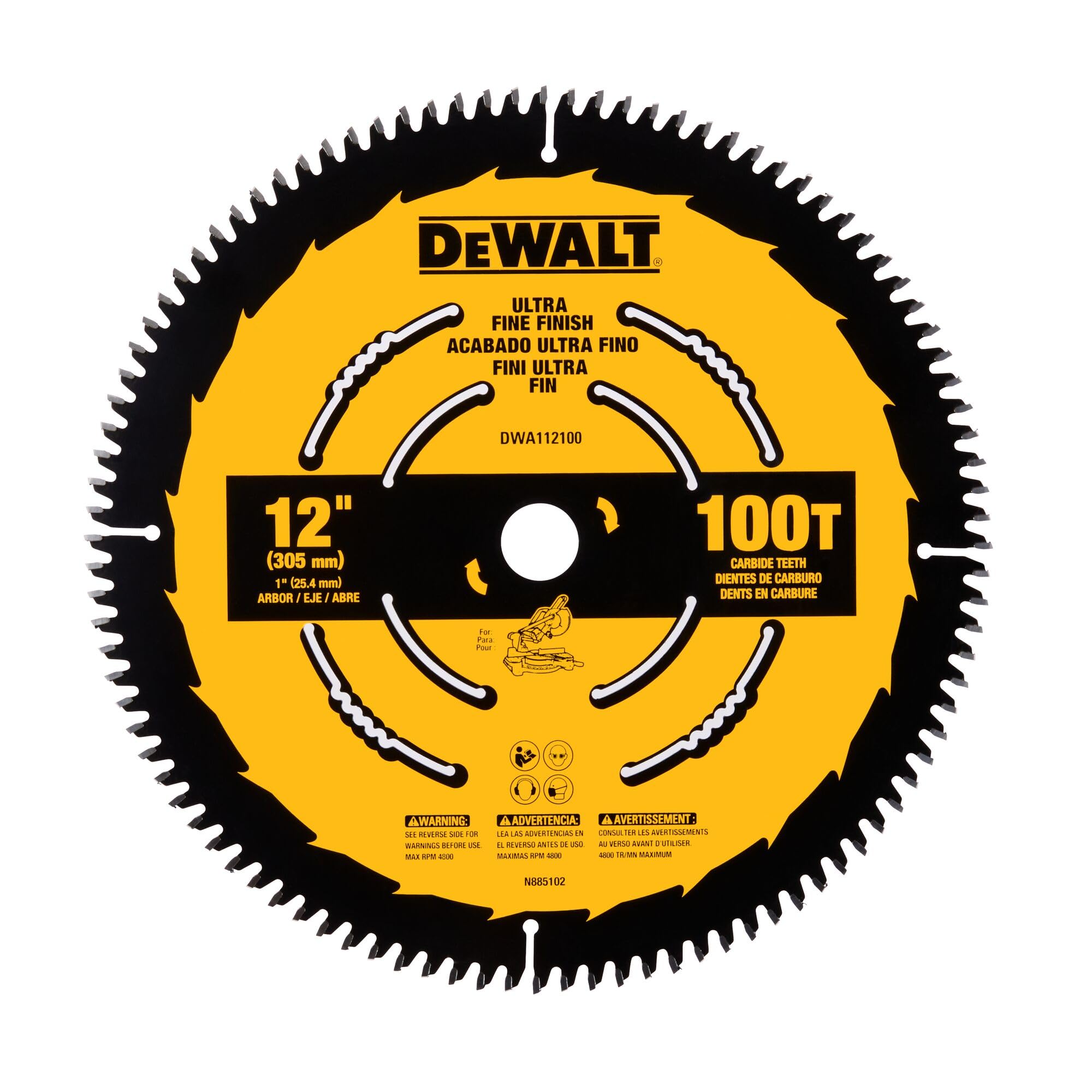
The DEWALT DWA112100 is engineered for finish work where chip-free edges are non-negotiable. With 100 teeth and ultra-sharp carbide, it produces cuts so clean on LVP (luxury vinyl plank) flooring that they require no sanding or filing before installation. The patented body slot design reduces vibration at high RPM, ensuring the blade tracks straight even through brittle materials.
Professional users report daily use over several months with no perceptible dulling, and the optimized tooth geometry maintains accuracy through hundreds of crown molding and baseboard cuts. At 2.73 pounds, it has substantial mass that helps stabilize the cutting arc on 12-inch dual-bevel compound miter saws.
The ultra-sharp carbide tips are brittle by design—do not use this blade for ripping or cutting metal. It is a crosscut specialist that excels on hardwoods, plywood, melamine, and engineered floorings. The anti-friction coating prevents resin buildup during repetitive cuts.
Why it’s great
- 100-tooth count provides near-zero tear-out on veneers and LVP
- Patented slot dampening makes it exceptionally quiet during high-speed cuts
- Carbide edge retention lasts through months of daily finish work
Good to know
- Not suitable for ripping or cutting any metal materials
- Heavier blade requires motor to spin up slower—check saw RPM rating
3. Freud LU85R012: 12″ Carbide Tipped Saw Blade for Crosscutting
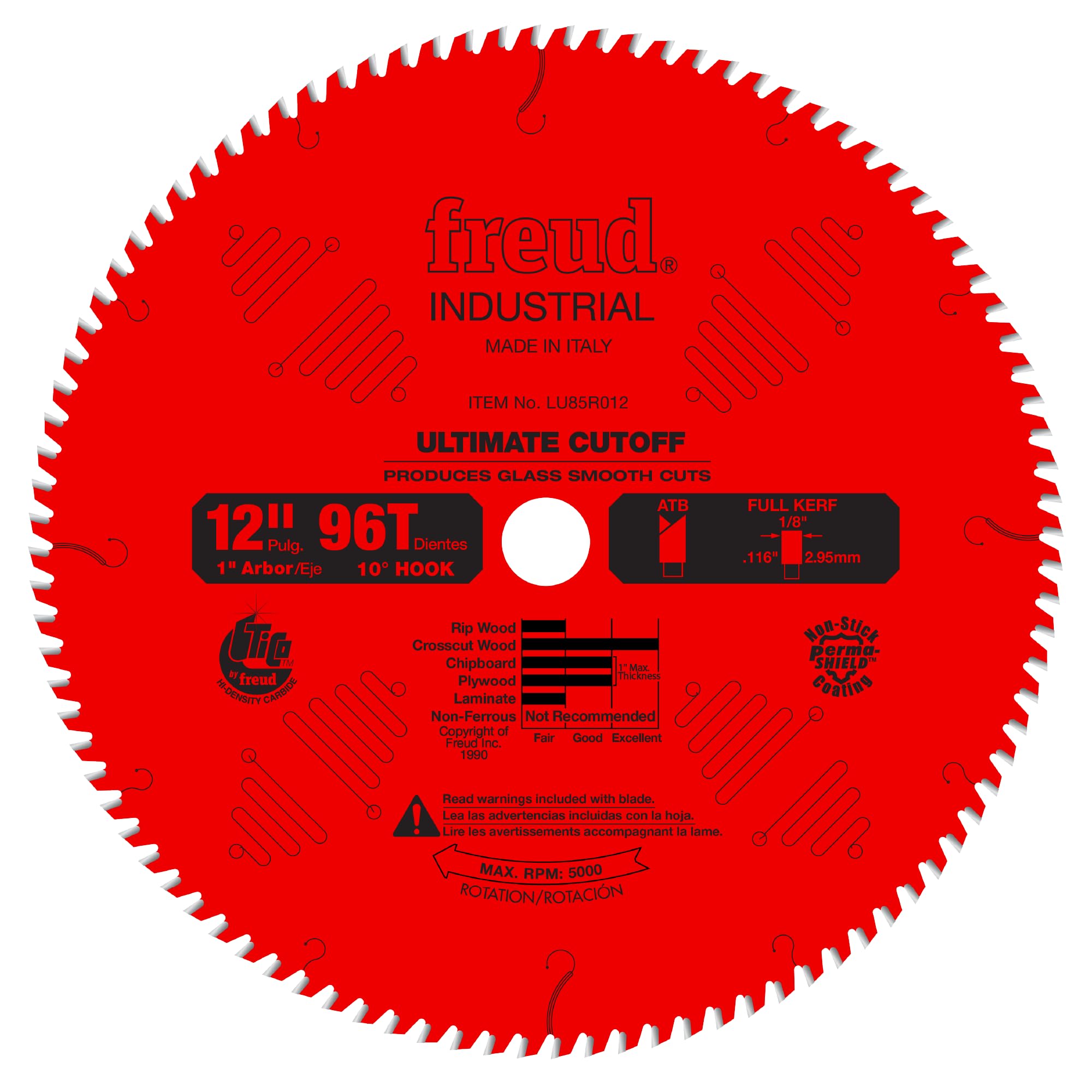
The Freud LU85R012 is a masterclass in crosscut engineering. It features a 38-degree ATB grind with a positive hook angle that pulls material through the blade aggressively, reducing the feed force required. The 48 Rockwell steel plate is laser-cut and precision-tensioned to remain true for the blade’s entire lifespan, which is critical for achieving glue-ready miter joints.
Freud’s Silver I.C.E. (Industrial Cooling Enhancement) coating actively manages heat and prevents rust, while the Perma-Shield non-stick layer stops pitch from welding to the teeth during resinous softwood cuts. Tri-Metal Shock-Resistant brazing ensures the carbide tips survive accidental contact with embedded nails—a common job-site reality.
At 3 pounds and a .098-inch plate thickness, this blade has the stiffness to resist deflection even under heavy feeds. Users consistently report glass-smooth cuts requiring zero sanding on end-grain joints. It is a premium investment that rewards users who demand show-quality cut surfaces daily.
Why it’s great
- 38-degree ATB hook angle reduces motor strain and delivers ultra-clean crosscuts
- 48 Rockwell steel plate with anti-vibration slots stays flat indefinitely
- I.C.E. coating prevents corrosion and heat-related blade damage
Good to know
- 12-inch only; premium price reflects professional-grade carbide and steel
- Positive hook angle not recommended for thin-kerf cordless saws
4. Diablo 10-Inch 40-Tooth ATB General Purpose Saw Blade (D1040X)

The Diablo D1040X is the workhorse of the miter saw world. Its 40-tooth ATB grind provides a legitimate all-around performance—clean enough for crosscuts, aggressive enough for ripping. Users routinely report cut finishes that rival 60-tooth blades, thanks to the TiCo Hi-Density carbide formulation that stays sharp through pressure-treated lumber and engineered wood alike.
One user documented cutting 192 pressure-treated 5/4×6 boards (doubled) and 72 1×4 boards on a single blade with no perceptible degradation in cut quality. The Perma-Shield non-stick coating prevents gumming, and the super-thin laser-cut kerf minimizes material waste while delivering smooth, quiet operation.
The blade weighs only 0.4 pounds, making it exceptionally light on the arbor. This is the blade for anyone who needs one blade to do everything—framing, decking, shelving, and general finish work—without swapping between cuts. It’s the highest-performing budget-friendly option available.
Why it’s great
- TiCo carbide stays sharp through hundreds of pressure-treated lumber cuts
- Lightweight design reduces arbor wear and motor load
- ATB geometry works for both crosscuts and light ripping
Good to know
- Not for ultra-fine finish work—grain tear may appear on figured maple
- Red Perma-Shield coating can transfer onto stock in rare cases
5. BOSCH DCB1244 12 In. 44 Tooth Daredevil Table and Miter Saw Blade

The Bosch DCB1244 uses a Brute Carbide C3/C4 micro-grain formulation that resists chipping better than standard carbides, making it a strong candidate for demolition-style cuts where hidden nails and staples are possible. The 44-tooth ATB geometry is tuned for fast crosscuts and general trim work, with a Speed Coat anti-friction finish that prevents burning even during dense hardwood cuts.
Users rave about how much quieter this blade runs compared to stock saw blades. One user reported that it made their old saw feel “young and spry,” and another noted it was the best upgrade they made to their 7-1/4-inch cordless miter saw. The thinner kerf reduces waste and feed effort significantly.
While some users mistakenly recommend this as a ripping blade for table saws, it is properly designed for crosscutting on miter and table saws. It is a durable, smooth-cutting option for the weekend handyman who wants dependable performance without the premium price tag.
Why it’s great
- Brute Carbide formulation resists shock from accidental nail contact
- Speed Coat prevents burn marks on dense oak and maple
- Quiet operation compared to entry-level and stock blades
Good to know
- 44 teeth means it leaves a rougher finish than 60T+ blades on veneers
- Not recommended for ripping lumber despite some user claims
6. WEN BL1232-2 12-Inch 32-Tooth and 80-Tooth Carbide-Tipped Saw Blade Set

The WEN BL1232-2 delivers two blades at an entry-level-friendly price: a 32-tooth general-purpose blade for framing and a 80-tooth fine-finish blade for trimming and cabinetry. Both blades feature an ultra-thin 1/10-inch kerf (2.6 mm) that reduces waste and allows clean, efficient cuts through hard and softwoods. The 1-inch arbor fits standard 12-inch miter saws, jobsite saws, and table saws.
Users report that the 80-tooth blade produces very clean cuts even after 100+ crosscuts in cedar tongue-and-groove installations. The 32-tooth blade handles rough framing work with minimal splintering, making this set versatile for users who switch between rough and finish woodworking frequently. The blades are rated for up to 6,000 RPM, covering the vast majority of miter saws on the market.
At 2.29 kilograms for the pair, this set offers significant value but the carbide tips are not at the same grade as premium options. They will dull faster on abrasive materials like MDF or pressure-treated lumber. For standard dimensional lumber and pine trim, however, they deliver impressive cut quality for the cost.
Why it’s great
- Two blades (32T and 80T) cover both rough and finish work
- Ultra-thin kerf design minimizes waste and motor strain
- Excellent cut cleanliness on cedar, pine, and dry hardwoods
Good to know
- Carbide grade less durable than TiCo or premium blends
- Not recommended for heavy-duty or abrasive material cuts
7. Diablo Saw Blade for Medium Aluminum – 12″ Diameter, 96 TCG Teeth (D1296N)

The Diablo D1296N is purpose-built for non-ferrous metal cutting. Its Triple Chip Grind (TCG) tooth design produces clean, burr-free finishes on aluminum extrusions, copper tubing, brass stock, and fiberglass. The -5° negative hook angle prevents the blade from self-feeding, giving the user full control when cutting through thick aluminum, which is essential for safety and accuracy.
Users report mirror-smooth cuts on 14-inch by 1/2-inch aluminum plate when using water cooling, and clean cuts on aluminum picture frame stock and piano hinge material without any burr cleanup. The Tri-Metal Shock-Resistant brazing allows the carbide tips to survive the vibration inherent in aluminum cutting, while the Perma-Shield coating prevents aluminum build-up on the teeth.
Some users note that Amazon packaging may mislabel this blade—always verify the blade’s part number (D1296N) on the blade body before installing. A small application of WD-40 during cuts improves finish quality and reduces friction. This blade is a specialized necessity for anyone regularly cutting aluminum or other non-ferrous metals.
Why it’s great
- TCG grind eliminates burrs on aluminum, copper, and brass
- Negative hook angle prevents dangerous self-feeding on metal cuts
- Perma-Shield coating prevents chip welding and pitch buildup
Good to know
- Designed for non-ferrous only—will burn or dull rapidly on steel
- Check blade body stamp carefully for correct model number
FAQ
Can I use a 12-inch blade on a 10-inch miter saw?
How many teeth do I need for cutting hardwood trim?
Is a negative hook blade necessary for cutting aluminum?
Can I sharpen a carbide-tipped miter saw blade at home?
Final Thoughts: The Verdict
For most users, the blade for miter saw winner is the Makita B-66977 10″ 80T because its ATAFR grind delivers near-flawless crosscuts on hardwoods while extending battery life on cordless saws. If you need a premium finish for LVP flooring and trim, grab the DEWALT DWA112100 12″ 100T. And for cutting aluminum or other non-ferrous metals, nothing beats the Diablo D1296N 12″ 96T TCG.