
Our readers keep the lights on and my morning glass full of iced black tea. As an Amazon Associate, I earn from qualifying purchases.
Specs are compiled from manufacturer listings and verified buyer reviews and can change over time — please confirm the key details on the product page before buying.
Waking up with numb, aching, or hypersensitive toes because your heavy comforter presses down all night is a real problem — and a blanket lifter for feet is the simple fix. This guide breaks down the best steel and aluminum frames that create a protective tent over your feet, so you get the warmth of covers without the crushing weight. You’ll learn which height range fits your mattress, which materials stay sturdy under heavy quilts, and how to tell a genuinely stable frame from one that slips.
I’m Min — the founder and writer behind Gadgets Feed. This guide is built by comparing the manufacturers’ published specifications and the patterns across verified customer reviews, so you get each pick’s real strengths and trade-offs instead of marketing spin.
Still, choosing the wrong one means a bar that’s too short, too flimsy, or too tall for your bed. This guide sorts through the noise so you find the right blanket lifter for feet that keeps your toes free without turning your bed into a tent.
Our Picks at a Glance


How To Choose The Best Blanket Lifter For Feet
Choosing a blanket lifter is really about matching three things: your mattress thickness, the weight of your bedding, and how much foot room you want. Getting these right means a restful night; getting them wrong means a wobbly bar or cold feet.
Height Range and Mattress Thickness
Most lifters adjust between roughly 23 and 34 inches, but the actual clearance above your mattress depends on how thick that mattress is. A thicker mattress eats into the frame’s effective height. If you have a very thick or pillow-top mattress, look for a taller maximum range — the QWORK extends to 32 inches and owners with thick mattresses say it still leaves enough room to move your feet freely.
Frame Material and Sturdiness
Heavy comforters need a frame that won’t flex or bend. The strongest options use 1″ diameter steel or carbon steel tubes. Aluminum is lighter and easier to move, but some buyers find it less rigid under a heavy down comforter. Consider what you sleep under — a thin sheet needs far less support than a heavy quilt.
Placement and Stability
Most designs tuck between the mattress and box spring, which anchors them without tools. Some frames can also stand on the floor for lower beds. Look for spring-button locks, which let you adjust height without fiddling with screws. Included clips are a huge bonus — they keep the blanket draped over the frame so it doesn’t slide down onto your toes in the middle of the night.
Assembly and Weight
Tool-free assembly with spring buttons is the norm on modern lifter frames. You’ll want something lightweight enough to move between rooms, but heavy enough to feel stable. Steel is the sturdiest, while aluminum is easier to lift and reposition. Check what tools are included before you buy.
Quick Comparison
| Model | Best For | Height Range | Material | Included Clips | Amazon |
|---|---|---|---|---|---|
| Vive Blanket Lifter★ Best Overall | Overall durability and balance | 26″–34″ | Stainless Steel | Yes (2) | Amazon |
| DePango Blanket LifterBest Value | Tool-free quick setup | 26″–33″ | Aluminum Alloy | Yes (4) | Amazon |
| Koociri Bed CradlePro Grade | Heavy-duty stability + bonus strap | 26″–33″ | 1″ Carbon Steel | Yes (4) | Amazon |
| ROYALAY Foot Lift Pad | Soft cushioning, not a frame | — | Polyester Foam | No | Amazon |
| Zelen LifeRiser | Wide double-bed coverage | 26.1″–33.8″ | Alloy Steel | No | Amazon |
| DMI Blanket Lifter | Budget-friendly basic option | Up to 19″ | Chrome Steel | No | Amazon |
| Performe Lifter | High adjustability range | 23″–31″ | Steel/Aluminum | Yes (2) | Amazon |
| QWORK Blanket Lifter | Thick mattresses | 24″–32″ | Heavy-duty Steel | No | Amazon |
| HEPO Blanket Lifter | Fine height tuning | 25″–33″ (10 settings) | 1″ Aluminum | Yes (4) | Amazon |
In‑Depth Reviews
1. Vive Blanket Lifter for Feet
Our pick — over 4★ from 150+ verified ratings; the strongest balance of quality and price.
A sturdy steel frame balancing height, weight, and rock-solid support.
The Vive earns the top spot because it nails the basics that matter most: a strong stainless steel frame and an adjustable height from 26” to 34”. That range lets you dial in exactly how much foot room you want, whether you’re recovering from surgery or just hate the feeling of covers brushing your toes. At 16 ounces, it’s light enough to move around the bed without a struggle, yet buyers report it holds heavy blankets and comforters with ease.
Assembly is genuinely tool-friendly — everything you need comes in the box, with push-button height adjustment. Buyers consistently praise how simple it is to put together before a foot surgery. The two large clips that come included do a great job of keeping your blanket draped over the frame instead of collapsing onto your feet. As owners put it: “I finally don’t have heavy covers hurting my very sensitive toes!”
You get a sturdier feel under a heavy comforter than the lighter aluminum DePango below, because this frame uses steel. The trade-off: some owners say it sits too tall at the lowest setting for very thick mattresses, and a couple of buyers noted protruding bolt nuts could rub against the mattress — a quick fix with plastic tubing.
Why It Wins Owners Over
- Very sturdy stainless steel holds heavy comforters without bending
- Easy solo assembly — reviewers did it before foot surgery
- 48″ max height gives generous room for movement
Honest Caveats
- Some find it too tall even at the lowest setting on thick mattresses
- A few noted the bolt nuts can wear on the mattress
The Balanced Pick: Best if you want a sturdy, lightweight steel frame that’s adjustable enough for most beds.
Consider Otherwise: If you have a very thick pillow-top mattress, you may want a frame with a shorter minimum height.
2. DePango Blanket Lifter
A lightweight aluminum frame that sets up in minutes with zero tools.
The DePango is the pick for anyone who wants the benefit of a blanket lifter without the hassle of assembly. It extends from 26 to 33 inches, covering mattresses 6 to 18 inches thick, and the spring-button locking mechanism means you adjust height in seconds. The heavy-duty aluminum alloy frame is coated with a solid paint finish, and the L-shape design keeps things stable even when you move around.
It includes four clips to secure your sheets and blankets, so you do not have to buy extras. Owners mention it stays in place far better than the pillows they used to prop up, and assembly takes just 2-3 minutes. Customers note it works much better than pillows and stays put through the night.
The honest trade-off is that it wobbles slightly when you shift the bedclothes — though reviewers are quick to note it doesn’t make the frame any less stable. Also, because it’s aluminum, it’s not quite as rigid as the carbon steel Koociri below under a very heavy comforter. One owner noted it’s narrow enough that you might want two for a split king bed.
The Fast Setup Advantage
- Tool-free, 2-3 minute assembly with instructional video
- Four included clips keep bedding from shifting
- Lightweight and portable for easy repositioning
Know Before You Buy
- Not compatible with articulated (adjustable) beds
- Narrow width may only cover half a split king
Reach For It If: You want a quick, tool-free setup with four clips and a lightweight frame that’s easy to move.
Look Elsewhere If: You have an adjustable bed frame, or you need maximum rigidity for an extra-heavy down comforter.
3. Koociri Bed Cradle with Leg Lifter Strap
The heaviest-duty steel cradle with a bonus leg strap for recovery.
If you want the sturdiest frame on this list for heavy blankets, the Koociri is built from a solid 1″ diameter carbon steel tube. That construction delivers noticeably better stability than lighter aluminum tubes, which matters if you sleep under a weighted blanket or thick quilt. It extends from 26 to 33 inches, and the spring-button connections mean no screws or nuts — just push and lock.
What makes this a standout recovery pick is the included 42-inch nylon leg lifter strap. The handgrip is padded with a sponge cover, and the foot loop uses a non-slip sponge pad so it’s comfortable even on bare feet. That makes it a genuinely useful aid for anyone who recently had knee replacement surgery or struggles to move their legs independently. It’s also FSA or HSA eligible.
Chemotherapy patients with hypersensitive feet report the Koociri keeps blankets off their toes with ample foot room. It comes with four strong clamp clips to stop sheets from shifting. The one caveat is that the clear arrow stickers on the tubes help you understand assembly, but the manual might still be confusing for someone in their 80s — so it’s better for a caregiver to set up.
The Recovery Edge: Tool-free assembly, four clips, and a padded leg lifter strap make this the most complete recovery kit here.
The One Catch: The assembly directions can be confusing for elderly users to figure out on their own.
4. QWORK Blanket Lifter
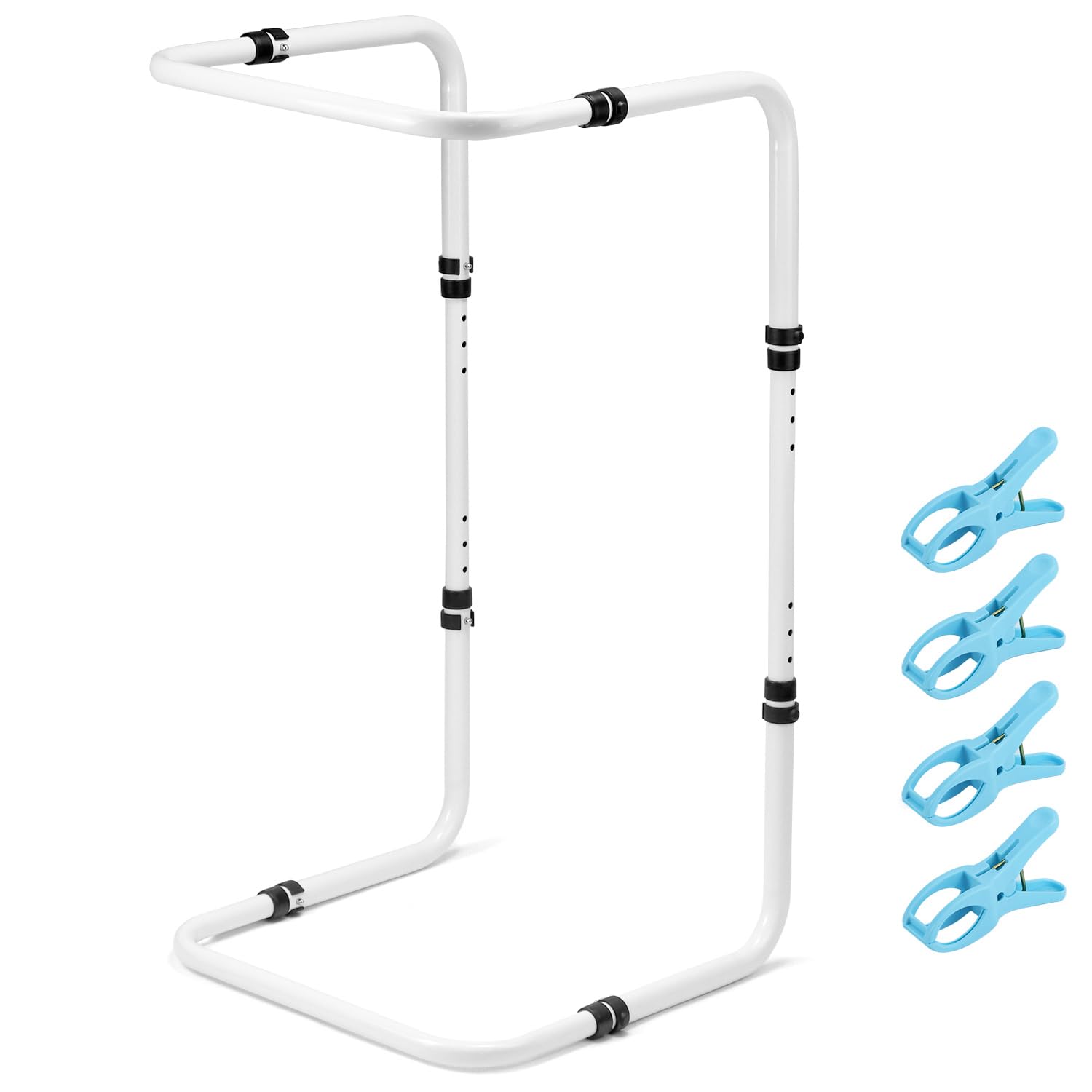
The go-to frame for thick mattresses that reduce clearance.
Thick mattresses are the enemy of most blanket lifters, because the frame’s height gets swallowed by the mattress itself. The QWORK tackles this with a 24 to 32-inch adjustable range, and owners with thick mattresses say it’s the only one they’ve found that still leaves enough room for their feet to move freely. One reviewer even noted it’s strong enough to lean on.
The heavy-duty steel construction handles the weight of heavy blankets and comforters without issue. It’s designed specifically for the foot area only, so it creates a comfortable space for your legs without trying to lift the whole bed. Placement is flexible — slide it under the mattress at the side or end, or stand it on the floor. Assembly and disassembly are straightforward.
The caveat here is coverage. One reviewer noted that you really do need two of them for a queen-size bed unless you don’t move at all, and you might want to add some padding to the bars. The review pages sum it up well: it works great, but it’s not a set-and-forget solution. It fits twin, full, and queen beds best.
Built For Deep Mattresses: The 32″ max height leaves real foot room even on thick mattresses where others fall short.
Plan On This: Buy two for a queen bed, and consider zip-ties or pool noodles for added padding on adjustable frames.
5. HEPO Blanket Lifter

Ten precise height settings for the perfect foot tent.
The HEPO is for the finicky sleeper who wants exact control over height. Instead of a few coarse settings, it offers 10 spring-button adjustments across a 25″ to 33″ range. That fine-tuning lets you find the perfect space for your feet — not too cramped, not so tall that cold air rushes in. The 1″ diameter aluminum tube is coated with a powder finish to resist rust and corrosion.
The HEPO is a top choice for neuropathy and restless legs sufferers. The four included clamps keep covers raised without you having to re-tuck them, and it works on one side of a queen bed without affecting the other side — which is great if only one partner needs it. The tool-free assembly is quick, with no screws or nuts required.
The trade-offs are minor but real. A few owners wish it were about 12 inches wider and a bit shorter, and the clamps are described as mediocre by some. It’s also one of the pricier options here, so it’s worth it only if you actually use all those height settings.
Fine-Tuned Comfort: Ten height settings give you the most precise control over your foot tent.
Value Check: It’s premium-priced — worth it if you’ll use the adjustability, but the clamps aren’t the strongest we’ve seen.
6. Zelen LifeRiser Blanket Lifter

A wide alloy steel frame that spans a double bed comfortably.
The Zelen stands out for its width. Owners using it on a double bed say the bars are wide enough to cover their whole foot area, which is more than some narrower competitors manage. Made from heavy-duty alloy steel, the two-part frame is strong enough to hold heavy blankets and comforters. The adjustable range extends from 26.1 to 33.8 inches.
It’s easy to install and disassemble, and you can slide it under the mattress from either side or the end of the bed. It fits twin, full, queen, and king sizes, and can be placed on the floor if needed. Neuropathy sufferers find the Zelen keeps covers off sensitive feet, making sleep more comfortable.
The recurring caveat from owners is height. Even at the lowest setting, some find it almost too tall, especially for elderly users with standard-thickness mattresses. One buyer had to cut the metal down by 4-6 inches to make it work. It’s also better with sheet, thin blanket, or comforter — not with very heavy covers.
Wide Foot Coverage: The broad alloy steel frame is great for double beds where narrower bars leave feet exposed.
The Height Catch: It runs tall — not ideal for very low-profile mattresses or shorter elderly users.
7. Performore Blanket Lifter

A low starting height and easy reach for softer beds.
The Performore starts lower than most — at just 23 inches — which makes it a better fit for plush, low-profile mattresses where taller frames feel like a tent pole. It extends up to 31 inches with push-button locks. The construction combines premium steel and aluminum, which owners say holds two blankets and a cover without any issue, even a down comforter.
It’s designed for any bed size from twin to king, and comes with two clips to fasten a blanket. Because it’s lightweight, you can move it around easily, and assembly is a breeze. The Performore is often recommended for foot and ankle recovery, especially with layered winter blankets.
The honest feedback is that it’s not quite as sturdy as some heavier builds, though it’s still functional for most users. As owners put it: “My feet are FREE!” The low starting height is the real reason to pick this one over the competition.
Great For Low Beds: The 23″ minimum height is ideal for plush mattresses where other frames start too tall.
Not The Heaviest: It’s lighter than full-steel frames, so very heavy comforters may push its limits.
8. ROYALAY Foot Lift Pad

A soft, washable cushion instead of a rigid metal frame.
Not everyone wants a metal frame at the end of the bed. The ROYALAY takes a completely different approach — a soft foam wedge instead of a steel bar. Available in S (20x12x8 inches) and M (20x15x8 inches) sizes, it gently improve blankets off your feet while also supporting knees, legs, and ankles to help with circulation. Its high-elastic sponge fill is breathable and ultra-soft.
The key advantage is the detachable, machine-washable pillowcase with invisible zippers. It’s much easier to keep clean than a metal frame. Back sleepers in particular get great results, with the sloped side toward the body keeping blankets close for warmth while relieving toe pressure.
The main trade-off is that it’s not as tall as a proper frame lifter — some owners find it too low to fully clear their feet. The case is also a bit flimsy and slow to expand. And it doesn’t always stay put; a few owners find it on the floor by morning. It works best as a knee bolster for back sleepers rather than a full foot tent.
For Back Sleepers: The sloped soft cushion keeps blankets close for warmth while easing toe pressure.
The Fit Issue: It’s softer and lower than a frame, so it can slide and doesn’t create a tall foot tent.
9. DMI Blanket Lifter Support Bar

A simple chrome bar that’s been around since 2005.
The DMI is the budget-friendly classic that’s been sold since 2005. Made of chrome-plated steel, it lifts to 19 inches — but since it inserts under the mattress, the actual clearance above the mattress will be less than 19 inches, depending on mattress thickness. It works best on standard mattresses, not thick or pillow-top ones. The frame measures 20 inches across, so it suits twin beds or one side of a larger bed.
The appeal is price and simplicity. It provides a subtle lift without a tent-like appearance, and it takes pressure off your toes. It rests on top of the mattress when not in use, and you can slide it under the mattress at the side or end of the bed.
This is the pick to skip if you have a thick mattress. Multiple reviewers point out the clearance is just not enough — one measured only a 4.25-inch gap, which means their feet still hit the frame. The stability is also a known weak point; the rubber caps can slide, and the height-adjustment screws can slip. It works for standard beds with light bedding, but it’s the most limited option here.
Best For Budget: The cheapest way to get a subtle lift off your toes on a standard-height mattress.
Who Should Skip: Anyone with a thick mattress or heavy bedding — the 19″ height just isn’t enough.
Understanding the Specs
Height Range
The adjustable range (measured in inches) determines how high the frame lifts. Most lifters span roughly 23 to 34 inches. A higher range gives you more foot room, but a thicker mattress reduces the actual clearance above the bed. For very thick mattresses, look for a frame with a taller maximum, like the QWORK at 32 inches, or a shorter minimum like the Performore at 23 inches for low beds.
Frame Material
Steel and carbon steel are the sturdiest, handling heavy comforters without flexing — the Koociri uses a 1″ carbon steel tube. Aluminum is lighter and easier to reposition but less rigid under very heavy loads. Consider the weight of your bedding: a light sheet barely stresses the frame, while a down comforter needs a rigid structure. The 1″ diameter tube size is a good indicator of load capacity.
FAQ
Will a blanket lifter work on my bed if I have a thick mattress?
Is a steel or aluminum blanket lifter better?
Can I use a blanket lifter on an adjustable bed frame?
How does a blanket lifter help after foot or knee surgery?
How do I stop the blanket from sliding off the lifter frame?
Can I use a blanket lifter to support my legs and knees too?
Will a small blanket lifter cover a queen-size bed?
What is the difference between a blanket lifter and pillows propping up the blanket?
Are blanket lifters FSA or HSA eligible?
How much assembly is required for most blanket lifters?
Final Thoughts: The Verdict
Across the board, the winner is the Vive Blanket Lifter because its stainless steel frame and 26″–34″ height range deliver the best mix of sturdiness, easy assembly, and adjustability. If you want a lighter, tool-free option with four clips for less, grab the DePango. And for the strongest build with a bonus recovery strap, the Koociri Bed Cradle is the one to reach for. Start with the Vive, and you’ll likely end the night with happy toes.
How We Picked
We do not accept paid placement. Every pick is matched to a real buyer and a real use-case; we do not hands-on test units.
Sources & Methodology
Specifications: manufacturer listings and product documentation. Review insights: verified customer reviews, as of August 2026. Pricing: not shown on this page (it changes often); check the current price via the retailer link.
As an Amazon Associate, Gadgets Feed earns from qualifying purchases. This does not affect which products we feature.