
Our readers keep the lights on and my morning glass full of iced black tea. As an Amazon Associate, I earn from qualifying purchases.
Specs are compiled from manufacturer listings and verified buyer reviews and can change over time — please confirm the key details on the product page before buying.
The first few minutes after a serious bleed often decide the outcome. A quality bleeding control kit puts those tools in your hands, whether on a trail, in a car, or at a desk. This guide focuses on what matters: tourniquets that work, gauze that packs, and kits that survive being carried.
I’m Min — the founder and writer behind Gadgets Feed. This guide is built by comparing the manufacturers’ published specifications and the patterns across verified customer reviews, so you get each pick’s real strengths and trade-offs instead of marketing spin.
Here is the breakdown of the best bleeding control kit options for 2025. These picks are sorted by quality, contents, and real-world reliability.
Our Picks at a Glance


How To Choose The Best Bleeding Control Kit
Choosing a kit is about more than buying the biggest box of supplies. You need to think about where the kit will live, who might use it, and what kinds of injuries it needs to handle. Your car kit needs different things than a kit you plan to strap to a backpack.
Assess Your Environment and Risk
The kit you keep in your glovebox for highway accidents is not the same as one you carry on a hunting trip. For a vehicle, you want a kit with a wide range of supplies, like trauma bandages and multiple gauze rolls, because help may be far away. For personal carry, the size and weight of the kit matter far more, because a bulky pouch will get left at home.
Understand the “Big Three” Bleeding Tools
Any serious kit should revolve around three core tools. The first is a tourniquet (a device that tightens around a limb to stop arterial blood flow) for life-threatening bleeds on arms and legs. The second is hemostatic gauze (special gauze that helps blood clot faster) for wounds where a tourniquet can’t be used, like the groin or torso. The third is an emergency pressure bandage (an elastic wrap with a pad to apply direct pressure). A kit missing any of these is only a partial solution.
Prioritize Training and Familiarity
Having the right gear is only half the battle. A kit full of advanced supplies is useless if you freeze when you open it. Look for kits that include clear, printed instructional inserts, and consider taking a formal “Stop the Bleed” course in your area. Training is better to have and not need than to need and not have.
Quick Comparison
| Model | Best For | Tourniquet Type | Hemostatic Agent | Total Pieces | Amazon |
|---|---|---|---|---|---|
| Professional Trauma Kit★ Best Overall | Home, Car & Office | Varies | No | 265 | Amazon |
| Rescue Essentials PocketBest Value | Pocket & EDC Carry | SWAT-T | No | 4 | Amazon |
| MediTac Zip Pack | Trauma & Clotting | None | Yes | — | Amazon |
| First Aid Only 91512 | Limb Wounds | Yes | No | 7 | Amazon |
| MediTac Basic Pack | Refills & Multi-use | SWAT-T | No | — | Amazon |
| Curaplex Stop the Bleed | Emergency Vehicle | CAT | Yes | 8 | Amazon |
| NAR Individual Kit | Professional Preparedness | CAT Gen 7 | No | — | Amazon |
In‑Depth Reviews
1. Professional Trauma First Aid Kit
Our pick — over 4.5★ from 700+ verified ratings; the strongest balance of quality and price.
The complete 265-piece roll that turns any bag into a serious response station.
That scale means it covers far more than just bleeding, with supplies for sprains, fractures, burns, and even fever, making it a true multi-threat medical bag for the home, car, or office.
What wins people over is the organization. The interior uses clearly labelled compartments and sleeves that explain the typical use for each item, so you don’t have to dump everything out to find a gauze pad in a panic. It is built from rip-resistant 600D polyester, and the removable MOLLE system (a grid of webbing that lets you attach it to a tactical vest or backpack) keeps it locked in place when you need it moving with you.
The crowd favorite — 4.7 stars across 700+ owners — is anchored by praise for build quality and the sheer comprehensiveness of the contents. The recurring gripe is quality control on specific details, with some units arriving missing a listed tourniquet or with a lower strap sewn backwards. It’s an occasional defect, not a pattern, but it means a quick inventory check on delivery is a wise habit.
complete trauma starter: For a family or workplace wanting one definitive kit that covers everything from a cut finger to a serious bleed, this is the most complete answer on the list. The labelled system alone is worth it for anyone who wants to be able to guide a nervous helper through an emergency.
bulkier carry: At 2.8 pounds, this is a “stays in place” kit for the car or a bug-out bag, not something you’ll want clipped to your belt on a daily run.
full coverage: You want a single, deeply-stocked kit to keep at home or in your trunk that covers more than just bleeding.
minimalists: You need something pocket-sized for daily personal carry, because this is a dedicated bag, not an EDC pouch.
2. Rescue Essentials Pocket Trauma Kit
A vacuum-sealed sliver of trauma care that disappears into a front pocket.
This is the kit you actually carry, which is the whole point. It measures approximately 5 x 7 inches versus the Bleeding Control Zip Pack’s 7.48 x 6.26 x 2.2 inches, and weighs only 3 oz, so it slides into a jeans pocket or a small EDC pouch without adding bulk. As buyers report, “It will fit comfortably in a front pocket.”
The genius is the multi-use SWAT-T tourniquet, which is a long elastic band that can serve as a tourniquet, a pressure bandage, or a simple compression wrap. It is designed for rapid response to penetrating injuries and comes vacuum-sealed with tear notches so you can rip it open fast under stress. The kit also includes Z-fold gauze, nitrile gloves, and 3 ft of duct tape, which can double as an occlusive dressing for a chest wound.
About that compact size: it’s a genuine trade-off. The kit is thicker than it looks in photos at roughly 2 inches, so while it fits a front pocket, it is not a flat back-pocket card. The value for money is what owners rave about most, especially given the field-proven NTOA testing and input from law-enforcement and ALERRT training professionals behind the design.
pocketable essentials: For the price, this is the smartest “always on you” option. The SWAT-T is a tool you can learn to use for everything from a sprained wrist to a severe limb bleed, making this far more versatile than its 4-piece count suggests.
limited supplies: It lacks hemostatic gauze, so for deep wounds to the torso or groin you’ll need to rely on packing with the Z-fold gauze and applying pressure instead.
on the go: Law-enforcement officers, hikers, and anyone who wants a professional-tier kit they’ll forget they’re wearing.
deep wounds: You expect to handle torso wounds, because this is built primarily for limb and extremity bleeding control.
3. Bleeding Control Zip Pack with QuikClot and Celox

The refillable pack that brings two of the strongest clotting agents to one fight.
This is the only kit on this list that includes both QuikClot and Celox, two hemostatic gauze brands known for accelerating natural blood clotting. Celox stops bleeding without generating heat and forms a gel plug in about 30 seconds when mixed with blood, reducing blood loss even from arterial wounds.
The 7.48 x 6.26 x 2.2 inch pack is larger than the Rescue Essentials pocket kit’s 5 x 7 inches, but that extra bulk buys you far more coverage. Alongside the clotting gauze you get assorted 100% cotton gauze, a sterile combine pad for larger wounds, BZK antiseptic towelettes, adhesive tape, and nitrile gloves. The Quick-Tear, resealable feature lets you open it to check contents or stage a supply, then close it again for later.
Owners consistently call out the quality of the contents and how the high-visibility red packaging makes it impossible to miss inside a bigger bag. It’s a popular add-on for fishing cabins and motorcycle first aid kits, where people want dedicated trauma supplies separate from their everyday band-aids.
clotting boost: If you are building a serious IFAK (Individual First Aid Kit) and want wound-packing capability for non-limb injuries, this is the most effective add-on on the list. The two clotting agents give you options in a situation where options are precious.
basic extras: There is no tourniquet in the pack, so it is designed to complement a kit that already has one, not to be your only trauma solution.
bleed control: Anyone upgrading an existing kit with professional-grade hemostatic capability and wanting a clearly-labelled, easy-to-grab packet.
comprehensive: A first-time buyer looking for a complete standalone kit, because you will still need to buy a tourniquet separately.
4. First Aid Only Critical Essentials Bleeding Control Kit

A 7-tool, clearly-marked bag that stashes quietly in a fanny pack or glovebox.
This kit is built around the specific reality of limb wounds, with 7 pieces that cover the essentials of stopping a severe bleed on an arm or leg. It includes a tourniquet, bleeding control instructions, a marker to write down the tourniquet application time, nitrile gloves, and trauma bandages — everything you need to apply the skills from a “Stop the Bleed” course.
The clear, portable bag is a smart touch for a few reasons. It keeps the contents visible so you can see at a glance what’s inside, and it makes the kit easy to toss into a vehicle emergency kit, a hunting stand, or a hiking pack. The measurements of 2 x 8 x 9 inches and 7.05 oz weight mean it slips into a sling bag with room to spare, and owners often pair it with other EDC gear.
Portability is what owners mention most, with the kit frequently described as a smart thing to keep in a vehicle or a bug-out bag. It is a deliberate, practical choice for someone who knows that a compact kit they’ll actually stow is better than a huge one they won’t. The trade-off is that it focuses strictly on bleeding, so you won’t find burn care or band-aids for minor scrapes here.
budget friendly: This is a teaching-friendly kit that mirrors the contents of a standard Stop the Bleed class. The included instructions and the marker for time-stamping the tourniquet make it an excellent choice for a family that has taken training and wants a dedicated, portable response tool.
fewer extras: With just 7 pieces, this is a purpose-built limb-bleed kit, not a general first aid kit, so plan to pair it with a broader medical bag.
tight budgets: Carrying in a vehicle, a daypack, or an organizational first aid station where you want a no-guess bleeding response.
heavy duty: You want a kit that also handles burns, breaks, or everyday cuts, because this stays laser-focused on trauma.
5. MediTac Basic Bleeding Control Pack

A single-use pack that turns a serious bleed into a manageable situation, with a blanket for the aftermath.
This pack stands out because it thinks beyond the initial bleed. Alongside the SWAT-T tourniquet, Israeli pressure bandage, and 2 rolls of compressed gauze, it includes a double-sided Mylar emergency blanket that claims to conserve up to 90% of your body heat to guard against shock and hypothermia in extreme conditions. It is a more complete picture of trauma care, covering both the wound and the patient’s body temperature.
The SWAT-T tourniquet here is the same multi-use elastic band found in the Rescue Essentials kit, giving you that same versatility for everything from a pressure dressing to a splint wrap. The kit also adds 7.5″ trauma shears for cutting through tough clothing and bandages, a permanent marker, and 3 antiseptic wipes. The non-resealable package uses a Quick Tear feature for fast access in those seconds that matter.
The story around this kit often comes from people with medical backgrounds or specific health needs. A former EMT called it compact and a great fit for a larger med kit, and someone on new blood thinners described it as a secure, comforting purchase to keep in the car, home, office, and even a golf bag. It is also a popular refill kit, with buyers pairing it with a separate CAT tourniquet to round out the supplies.
compact basics: The added Mylar blanket and shears make this the most well-rounded single-pack on the list. It’s a smart choice for teachers, travelers, or anyone who wants one grab-and-go pack that covers more than just the wound itself.
no tourniquet: It is non-resealable, so once you tear it open — even just to check the contents — you’ll want to use or repackage the supplies.
light duty: Stocking a med bag, an ammo can, or a classroom, where you want a thorough multi-tool trauma pack at a sensible value.
major bleeds: You want a resealable pouch you can reopen repeatedly, because the Quick Tear package is meant to be opened once and deployed.
6. Stop the Bleed Basic Kit with CAT Tourniquet

The officially-licensed, military-standard 8-piece kit that fits in a glovebox between two cars.
This kit is anchored by the C-A-T (Combat Application Tourniquet), the windlass-style tourniquet that has become the worldwide standard for limb bleeds. It is officially licensed in partnership with the U.S. Department of Defense, reflecting military-developed standards for emergency hemorrhage control. That is the headliner here, and it’s a strong one.
Beyond the tourniquet, the 8-piece kit includes 2 pairs of latex-free large gloves, an emergency bandage, a pair of 7.5″ trauma shears, 2 rolls of hemostatic gauze dressing (Z-fold, 5′ L x 3″ W), and a permanent marker. Everything is vacuum-packed in a tamper-proof, clear plastic pouch that keeps contents protected from contamination and makes quick identification easy in an emergency.
Quality is what owners mention most, and the high-quality CAT tourniquet is the specific item they single out. The compact pouch fits in a RAM glovebox and a Hyundai glovebox, and owners suggest keeping at least two in the car if you have a family. It is also a popular choice for churches and organizations looking to equip their buildings.
tourniquet included: If you want the genuine CAT tourniquet — the one taught in every serious stop-the-bleed class — in a tidy, sealed package, this is the easiest way to get it. The hemostatic gauze makes it a complete solution for both limb and junction wounds.
minimal add-ons: It’s a basic kit by design, so some owners supplement it with an extra CAT tourniquet or additional gauze for redundancy when stocking a family vehicle.
tourniquet first: You want an officially-partnered, military-standard kit with the real CAT tourniquet, sealed and ready for the glovebox.
extra gear: You need a multi-scenario kit with burn care or splints, because this is a dedicated hemorrhage-control package.
7. North American Rescue Individual Bleeding Control Kit
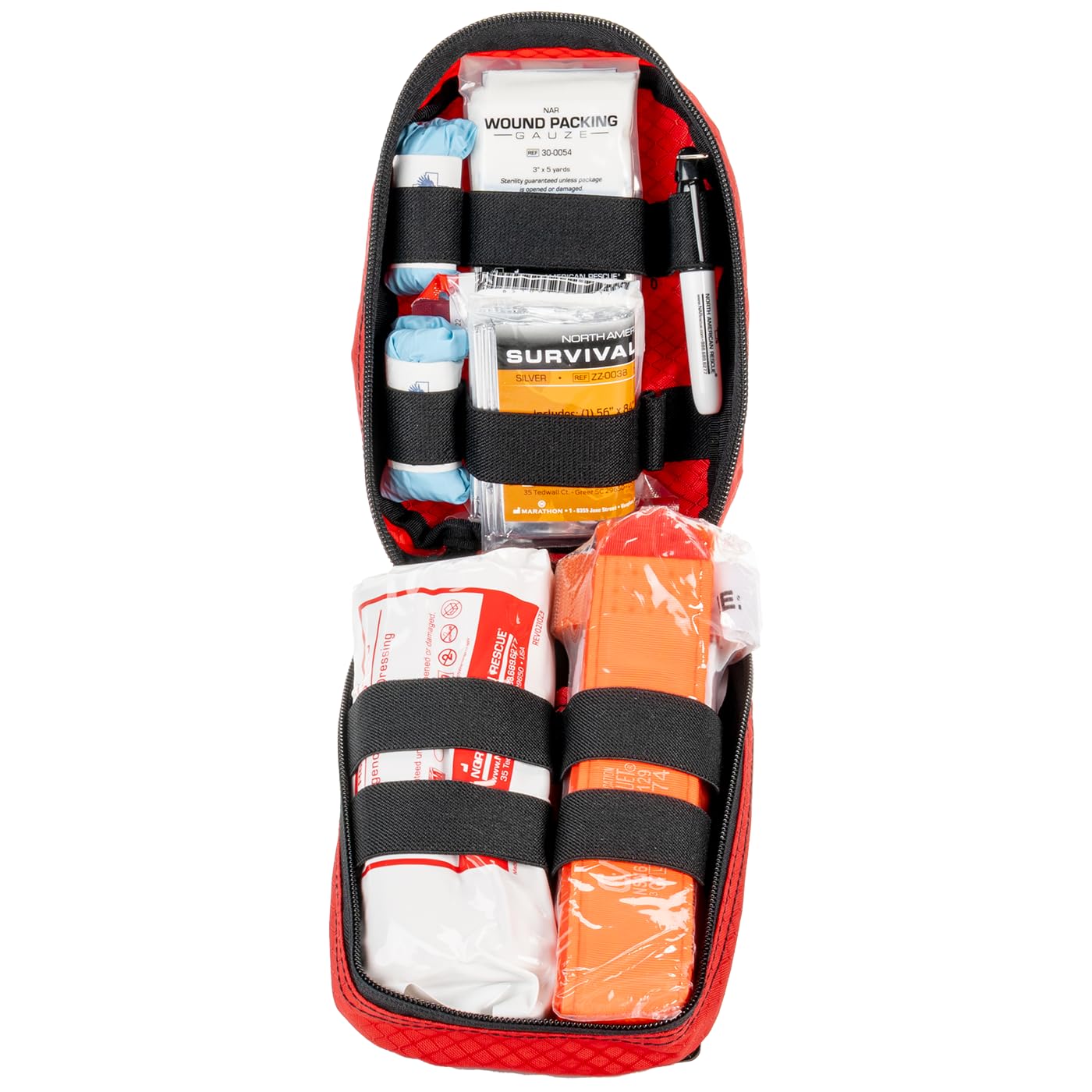
The professional-grade pick that wilderness first responders carry in every kit they own.
This is the kit that professionals reach for. It includes the Gen 7 CAT Tourniquet, NAR gauze, an ETD (Emergency Trauma Dressing) bandage, a survival blanket, responder gloves, shears, a permanent marker, and bleeding control instructions — a comprehensive set for a single responder. It comes in a compact, red nylon carry bag that is small enough to toss on a hike, yet organized enough for rapid access.
The story here is one of quiet confidence. Owners describe it as a “pay-for-what-you-get” kit, with one responder noting they have ordered several — one for each car, their home, shop, and each of their Wilderness First Responder (WFR) emergency kits. That same owner adds Celox and a pair of HyFin chest vent seals to the pouch and says it all fits just fine, which tells you the bag has a little extra room for customization.
Quality is the aspect owners praise most, and value for money follows close behind. It is a clear statement that you get what you pay for with a kit from North American Rescue, a brand that is essentially credentialed by its field use among serious emergency responders.
military grade: If you want the genuine article and plan to buy one kit that could define your emergency response, this is it. The Gen 7 CAT tourniquet is the latest iteration of the proven design, and the kit’s construction reflects its professional heritage.
pricey: It is the premium-priced pick on this list, so it makes sense when you want maximum reliability rather than maximum value for a casual user.
pro reliability: Wilderness first responders, serious preppers, and anyone who wants a field-proven kit with the latest-generation CAT tourniquet and room to grow.
casual users: A budget-conscious first-time buyer, because the price reflects the professional-grade components more than a casual user might need.
Understanding the Specs
Tourniquet Types
The tourniquet is the single most important tool for a life-threatening limb bleed. A windlass-style tourniquet, like the CAT, uses a rod that you twist to tighten a strap around the arm or leg until blood flow stops. An elastic-wrap tourniquet, like the SWAT-T, is a wide band you stretch and wrap, which is more versatile but requires careful training to avoid over-tightening.
Hemostatic Gauze
Hemostatic gauze (pronounced hee-moh-STAT-ik) is special gauze coated with substances that help blood clot faster. It is meant for wounds where a tourniquet can’t be used, like the groin, torso, or neck. You pack the gauze directly into the wound and apply firm pressure for several minutes. Some versions, like Celox, create a gel-like plug without generating the heat that older formulas produce.
FAQ
What is the difference between a CAT and a SWAT-T tourniquet?
How many kits should I keep in my car?
Does a bleeding control kit expire?
Can I use a bleeding control kit on myself?
Is a kit with more pieces always better?
What is an IFAK and how is it different from a first aid kit?
Will a bleeding control kit help with a gunshot wound?
How small can a bleeding control kit be and still be useful?
What does hemostatic gauze actually do to stop bleeding?
How do I know if a tourniquet is applied correctly?
Final Thoughts: The Verdict
For the majority of shoppers, the bleeding control kit winner is the Professional Trauma Kit because its labelled 265-piece organization makes it possible for anyone, even in a panic, to find what they need. If you want the professional-grade reliability of a Gen 7 CAT tourniquet with room to customize, grab the North American Rescue kit. And for those who need a kit that actually lives in a pocket every day, ready for the worst, the Rescue Essentials Pocket kit is the one to reach for.
How We Picked
We do not accept paid placement. Every pick is matched to a real buyer and a real use-case; we do not hands-on test units.
Sources & Methodology
Specifications: manufacturer listings and product documentation. Review insights: verified customer reviews, as of August 2026. Pricing: not shown on this page (it changes often); check the current price via the retailer link.
As an Amazon Associate, Gadgets Feed earns from qualifying purchases. This does not affect which products we feature.