
Our readers keep the lights on and my morning glass full of iced black tea. As an Amazon Associate, I earn from qualifying purchases.
Specs are compiled from manufacturer listings and verified buyer reviews and can change over time — please confirm the key details on the product page before buying.
Managing your dog’s diabetes at home hinges on getting a clean blood sample without a daily struggle. The right meter delivers a reading fast enough that your dog stops flinching and wastes fewer strips while you learn the technique. This guide cuts through the options by focusing on the specs that actually matter for a wiggly patient: the size of the blood sample a meter needs, how many strips you get in the kit, and what real owners say about accuracy when the reading counts.
I’m Min — the founder and writer behind Gadgets Feed. This guide is built by comparing the manufacturers’ published specifications and the patterns across verified customer reviews, so you get each pick’s real strengths and trade-offs instead of marketing spin.
Whether you are checking glucose once daily or running a full curve, the right blood glucose meter for dogs saves you frustration, fewer pokes, and a lot less second-guessing when the numbers pop up on the screen.
Quick Picks
- PetTest Painless Glucose Monitoring Kit — Top Overall
- AlphaTrak 3 Pet Blood Glucose Monitoring Kit — Vet Preferred
- Pet Control HQ Pet Blood Sugar Glucose Monitoring Kit — Best 2-Chip Value
- PawDiag Pet Blood Glucose Monitor Kit — Strips for Days
- IMPet Glucose Monitoring Kit for Dogs & Cats — Great for Beginners
- VQ PET H Blood Glucose Monitoring System — Budget Starter
How To Choose The Best Blood Glucose Meter For Dogs
Choosing a meter means evaluating the entire system: strips, lancets, and the blood volume your dog’s ear or lip can spare.
Blood Sample Size (the Number That Saves Pokes)
Meters ask for a certain volume of blood, measured in microliters (µL). A meter that needs 0.3 µL works far better on a small ear vein than one that needs 1.0 µL. The smaller the number, the easier it is to get a reading on the first try without having to poke again.
Species-Specific Calibration
Dog blood has a different red-cell structure than human blood, so a human meter can give a misleading number. The best meters for dogs come with a code chip or a factory setting for canines. Some even include a separate chip for cats if you have both.
Kit Contents and Strip Cost
A starter kit with 50 strips gets you through the first month, but frequent testing — especially for a glucose curve — burns through them fast. Check how many strips the kit includes and what replacement strips cost, because that is where the long-term expense lives.
Quick Comparison
| Model | Best For | Sample Size | Result Time | Kit Strips | Amazon |
|---|---|---|---|---|---|
| PetTest Classic Genteel Kit | Pain-free daily testing | 0.3 µL | 5 sec | 50 | $119.99Amazon |
| AlphaTrak 3 | Vet-grade accuracy | 0.3 µL | — | 25 | $76.33Amazon |
| Pet Control HQ | Dual dog/cat household | 0.6 µL | 10 sec | 50 | $69.80Amazon |
| PawDiag | High strip count for curves | 0.8 µL | 5 sec | 100 | $59.99Amazon |
| IMPet | First-time owners | — | — | 50 | Amazon |
| VQ PET H | Budget-friendly starter | — | — | 50 | $32.95Amazon |
In‑Depth Reviews
1. PetTest Painless Glucose Monitoring Kit

This kit stops the flinch by pairing the smallest sample size with a vacuum-assisted lancet.
Managing dog diabetes is stressful enough without a meter that turns each test into a guessing game. The PetTest Classic Genteel Kit solves two pain points at once: it requires only 0.3 µL of blood, and its Genteel lancing device uses suction to draw blood without hitting deep nerve endings. Buyers report a 2- to 3-day learning curve to hold the device steady for six seconds, but once mastered, the dog stays still and strip waste stops. One reviewer noted they wish they had ordered the kit earlier because of how much less painful the process became.
The kit lands fast 5-second results and includes 50 individually foil-wrapped test strips, a generous amount compared to the 25 strips many premium kits ship with. The strips are sealed one by one, so humidity or temperature changes in your bag do not ruin the next test. It also includes a carrying case, control solution, and 50 lancets — everything is ready to go right from the start. The biggest trade-off is that the Genteel’s vacuum technique takes a bit of practice, and a handful of owners with very small dogs (around 15 lb) still had trouble drawing enough blood even with the largest tip.
Why it earns the top spot
- Needs only 0.3 µL of blood — the smallest sample size in this lineup, so you poke less.
- Genteel lancet vacuum reduces pain; owners mention dogs stop flinching after the first week.
- Individually sealed strips stay accurate longer and are not affected by moisture.
- Complete kit with 50 strips, so you can run full glucose curves without an immediate reorder.
The realistic trade-offs
- Vacuum technique takes 2-3 days to learn; some owners struggle with the 6-second hold time.
- Very small dogs (under 15 lb) may still need multiple pokes to get enough blood.
- Reported defective units (HI error readings) with inconsistent customer service response.
Reach for this if: you want the gentlest possible testing routine and you are willing to practice the vacuum technique for a few days.
Look elsewhere if: you have a tiny dog under 15 lb or you need a meter with zero learning curve from day one.
2. AlphaTrak 3 Pet Blood Glucose Monitoring Kit
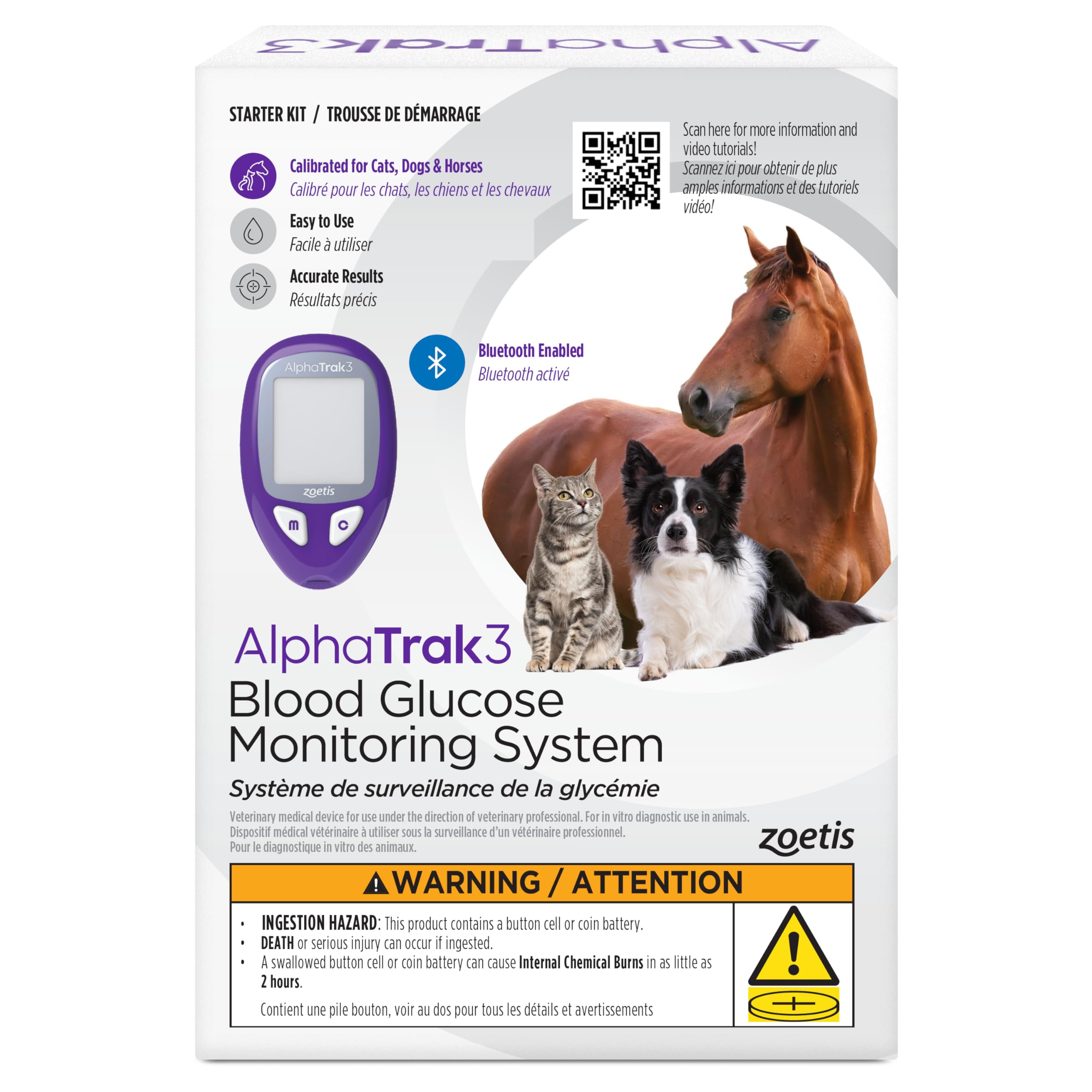
The #1 veterinarian-recommended meter, built for dogs, cats, and horses with an extended range.
When your vet nods at a specific meter, that name is almost certainly AlphaTrak. The AlphaTrak 3 is the #1 veterinarian-recommended blood glucose monitor for dogs, cats, and horses, and it backs that reputation with an extended testing range of 20-750 mg/dL — a wider spread than most competitors, so you catch both dangerously low and extremely high numbers accurately. It takes only 0.3 µL of blood, matching the PetTest on sample size, and the kit ships with 25 test strips, a lancing device with 30 lancets, control solution, a carrying case, and a two-year manufacturer warranty. The meter also connects to the AlphaTrak Mobile App, so you can graph glucose trends and share them directly with your vet.
Buyers who have used the AlphaTrak system for years say it has helped them maintain stable blood sugar in their dogs — one buyer mentioned testing their Golden Retriever twice daily for three straight years with consistent results. The biggest frustration across reviews is that the mobile app has known issues: limited character fields, failure to save data, and a setup process that relies on poorly written instructions and PowerPoint-style slides instead of real videos. The test strips are also single-use and relatively expensive, so the long-term cost is higher than the mid-range options. Customers note that a YouTube tutorial or a quick vet demo helps a lot with the learning curve.
The standout strengths
- Vet-recommended brand with specific calibration for dogs, cats, and horses.
- Extended range of 20-750 mg/dL catches both low and high extremes accurately.
- Two-year warranty and a mobile app for sharing glucose curves with your vet.
Where it frustrates
- Only 25 test strips in the kit — you will need to reorder quickly if you test twice daily.
- Mobile app has known data-saving problems and poor instructions.
- Test strips are single-use and more expensive than generic alternatives.
Choose this if: your vet specifically recommends AlphaTrak and you plan to share trend data through the app.
skip it if: you want a bigger starter strip supply or a lower long-term cost per test.
3. Pet Control HQ Pet Blood Sugar Glucose Monitoring Kit

Two separate code chips for dogs and cats, because their insulin chemistry is not the same.
If you have both a diabetic dog and a diabetic cat, the Pet Control HQ kit saves you from owning two separate meters. It comes with two code chips — one calibrated for dogs and a second one for cats — so you swap the chip before switching species and get readings that account for their different red-cell biology. The meter needs only 0.6 µL of blood, which is between the ultrasmall 0.3 µL meters and the more demanding 0.8 µL models, and it returns results in 10 seconds. The complete starter kit includes 50 test strips, 50 lancets, a lancing device, control solution, a logbook, and a carrying case.
Reviewers point out that the meter is reliable, getting a reading every time compared to other brands that produced up to 7 error strips in one session. The trade-off is a slightly larger blood sample than the top picks (0.6 µL vs 0.3 µL), which means the ear poke needs to be a little more deliberate. Some owners also note that the reference range on this meter runs a bit higher than what the vet uses, but that the trending — the rise and fall pattern after insulin and meals — tracks correctly. The 10-second wait is a bit longer than the 5-second meters above, but still fast enough for a wiggly patient.
What makes it unique
- Two code chips (dog + cat) so one kit works for a multi-pet household.
- Reliable readings — shoppers say zero wasted strips compared to 7 errors on other brands.
- Complete kit includes control solution and logbook for easy record-keeping.
The drawbacks
- Needs 0.6 µL of blood — more than the 0.3 µL leaders, so the poke must be a bit deeper.
- 10-second result is slower than the 5-second alternatives.
- Reference range runs higher than some vet meters; trend monitoring is more reliable than absolute numbers.
Pick this if: you manage diabetes for both a dog and a cat and want one meter for both.
Pass if: you only test dogs and want the smallest possible blood sample size.
4. PawDiag Pet Blood Glucose Monitor Kit
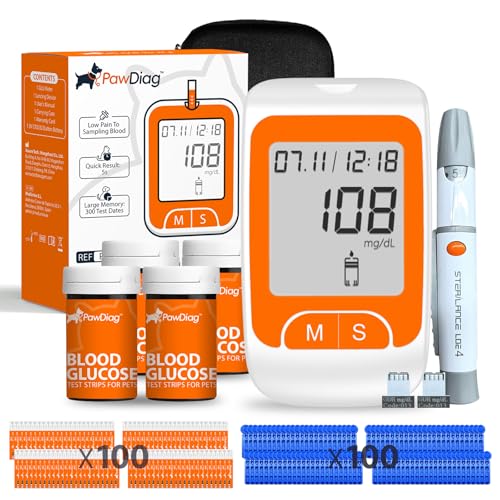
100 test strips in one box means you can run a full glucose curve without worrying about running out.
Most starter kits give you 50 strips, which disappears fast when your vet asks for a 12-hour glucose curve. The PawDiag kit ships a full 100 test strips plus 100 lancets, enough for twice-daily testing for nearly two months or a thorough curve right out of the gate. The meter needs a 0.8 µL blood sample — larger than the 0.3 µL leaders — but it gives you a reading in only 5 seconds, and the lancing device has 5 depth levels (buyers report level 3 works best). The included zippered carrying case keeps everything organized for home or travel.
Buyers who have a newly diagnosed diabetic dog call this kit a lifesaver specifically because it avoids stressful and expensive vet visits for every glucose check. The readings remain consistent and closely match what the vet gets. The catch is technique — owners mention that the strip must be placed very close to the blood source so it draws from the tip; you cannot drop blood on top of the strip like a human meter. A couple of owners could not get the meter to work at all and planned to take it to their vet for help, so there is a learning curve with the 0.8 µL requirement on a small ear vein.
The biggest reasons to choose it
- 100 test strips + 100 lancets — the highest kit count in this lineup, perfect for frequent testing.
- 5-second fast results with 5 adjustable depth levels on the lancing device.
- Readings consistently match vet results, per buyer reports.
The honesty section
- Needs 0.8 µL of blood — larger sample means you need a good, solid poke to get enough.
- Strip technique is specific: must draw from the tip, not accept a drop on top.
- Some customers note they simply could not get the meter to read at all.
Go for this if: your vet wants frequent or full-curve testing and you want a bulk strip supply ready.
Think twice if: you have a small dog with tiny ear veins and want a 0.3 µL sample instead.
5. IMPet Glucose Monitoring Kit for Dogs & Cats
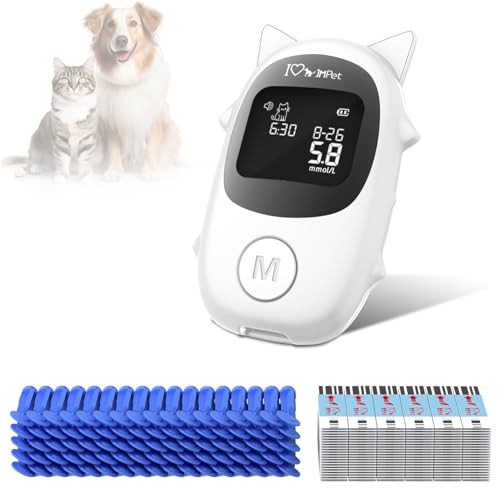
A vet-recommended meter with over 12,000 clinical validations behind its accuracy claim.
The IMPet kit leans into proof: the manufacturer states it has gone through 12,000+ clinical validations, achieving a 95.6% accuracy rate against professional veterinary equipment, and it is certified by ISO 15197:2015. For a first-time pet owner who is nervous about getting a wrong number and making a bad insulin call, that stamp of validation can mean a lot. The kit is designed around a one-touch, no-coding, three-step process — insert strip, collect blood, read the result — so you are not fumbling with settings while trying to hold a dog still. It comes with 50 strips, 50 lancets, a lancing device, and a storage bag.
Buyers consistently mention the responsive customer service; one owner noted the company answered a reordering question quickly, which builds trust for ongoing strip purchases. The security seal on the packaging is a nice safety touch. The biggest drawback is that the raw data does not list the blood sample size in microliters or the result time, so you cannot directly compare those specs to the other meters. That lack of transparency means you are buying based on the validation record rather than a leaner spec sheet. Some users also mention the lancet device itself is solid, but a few opted to buy TruePlus lancets separately because the included ones did not fit their preferred “gun.”
Why beginners like it
- 12,000+ clinical validations and 95.6% accuracy rate for confidence.
- Certified ISO 15197:2015 and has anti-interference strip design for reliable data.
- One-touch, no-coding operation for first-time users.
Missing information
- Exact blood sample size in µL and result time are not listed — harder to compare with the leaders.
- Some buyers had to buy separate lancets that fit their preferred lancing device.
- Kit includes only 50 strips, similar to the entry-level options.
Best suited for: a first-time diabetic pet owner who values clinical validation data over bleeding-edge specs.
Not for you if: you specifically want to know the µL sample size before buying.
6. VQ PET H Blood Glucose Monitoring System
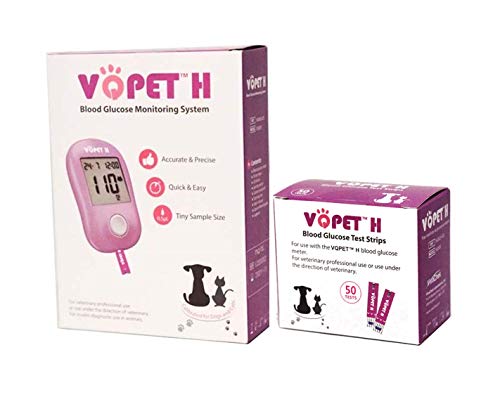
The budget-friendly entry point that uses less blood from the vein and cheaper replacement strips.
If you are not sure your dog will tolerate testing at all, or you just need a backup meter to keep in the car, the VQ PET H starter kit keeps the upfront cost low without cutting the essentials. It includes the meter plus 50 test strips, weighs 7 ounces, and reviewers point out that it uses less blood from the vein compared to some pricier models. One particularly telling comparison from a reviewer: the VQ PET H produced only 1 error lost out of a batch versus roughly 1 in 10 errors with the AlphaTrak brand, which is a strong reliability result for a budget-tier device. It also includes a test guide printed clearly for quick reference.
The honest trade-off is inconsistency in user experience. While some owners found it accurate and easy to use, others reported the opposite — that the monitor was impossible to get a correct reading from, that it required more blood than expected (despite the reviewer who said the opposite), and that the unit would not stay on the dog mode setting, defaulting to a “Hi” message. The 50-strip count also proved too low for one owner who used 10 strips in the first 24 hours due to blood volume issues. The lack of a listed sample size in microliters means you are going in blind on the draw technique.
The good news
- Lowest entry price in the lineup with 50 test strips included.
- Some shoppers say far fewer error strips than a premium brand (1 error vs 1 in 10).
- Light at 7 ounces, easy to toss in a bag for travel.
The real risk
- User experience is split — some owners cannot get a correct reading at all.
- Blood sample size in µL is not spec’d, so you cannot compare draw ease to other meters.
- Some users report the device won’t stay in dog calibration mode.
Perfect for: a low-commitment tryout or a secondary travel meter when cost matters most.
Skip if: you want a consistent first-read experience with published µL specs.
Understanding the Specs
Microliters (µL) – the Blood Sample Size
This is the volume of blood the meter needs to produce a reading. Think of a single drop of water from a faucet — that one drop holds roughly 50 µL. A meter that needs 0.3 µL needs only about one 150th of that drop, so a tiny prick on the inside of the ear or the lip pad is enough. A meter that needs 0.8 µL or more requires a bigger, more deliberate sample, which can mean poking twice or squeezing the ear, which your dog will not enjoy. Lower is always better here for comfort and first-try success.
Species-Specific Calibration Chips
Dog red blood cells have a different glucose distribution than human cells, and cat cells differ from dog cells. A human meter can read a dog’s glucose and be off by a significant margin — potentially enough to misguide an insulin dose. A code chip or factory calibration for dogs adjusts the algorithm to match canine blood chemistry. Some middle-tier kits include two chips (one for dogs, one for cats), so you can test both species with one device. If you are testing only a dog, a dedicated dog chip or meter is sufficient.
FAQ
Can I use a human blood glucose meter on my dog?
How much blood does a typical dog glucose meter need?
Where is the best place to draw blood from my dog?
How often should I test my diabetic dog’s blood glucose?
What does a glucose curve involve?
How long do test strips last once opened?
What does a “HI” reading mean on a pet glucose meter?
Can I reuse lancets or test strips to save money?
Do I need a code chip for my dog’s meter, or is a single-calibration meter enough?
How do I know if the meter reading is accurate?
Final Thoughts: The Verdict
For most dog owners, the blood glucose meter for dogs that balances comfort, accuracy, and value is the PetTest Painless Classic Genteel Kit, because its 0.3 µL sample and vacuum-assisted lancet produce reliable readings with the least flinch. If you want vet-grade reputation and the ability to share graphs through an app, grab the AlphaTrak 3. And for households that test both a dog and a cat, the Pet Control HQ kit with its two code chips is the smartest single-device solution.
How We Picked
We do not accept paid placement. Every pick is matched to a real buyer and a real use-case; we do not hands-on test units.
Sources & Methodology
Specifications: manufacturer listings and product documentation. Review insights: verified customer reviews, as of July 2026. Pricing: not shown on this page (it changes often); check the current price via the retailer link.
As an Amazon Associate, Gadgets Feed earns from qualifying purchases. This does not affect which products we feature.
Product prices and availability are accurate as of the date/time indicated and are subject to change. Any price and availability information displayed on Amazon at the time of purchase will apply to the purchase of this product. As an Amazon Associate I earn from qualifying purchases.
CERTAIN CONTENT THAT APPEARS ON THIS SITE COMES FROM AMAZON. THIS CONTENT IS PROVIDED "AS IS" AND IS SUBJECT TO CHANGE OR REMOVAL AT ANY TIME.
Amazon and the Amazon logo are trademarks of Amazon.com, Inc. or its affiliates.