
Our readers keep the lights on and my morning glass full of iced black tea. As an Amazon Associate, I earn from qualifying purchases.
Specs are compiled from manufacturer listings and verified buyer reviews and can change over time — please confirm the key details on the product page before buying.
If you want the short answer: a home blood pressure monitor only helps you if the cuff fits your arm and the numbers come out close to what the clinic gets. That is the whole game. Everything else — memory, apps, backlights — is a bonus on top. This guide walks through nine upper-arm monitors, explains what each spec actually does for you in plain words, and points out the trade-offs nobody puts on the box.
I’m Min — the founder and writer behind Gadgets Feed. This guide is built by comparing the manufacturers’ published specifications and the patterns across verified customer reviews, so you get each pick’s real strengths and trade-offs instead of marketing spin.
You will see how cuff range, memory capacity, and power options differ across these picks, and which one fits your arm and your routine before you buy a blood pressure monitor.
Our Picks at a Glance
How To Choose The Best Blood Pressure Monitor
Most people buy on screen size or brand name and end up with a cuff that pinches or a reading that drifts high. Get the cuff circumference right first, then look at memory, power, and extras.
Measure your upper arm before anything else
The cuff is the part of the monitor actually touching your body, and it has to wrap the right section of your upper arm — snug, level with your heart, and no gap under the edge. Wrap a soft tape measure around the middle of your upper arm, halfway between shoulder and elbow. If your arm measures anywhere from roughly 9 to 17 inches, almost every cuff on this list will work. If you are at the small or large ends of that range, you need to check each monitor’s own cuff specs carefully — a cuff that is too small will inflate past its comfort zone and read high, and one that is too loose will lose pressure and read inconsistently.
Irregular heartbeat detection explained
An irregular heartbeat indicator is a small feature that watches the rhythm of your pulse during the reading and shows a warning symbol if it looks uneven. It is not a diagnosis and it never replaces a doctor’s review — it is simply a flag that says “mention this reading at your next appointment.” Several monitors here include it, and it costs you nothing extra to have.
Memory, users, and app syncing
Single-user memory stores one person’s readings so you can spot trends over weeks. Two-user memory means a spouse can log their own numbers on the same device. App syncing sends readings to your phone so you can hand a doctor a clean chart instead of a handwritten notebook. If two people share one monitor, check whether the app supports two separate accounts — some do not.
Power: batteries, USB-C, or wall adapter
Battery models travel easily but need fresh cells; a wall adapter keeps you running indefinitely on a nightstand. Several monitors on this list support both, which is the most flexible setup for most homes.
Quick Comparison
| Model | Best For | Cuff Range | Memory | Power | Amazon |
|---|---|---|---|---|---|
| Acenis Automatic BP Monitor (AOJ-30F)★ Best Overall | Everyday one-touch monitoring with a color-coded screen | Large adjustable cuff | 2 users | 4 AAA batteries (included) or charge cord | Amazon |
| Beurer BM25Best Value | Compact travel-friendly monitor with app syncing | Large cuff, can be sized down | Scan & Save app storage | 4 AAA batteries (included) or USB-C | Amazon |
| Braun ExactFit 1 (BUA5000US)Simple Pick | Straightforward one-button daily checks | 8.6″ – 16.5″ | Latest measurement only | 4 AA batteries (included) | Amazon |
| Greater Goods Upper Arm Monitor | Two people tracking trends on one device | 8.75″ – 16.5″ | 60 per user (120 total) | 4 AAA batteries (included) plus wall adapter | Amazon |
| AOJ Electronic BP Monitor (U80BH) | Plugged-in desk use with AC adapter | 9″ – 17″ | 90 per user, 2 users | 6V 1A adapter or 4 AA batteries (not included) | Amazon |
| iHealth Track (550BT) | Phone tracking and sharing with a doctor | 8.7″ – 16.5″ | 99 on device, unlimited in app | 4 AAA batteries (included) | Amazon |
| AQESO Blood Pressure Machine (U80AH) | Households with several arm sizes | 7″ – 21″ (3 cuffs) | 500 per user, 3 users | 4 AAA batteries or USB-C cable | Amazon |
| OMRON Gold (BP5360) | Doctor-facing data with AFib and morning alerts | 9″ – 17″ | 2 users, unlimited in app | 4 AA batteries (included) | Amazon |
| Withings BPM Vision | App-first users who want Wi-Fi sync and long battery life | 8.7″ – 16.5″ | Unlimited in Withings app | 1 battery (included), 1-year battery life | Amazon |
In‑Depth Reviews
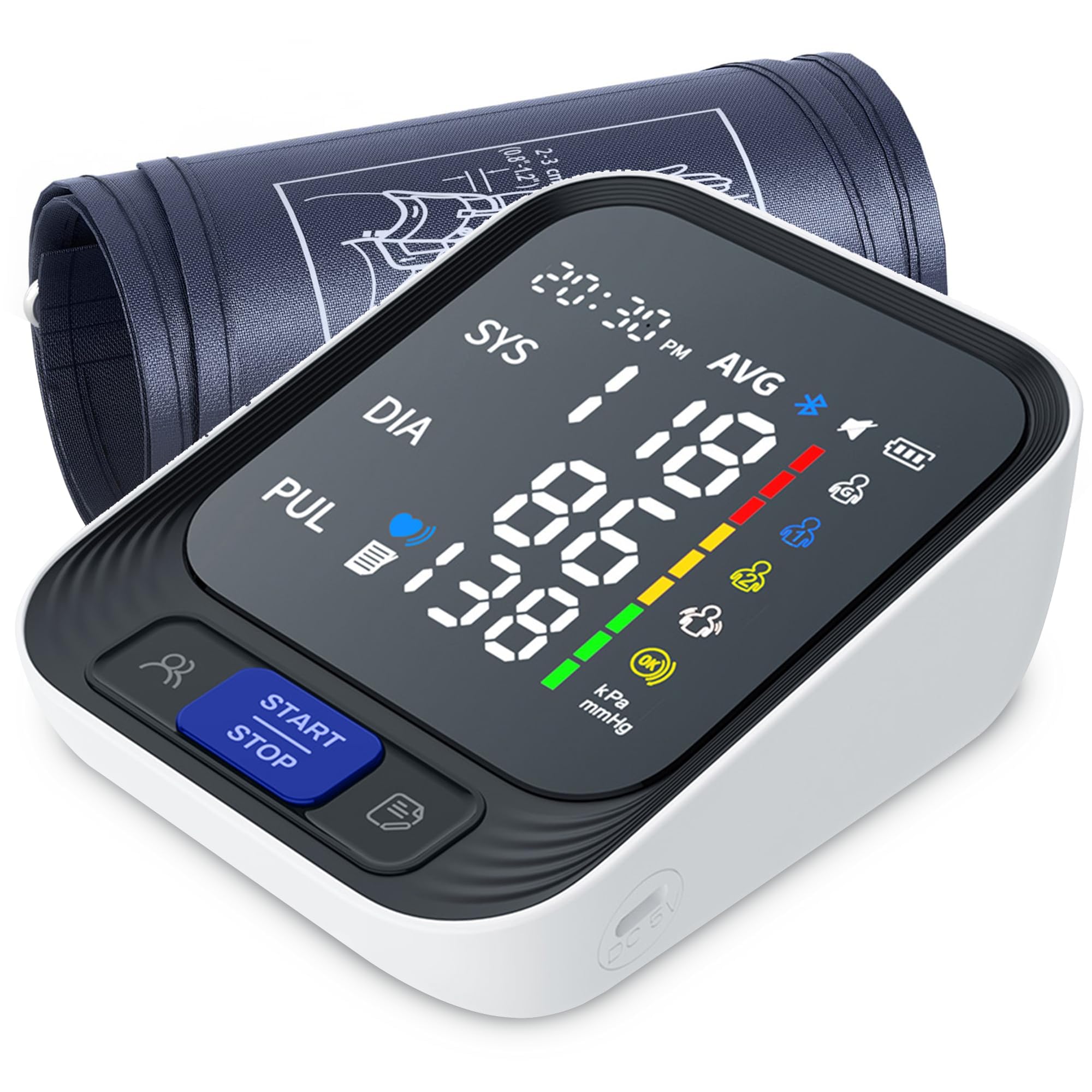
1. Blood Pressure Monitor – Automatic Blood Pressure Machine for Home Use
Our pick — 4.5★ from 500+ verified ratings; the strongest balance of quality and price.
The one-touch monitor that gives you numbers the doctor recognizes — and color that tells you what they mean.
This is the pick that wins on the whole experience rather than one flashy headline. Its biggest draw is a large color display (a screen big enough to read across the room without your glasses) that also floods green, yellow, or red depending on where your reading lands, so you know instantly whether it is fine or worth a call. Press one button and you have a result in 40 seconds — no menus, no setup marathon, no learning curve for a parent or a caregiver. The adjustable cuff is sized generously enough to snug up on most adult upper arms, and the 5 x 2.87 x 3.66 inch, 1.1 pound body is about as small as a home monitor gets — you can leave it on a nightstand without it becoming clutter.
What wins people over is the accuracy — the readings land close to what the clinic sees, which is the one thing that money can’t fake in this category. Users also mention the readable oversized digits, the portability for trips to a doctor’s office or a relative’s house, and the comfort factor: this cuff does not crank down and leave your arm aching. You can run it on four AAA batteries (included) or the supplied charge cord, and for daily clinic-style home use it is the balance on value.
The honest catch is the included batteries. They arrive ready to go, but if you use this monitor daily the supplied cells wear down quickly and you will be buying replacements sooner than expected. Pair it with the charge cord and that problem disappears entirely. There is also one small tell: the cuff runs on the snug side for very large arms — if your upper arm is at the very top of the range, measure carefully first. It is also note this unit weighs 1.25 pounds in shipping terms compared against the lighter 1.1 pound alternative, though in practice that difference is negligible on a countertop.
The wins that matter
- Accurate readings that track closely with the doctor’s office — the single most valuable quality in this category
- One-button start, result in 40 seconds
- Large color screen with green/yellow/red indicator so you don’t have to interpret the numbers yourself
- Works on 4 AAA batteries or the included charge cord — pick either depending on your setup
- Compact 1.1 pound body with a carrying-friendly 5 x 2.87 x 3.66 inch footprint
What to plan around
- Included AAA batteries run out quickly if you measure daily — use the charge cord for heavy use
- Cuff runs a touch snug at the very top of its size range
- No app or phone syncing; memory lives on the device only
Reach for this if: you want a fast, color-coded daily check with two-user memory and a display a grandparent can read without squinting.
Look elsewhere if: your ideal setup includes phone syncing or you need a small-arm cuff below the standard large size.
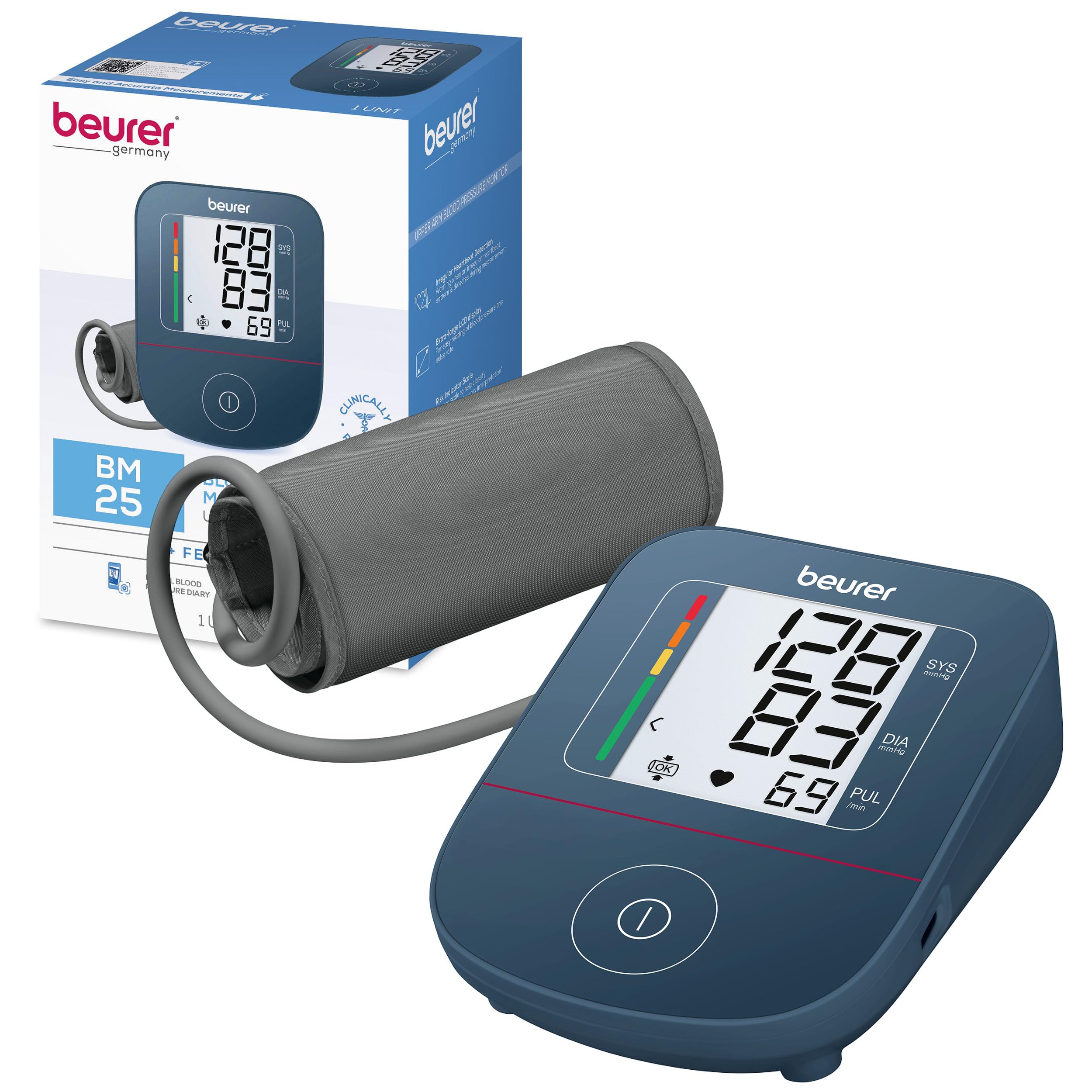
2. Beurer BM25 Upper Arm Blood Pressure Monitor
A slim, app-connected monitor you can slip into a carry case and forget takes up space.
Compact is the whole point here. The Beurer BM25 measures just 4.7 x 3.5 x 1.5 inches and weighs 12.77 ounces, so it is small enough to tuck in a drawer, pack in a carry case, or take on a trip without swallowing half your bag. It measures both blood pressure and pulse rate automatically, and its cuff position control prevents the classic home-monitoring mistake of wrapping the cuff too high or too low — that single check keeps your readings consistent from one day to the next.
What quietly impresses people is the comfort: this unit does not over-inflate or leave bruises the way older monitors did. The one-button operation and large display make it easy for a first-timer who has never used a home monitor before. It also has arrhythmia detection, which scans your pulse rhythm during the reading and flags irregular heartbeats, plus a color-coded risk indicator and a Scan & Save function that pushes readings into the Beurer HealthManager Pro app. Power is flexible: four AAA batteries come with it, or you can run on a USB-C cable (not included).
Comparing it side-by-side with the Acenis, this Beurer is the smaller travel companion — at 4.7 x 3.5 x 1.5 inches it packs down tighter than the Acenis 6.61 x 4.61 x 3.66 inch body, and it carries the same large cuff that can be sized down for smaller arms. What lands it second rather than first is the cuff on very large arms — it can feel snug at the upper end. On balance, the majority of buyers find it reliable and recommend it for its clarity, portability, and the fact that it comes neatly cased.
The strong pull: irregular heartbeat detection plus app syncing at a value-tier price — two features usually reserved for premium monitors.
The honest fine print: the USB-C power option is convenient, but the cable is not in the box; if that is your plan, add one to your order.
Suits: frequent travelers and small-drawer households who want a light, tidy monitor with app tracking and battery or USB-C power.
Pass on it if: you need a cuff that comfortably fits the very largest arms from the start.
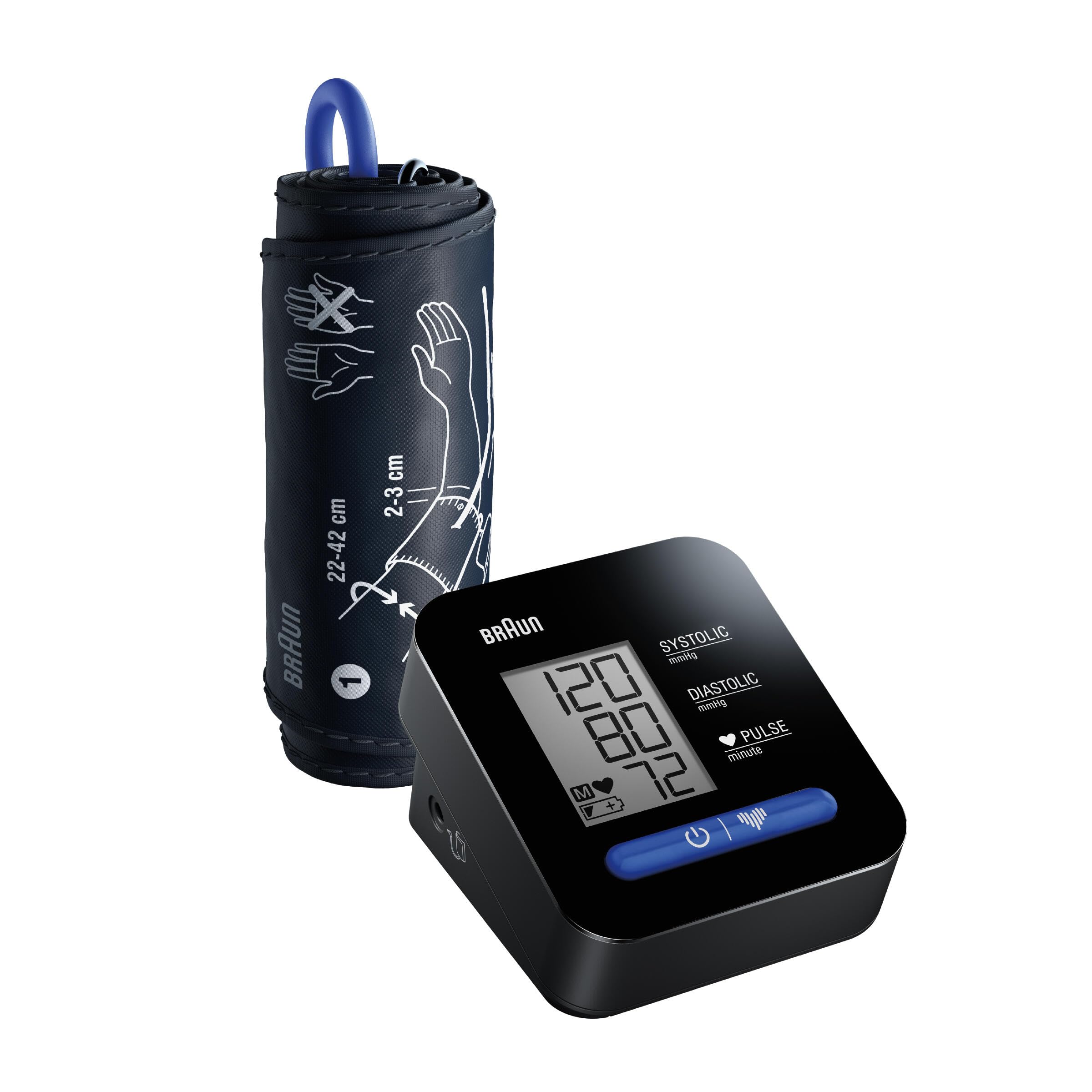
3. Braun ExactFit 1 Upper Arm Digital Blood Pressure Monitor
One button, one screen, one reading — the closest thing to a set-and-go clinic cuff.
Simplicity is the design brief here, and the Braun ExactFit 1 delivers it without fuss: one big button on a large, easy-to-read display, an upper-arm cuff that handles arms from 8.6 to 16.5 inches, and a memory that stores the latest measurement for quick recall. That memory-only-the-last-reading approach keeps things clean if you take one measurement in the morning and move on with your day, and the 6.61 x 4.61 x 3.66 inch, 1.25 pound body has a solid, no-nonsense feel on a nightstand.
Where this monitor really earns its place is in ease of use — the thing buyers report wins them over is how fast the whole routine is, from wrapping the cuff to reading the result. It inflates the way a manual cuff would, which some users find reassuring, and it is a compact unit that does not crowd your counter. The armband positioning can take a try or two to nail, but the payoff is a clinic-style reading once you have the wrap down.
The honest caveat: this is a single-user, single-last-reading device. If you and a partner both track blood pressure, or you want weeks of trend data stored locally, this is not the monitor for that. It is also pickier about technique than some — the armband has to sit level and snug. Get that right and the majority-user pattern is consistent: it is easy to use, priced as a value option, and reliable enough for daily checks. It is worth calling out that this is the largest of the three-value contenders at 6.61 x 4.61 x 3.66 inches, roughly 41% more desk footprint than the Beurer BM25 at 4.7 x 3.5 x 1.5 inches — a trivial distinction until you are packing for a trip.
Who this fits: a single user who wants one reading a day and no fiddling with profiles or apps.
One thing to know: the armband placement takes practice — follow the cuff graphics carefully on your first few tries.
Great for: one-person households that want a dedicated, low-maintenance daily check with a memory that keeps the last reading ready.
Not the fit if: you need multi-user tracking or want to compare readings over weeks from stored history.
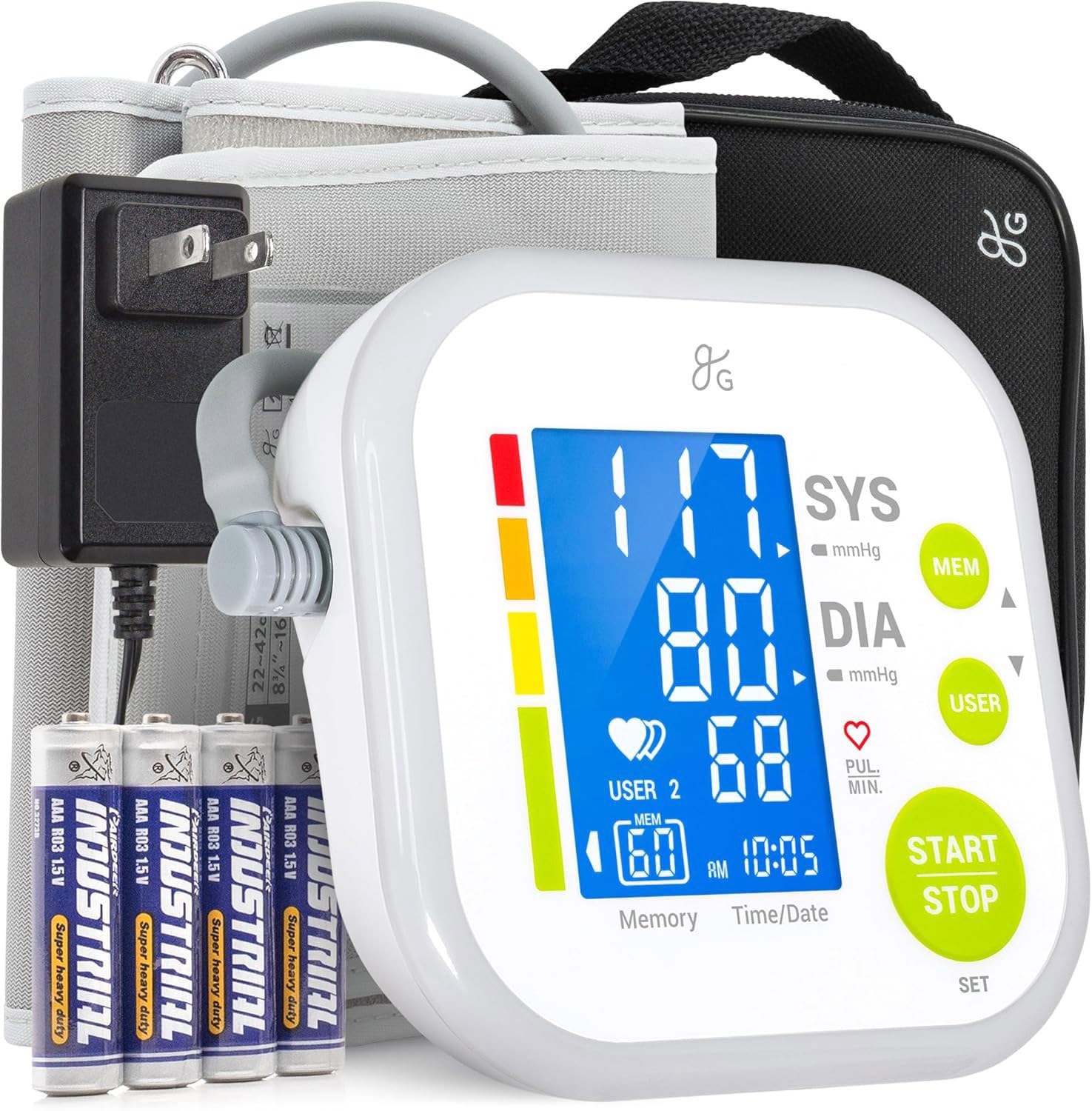
4. Greater Goods Upper Arm Blood Pressure Monitor for Home Use
Your whole household’s blood pressure history, one monitor, two sets of memories.
Two-user memory is the feature that makes this monitor the obvious pick for a household where two people track their numbers. Each profile stores up to 60 readings — 120 total on the device — and the backlit display shows large digits so both of you can read the results without a magnifier. It is a fully automatic upper-arm monitor that measures systolic and diastolic pressure plus pulse rate, and it detects irregular heartbeats and shows a color-coded range indicator with an arrow marking where your reading lands.
The cuff runs 8.75 to 16.5 inches with a printed artery alignment marker that takes the guesswork out of positioning. That marker matters: it produces consistent placement, which is the biggest win in home monitoring, and it means the reading you get at home is directly comparable to the one you get at the clinic. The kit arrives ready to go — monitor, cuff, wall adapter for plug-in power, four AAA batteries for portability, and a travel case.
What buyers rave about most is the overall quality and the ease of use — it is a genuinely simple process: pick your user profile, press Start, and wait. The most recurring caveat is the cuff: the standard one that ships is sized for large arms, so if your upper arm is on the smaller side you will want to request the smaller cuff through the St. Louis-based support team (it is available on request). The other consideration is reliability — there are reports of the occasional unit that needs a warranty replacement, but the customer service behind it steps up and honors the replacement quickly. That balance is exactly why this pick has stayed at the top of the value-and-features chart for years.
Where it earns the spot
- Two-user memory stores 60 readings per person for tracking trends over time
- Artery alignment marker on the cuff makes correct placement easy
- Backlit large-digit display readable in dim rooms
- Wall adapter and four AAA batteries both included, plus a travel case
- Warranty replacement is handled directly, quickly, and politely
Considerations
- The cuff that ships is sized for large arms — smaller users should request the smaller cuff from support at no extra charge
- Firewalled to a wired-or-battery setup: no Bluetooth, no app syncing
- Memory scrolls in one direction only, so moving through past readings takes a few extra presses
Go with this: when two people share one monitor and want the numbers to live on the device, ready to check anytime without a phone.
Think twice if: you are a smaller-arm user and want the out-of-the-box cuff to fit without requesting a swap.
5. Electronic Blood Pressure Monitor, Upper Arm Automatic Digital BP Monitor (U80BH)

Pitched as the plug-it-in-and-leave-it-there monitor with a screen you can read from across the room.
Big screen, plug-in power, two users, and no batteries to buy on a routine basis — that is the value proposition here, and for a monitor that lives permanently on a nightstand it is a sensible one. The 3.5-inch LCD shows systolic, diastolic, and pulse results in oversized type, and the 9 to 17 inch detachable cuff fits most standard and large adult arms. Two-user mode holds up to 90 measurements per person, which is plenty if you are logging a couple of readings a week for a doctor’s review.
Regular users of this monitor tend to run it purely off the supplied 6V 1A adapter rather than batteries, which is exactly how it is designed to shine — the plug-in setup keeps the readings consistent and removes the “are my batteries getting weak?” variable from the equation. Many owners note it works best on the wall adapter rather than 4 AA batteries (which are not included), and it can genuinely save you from a mid-reading battery swap.
Where this pick splits opinion: a subset of users report inconsistent results on larger arms despite the wide cuff, and reliability — a small number report units that failed after a few months, though the seller does respond with a replacement. The pattern to know before you buy is that a snug, correct cuff wrap pays off more with this monitor than with most. If you are willing to plug it in and commit to correct placement, this is the value desk-side monitor. If you want the safest accuracy bet for a large arm, weigh the alternatives above.
What you are really buying: a permanent, plugged-in station with a big readable display, two user profiles, and 90-reading memory per user.
The trade-off: accuracy feedback is mixed, so perfecting the snug cuff wrap matters more here than on most of the other picks.
Best for: a dedicated at-home station where the monitor stays plugged in and gets used a few times a week.
Look elsewhere if: you want a monitor that travels with you or carries a track record of consistent accuracy on very large arms.
6. iHealth Track Smart Upper Arm Blood Pressure Monitor (550BT)
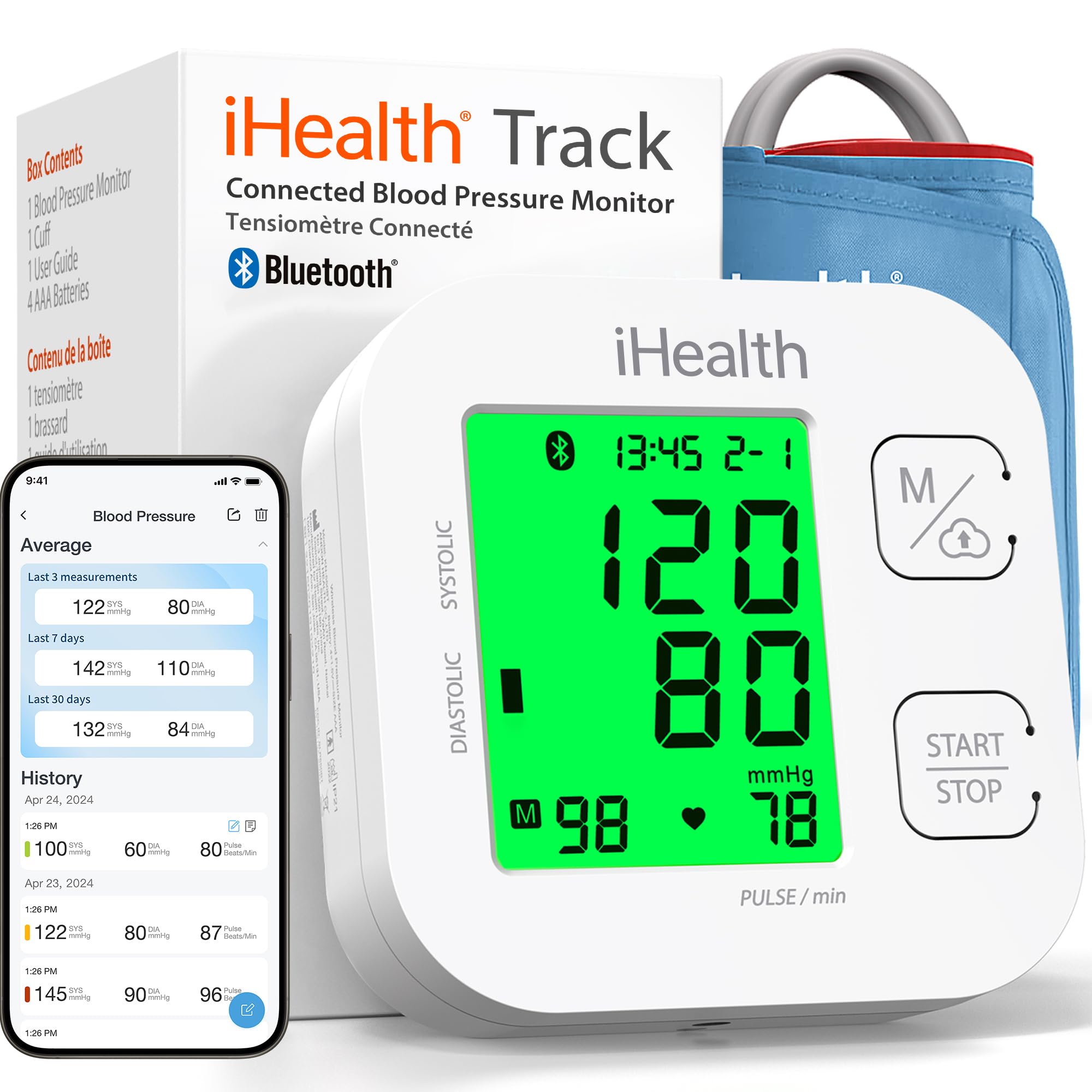
The phone-syncing favorite for anyone building a digital log of their readings.
If you want your numbers to live on your phone, this is the pick built for you. Two-button operation keeps the device itself simple — no calibration, no menus to learn — while the wide-range cuff handles upper arms from 8.7 to 16.5 inches (22 to 42 cm). On-device memory holds up to 99 readings, and the phone side is unlimited: the free iOS and Android app pairs over Bluetooth 4.0 and up, logs each reading automatically, and organizes results over 3, 7, and 30-day windows so you can see a trend instead of a single data point.
The display is genuinely helpful for anyone monitoring on a regular basis — large multicolor digits flood green, yellow, or red depending on where your reading sits, and the oversized numbers are legible without glasses. The unit also alerts you to irregular heart rhythm during a reading with a warning symbol. On Apple side, it connects to Apple HealthKit, so your readings flow into the same app you likely already use for other vitals.
Reliability is the honest note. Accuracy feedback is mixed — some users get readings that track their doctor’s machine closely, and others see readings that do not. A subgroup of long-run users felt the cuff needed to be repositioned to get consistent numbers, and the tubing is on the short side, which one buyer specifically called out with the words: “I took off 1 star because the tubing could be a little longer.” Still, the sheer popularity and the working pairing with phones and Apple Health make this the pick for someone who wants trends, not just a one-off number.
Where it shines
- Free iOS and Android app with unlimited reading storage and 3/7/30-day trend tracking
- Pairs over Bluetooth and connects to Apple HealthKit
- Large multicolored backlit display — green/yellow/red coded by range
- Wide-range cuff fits 8.7″–16.5″ upper arms
- Irregular heart rhythm alert displayed after measurement
- 99 onboard readings for when you are away from your phone
Where it splits opinion
- Accuracy reviews are genuinely mixed — some users report tight matching with clinic numbers, others do not
- Air tube is on the shorter side for some users
- App works best when you follow the sitting and arm-position instructions exactly
Pick this: if you want readings on your phone, on a health app, and shareable with a doctor inside a minute of taking them.
Choose another if: you want a monitor with a track record of every-user accuracy, not a mostly-accurate one.
7. AQESO Blood Pressure Machine Upper Arm, 3 Size Cuffs

Three cuffs, three users, 1,500 readings — the monitor built for the whole family.
The defining feature is the cuff trio in the box: a small 7 to 9 inch, a medium/large 9 to 17 inch, and an extra-large 13 to 21 inch cuff. That is the widest range in this entire list, and it means one device fits a slim-framed teenager, a mid-sized adult, and a large-armed grandparent without anyone having to buy a separate cuff. Store up to 500 readings for each of three users — 1,500 on-device total — and pick the right profile with one button. The large backlit LCD with oversized digits is designed for low-light readability, especially helpful for elderly users at a bedside table.
What wins buyers over is the combination of consistent quality and the cuff choice — the ability to hand a properly-sized cuff to each family member is the thing that most often comes up in positive reviews. It uses advanced oscillometric technology (the standard inflation-and-sensor method used by clinic devices) and shows a WHO classification bar so you can see your reading against a recognized scale without interpreting the raw numbers yourself. Power is flexible: four AAA batteries or a USB Type-C cable.
Two things to plan around, and neither is fatal. First, the accuracy split: a subset of users report the medium cuff losing air or the large cuff giving inconsistent numbers after several months of daily use. Second, the cuff gasket has been reported to crack on rare units, and durability is a low but existing concern. Both issues were resolved for affected users via replacement cuff and a doubled warranty to 24 months, so the after-sale support is real. The monitor is not rechargeable via USB — it needs a continuous power connection on USB, so plan on batteries if you want portability. For a household with multiple arm sizes, this is the most sensible single purchase here.
Strongest argument: three cuffs (7″–21″ range) means nobody in the family has to compromise on fit, and 1,500 readings of storage covers months of multiple-user data.
Worth knowing: cuff durability has been a rare weak point, so register the warranty and use the correct cuff for each user to extend life.
Choose it when: multiple adults with different arm sizes share one monitor and you want each person to have a properly-sized cuff from day one.
Reconsider if: you only need a single-user monitor and want to keep setup simple.
8. OMRON Gold Blood Pressure Monitor & Upper Arm Blood Pressure Cuff (BP5360)
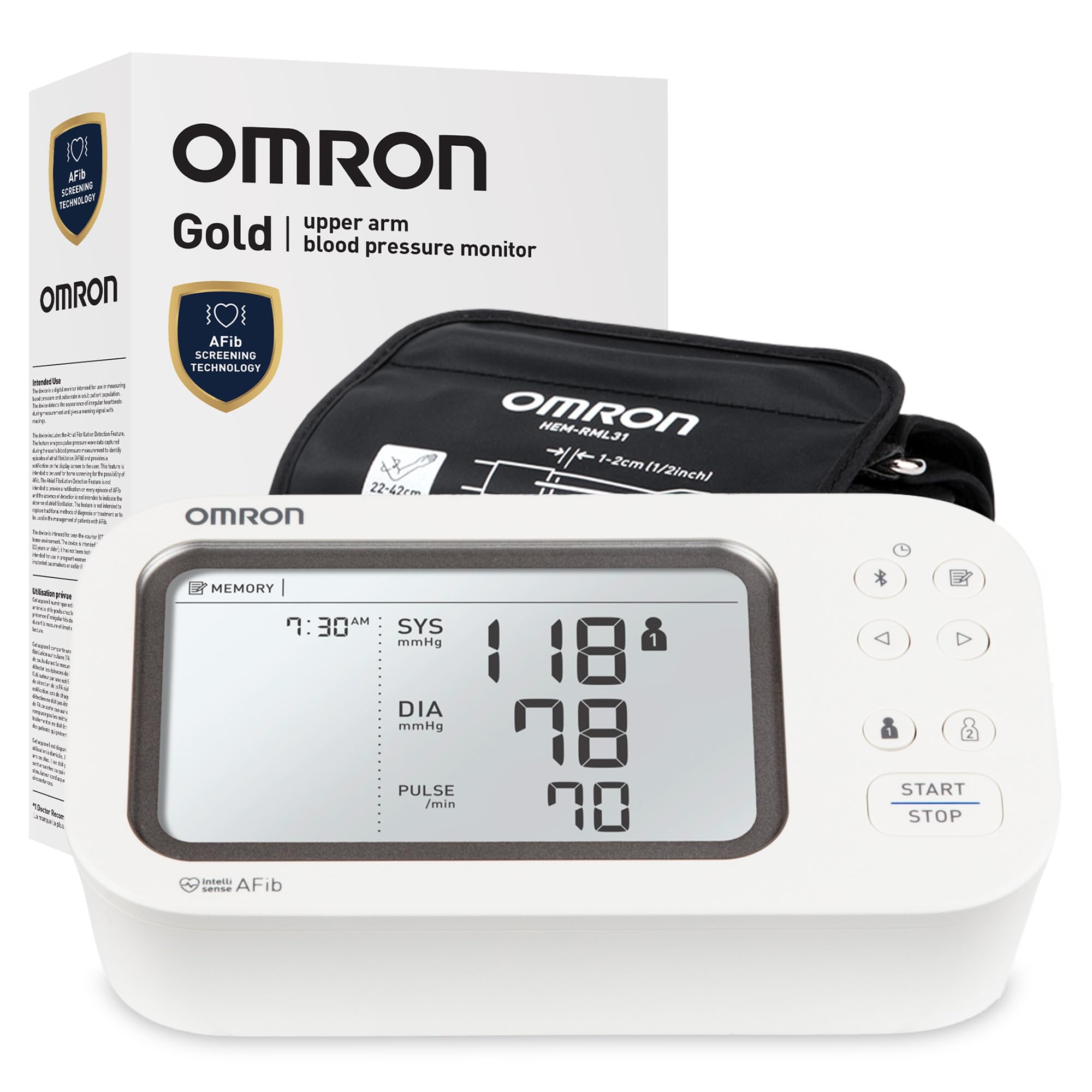
Rounds out the top-tier monitors with morning-spike tracking, an irregular-heartbeat screener, and a phone app for doctor visits.
This is the highest-tech monitor here, and what you are paying for is the diagnostic extras. It adds Atrial Fibrillation (AFib) detection, which screens for unusual heart rhythms during the reading, plus a High Morning Average Indicator that flags spikes in your morning readings. Morning readings carry extra weight in the conversation with your doctor, so having that summarized on-device is genuinely useful. The cuff wraps 9 to 17 inch arms with a D-ring clip style that some users find easier to position solo. A dual-display design shows your current reading beside your previous one for instant comparison.
The honest catch list is longer here, and it is worth reading before you commit. A meaningful subset of users report app issues, particularly that Bluetooth syncing can be glitchy and readings sometimes do not appear immediately. A smaller group of users feel their unit produced readings that did not match their doctor’s machine — one user even mentioned reporting this to customer service. The D-ring cuff is on the bulky side for travel, and there is no wall adapter in the box (four AA batteries are included instead). For buyers who want the most capable monitor for a doctor-facing routine, this earns the spot; for a simple one-reading-a-day routine, it is more monitor than most homes need. The Bluetooth syncing works best when you back up your data externally rather than relying on the app as your only record.
Smart features worth having
- AFib detection screens for abnormal heart rhythms during each reading
- High Morning Average Indicator summarizes your morning readings for the doctor
- Free OMRON connect app stores unlimited readings over Bluetooth
- Syncs to Apple Health and Google Fit
- Dual display shows current reading beside the previous one for comparison
- 9″–17″ wide-range D-ring cuff, storage case, and four AA batteries all included
Honest considerations
- The app is the weak link — Bluetooth syncing is occasionally slow or glitchy, so back up readings externally
- D-ring cuff is bulky for travel compared with smaller cuffs on other picks
- No wall adapter in the box — plan on batteries or add your own
- Some users report their unit’s readings did not match their clinic’s machine
Best for: buyers who want the AFib detector, morning-average tracker, and doctor-shareable app data — the most capable monitor on this list.
Not for you if: you just want a simple cuff-and-read monitor and don’t want to deal with the app’s quirks.
9. WITHINGS BPM Vision – Blood Pressure Monitor
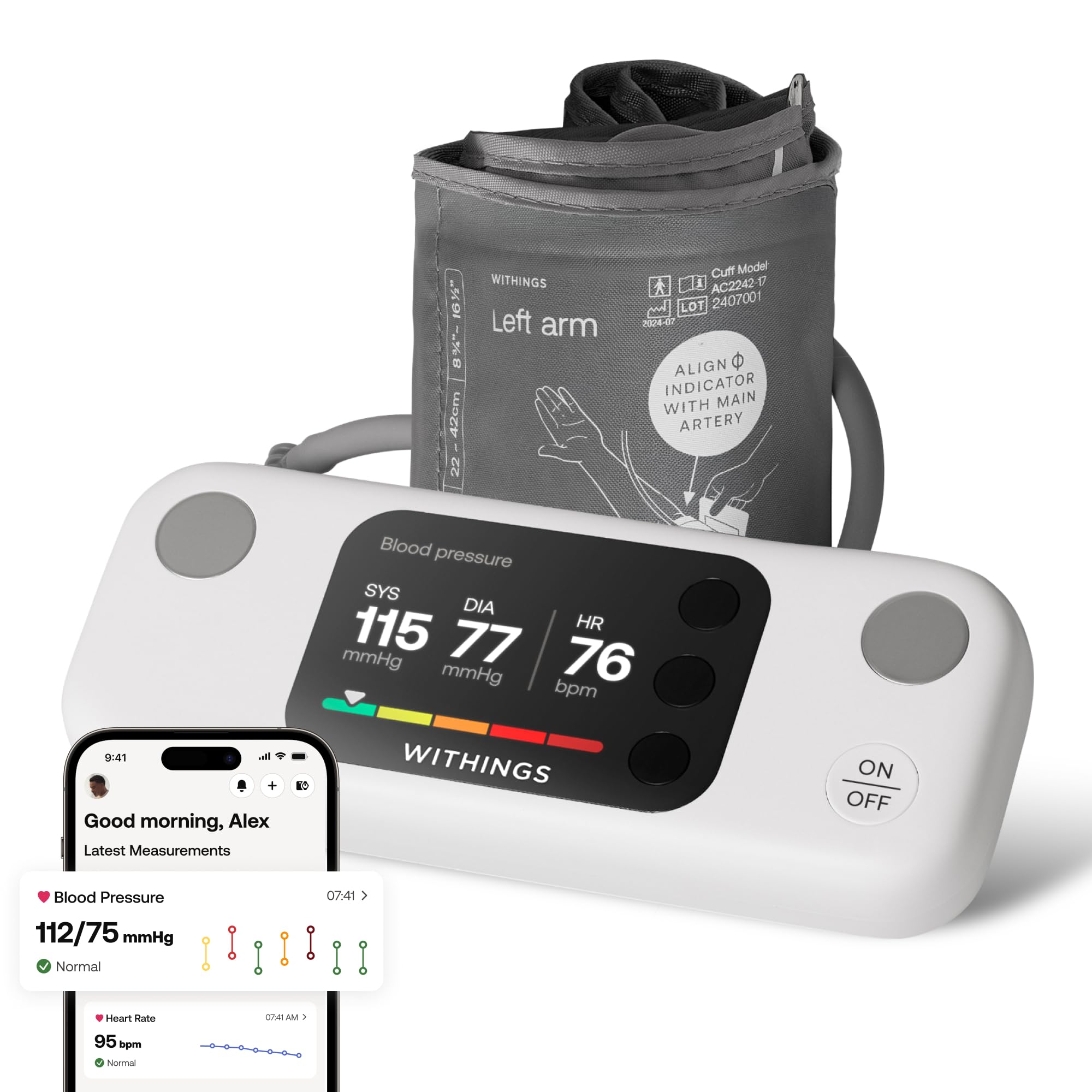
An FDA-cleared monitor with a year of battery life and automatic Wi-Fi or Bluetooth syncing.
One-year battery life is a category anomaly, and it is the reason this monitor belongs in the premium tier. It runs on a single included battery that lasts about a year of weekly use and recharges over USB-C. Its 2.8 inch LCD screen is one of the largest in this list, showing systolic and diastolic pressure plus heart rate in clear oversized type, and it color-codes the result against American Heart Association hypertension levels so you see right away whether the reading is in range. A protective case doubles as a stand, which is a small but genuinely useful touch when you are re-checking readings daily.
The syncing is the real story. It pushes readings automatically over Wi-Fi or Bluetooth into the Withings app for unlimited storage, no phone step required — the monitor uploads directly to the cloud, which matters if you travel between phone and home Wi-Fi. Built-in step-by-step tutorials walk you through an ideal-condition reading every time, which removes the positioning guesswork that frequently throws off home measurements. The standard cuff handles 8.7 to 16.5 inch arms, and a 3-reading average mode gives you a steadier number than a single inflation.
The honest sticking points: it is not compatible with pacemakers, and the app has occasionally shown glitches — including a subset of users who found Bluetooth sync slow, and a few who reported readings only appearing a few minutes later over Wi-Fi. A small number of units arrived faulty, and while customer support exists, it runs via email rather than phone. Two household users cannot share one phone for the app. If those trade-offs are acceptable and you value a monitor that feels like modern hardware and syncs reliably once set up, this is the premium choice for a real app-first routine.
Where it leads: Wi-Fi and Bluetooth syncing with 1-year battery life, 2.8″ LCD, and step-by-step on-screen tutorials — the most smooth routine here.
Where it stumbles: the app can be slow to sync and support is email-only; pacemaker users should skip it entirely.
The fit: tech-comfortable users who want an app-first monitor with year-long battery life and hands-off cloud syncing.
Avoid if: you use a pacemaker, prefer phone support, or share one phone across two app users.
Understanding the Specs
Cuff circumference is the first spec to check
Every monitor’s cuff has a range of upper-arm sizes it fits — typically printed as two numbers in inches or centimeters. Wrap a soft tape around the middle of your upper arm; if that measurement lands outside a monitor’s stated range, no software fix or app can save the reading. When the cuff is too small it over-inflates past comfort and tends to read high. When it is too loose it loses the pressure seal and the readings swing. Match the cuff first, then everything else.
Memory and user profiles determine how you track
Single-user monitors that store only the last measurement are ideal for one person checking once a day — you press the button, note the result, and move on. Multi-user memory (two profiles with dozens or hundreds of readings each) suits households where two or three people log their numbers on the same device. App-connected monitors push readings to your phone with unlimited history, which is what most doctors prefer when you want to show a trend rather than a single number.
Irregular heartbeat detection demystified
This feature analyzes the rhythm of your pulse during a measurement and displays a warning symbol if the pattern looks uneven. It is a signal to mention the reading to your doctor — not a diagnosis, and not a substitute for medical evaluation. Several monitors on this list include it, and it costs nothing extra to have in your pocket.
Batteries, adapters, and USB-C
Battery-only monitors are the most portable but need fresh cells, often unexpectedly. Adapter-included monitors are ideal if the device lives in one spot. A few monitors here support both — batteries for travel and a plug-in or USB-C cable for home — which is the most flexible setup. Note that some monitors with a USB-C connection need the cable plugged in continuously rather than recharging an internal battery.
FAQ
How do I know if a cuff will actually fit my arm?
Can two people share one home blood pressure monitor?
Does irregular heartbeat detection replace a doctor’s checkup?
Will an app-connected monitor share readings with my doctor?
How long does a home blood pressure monitor battery last?
Should I buy battery powered or plug-in blood pressure monitor?
Can I take readings on the wrist instead of the upper arm?
Do I need to have my monitor calibrated or checked?
Is a color coded display really useful or just a gimmick?
What if my monitor gives a reading that looks wrong?
Which type of cuff is easiest to put on by yourself?
Final Thoughts: The Verdict
For most households, the blood pressure monitor winner is the Acenis Automatic Blood Pressure Machine — it earns its place on the fundamentals that matter most: a large color-coded display anyone can read, a 40-second one-button check, two-user memory, and accurate readings that track the clinic. If you want the same accuracy wins plus app syncing and arrhythmia detection in a smaller case, the Beurer BM25 is the compact travel companion; if two people share one monitor and want numbers stored on the device, the Greater Goods Upper Arm Monitor handles two profiles and 120 readings without a phone involved. And if you want your readings in an app, ready to show a doctor, the iHealth Track is the crowd favorite for phone-based tracking. Whichever you choose, spend five minutes measuring your upper arm first — a monitor is only as good as the cuff that fits it.
How We Picked
We do not accept paid placement. Every pick is matched to a real buyer and a real use-case; we do not hands-on test units.
Sources & Methodology
Specifications: manufacturer listings and product documentation. Review insights: verified customer reviews, as of September 2026. Pricing: not shown on this page (it changes often); check the current price via the retailer link.
As an Amazon Associate, Gadgets Feed earns from qualifying purchases. This does not affect which products we feature.