
Our readers keep the lights on and my morning glass full of iced black tea. As an Amazon Associate, I earn from qualifying purchases.
Specs are compiled from manufacturer listings and verified buyer reviews and can change over time — please confirm the key details on the product page before buying.
If your old receiver died or you just want to stream phone music through the real speakers you already own, the answer is simpler than most shoppers think: buy an amp with Bluetooth built in and proper binding posts on the back. The catch is that “450W” on a listing rarely means 450 clean watts, and a cheap amp that buzzes will ruin a good pair of speakers. This guide sorts the nine strongest contenders by what actually matters — honest power, low noise, and inputs that match your gear.
I’m Min — the founder and writer behind Gadgets Feed. This guide is built by comparing the manufacturers’ published specifications and the patterns across verified customer reviews, so you get each pick’s real strengths and trade-offs instead of marketing spin.
You will see which amps drive hard-to-move speakers, which ones add a subwoofer cleanly, and where the noise floor actually sits. By the end you can pick a winner without guessing. Here are the best Bluetooth amplifier for wired speakers picks.
Our Picks at a Glance


How To Choose The Best Bluetooth Amplifier For Wired Speakers
A Bluetooth amplifier takes the wireless signal from your phone, tablet, or TV and turns it into the electrical current that moves your passive speakers. That last part is the whole job. Everything else — the knobs, the lights, the remote — is convenience layered on top of one question: can this box push your specific speakers cleanly and quietly?
Start with your speakers, not the amp
Look at the back of your speakers. You will see an impedance rating in ohms, usually 4, 6, or 8. Lower numbers are harder to drive because they pull more current from the amp. An amp rated for 4-16Ω passive speakers covers the widest range, while a 4-8Ω amp handles the common home-audio loads. If your speaker says 4Ω and the amp only lists 8Ω, you risk the amp shutting down or overheating.
Then check the power rating. Watts per channel at a stated impedance — like 70W at 4 ohms — is a real measurement you can trust. “1200W max” in giant letters is a peak number that lasts a fraction of a second and tells you almost nothing about daily listening. Compare the honest figures instead.
Bluetooth version and codec support
Bluetooth 5.0 or newer gives you a steadier connection over longer distances. What many buyers miss is the codec — the compression method. Standard Bluetooth uses SBC or AAC, which sounds fine but compresses the audio. Higher-end amps advertise aptX or HD variants for closer-to-wired quality. If you mainly stream Spotify from a phone in the same room, standard Bluetooth is perfectly usable. If you care about the last bit of detail, look for aptX support.
Inputs you will actually use
A phono input lets you plug a turntable straight in without an extra box. Optical and coaxial inputs take digital signals from a TV or CD player. RCA handles analog sources like a preamp or old tape deck. USB-C or USB-A ports add computer audio and flash-drive playback. Remote control, subwoofer pre-out, and tone knobs are the extras that make day-to-day use easier. Buy for the inputs you have today, not the ones you might add someday.
Quick Comparison
| Model | Best For | Power | Bluetooth | Key Inputs | Amazon |
|---|---|---|---|---|---|
| Denon PMA-600NE★ Best Overall | Analog purists wanting real power | 70W at 4 ohms | Built-in | 2 Optical, 1 Coaxial, Phono | Amazon |
| BT-398ABudget Champion | Budget garage and small-room setups | 60W x 2 | 5.0 | Optical, Coaxial, USB/SD, RCA | Amazon |
| Romicta 4 ChannelFour Speakers | Powering four speakers at once | 50W x 4 | 5.0 | USB, micro SD, AUX, Mic | Amazon |
| AIYIMA A07 Pro | Desktop 2.1 with swappable op-amps | 300W x 2 at 48V | 5.2 | RCA | Amazon |
| Fosi Audio MC331 | Retro tube look on a desktop | 105W x 2 at 4 ohms | Built-in | USB, Optical, Coaxial, RCA | Amazon |
| SMSL A300 | Clean class D with BTL power | 165W at 4 ohms | 5.0 | RCA, USB | Amazon |
| Ampapa D1 | 2.1 systems with a true high-pass filter | 300W x 2 at 48V | 5.2 | TRS Balanced, RCA | Amazon |
| AIYIMA A80 | Desktop DAC and amp in one box | 300W x 2 at 48V | Built-in | PC-USB, Coaxial, Optical, TRS | Amazon |
| WiiM Amp Ultra | Streaming-first whole-home system | 100W | 5.3 with LE Audio | HDMI ARC, Optical, RCA, LAN | Amazon |
In‑Depth Reviews
1. Denon PMA-600NE Bluetooth Stereo Amplifier
Our pick — over 4.5★ from 550+ verified ratings; the strongest balance of quality and price.
The full-size integrated amp for people who still own real wood-and-vinyl speakers.
Sound quality is what carries this amp, and it carries it a long way. That is the single trait buyers fixate on, and the reason is easy to hear: the divided circuitry lets you switch off the digital side entirely, so Bluetooth and DAC circuits go silent and the signal stays pure analog into the power stage. Owners describe the tone as warm and tube-like, close in character to a 1970s solid-state receiver but with modern quiet. Treble stays detailed and airy, bass stays tight, and the soundstage opens up in a way small desktop amps struggle to match.
Power is honest and measured. This Denon is an integrated amp rated 70W at 4 ohms and 45W at 8 ohms — the 8-ohm number is the one that matters with typical bookshelf speakers. It drives an 86dB, 6-ohm pair of Elac Debut B5.2s to room-filling volume at just 20 percent on the dial. For harder loads, one 300-ohm Sennheiser HD-600 pair runs easily at 9 o’clock on the headphone jack. The included phono preamp is quiet enough to skip an external box, and the optical DAC is clean enough that most listeners will never need a separate one.
The trade-off is the volume control. A long-standing gripe from buyers concerns the motorized knob — it is coarse, the remote has noticeable lag, and the input-selector font is small and recessed enough to be hard to read from a couch. The relay switching clicks audibly on input changes. Those are real annoyances on an otherwise high-performing amp. What you get for accepting them: a vibration-resistant chassis, 18 pounds of build weight, USB and coaxial and optical digital inputs, RCA analog ins, a subwoofer out, and Bluetooth that pairs instantly with an iPhone and streams AAC without drama.
Why people keep it
- Pure analog mode turns off the digital circuits for an undivided signal path
- 70W at 4 ohms drives real floor speakers and hard-to-move bookshelves without strain
- Built-in phono preamp means a turntable plugs straight in — no extra box
- 18-pound vibration-resistant chassis stays planted on a shelf
Where it asks patience
- Volume knob and remote feel coarse and laggy compared to the rest of the amp
- Input LEDs sit recessed and are genuinely hard to read in a dim room
- Input relay clicks are audible on every source change
Reach for this if: you want one amp that handles turntable, TV, streaming, and headphones without adding boxes — and you care more about sound than convenience features.
Look elsewhere if: you want touchscreen control, slick app integration, or a compact footprint; this is a full-size analog-first integrated amp with a physical volume knob and a clicky relay switch.
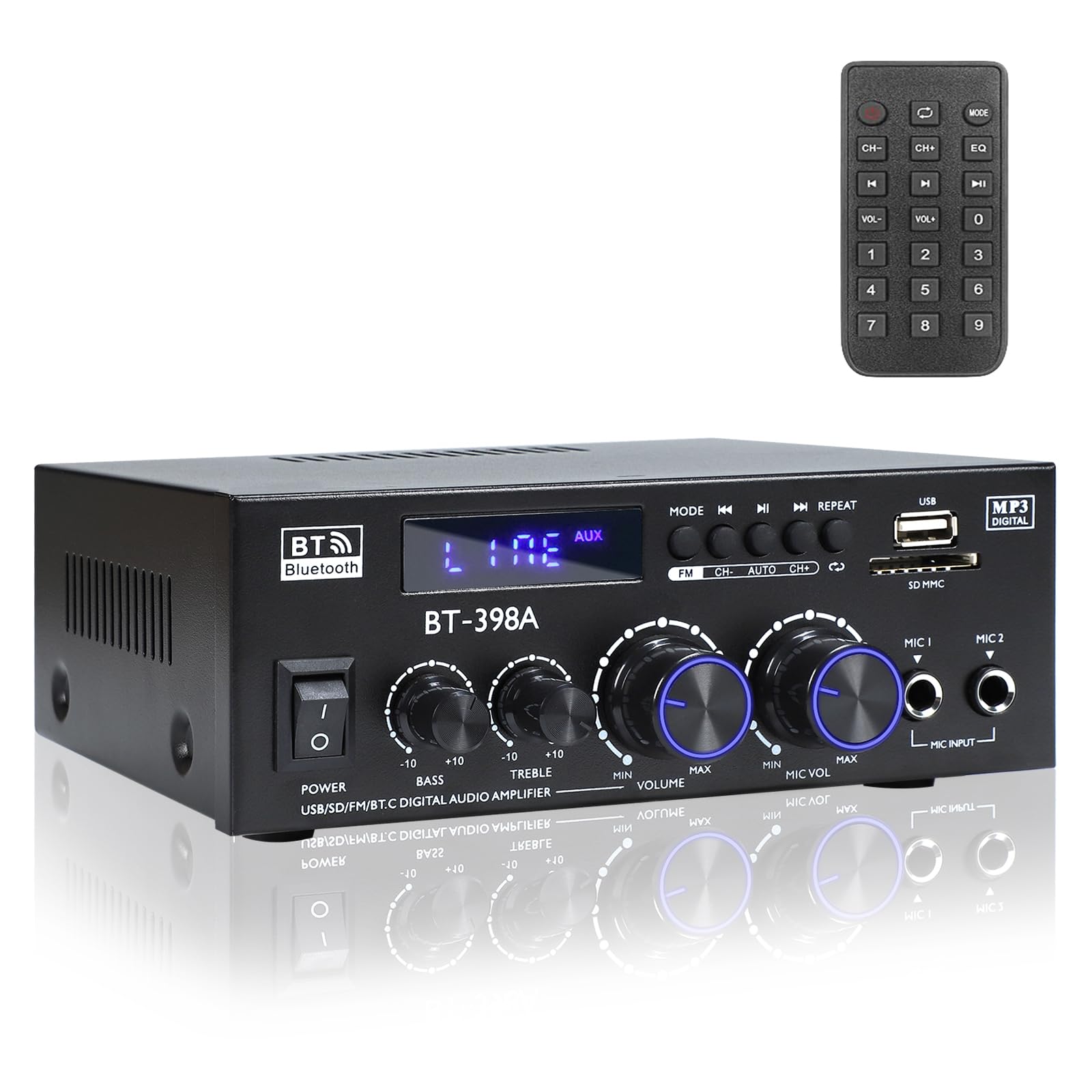
2. BT-398A Bluetooth 5.0 Stereo Receiver, 2 Channel 450W
Entry-level money, surprisingly serious inputs, and enough drive for a small room.
For buyers with bookshelf speakers in a garage, office, or small living room, the BT-398A does the core job without drama. Its honest figure is 60W x 2 into 4-16Ω passive speakers, which is plenty for typical bookshelf loads. Real-world owners put it against Sony tower speakers and report that 60 percent on the dial fills the room, and it handles vintage 1990s Panasonic passive speakers without hesitation. The distortion rate is stated at ≤0.4%, and the signal-to-noise ratio is 80dB — clean enough that buyers describe the sound as crisp and room-filling on wired speakers.
What surprises people at this tier is the input menu. Optical, coaxial, RCA, USB, SD card, and FM radio are all here, plus Bluetooth 5.0 with a rated 10-meter transmission range. That means a TV, a turntable with a built-in preamp, a phone, and a USB drive can all share one box. One-touch mode switching uses a disconnect-first logic — you have to break the current Bluetooth link before switching inputs to avoid interference. Once you learn it, it is not a problem; forgetting it is the only quirk worth knowing about up front.
The honest catch: this is a budget amp, and the speaker buzz issue shows up in a minority of units. The most-quoted buyer complaint describes an immediate buzz that would not go away, which is why some users return their unit. Most owners do not hit it, but if you do, the return is easy. The remote is also flaky — volume is limited by the physical knob setting, and the panel defaults to USB if a drive is inserted. skip it if you need app control or a truly quiet noise floor; grab it if you want full input coverage for a starter stereo.
Floor and ceiling: The BT-398A sits in the entry-level bracket and delivers real inputs and honest 60W x 2 into 4-16Ω speakers — the sub- category rarely covers this much ground.
Who this suits: Someone building a first wired stereo around existing bookshelf speakers, a TV, and a turntable, without spending mid-range money.
Buy it if: you want the most inputs at the lowest outlay and you can live with a plastic remote and a small learning curve on input switching.
pass on it if: you have high-efficiency or hard-to-drive speakers that demand clean headroom and a low noise floor — the budget build has a real buzz risk in a minority of units, and that is the honest limitation here.
3. Romicta 4 Channel Bluetooth 5.0 Stereo Amplifier, 50W x 4
The four-channel desktop amp built for a party, a karaoke night, or a dual-room setup.
If you own four passive speakers and want them all singing, this is the obvious shortcut. Four channels at 50W x 4 RMS means up to four speakers driven at once — two in the front and two in the back, or a pair in the living room and a pair in the garage. Harmonic distortion sits at 0.04% according to the build sheet, which is a genuinely low figure and shows in the clean, tunable sound. Owners power 4-ohm 18W and 8-ohm 34W speakers loudly without distortion and drive a couple of pairs of big bookshelves well.
Bluetooth 5.0 gives you 33 feet of stated operating range, which is generous for a room-to-room setup. The input menu is desktop-friendly: USB, micro SD, AUX, and mic inputs with a physical bass and treble knob and a bright LED display showing power and Bluetooth status. The compact aluminum chassis — about 6.9 inches square and 4.5 inches tall — sits on a desk without dominating it.
The two realities to weigh: this amp gets warm, and buyers loudly recommend keeping it in a well-ventilated spot. Second, at high volume the sound quality degrades — buyers report it sounds great below the ceiling, but the ceiling is real. There is also a soft-start logic where quieter TV signals stay muted until a volume threshold is met, which is fine for movies but bad for music production or anyone tracking quiet dialogue in 5-minute stretches. For karaoke, gaming, and casual home theater, the trade-offs are easy to accept at this tier.
Built for multi-speaker: 50W x 4 RMS, 1200W peak, aluminum casing, and a full input bank make this a very practical hub for a small venue, a bar, or a dual-room home setup.
Where it stumbles: at volume the sound softens, and the amp runs hot — leave breathing room around it.
Consider this if: four channels matter more than absolute fidelity, and you have a well-ventilated shelf.
Think twice if: you need sub-100% clean sound at high output — the mixed feedback on high-volume quality is a real ceiling, not a rumor.
4. AIYIMA A07 Pro Bluetooth 5.2 Amplifier, 300W x 2 Class D

A desktop chip-swapper’s dream: TPA3255 power plus socketed op-amps you can upgrade.
This is the amp for the buyer who wants to tinker. Two socketed NE5532 op-amps sit inside the chassis — an op-amp is a small signal-handling chip — and they can be swapped for LME49720, MUSES02, or OPA2604 to nudge the sound signature toward warm and musical or ultra-analytical. Very few amps in this bracket offer that level of personalization. The power figures are equally focused: 300W x 2 into 4-8Ω passive speakers, rated for up to 600W total under a 48-volt supply, and driven from a 36V 6A adapter in the box with an upgrade path to a 48V supply.
Sound quality lands where the chip and knobs suggest it should. Full, clean separation, a wide soundstage, and independent bass and treble knobs let you tune the amp to a room. Owners mention Bluetooth sounds as good as RCA in their setups, and the S20 phone pairs using aptX for around 40 meters through walls. Against other small class D amps, one buyer notes it drives 4-ohm ELAC UB5 bookshelf speakers louder than a 100W Fosi with more bass. A 1964 Dynaco A25 pair gets new life on this amp.
The catches are real but minor. The speaker terminals sit close together, and buyers recommend banana plugs (the locking plug style) rather than bare wire because the spacing is tight. Bluetooth gain runs lower than RCA — around a 15dB difference — so pushing past 80-90 percent on Bluetooth can distort. With 3-ohm loads and heavy bass, the amp overheats unless you keep volume under about 60 percent. The included adapter limits it to 36V; a 48V upgrade is where the full 600W potential sits. No remote, no headphone jack, no LDAC — deliberate omissions that keep the price down.
For the tinkerer: socketted op-amps plus a 24-48V power path make this the most customizable amp at this tier.
For the plug-and-play buyer: missing remote and ho-hum Bluetooth gain make it less convenient than it sounds.
Pick this if: you enjoy choosing your own op-amps and power supply, and you like the idea of an amp that grows with the system.
it’s not for you if: you want a remote, a headphone jack, or true 48V power from the start — this one asks you to bring all that yourself.
5. Fosi Audio MC331 Tube Integrated Amplifier with DAC
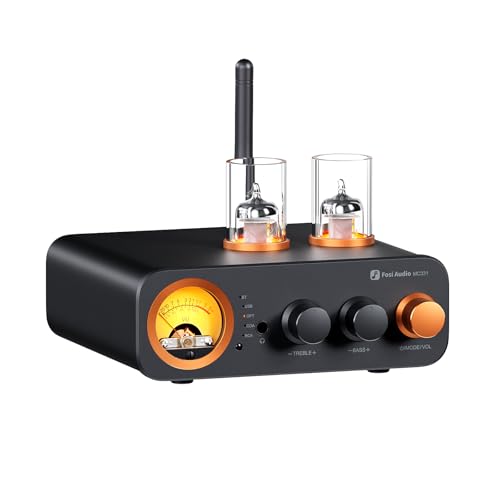
Vacuum tubes, a VU meter, and 105W x 2 in a box small enough for a desk.
This is the amp you buy for how it looks as much as for how it sounds. Two vacuum tubes glow through the top, the VU meter (a needle-style volume display) dances with the music, and warmth hits the tone after the tubes settle. The sound runs slightly warm and detailed, and it powers efficient speakers loudly without distortion. It drives a Polk T15 pair and vintage Bose 201 Series IV speakers via banana clips — enough to fill a 900-square-foot room from a compact footprint. The chassis is all metal and the knobs feel satisfying.
Functionally, it is a genuine all-in-one. A DAC (digital-to-analog converter — turns digital signals from a computer or TV into sound), preamplifier, power amplifier, and headphone amp live in one chassis. Inputs cover Bluetooth, USB-C, optical, coaxial, and RCA, so a computer, a phone, a CD player, and a turntable with a built-in preamp all reach the same amp. There is a pre-out, a 3.5mm headphone output, and remote-controlled bass and treble adjustment. The tubes are replaceable, which means you can roll in different tubes later and change the character of the sound.
The complaints land in two places. The remote is sluggish — about 2 seconds of latency and it needs direct line of sight — and the tubes sit deep enough in the chassis that the glow can be hard to see from the front. It also needs the remote to power on, since there is no physical power switch. The DAC tops out short of hi-res codec support, and the knob clicks audibly on the way around. Packed with the DAC, the tubes, the remote, and the 24V adapter, this is the most retro-leaning option at this tier.
Tubes, meter, everything
- Vacuum tube front end adds a warm, detailed character hard to find in solid-state amps at this tier
- 105W x 2 at 4 ohms pushes efficient bookshelf speakers to full room volume
- DAC, preamp, power amp, and headphone amp in one compact chassis
- Replaceable tubes let you tune the sound signature to taste
The fine print
- Remote has roughly 2 seconds of latency and requires line of sight
- No physical power switch — you need the remote to switch it on
- Tubes sit deep in the chassis, so the glow is subtle from the front
Designed for: the desktop listener who wants their amp to be a visible centerpiece with tube warmth and a moving needle on the front.
Not for: anyone who wants snappy remote response, an on-unit power switch, or hi-res streaming from the internal DAC — those are the real limits here.
6. SMSL A300 HiFi Power Amplifier, BTL Mode Bluetooth 5.0

A class D amp built around measurements: 165W at 4 ohms with 0.004% distortion.
Two things make the A300 stand out on paper: the German Infineon MA5332MS amplifier chip and the 0.004% total harmonic distortion (THD+N — an industry measure of how much unwanted noise the amp adds). The lower that number, the cleaner the signal. Customers note transparent sound, tight bass, and almost no added character — the A300 is a chameleon that lets your speakers sound like themselves. BTL mode (a bridged wiring method that doubles power on a single speaker pair) is where the 165W at 4 ohms lives. Into 8-ohm loads, it produces 85W per channel of clean power. It has a dedicated subwoofer pre-out for building a 2.1 system, 8 preset EQ options, and manual bass and treble knobs.
The build is where this amp earns its look. The aluminum alloy chassis is CNC-machined with anodizing and chamfered edges — it feels more expensive than the price tier. It runs cool, comes with a full-featured remote, and includes Bluetooth 5.0 alongside USB and RCA inputs. One buyer describes it as a “smart pick” for a desktop hi-fi, bedroom rig, or minimalist living room setup, and another compares it directly to a popular small class D amp and finds it cleaner with more power.
Two honest limits. First, the tone controls are preset EQ options plus manual bass and treble — there is no full multi-band EQ for precise room correction. Second, its 3-character LCD display is minimal and looks basic next to the digital VU screens elsewhere on this list. One owner reports a right-channel output failure after a few weeks; the other side of the coin is that early failures also happen on dozens of amps in this tier, and quick-strike returns with Amazon protect the buyer. For the clean 0.004% THD+N signal, the machined aluminum build, and the 2.1 sub pre-out, the A300 is a strong mid-tier value.
What you get: 165W at 4 ohms, 85W at 8 ohms, 0.004% THD+N, a machined aluminum case, and 2.1 subwoofer pre-out — quietly one of the cleanest class D amps here.
What to expect: a small 3-character LCD and preset EQ options only — the interface is plain, by design.
This is the pick for: desktop or bedroom listeners who want a small amp with serious measured performance and a 2.1 path.
Consider alternatives if: you want a full 7-band EQ, a showy display, or streaming features — the A300 stays utilitarian.
7. Ampapa D1 2 Channel Bluetooth Amp, 300W x 2 with HPF
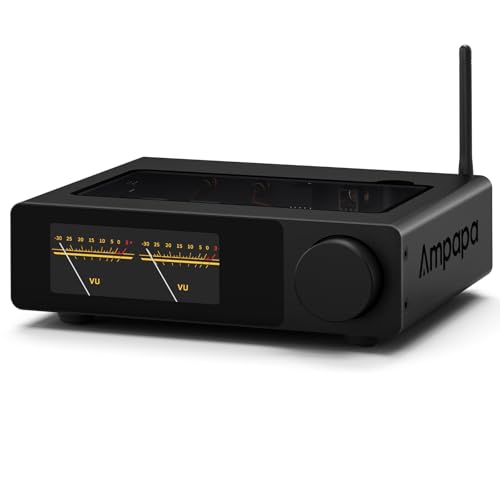
The compact 2.1 amp with the OLED VU meter and a genuine high-pass filter.
For a buyer building a real 2.1 system on a desk, this is the sweet-spot pick. The 30-200Hz high-pass filter strips low frequencies out of the signal sent to your main speakers, letting them focus on mids and highs. Meanwhile the sub pre-out passes a full-range signal to an active subwoofer. The result is a cleaner stereo image and a sub that blends properly — buyers call it a real upgrade over a soundbar. Because it is built on Douk Audio’s A5 amp with the TPA3255 chip (a popular high-efficiency class D amplifier), the sound quality lands at the top of the small-amp class even on high-end rigs.
The OLED display is the standout feature. Seven VU styles (meter animations, essentially) in classic yellow, blue, or black rotate with real-time feedback on volume and input — reviewers call it a gorgeous, retro-modern faceplate. Under it sits a glass top for op-amp swaps when you want to tune the character, plus a 12V trigger so other components can power it on. The aluminum chassis is compact and mounted on a shelf or desk without stealing space.
The honest trade-off is auto-standby. It kicks in after 5 minutes of no signal and there is no defeat switch — you have to wake it via the remote power button. Buyers also note it runs warm at high volume and that the real 8-ohm wattage falls short of the 300W headline. In practice, in near-field or small-room listening, it gets loud enough with room to spare. The 48V/5A GaN power adapter (a more efficient supply type) is included, so you do not need to buy one separately.
Why it wins on features: a 30-200Hz HPF, sub pre-out, TRS balanced input, 12V trigger, digital VU display, and swappable op-amps — a rare combination at this tier.
What to know: auto-standby after 5 minutes is not defeatable and Bluetooth output runs quieter than wired input.
Perfect match if: you want an actual 2.1 system with a subwoofer, a bright VU display, and a small footprint on the desk.
look elsewhere if: you need always-on power with no signal-detection quirks, or you plan to push demanding 4-ohm tower speakers at high volume.
8. AIYIMA A80 Bluetooth Stereo DAC Amplifier TPA3255
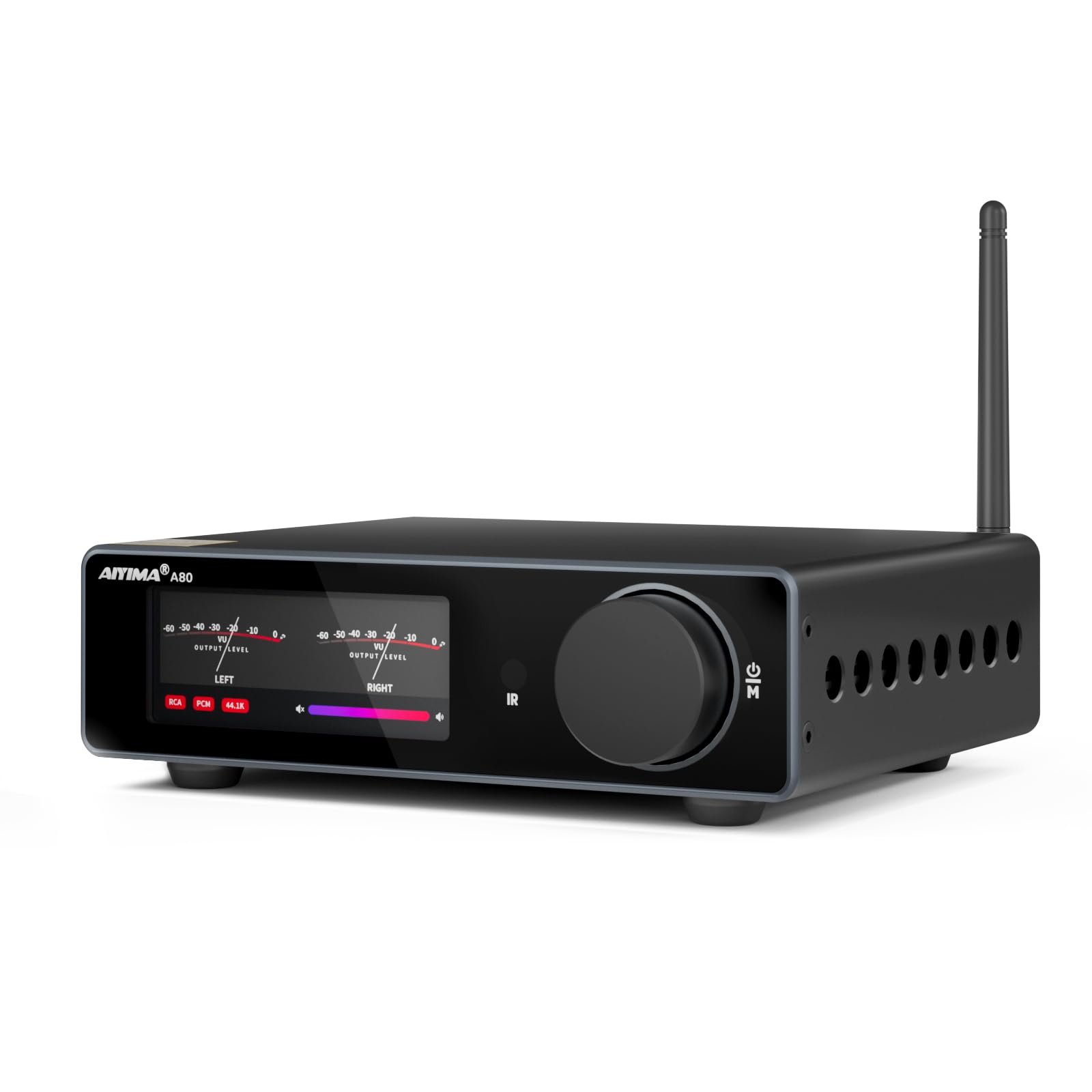
A desktop amp and a seriously good DAC living in the same small aluminum box.
The A80 pairs a studio-grade ESS9038Q2M DAC (the chip that turns a digital file into an analog signal) with the TPA3255 amplifier chipset, so the digital conversion and the amplification happen in one chassis. Total harmonic distortion is stated at 0.006%, and the SINAD figure (signal-to-noise-and-distortion — a single-number quality score for the signal path) is 109dB. The DAC supports DSD256 and PCM high-resolution audio, so a computer feeding lossless files gets the full fidelity of what you send. The flagship TPA3255 stage is rated 300W x 2 at up to 600W total on the included 48V 5A power adapter, and drives tower speakers like JBLs to full, easy volumes.
What separates this from the cheaper desktop amps is the input list. TRS balanced inputs (the pro-audio style connectors that reject interference) sit next to USB, optical, coaxial, and Bluetooth. Buyers call the near-zero hiss floor at 100 percent volume a genuine step up from receiver-class gear. There is a 12V trigger input, a subwoofer pre-out, RCA and 3.5mm AUX outs for adding an external sub or driving an amplifier, and a digital VU display with multiple modes so you can watch the meter or an album-art style graphic while music plays.
The honest limits are small and specific. One owner notes the A80 runs warm after about 30 minutes of average-volume listening — ventilation matters. The display is bright but small enough to read only from nearby. Auto-power-on is not supported, and auto-off can trigger at low volumes. Buyers who already own only RCA sources and don’t need USB or optical may find the feature set overkill. The included 48V 5A GaN supply already delivers the full 600W potential, so no power upgrade is needed.
The standout: a 109dB SINAD and 0.006% THD from a single TPA3255 stage, plus TRS balanced inputs that most desktop amps skip entirely.
The reality: it runs warm, the display is small from across a room, and RCA-only buyers pay for features they will not use.
This delivers for: desktop setups where the DAC quality and quiet input path matter — especially with a PC feeding lossless files or a subwoofer joining the party.
Consider the D1 or A07 Pro instead if: you only need RCA inputs or a single-purpose power amp without the DAC investment.
9. WiiM Amp Ultra Stereo Streaming Amplifier, HDMI ARC & RoomFit

The all-in-one streamer-amp that replaces both your receiver and your streaming box.
This is the pick for a listener who wants one box to do everything: stream, amplify, correct the room, and show album art. Inside sits the combination of an ESS SABRE DAC, dual TI TPA3255 amplifier chips (two class D amp modules working together), and PFFB technology — a design that keeps the amp’s output consistent no matter what speakers are connected. Distortion is measured at -106 dB THD+N, and the amp is rated 100W into seven or eight-ohm loads, which means punchy, clean output into towers like Emotiva T2s or bookshelves like B&W 706 S2s and KEF Q1s.
Streaming is the WiiM Amp Ultra’s real home turf. Wi-Fi 6 and Bluetooth 5.3 with LE Audio (a newer, lower-power version of Bluetooth audio) keep the signal steady. Spotify, TIDAL, Qobuz, Amazon Music, Roon Ready, and Chromecast are supported up to 24-bit/192kHz, which is higher-resolution than a CD. HDMI ARC (the TV audio return channel standard) means one cable carries TV sound into the amp with no separate decoder. RoomFit room correction auto-calibrates the sound to your room and speakers, and the 3.5-inch glass-covered touchscreen shows album art, input, and system settings at a glance. The powered remote is aluminum and rechargeable.
Two things to know going in. There is no AirPlay support and cannot be used as an AirPlay receiver — Apple-centric households will miss it, and buyers repeatedly flag this in their notes. Bluetooth is only SBC and AAC (no aptX or LDAC), so if you want top-shelf wireless fidelity, use the Wi-Fi streaming or wired inputs instead. The WiiM Home app takes a beat to learn. If you can live without AirPlay and aptX, no other amp here matches this streaming integration and app control in one chassis.
Why buyers crown it
- Streams Spotify, TIDAL, Qobuz, Amazon Music, Roon, and Chromecast up to 24-bit/192kHz
- HDMI ARC puts TV audio through the amp over one cable, no separate decoder needed
- RoomFit room correction auto-calibrates sound to your room and speakers
- 3.5-inch glass touchscreen and rechargeable aluminum remote handle daily control
Where buyers flag limits
- No AirPlay support, and it cannot act as an AirPlay receiver — Apple streaming requires another path
- Bluetooth runs SBC/AAC only, so high-fidelity listeners should use Wi-Fi or a wired source
- The WiiM Home app takes time to learn, especially for EQ and subwoofer settings
This is the one for: anyone who wants streaming, room correction, HDMI TV audio, and amplification in a single compact aluminum box with a real screen.
Not the one for: Apple-only households that rely on AirPlay for streaming, or buyers who only need a simple wired amp.
Understanding the Specs
Watts per channel (and why 450W rarely means 450W)
Watts per channel is the headline number every listing wants you to see, and the one most often inflated. Real ratings state the load (an impedance in ohms) alongside the power — like 70W at 4 ohms, or 85W at 8 ohms. If a spec only says “450W” or “1200W max,” that is usually a peak number that lasts only a fraction of a second and tells you nothing about the honest output on your speakers. When you are shopping, compare the watts-at-a-stated-impedance figure across amps in the same tier; that is the only apples-to-apples number.
Impedance matching (ohms) and why it changes the sound
Your speakers carry an impedance rating — often 4Ω, 6Ω, or 8Ω. Lower numbers present a harder electrical load, and the amp has to work harder to hold the voltage steady. An amp rated 4-16Ω passive speakers can drive any common home speaker. An amp rated only 8Ω will strain on 4Ω speakers and may overheat or trip its protection. Before you buy, look at the back of your speakers and match: if they say 4Ω, choose an amp whose spec includes 4Ω in its supported range.
Bluetooth version versus Bluetooth codec
The Bluetooth version — 5.0, 5.2, 5.3 — is about connection stability and range. Newer versions hold a signal through walls and lag less. The codec is about sound quality. SBC and AAC are the standard codecs; they compress the audio and sound fine but lose some detail. aptX and its HD variants send more data for closer-to-wired quality. If you stream from a phone, check both: version 5.2 or newer for stability, and aptX support if you care about the last few percent of fidelity.
Distortion (THD) and signal-to-noise — the quiet quality numbers
Total harmonic distortion, or THD, measures how much unwanted noise the amp adds to the music. A figure like 0.004% or 0.006% means the amp keeps the signal clean — the lower the number, the purer the sound. Signal-to-noise ratio (often written SINAD) is the same idea from the other direction: a higher number means a quieter background in quiet passages. These two numbers are where great amps separate from good ones, and they matter more than any peak-power headline.
FAQ
Can I connect my existing wired speakers to a Bluetooth amplifier?
What is the difference between active and passive speakers when choosing an amp?
How many watts do I actually need for my speakers?
Will Bluetooth sound as good as a wired RCA input on these amps?
Can I add a subwoofer to a Bluetooth amplifier for a 2.1 system?
What does the high-pass filter (HPF) actually do on an amplifier?
Do these amps work with 4-ohm speakers?
Why does my amplifier get warm — is that normal?
Can I use a Bluetooth amplifier as a preamp in a bigger stereo system?
How long does a Bluetooth amplifier last?
Which Bluetooth amplifier has the lowest noise floor?
Final Thoughts: The Verdict
For most people upgrading a wired stereo, the bluetooth amplifier for wired speakers to buy is the Denon PMA-600NE. It pairs a real phono input, two opticals, coaxial digital, Bluetooth, and 70W at 4 ohms into one chassis, and its analog mode genuinely turns off the digital circuits when you want the purest path. The coarse, laggy volume knob is the one real gripe; everything above the dial is a step up in this tier.
If streaming and app control matter more than analog purity, the WiiM Amp Ultra is the one to reach for — HDMI ARC, Wi-Fi 6, Roon Ready, and RoomFit room correction in a single box. For a desktop 2.1 system on a budget, grab the Ampapa D1, whose 30-200Hz high-pass filter and sub pre-out do more for bookshelf speaker clarity than any equalizer. And for the tinkerer who wants to swap op-amps and upgrade power, the AIYIMA A07 Pro hands you that control for the price of a single dinner out.
The three quietest amps here — the A80, A300, and WiiM Amp Ultra — all rate at or above 109dB SINAD, so spend up only if hiss bothers you. Otherwise, budget amps here drive real speakers cleanly enough for casual rooms and small parties. Pick by your speakers, your inputs, and what you own today, and you will land on the right box.
How We Picked
We do not accept paid placement. Every pick is matched to a real buyer and a real use-case; we do not hands-on test units.
Sources & Methodology
Specifications: manufacturer listings and product documentation. Review insights: verified customer reviews, as of September 2026. Pricing: not shown on this page (it changes often); check the current price via the retailer link.
As an Amazon Associate, Gadgets Feed earns from qualifying purchases. This does not affect which products we feature.