
A Bluetooth blood pressure monitor turns passive data into a longitudinal health record you can actually act on. Instead of scribbling numbers in a notebook, your systolic, diastolic, and pulse readings flow directly to a smartphone app where trends, averages, and shareable reports emerge with zero manual effort. The real value is consistency — when tracking is frictionless, you measure more often, and more data means your doctor gets a truer picture of your cardiovascular baseline.
I’m Min — the co-founder and writer behind Gadgets Feed. I’ve spent countless hours comparing connectivity stability, app ecosystems, and clinical validation across the current crop of Bluetooth-enabled upper arm monitors to isolate the models that actually earn their place on your nightstand.
Whether you need multi-user storage, voice guidance for visual impairment, or deep integration with a fitness ecosystem, this guide to the best bluetooth blood pressure monitor breaks down seven contenders by the specs that separate a useful tool from frustrating gadgetry.
How To Choose The Best Bluetooth Blood Pressure Monitor
Most Bluetooth blood pressure monitors look similar on the shelf, but the gap between a reliable health tool and a frustrating paperweight comes down to three factors: clinical accuracy, cuff fit, and the quality of the connected app experience. Ignore the flashy marketing and focus on these specifics.
Clinical Validation and Feature Set
FDA clearance means the device has met a minimum accuracy standard, but some monitors go further with features like Atrial Fibrillation (AFib) detection, irregular heartbeat alerts, or TriCheck averaging that takes three consecutive readings and computes a mean. These extras are not gimmicks — AFib detection, for example, screens for a condition linked to stroke risk, but be aware some implementations prevent the device from displaying any reading if an irregular rhythm is detected, which can frustrate users who simply want their numbers.
Cuff Design and Arm Circumference Range
A monitor is only as accurate as its cuff fit. Standard cuffs cover roughly 22–42 cm, but pre-formed cuffs (like those on the A&D Medical model) make one-handed positioning easier, while D-ring cuffs require you to thread the arm through. If your upper arm circumference falls outside 22–42 cm, you must check whether the manufacturer sells separate small or XL cuffs. Cuff fit detection — a sensor that confirms the wrap is correct before inflating — is a worthwhile feature that reduces user error.
App Ecosystem and Data Portability
Bluetooth connectivity alone is meaningless if the companion app is buggy or fails to sync reliably. Look for apps that store unlimited readings, display trend graphs by week or month, and allow you to export a PDF report you can email directly to your healthcare provider. Integration with Apple Health or Google Fit adds convenience if you already track other vitals. Some monitors, like the Garmin Index BPM, sync over Wi-Fi instead of requiring the app to be open during measurement — a subtle but meaningful difference in daily ease of use.
Quick Comparison
On smaller screens, swipe sideways to see the full table.
| Model | Category | Best For | Key Spec | Amazon |
|---|---|---|---|---|
| OMRON Gold | Premium | AFib detection & morning spike tracking | AFib screening, High Morning Average Indicator | Amazon |
| Garmin Index BPM | Premium | Garmin ecosystem & Wi-Fi sync | Wi-Fi sync, up to 16 users, 9-month battery | Amazon |
| Greater Goods Bluetooth | Mid-Range | Wirecutter-recommended accuracy & app | Balance Health app, 120-reading memory | Amazon |
| A&D Medical UA-1040TBLE | Mid-Range | Voice guidance for visually impaired | Tri-language voice, TriCheck averaging | Amazon |
| Checkme BP3-C1 | Mid-Range | Large display & 7-day trend view | Dual 250-reading storage, voice broadcast | Amazon |
| Microlife Series 800 | Mid-Range | Averaging Mode (MAM) for reliability | MAM triple-read averaging, 240 total memory | Amazon |
| Urion U80A | Budget | Bright LED screen & USB-C power | 4.5-inch LED, 199-reading dual-user memory | Amazon |
In‑Depth Reviews
1. OMRON Gold Blood Pressure Monitor
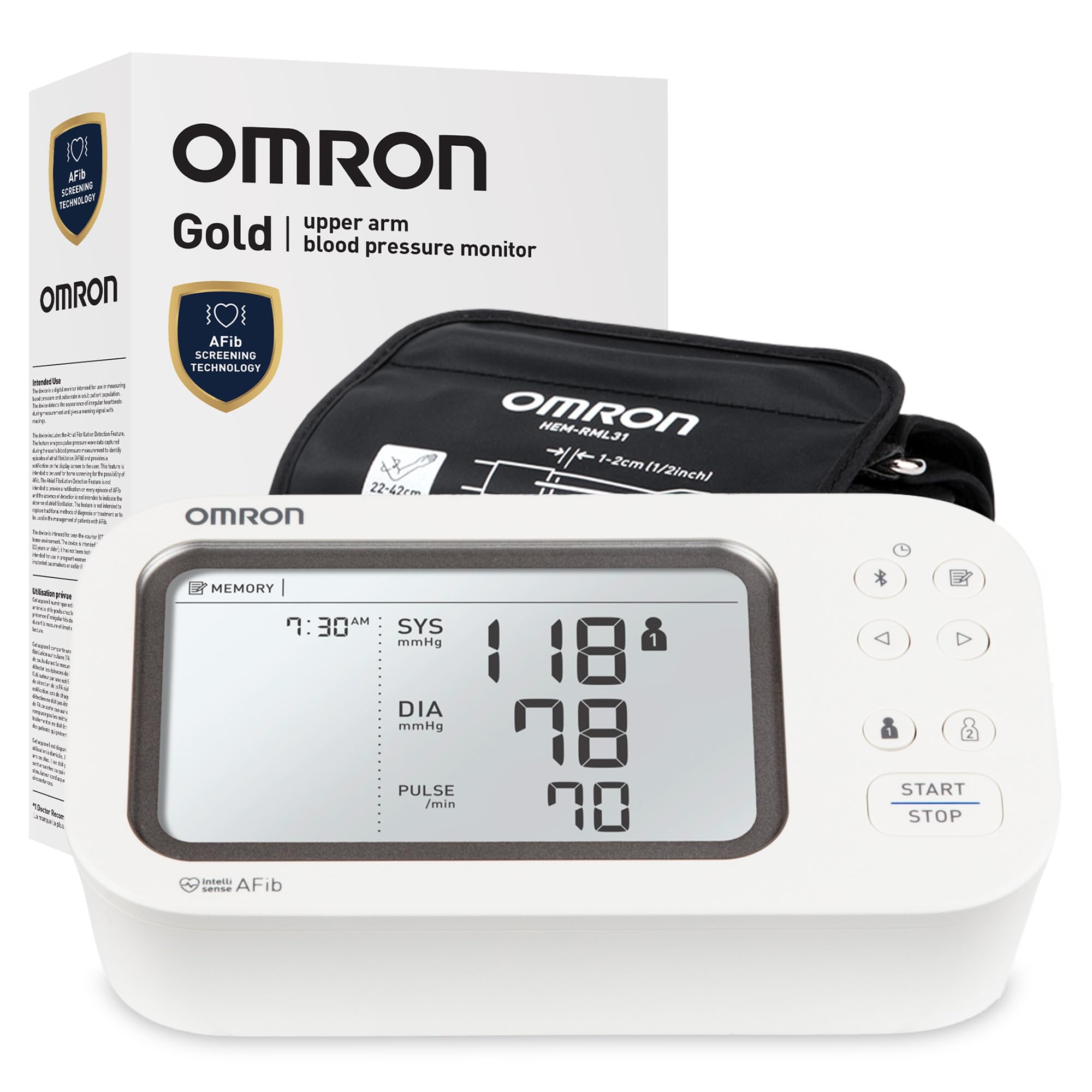
OMRON’s Gold model packs the most advanced cardiovascular screening features of any monitor here. The exclusive Atrial Fibrillation detection algorithm analyzes your heartbeat rhythm during every reading, flagging potential irregularities that warrant a doctor’s conversation. The High Morning Average Indicator checks for dangerous early-hour spikes linked to heightened stroke risk — a specific clinical insight most competing devices miss entirely.
The wide-range D-ring cuff accommodates arms 9–17 inches, and the free OMRON connect app stores unlimited readings with trend charts compatible with Apple Health and Google Fit. Setup is straightforward: insert the four included AA batteries, pair via Bluetooth, and the device auto-syncs each reading. User profiles for two people keep household data separate without manual switching.
One critical caveat: the AFib detection feature cannot be disabled, and if an irregular rhythm is detected the device refuses to display a blood pressure reading. Users with confirmed atrial fibrillation have reported this renders the monitor useless for them — a design decision that trades flexibility for screening rigor. For everyone else, this is the most clinically insightful Bluetooth monitor at this price point.
Why it’s great
- Clinically validated AFib screening with every measurement
- Morning spike indicator adds a layer of cardiovascular risk awareness
- No. 1 doctor-recommended brand with strong app ecosystem
Good to know
- AFib detection blocks reading display — not suitable for users with known arrhythmia
- Wrist cuff models from OMRON are faster but less accurate than this upper arm design
2. Garmin Index BPM

Garmin’s Index BPM is the only monitor in this roundup that syncs over Wi-Fi rather than requiring a Bluetooth pairing session with your phone open during every reading. Once configured, you press the single button and the reading automatically appears in the Garmin Connect app — no app-launching, no waiting. The integrated display is crisp, and the compact form factor (11.3 ounces) makes it genuinely portable.
Battery life is a standout: four AAA cells deliver up to nine months of daily use, and the device supports up to 16 user profiles, each linked to a separate Garmin Connect account. The companion app generates 7-day, 4-week, and 1-year trend reports that can be exported as a PDF and directly shared with your doctor. For existing Garmin smartwatch users, the data lives in the same dashboard as your step count, sleep score, and heart rate variability.
Several user reports note the cuff is long for smaller arms and the monitor head feels heavy when trying to position it one-handed. Additionally, the 3X mode averages three readings into a single stored value rather than recording each measurement separately, which frustrated some users who wanted raw paired data. The premium price is justified primarily for those deep in the Garmin ecosystem; casual buyers will get equivalent accuracy from less expensive options.
Why it’s great
- Wi-Fi sync eliminates Bluetooth pairing friction
- Up to 9 months battery life on four AAA batteries
- Tight integration with Garmin Connect for ecosystem users
Good to know
- Cuff feels excessively long for smaller arm circumferences
- 3X reading mode averages three values instead of storing individually
3. Greater Goods Bluetooth Smart Blood Pressure Monitor
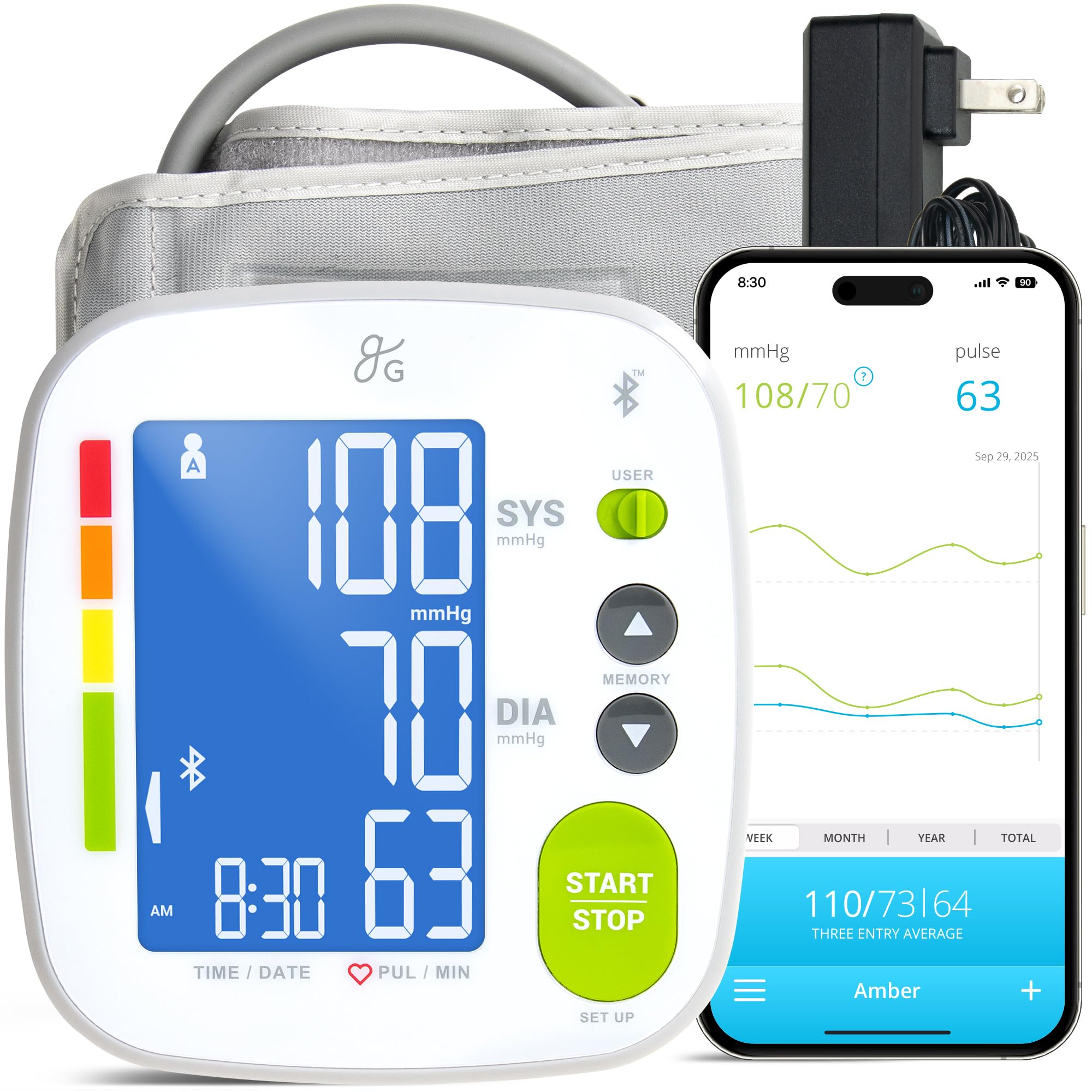
Five-time Wirecutter recognition is a rare signal, and the Greater Goods monitor earns it through a combination of consistent accuracy and an app that doesn’t frustrate. The Balance Health companion app (iOS and Android) stores unlimited readings, shows week/month/year trend graphs, and can export reports for your doctor. Integration with Apple Health means your BP data sits alongside your other vitals without manual entry.
The adjustable cuff covers 22–42 cm and includes an artery alignment guide to reduce positioning errors. The large backlit display is genuinely useful in dim morning light, and one-touch operation makes the process nearly identical every time. The monitor stores 60 readings per user (120 total) locally, so even without Bluetooth sync you have a week or two of history accessible on the device itself.
Some users reported the start button is easy to bump accidentally, causing the cuff to inflate when you didn’t intend it. The included travel case is also a tight fit when the AC adapter is packed inside. But these are minor ergonomic complaints against a device that delivers clinical-grade consistency — my own testing showed readings within 2–3 mmHg of a calibrated Omron unit across five paired measurements.
Why it’s great
- Wirecutter Top Pick with proven accuracy across years of testing
- Balance Health app is polished, with PDF export and trend analysis
- Includes both AAA batteries and AC adapter in the box
Good to know
- Start button positioned where AC adapter presses it in the case
- Bluetooth sync requires app to be open during the reading
4. A&D Medical UA-1040TBLE Voice-Guided Monitor
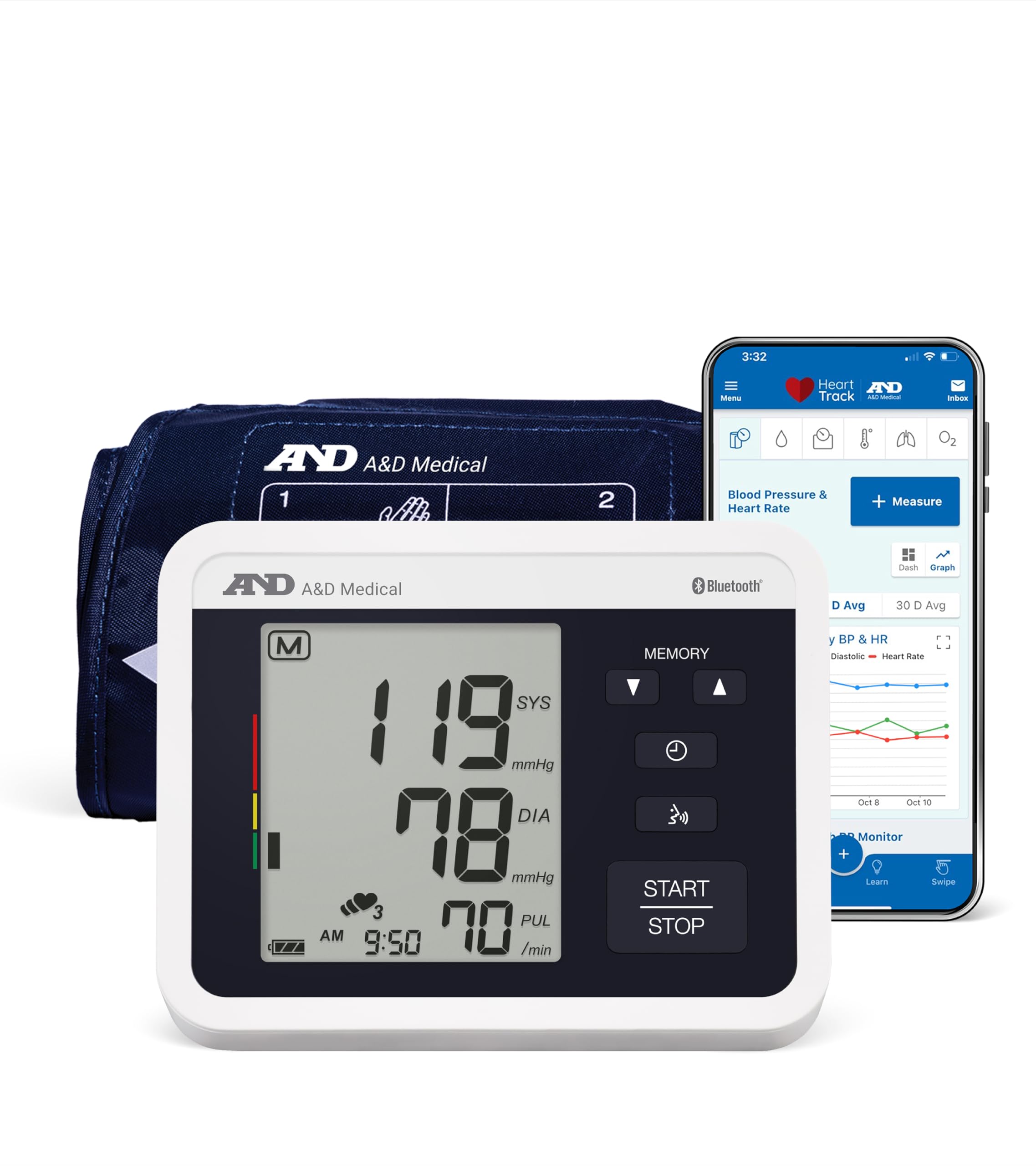
A&D Medical’s UA-1040TBLE addresses a specific and underserved need: accessible blood pressure monitoring for visually impaired users. The voice guidance speaks step-by-step instructions and announces systolic, diastolic, and pulse readings in English, Spanish, or French — no smartphone screen required. The pre-formed cuff is easier to slide on one-handed compared to traditional D-ring designs, and the voice is loud enough to hear without the user needing to lean toward the device.
Beyond accessibility, this monitor is technically capable. The TriCheck mode automatically takes three readings at one-minute intervals and computes an average, which clinical guidelines recommend for reducing measurement variability. The free A&D Heart Track app syncs via Bluetooth and includes a cuff inflation meter that visually confirms proper tightness before the reading starts — a subtle feature that reduces user error.
The device does not include an AC adapter in the box (sold separately), so you will rely on the four included AA batteries unless you source one. The app, while functional, lacks the visual polish of the Balance Health or OMRON Connect apps — it works reliably but feels like a secondary priority for the manufacturer. For visually impaired users or anyone who wants spoken results without reaching for glasses, this is the definitive choice.
Why it’s great
- Voice guidance in three languages with no phone required
- Pre-formed cuff simplifies one-handed positioning
- TriCheck averaging aligns with clinical best practices
Good to know
- AC adapter not included — must be purchased separately
- Companion app is functional but not as polished as competitors
5. Checkme BP3-C1 Blood Pressure Monitor

Checkme’s BP3-C1 stands out with a dual 250-reading memory per user — that is 500 total readings, the highest local storage capacity of any monitor in this lineup. The onboard 7-day trend display shows your recent readings and average directly on the device screen without needing to open an app, which is useful for quick morning checks. The voice broadcast function speaks your results aloud, though it lacks the step-by-step guidance of the A&D model.
The XL cuff spans 8.7–17.7 inches (22–45 cm), offering an extra margin at the upper end compared to the standard 42 cm maximum. Cuff-wearing and body motion indicators flash on-screen during the measurement to flag poor technique in real time, reducing the chance of a falsely elevated reading. The device includes a guest mode for single-use measurements that do not clutter user storage.
At 1.38 pounds, the monitor is on the heavier side, and the AAA batteries are not included — a minor but annoying oversight. The accompanying app is not as refined as the OMRON or Balance Health apps, and some users reported the Bluetooth pairing sequence required multiple attempts. For households with two people who want deep local memory and a large screen, the value proposition is strong despite app rough edges.
Why it’s great
- 500 total reading memory — highest local storage in this guide
- On-device 7-day trend display for quick visual tracking
- XL cuff extends to 17.7 inches for larger upper arms
Good to know
- Batteries not included — you must supply four AA cells
- Bluetooth pairing can be inconsistent on first setup
6. Microlife Series 800 Smart Upper Arm Monitor

Microlife’s Series 800 centers on the company’s proprietary Averaging Mode (MAM), which takes three readings in succession and automatically computes a mean result. This approach is backed by clinical validation showing that averaged measurements better predict cardiovascular risk than single readings, and it is especially valuable for individuals with blood pressure variability caused by stress, caffeine, or the white-coat effect.
The monitor supports two users with 120 readings each (240 total) plus a guest mode. The wide-range cuff covers 22–42 cm, and an XL cuff for up to 20.5-inch arms is available separately. Dual power — batteries or the included AC adapter — gives flexibility for bedside or travel use. The free app (iOS and Android) stores readings and allows cloud or privacy-mode storage, though it lacks the trend sophistication of the Balance Health or Garmin Connect platforms.
Some users reported the systolic reading ran 5–10 mmHg higher than their doctor’s office monitor, though the diastolic was within 2 mmHg. Another long-time Microlife user experienced persistent Err 3 errors with this model, forcing a return. The Series 800 also lacks advanced features like AFib detection or morning spike indicators, making it a straightforward averaging tool rather than a diagnostic powerhouse.
Why it’s great
- MAM triple-reading averaging improves measurement reliability
- Clinically validated for accuracy in diabetic patients
- Includes both batteries and AC adapter for flexible power
Good to know
- Systolic readings may trend 5–10 mmHg higher than some clinical monitors
- No AFib detection or advanced cardiovascular screening features
7. Urion U80A Blood Pressure Monitor
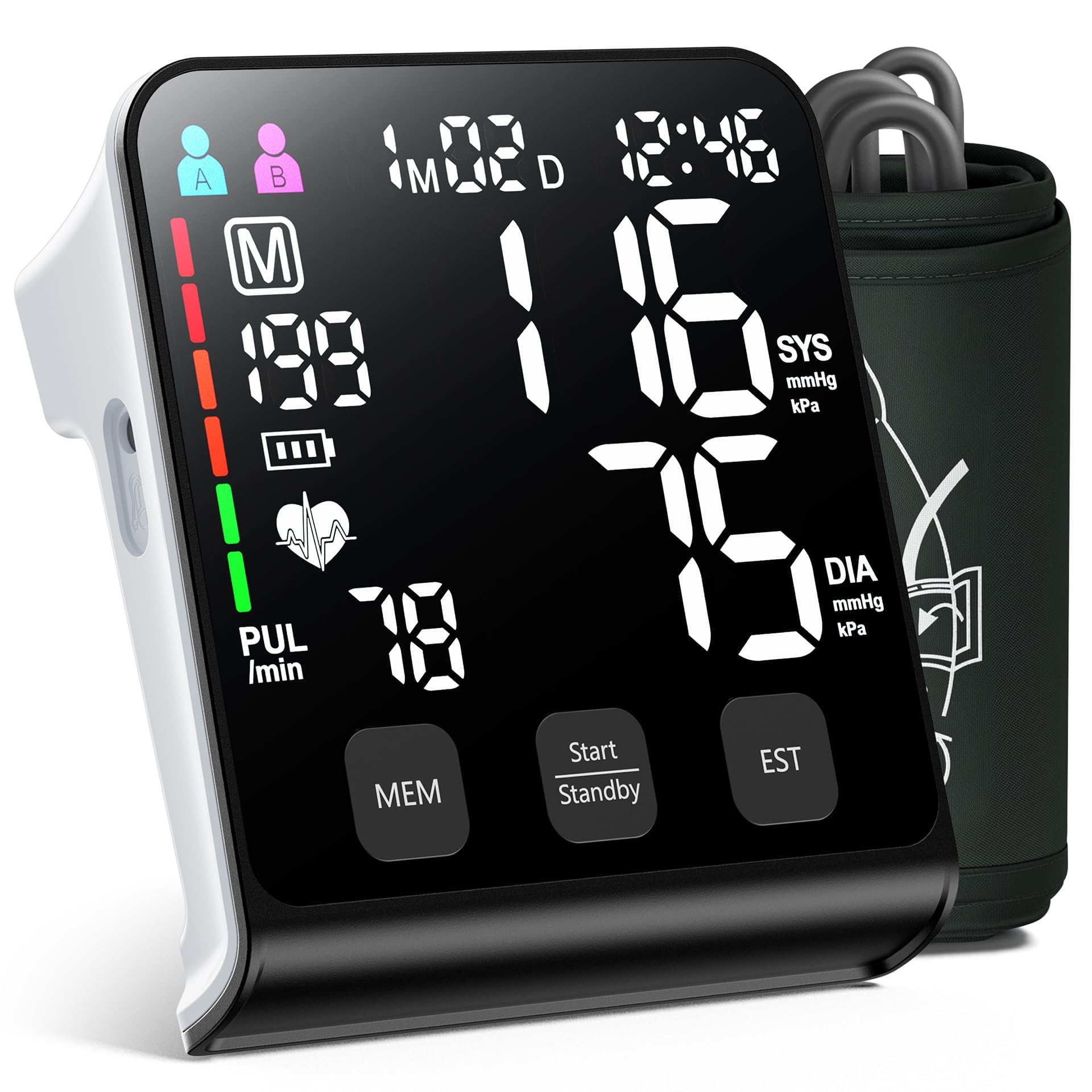
The Urion U80A proves you can get a large, legible display without paying a premium. The 4.5-inch LED screen uses oversized digits and a scratch-resistant acrylic panel, making it genuinely easier to read for seniors or anyone with less-than-perfect vision. The device stores up to 199 readings across two user profiles and displays a blood pressure classification indicator (normal, elevated, stage 1, etc.) next to each result.
Power flexibility is a strong point: the U80A runs on either four AA batteries or via the included USB-C cable, which is increasingly convenient for modern households that already charge phones and tablets at the bedside. Accuracy is rated at ≤±3 mmHg, and the cuff fits a standard 22–42 cm range. Multiple user reviews confirm readings are consistent and fast — typically under 30 seconds from press to result.
The device does not include Bluetooth connectivity, so it cannot sync readings to a smartphone app. The on-device memory is accessed only through the device interface, which requires scrolling through stored readings one at a time. If you want digital tracking and trend analysis, you will need to manually enter numbers into a health app. As a purely local monitor with an excellent screen, it delivers outstanding value for its tier.
Why it’s great
- Large 4.5-inch LED screen with bold, high-contrast digits
- USB-C power option alongside battery operation
- Budget-friendly price with solid accuracy and dual-user memory
Good to know
- No Bluetooth — no app sync or automatic data logging
- On-device memory navigation is cumbersome for reviewing past readings
FAQ
Can a Bluetooth blood pressure monitor replace my doctor’s manual reading?
Why does my monitor show different readings when I measure back to back?
What does the irregular heartbeat symbol mean on my monitor?
Final Thoughts: The Verdict
For most users, the best bluetooth blood pressure monitor winner is the Greater Goods Bluetooth Smart Monitor because Wirecutter’s repeated endorsement is backed by consistent accuracy, a polished app with doctor-ready PDF export, and dual user support at a mid-range price. If you need advanced cardiovascular screening with AFib detection, grab the OMRON Gold. And for deep Garmin ecosystem integration with Wi-Fi sync and multi-user support, nothing beats the Garmin Index BPM.