
Our readers keep the lights on and my morning glass full of iced black tea. As an Amazon Associate, I earn from qualifying purchases.
Cramming high-fidelity audio onto a cluttered desk is the defining challenge of modern desktop listening. You need speakers that deliver clear mids, articulate highs, and usable bass without consuming your entire workspace or introducing a rats nest of cables. The wrong pair leaves you with muddy sound, Bluetooth dropouts, and a permanent lip-sync delay that ruins movie nights.
I’m Min — the co-founder and writer behind Gadgets Feed. I’ve spent over 200 hours analyzing the technical specifications and real-world performance trade-offs of the current Bluetooth desktop speaker market, from driver materials and amplifier wattage to codec support and input versatility.
Whether you’re producing music, gaming competitively, or just want crisp Zoom calls, the right set transforms your workflow. This guide cuts through the marketing noise to help you find the best bluetooth desktop speakers for your specific setup and budget.
How To Choose The Best Bluetooth Desktop Speakers
Selecting the right pair requires examining the physical design, connectivity options, and audio tuning that fit your desk environment. A speaker that sounds great in a showroom can fall apart on a crowded desk next to a monitor.
Driver Configuration and Cabinet Build
The driver combo — typically a 0.75-inch tweeter paired with a 3-inch to 3.5-inch mid-bass driver — defines the frequency range and clarity of your desktop setup. A silk dome tweeter delivers smoother highs than a standard mylar unit, reducing listening fatigue during long sessions. The cabinet material matters equally; MDF wood effectively damps unwanted resonance, while plastic enclosures can introduce a “boxy” coloration to vocals.
Connectivity and Input Versatility
Bluetooth is only one part of the equation. The best desktop speakers offer a wired fallback via USB, RCA, or 3.5mm Aux to eliminate latency during video editing or gaming. For professional setups, balanced TRS or ¼-inch inputs allow connection to audio interfaces and mixers without ground loop hum. Bluetooth version also plays a role: version 5.3 offers lower power consumption and improved range compared to 5.0.
Amplification and Tuning Options
Active speakers with built-in amplification remove the need for a separate receiver. Look for a minimum of 15W RMS per channel for clean volume in a small to medium room. EQ flexibility — whether through physical knobs for treble and bass or a companion app — lets you tailor the output to your room’s acoustics and personal preference.
Quick Comparison
On smaller screens, swipe sideways to see the full table.
| Model | Category | Best For | Key Spec | Amazon |
|---|---|---|---|---|
| PreSonus Eris 3.5BT | Premium | Studio monitoring & Music production | 50W Class AB, 3.5″ woven-composite woofer | Amazon |
| Edifier MR3 | Premium | Hi-Res Audio & App EQ control | 52Hz–40kHz response, Bluetooth 5.4 | Amazon |
| Audio-Technica AT-SP3X | Premium | Turntable pairing & multipoint streaming | Bluetooth multipoint, dual RCA jacks | Amazon |
| Ortizan C7 | Mid-Range | Near-field production & content creation | 3.5″ carbon fiber driver, TRS balanced input | Amazon |
| Electrohome Huntley EB10B | Mid-Range | Retro aesthetic with warm, natural sound | Handcrafted wood cabinet, 3″ drivers | Amazon |
| OHAYO 60W | Mid-Range | Gaming & multimedia with 60W punch | Carbon fiber tweeter + 3″ woofer, MDF wood | Amazon |
| NSY Audio 60W | Budget | Compact desk setup for office & casual use | 60W output, Bluetooth 5.3, 3″ drivers | Amazon |
In‑Depth Reviews
1. PreSonus Eris 3.5BT Studio Monitors

The PreSonus Eris 3.5BT sets the standard for desktop near-field monitoring. Its 50W of Class AB dual amplification (25W per channel) drives woven-composite woofers that deliver surprisingly tight bass for a 3.5-inch driver, while the 1-inch silk-dome tweeter ensures sweet-spot imaging across a wide listening angle. The acoustic tuning controls for high and low frequencies let you compensate for desk boundary effects that typically muddy the midrange.
Bluetooth 5.0 provides reliable wireless connectivity, but the real strength lies in its wired flexibility: ¼-inch TRS balanced inputs for pro gear, unbalanced RCA for consumer devices, and a front-panel ⅛-inch aux input with a headphone output that includes its own amplifier. Reviewers highlight clean, flat response with punchy lows that don’t distort at moderate volumes. The ported cabinet adds some low-end weight, though true sub-bass extension requires the companion Eris Sub 8BT.
The auto power-saver mode engages after 40 minutes of idle time — a subtle but appreciated feature for energy-conscious studios. While the power switch requires a firm press that can slide the lightweight unit, the overall build quality and sonic accuracy make this the go-to choice for creators who demand honest playback without coloration. It earns its premium status through engineering maturity rather than flashy extras.
Why it’s great
- Class AB amplification delivers clean, distortion-free power across the frequency range.
- Front-panel headphone jack with dedicated amp for private monitoring.
- Acoustic tuning controls for room compensation without external EQ.
Good to know
- Lightweight build requires holding the cabinet down to toggle the rear power switch.
- True sub-bass requires adding the separate subwoofer.
2. Edifier MR3 Powered Studio Monitors

The Edifier MR3 brings Hi-Res Audio certification to the desktop, supporting a frequency response stretching from 52Hz to 40kHz. The driver pairing — a 3.5-inch mid-low driver with a 1-inch tweeter — produces a balanced, neutral signature that suits both critical listening and casual media consumption. The 18W RMS per channel output might seem modest on paper, but the peak SPL of 92.5dB ensures room-filling volume without audible compression.
Connectivity is where the MR3 punches above its price tier: Bluetooth 5.4 with multipoint, balanced TRS inputs, RCA, and AUX. The Edifier ConneX app provides customizable EQ, letting you switch between Music, Monitor, and Custom modes. Reviewers consistently praise the “tactile” bass and zero-hiss amplifier design, even at low volumes. The MDF cabinet reduces resonance effectively, keeping the midrange clear and vocals present during spoken-word content like podcasts and video calls.
The only notable compromise is Bluetooth volume control — you must adjust volume via the physical knob or app rather than your phone’s rocker. However, the simultaneous wired and Bluetooth connection capability makes it easy to keep a turntable or PC connected alongside a phone. For anyone seeking studio-grade accuracy without the standard sticker shock, the MR3 delivers remarkable performance per dollar.
Why it’s great
- Hi-Res Audio certified response extends to 40kHz for detailed high-frequency reproduction.
- Bluetooth 5.4 with multipoint keeps two devices connected simultaneously.
- App-based EQ with three presets for Music, Monitor, and Custom tuning.
Good to know
- Bluetooth source cannot independently control speaker volume.
- Enclosure uses plastic rather than full MDF construction.
3. Audio-Technica AT-SP3X Bookshelf Speakers

Audio-Technica brings its transducer expertise to the desktop with the AT-SP3X, a compact bookshelf pair specially tuned for full-range audio from a 3-inch driver. The bass boost switch compensates for the small cabinet, adding heft to kick drums and synth lines without overwhelming the midrange. The multipoint Bluetooth functionality lets you keep a phone and PC connected, toggling between calls and music seamlessly.
The connectivity suite is clean and purposeful: dual RCA jacks for wired sources like turntables or audio interfaces, and Bluetooth for wireless streaming. Reviewers running AT-LP120 turntables report easy switching between vinyl and Bluetooth phone playback via the front volume knob. The included international plug adapters indicate global design consideration, while the 6.6-foot speaker cable offers flexible placement options.
Bass-heavy tuning is the defining characteristic here — some listeners may find it slightly too dominant for critical mixing, but for casual listening and vinyl enjoyment, it adds a welcome warmth. The plastic enclosure is a trade-off for the price point, but the build quality and Audio-Technica reliability make this a safe bet for users who want a simple, elegant desktop audio solution with solid bass performance.
Why it’s great
- Multipoint Bluetooth pairs two devices simultaneously for easy switching.
- Bass boost switch adds low-end weight without muddling the mids.
- International AC plugs included for global use.
Good to know
- Bass-heavy tuning may not suit critical mixing or flat-response monitoring.
- Plastic enclosure lacks the resonance damping of MDF wood cabinets.
4. Ortizan C7 Dual-Mode Studio Monitors

The Ortizan C7 targets the content creator segment with a feature set that punches above its mid-range price. The built-in 24-bit DAC captures digital audio directly via USB-C, minimizing signal loss during conversion — a capability usually reserved for more expensive units. The driver combination of a 0.75-inch silk dome tweeter and a 3.5-inch carbon fiber mid-bass driver delivers clean, layered sound with a flat response curve tuned through extensive laboratory adjustments.
Connectivity is where the C7 truly stands out: 6.35mm TRS balanced inputs allow direct connection to mixing consoles and audio interfaces, alongside RCA, 3.5mm Aux, and Bluetooth 5.3. The front panel includes a headphone output and dual Aux inputs that can operate simultaneously, making it easy to switch between a computer and a secondary device. Reviewers report near-flat response that reveals details in recordings they hadn’t noticed before, with bass extension down to approximately 45Hz.
The volume knob has a stepped, choppy feel that some users dislike, and the idle hiss is faintly audible in quiet passages. Monitor/Music mode switching tailors the sound signature for either flat production or enhanced listening. For desktop creators who need a compact, budget-friendly near-field setup with professional input options, the C7 delivers impressive accuracy.
Why it’s great
- Built-in 24-bit USB DAC preserves digital audio fidelity during conversion.
- TRS balanced inputs support professional audio interfaces and mixers.
- Flat frequency response tuned for accurate near-field monitoring.
Good to know
- Volume knob uses a stepped rotation with imprecise feel.
- Faint idle hiss may be noticeable in silent environments.
5. Electrohome Huntley EB10B

The Electrohome Huntley EB10B takes a different approach by prioritizing warm, natural sound and classic aesthetics over flat-response monitoring. The handcrafted wood cabinets are rear-ported to enhance bass response, and the 3-inch drivers produce a balanced, non-fatiguing sound that suits background music and casual listening. The retro design with wood grain finish integrates seamlessly with turntable setups and mid-century modern decor.
Connectivity covers the essentials: Bluetooth 5, RCA, and 3.5mm Aux input. The included 8-foot speaker wire and 6-foot power cord offer generous reach for desktop placement. Reviewers running these with Technics turntables report impressive compatibility and sound quality when paired with a decent phono preamp. The warm tuning means vocals sound rich and natural, though the bass response is polite rather than punchy.
The absence of separate bass and treble controls is a notable omission at this price point — listeners who want to tweak the frequency balance will need an external equalizer. Cable management requires attention due to the rear connections and exposed speaker wire. However, for users who value aesthetics and relaxed, musical playback over clinical accuracy, the Huntley delivers a compelling package.
Why it’s great
- Handcrafted wood cabinet reduces resonance for cleaner acoustic output.
- Rear-ported design enhances bass extension for a 3-inch driver.
- Aesthetic retro design matches turntables and vintage decor.
Good to know
- No built-in bass or treble tuning controls for custom sound adjustment.
- Exposed speaker wire requires careful cable management.
6. OHAYO 60W Computer Speakers

The OHAYO 60W system is built around a 30W per channel amplifier driving a 0.75-inch carbon fiber silk dome tweeter and a 3-inch carbon fiber full-range driver. The dual carbon fiber construction targets low distortion and responsive mid-bass, while the rear bass port adds depth for gaming explosions and movie soundtracks. The MDF wooden enclosure suppresses cabinet resonance, keeping the sound clean even at high volumes.
Input options are generous: Bluetooth 5.3, RCA, AUX, USB, and USB-C — the USB-C input is a rarity at this price point, allowing direct connection to modern laptops and tablets. Separate treble and bass knobs give you direct tonal control, and the front volume knob doubles as a power switch and Bluetooth pairing button. Reviewers with audiophile backgrounds note the clear 3D soundstage and energy efficiency, consuming less than 1W at full volume.
The size limitation remains — 3-inch drivers physically cannot produce deep sub-bass, so the system rolls off before 40Hz. But for a compact desktop setup, the midrange clarity and respectable low-end punch exceed typical PC speakers. The OHAYO offers a strong balance of power, connectivity, and build quality for users who want a step up from budget options without jumping to premium pricing.
Why it’s great
- Carbon fiber tweeter and woofer reduce distortion for cleaner audio reproduction.
- USB-C input enables direct connection to modern laptops and tablets.
- Separate treble and bass knobs provide physical tonal adjustment.
Good to know
- 3-inch drivers limit deep sub-bass extension below 40Hz.
- 3.5mm aux input produces slightly quieter output than USB or Bluetooth.
7. NSY Audio 60W Bluetooth 5.3 Speakers
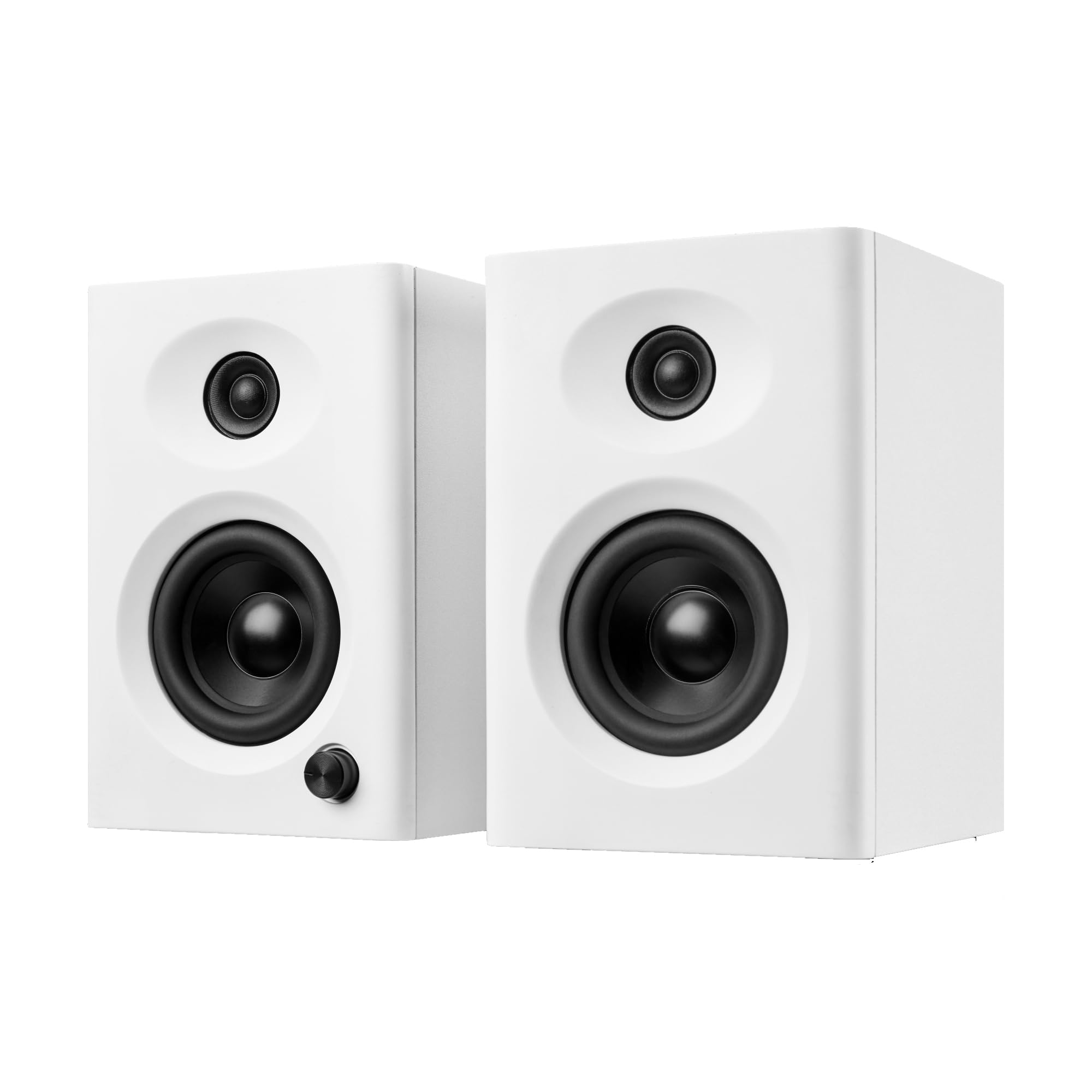
The NSY Audio 60W speakers prove that budget-tier options can deliver competent desktop audio without major compromises. The 3-inch drivers are tuned for balanced mid-range presentation, with a rear port providing enough air movement to prevent the sound from sounding thin. Bluetooth 5.3 ensures stable wireless connectivity up to 33 feet, and the multiple wired inputs (RCA, USB, 3.5mm Aux) offer flexibility for older devices.
The compact white cabinet design is one of the most minimalist options on this list, fitting unobtrusively into home offices and dorm rooms. Front-panel volume knob and power switch simplify daily operation. Reviewers consistently note that the sound quality exceeds TV-integrated speakers and basic PC speakers, with clear vocals for conference calls and balanced audio for music production reference.
The soft treble and bass response may require EQ adjustment for listeners who prefer a more aggressive sound signature, and one reviewer reported noticeable audio delay when watching YouTube videos. The build uses fiber wood construction that feels more substantial than all-plastic alternatives. For those on a tight budget who need versatile connectivity and clean basic sound quality, the NSY speakers deliver reliable performance.
Why it’s great
- Bluetooth 5.3 provides low-latency wireless connection with 33-foot range.
- Compact white design blends into minimalist and modern desk aesthetics.
- Multiple wired inputs including RCA, USB, and 3.5mm Aux for device compatibility.
Good to know
- Some users report audio delay causing lip-sync issues during video playback.
- Soft treble and bass tuning may require EQ adjustment for punchier sound.
FAQ
Why do my Bluetooth desktop speakers have audio delay during video playback?
What is the difference between near-field and far-field monitoring for desktop speakers?
Final Thoughts: The Verdict
For most users, the best bluetooth desktop speakers overall are the PreSonus Eris 3.5BT because their Class AB amplification, woven-composite woofers, and acoustic tuning controls deliver studio-grade accuracy in a compact desktop footprint. If you want Hi-Res Audio certification and app-based EQ flexibility, grab the Edifier MR3. And for a minimalist budget setup with Bluetooth 5.3 and versatile wired inputs, nothing beats the NSY Audio 60W.