
The gap between a win and a wipeout in a competitive shooter often comes down to how fast your thumbstick registers a directional change and how precisely the trigger breaks. That gap is determined by your controller’s polling rate, stick sensor type, and wireless latency — three specs that most PC gamers overlook until they lose a round because of a missed input.
I’m Min — the co-founder and writer behind Gadgets Feed. I’ve spent hundreds of hours cross-referencing technical sheets, decoding marketing claims around Hall Effect versus TMR sensors, and mapping real-world polling rates against pricing tiers to identify the controllers that actually deliver on their latency promises for PC gaming.
Whether you need a sub-millisecond response for esports or a drift-proof companion for marathon RPG sessions, this guide breaks down the seven strongest candidates for the best bluetooth gaming controller for pc based on measurable specs that define real in-game performance.
How To Choose The Best Bluetooth Gaming Controller For PC
Selecting a controller for PC means balancing three competing demands: wireless latency low enough that you never feel a delay, stick accuracy that doesn’t degrade after a few months of use, and a button layout that matches the genres you actually play. Below are the concrete specs and design choices that separate a genuinely good PC controller from one that feels sluggish out of the box.
Stick Sensor Type: Potentiometer vs Hall Effect vs TMR
Standard potentiometer sticks are the oldest technology and the most prone to drift as dust or wear degrades the physical contacts. Hall Effect sticks use magnets and sensors to detect position with no physical contact, eliminating drift almost entirely. TMR (Tunnel Magnetoresistance) sensors are a more recent evolution — they offer the same drift immunity as Hall Effect but with higher precision at low deflection angles and lower power consumption, which translates to smoother micro-adjustments for aiming in shooters. If you are buying a controller for PC gaming today and you expect it to feel the same six months from now, choose a model with Hall Effect or — ideally — TMR sticks.
Polling Rate: What 125 Hz vs 1000 Hz vs 8000 Hz Actually Means
The polling rate determines how often the controller reports its state to the PC. A standard Xbox controller polls at roughly 125 Hz, which means it reports input every 8 milliseconds. A 1000 Hz controller reports every 1 millisecond. The difference is perceptible in twitch-based titles like Call of Duty or Apex Legends, where a 7 ms head start on an opponent can decide a gunfight. An 8000 Hz controller reports every 0.125 ms — that extreme rate is meaningful only for top-tier esports players who can feel single-millisecond differences, but even the jump from 125 Hz to 1000 Hz is immediately noticeable during fast camera movements.
Connection Method: Standard Bluetooth vs 2.4 GHz Dongle vs Wired
Standard Bluetooth (most common on budget controllers) introduces between 5 ms and 15 ms of additional latency depending on the implementation and environmental interference. A dedicated 2.4 GHz wireless dongle drops that figure to 1–2 ms, matching wired performance in most scenarios. Many premium PC controllers now include both Bluetooth and a 2.4 GHz dongle — use the dongle for competitive gaming and Bluetooth for casual couch play or when pairing with a mobile device. If you primarily play single-player or slower-paced genres, standard Bluetooth latency will not be an issue, but for competitive multiplayer, a dongle-based connection or high-speed wired mode is non-negotiable.
Quick Comparison
On smaller screens, swipe sideways to see the full table.
| Model | Category | Best For | Key Spec | Amazon |
|---|---|---|---|---|
| Razer Wolverine V3 Pro | Premium | Competitive Esports & 8K Polling | 8000 Hz polling rate, TMR sticks | Amazon |
| GameSir G7 Pro | Premium | Xbox & PC Dual Ecosystem | 1200 mAh battery, TMR sticks | Amazon |
| Leadjoy Xeno Plus | Mid-Range | Feature-Rich with Charging Dock | 1000 Hz polling, dual triggers | Amazon |
| Xbox Wireless Controller (Velocity Green) | Mid-Range | Native PC Compatibility & Ergonomics | Hybrid D-pad, textured grip | Amazon |
| EasySMX D10 | Mid-Range | Dual-Mode Triggers & Software-Free Setup | TMR sticks, 1000 Hz polling | Amazon |
| 8BitDo SN30 Pro (Crystal Purple) | Value | Retro Emulation & Travel | 16-hour battery, Hall Effect sticks | Amazon |
| EasySMX S10 Elite | Value | Multi-Platform with Custom Faceplates | 1200 mAh battery, TMR sticks | Amazon |
In‑Depth Reviews
1. Razer Wolverine V3 Pro 8K PC Wireless Gaming Controller

The Razer Wolverine V3 Pro is the first PC controller to deliver a legitimate 8000 Hz polling rate over both wired and 2.4 GHz wireless connections, which means the PC receives positional data from the sticks every 0.125 milliseconds — a 64x improvement over the standard 125 Hz Xbox controller polling. The TMR thumbsticks are calibrated at the factory with zero deadzone out of the box, and they maintain that precision without developing drift because the magnetic sensors have no physical contact surfaces to wear down. The face buttons use Razer’s mecha-tactile switches with a hybrid feel — a short, crisp click with a shallow actuation point that sits between a full mechanical keyboard switch and a standard membrane button.
Six remappable controls are built in: four paddle buttons on the rear and two claw-grip bumpers on the top shoulders, all of which use the same micro-switch actuation found in Razer’s top gaming mice. The Pro HyperTriggers offer a physical toggle that switches between full analog travel for racing games and a hair-trigger mode with near-zero travel for shooters. The battery is rated for up to 36 hours at the stock polling rate, though running at 8000 Hz wireless drops that to roughly 8 hours — still enough for a full evening session.
The 2-meter braided USB-C cable and a hard carrying case are included. This is not a controller for someone who wants heft or console-style rumble feedback — it is built for competitive PC gamers who prioritize every measurable millisecond of input lag reduction and will trade vibration for speed.
Why it’s great
- True 8000 Hz wireless polling provides the lowest observable input lag on PC
- TMR sticks with zero deadzone and no drift deliver consistent aim precision
- Six remappable controls (4 paddles + 2 claw bumpers) without needing software for basic remapping
- Lightweight design reduces hand fatigue during long competitive sessions
Good to know
- No rumble motors — the controller is deliberately vibration-free to save weight
- Battery life at 8000 Hz wireless is around 8 hours, so nightly charging is recommended
- Smaller form factor may feel too light for players accustomed to heavier controllers
2. GameSir G7 Pro Wireless Gaming Controller
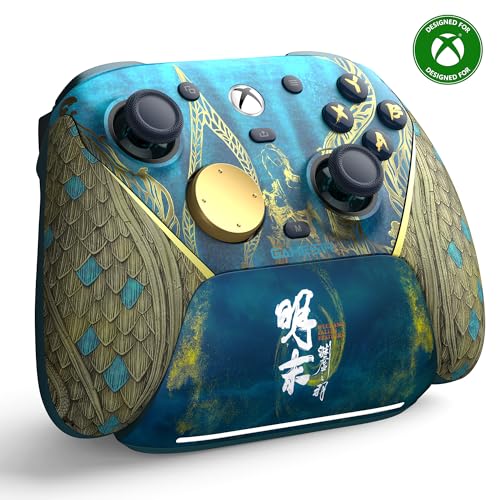
The GameSir G7 Pro is the first officially licensed wireless Xbox controller from GameSir, which means it uses the Xbox Wireless protocol natively on Xbox consoles while also offering a 2.4 GHz dongle and USB-C wired modes for PC. The TMR sticks use GameSir’s Mag-Res technology that combines the low-power characteristics of a potentiometer with the contactless durability of Hall Effect sensors, and the result is a stick that feels smooth during fine aim adjustments and stays centered without any drift after extended use. The Hall Effect analog triggers include a hair-trigger mode that can be activated by holding the M button together with the trigger button — switching from full travel to near-instant actuation without any software interaction.
The 1200 mAh battery is slightly larger than the 1000 mAh found in many competitors, and the smart charging station in the box automatically starts and stops charging when the controller is docked, preventing overcharge. The rear of the charging station includes a storage compartment for the 2.4 GHz wireless receiver, which is a small detail that keeps the dongle from getting lost during travel. The four remappable back paddles are positioned slightly inward from the grips, accessible without shifting hand position, and can be configured through the Xbox Accessories app on PC or directly using the controller’s onboard button combos.
The D-pad is a standard four-way directional pad rather than a separated eight-way design, which limits its effectiveness for fighting games that require precise diagonal inputs. The face buttons use membrane switches with a soft bottom-out feel rather than the clicky mechanical feedback found on the Razer Wolverine V3 Pro or the EasySMX D10. For players who want an Xbox-native controller with TMR precision, a charging dock, and the ability to switch between Xbox Wireless and 2.4 GHz PC modes without re-pairing, this controller fills that specific slot cleanly.
Why it’s great
- Officially licensed Xbox Wireless works natively on Xbox and PC without a dongle
- Smart charging dock with auto start/stop and receiver storage
- Hall Effect triggers with hair-trigger toggle for instant response in shooters
- TMR sticks maintain precision without drift over long-term use
Good to know
- D-pad is standard four-way design, not ideal for fighting game inputs
- Face buttons are membrane-style, not mechanical or micro-switch
- Limited color options — only available in the Wuchang: Fallen Feathers edition
3. Leadjoy Xeno Plus Wireless Game Controller
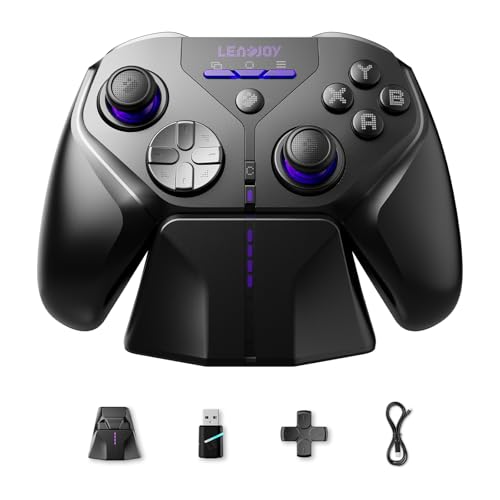
The Leadjoy Xeno Plus packs a surprising amount of pro-level hardware into a mid-range price bracket. The TMR sticks deliver the same anti-drift, high-precision feel as controllers costing twice as much, and they pair with a 1000 Hz polling rate over both the 2.4 GHz dongle and wired USB-C connection. The dual-mode triggers are the standout design feature here — a physical switch on the back of the controller lets you toggle between smooth Hall Effect analog travel for racing sims and micro-switch clicky actuation for FPS games, giving you two distinct trigger feels from a single controller without needing to swap anything in software.
Four programmable back paddles are positioned in a layout similar to the Xbox Elite Series 2, with two long paddles and two short paddles that sit under your middle and ring fingers. The Leadjoy Nexus companion app for PC allows you to adjust stick response curves, map gyro controls (the 6-axis gyro is active in Switch mode but can be mapped to mouse inputs on PC through the app), and customize button assignments on the fly. The 1000 mAh battery supports roughly 10–12 hours of playtime depending on RGB lighting settings, and the smart charging dock in the box features a start-stop mechanism that prevents overcharging.
On the Switch, several reviewers reported that inputs occasionally failed to register during heavy gameplay sessions — this appears to be a firmware-related issue specific to Switch mode. On PC, the controller is recognized as an Xbox 360 controller by default, which means it works with virtually every Windows game without additional configuration. The face buttons use micro-switches that produce a loud, clicky sound that some players will enjoy for tactile feedback and others may find disruptive in a shared room.
Why it’s great
- Dual-mode trigger system (analog Hall Effect + micro-switch clicky) covers both racing and shooters
- Four rear paddles match the layout of premium pro controllers
- Leadjoy Nexus app allows deep customization of stick curves, gyro mapping, and button profiles
- Smart charging dock with auto start-stop prevents battery degradation
Good to know
- Switch compatibility has intermittent input registration issues reported by multiple users
- Face buttons are audibly clicky — not suitable for quiet environments
- Right stick may feel slightly loose or springy on some units right out of the box
4. Xbox Wireless Gaming Controller (Velocity Green)
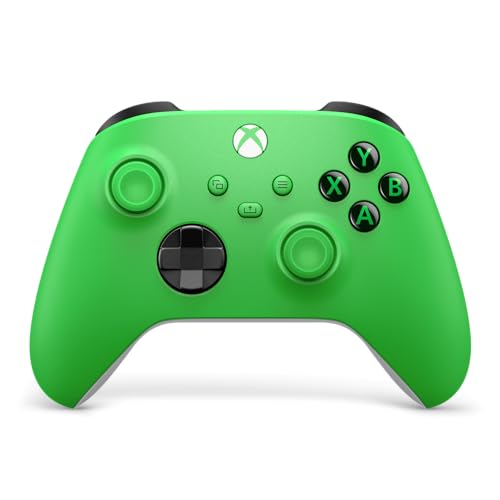
The standard Xbox Wireless Controller remains the baseline against which all other PC controllers are measured, largely because Windows has native driver support for it — no dongle, no pairing process beyond the initial Bluetooth connection, no compatibility issues across the entire Steam and Game Pass library. The Velocity Green edition uses the same updated geometry as the Series X|S controller: a slightly smaller body with rounded edges that fits medium to large hands comfortably, a textured grip on the back shell and triggers, and a hybrid D-pad that sits somewhere between a traditional plus-sign and a full disc, offering reliable diagonal detection for fighting games without the mushiness of the older Xbox One D-pad.
The 3.5 mm audio jack on the bottom edge allows direct headset connection without needing an external DAC or adapter, and the Share button captures screenshots and clips natively on both Xbox and Windows. The Bluetooth connection uses standard Bluetooth 4.0 LE, which introduces 5–10 ms of additional latency compared to a 2.4 GHz dongle — acceptable for single-player and casual multiplayer, but noticeable in competitive scenarios where the controller’s 125 Hz polling rate already adds an 8 ms baseline delay. The controller runs on two AA batteries rather than a built-in rechargeable pack, which some users prefer for instant replacement and others find inconvenient compared to USB-C charging.
The absence of Hall Effect or TMR sticks means the potentiometer-based thumbsticks are susceptible to drift over time — a well-documented failure point on Xbox controllers after several months of heavy use. The Xbox Accessories app allows button remapping and stick sensitivity curve adjustments, though you cannot add extra paddles or triggers without a separate attachment. If you want guaranteed native compatibility with Windows and a comfortable shape that has been refined over three console generations, this controller is the safe default — but it lacks the latency performance and drift resistance that serious PC gamers should expect from a dedicated gaming peripheral.
Why it’s great
- Plug-and-play native compatibility with Windows requires zero configuration
- Hybrid D-pad offers improved diagonal input accuracy over older Xbox designs
- Textured grip on triggers and back case reduces slipping during intense gameplay
- Built-in 3.5mm audio jack eliminates the need for additional adapters
Good to know
- Potentiometer sticks are prone to drift developing over time
- Standard Bluetooth adds 5–10 ms latency compared to 2.4 GHz dongle solutions
- Runs on AA batteries rather than a built-in rechargeable cell
5. EasySMX D10 Wireless Game Controller

The EasySMX D10 brings TMR sticks and a 1000 Hz polling rate to a price point that typically stops at Hall Effect or even potentiometer technology, making it a strong candidate for budget-conscious PC gamers who still want competitive-grade input response. The TMR sensors on this controller are the same generation found in the Leadjoy Xeno Plus and the Razer Wolverine V3 Pro — they detect positional changes at very low deflection angles without the need for a large deadzone, which means you can make tiny aim corrections without the stick feeling loose or unresponsive near center. The dual-mode trigger system uses a physical switch on the top edge to toggle between Hall Effect analog travel for precision control in racing games and micro-switch tactile actuation for fast trigger pulls in shooters, similar to the trigger lock mechanism on the Leadjoy Xeno Plus but executed with its own distinct switch feel.
The exclusive EasyPos D-pad uses eight directional switches arranged under a circular pad, which gives each diagonal input its own physical contact point — this is a genuine improvement over standard four-direction D-pads for fighting games and retro platformers where accurate quarter-circle and half-circle motions matter. The mechanical face buttons use true micro-switches with 1.0 mm actuation and a crisp click that provides tactile confirmation of each press, much like the buttons on the Razer Wolverine V3 Pro or a mechanical keyboard. The magnetic charging dock in the box includes a built-in compartment for the 2.4 GHz dongle, and the controller charges fully in about 2.5 hours.
The circular D-pad design requires some adjustment for traditional fighting game players who are accustomed to the raised edges of a plus-sign D-pad. The ABXY buttons are flat and sit flush with the controller face, which means rolling your thumb between buttons for rapid inputs can feel less defined than on controllers with raised button edges. The rumble motors are noticeably noisy at higher intensity settings — several reviewers described the vibration as loud rather than tactile. For the price, the D10 delivers TMR precision, 1000 Hz polling, and dual-mode triggers that would typically belong to a controller in a higher bracket, with trade-offs mainly in the D-pad feel and vibration quality.
Why it’s great
- TMR sticks with 1000 Hz polling deliver pro-grade latency at a mid-range price
- Dual-mode trigger system with physical switch covers both analog and clicky needs
- EasyPos 8-direction D-pad provides dedicated diagonal switches for fighting games
- Mechanical face buttons with 1.0 mm actuation give satisfying tactile feedback
Good to know
- Circular D-pad design takes time to adjust to for traditional fighting game inputs
- Flat ABXY buttons hinder rolling finger inputs during fast combo sequences
- Rumble motors are audibly noisy at higher vibration intensity settings
6. 8BitDo SN30 Pro Wireless Bluetooth Controller (Crystal Purple)

The 8BitDo SN30 Pro is a compact controller modeled after the Super Nintendo gamepad but with modern additions: dual analog sticks, shoulder buttons, a full set of triggers, and Hall Effect joysticks that eliminate the drift failure common to older SN30 Pro models. The form factor is distinctly smaller than any full-size Xbox or PlayStation controller — measuring roughly the width of a smartphone and significantly thinner — which makes it ideal for travel, emulation handheld rigs, and players with smaller hands who find standard controllers fatiguing over time. The Crystal Purple transparent shell reveals the internal PCB and battery, adding a nostalgic aesthetic that appeals to retro game collectors without sacrificing build quality; the plastic feels dense and the buttons have no lateral wobble.
The controller connects via Bluetooth to PC and is recognized as a standard Xbox 360 controller once the firmware is updated through the 8BitDo Ultimate Software on Windows — the out-of-the-box behavior defaults to a Nintendo-style ABXY layout (A on the right, B on the bottom), which requires a software remap or the user’s mental adjustment for PC games. The battery is rated for 16 hours of playtime on a single charge with a 1–2 hour full recharge time via USB-C, which is excellent endurance for a controller this compact. The rumble vibration is on the weaker side compared to full-size controllers — more of a buzz than a thump — but adequate for providing basic haptic feedback during gameplay.
Bluetooth latency on the SN30 Pro is average for a standard Bluetooth controller — usable for emulated retro games, platformers, and RPGs, but not ideal for competitive shooters on PC. The rubberized surface of the thumbsticks can feel slightly slick during extended sessions, and the small form factor means your palms will not rest on the controller body the way they do on a larger gamepad. If your primary use case is playing 16-bit and 32-bit emulated titles on a PC or handheld device, or if you need an ultra-portable second controller for travel, the SN30 Pro’s Hall Effect sticks and 16-hour battery make it a reliable choice — but it is not designed for modern AAA shooters or games that demand precise analog trigger control.
Why it’s great
- Hall Effect joysticks eliminate drift and maintain accuracy over the controller’s lifespan
- Compact SNES-inspired form factor fits easily in a bag for portable use
- 16-hour battery life with quick 1–2 hour USB-C recharge cycle
- Transparent Crystal Purple shell offers a durable, nostalgic aesthetic
Good to know
- Small size may cause hand cramping for players with larger hands during long sessions
- Default button layout follows Nintendo convention (A/B swapped) — requires software remap for PC
- Rumble vibration is weak and rumble implementation is entry-level
7. EasySMX S10 Elite Wireless Controller
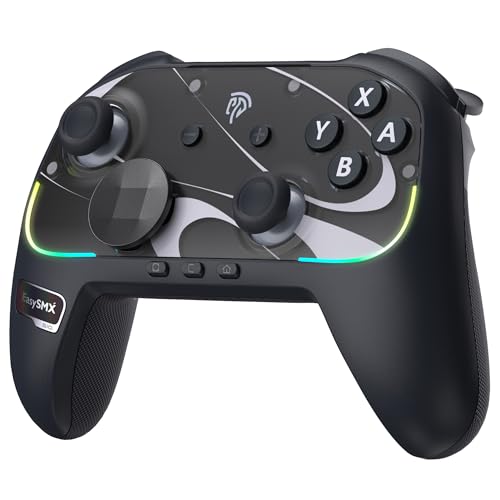
The EasySMX S10 Elite delivers TMR magnetic joystick modules at an entry-level price point, which immediately sets it apart from other budget controllers that still rely on aging potentiometer sticks prone to drift. The TMR sensors here provide the same contactless, wear-resistant precision found in the more expensive EasySMX D10 and the Leadjoy Xeno Plus, with the added benefit of lower power consumption that contributes to the 1200 mAh battery’s 17-hour rated playtime.
The mechanical face buttons use micro-switches with a crisp, short throw that provides clear tactile feedback on each press, similar to the clicking sensation of a gaming mouse button. The D-pad is a standard four-direction design but is swappable — the box includes an alternate D-pad and magnetic faceplates with two different color schemes, allowing some personalization of the controller’s appearance. The HD Rumble implementation is noticeably more refined than the basic buzzy vibration on the 8BitDo SN30 Pro, offering a wider range of intensity gradients that provide useful haptic cues during gameplay. The controller also supports NFC functionality for reading amiibo on Switch.
The connection guide for pairing requires following a specific sequence (setting the back toggle to “S” mode, holding the Home button for three seconds) that is not immediately intuitive without referring to the manual. The wake-from-sleep function requires a one-time pairing setup with the main console or PC, and some reviewers noted that the controller occasionally fails to wake the paired device on the first attempt. For PC gamers on a tight budget who refuse to compromise on stick precision, the S10 Elite offers TMR durability and mechanical buttons that outperform anything else in its price bracket, with the main concessions being the lower back-button count and the slightly finicky pairing procedure.
Why it’s great
- TMR magnetic joysticks at an entry-level price point eliminate drift concerns
- 17-hour battery life on a full charge supports extended gaming without interruption
- Mechanical face buttons with crisp micro-switch actuation provide satisfying feedback
- Swappable D-pad and magnetic faceplates allow physical customization
Good to know
- Only two programmable back buttons — fewer than the four-paddle competitors
- Initial pairing and wake-from-sleep setup requires following a specific sequence
- D-pad is standard four-direction design despite being swappable
FAQ
Will any Bluetooth controller work with Windows PC games?
How much does polling rate matter for single-player games?
What is the difference between TMR and standard Hall Effect sticks?
Final Thoughts: The Verdict
For most PC gamers, the best bluetooth gaming controller for pc winner is the Razer Wolverine V3 Pro because its 8000 Hz polling rate, TMR sticks with zero deadzone, and six remappable controls offer a genuine competitive advantage that no other controller in this list matches. If you want Xbox Wireless protocol compatibility with TMR precision and a smart charging dock, grab the GameSir G7 Pro. And for the best value-to-performance ratio on a tighter budget, the EasySMX D10 delivers TMR sticks, 1000 Hz polling, and dual-mode triggers that punch well above their price tier.