
Our readers keep the lights on and my morning glass full of iced black tea. As an Amazon Associate, I earn from qualifying purchases.
Specs are compiled from manufacturer listings and verified buyer reviews and can change over time — please confirm the key details on the product page before buying.
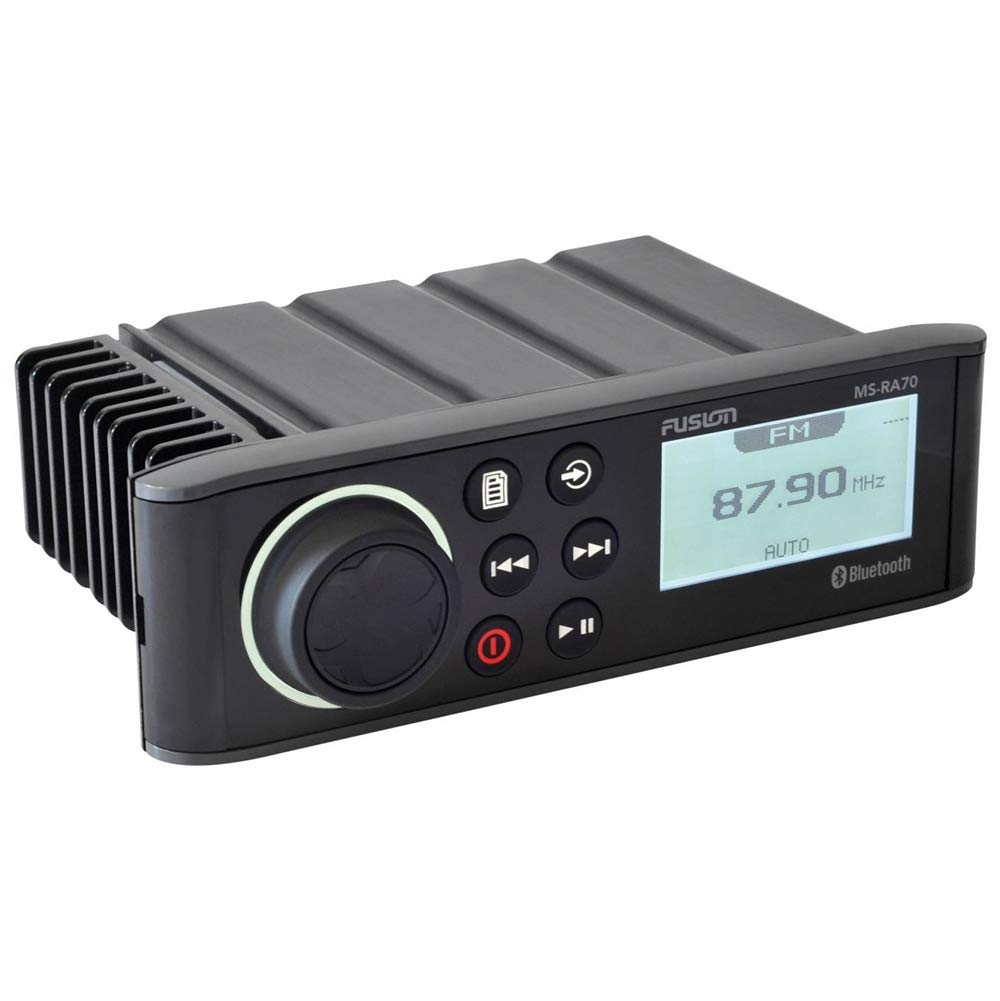
Water, sun, and salt spray wreck a standard car stereo fast. You need a head unit that survives a soaking, plays clear audio over your outboard, and pairs with your phone in seconds. The Fusion MS-RA70 wins as the overall best Bluetooth marine stereo because its IPX7 water resistance (survives brief submersion) and 2-zone audio let you control music in two separate areas from one unit. This guide looks at published specs and what verified buyers actually report, so you get real strengths and honest trade-offs.
I’m Min — the writer behind Gadgets Feed. This guide uses manufacturer specs and patterns from customer reviews to give you each pick’s real strengths and trade-offs.
These picks cover pontoons, center consoles, and side-by-sides. Each one is a real contender for a wet, sun-beaten environment.
Our Picks at a Glance

How To Choose The Best Bluetooth Marine Stereo
A marine stereo faces constant moisture, UV rays, and temperature swings. Here are the key specs to look at before you buy.
Water Resistance Rating (IPX)
This number tells you how well the unit resists water. An IPX6 rating handles heavy splashes and spray, which is good for most open boats. An IPX7 rating can survive brief submersion in a meter of water, giving extra confidence if you get caught in a sudden downpour. For a gauge-style unit that fits in a small hole, look for an IPX66 certification—it means it’s dust-tight and protected against powerful jets of water.
Power Output and Preamp Outputs
Peak power is a marketing number (often 200W or 300W), but the RMS power is what you’ll actually hear. A built-in amp with 50 Watts x 4 channels can drive four speakers on their own. If you want more volume or a subwoofer, look for 2-volt or 2.5-volt preamp outputs (the signal voltage sent to an external amplifier) so you can hook up an amp cleanly.
Connectivity and Controls
Stable Bluetooth is the main reason to upgrade—look for a unit that pairs quickly and stays connected across the deck. Some models offer NFC (a chip that lets you tap your phone to pair instantly) for one-touch pairing. A USB port lets you play music from a flash drive while it charges your phone. If you listen to talk radio or weather alerts, check for a NOAA Weather Band tuner (a dedicated radio band that broadcasts live National Weather Service forecasts), which gives you live forecasts right from the receiver.
Quick Comparison
| Model | Best For | Water Rating | Peak Power | Preamp Outputs | Amazon |
|---|---|---|---|---|---|
| BOSS MGR450B★ Best Overall | Weatherproof gauge fit | IPX6 | — | Front/rear/sub preamp | $170.99Amazon |
| Fusion MS-RA70Also Great | Multi-zone audio control | IPX7 | 4x50W | 2-zone line out | $299.99Amazon |
| Sony DSXM55BT | Best value and clarity | — | — | 2-volt rear/sub | Amazon |
| KENWOOD KMR-M332BT | Sunlight readability | Conformal coated | — | 2.5-volt rear/sub | $139.00Amazon |
| Kicker 46KMC2 | Gauge-hole mounting | IPX66 | Over 200W | RCA | Amazon |
| Pyle PLMRKT48BK | Complete kit with 4 speakers | Waterproof cones | 300W | RCA L/R | Amazon |
| BOSS MR1308UABK | Budget upgrade | Weatherproof | 50W x 4 channels | — | Amazon |
In‑Depth Reviews
1. BOSS Audio Systems MGR450B Marine Gauge Receiver
Our pick — over 4.5★ from 750+ verified ratings; the strongest balance of quality and price.
A gauge-shaped receiver that brings NOAA alerts—something the Kicker omits.
This BOSS model is a gauge-style receiver, but it includes a NOAA Weather Band tuner, a useful safety feature if you boat in unpredictable weather. It carries an IPX6 rating (protected against powerful water jets) and a UV-coated front panel to resist sun damage. Weighing in at 1.7 lbs, while the BOSS MR1308UABK weighs 2.15 lbs. One buyer mentioned it was an “easy install on 2009 RZR” and that the Bluetooth worked flawlessly, powering an amp, 8-inch sub, and Clarion speakers without issue. It includes front and rear preamp outputs plus a subwoofer preamp output, giving you flexibility to expand later. On the downside, several owners reported that the USB/aux plug does not work for charging phones, and the Bluetooth volume requires cranking the unit higher than expected. The built-in amp can still drive four Skar Audio 6.5-inch speakers to fantastic volume without external amplification, per one review. At 4.6 stars from 787 ratings, this gauge receiver matches the Fusion for highest average rating—just be aware of the USB limitation.
Weather-aware design: The NOAA band gives it an edge over most gauge-style competitors like the Kicker.
USB caveat: Don’t count on the front port to charge your phone—it’s for playback only.
Best for: side-by-sides and small center consoles where a gauge mount fits and you want weather alerts.
Not for: anyone who needs the USB port to also charge a device while playing music.
2. Fusion MS-RA70 Stereo with 4x50W AM/FM/Bluetooth
Treats your boat like a two-room lounge, with separate volume for each area.
You can set music loud on the swim deck and keep it quiet at the helm, all from one head unit. That is what Multi-Zone technology does: it lets you adjust audio levels for up to two separate areas. The bright 2.6-inch optically bonded monochrome LCD (a screen glued to the glass to cut glare) stays readable in direct sunshine, so you don’t squint when the sun is high. It pushes 4x50W of peak power, and buyers report it drives four Rockville 6.5-inch speakers clearly on a pontoon. The Fusion-Link integration (a smartphone app) lets you control the music from your phone or even a Garmin watch, so you can skip a track without walking to the helm. It’s rated IPX7, meaning it survives a brief dunk if a wave comes over the bow. Its 1.23-pound weight feels light and compact, but some owners note it isn’t super loud without an external amp if you want to hear it over a 50 mph motor blast. For mellow cruising and deck-wide control, this is the most thoughtful marine stereo you can buy.
Zone control champ: The Multi-Zone and app control put it ahead of simpler units like the Sony DSXM55BT.
One honest limit: You’ll want an amp if your boating includes full-throttle wake sessions.
Reach for this if: you want app-controlled, zone-based audio and top-level water resistance on a mid-to-large boat.
Look elsewhere if: you need ear-splitting volume without spending extra on an amplifier.
3. Sony DSXM55BT Bluetooth Marine Digital Media Stereo Receiver
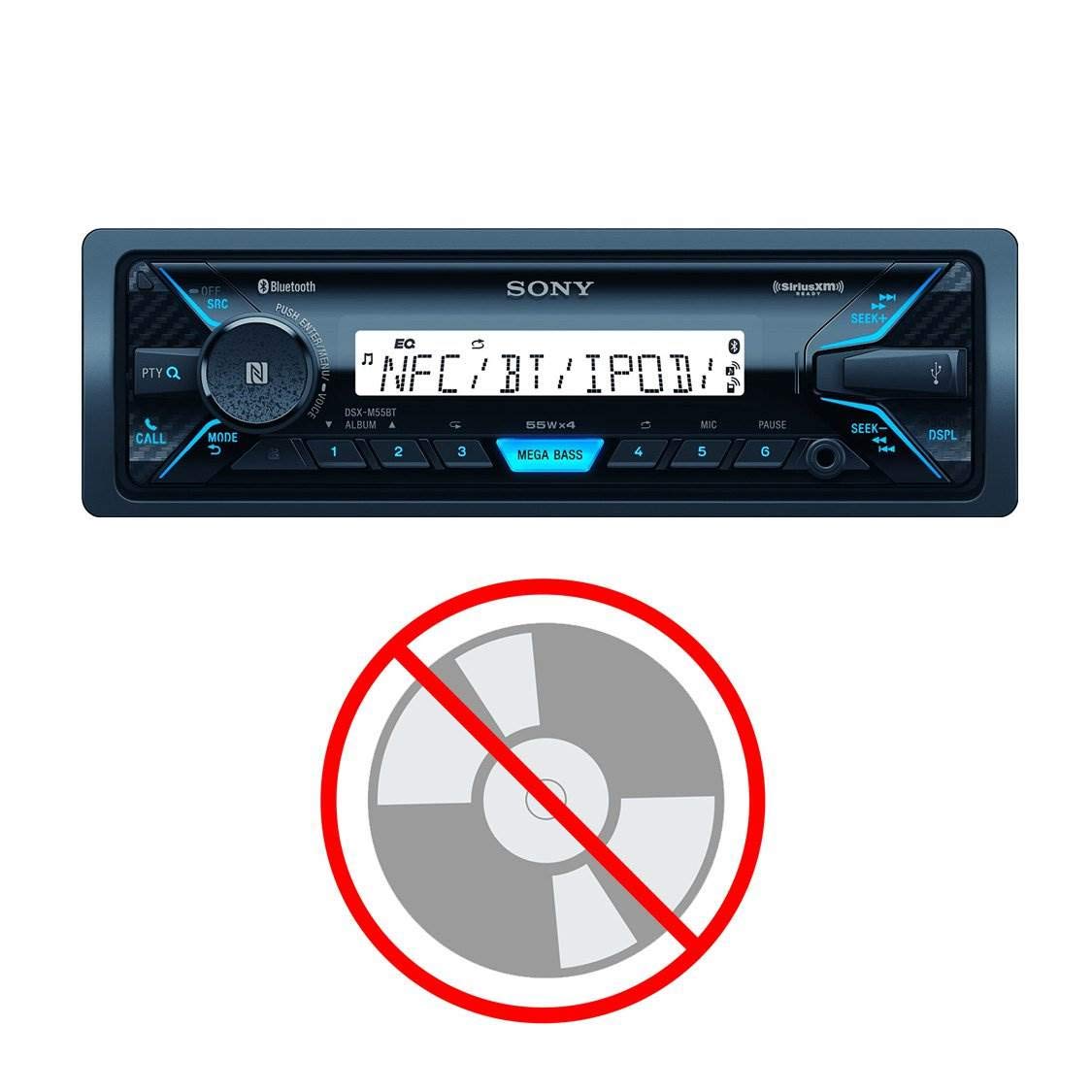
A no-nonsense receiver with a crisp display that cuts through glare.
Sony’s marine receiver stands on straightforward, clean performance. The integrated Bluetooth with NFC (a chip that lets you tap your phone to pair instantly) lets you connect in one tap—no digging through menus. Owners mention it drives four Infinity speakers with ease and that the display stays perfectly clear even in direct sunlight, a huge win if your helm is exposed. The 2-volt rear and sub RCA preamp outputs give you a clean signal path if you want to connect an external amplifier later. It supports FLAC (a lossless audio format that preserves full sound quality) playback, plus Siri control for hands-free operation. The EQ5 with Mega Bass (five equalizer presets) lets you dial in the sound quickly. One trade-off: owners note that it loses its radio presets when the boat’s battery is switched off, so you’ll reset your stations each time you launch. From nearly 1000 ratings, it holds a 4.3-star average, and one long-term reviewer said after two seasons it still worked perfectly with a stable Bluetooth connection. The Sony is the pick for clear, uncluttered audio and a no-fuss daily driver.
Sunlight star: Its bright, clear display beats most rivals in open-boat conditions.
Annoying quirk: Expect to lose your preset radio stations every time the battery is disconnected.
Ideal for: the skipper who wants excellent sound, easy pairing, and a high-contrast screen without premium pricing.
skip it if: having permanent memory for your radio presets is a dealbreaker for you.
4. KENWOOD KMR-M332BT Marine Stereo

Built for brutal visibility in the harshest midday sun.
Kenwood designed this head unit so you can read the display from total darkness straight into blinding direct sunlight. The high contrast black characters on a white background makes it highly readable on a boat in direct sunlight. It also has a conformal-coated circuit board (a plastic layer that seals the electronics against moisture) to resist salt spray and humidity. One reviewer noted it fixed the interference they had in their boat, which points to solid noise rejection on the power line. It plays FLAC files for hi-res audio and offers 2.5-volt rear/subwoofer preamp outputs for adding an amp later. The digital time alignment lets you fine-tune the sound to your seating layout, something rare at this level. The display changes color for customization. Weighing in at 1.9 pounds, it feels solid. A few owners had early quality issues with the faceplate connector, but the consensus on nearly 500 ratings is that Kenwood got the important things right: bright readability and clean power. It lacks an antenna and faceplate case in the box, so check your installation kit. This is the one for you if glare makes other screens useless on bright days.
Readability king: No other marine stereo matches its white-on-black clarity in full sun.
Kit warning: You may need to buy an antenna adapter separately if your boat uses a non-standard plug.
Choose the Kenwood when: your helm is completely exposed and you refuse to squint at a washed-out display.
Pass on it if: you want a complete ready-to-install package with every cable in the box.
5. Kicker 46KMC2 Weather-Resistant Gauge-Style Media Center

The round gauge that hides in a tiny dash hole but delivers big sound.
If your dash has no room for a standard single-DIN slot (a rectangular cutout about 7 inches wide and 2 inches tall), the Kicker 46KMC2 fits into a standard gauge opening. Its IPX66 certification means it is dust-tight and can handle powerful jets of water. It delivers over 200 watts of total peak power through four channels, enough to run a set of speakers without an external amp. The rotary encoder knob makes volume changes easy even with wet hands. Customers note that it sounds “amazing” with excellent clarity and bass after tweaking the EQ, and many replaced older Clarion units in Yamaha boats by simply relocating pins in the harness for plug-and-play installation. One owner swapped it into a 2021 Ranger bass boat and said it worked with the existing plug without cutting a single wire. It lacks the NOAA weather band that some boaters rely on. This gauge-style unit is perfect for replacing a tachometer or blank gauge hole when you want hidden, clean audio.
Why it shines
- Fits a standard 2-inch gauge hole when DIN won’t work
- IPX66 certified against powerful water jets
- Over 200W peak power with rotary control
Where it falls short
- No NOAA weather band tuner
- Wiring harness pins may need relocation for OEM plugs
Grab the Kicker for: tight dash spaces where a standard radio won’t fit, and you need rugged water protection.
pass on it if: you rely on live NOAA weather alerts from your head unit.
6. Pyle Marine Head Unit Receiver Speaker Kit (PLMRKT48BK)
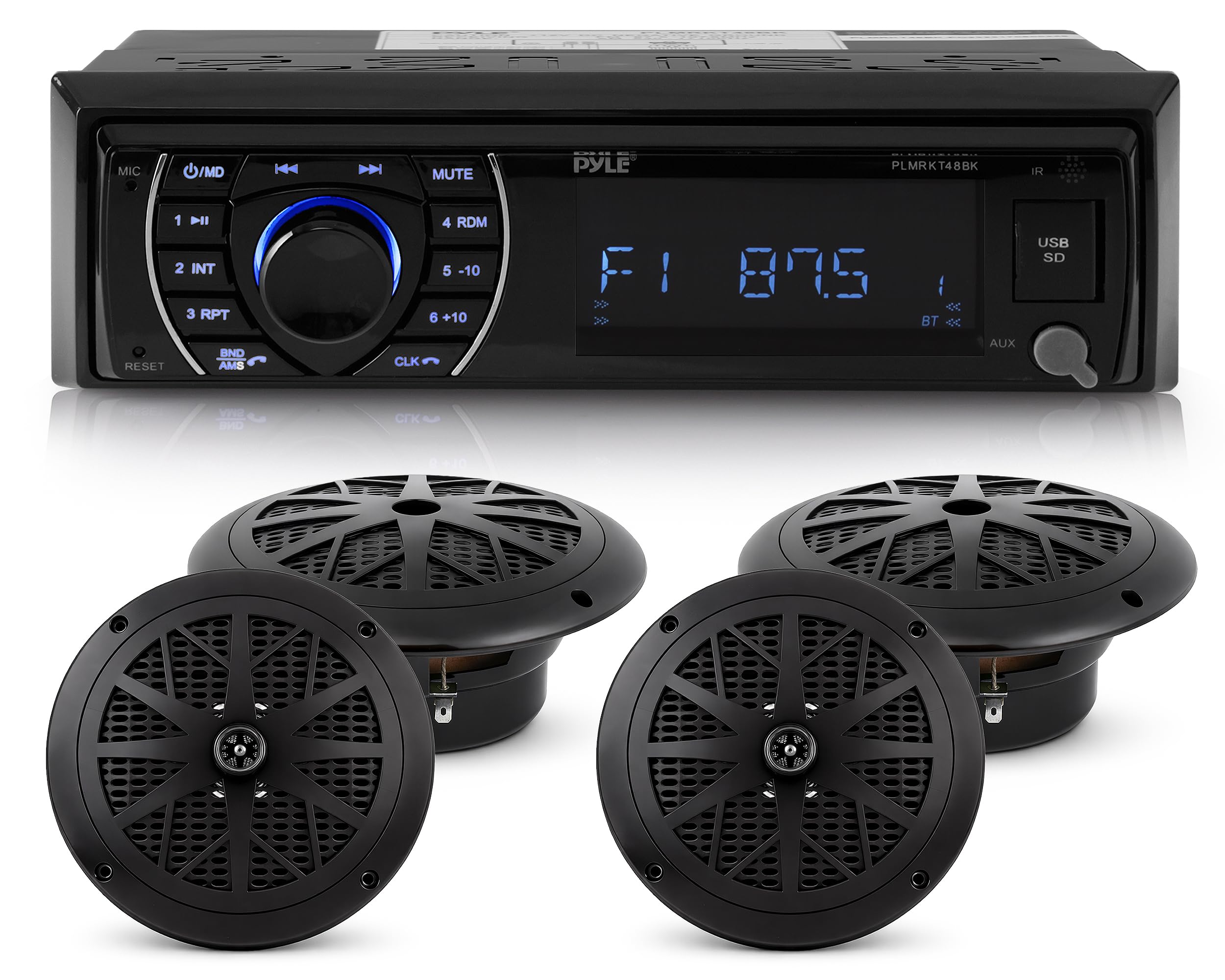
The complete system that comes in one box with four speakers.
This Pyle kit is the only pick that bundles the head unit with four 6.5-inch marine-grade speakers. The head unit pushes 300 watts peak power (the maximum burst wattage, not the continuous power you hear) and has a built-in front-panel microphone for hands-free calling, plus an illuminated LCD display with ID3 tag readout. It also includes USB and SD card readers that support up to 32GB each. One buyer driving a pontoon boat said it was loud enough to hear clearly over a 115 horsepower outboard, which tells you the included 20 oz. magnet speakers can actually fill a deck. The trade-off is that the aux input jack plug tends to fall out, a minor irritation that one reviewer fixed by taping it in place. The remote works only at a short distance, and the display can be hard to read from above if you mount the unit overhead. For a single-box upgrade that gives you a complete system—receiver, four speakers, and wiring—this is the most economical way to add Bluetooth audio to a boat from scratch.
The whole package
- Includes four 6.5-inch marine speakers with 20 oz. magnets
- Hands-free calling via front-panel mic
- USB and SD slots up to 32GB
Known shortcomings
- Aux input plug is loose and may fall out
- Remote control range is limited
- Display hard to read in overhead mounts
Buy the Pyle when: you need a full speaker-and-receiver system in one box and want to keep costs low.
it’s not for you if: you want a glossy touchscreen or high-fidelity audio that rivals dedicated components.
7. BOSS Audio Systems MR1308UABK Marine Boat Stereo

The entry-level step up from a dead factory radio.
If your boat has a non-functional stereo and you just want Bluetooth and AM/FM without spending much, this BOSS receiver gets the basics right. It delivers 50 Watts x 4 channels (peak power, enough for moderate volume on a small pontoon) and has a detachable front panel for theft protection. The push-to-talk feature connects to your phone’s voice assistant so you can control it hands-free. It weighs 2.15 lbs and fits a standard single-DIN slot. One owner replaced the dead radio in a 1996 Harley FLH and said the sound quality was surprisingly good for the price. The catch is that the SD card slot is missing, and the preset EQ options are limited—there’s no manual equalizer for fine-tuning. A few buyers noted a shorted speaker wire issue that triggered the internal amp protection, but BOSS’s tech support was responsive and sent replacement units quickly. It is the right pick when you just need tunes on the water without any fuss.
Cost-effective core: Bluetooth streaming, 50W x 4, and push-to-talk at a baseline price.
What you give up: No manual EQ, no SD card slot, and the detachable face can be a hassle.
Go with this BOSS if: you have a tight budget and just need a simple Bluetooth receiver to replace a dead stock radio.
Pass it by if: you want to fine-tune your sound with a custom equalizer or need advanced media playback options.
Understanding the Specs
IPX Water Resistance Ratings
These numbers tell you exactly how wet it can get. An IPX6-rated unit handles heavy splashes and powerful jets of water, which is plenty for most open boats. An IPX7 rating means it can survive being submerged in up to a meter of water for about 30 minutes. A gauge-style unit might carry an IPX66 rating, meaning it is dust-tight and can withstand powerful water jets. Higher numbers mean better protection, but no marine stereo should be submerged intentionally—it’s a safety margin, not a feature.
Peak Power vs. RMS Power
Peak power is the maximum wattage a stereo can produce in a very short burst—it’s mostly a marketing number. The real spec to look at is RMS (Root Mean Square) power, which is the continuous power the unit can deliver. A marine stereo that claims 300 watts peak might only put out about 25-30 watts RMS per channel. For loud music over engine noise, aim for a unit that lists actual RMS or channel wattage (like 50W x 4) so you know what you’ll actually hear.
FAQ
Can I use a regular car stereo on my boat?
What does IPX6 mean on a marine stereo?
Will a marine stereo fit in my car or side-by-side?
How many watts do I need to hear music over my boat motor?
What is a NOAA Weather Band tuner?
Does a Bluetooth marine stereo drain my boat battery?
Can I control the stereo from my phone?
What is the difference between a marine stereo and a gauge-style marine stereo?
Final Thoughts: The Verdict
For most people, the bluetooth marine stereo winner is the Fusion MS-RA70 because it combines IPX7 water resistance with powerful 2-zone audio control and a sunlight-readable display. If you want a fantastic direct performer without the multi-zone complexity, grab the Sony DSXM55BT. And for a compact gauge-hole solution that doesn’t need much dash space, the Kicker 46KMC2 is your best choice for tight installs.
How We Picked
We do not accept paid placement. Every pick is matched to a real buyer and a real use-case; we do not hands-on test units.
Sources & Methodology
Specifications: manufacturer listings and product documentation. Review insights: verified customer reviews, as of July 2026. Pricing: not shown on this page (it changes often); check the current price via the retailer link.
As an Amazon Associate, Gadgets Feed earns from qualifying purchases. This does not affect which products we feature.
Related Guides
Product prices and availability are accurate as of the date/time indicated and are subject to change. Any price and availability information displayed on Amazon at the time of purchase will apply to the purchase of this product. As an Amazon Associate I earn from qualifying purchases.
CERTAIN CONTENT THAT APPEARS ON THIS SITE COMES FROM AMAZON. THIS CONTENT IS PROVIDED "AS IS" AND IS SUBJECT TO CHANGE OR REMOVAL AT ANY TIME.
Amazon and the Amazon logo are trademarks of Amazon.com, Inc. or its affiliates.