
TV speakers are a compromise. They are thin, rear-facing, and physically incapable of reproducing the low frequencies that make an explosion feel real or a movie score feel grand. A dedicated soundbar with a subwoofer solves this by handling the dialogue, effects, and bass separately, creating a soundstage that actually matches the visuals on your screen. The challenge is navigating the many channel configurations—2.1, 3.1, 4.1, 5.1—and understanding which features like Dolby Atmos or room calibration actually matter for your space.
I’m Min — the co-founder and writer behind Gadgets Feed. I’ve analyzed the technical specifications and real-world performance data of dozens of home audio systems to identify the models that deliver genuine sonic upgrades without unnecessary complexity or hidden compromises.
After comparing power ratings, driver configurations, and connectivity options across a wide range of price points, here is my curated list of the best bluetooth soundbar with subwoofer options available today for every room size and budget.
How To Choose The Best Bluetooth Soundbar With Subwoofer
Selecting the right soundbar system involves more than just picking the highest wattage number. The interaction between channel count, driver size, room size, and connectivity determines whether you get clear dialogue or muddy, boomy noise. Here are the critical factors to consider before making a purchase.
Channel Configuration and Driver Layout
A 2.1 system uses left and right channels plus the subwoofer. This works for basic stereo separation, but lacks a dedicated center channel. A 3.1 system adds a center channel, which dramatically improves dialogue clarity by anchoring voices to the screen. Moving to 4.1 or 5.1 adds surround speakers (wired or wireless) that create rear soundstage effects, essential for cinematic immersion. A 3.1.2 system adds two up-firing drivers for overhead Dolby Atmos effects, bouncing sound off the ceiling to simulate height.
Subwoofer Size, Power, and Wireless Connectivity
The subwoofer driver diameter (commonly 5.25-inch, 6.5-inch, 8-inch, or 10-inch) directly dictates how low the system can go and how much air it can move. A 10-inch driver can reproduce frequencies down to 20 Hz, producing physical, chest-thumping bass, while a 5.25-inch driver may struggle below 40 Hz. Wireless connectivity for the sub is standard, but the range and reliability vary — look for systems that pair automatically and maintain a stable link without dropouts. Placement matters: corner placement amplifies bass response but can create uneven nulls across the room.
Audio Codec Support and Room Correction
Dolby Atmos and DTS:X are the primary object-based audio formats that create three-dimensional soundfields. HDMI eARC is the only connection that supports lossless variants of these codecs — optical is limited to compressed Dolby Digital or DTS. Room correction technologies like AI Sonic (TCL) or SpaceFit Sound (Samsung) use the soundbar’s built-in microphones to measure how sound reflects off your walls and adjust the EQ accordingly. This can fix issues like boomy bass from corner placement or muffled mids from thick carpets.
Connectivity and Control
Bluetooth 5.3 is the current standard, offering lower latency and better range than older versions. HDMI eARC is mandatory for high-bitrate audio, while optical serves as a fallback for older TVs. Many modern soundbars also support app-based control, which provides multi-band equalizers and firmware updates — a feature that extends the product’s useful life. CEC compatibility lets you control volume and power with your TV remote, eliminating remote clutter.
Quick Comparison
On smaller screens, swipe sideways to see the full table.
| Model | Category | Best For | Key Spec | Amazon |
|---|---|---|---|---|
| Samsung HW-Q600F | 3.1.2ch Dolby Atmos | Overhead Atmos immersion | 3.1.2ch / up-firing drivers | Amazon |
| JBL Bar 500MK2 | 5.1ch Dolby Atmos | Maximum bass and power | 750W / 10-inch sub | Amazon |
| LG S60T | 3.1ch Dolby Audio | LG TV synergy and voice clarity | 3.1ch / AI Sound Pro | Amazon |
| Samsung HW-B550F | 2.1ch DTS Virtual:X | Balanced sound on a budget | 2.1ch / 300W / Adaptive Sound | Amazon |
| LG S40TR | 4.1ch Dolby Audio | Wireless rear speakers included | 4.1ch / wireless rears | Amazon |
| ULTIMEA Poseidon D50 | 5.1ch Virtual Surround | Customizable EQ and app control | 320W / 5.1ch / 121 presets | Amazon |
| ULTIMEA Aura A40 | 7.1ch Virtual Surround | Multi-speaker immersion on a budget | 330W / 7.1ch / 4 surround speakers | Amazon |
| TCL S55H | 2.1ch Dolby Atmos | Auto room calibration and app control | 220W / AI Sonic room calibration | Amazon |
| Saiyin Soundbar | 2.1ch Detachable | Swappable form factor and value | 100W / 2-in-1 detachable design | Amazon |
In‑Depth Reviews
1. Samsung Q-Series HW-Q600F
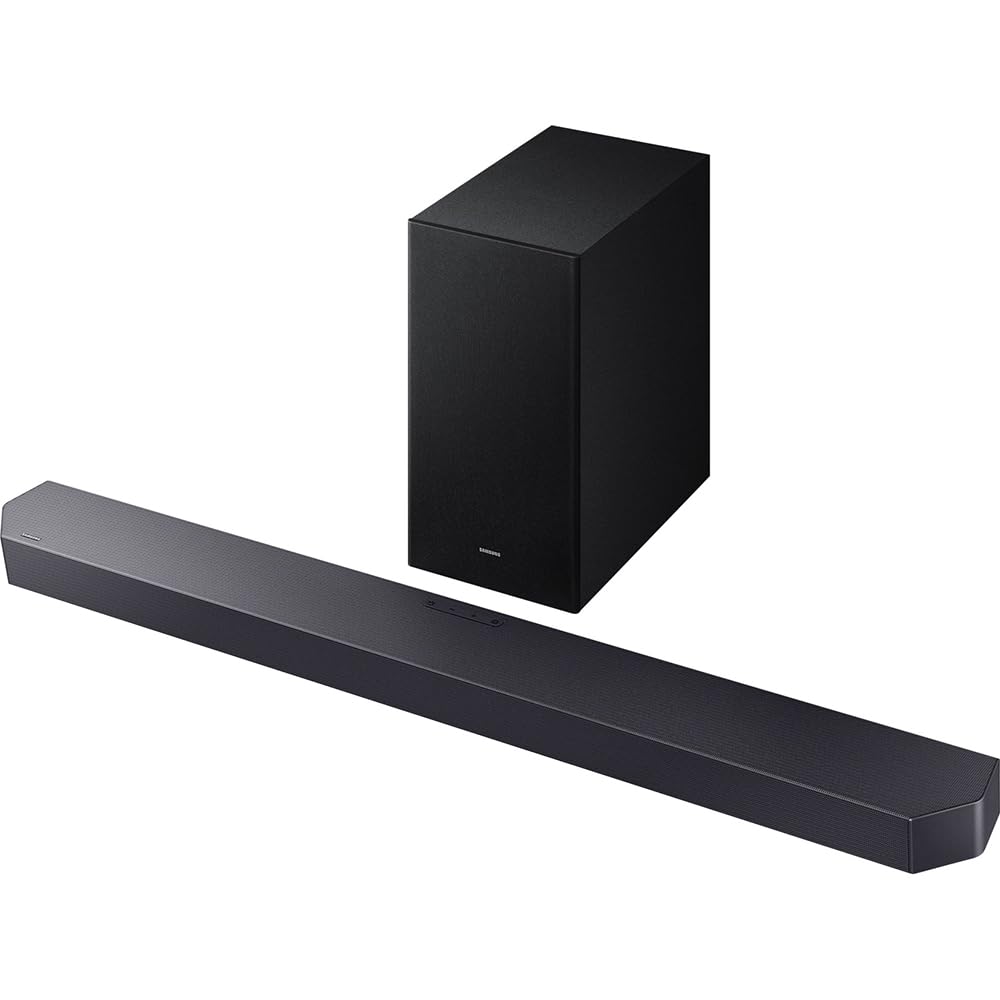
The Samsung HW-Q600F is a true 3.1.2-channel system, meaning it has dedicated left, right, and center channels plus two up-firing drivers that bounce sound off the ceiling to create overhead Atmos effects. This is a significant step above virtual surround systems that simulate height through psychoacoustic processing. The wireless subwoofer handles the low end with authority, reaching down to 20 Hz, which covers the deepest rumbles in action movies and bass-heavy music.
Q-Symphony is the standout feature if you own a compatible Samsung TV — it synchronizes the TV’s built-in speakers with the soundbar to create a wider, more cohesive front soundstage. The Adaptive Sound mode analyzes each scene in real time and adjusts the EQ to prioritize dialogue during quiet moments and expand the soundfield during action sequences. Game Pro Mode automatically detects a console and applies a 3D audio profile with enhanced directional cues for competitive gaming.
Setup is streamlined via HDMI eARC, which is essential for passing lossless Dolby Atmos TrueHD from a Blu-ray player or streaming device. The included remote controls the essentials, but the Samsung SmartThings app provides access to sound modes and firmware updates. The only real compromise is the single HDMI input, which limits expandability without an external switch. For the price, this delivers genuine object-based audio without requiring rear satellite speakers.
Why it’s great
- True up-firing drivers deliver convincing overhead Atmos effects
- SpaceFit Sound calibration tunes the EQ to your specific room acoustics
- Q-Symphony integration with Samsung TVs creates a wider soundstage
Good to know
- Only one HDMI input — you may need a switch for multiple sources
- Atmos height effects are diminished with very high or vaulted ceilings
2. JBL Bar 500MK2
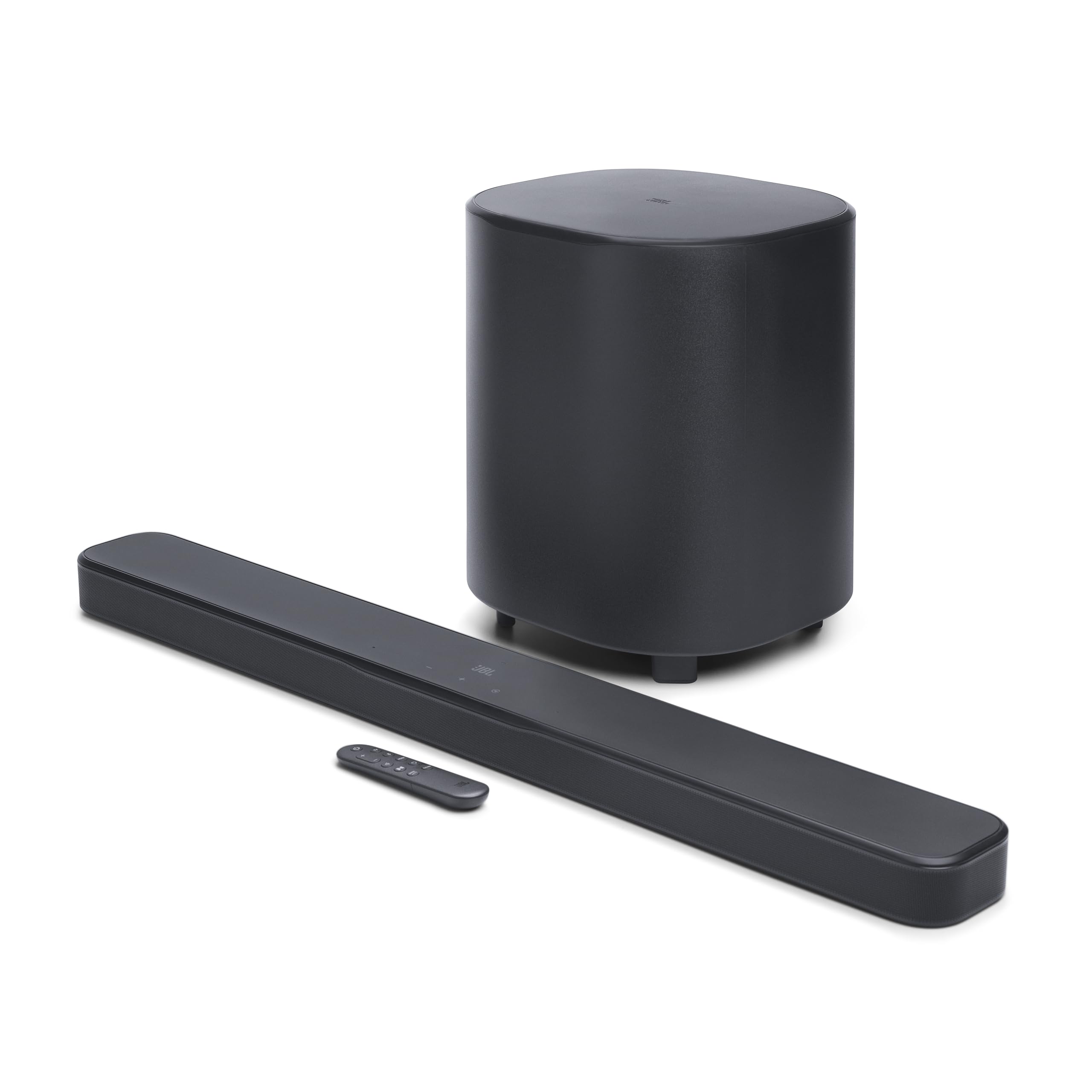
The JBL Bar 500MK2 is a brute-force audio solution with 750 watts of total system power driving a 5.1-channel configuration. The defining component is the 10-inch wireless subwoofer, which moves enough air to reproduce frequencies down to 20 Hz with physical, couch-shaking force. This is the only system in this list with a driver that large, making it the clear choice for anyone who prioritizes deep, tactile bass over compact form factor.
Dolby Atmos is handled through JBL’s MultiBeam 3.0 technology, which uses an array of drivers and beamforming to create a wide, cinema-like soundstage without dedicated up-firing speakers. While it does not match the precise overhead localization of a true 3.1.2 system like the Samsung HW-Q600F, it delivers a convincingly spacious soundfield that fills medium to large rooms. PureVoice 2.0 automatically adjusts dialogue clarity based on the ambient sound of the scene, so whispered lines remain intelligible even during loud action sequences.
Connectivity is comprehensive with HDMI eARC, Wi-Fi (AirPlay, Google Cast, Spotify Connect), and Bluetooth 5.3. The JBL ONE app provides a 10-band equalizer for fine-tuning, plus automatic sound calibration that measures the room’s reflections and adjusts the output accordingly. The system also supports multi-room audio and voice assistant integration. The main trade-off is size — the 10-inch sub is physically large and needs dedicated floor space — but for raw output and bass extension, this is the most powerful system on the list.
Why it’s great
- 10-inch subwoofer delivers deep, distortion-free bass down to 20 Hz
- MultiBeam 3.0 creates a wide soundstage without rear speakers
- Full suite of Wi-Fi streaming features (AirPlay, Google Cast, Spotify Connect)
Good to know
- Large subwoofer requires significant floor space
- Virtual Atmos is less precise than systems with physical up-firing drivers
3. LG S60T

The LG S60T is a 3.1-channel system that focuses on dialogue clarity and seamless integration with LG televisions. The dedicated center channel is the key differentiator here — it anchors voices to the screen, making it significantly easier to follow quiet dialogue without constantly adjusting the volume. The wireless subwoofer, while not the largest on this list, provides enough low-end punch to add weight to explosions and soundtracks without overwhelming the mids.
WOW Orchestra is the feature that makes this system stand out for LG TV owners. It allows the TV’s own speakers to work in concert with the soundbar, using the full array of drivers to create a larger, more immersive soundstage. The WOW Interface lets you control the soundbar’s volume, sound mode, and audio settings directly through the LG TV’s on-screen menu, eliminating the need for a secondary remote. AI Sound Pro automatically analyzes the content and optimizes the EQ in real time, boosting vocals during news programs and expanding the soundfield during action scenes.
Setup is straightforward with HDMI eARC, and the LG Soundbar App provides access to a 3-band equalizer for fine-tuning the bass, treble, and mid-range. The Crest Design metal grille is a practical touch, keeping dust out while maintaining a clean, low-profile appearance under the TV. The primary consideration is that WOW Orchestra and WOW Interface are locked to LG TVs — if you own a different brand, you lose those features, and the system becomes a well-performing but less feature-rich 3.1 soundbar.
Why it’s great
- Dedicated center channel provides excellent dialogue clarity
- WOW Orchestra combines TV and soundbar speakers for a wider soundstage
- WOW Interface allows seamless control through LG TV menu
Good to know
- Key WOW features are exclusive to LG TVs
- 3-band EQ is less flexible than multi-band options from competitors
4. Samsung B-Series HW-B550F

The Samsung HW-B550F is a 2.1-channel system that punches well above its price tier. It uses DTS Virtual:X to process stereo signals into a simulated surround soundfield, creating a sense of space and directionality that rivals many entry-level 3.1 systems. While it lacks a physical center channel, the Adaptive Sound and Voice Enhance modes work together to boost dialogue frequencies, ensuring speech remains clear even during complex audio mixes.
The wireless subwoofer is well-matched to the soundbar’s 300-watt total output. It delivers tight, controlled bass that adds impact to movie soundtracks and music without the boomy, one-note drone that plagues cheaper subwoofers. The Bass Boost mode provides an extra dose of low-end energy for action-heavy content, though the subwoofer does not dig as deep as larger 8-inch or 10-inch units — expect a roll-off below 40 Hz.
Setup is simple via HDMI ARC or optical, and the soundbar can learn your TV remote’s IR codes for unified control. The included remote covers the basics — volume, source, sound modes — but there is no app-based EQ customization. For users who want a significant upgrade from TV speakers without the complexity of a multi-channel setup, this is a focused, effective solution. The 2025 model designation ensures updated Bluetooth and HDMI chipsets for long-term compatibility.
Why it’s great
- DTS Virtual:X creates convincing spatial effects from 2.1 hardware
- Voice Enhance mode improves dialogue clarity without a center channel
- Clean, balanced bass that avoids port noise or distortion at moderate volumes
Good to know
- No dedicated center channel — virtual processing may not satisfy critical listeners
- Lacks app-based EQ controls for custom sound tuning
5. LG S40TR

The LG S40TR is a 4.1-channel system that includes wireless rear surround speakers and a wireless subwoofer straight out of the box — no separate receiver or additional purchases required. This is a rare configuration at this price point. The two rear speakers create genuine rear-channel audio, placing sounds behind the listener and dramatically improving the sense of immersion for movies and games where directional cues matter.
The subwoofer, while physically compact, produces a satisfying thump that fills small to medium rooms. It does not match the depth or force of larger subwoofers, but it integrates smoothly with the soundbar’s main drivers. The Smart Up-Mixer takes 2-channel content and distributes it across all available speakers, creating a wider surround field. Clear Voice Plus uses the center processing to ensure dialogue remains intelligible even when the rear speakers are active.
Setup is clean because the rear speakers are truly wireless (they need power, but no connection to the soundbar). The included wall-mount kit helps keep the setup tidy. The LG Soundbar App unlocks a 3-band EQ and firmware updates. The main limitation is the lack of Dolby Atmos support — this is a standard Dolby Digital system, so there are no height effects. For users who want a real, hassle-free surround setup for TV and movies without Atmos complexity, this is a compelling package.
Why it’s great
- Includes wireless rear surround speakers — no extra purchases needed
- Smart Up-Mixer expands 2-channel content to all four speakers
- Clear Voice Plus maintains dialogue clarity even with surround effects
Good to know
- No Dolby Atmos or DTS:X support — limited to legacy surround codecs
- Rear speakers require power outlets — placement depends on proximity to wall sockets
6. ULTIMEA Poseidon D50

The ULTIMEA Poseidon D50 is a 5.1-channel system built around the company’s SurroundX technology, which upmixes standard 2.0 PCM stereo audio into a simulated 5.1 surround field. The package includes a soundbar, two wired rear surround speakers, and a wireless subwoofer with a 5.25-inch driver. The system delivers 320 watts of peak power, which is sufficient for small to medium rooms, and produces a clean, balanced sound signature out of the box.
The standout feature is the companion app, which provides access to 121 preset equalizer matrices organized by musical genre (Bass, Pop, Classical, Rock) and six optimized EQ modes (Movie, Music, Voice, Sport, Game, Night). A 10-band customizable equalizer lets you adjust specific frequencies to match your room’s acoustics or personal preferences. This level of granular EQ control is almost unheard of at this price tier and makes the Poseidon D50 exceptionally flexible for different content types.
Connectivity options include Bluetooth 5.3, optical, AUX, and HDMI ARC. The two rear speakers connect to the subwoofer via included 19.6-foot cables, which is generous for most living room layouts. The BASSMX technology adds extra low-end emphasis without introducing distortion. The primary trade-off is the 5.25-inch subwoofer, which cannot reproduce the deepest sub-30 Hz frequencies — expect bass that is punchy but not physically deep. For the price, the combination of app-based EQ and real 5.1 channel architecture is difficult to beat.
Why it’s great
- 10-band EQ and 121 preset matrices via app provide unmatched sound customization
- Real 5.1 channel layout with included wired rear speakers
- BASSMX technology adds punch without audible distortion at normal volumes
Good to know
- 5.25-inch subwoofer lacks deep sub-bass extension below 30 Hz
- Rear speakers require long cable runs — may be inconvenient for some layouts
7. ULTIMEA Aura A40

The ULTIMEA Aura A40 pushes the channel count further by offering a 7.1-channel virtual surround system with four physical surround speakers — two wired front units and two wired rear units — plus a wired subwoofer. This configuration creates a dense, 360-degree soundfield that is particularly effective for action movies and immersive gaming, where precise spatial cues matter. The SurroundX technology processes the audio to route specific sounds to the correct speaker, achieving 99.99% detail accuracy according to the manufacturer.
The system features 13 adjustable surround levels, allowing you to fine-tune the balance between the front and rear channels to suit your room size and seating position. The rear speakers connect wirelessly to the soundbar for signal, though they require power cables. The bass response is adequate but not overwhelming — the subwoofer is smaller than some competitors, and users seeking chest-thumping low end may find it lacking. The 10-band EQ and 121 preset matrices in the app apply here as well, giving you extensive control over the sound signature.
Setup involves connecting the front surround speakers to the soundbar via included cables and pairing the rear right speaker wirelessly. The process is straightforward, but the cable management for four wired satellite speakers can be involved. The system does not support HDMI, relying instead on optical, AUX, USB, and Bluetooth 5.3 — a notable omission that means you cannot pass Dolby Atmos or DTS:X through this system. For users who prioritize physical speaker placement for surround immersion over object-based audio codecs, the Aura A40 delivers impressive spatial presence at a budget-friendly price.
Why it’s great
- Four physical surround speakers create a dense, immersive soundfield
- 13 adjustable surround levels let you tune rear channel balance precisely
- App-based 10-band EQ and 121 presets offer deep customization
Good to know
- No HDMI input — limited to optical, AUX, and Bluetooth audio
- Wired subwoofer and four wired satellites require careful cable routing
8. TCL S55H

The TCL S55H is a 2.1-channel system that brings auto room calibration — typically found in higher-priced models — to the budget segment. AI Sonic technology uses the soundbar’s built-in microphones to measure how sound reflects off your walls, furniture, and ceilings, then adjusts the EQ to deliver balanced output regardless of room shape or subwoofer placement. This is a genuinely useful feature that compensates for imperfect room acoustics without requiring calibration equipment or expertise.
Despite being a 2.1 system, the S55H supports Dolby Atmos and DTS Virtual:X, using psychoacoustic processing to simulate height and surround effects from the soundbar’s physical drivers. The result is a surprisingly wide soundstage that creates the illusion of sound coming from above and beside the listener. The wireless subwoofer delivers 220 watts of total system power, which is adequate for small to medium rooms, though users in larger open-plan spaces may want more headroom.
Setup is genuinely plug-and-play: the soundbar and subwoofer pair automatically out of the box. The TCL app walks you through the room calibration process, and the system also supports HDMI eARC for lossless audio passthrough. The compact form factor (31.89 inches wide) fits easily under most TVs. The main limitation is the 2.1-channel hardware — the virtual processing creates a wide soundstage, but it cannot match the discrete channel separation of a true 3.1 or 5.1 system. For apartment dwellers and bedroom setups where space and neighbor-friendly volume levels are priorities, the S55H is a smart, sonically optimized choice.
Why it’s great
- AI Sonic room calibration automatically optimizes sound for your specific room
- Virtual Dolby Atmos and DTS:X create a wide soundstage from 2.1 hardware
- Compact size and automatic subwoofer pairing simplify installation
Good to know
- 2.1-channel hardware cannot match discrete surround clarity of multi-speaker systems
- 220-watt total power may be insufficient for large, open-concept rooms
9. Saiyin Soundbar with Subwoofer

The Saiyin Soundbar is a 2.1-channel system with a unique detachable design — the main soundbar unit splits into two separate tower speakers that can be placed on either side of your TV for improved stereo separation and a wider soundstage. This is a creative solution for users who want the simplicity of a soundbar but also value physical channel separation. The system uses two silk dome tweeters and two 53mm x 83mm square woofers to produce clear highs and a warm midrange.
The 10-level adjustable bass control lets you dial in the subwoofer output without needing an app, though there is no visual indicator for the current bass level, so you are setting it by ear. The included remote covers the basics — volume, input, bass level, and three DSP sound modes (Movie, Music, News). Bluetooth 5.3 provides a stable wireless connection for streaming from your phone or tablet, and the system also supports HDMI-ARC, optical, and AUX inputs for TV connectivity.
Build quality is basic — the enclosures are plastic, and the overall aesthetic is functional rather than premium. The subwoofer is a passive radiator design, which means it lacks the punch of a powered subwoofer, but it adds enough low-end weight to make a noticeable difference over TV speakers. Customer feedback highlights port noise between 70-110 Hz at higher volumes, which can be mitigated by adding acoustic foam to the port. For the price, the detachable design and comprehensive connectivity make this a versatile entry-level option for budget-conscious users in small rooms or desktop setups.
Why it’s great
- Unique detachable design allows use as a soundbar or two separate tower speakers
- Silk dome tweeters deliver clear, detailed high-frequency reproduction
- 10-level adjustable bass gives control over low-end output
Good to know
- Plastic build quality feels less robust than metal-enclosure competitors
- Port noise between 70-110 Hz may require acoustic foam modification
FAQ
Does a 2.1 soundbar with virtual surround sound provide the same experience as a 5.1 system with rear speakers?
Can I add rear speakers to any soundbar with a wireless subwoofer?
How important is HDMI eARC for Dolby Atmos?
Will a soundbar with a subwoofer work well in an apartment without disturbing neighbors?
What does the “sound mode” button on the remote actually change?
Final Thoughts: The Verdict
For most users, the best bluetooth soundbar with subwoofer winner is the Samsung HW-Q600F because its true 3.1.2-channel Dolby Atmos performance, Q-Symphony integration, and SpaceFit Sound room calibration deliver a premium experience that rivals dedicated AV systems. If you want the most powerful bass and a 10-inch subwoofer, grab the JBL Bar 500MK2. And for a complete, hassle-free surround setup with included rear speakers, nothing beats the LG S40TR.