
TV speakers have a fundamental design flaw: they are thin, rear-firing, and physically incapable of delivering the weight and clarity of a dedicated audio system. A Bluetooth Speaker For TV is the direct solution, bypassing your television’s anemic onboard sound to deliver clear dialogue, a wider soundstage, and bass that doesn’t distort at moderate volume. This guide isolates the essential specs and real-world performance metrics that separate a meaningful upgrade from a lateral move.
I’m Min — the co-founder and writer behind Gadgets Feed. For this guide, I analyzed technical specifications, customer feedback, and performance data across a range of soundbars and TV-oriented Bluetooth speakers to identify which models actually solve the specific problems of TV audio: lip-sync delay, dialogue intelligibility, and room-filling presence.
Whether your primary concern is understanding whispered dialogue in dramatic scenes or feeling the rumble of an action sequence, this analysis cuts through the marketing noise to deliver the definitive breakdown of the best bluetooth speaker for tv options available today.
How To Choose The Best Bluetooth Speaker For TV
Not every Bluetooth speaker is suitable for TV use. The three most common failure points are audio delay (lip-sync error), weak dialogue projection, and insufficient power for the listening space. Understanding these three vectors will prevent a frustrating purchase.
Lip-Sync and Codec Support
Bluetooth inherently introduces latency. For a TV speaker, anything above 50ms of delay becomes visually distracting. Speakers with support for advanced audio codecs like Apt-X Low Latency or AAC (native to Apple devices) minimize this to imperceptible levels. Models without codec support often require an optical or HDMI ARC backup connection for sync-free audio.
Dialogue Intelligibility
The most common complaint with TV speakers is the inability to hear dialogue clearly over background music or effects. A dedicated center channel driver, or a software-based dialogue enhancement mode (like Voice Enhance on Samsung or A.I. Dialogue Mode on Bose), directly addresses this. Without it, even a powerful speaker can sound muddy during complex scenes.
Power Output and Driver Configuration
A 40-watt soundbar might be sufficient for a small bedroom, but a 20ft x 15ft living room demands at least 100 watts RMS to maintain headroom without distortion. Additionally, a 2.1 configuration (two drivers plus a subwoofer) provides a much better balance of clarity and bass extension than a simple 2.0 stereo bar.
Quick Comparison
On smaller screens, swipe sideways to see the full table.
| Model | Category | Best For | Key Spec | Amazon |
|---|---|---|---|---|
| Sonos Arc Ultra | Premium | Best Overall | 9.1.4 channels, Dolby Atmos | Amazon |
| Bose Smart Dolby Atmos Soundbar | Premium | All-in-One Performance | TrueSpace upmixing, A.I. Dialogue | Amazon |
| ULTIMEA Skywave F40 | Mid-Range | Immersive Surround | 5.1.2ch, Dolby Atmos, BT 5.4 | Amazon |
| LG S40TR | Mid-Range | Wireless Rear Setup | 4.1ch, wireless sub + rears | Amazon |
| TCL S55H | Mid-Range | Best Value with Sub | 220W, Dolby Atmos, AI Room Cal. | Amazon |
| Samsung HW B400F | Budget | Entry-Level Upgrade | Built-in subwoofer, Voice Enhance | Amazon |
| MZEIBO Sound Bar | Budget | Detachable Flexibility | 80W, detachable 2-in-1 design | Amazon |
In‑Depth Reviews
1. Sonos Arc Ultra Soundbar

The Sonos Arc Ultra establishes a new ceiling for integrated TV audio. Its Sound Motion technology compresses a 9.1.4 channel array into a single bar, using upward-firing drivers to bounce sound off the ceiling for Dolby Atmos height effects. The AI-driven Speech Enhancement mode dynamically isolates vocal frequencies, which makes even mumbled dialogue in dense mix scenes perfectly intelligible.
Trueplay tuning uses your smartphone’s microphone to analyze the room’s acoustics and adjust the EQ in real time. This is not a gimmick — in an irregularly shaped living room with hard floors, the calibration noticeably tightened the bass response and widened the center image. The bar also supports Wi-Fi, Bluetooth, AirPlay 2, and Spotify Connect, giving you streaming flexibility beyond TV audio.
For users who want the best possible single-bar experience with an upgrade path to a full surround system (adding Sonos Sub and Era 300 rears), this is the definitive choice. The premium price reflects the engineering investment and the seamless Sonos ecosystem integration.
Why it’s great
- Best-in-class dialogue clarity via AI Speech Enhancement.
- Trueplay room calibration dramatically improves soundstage accuracy.
- 9.1.4 channel architecture for true height effects.
Good to know
- Requires HDMI eARC for full Dolby Atmos passthrough.
- Optimal performance requires the full ecosystem investment.
2. Bose Smart Dolby Atmos Soundbar

The Bose Smart Dolby Atmos Soundbar is a masterclass in miniaturization. In a chassis narrower than most 2.0 bars, Bose fits five transducers including two upward-firing drivers dedicated to height information. TrueSpace technology upmixes non-Atmos content (stereo or 5.1) to a virtual multi-channel experience that sounds convincingly wider than the physical bar.
A.I. Dialogue Mode is the standout feature for TV use. It continuously analyzes the incoming audio signal and adjusts the center channel presence to keep vocal intelligibility high without affecting the surround or bass levels. The result is a soundbar that never forces you to reach for the remote to catch a quiet line. Built-in Amazon Alexa and Bose Voice4Video allow voice control of the bar and connected TV.
This is the best option for those who prioritize a clean, single-component setup and want premium audio without managing multiple satellites. It also supports AirPlay 2 and Chromecast, making it a strong music speaker when the TV is off.
Why it’s great
- TrueSpace upmixing creates impressive width from a single bar.
- A.I. Dialogue Mode is the best automatic dialogue enhancement available.
- Compact footprint fits under nearly any TV stand.
Good to know
- No dedicated subwoofer included.
- Dolby Atmos height effect is less pronounced than multi-speaker setups.
3. ULTIMEA 5.1.2ch Skywave F40
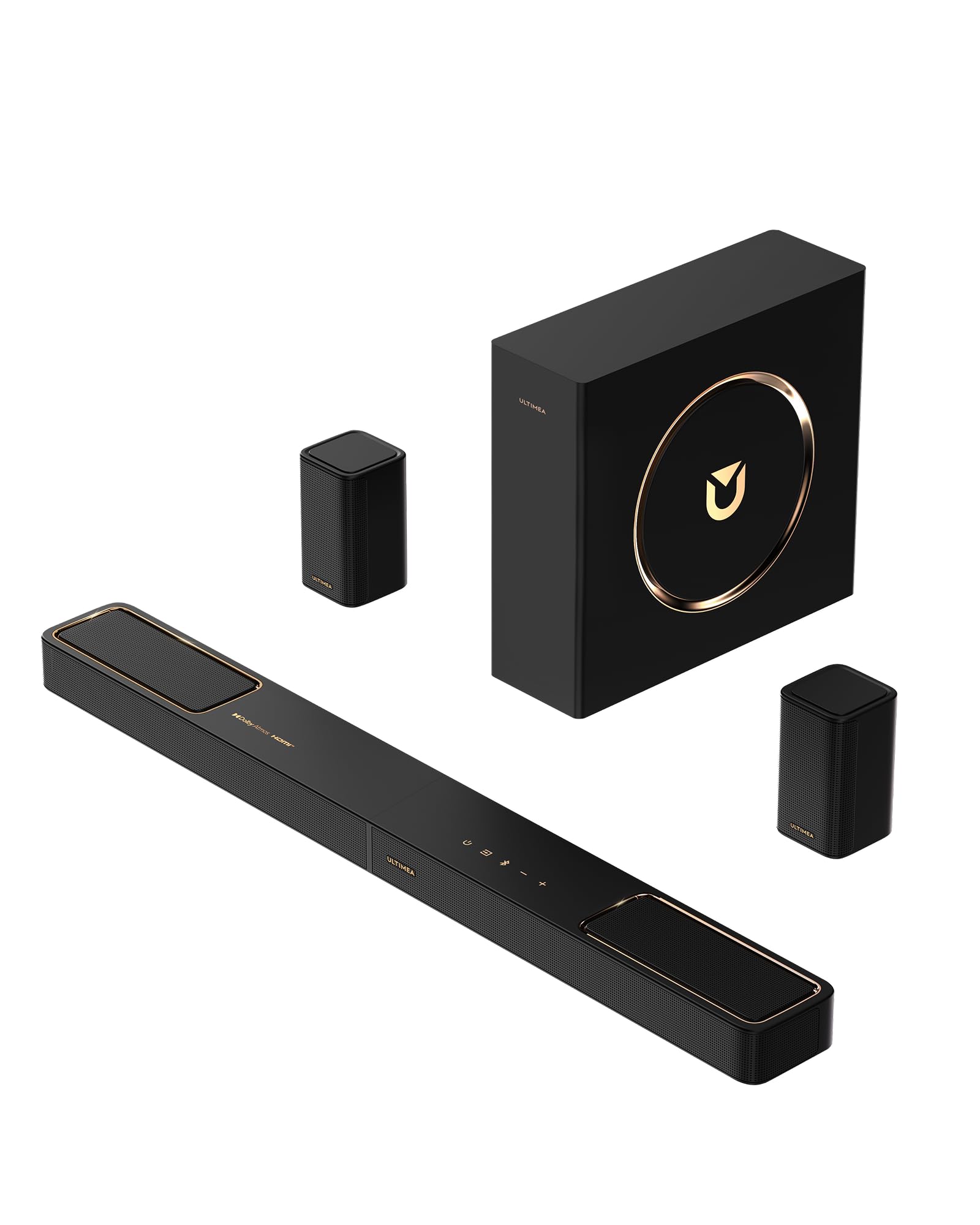
The ULTIMEA Skywave F40 delivers a true 5.1.2 channel configuration — including two rear surround speakers and a wired subwoofer — at a price point typically reserved for 3.1 systems. The up-firing neodymium-core drivers produce a convincing overhead sound field, making helicopter flyovers and rain effects audible above the listening position rather than just from the front.
HDMI eARC support enables lossless transmission of Dolby Atmos up to 37Mbps, meaning no compression artifacts on the height channels. The 13-step level adjustment per channel in the app gives granular control over balance, which is essential for rooms where the rear speakers sit closer to one seating position. VoiceMX technology specifically targets vocal clarity, and it works effectively without dulling the rest of the mix.
This is the strongest affordable entry point into a genuine surround sound experience. The wired subwoofer connection ensures zero latency overhead for bass, and Bluetooth 5.4 keeps future codecs in play.
Why it’s great
- Full 5.1.2 surround with rear speakers at a mid-range price.
- HDMI eARC for lossless Dolby Atmos.
- Detailed app with 10-band EQ and per-channel level adjustment.
Good to know
- Rear speakers require a wired connection to each other.
- Subwoofer bass response is moderate, not room-shaking.
4. TCL S55H 2.1 Sound Bar

The TCL S55H is a 2.1 channel system that punches well above its weight class. With 220 watts of total power driving a soundbar and a wireless subwoofer, it fills medium-sized rooms easily without distortion. The AI Sonic auto room calibration is a genuine differentiator: the system measures the room’s reflection points and adjusts the EQ curve to flatten the frequency response at the listening position.
Dolby Atmos and DTS Virtual:X processing are applied to create a virtualized height layer. While not as convincing as physical up-firing drivers, the effect widens the soundstage and adds perceived depth to action sequences. The subwoofer connects wirelessly, freeing placement options, and the included wall-mount kit allows a clean installation under the TV.
For buyers who want a tangible upgrade in bass and clarity without spending on a full multichannel system, the S55H represents the best performance-per-dollar ratio in this guide. The app-based calibration alone makes it the set-and-forget champion.
Why it’s great
- AI room calibration genuinely improves sound balance.
- 220W provides headroom for dynamic movie mixes.
- Wireless subwoofer simplifies placement.
Good to know
- Subwoofer does not produce deep infrasonic bass.
- No rear speakers for true surround.
5. LG S40TR 4.1ch Soundbar

The LG S40TR is a rare find: a 4.1 channel system that includes wireless rear speakers and a wireless subwoofer at a compact price. The rear satellites connect wirelessly to the soundbar, eliminating the need for a separate receiver, while the subwoofer adds the low-end foundation that 2.0 bars lack. Clear Voice Plus processes the center channel to boost vocal frequencies, and the Smart Up-Mixer converts stereo content into a wider multi-channel presentation.
Integration with LG TVs is seamless. The WOW Orchestra feature allows the soundbar and the TV’s internal speakers to work together, increasing the effective soundstage area. The WOW Interface puts soundbar controls on the LG TV’s on-screen display, letting you adjust EQ and sound modes without switching remotes. Dolby Audio support ensures compatibility with streaming and broadcast content.
This is the ideal solution for LG TV owners who want a hassle-free surround upgrade. The wireless rear speakers eliminate the most intimidating part of home theater installation, and the Crest Design metal grill adds a premium aesthetic.
Why it’s great
- Wireless rear speakers with no receiver needed.
- WOW Orchestra uses TV speakers to augment the soundbar.
- Clear Voice Plus effectively improves dialogue clarity.
Good to know
- Rear speakers require a power outlet each.
- Satellites are wired to each other.
6. Samsung HW B400F 2.0ch Soundbar

The Samsung HW B400F delivers a 2.0 channel experience with a built-in subwoofer driver, which gives it a bass presence that entry-level soundbars often lack. The Voice Enhance mode is specifically tuned for TV dialogue — it amplifies the mid-range frequencies where human speech lives, making it effective for news, dramas, and sports commentary. One Remote Control integration lets you manage the soundbar through your Samsung TV remote.
Surround Sound Expansion widens the stereo image to create a broader listening zone, which helps fill small to medium rooms despite the lack of rear speakers. Night Mode reduces bass and compresses the dynamic range, so you can watch action content at low volume without waking others. The bar connects via Bluetooth for mobile streaming or via HDMI/optical for a direct TV connection.
This is the best budget option for Samsung TV owners who want a simple, low-profile upgrade that prioritizes dialogue clarity. It’s also lightweight, making it easy to mount or reposition.
Why it’s great
- Built-in subwoofer adds bass without a separate box.
- Voice Enhance mode is effective for dialogue-heavy content.
- Integrates with Samsung TV remote control.
Good to know
- 40-watt output may be insufficient for large rooms.
- Bass response is limited compared to external subwoofer systems.
7. MZEIBO Sound Bar

The MZEIBO Sound Bar offers a unique modular design: the bar separates into two independent units that can be placed separately for a wider stereo spread. Each half contains two full-range drivers, and when combined, they deliver 80 watts of clear audio with a large sound cavity that produces deeper lows than a typical all-in-one bar of this size. It supports Bluetooth, AUX, Optical, and ARC connections for universal TV compatibility.
Three EQ modes (Movie, Music, News) allow quick profiling of the sound signature. The Movie mode emphasizes the low end and high-frequency detail for cinematic content, while the News mode boosts the vocal range for dialogue clarity. The included remote control provides hands-free access to all settings, and the compact profile fits easily under monitors or smaller TVs.
This is a strong choice for users in dorms, bedrooms, or offices who want an audio upgrade that can physically adapt to their space. The detachable design is genuinely useful for setups where the TV is not centered on a media console.
Why it’s great
- Detachable design offers placement flexibility.
- Three EQ modes tailored for different content types.
- ARC/Optical/Bluetooth connectivity covers all TV setups.
Good to know
- Maximum volume is moderate for larger rooms.
- Bass is adequate but not subwoofer-level.
FAQ
Will any Bluetooth speaker work with my TV?
How many watts do I need for a Bluetooth Speaker For TV?
Does Dolby Atmos matter for a TV Bluetooth speaker?
Final Thoughts: The Verdict
For most users, the bluetooth speaker for tv winner is the Sonos Arc Ultra because it combines the best dialogue clarity, room calibration, and Dolby Atmos performance in a single bar. If you want wireless rear speakers for a genuine surround setup at a lower price, grab the ULTIMEA Skywave F40. And for unmatched performance in a compact single-component package, nothing beats the Bose Smart Dolby Atmos Soundbar.