
Adding wireless streaming to a traditional stereo system often introduces a hidden trade-off: convenience at the cost of clarity. A Bluetooth Stereo Receiver bridges that gap, but the market is flooded with units that compress the life out of your music. The difference between a capable receiver and a poor one isn’t just about the Bluetooth version number—it’s about the digital-to-analog converter (DAC) quality, the output topology, and whether the unit strips away the spatial detail that makes your favorite recordings feel alive.
I’m Min — the co-founder and writer behind Gadgets Feed. To build this guide, I cross-referenced every claimed spec against the real-world listening experiences shared by hundreds of buyers, focusing specifically on the audio codec support, power delivery, and connectivity versatility that actually matters in a dedicated stereo receiver.
Whether you are upgrading a vintage speaker setup or simplifying a modern desktop audio chain, finding the right best bluetooth stereo receiver means understanding which internal components handle the wireless-to-wired translation without destroying the music’s integrity.
How To Choose The Best Bluetooth Stereo Receiver
Selecting a Bluetooth Stereo Receiver is not just about picking the unit with the highest wattage or the smallest footprint. The critical decision hinges on whether you need an integrated amplifier (to power passive speakers) or a pure receiver (to feed an existing amplifier or powered monitors). After that, the audio codec support and DAC quality will determine how much of your original recording survives the wireless journey.
Power Output and Speaker Matching
If you are driving passive speakers, look at the continuous RMS power per channel at your speaker’s nominal impedance (typically 8 or 4 ohms). A unit delivering 60W to 100W per channel is sufficient for most bookshelf speakers in a medium-sized room. Overpowering is safer than underpowering—clipping distortion from an underpowered amp damages tweeters faster than a clean, higher-powered signal.
Bluetooth Codec and DAC Quality
Standard SBC codec is acceptable for casual listening, but AAC (iOS) and aptX (Android) provide noticeably better clarity. For true high-fidelity streaming, seek LDAC (for Android) or aptX HD. The DAC chip—such as the ESS ES9018K2M or the AKM series—converts the digital Bluetooth signal to analog. A superior DAC eliminates the flat, two-dimensional sound that plagues budget receivers and restores instrument separation and soundstage depth.
Connectivity and Analog Bypass
Beyond Bluetooth, consider how many physical inputs you need. Optical and coaxial inputs allow connection to a TV or CD transport. A phono input is essential if you use a turntable without a separate preamp. For purists, an Analog Mode or Source Direct feature disables the digital processing circuits, allowing a purely analog signal path from your turntable or CD player—a feature rarely found in entry-level units.
Quick Comparison
On smaller screens, swipe sideways to see the full table.
| Model | Category | Best For | Key Spec | Amazon |
|---|---|---|---|---|
| Denon PMA-600NE | Integrated Amp | Analog Purists | 70W/ch (4 ohm), Analog Mode | Amazon |
| Marantz NR1510 | AV Receiver | Compact Home Theater | 50W/ch, 5.2ch, HEOS | Amazon |
| Yamaha R-S202 (Renewed) | Stereo Receiver | Pure 2-Channel Value | 100W/ch (8 ohm), 4 RCA inputs | Amazon |
| Donner MAMP2 | Integrated Amp | Karaoke & Party Use | 60W RMS/ch, Dual Mic Inputs | Amazon |
| blafili B3 | Receiver Only | High-Fidelity Streaming | ESS ES9018K2M DAC, LDAC | Amazon |
In‑Depth Reviews
1. Denon PMA-600NE Bluetooth Stereo Amplifier

The Denon PMA-600NE is the standout choice for anyone who values analog purity but still wants Bluetooth convenience. Its defining feature is the Analog Mode switch, which physically disconnects the digital circuits—including the Bluetooth receiver—from the signal path, delivering a completely undiluted analog experience when you connect a turntable or CD player. This is an integrated amplifier that treats Bluetooth as a supplemental input, not the main event, which is exactly the right priority for a serious stereo system.
Under the hood, the Advanced High Current (AHC) power amplifier delivers 70 watts per channel into 4 ohms, which provides ample headroom for most bookshelf and floor-standing speakers. The built-in DAC handles optical and coaxial inputs with a level of precision that rivals standalone DACs in the same price bracket. Listeners frequently report that the PMA-600NE reveals instrument separation and soundstage depth that their previous receivers simply masked, particularly when streaming via a high-quality source.
The slim, vibration-resistant chassis houses a phono input for moving magnet cartridges, making it a complete hub for both modern wireless streaming and vintage vinyl playback. While the remote control volume adjustment is slightly coarser than the front-panel knob, this is a minor inconvenience given the unit’s overall transparency and musicality. It runs cool and fits cleanly into a desktop or media console without dominating the space.
Why it’s great
- Analog Mode disables digital circuits for pure analog playback
- High Current amplifier delivers clean, detailed sound across all listening levels
- Includes phono input and built-in DAC with optical/coaxial inputs
Good to know
- Bluetooth is SBC/AAC only, no aptX or LDAC support
- Remote volume control is not as smooth as the manual knob
2. Marantz NR1510 UHD AV Receiver

The Marantz NR1510 is a 5.2-channel AV receiver that stands out for its radically slim profile—just over four inches tall—without sacrificing the connectivity that a modern home theater demands. It includes six HDMI inputs with full HDCP 2.2 support, eARC, and Dolby Vision passthrough, making it an ideal centerpiece for a 4K HDR setup. Despite its compact dimensions, the discrete power amplifier delivers 50 watts per channel with the smooth, open sound signature that Marantz is known for.
Wireless streaming is handled through built-in HEOS, Wi-Fi, Bluetooth, and Apple AirPlay 2, giving you complete flexibility to cast from any device. The unit also includes a built-in MM phono preamp, so turntable users can connect directly without an external phono stage. The setup assistant walks you through speaker configuration and room calibration using the included microphone, which significantly reduces the intimidation factor for users new to surround sound.
One important limitation to note: the NR1510 supports 4K at 60Hz, not the newer 120Hz found in gaming-focused receivers. This makes it a better fit for movie and music enthusiasts rather than competitive gamers looking for high refresh rates. The HEOS app, while functional, is not as polished as some dedicated streaming platforms, but AirPlay 2 provides a reliable fallback. The sound quality, however, is consistently praised for its clarity and warmth at moderate volumes.
Why it’s great
- Ultra-slim chassis fits into tight entertainment centers
- Full 4K HDR support with eARC and Dolby Vision
- Integrated phono input and HEOS multi-room streaming
Good to know
- 4K limited to 60Hz, no 120Hz for next-gen gaming
- HEOS app experience can be inconsistent compared to dedicated streamers
3. Yamaha R-S202 Stereo Receiver (Renewed)

The Yamaha R-S202 is a straightforward, no-nonsense stereo receiver that delivers 100 watts per channel into 8 ohms, providing generous power for driving a wide range of passive speakers. The renewed versions offer significant savings while retaining the same robust build quality and performance as the original. Its four RCA inputs and one RCA output give you plenty of flexibility to connect a CD player, tape deck, and other analog sources alongside the built-in Bluetooth receiver.
Bluetooth streaming is simple and reliable, pairing quickly with smartphones and tablets for music playback. The front panel includes a 1/4-inch headphone output, a large volume knob, and bass and treble controls that let you fine-tune the sound to your room and preferences. The AM/FM tuner with 40 station presets is a welcome addition for radio listeners, and the dimmable display prevents the receiver from being a distracting light source in a dark listening room.
One common observation among users is that the volume knob requires many rotations to travel from silent to loud, which can feel slow when making large adjustments. Additionally, there is no optical or coaxial digital input, so connecting a TV will require either an external DAC or a separate audio extractor. For a pure two-channel music system where digital inputs aren’t needed, however, this Yamaha delivers outstanding performance per dollar and the reliability that the brand is known for.
Why it’s great
- High 100W per channel power output at 8 ohms
- Simple, intuitive controls with bass, treble, and balance adjustment
- Reliable Bluetooth connectivity and excellent FM/AM tuner
Good to know
- No digital audio inputs (optical or coaxial)
- Volume knob requires many turns for large adjustments
4. Donner Stereo Audio Amplifier MAMP2
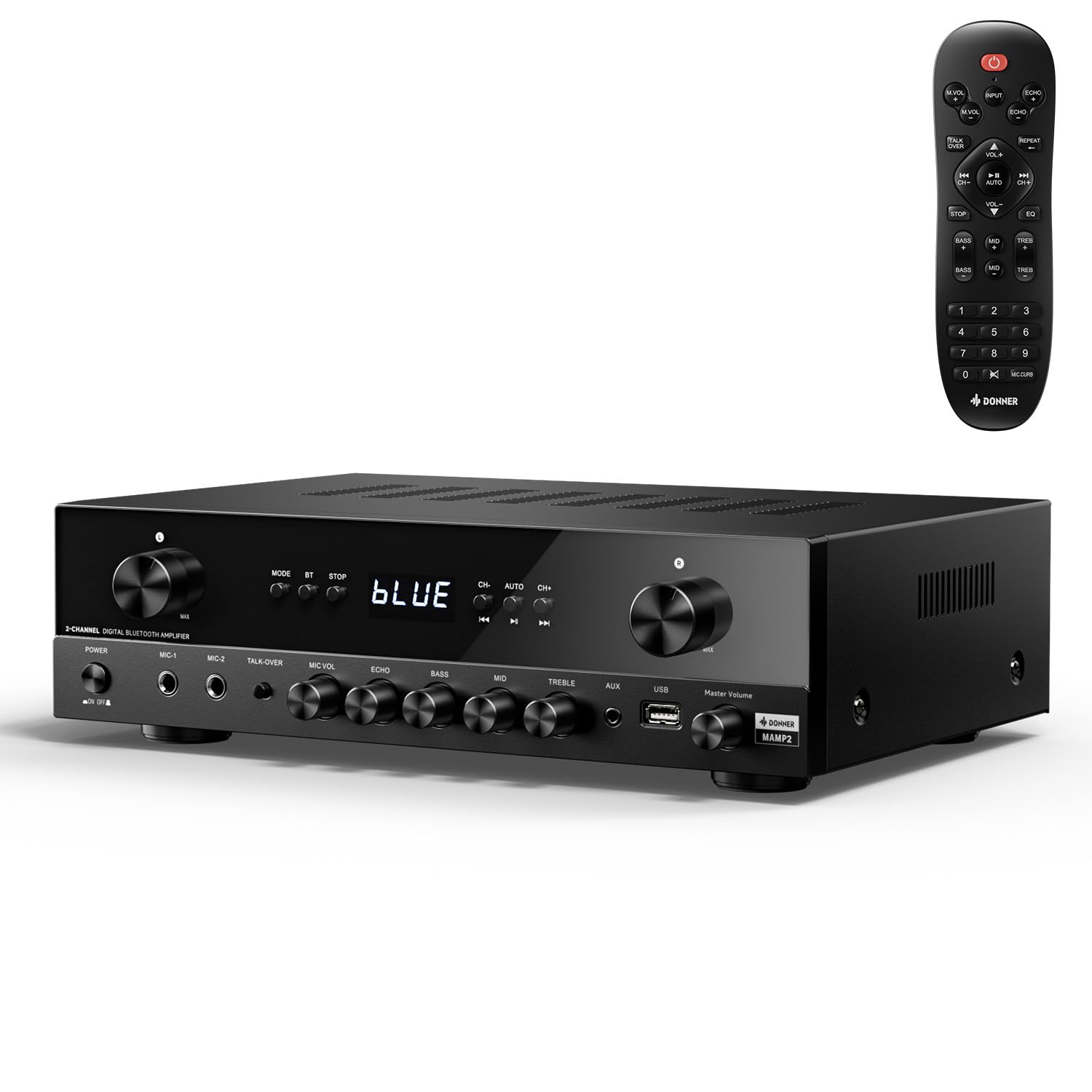
The Donner MAMP2 is a colorfully versatile integrated amplifier that packs an unusual amount of features into a compact, affordable chassis. Its headline spec is 600 watts peak power (60 watts RMS per channel), which is sufficient for driving two pairs of speakers in a 4-speaker setup or a single pair plus a passive subwoofer. What really sets it apart, however, is the inclusion of two 1/4-inch microphone inputs with independent reverb and Talkover functions, turning this receiver into a functional karaoke machine.
Input options are extensive for the price range: Bluetooth 5.3, USB (up to 64 GB), optical, coaxial, RCA, AUX, and a dedicated phono input for turntables. The upgraded remote control allows you to adjust treble, midrange, bass, and echo settings from across the room, and the unit remembers your EQ and volume settings between power cycles. The FM tuner also supports direct frequency entry, which is a rare convenience feature at this price tier.
Build quality is a step below the major Japanese brands—the binding posts are too small for banana plugs, and some users have reported that the optical input can be finicky. The single RCA input limits the number of analog sources you can connect simultaneously. Nonetheless, for a user who wants Bluetooth streaming, karaoke capability, and the flexibility to connect a TV and turntable in one box, the Donner MAMP2 offers remarkable value and genuine utility that competing units at this price point cannot match.
Why it’s great
- Dual mic inputs with reverb and Talkover for karaoke and events
- Comprehensive input selection: Bluetooth 5.3, optical, coaxial, phono, USB
- Independent EQ controls for treble, midrange, and bass
Good to know
- Banana plugs do not fit the binding posts
- Only one RCA input for analog sources
5. blafili B3 Bluetooth Receiver

The blafili B3 is not an amplifier—it is a dedicated Bluetooth receiver designed to upgrade an existing stereo system with high-fidelity wireless streaming. At its core lies the Qualcomm QCC5125 chipset paired with the ESS ES9018K2M DAC, a combination that supports LDAC, aptX HD, aptX Low Latency, AAC, and SBC codecs. This means it handles the highest-resolution Bluetooth streams available from both Android and iOS devices, preserving the dynamic range and spatial detail that budget receivers typically lose.
Output options are unusually comprehensive: balanced XLR, unbalanced RCA, coaxial, and optical outputs are all active simultaneously, allowing you to feed multiple devices at once. The 1.3-inch display shows connection status and codec information, and the unit supports custom Bluetooth broadcast names and pairing passwords—features that are invaluable for professional DJ or installed audio setups where you need to control access. The removable RP-SMA antenna provides a solid 100-foot range and can be upgraded for even longer distances.
The B3 also functions as a USB DAC for a computer, supporting up to 16-bit 48 kHz audio. One key detail: the optical port is output-only, so this unit cannot accept an optical input from a TV. It also requires an external USB power adapter (not included) and ships without RCA cables. For anyone with a high-quality amplifier or powered monitors who wants to add Bluetooth without degrading the sound quality, the blafili B3 is the cleanest and most capable solution in its class.
Why it’s great
- Supports LDAC, aptX HD, and aptX Low Latency for maximum wireless fidelity
- ESS ES9018K2M DAC delivers low distortion and high dynamic range
- Balanced XLR outputs alongside RCA, coaxial, and optical
Good to know
- Optical port is output only, cannot accept TV optical input
- External USB power adapter and RCA cables sold separately
FAQ
Can I use a Bluetooth Stereo Receiver with passive speakers that have no built-in amplifier?
Does a higher Bluetooth version number guarantee better sound quality?
What is the difference between a Stereo Receiver and an AV Receiver for music listening?
Final Thoughts: The Verdict
For most users, the best bluetooth stereo receiver winner is the Denon PMA-600NE because it combines analog purity with wireless convenience in a package that respects the music above all else. If you want a compact multi-channel home theater hub with 4K video support, grab the Marantz NR1510. And for upgrading an existing high-end system with the highest-fidelity Bluetooth streaming available, nothing beats the blafili B3.