
Our readers keep the lights on and my morning glass full of iced black tea. As an Amazon Associate, I earn from qualifying purchases.
Specs are compiled from manufacturer listings and verified buyer reviews and can change over time — please confirm the key details on the product page before buying.
If you are buying a BMX bike for a young rider, the real question is not about the brand sticker on the frame. It is whether the bike matches their height, their skill level, and the beating it will take at the skate park or on the street. A bike that is too heavy or has the wrong crank length makes learning tricks frustrating, while a bike that is too small or big can feel unsafe right from the first push. This guide cuts through the noise by lining up the exact specs that matter for youth riders — frame material, drivetrain gearing, brake type, and the small details like pegs and rotors that separate a beginner bike from one they can grow into.
I’m Min — the founder and writer behind Gadgets Feed. This guide is built by comparing the manufacturers’ published specifications and the patterns across verified customer reviews, so you get each pick’s real strengths and trade-offs instead of marketing spin.
Whether your child is just starting out on pavement or already trying tailwhips at the local pump track, this roundup of the bmx bikes for youth will help you find the model that actually fits their size, skill, and budget.
Our Picks at a Glance


How To Choose The Best BMX Bikes For Youth
Picking a BMX for a growing rider means balancing immediate comfort with room to progress. A bike that is too small on day one will feel cramped, while one that is too large can be hard to control during tricks. Start by checking the rider height against the suggested height range in the specs — most 20-inch youth BMX bikes fit riders from about 4’0″ to 5’8″.
Frame material and weight
Hi-ten (high-tensile) steel is the most common frame material at this price level. It is strong and affordable but adds weight. Chromoly (chromium-molybdenum) steel is lighter and stronger, but it usually appears on premium models priced higher. A heavier frame is tougher to lift for jumps and tricks, so a lighter bike can help a smaller rider learn faster.
Gearing and cranks
Single-speed drivetrains are standard on youth BMX bikes — no derailleurs or shifters to break. The crank length (measured in millimeters) should match the rider’s leg length. Shorter cranks, around 152 mm or 165 mm, suit younger riders better because they allow a smoother pedal stroke without banging knees on the handlebar. The chainring and freewheel combination (like a 36T chainring with an 18T cog) determines how easily the bike accelerates from a stop.
Brakes, pegs, and rotors
Most youth BMX bikes come with a rear U-brake or caliper brake, which is simple to maintain. A gyro rotor lets the handlebars spin 360 degrees without tangling the brake cable, which matters for bar spins. Pegs (small metal cylinders on the axles) let riders grind rails and ledges. Some bikes come with two pegs; others include four. If your child is just cruising, extra pegs and a rotor add weight they might not need yet.
Quick Comparison
| Model | Best For | Frame Material | Brake Style | Crank Length | Amazon |
|---|---|---|---|---|---|
| JOYSTAR Brockway 20″★ Best Overall | First BMX for younger beginners | Carbon Steel | Caliper | 165 mm | Amazon |
| Eastern Bikes LowdownTop Performer | Aggressive trick riding | Hi-Tensile Steel | U Brake | — | Amazon |
| Retrospec Sesh 20″Best Progression Pick | Progression to advanced tricks | Carbon Steel | U Brake | — | Amazon |
| Schwinn Sting Pro | Racing and retro style | Alloy Steel | Caliper | — | Amazon |
| cubsala Echo 20″ | Beginner safety and simplicity | High Carbon Steel | U Brake | — | Amazon |
| cubsala Trident 20″ | Race-styled versatility | Carbon Steel | V Brake | — | Amazon |
| Hiland 20″ Freestyle | Full freestyle features on a budget | Carbon Steel | U Brake | — | Amazon |
| WEIZE Freestyle 20″ | 360-degree rotor and four pegs | High Carbon Steel | Linear Pull | 170 mm | Amazon |
| KORIMEFA Freestyle 20″ | Highest-rated entry-level value | High Carbon Steel | Linear Pull | 165 mm | Amazon |
In‑Depth Reviews
1. JOYSTAR Brockway 20″
Our pick — over 4★ from 650+ verified ratings; the strongest balance of quality and price.
A beginner-focused BMX with a tall chainring and a high weight limit for growing riders.
The JOYSTAR Brockway is built specifically for beginner-level riders ages 6 to 14. The hi-ten steel frame uses a 19.9-inch top tube, which fits the suggested rider height of 4’0″ to 4’8″. The single-speed drivetrain features a 165 mm one-piece crank with a 36T chainring — that is a larger chainring than the KORIMEFA’s 32T, which means the bike pulls away smoothly from a stop with less pedal effort.
The rear caliper brake and hand-brake levers give simple speed control. The wheelset is 20×2.125-inch tires on carbon steel single-wall 36H rims with a sealed bearing cassette rear hub — that cassette hub lets the rider coast freely without the pedals spinning, which is the standard for modern BMX bikes. The maximum weight recommendation of 220 pounds gives plenty of room for growing teens.
Reviewers point out that the 2 colored pegs, adjustable seat, and 85% pre-assembled state make it easy to get rolling quickly. However, the rear caliper brake is less powerful than a U-brake for quick stops, and some riders prefer the modulation of a V-brake or U-brake for learning tricks. Also, the carbon steel frame is heavier than some alternatives.
What works well
- 36T chainring makes starting from a stop easy for new riders
- 220-pound max weight recommendation fits growing youth riders
- Sealed bearing cassette rear hub allows free coasting
What to watch for
- Rear caliper brake is less powerful than a U-brake for quick stops
- Carbon steel frame is durable but adds weight
- Single-wall rims may not hold up to heavy park use as well as double-wall rims
Grabs this if: you need a beginner-friendly BMX with a large chainring and a high weight limit for a child who is still learning to pedal and coast comfortably.
Consider an upgrade if: your kid is already hitting jumps and needs a stronger rear brake and double-wall rims.
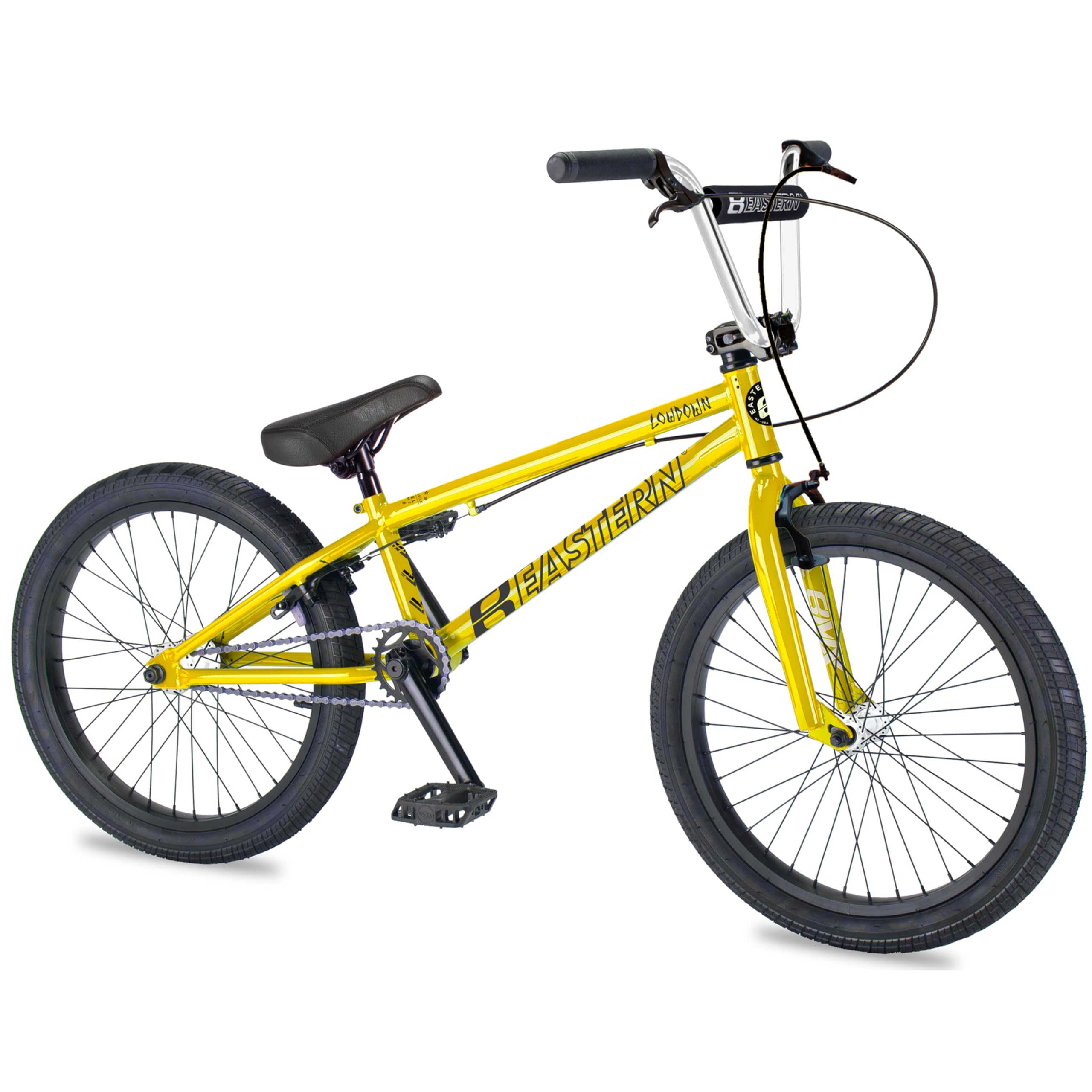
2. Eastern Bikes Lowdown 20″
The heaviest hitter here for young riders ready to throw down real tricks.
If your teen is already past the “learning to pedal” phase and wants a bike that can handle hard landings, this is the one. Eastern Bikes fits the Lowdown with 3-piece tubular Chromoly cranks — that is stronger than the one-piece forged cranks you find on most budget models. These cranks resist bending when the rider stomps a drop or lands heavy off a ramp.
Sealed front and rear hubs mean dirt and water stay out of the bearings, so the wheels keep spinning smoothly with less maintenance. The bike ships without a gyro rotor, which keeps weight down and simplifies the cable routing — good for park or dirt, but less ideal if the rider is specifically learning bar spins. Buyers report the 25-tooth Eastern Phorcys sprocket feels snappy off the line.
The main trade-off is the price point. It is the most expensive model here, and its hi-tensile steel frame (listed as Alloy Steel in the specs) is still heavier than a full Chromoly frame — the real strength comes from the cranks and hubs, not the frame itself. This bike is designed for riders 13 years old and older, so it is not the fit for a smaller 8-year-old beginner.
Where it excels
- 3-piece tubular Chromoly cranks resist bending under aggressive riding
- Sealed bearing hubs reduce maintenance in dirt and dust
- Eastern Bikes backs it with 20 years of customer service
Real limitations
- Hi-tensile steel frame, not full Chromoly
- No gyro rotor included for bar spins
- Age recommendation starts at 13 years old — not for smaller kids
Ideal for: aggressive teen riders who need a bike that survives hard park sessions and wants pro-level cranks right away.
skip it if: you are buying for a younger child just starting out, or a gyro rotor is a must-have from day one.
3. Retrospec Sesh 20”
Engineered for kids who want to grow from cruising into real freestyle territory.
Retrospec gives the Sesh a pro-grade design that you usually find on adult BMX bikes: 3-piece CrMo tubular cranks and a 25x9T gearing ratio. That gearing gives a balanced mix of speed and control for young riders learning manuals and bunny hops. The bike also has a snag-free U-brake and threadless steering, which means the front end stays precise when the rider is pulling up for a jump.
The removable axle pegs are a smart touch — beginners can leave them off for less weight, then add them later for grinding ledges. Owners mention the wide 20×2.40 shock-absorbing tires provide a stable, confident feel on pavement and park concrete. The heavy-duty frame with reinforced dropouts adds durability where the rear wheel takes the most stress.
At this price tier, the frame is still carbon steel, not full Chromoly, so it is heavier than the most premium race bikes. And although the bike is designed for kids ages 6-11, the 25x9T gearing might feel a little quick off the line for very small or brand-new riders compared to a lower gear ratio.
What stands out
- 3-piece CrMo cranks and 25x9T gearing for smooth power transfer
- Removable pegs let you customize as skills advance
- Extra-long handlebars and snag-free U-brake improve confidence
Considerations
- Carbon steel frame is heavier than Chromoly alternatives
- 25x9T gearing may feel tall for absolute beginners
- Price sits at the higher end of the youth range
Reach for this pick if: your child has already caught the BMX bug and needs a durable bike with removable pegs and performance gearing to progress from basic riding to park tricks.
Look elsewhere if: the rider is under 6 and needs a smaller frame or a lower-geared drivetrain for gentle cruising.
4. Schwinn Sting Pro 20″

Retro looks with aluminum rims and a frame built for speed, not freestyle.
Schwinn brought back the Sting Pro based on the iconic 1989 design. It is a pure racing machine — not a freestyle bike. The hi-ten steel frame (listed as Alloy Steel) uses a period-correct laid-back seat post and a Sting top tube pad that give it a timeless look. The bike fits riders 4’8” to 5’4” in height, which covers the upper end of the youth range.
The single-speed drivetrain and rear caliper brake keep things simple and low-maintenance. What separates this bike from the pack is the aluminum rims — they reduce rotational weight significantly versus steel rims, which helps the bike accelerate faster. The tubular crankset adds stiffness for efficient power transfer when the rider is sprinting out of a berm. The rear caliper brake provides simple, predictable stopping power.
If your young rider wants to do bar spins, tailwhips, or grind rails, this is not the bike for that — no pegs, no gyro rotor, and the caliper brake limits trick versatility. But if they want to race on a track or cruise the neighborhood in style, the Sting Pro is a solid choice that reviewers consistently praise for its build quality.
Why it wins
- Aluminum rims reduce weight and improve acceleration
- Tubular crankset adds stiffness for faster pedaling response
- Retro design based on the 1989 classic gets attention at the track
Where it falls short
- No pegs or gyro rotor for freestyle tricks
- Caliper brake, not a U-brake — less modulation for tricks
- Premium price with a hi-ten steel frame rather than Chromoly
Best for: racing-focused youth riders who want a lightweight, vintage-styled bike with aluminum rims and a stiff crankset for fast starts.
Pass on it if: your child wants to ride at the skate park or learn freestyle tricks like bar spins and grinds.
5. cubsala Trident 20″
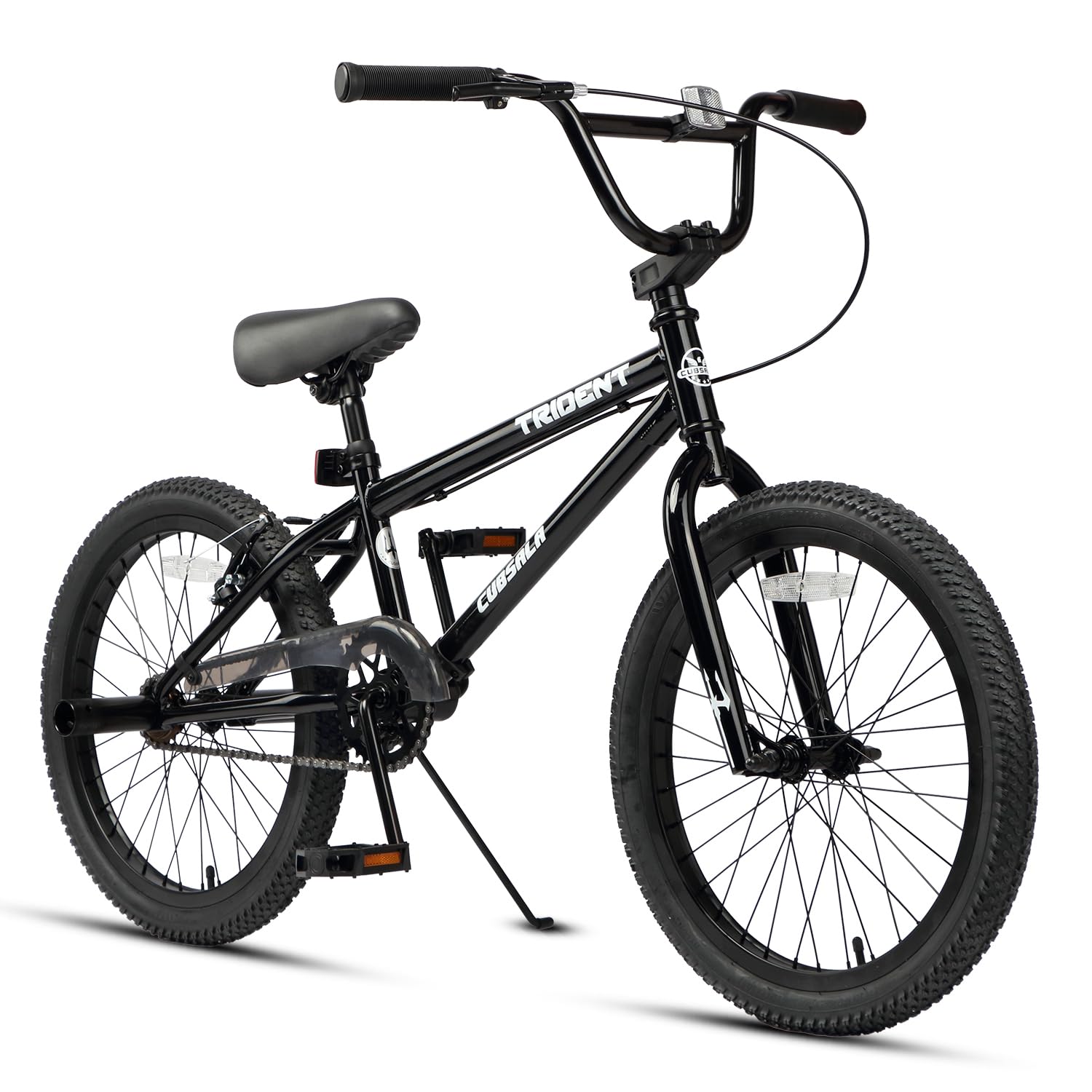
Race-inspired styling at a mid-range price that fits a wide range of heights.
The cubsala Trident is designed for versatility rather than pure freestyle. It uses a carbon steel hi-ten frame with a linear pull V-brake on the rear wheel for excellent speed control. That V-brake design is low-maintenance and easy to adjust, which matters when the bike gets ridden daily. The 20-inch wheel size fits riders from 4’0″ to 6’2″, an unusually wide range that means the bike can stay with a growing rider for years.
Does it come trick-ready? Not exactly — it includes 2 pegs, but no gyro rotor. The race-style appearance with a sleek gold look makes it stand out visually, but the single-speed drivetrain and chain drive keep the mechanical side simple. Customers note the 85% pre-assembled setup makes unboxing straightforward, with pedals and assembly tools included.
The main limitation for freestyle riders is the lack of a gyro rotor — if your child wants to learn bar spins, they would have to add a rotor or ride without a front brake. Also, the linear pull V-brake sits on the rear wheel only, so there is no front brake for extra stopping power on descents.
Strengths
- Wide height range from 4’0″ to 6’2″ fits growing kids
- Low-maintenance linear pull V-brake gives smooth stopping
- Race-inspired styling with a distinct gold frame
Weaknesses
- No gyro rotor — bar spins will tangle the cable
- Rear brake only, no front brake for extra stopping power
- Hi-ten steel frame adds weight versus lighter Chromoly options
Who it fits: a young rider who wants a sharp-looking race bike for pavement and dirt, with a height range that lets them keep the same frame for years.
Not the one for: a child who needs a gyro rotor for freestyle tricks or prefers the feel of a front-and-rear brake setup.
6. Hiland 20″ Freestyle BMX

A freestyle bundle with a gyro rotor and dual U-brakes at a mid-range price.
The Hiland packs features that usually cost more: a 360-degree gyro rotor for unlimited bar spins, a dual U-brake system (one on the front and one on the rear), and 4 pegs. The dual U-brakes give the rider independent stopping control at both wheels, which helps when balancing for manuals or rolling out of a spin. The 20×2.125-inch wide tires provide good grip even on uneven roads, according to the manufacturer.
The hi-ten steel frame and fork are rugged, and the bike comes 85% pre-assembled with tools included. The suggested rider height is 42 inches to 60 inches. The carbon steel frame (listed as such in the specs) keeps the price reasonable, but at 27 pounds, it is heavier than some competitors. That extra weight is noticeable when the rider is trying to lift the bike for bunny hops or tabletop tricks.
One buyer-reported trade-off: the steel frame is durable, but the weight can fatigue younger or smaller riders on longer sessions. Also, the 360-degree rotor adds some complexity to the brake cable routing — it is a feature that makes bar spins possible, but it also adds a potential maintenance point.
What you get
- 360-degree gyro rotor for unlimited handlebar spins
- Dual U-brakes (front and rear) for independent stopping control
- 4 pegs for grinding and trick variety
Trade-offs
- 27-pound weight makes it heavier than some youth bikes
- Gyro rotor adds complexity to the braking system
- Carbon steel frame is durable but not as light as Chromoly
Grab this if: your child wants a fully loaded freestyle setup with a gyro rotor and dual brakes without jumping to the highest price bracket.
Consider something else if: the rider is small for their age and needs a lighter bike for lifting during jumps and tricks.
7. cubsala Echo 20″
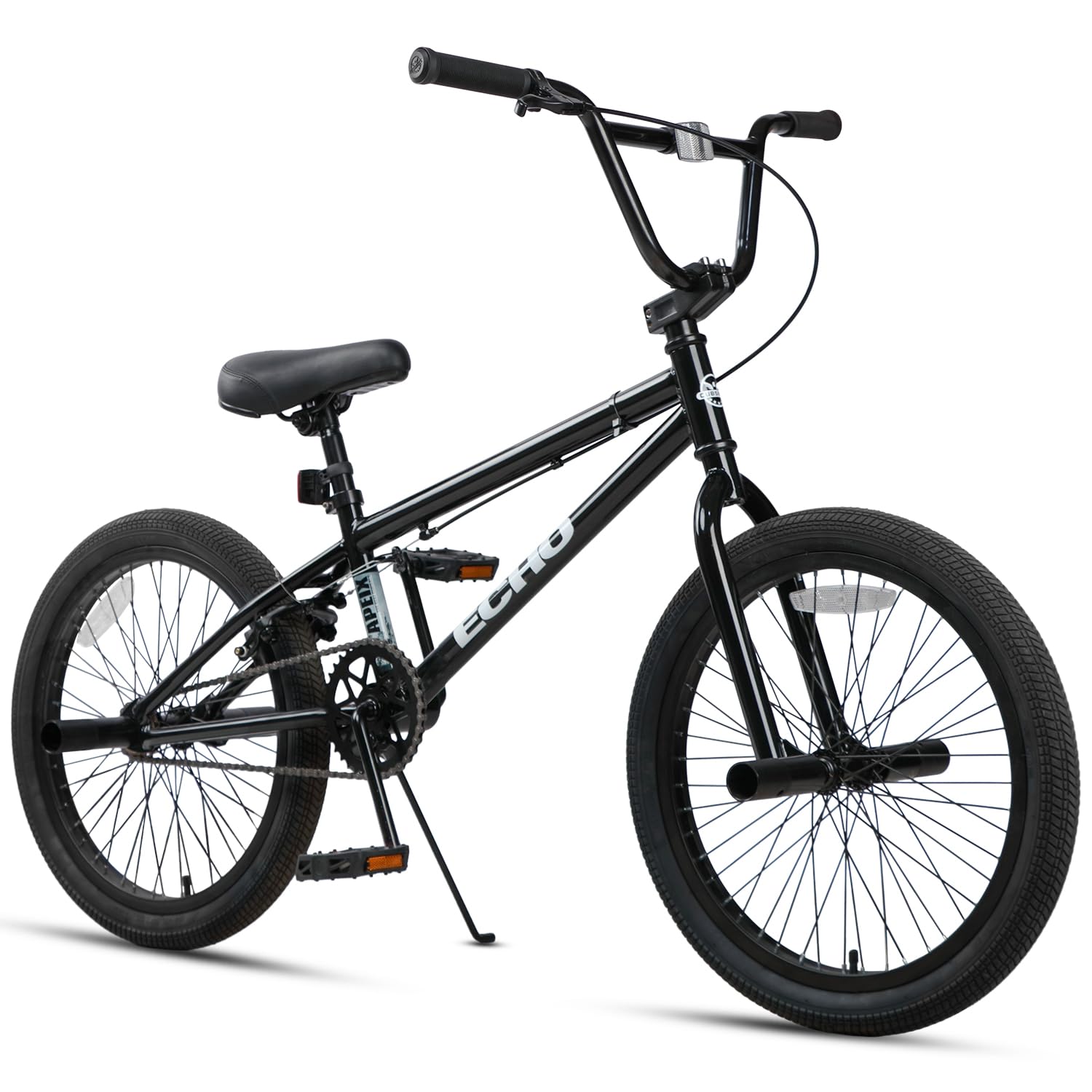
Designed specifically for kids learning BMX basics, with safety features front and center.
cubsala designed the Echo specifically for beginner riders. It uses a high tensile steel frame that the manufacturer describes as “more solid and reliable” for handling daily riding and beginner tricks. The responsive rear U-brake provides consistent stopping power with just one hand, which simplifies braking for kids who are still building coordination.
The bike comes with 4 pegs, reflectors, and a tool kit. The 85% pre-assembled build means a parent can finish setup quickly. The single-speed drivetrain removes gear-shifting complexity entirely, letting the child focus on balance and steering. The rigid suspension (no front or rear suspension) keeps the bike light and simple — no extra parts to break or maintain.
The catch is the same as many entry-level BMX bikes: the high carbon steel frame is solid but adds weight compared to more expensive models. And while the rear U-brake is effective, there is no front brake for additional stopping power on hills. Also, the bike does not include a gyro rotor, so bar spins are not possible without modification.
Safety and simplicity
- Responsive rear U-brake gives beginner-friendly one-hand stopping
- 4 pegs included for early trick exploration
- High tensile steel frame is strong and stable for learning
Limitations
- No front brake for extra stopping power on descents
- No gyro rotor — bar spins will require an upgrade
- Steel frame is durable but adds weight versus premium options
Ideal for: first-time BMX riders who need a safe, simple bike with a rear U-brake and 4 pegs for gradual progression.
Better to skip if: your child already has a gear-shifting bike and needs a front brake or gyro rotor for advanced park riding.
8. WEIZE Freestyle BMX 20″

A freestyle bundle with a 360-degree rotor and four pegs at a budget-friendly price.
The WEIZE delivers a complete freestyle package — 360-degree rotor for bar spins, 4 pegs for grinding, and linear pull V-brakes for reliable stopping power. The 170 mm one-piece forged steel cranks provide a strong connection for accelerating out of gates or pushing through a manual. The 20×2.40-inch tires are wider than many youth BMX tires, giving a cushioned ride over bumps and cracks in the pavement.
The 32T chainring paired with a 16T freewheel delivers a standard gear ratio that balances acceleration and top speed. The high carbon steel frame and fork are built for park, street, or dirt riding. The bike fits riders 4’0″ to 5’8″ in height. Shoppers say that the 85% pre-assembled state and included installation video make setup straightforward.
One trade-off: the 170 mm crank length is longer than the 165 mm crank on the JOYSTAR, which could feel slightly less comfortable for smaller riders with shorter legs. Also, the linear pull V-brake is effective but not as common on modern freestyle BMX bikes as U-brakes — replacement pads may be slightly harder to find. The freewheel hub is less durable for hard landings than a cassette hub.
Why choose it
- Complete freestyle features: 360-degree rotor and 4 pegs at a competitive price
- Wide 20×2.40-inch tires cushion impacts on rough surfaces
- 170 mm forged steel cranks provide strong pedaling platform
Shortcomings
- 170 mm crank length may feel long for smaller riders
- Freewheel hub is less durable than cassette hub for park use
- Linear pull V-brakes are less common than U-brakes on this type of bike
Pick this if: your child wants a fully loaded freestyle bike with a rotor, pegs, and wide tires at a budget-friendly price point.
Move on if: the rider has short legs and would benefit from a shorter 165 mm crank, or you prefer a cassette hub for durability.
9. KORIMEFA Freestyle BMX 20″
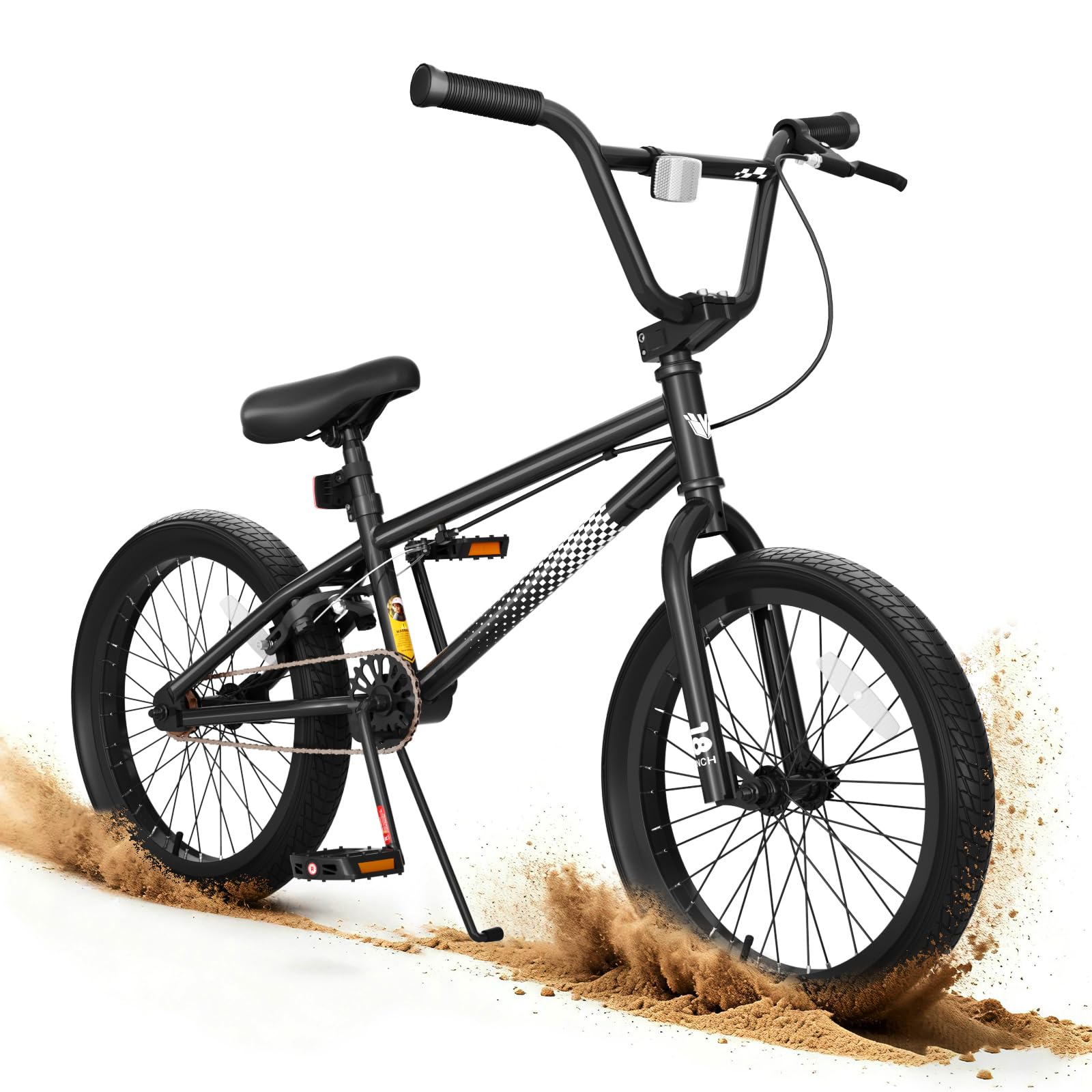
The highest-rated model here, built for beginners with room to progress.
KORIMEFA’s 20-inch freestyle BMX earns the strongest customer rating in this roundup at 4.7 out of 5 stars from 78 ratings. It is designed for riders aged 8 to 12 years and uses a high carbon steel frame with a simple rear linear pull brake, chain guard, and reflectors. The 165 mm cranks are sized for young legs — they deliver smooth power without the rider banging their knees. The 32T chainring and 16T freewheel provide smooth, direct power transmission.
The drivetrain is tune for beginners: no complicated gears to learn, just a single-speed drivetrain that lets the child focus on balance and trick progression. The bike ships 90% pre-assembled — the highest pre-assembly rate in this list — so the unboxing experience is quick. The maximum weight recommendation is 154.3 pounds, which is appropriate for the target age range.
Compared to the JOYSTAR’s 36T chainring, the KORIMEFA’s 32T is smaller, so it requires a bit more pedaling effort from a dead stop but builds better leg muscle for progressing to faster gearing. Also, the KORIMEFA does not come with pegs or a gyro rotor, so if your child wants to try bar spins or grinding right from the start, they would need to buy those extras separately.
Customer favorite
- 4.7/5 rating across 78 reviews — highest in this guide
- 90% pre-assembled for the fastest setup time
- 165 mm cranks are sized perfectly for growing riders
What it lacks
- No pegs or gyro rotor included for advanced tricks
- 32T chainring requires more pedal effort from a stop than larger chainrings
- 154.3-pound weight limit is lower than some competitors
Best for: beginner to intermediate riders who want the highest-rated, easiest-to-assemble BMX with a fit that supports smooth progression to intermediate riding.
Not ideal for: a rider who wants pegs and a gyro rotor included in the box, or a heavier teen near the 154.3-pound maximum limit.
Understanding the Specs
Frame material
The frame material determines how much the BMX weighs and how long it lasts. Hi-tensile (hi-ten) steel is the most common and most affordable — it is strong but heavy, which can make lifting the bike for tricks harder for smaller riders. Chromoly (chromium-molybdenum) steel is lighter and stronger, but it is usually reserved for higher-priced models. Alloy steel is another name sometimes used for a steel alloy that may be similar to hi-ten. Always check the manufacturer’s description to see if the frame is hi-ten or Chromoly.
Crank length and gearing
Crank length (measured in millimeters, like 165 mm or 170 mm) affects how comfortable the pedal stroke feels for the rider. Shorter cranks (152 mm or 165 mm) suit younger riders better because they reduce the chance of hitting the knees on the handlebar. The chainring size (measured in teeth, like 32T or 36T) and freewheel/cog size (like 16T or 18T) determine how easy it is to accelerate. A larger chainring (e.g. 36T) makes starting from a stop easier, which is helpful for beginners.
Brake types
Youth BMX bikes use three main brake styles: U-brakes, linear pull V-brakes, and caliper brakes. U-brakes are the most common on freestyle bikes because they provide strong stopping power and a clean, snag-free design. Linear pull V-brakes offer good modulation and are easy to maintain. Caliper brakes are simpler and lighter but offer less stopping power than U-brakes. A gyro rotor (a rotating cable splitter) allows the handlebars to spin 360 degrees without tangling the brake cable, which is necessary for bar spins.
Hub type: freewheel vs cassette
The rear hub type affects how the bike coasts and how durable it is. A freewheel hub has the gearing built into the freewheel body that screws onto the hub; it is simpler and cheaper but can be less durable for hard landings. A cassette hub has the gearing integrated into the hub shell itself — it is stronger, allows the bike to coast more smoothly, and is the standard on higher-end BMX bikes. Cassette hubs also let the rider run a smaller rear cog for a faster top speed.
FAQ
What size BMX bike does my child need?
Is hi-tensile steel frame bad for a young rider?
Do I need a gyro rotor for my child’s BMX bike?
How many pegs should I get?
What is the difference between a caliper brake and a U-brake?
Can a 10-year-old ride a 20-inch BMX bike?
Is single-speed drivetrain good for a kid?
How much assembly do most BMX bikes require?
What is the maximum weight limit for a youth BMX bike?
Should I buy a 20-inch or 24-inch BMX for my teenager?
Final Thoughts: The Verdict
For most buyers, the bmx bikes for youth winner is the Eastern Bikes Lowdown because its 3-piece Chromoly cranks and sealed hubs deliver professional-level durability for aggressive young riders. If you want a bike with a gyro rotor and dual brakes for freestyle fun, grab the Hiland 20″ Freestyle. And for a beginner who needs a simple, high-rated, easy-to-assemble BMX with a proven track record, the standout is the KORIMEFA Freestyle 20″.
How We Picked
We do not accept paid placement. Every pick is matched to a real buyer and a real use-case; we do not hands-on test units.
Sources & Methodology
Specifications: manufacturer listings and product documentation. Review insights: verified customer reviews, as of July 2026. Pricing: not shown on this page (it changes often); check the current price via the retailer link.
As an Amazon Associate, Gadgets Feed earns from qualifying purchases. This does not affect which products we feature.