
Our readers keep the lights on and my morning glass full of iced black tea. As an Amazon Associate, I earn from qualifying purchases.
Specs are compiled from manufacturer listings and verified buyer reviews and can change over time — please confirm the key details on the product page before buying.
At four years old, a board game is less about winning and more about the magic of taking turns, rolling a die, and watching something pop or hop. The best picks for this age skip reading and complex rules entirely, leaning into color matching, fine motor skills, and cooperative play where everyone cheers together.
I’m Min — the founder and writer behind Gadgets Feed. This guide is built by comparing the manufacturers’ published specifications and the patterns across verified customer reviews, so you get each pick’s real strengths and trade-offs instead of marketing spin.
For a first family game night or a preschooler’s gift, these board games for 4 year olds keep rounds short (about 10 minutes each) and pieces tough enough for little hands, so your child stays engaged without losing interest.
Our Picks at a Glance


How To Choose The Best Board Games For 4 Year Olds
At four, kids are just learning how to follow simple rules, wait for their turn, and handle a loss. The right game turns those early skills into pure fun, while the wrong one ends in tears and a flipped board.
Prioritize cooperative or non-competitive play
Games where everyone works toward a shared goal, like racing all the wooden snails to the finish or catching a fox together, remove the sting of losing. This builds confidence and keeps the mood light, which is exactly what makes a game get requested again and again.
Check the physical skills required
A four-year-old’s hands are still developing. Look for games that use squeezers, tongs, or simple dice rolling, which build dexterity naturally. Avoid games with tiny pieces that require precise placement, or you will spend the whole session helping instead of playing.
Match the game to the attention span
Short rounds are everything at this age. A game that finishes in 15 minutes feels like a victory, while a 40-minute epic will lose them halfway through. Games with a strong visual payoff, like a pirate that pops or bugs that bounce, keep focus locked in until the very end.
Quick Comparison
| Model | Best For | Players | Play Time | Key Skill | Amazon |
|---|---|---|---|---|---|
| ThinkFun Zingo Bingo★ Best Overall | Word & matching fun | Up to 7 | Fast-paced | Language & matching | Amazon |
| TOMY Pop Up PirateClassic Choice | Suspenseful family nights | 2–4 | Quick rounds | Fine motor & strategy | Amazon |
| Hasbro Bed BugsActive Play | High-energy bug catching | 2–3 | 20 minutes | Hand-eye coordination | Amazon |
| Hasbro Clue Junior | Growing deductive minds | 2–6 | 15–20 minutes | Logic & deduction | Amazon |
| Nat Geo My First Safari | Cooperative animal adventure | 2+ | Short rounds | Teamwork & strategy | Amazon |
| Ravensburger Snail’s Pace | Gentle first game | 2–6 | 15 minutes | Colors & counting | Amazon |
| WhimsiPlay Montessori Sticks | Fine motor & counting | 1–6 | Varies | Strategy & motor skills | Amazon |
| Sneaky Snacky Squirrel | Color matching with tweezers | 2–4 | 5–10 minutes | Fine motor & colors | Amazon |
| Gamewright Outfoxed | Cooperative whodunit | 2–4 | 20 minutes | Deduction & teamwork | Amazon |
In‑Depth Reviews
1. ThinkFun Zingo Bingo Award Winning Preschool Game
Our pick — over 4.5★ from 17,000+ verified ratings; the strongest balance of quality and price.
The beloved crowd-pleaser that turns sight words into a fast, suspenseful tile-snapping race.
Zingo earns its spot because it turns bingo into a fast, tactile game: a Zinger device (a plastic dispenser that pops out two picture tiles at a time) slides out tiles, and the first player to match them to their card shouts it out. That mechanical pop keeps kids hooked, while the matching practice builds vocabulary and observation skills. The newest edition adds an extra Zingo card, so up to 7 players can join one game — ideal for a big family or a preschool classroom. Buyers report that even adults enjoy the satisfying click of the Zinger, making it a rare game that bridges ages.
The learning payoff is why teachers stock it. It builds language and matching skills in preschool kids through fast-paced play, with 72 double-sided tiles that keep the vocabulary fresh. Owners specifically point out that the game helped a 4-year-old with hand coordination, focus, and recognizing the pieces, and the durability is a recurring theme — it survives years of play without broken parts or bent cards.
The one logistical quirk comes from the Zinger itself: some families set unused plastic tiles aside near the tray because opening the holder after every slide slows the pace. It is a minor friction in an otherwise beloved game that has become a birthday-gift staple for good reason.
Why it wins at game night
- Fast-paced gameplay is the number one thing owners praise, with hundreds calling it out
- Grows with the child — two levels of play on double-sided cards
- Two-sided tiles offer 72 pieces of replayable vocabulary fun
Small frictions
- The Zinger tile holder is awkward to reopen mid-game for some families
- Too simple for kids much older than 7
Reach for it if: you want one game that works for a 4-year-old, a classroom group, and a family with kids spread across different ages.
Look elsewhere if: you want a purely physical or active game — Zingo is a sit-still matching race, not a movement game.
2. TOMY Pop Up Pirate Family Action Game
A barrel of nerve-jangling suspense where a plastic pirate springs sky-high and someone always shrieks with delight.
Pop Up Pirate is the fizziest kind of suspense a 4-year-old can handle. Pirate Pete hides in his brown barrel, and players take turns sliding one of 24 colorful swords into the slots. Nobody knows which slot launches him, so every game delivers a different jolt, and the last surviving player wins. The genius is the tension: kids go quiet, lean in, and then explode with laughter when Pete goes flying.
For a game this simple, the play value is enormous. Owners consistently call it age-appropriate for a 4-year-old, with no assembly required — just pop the swords out of the plastic and start. It is a classic rerelease with themed versions available, and it runs on zero batteries, which makes it a reliable travel or camping companion that grandparents can enjoy too.
The honest trade-offs are the recurring themes. The pirate insertion needs notch alignment — twist him to lock him in — and the pop mechanism can occasionally jam, requiring a wiggle of each sword to trigger it. Storage is also tight: the barrel won’t fit back in the box if you leave the swords inside.
Built for giggles: Fun is overwhelmingly what buyers talk about with this one, and the age-appropriateness earns the second-most praise.
The catch: the pop-up function is occasionally finicky, per recurring owner notes, so treat the mechanism gently.
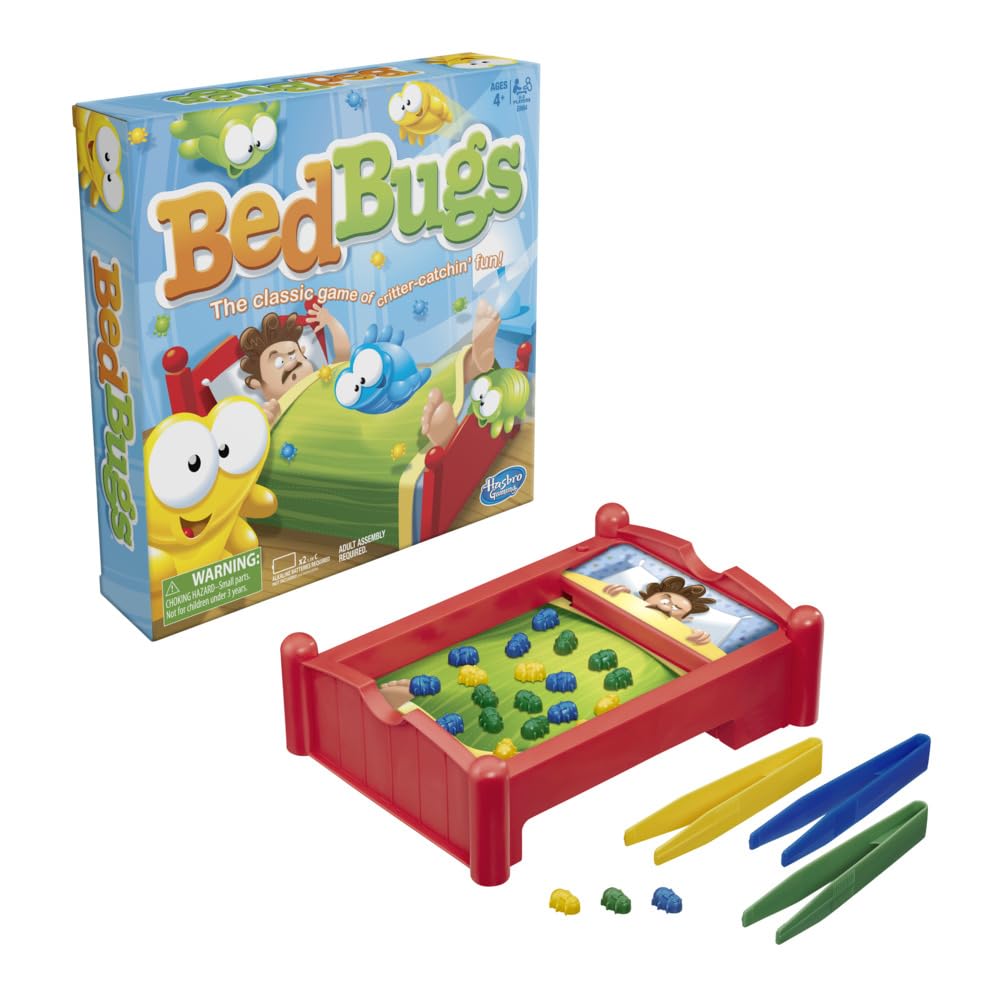
3. Hasbro Gaming Bed Bugs Board Game
A vibrating bed makes plastic bugs hop wildly while kids scramble with tongs to catch their color first.
Bed Bugs turns the board game into pure reflex chaos. The motorized gameboard “bed” vibrates, sending 36 plastic bugs bouncing across the surface, and each player uses one of three colored tongs — blue, yellow, or green — to snatch up all the bugs of their matching color. The first to clear their color wins, and it is as frantic and giggly as it sounds.
The educational upside is real and specific. Beyond the fun, it develops color recognition, hand-eye coordination, and quick thinking, which is exactly the mix a 4-year-old’s brain is ready for. Play sessions run about 20 minutes, and owners note it survives rough handling by 4- and 6-year-olds, which is the highest compliment a preschool toy can earn.
The drawbacks are worth knowing. The board stops vibrating if you press down on it too hard, which can stall the action mid-round. And while the box dimensions are compact at 2.5 x 10.5 x 10.5 inches, the overall footprint reads small to some buyers. Repetitive play is the other note — the single catch-and-match loop can lose steam after extended sessions.
Chaos with a purpose: gameplay is the top thing owners praise, with the easy set-up and hand-coordination benefits close behind.
Who it’s not for: only-child households, since it needs 2 to 3 players to really shine.
4. Hasbro Gaming Clue Junior Board Game

A double-sided mystery game that starts as a friendly playground search and flips into a real whodunit as kids age.
Clue Junior solves the “my kid outgrew it in a month” problem with a clever two-sided gameboard. Level 1, the Playground Mix-up, is a cooperative game where a character mistakenly packed an item in their backpack and everyone teams up to hunt picture clues and deduce what is missing. Flip the board for Level 2, the Science Lab Mystery, where a volcano has erupted and kids race to solve the who, what, and where in proper Clue fashion.
This is the game that grows from ages 4 to 7 and beyond. The level 1 game runs about 15-20 minutes, perfect for a preschooler’s stamina, and the collaborative format means no sore losers. As an entry point to the iconic mystery franchise, it teaches logical deduction without the reading load — picture clues do the heavy lifting.
The early rounds need a guiding hand. Some families find the directions unclear on first read, and a 4-year-old will need an adult or older sibling to walk them through the deduction concept initially. It is also a game with many small components — pawns, tokens, bases, and dice — so the 1.63 x 13.13 x 10.5 inch box demands careful setup and cleanup.
Two games in one: the reversible board is the standout feature, letting the difficulty scale with your child’s skills.
Plan for a learning curve: gameplay is praised highly, but expect to coach the rules for the first session or two.
5. National Geographic My First Safari Cooperative Board Game

A team race to spot every safari animal before the sun sets, where nobody owns a pawn and everybody wins together.
My First Safari flips the competitive script entirely. Players work together to move all 5 safari explorers across the board and see every animal before the “Sun” cards run out. You do not own a playing piece — the goal is getting ALL pieces to the end, which makes it a pure exercise in cooperation and shared strategy rather than any single winner.
The educational layer is deep for a preschool game. It teaches social skills, strategic thinking, and teamwork, and it grows with the child through three difficulty levels. The included full-color Learning Guide is packed with facts about all 21 featured animals — elephants, cheetahs, giraffes, gorillas, and more — so game night slides naturally into a nature lesson.
Owners love the collaborative feel, but the setup physically is the weak spot. The little explorer characters are notoriously hard to press into their stands, with some almost ruined in the attempt. The instructions also drew mixed feedback, with several families wishing the rules were clearer on first read.
The team-spirit payoff
- Cooperative play teaches decision-making and strategy with zero loser tears
- Three difficulty levels extend the game’s lifespan significantly
- The 21-animal Learning Guide adds real educational depth
Assembly friction
- The explorer stands are very hard to push together without bending pieces
- Instructions left several families wanting clearer guidance
Best for: families who want a gentle, no-competition game that also sneaks in animal facts and teamwork lessons.
Think twice if: you want a game your child can fully set up alone — the character stands will need an adult’s hands.
6. Ravensburger Snail’s Pace Race Game

Six adorable wooden snails race to the finish while everyone wins, making it the perfect introduction to board games.
Snail’s Pace Race is the benchmark for a first-ever board game because it has no reading and no losing. It comes with 6 wooden snails, 2 colored dice, and a simple board: roll the dice, move the matching colored snail forward one space, and repeat until all 6 snails cross the line. Since every snail finishes, there is no single winner — just a shared celebration, which is perfect for a 4-year-old who is not ready for competition. skip it if your child already understands winning and losing; they may find the cooperative ending too tame compared to Zingo’s fast-paced matching.
The award-winning design (it holds the Parent’s Choice Gold Seal Award) shines in its gentle pacing. A full game wraps in about 15 minutes, which is the ideal length for a 3- or 4-year-old attention span. It teaches turn-taking, patience, counting, and color-matching, all through dice control that feels empowering rather than instructional. The wooden pieces are well-made and bright, built to survive eager little hands.
The charm is durable but the drama is low. Unlike pop-up or bouncing games, there is no surprise mechanic here — it is a predictably sweet race, which some high-energy kids might find too calm. The one practical gripe from owners is shipping damage: a few boxes arrived dented with sticky label residue, which is frustrating when it is a gift.
The gold standard intro: game quality is the most-praised aspect, with the age-appropriateness earning the second-most mentions from owners.
Who it’s perfect for: the shy kid or the anxious kid who needs a win without the pressure of losing.
7. WhimsiPlay Montessori Wooden Board Game
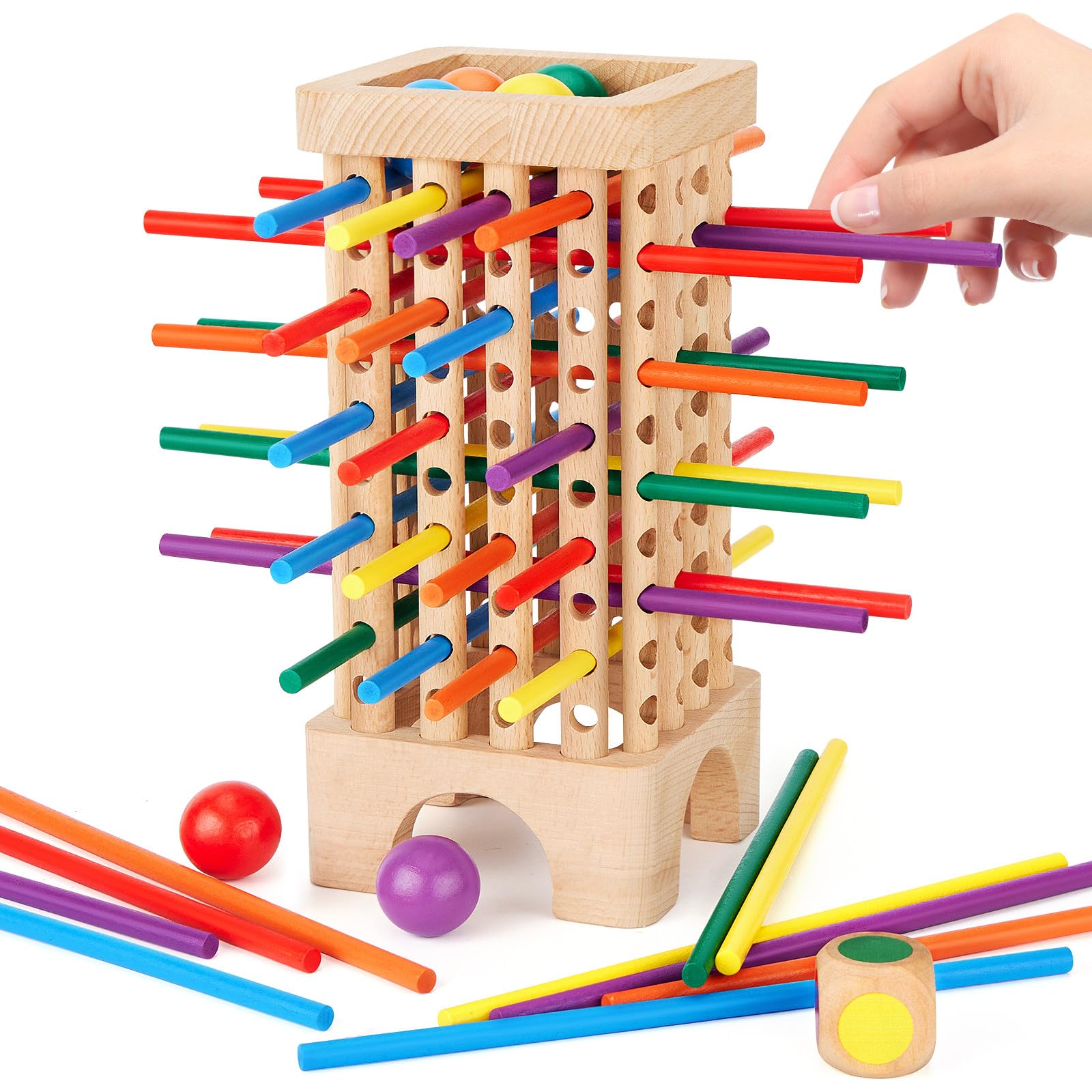
A Pisa-tower-inspired wooden puzzle that tests steady hands and strategy with every colored stick you dare to pull.
This wooden game reimagines the classic Kerplunk format with a Leaning Tower of Pisa twist. Players weave a net of 42 colorful sticks through the tower, balance a wooden ball on top, then take turns rolling a dice to see which color stick to remove. Pull the wrong one and the ball drops — the player who drops the fewest balls wins.
The Montessori pedigree shows in the materials and the skills it builds. It is crafted from premium beech wood with a non-toxic, water-based paint, so it is splinter-free and safe for small hands. As kids strategize which stick to remove without dropping the ball, they exercise logical thinking, hand-eye coordination, and visual-spatial skills, plus patience and concentration.
The setup is the polarizing part. Some owners call it a breezy 2-minute assembly, while others find the stick alignment through the holes slow and fiddly, with sticks falling out if the tower tilts. It arrives with a drawstring pouch for tidy storage, and it works for 1 to 6 players, which makes it surprisingly versatile for solo practice or big family gatherings.
The steady-hand payoff
- Durable beech wood construction with a smooth, splinter-free surface
- Teaches colors, counting, and turn-taking in one compact travel-friendly set
- Plays solo or with up to 6 players, thanks to the included 6 balls
Patience required
- The stick-threading setup drew mixed reviews — it can be slow for impatient kids
- The tower tilts easily, which dislodges sticks if you bump it
Best suited to: kids who love building and tinkering — the assembly is half the fun for them, and gameplay is what owners praise most.
pass on it if: your child has little patience for setup and just wants instant action.
8. Educational Insights The Sneaky, Snacky Squirrel Game

A squeezer-tong squirrel game where kids pinch their way to color-matching glory, one acorn at a time.
Sneaky Snacky Squirrel is the gold standard for fine motor skill development disguised as pure fun. Players spin the spinner, then use the adorable Squirrel Squeezer to pick up the matching colored acorn and drop it into their log. But the spinner can also trigger a windstorm that steals acorns, or an opponent who snatches them away, keeping every round full of giggles and suspense.
The motor skill payoff is immediate and visible. The squeezer action strengthens the same hand muscles kids need for pencil grip, while the color matching and turn-taking build cognitive and social skills. The tree-shaped game board doubles as the box, so cleanup is as simple as dropping the 20 acorns back in and closing the lid — a detail parents genuinely appreciate.
Owners note how quickly kids pick it up, with 3-year-olds mastering the spinner and squeezer in a single sitting. The 5-10 minute rounds are ideal for short attention spans, and the pieces are durable enough for repeat play.
What everyone raves about: the gameplay leads the praise by a wide margin — owners consistently highlight simplicity and the squeezer mechanic as the winning combination.
A final note: it is ideal for ages 3-4, but a 6- or 7-year-old will likely find the challenge too easy.
9. Gamewright Outfoxed Cooperative Whodunit Game

A family detective team races to crack the case and catch the sneaky fox before it escapes into the night.
Outfoxed delivers real mystery-solving logic without a single reader requirement. Players work as a team to catch a sneaky fox who swiped a pot pie, rolling dice to move around the board, collecting clue cards, and using a special decoder to eliminate suspects. The twist? The fox is also moving toward the exit, so there is genuine time pressure that keeps kids engaged without any losing side.
The deduction engine is remarkable for the age group. Kids use the decoder to reveal suspect features — coat color, eyewear, accessories — and methodically eliminate who could not have done it. This builds logic, memory, and visual discrimination in a way that feels like a game, not a lesson. The cooperative format means no sore losers, and the 20-minute playtime fits neatly into a family evening.
Owners consistently call it a top-5 game in their house, enjoyed by kids as young as 4 and as old as 9, and often enjoyed by adults just as much. It is well-made with minimal pieces, which speeds setup and cleanup. The only real caution is the listed age of 5 years — a 4-year-old will pick up the dice-rolling but may need help with the deduction step initially.
The deduction payoff
- Teaches genuine logical elimination through hands-on clue-solving
- Cooperative play means zero loser tears and real teamwork
- Quick 20-minute rounds that work for anxious or easily frustrated kids
Age reality check
- Officially rated for 5 years, so a 4-year-old will need guidance on the clue elimination
- The mystery may feel repetitive once the fox patterns become familiar
The standout: gameplay is the most-praised aspect by a wide margin, with game quality and family-friendliness close behind — a genuine all-ages crowd-pleaser.
Consider carefully if: your child is exactly 4 and you want zero coaching; this one is best for a 4.5-year-old and up.
Understanding the Specs
Cooperative vs. Competitive Mechanics
Cooperative games have all players working toward a shared goal, so everyone either wins together or loses together as a team. Competitive games have a single winner. For a 4-year-old, cooperative play removes the sting of losing and builds confidence, which is why several of these picks — like Snail’s Pace and Outfoxed — explicitly avoid declaring a single victor.
Fine Motor Skill Demands
This is the hidden spec that determines whether a game frustrates or delights. Games using squeezers, tongs, or simple dice rolling build the hand muscles kids need for writing. Games requiring precise stick placement or tiny piece handling can overwhelm a 4-year-old’s developing dexterity and turn game night into a parent-helping session.
FAQ
Are cooperative board games really better for a 4 year old?
How long should a board game for a 4 year old last?
Can a 4 year old play a game meant for 3 year olds?
What is the difference between a competitive and a cooperative game?
Is Zingo just bingo or does it teach something?
Which game is best for a child who hates losing?
How many players do these preschool games need?
Are the pieces in these games safe for a 4 year old?
Final Thoughts: The Verdict
For most families, the board games for 4 year olds winner is the ThinkFun Zingo Bingo because its fast-paced matching gameplay, durable pieces, and true educational depth make it the crowd favorite with thousands of happy owners. If you want a gentle, no-pressure first game, grab the Ravensburger Snail’s Pace Race. And for a high-energy family night full of suspense, the TOMY Pop Up Pirate is the one to reach for.
How We Picked
We do not accept paid placement. Every pick is matched to a real buyer and a real use-case; we do not hands-on test units.
Sources & Methodology
Specifications: manufacturer listings and product documentation. Review insights: verified customer reviews, as of August 2026. Pricing: not shown on this page (it changes often); check the current price via the retailer link.
As an Amazon Associate, Gadgets Feed earns from qualifying purchases. This does not affect which products we feature.