
Finding a board game that actually holds the attention of a 6- to 8-year-old is a different kind of puzzle. At this age, kids are reading confidently, solving multi-step problems, and starting to enjoy a little friendly competition—but they still need immediate gratification and rules that click within the first minute. A game that drags or feels too babyish gets abandoned after one round; one that challenges just enough becomes the nightly request.
I’m Rikta — the co-founder and writer behind Gadgets Feed. I’ve spent years analyzing how game mechanics and component quality affect engagement for early-elementary children, from spatial reasoning puzzles to cooperative strategy and early literacy builders. (And Homer 🐱 supervised the unboxing from his usual perch on the warm game-box stack).
The board games on this list were selected after studying materials, age recommendations, playtime length, and what real families actually say works at home. Whether you need a gift, a family-night anchor, or a stealth learning tool, board games for 6-8 year olds at this level reward short attention spans with big laughs and genuine replay value.
How To Choose The Best Board Games For 6-8 Year Olds
A 6-year-old and an 8-year-old are in very different skill bands. The sweet-spot game works for both ends of that range without frustrating one or boring the other. Focus on these three factors.
Playtime Length vs. Attention Span
Games that run 15 to 30 minutes are ideal. Anything much longer and you lose the 6-year-old; anything shorter and the 8-year-old feels unsatisfied. Look for estimated playtimes on the box or in the specs—this single number predicts whether the game will actually hit the table again.
Reading and Math Load
Many games for this age range are labeled “no reading required,” which opens them up to the full 6–8 spectrum. If a game does involve text, check whether the vocabulary matches an early reader (simple sight words) or a confident second-grader. The same applies to math: single-digit addition and subtraction are perfect; multiplication is too advanced for most.
Cooperative vs. Competitive Flow
At ages 6–8, losing gracefully is still a developing skill. Cooperative games—where everyone wins or loses together—remove the sting and encourage teamwork. Competitive games with quick rounds and low-stakes outcomes also work well. Avoid elimination-style mechanics that leave one child sitting out for the rest of the game.
Quick Comparison
On smaller screens, swipe sideways to see the full table.
| Model | Category | Best For | Key Spec | Amazon |
|---|---|---|---|---|
| Cascadia Junior | Pattern Matching | Spatial & strategy beginners | 15–30 min playtime | Amazon |
| Castle Panic 2nd Edition | Cooperative Defense | Teamwork & tower defense | 1–6 player count | Amazon |
| Peaceable Kingdom Space Escape | Cooperative | High-energy teamwork | No reading required | Amazon |
| Clever Fox Play Number Hunter | Math Practice | Addition & subtraction practice | 50 challenge cards | Amazon |
| Spin Master Games Tetris | Spatial Puzzle | Tabletop Tetris fans | 128 Tetrimino pieces | Amazon |
| Hasbro Gaming Operation | Dexterity | Fine motor skill practice | 12 plastic ailments | Amazon |
| Wordplay for Kids | Vocabulary | Word-building & spelling | 60-second timer | Amazon |
In‑Depth Reviews
1. AEG & Flatout Games Cascadia Junior

Cascadia Junior takes the award-winning spatial puzzle of its parent game and strips it down to a 15–30 minute experience that a 6-year-old can grasp. Players place hexagonal habitat tiles and animal tokens to match patterns—like pairing a bear tile with a forest or a salmon with a river. The “Advanced Mode” adds a layer of scoring complexity for when the 8-year-old wants more depth, making this a game that grows with the child rather than gathering dust after two plays.
The components are thick cardboard with a premium matte finish, and the color palette is vibrant without being garish. Because it is a tile-laying game, every round feels different; there is no fixed board, so replayability is genuinely high. Parents report that the mechanic of pattern matching teaches strategic decision-making without the child even realizing they are learning.
The included cards and tokens are clearly illustrated, and the rulebook uses large type and simple diagrams so an early reader can follow along with minimal help. At roughly 20 minutes per game, it fits perfectly into a weeknight schedule without dragging.
Why it’s great
- Excellent stepping stone from casual play to strategy
- Gorgeous, durable components that survive drops
- Adult-friendly enough for parents to genuinely enjoy
Good to know
- Pieces are cardboard, not wood, which some buyers prefer
- Only 2–4 players, not ideal for larger groups
2. Fireside Games Castle Panic 2nd Edition

Castle Panic is a cooperative tower-defense game where players trade cards and coordinate to stop monsters from destroying Castle Bravehold. The 2nd Edition includes 3D plastic towers and vibrant monster tokens that immediately capture attention. The core mechanic is simple: draw a monster card, place the monster on the board, and use your hand of cards to fight it off before it reaches your walls. Every player is on the same team, which eliminates the sting of losing.
The game supports 1–6 players, which makes it unusually flexible for a family game—a solo mode exists for the child who wants to play alone, and an Overlord mode lets one player control all the monsters. The 45-minute playtime is on the longer side for this age group, but the cooperative tension keeps most 7- and 8-year-olds engaged through the final siege.
Multiple difficulty modes and expansion compatibility mean this game can stay relevant for years. The card-trading mechanic introduces light resource management and forced negotiation, which builds communication skills in a natural, unforced way.
Why it’s great
- Fully cooperative—no winner or loser, just team victory
- High player count range works for playdates and family gatherings
- 3D towers add tactile excitement to the board
Good to know
- 45-minute rounds may be too long for some 6-year-olds
- Rated 8+; younger children need moderate adult guidance
3. Peaceable Kingdom Space Escape

Space Escape is a cooperative game from Peaceable Kingdom designed by the inventor of Pandemic. The premise is charming: a team of Mole Rats must gather their equipment and reach an escape pod before snakes overrun the space station. Every card drawn gives two actions—one for your team, one for the snakes—forcing players to prioritize and negotiate who moves where. There is no reading required, which makes it accessible to the full 6–8 range.
The game board is colorful and intuitive, with clear paths and equipment tokens. The “challenge game” variant included in the instructions adds extra difficulty for experienced players. Parents report that the cooperative dynamic encourages even reluctant participants to speak up and contribute, and the built-in time pressure (the snake deck runs out quickly) adds just enough urgency without causing tears.
At roughly 20–30 minutes per game, it hits the optimal playtime window for this age group. The components are sturdy and the box design includes a tidy insert for storage, which matters when you are stuffing it back on a shelf after family game night.
Why it’s great
- Zero reading required—accessible to pre-readers
- Encourages shared decision-making and communication
- High replay value due to randomized snake movement
Good to know
- Winning is genuinely difficult (around 1 in 4 games)
- Theme may feel slightly young for an 8-year-old gamer
4. Clever Fox Play Number Hunter Math Board Game
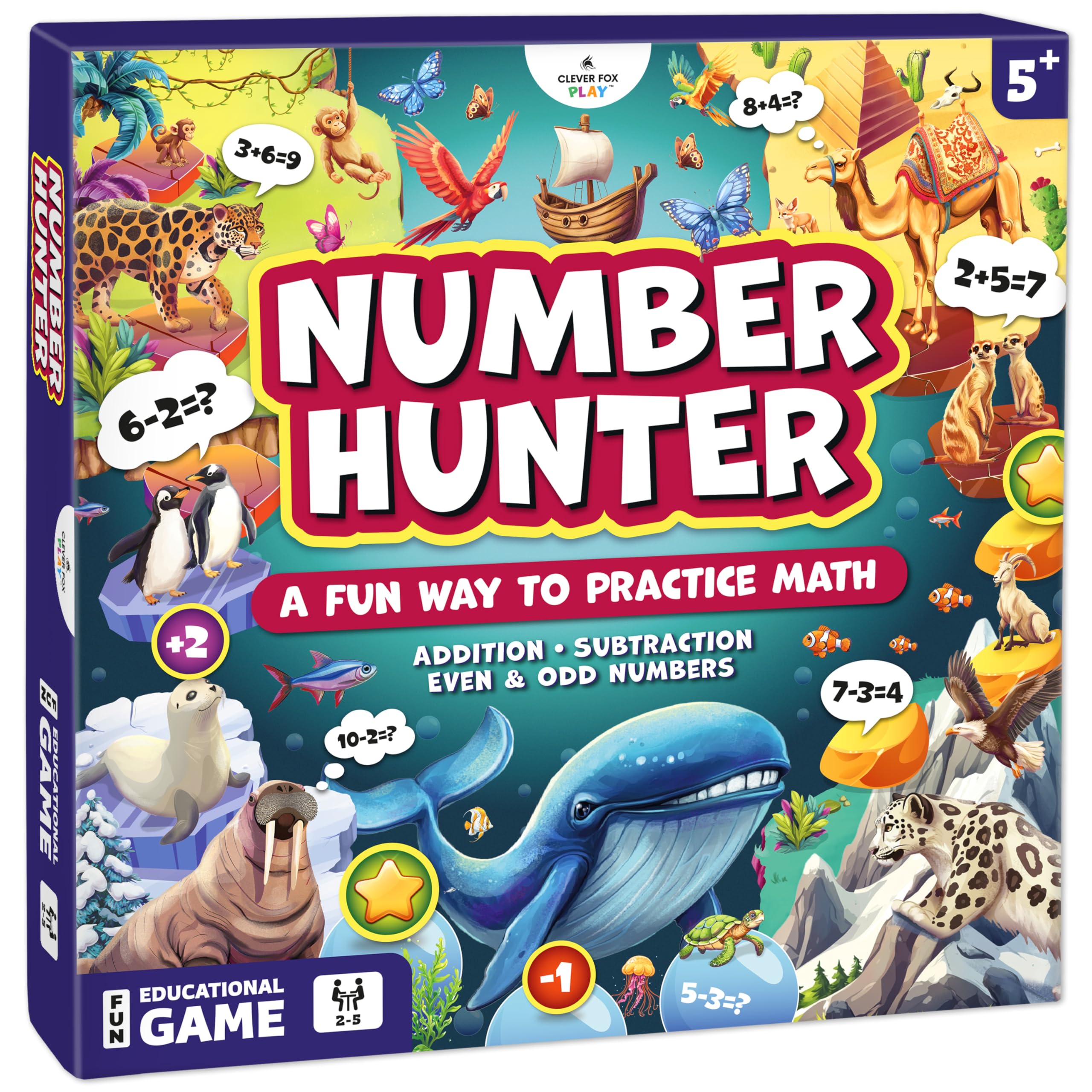
Number Hunter turns math practice into a race around the world. Players roll two number dice and one operation die to add or subtract, then move their piece along the board. Landing on a star tile triggers a challenge card that might ask for a quick calculation, a physical action like hopping on one leg, or an odd/even identification. The game is explicitly designed for children ages 5–7, which aligns perfectly with the lower half of our target range.
The kit includes a game board, five game pieces, two number dice, one operation die, and 50 challenge cards. The cards require reading, so a 6-year-old may need an adult or older sibling to read them aloud—but the 8-year-old can handle them independently. The math is single-digit addition and subtraction only, which matches typical kindergarten through first-grade curriculum.
Parents and teachers report that the active elements (hopping, balancing) break up the sitting-still time and keep kinetic learners engaged. The reinforced box and thick card stock hold up well to repeated use, and the game’s focus on even/odd introduces a concept that many classroom teachers are covering at this exact age.
Why it’s great
- Stealth math practice that feels like a race, not a lesson
- Active movement challenges suit high-energy kids
- Durable, non-toxic materials withstand enthusiastic play
Good to know
- Challenge cards need adult reading help for younger kids
- Math range (single-digit) is too basic for advanced 8-year-olds
5. Spin Master Games Tetris: The Board Game
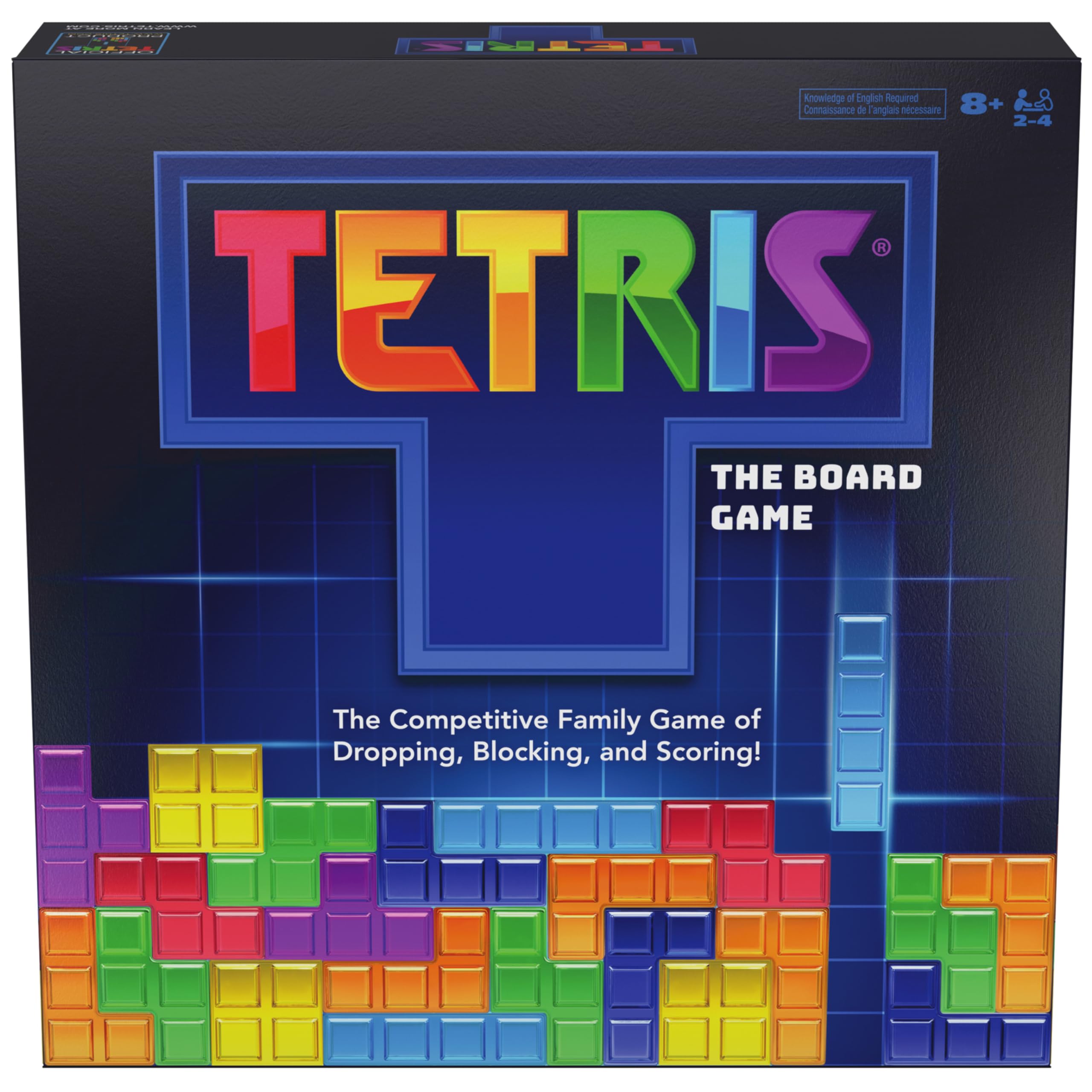
This tabletop adaptation of the iconic video game translates digital piece-dropping into a physical 2–4 player head-to-head challenge. Each player has their own grid and a supply of semi-translucent Tetriminos. The goal is to complete full lines and use “Garbage Drop” spaces to send blocking pieces into opponents’ grids. The game includes 128 Tetriminos and 24 Tetrimino cards, giving each player a randomized hand of shapes to work with.
The physical nature of rotating and placing actual pieces adds a tactile layer the video game cannot replicate. The blocking mechanic introduces a direct competitive element that 8-year-olds in particular enjoy, though it can frustrate a 6-year-old who is still learning spatial relationships. The estimated playtime is just 20 minutes, which keeps the competitive friction from overstaying its welcome.
Customer feedback highlights the clever translation of digital mechanics to analog—the pieces are colorful and grid fits snugly. Some users reported warped pieces in their units, but overall the components are durable enough for regular use. This game is best for the older end of the 6–8 range.
Why it’s great
- Brilliant physical adaptation of a beloved digital puzzle
- Fast 20-minute rounds prevent boredom
- Teaches spatial reasoning and blocking strategy
Good to know
- Rated 8+; 6-year-olds may find piece rotation challenging
- Some reported quality inconsistencies (bent pieces)
6. Hasbro Gaming Operation Electronic Board Game

Operation is a dexterity game where players use tweezers to remove plastic “ailments” from Cavity Sam’s body without touching the metal edges. Touch the edge, and the buzzer sounds while his nose lights up red. The game includes 12 ailments, a pair of tweezers, and doctor cards that assign each player specific pieces to remove. It supports solo play, which is rare among board games and useful for quiet independent play.
The core skill here is fine motor control—steady hands and careful pressure. The unpredictability of the buzzer creates genuine suspense and laughter. Rounds last roughly 10–15 minutes, making Operation one of the quickest games on this list. The money-collecting mechanic (each successful removal earns cash) adds a light counting element that fits the 6–8 math range.
Long-term durability is the main concern. The plastic components have gotten thinner over the years, and the game requires two AA batteries for the buzzer and light. Despite this, the game’s reputation as a childhood staple means it remains a reliable crowd-pleaser for playdates and rainy days.
Why it’s great
- Builds fine motor control and steady-hand precision
- Solo mode works for independent play
- Short rounds allow multiple plays in one sitting
Good to know
- Plastic components feel less durable than older editions
- Batteries drain quickly; keep spares handy
7. Wordplay for Kids

Wordplay for Kids is a fast-paced word game that spins a wheel for two letters and a die for a category—Food or Drink, Object or Thing, Living Creature, Boy’s or Girl’s Name—and gives players 60 seconds to shout out words that fit. The longer the word, the farther you move on the board. The Teacher’s Choice Award on the box reflects its genuine classroom utility.
The game works for a wide age range because younger kids can use simple three-letter words while older kids stretch for multisyllabic answers. The timer creates a fun pressure that keeps the energy high. Because the categories are concrete and familiar, even a 6-year-old with a limited vocabulary can participate. The game pads included allow players who want to write their answers to do so, integrating spelling practice.
Parents report that this game improved their child’s comfort with sounding out words and thinking on their feet. The compact box and simple setup mean it travels well for restaurant visits or car trips. The only drawback is that the game requires a reader to manage the category cards and timer, but an adult or older sibling can easily fill that role.
Why it’s great
- Builds vocabulary and quick-thinking skills naturally
- Award-winning design validated by educators
- Fast rounds keep multiple players engaged simultaneously
Good to know
- Children must be able to read to handle category cards
- Some categories may be too abstract for very young players
FAQ
How long should a board game session be for a 6-year-old?
Can a 6-year-old and an 8-year-old play the same game fairly?
Final Thoughts: The Verdict
For most families, the board games for 6-8 year olds winner is Cascadia Junior because it balances simple pattern-matching rules with genuine strategic depth that grows with the child. If you want a pure cooperative experience that builds teamwork and communication, grab Peaceable Kingdom Space Escape. And for stealth math practice that keeps kids moving, nothing beats Clever Fox Play Number Hunter.