
The problem with many board games aimed at seven-year-olds is that they either bore adults within one round or frustrate kids with rules too complex to follow. You need something that hits a narrow sweet spot — simple enough to learn in under two minutes, yet strategically deep enough to hold attention across multiple family game nights.
I’m Min — the co-founder and writer behind Gadgets Feed. For this guide, I analyzed dozens of box sets, reading through hundreds of verified customer reviews to isolate which games truly deliver on their promises for the 7-year-old demographic.
After weighing replayability, component quality, skill-building value, and age-appropriate challenge across every candidate, I landed on this curated list of the best board games for 7 year olds.
How To Choose The Best Board Games For 7 Year Olds
A seven-year-old sits right at the inflection point between picture-based memory games and actual strategic tabletop play. The right game accelerates reading and math skills without feeling like homework. The wrong one collects dust after a single playthrough.
Estimated Playing Time Matters More Than You Think
Most 7-year-olds lose focus around the 20-minute mark. Games that claim 30-45 minute playtimes often end halfway through with scattered pieces. Look for titles with an estimated 20-minute round — this gives you enough time for a full game without pushing into meltdown territory. You can always play another round if engagement holds.
Component Durability and Young Hands
Thin cardboard tokens, tiny plastic pawns, and flimsy spinner mechanisms break within two sessions. At this age, kids handle components with enthusiasm rather than care. Magnetic pieces, solid wooden boards, and thick cardstock survive repeated drops and aggressive dice rolls. The storage solution matters too — built-in slots or a dumpster-style tin prevent lost pieces between plays.
Skill Reinforcement vs. Pure Entertainment
The best games for this age group teach without announcing it. A game that requires reading two-letter combinations to form words stealthily builds vocabulary. A dice game involving addition and subtraction drills math facts under the guise of competition. Avoid titles that explicitly present themselves as “educational tools” — kids spot those immediately. Look for games where the learning happens as a natural byproduct of the fun.
Quick Comparison
On smaller screens, swipe sideways to see the full table.
| Model | Category | Best For | Key Spec | Amazon |
|---|---|---|---|---|
| Wordplay for Kids | Word Game | Building vocabulary and spelling skills | 60-second timer per round | Amazon |
| Snack-O-Saurus Rex | Action/Dexterity | Active, giggly play with a physical component | Magnetic dino tongue mechanism | Amazon |
| AMEROUS Chess & Checkers | Strategy | Developing long-term strategic thinking | 15-inch magnetic wooden board | Amazon |
| Tetris: The Board Game | Puzzle/Strategy | Spatial reasoning and competitive blocking | 128 physical Tetrimino pieces | Amazon |
| Clever Fox Number Hunter | Math Game | Reinforcing addition, subtraction, and number sense | 2 number dice + 1 operation die | Amazon |
| My First Dragon Adventure | Fantasy/Adventure | Imaginative storytelling and basic counting | Numbered and image-based movement cards | Amazon |
| Big Discoveries Dumpster Dice | Dice Game | Quick, portable family fun | 80 colorful dice in a tin dumpster | Amazon |
In‑Depth Reviews
1. Wordplay for Kids

Wordplay for Kids earns the top spot because it turns a potential weakness — early reading skills — into a competitive thrill. Each round spins the wheel to reveal two letters, rolls a category die (Food or Drink, Living Creature, Boy’s or Girl’s Name, etc.), and drops a 60-second timer. Players scramble to shout out words containing both letters within the category. The pressure creates a natural urgency that makes reluctant readers forget they are practicing language skills.
The full-sized edition features a larger board and more accessories than the old travel version, and the Teacher’s Choice Award it received speaks to its classroom effectiveness. The game scales naturally: a 6-year-old might say “cat” for letters C-T, while an 8-year-old might say “caterpillar.” This built-in difficulty curve keeps the game challenging across the 6-12 age range without requiring rule changes.
The included timer and spinner are simple mechanical pieces that hold up well to regular use. Setup takes under two minutes, and the 30-minute estimated playtime gives families room for multiple rounds. The only limitation is that younger kids need an adult or older sibling to read the category cards initially, but this quickly builds reading confidence.
Why it’s great
- Builds vocabulary and spelling under fun time pressure
- Teacher’s Choice Award winner with proven classroom results
- No batteries required, pure analog play
Good to know
- Early readers may need help reading category cards
- Timer can be stressful for very shy children
2. Snack-O-Saurus Rex

Snack-O-Saurus Rex puts a physical dexterity spin on the classic race game. Players move cavepeople along a path collecting snack tokens while a massive T-Rex with a spring-loaded, magnetic tongue sits in the center. When players land on special spaces, they launch the dino’s tongue to snatch snacks — or aim at opponents to knock them backward. The 20-minute playtime and age-appropriate 5+ rating make it ideal for the 7-year-old crowd.
The standout feature is the interactive dinosaur itself. The magnetic tongue mechanism creates genuine physical chaos — it rarely lands where you aim, producing the kind of unpredictable outcomes that keep kids laughing and coming back. Speech-language pathologists have flagged it as a useful tool for fine motor practice and turn-taking in therapy settings. The board is bidirectional, meaning players can move in either direction, adding a layer of choice absent from traditional roll-and-move games.
Assembly requires snapping the dino onto its base and fitting the tongue, which takes about 30 seconds. Some reviewers note that the tongue occasionally fails to fully retract if pulled aggressively, but this is a minor issue given the price point. For families seeking a game that gets kids literally reaching and interacting rather than sitting still, this is the clear winner.
Why it’s great
- Physical tongue mechanism creates genuine unpredictable fun
- Therapist-approved for fine motor and turn-taking skills
- Bidirectional movement adds strategic choice
Good to know
- Tongue may not fully retract if pulled too hard
- Some kids ignore the game to focus on launching the dino
3. AMEROUS 15” Magnetic Wooden Chess & Checkers

The AMEROUS 2-in-1 set is the only product on this list that grows with a child beyond the 7-year-old phase. Chess teaches long-term strategic planning, pattern recognition, and consequence analysis — skills that benefit kids for life. The magnetic pieces (inlaid magnets at the base of each wooden figurine) keep the board stable during travel or on less-than-flat surfaces, and the flocked bottoms eliminate scraping sounds. The 15-inch board folds in half for storage, and each piece has a dedicated slot inside to prevent loss.
The set includes everything needed for both chess and checkers: a full chess set with two extra queens (useful when pawns promote), plus 24 wooden checkers pieces in two colors. The solid wood construction and smooth finish justify the premium positioning. The board measures 15 by 15 inches when open, giving players adequate space without dominating a table. The folding design doubles as a carrying case, making this a strong candidate for car trips or visits to grandparents.
The one caveat is that the instruction booklet contains an error on pawn capture rules — it incorrectly describes sideways capture instead of diagonal forward capture. For experienced players this is a non-issue, but parents new to chess should double-check the official rules online. The magnet poles are also inconsistently oriented, so some pieces repel each other slightly when placed adjacent on the board. These are minor flaws in an otherwise excellent heirloom-quality set.
Why it’s great
- Solid wood construction with smooth, durable finish
- Magnetic pieces stay stable during play and travel
- Includes extra queens and dedicated storage slots
Good to know
- Instruction booklet has an incorrect pawn capture rule
- Inconsistent magnet polarity between some pieces
4. Spin Master Games, Tetris: The Board Game
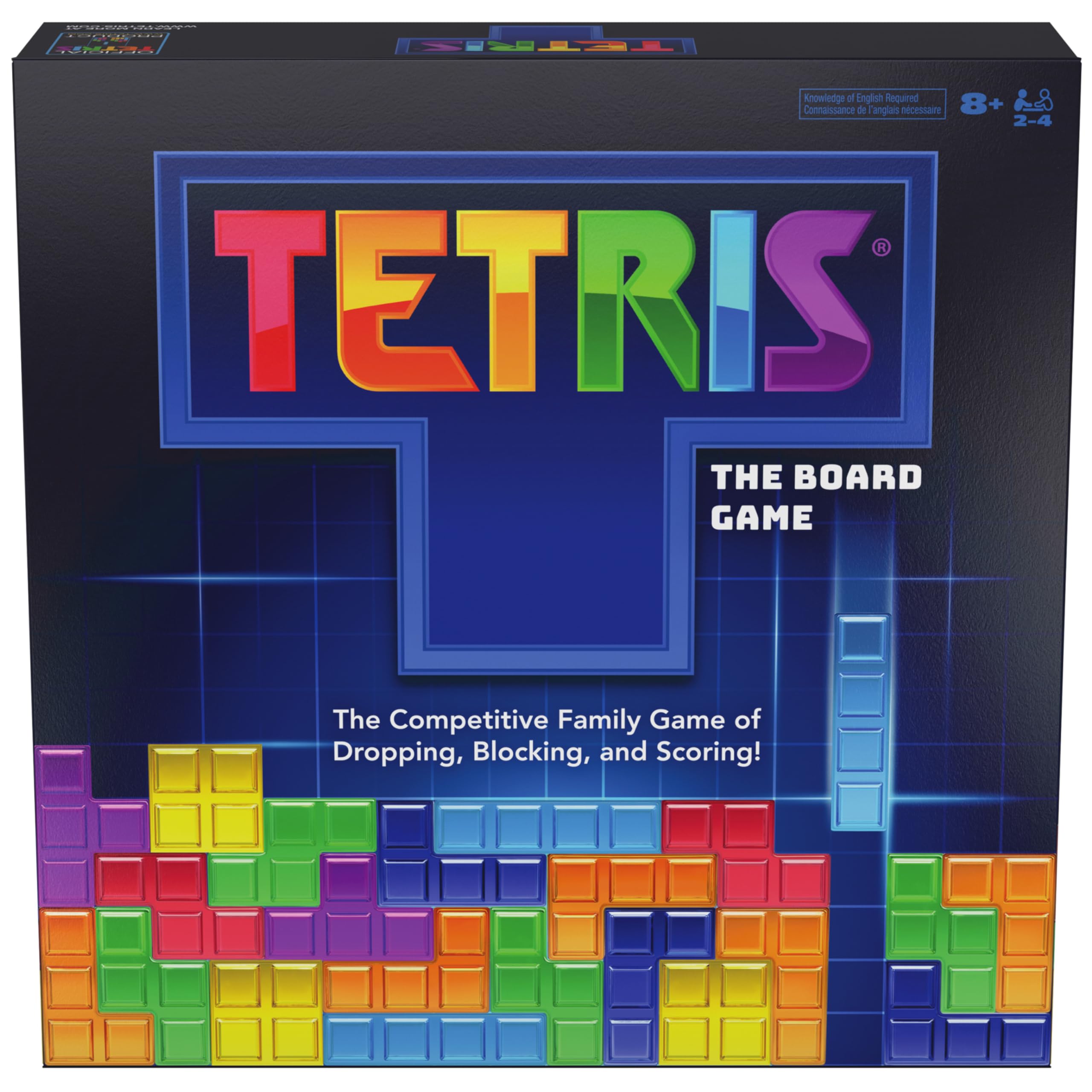
Spin Master’s tabletop adaptation of Tetris translates the iconic video game into a physical experience without losing the core tension. Each player gets a grid board and must drop semi-translucent Tetrimino pieces into their grid to complete horizontal lines. The competitive twist: landing a Tetrimino on a “Garbage Drop Icon” lets the player add a piece to an opponent’s grid, blocking their progress. This mechanic transforms the solo puzzle into a multiplayer battle of spatial reasoning.
The components are surprisingly high quality for this price tier. The 128 Tetriminos are made of thick, durable plastic with a semi-translucent finish that mimics the digital game’s aesthetic. The four player grids snap into separate bases, and the gameboard tracks scores. Setup is straightforward, and the 20-minute playtime means multiple rounds fit comfortably into a single game night. For the 8+ age rating, a mature 7-year-old with good spatial awareness can handle the rules with minimal guidance.
The main knock against this game is that younger 7-year-olds who struggle with spatial rotation may find the piece-placement frustrating. The competitive element — dumping garbage pieces on opponents — can lead to bruised feelings if one player dominates. Families should approach this as a cooperative learning experience initially rather than cutthroat competition. For kids who already enjoy the digital Tetris experience, this physical version offers a fresh and engaging alternative.
Why it’s great
- Faithful physical adaptation of the classic digital puzzle game
- Garbage drop mechanic adds competitive tension
- Durable Tetrimino pieces with authentic semi-translucent look
Good to know
- Spatial rotation challenges may frustrate younger 7-year-olds
- Competitive garbage mechanic can feel unfair to losing players
5. Clever Fox Play Number Hunter Math Board Game
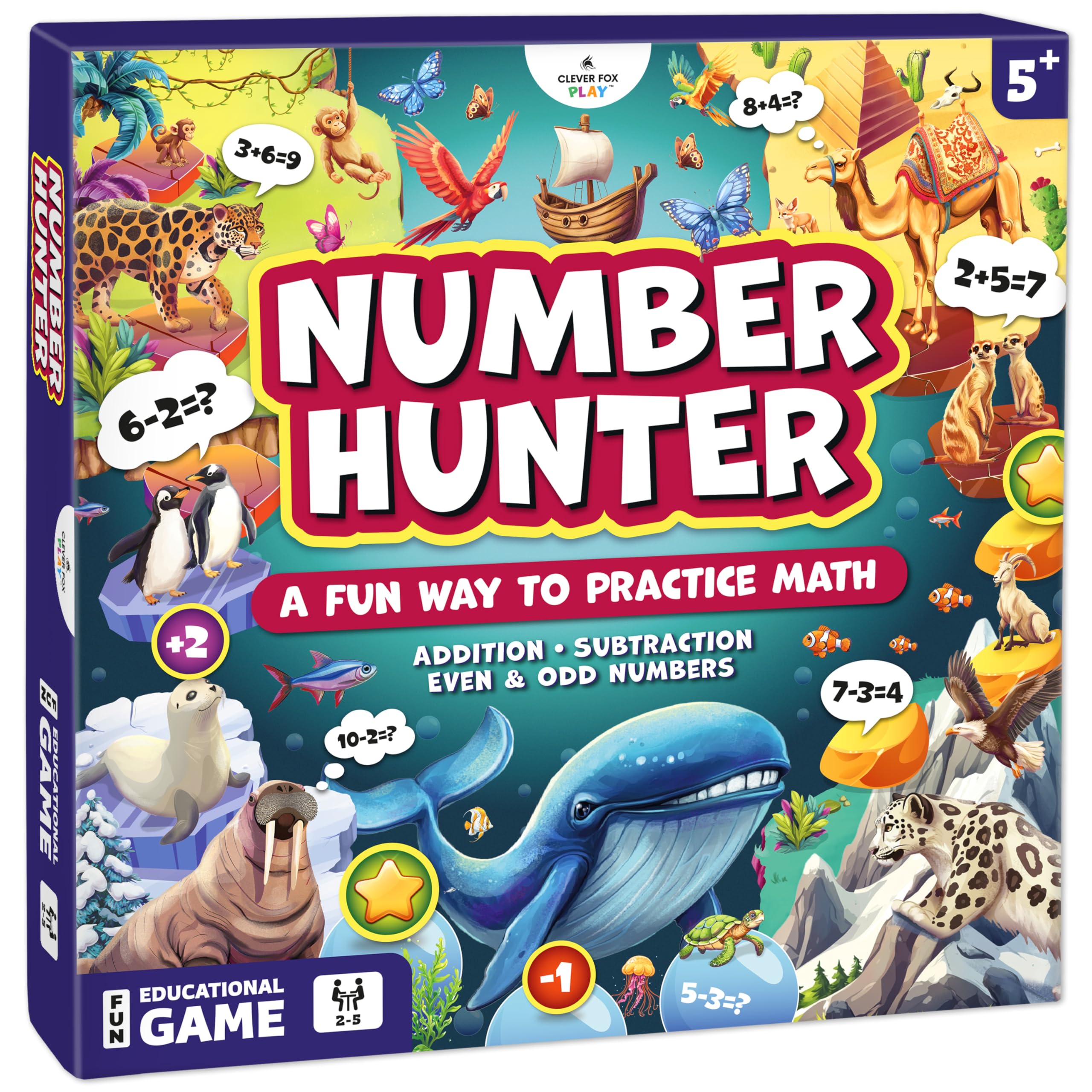
Number Hunter disguises math drills as an adventure around the world. Players roll two number dice and one operation die (plus or minus), calculate the result, and move their piece across the board. Landing on a star tile triggers a fun action challenge — hopping on one foot, balancing, or answering a bonus math question. The game covers addition, subtraction, and odd/even number recognition, making it a comprehensive tool for first and second graders.
The component quality is solid: a thick gameboard, five durable player pieces, two number dice, one operation die, and 50 challenge cards. The cards include both math challenges and physical movement prompts, which keeps the game from feeling like a worksheet. Seven-year-olds who resist traditional flash cards often engage with this game because the math is wrapped in a competitive race to the finish line. The non-toxic, child-safe materials and reinforced box add to the overall durability.
The main limitation is that younger children may need an adult to read the challenge cards, and the math difficulty caps at single-digit addition and subtraction. A 7-year-old who has already mastered these operations may find the game too easy. The suggested age range of 5-7 is accurate — kids older than 8 will likely outgrow it within a few sessions. For the target demographic of kindergarten through first grade, however, it is an excellent screen-free learning tool.
Why it’s great
- Made from non-toxic, child-safe materials with reinforced box
- Physical movement challenges keep the game active
- Teaches addition, subtraction, and odd/even naturally
Good to know
- Math difficulty caps at single-digit operations
- Adults needed to read challenge cards for early readers
6. My First Dragon Adventure Board Game

My First Dragon Adventure pitches itself as a beginner fantasy role-playing game — think of it as a gateway drug to deeper tabletop experiences like Dungeons & Dragons. Players race through enchanted lands using numbered and image-based cards to move, aiming to reach a dragon and convince it to re-light the castle’s magical s’mores fire. The theme is deliberately silly and engaging for the 5-8 age bracket. The board art and card illustrations are vibrant and detailed, encouraging kids to invent their own stories during play.
The game mechanics are straightforward: each card has a number and an image, and players use basic counting to advance. This simplicity allows 5-year-olds to participate fully while giving 7-year-olds room to develop strategic thinking through card management. The varied scoring system — points for reaching the dragon, bonus points for collecting certain items — adds replayability. Many reviewers note that the flexibility of the rules encourages creative house modifications, extending the game’s lifespan beyond what strict adherence would allow.
Components are adequate for the price point: a gameboard, player tokens, dragon tiles, dice, and cards. The pink, blue, red, yellow, brown, purple, and green color scheme appeals broadly. The main drawback is that the cardboard components are thinner than premium sets — expect some wear after a dozen playthroughs. The game also suffers from the “strict rules” problem: if you play exactly by the book, the novelty wears off after 4-5 sessions. The solution is to embrace creative rule expansion, which families with active imaginations will naturally do.
Why it’s great
- Image-based cards allow non-readers to play independently
- Encourages imaginative storytelling and creative house rules
- Fun for adults too — avoids the “boring kids game” trap
Good to know
- Cardboard components show wear after repeated play
- Strict rule adherence reduces replayability
7. Big Discoveries Dumpster Dice
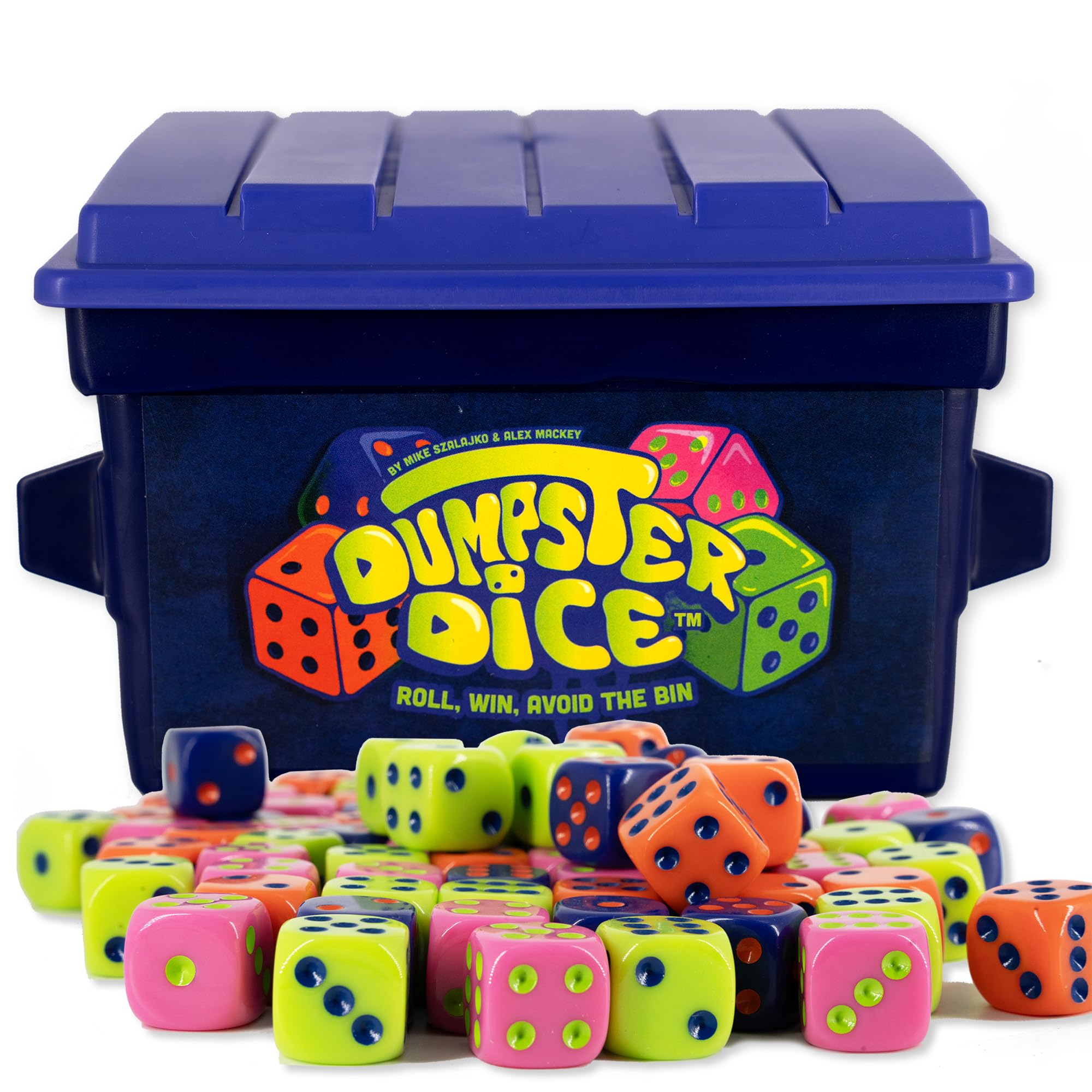
Dumpster Dice is a pure chaos engine in a tin box, and that is exactly its appeal. The premise is simple: roll dice to complete a 1-6 set on your board section while avoiding duplicates that force you to pass. The dumpster-shaped tin doubles as the game container and playing surface, with a removable lid that becomes the game board. The 80 colorful dice come in four player colors (red, blue, green, pink), and the included graffiti sticker sheet lets kids customize their dumpster.
Five gameplay variations are included in the instructions, adding significant replay value. You can combine Dumpster Dice with Trash Dice (a separate product from the same company) to expand play to up to 6 players. The 5-10 minute round length is perfect for short attention spans or as a filler between longer games. The portability factor cannot be overstated — the entire game fits in a small tin that slides into a backpack, making it ideal for restaurants, car trips, or waiting rooms.
The trade-off is depth: this is a pure luck-driven game with minimal strategic decision-making. Kids who enjoy tactical thinking may find it unsatisfying after a few rounds. The dice are ABS plastic, which feels durable but produces a loud rattling sound during play. The tin container, while clever, can open accidentally if the lid isn’t fully secured. For families looking for a fast, portable, laugh-heavy game without the complexity of a full board setup, Dumpster Dice delivers exactly what it promises.
Why it’s great
- Ultra-portable tin design perfect for travel and restaurants
- 80 colorful ABS dice provide tactile satisfaction
- Five gameplay variations extend replay value
Good to know
- Pure luck-based gameplay with minimal strategic depth
- Tin lid may open accidentally if not fully secured
FAQ
Are board games with a target age of 8+ appropriate for a 7-year-old?
How long do board games for 7-year-olds typically last before they get bored?
What is the best board game for a 7-year-old who struggles with reading?
Final Thoughts: The Verdict
For most families, the board games for 7 year olds winner is the Wordplay for Kids because it delivers the highest replayability-to-complexity ratio, building vocabulary and spelling skills without feeling like homework. If you want something that gets kids physically moving and laughing, grab the Snack-O-Saurus Rex. And for long-term strategic development that grows with your child, nothing beats the heirloom-quality AMEROUS Chess and Checkers Set.