
Our readers keep the lights on and my morning glass full of iced black tea. As an Amazon Associate, I earn from qualifying purchases.
Specs are compiled from manufacturer listings and verified buyer reviews and can change over time — please confirm the key details on the product page before buying.
You want a game that holds a 9-year-old’s attention without boring the adults at the table. The picks below balance quick-to-learn rules with strategic depth that grows alongside your child.
I’m Min — the founder and writer behind Gadgets Feed. This guide is built by comparing the manufacturers’ published specifications and the patterns across verified customer reviews, so you get each pick’s real strengths and trade-offs instead of marketing spin.
Every pick here passes the 9-year-old test, spanning tile-laying, marble mazes, and train routes. The best board games for 9 year olds combine quick learning, deep strategy, and high replay value so nobody gets bored.
Our Picks at a Glance


How To Choose The Best Board Games For 9 Year Olds
At nine, kids are ready to move past pure luck and make meaningful choices. You need rules that take minutes to grasp but strategy that offers genuine depth.
Match the complexity to the child
Some 9-year-olds devour rulebooks, while others bounce off anything that feels like homework. Cooperative games work wonders for kids who hate losing, letting the whole table win or lose together.
Look at playtime and reading level
A 30-45 minute session fits a school night, while games past an hour can test attention spans. Check whether a game requires strong reading, since a text-heavy game can frustrate a confident player who’s still building literacy.
Prioritize replay value
The biggest risk with kids’ games is a one-and-done shelf warmer. Games with random tile draws, shuffled cards, or multiple challenge levels stay fresh on the tenth play.
Quick Comparison
| Model | Best For | Players | Playtime | Mechanic | Amazon |
|---|---|---|---|---|---|
| Azul★ Best Overall | Visual strategy lovers | 2-4 | 30-45 min | Tile Drafting | Amazon |
| ThinkFun Gravity MazeSTEM Favorite | Solo puzzle solvers | 1+ | Varies | Logic Building | Amazon |
| Peaceable Kingdom Space EscapeTeamwork Pick | Teamwork fans | 2-4 | — | Cooperative | Amazon |
| Grandma Smiley’s Baseball Game | Sports enthusiasts | 2+ | — | Dice Simulation | Amazon |
| The World Game | Geography nerds | 2-5 | 40 min | Trivia Racing | Amazon |
| Carcassonne | Classic tile strategy | 2-5 | 35 min | Tile Placement | Amazon |
| Hasbro Electronic Battleship | Head-to-head duels | 1-2 | — | Coordinate Guessing | Amazon |
| Asmodee Monkey Palace | LEGO builders | 2-4 | 45 min | Brick Building | Amazon |
| Ticket to Ride (2025 Refresh) | Route planning | 2-5 | 30-60 min | Set Collection | Amazon |
In‑Depth Reviews
1. Azul Mosaic Tile-Placement Strategy Board Game
Our pick — over 4.5★ from 16,500+ verified ratings; the strongest balance of quality and price.
The award-winning tile game that turns pattern-building into a beautifully cutthroat duel.
Azul won the 2018 Spiel des Jahres — the industry’s highest honor — and it shows why within one round. You draft colored resin tiles from shared factory displays, then place them on your personal board to complete pattern rows and build a mosaic wall. The rules take minutes to explain, yet every placement decision shapes your score and your board, creating satisfying complexity that scales from casual family night to serious head-to-head play.
What wins people over is the sheer gameplay depth — it keeps rewarding planning and adaptability every single session. The tactile 100 resin tiles feel weighty and gorgeous, with 4 player boards, 9 factory displays, and 4 scoring markers included in the box. Each round deals new tile combinations, so no two games play the same, and the drafting mechanic forces you to deny tiles your opponents need — the game starts friendly and turns delightfully cutthroat once everyone learns to plan ahead.
Families genuinely love the balance between strategy and luck, praising its quick pace that finishes in 30-45 minutes for 2-4 players ages 8 and up. The recurring honest gripe is the rules — most find them straightforward, but a notable share find the rulebook confusing on a first read. As a gift for a 9-year-old who enjoys puzzles, this is the rare game that grows with them from family-friendly to genuinely competitive.
What makes it a household staple
- Beautiful, weighty resin tiles that feel premium in hand
- Quick 30-45 minute sessions perfect for school nights
- Deep strategy that rewards planning and blocking opponents
The honest trade-offs
- Rules can feel confusing on a first read for some families
- Bigger box takes up real shelf space at 10.25 x 10.25 x 2.75 inches
Reach for this if: your 9-year-old loves puzzles, patterns, and games that reward thinking two moves ahead.
Look elsewhere if: your child hates reading rules or prefers pure luck-based chaos over strategy.
2. ThinkFun Gravity Maze – Falling Marble Logic Game
A marble-run logic puzzle that quietly builds critical thinking while kids think they’re just playing.
Gravity Maze is the rare STEM toy that feels nothing like homework. Kids build towers and ramps from 9 towers, 3 marbles, a game grid, and a target piece to guide a marble from start to finish, working through 60 challenge cards that climb from beginner to expert. The satisfying marble “clink” on a successful run is the kind of instant feedback that keeps kids hooked.
The gameplay gets glowing praise because each of the 60 challenges has a single correct solution, so kids think spatially, plan their moves, and test their builds with instant feedback — no screens involved. Buyers report the balance is closer to 10 years old; “Probably 10 years old to be interested,” one observed, noting an 8-year-old may find the puzzle aspect too challenging and enjoy it better as free play. The challenge levels genuinely stump adults too, with answers printed on the card backs.
At just 1.1 pounds and sized at 9.38 x 2.83 x 10.47 inches, it’s compact enough to slip into a bag for travel. The recurring note is that it demands patience, and some find later puzzles feel repetitive once solved. But the build-and-test loop is so absorbing that it creates the same “one more level” syndrome as a video game — which is exactly why it’s such a strong, screen-free gift for curious minds.
Why it wins as a brain-builder
- 60 challenges from beginner to expert with single solutions
- Builds spatial reasoning and planning through hands-on play
- Instant feedback via the satisfying marble drop
Who should hesitate
- True puzzle challenges skew closer to 10 years old
- Demands patience; younger kids may prefer free building
Best for: the 9-year-old who loves engineering, building, and figuring things out independently.
Not for: kids who bounce off anything without fast, loud action — this one rewards patience.
3. Peaceable Kingdom Space Escape Cooperative Strategy Game
From the inventor of Pandemic — a cooperative space adventure where the whole table wins or loses together.
Space Escape flips the competitive script entirely: a band of snakes has infiltrated the Mole Rats’ Space Station, and players work together to help the busy Mole Rats gather equipment and reach their escape pod before time runs out. You draw cards with two actions — one for you, one for the snakes — then decide as a team which Mole Rats to move and where to send the snakes. Everyone wins if all the Mole Rats escape without being bitten.
This is the game parents reach for when their child hates losing. The cooperative gameplay means no one sits out feeling crushed, and the shared decision-making encourages communication and teamwork in a way competitive games never can. The box includes 1 game board, 51 cards, 20 tokens, and 4 plastic mole rat movers, and because there’s no reading involved, younger siblings can join in with the rules explained orally.
Kids love the challenging-but-fair difficulty — one family won only once in four plays, which kept everyone eager to replay toward the 3 wins needed to open up challenge cards. It sits at Ages 7 and up for 2-4 players, with components that feel extremely durable. The honest trade-off is that newer players may need a round or two to grasp the action-card rhythm, but the teamwork payoff makes it a family favorite that feels like everyone wins.
Why it’s a classroom staple: teachers pick it up specifically because it forces students to work cooperatively, and older elementary kids stay engaged while younger ones join in since no reading is required.
Pick this if: your 9-year-old is sensitive to losing or you want a game that teaches teamwork over competition.
Consider passing if: your child thrives on head-to-head rivalry and wants to beat someone at the table.
4. Grandma Smiley’s Baseball Board Game
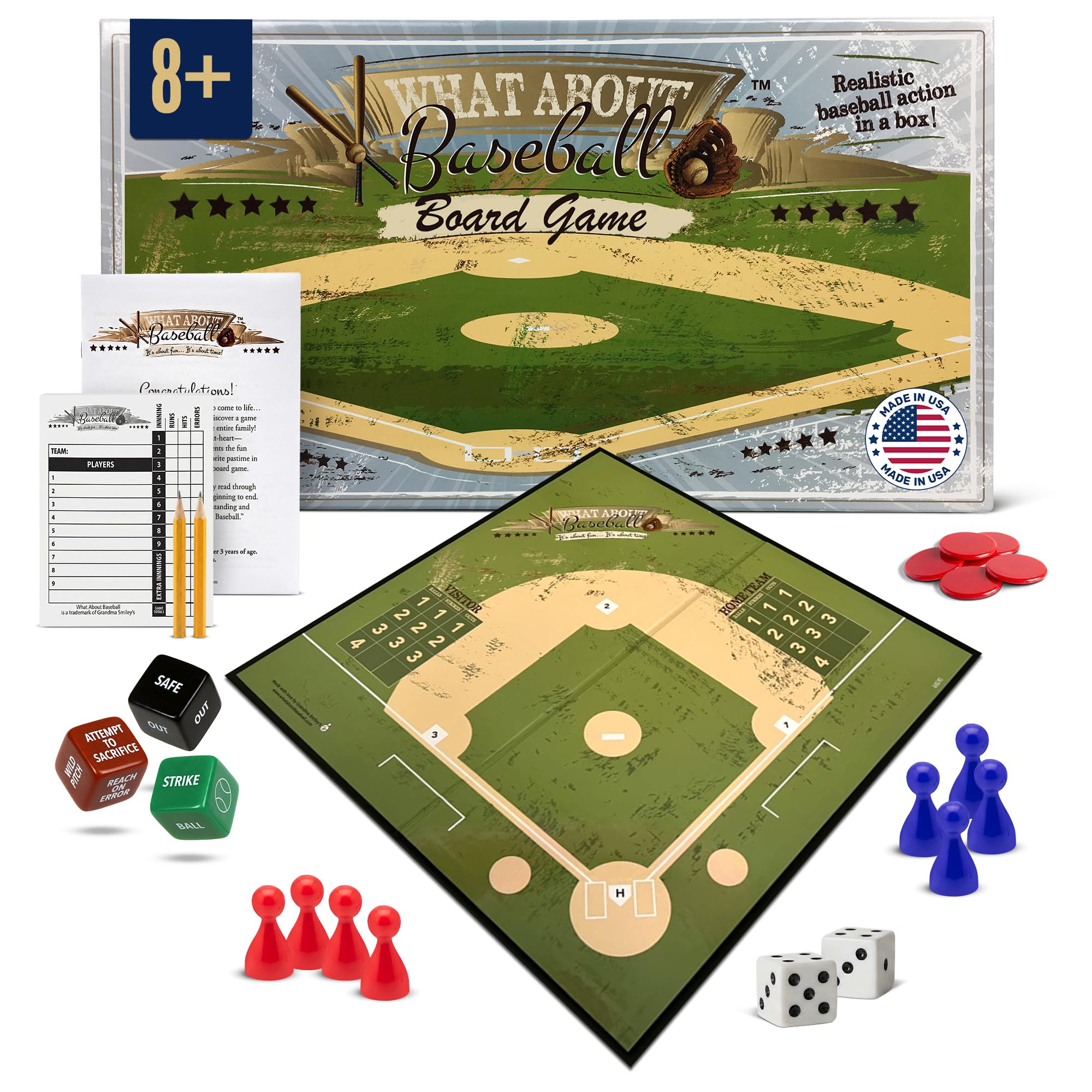
An all-American dice baseball sim that turns a rainy afternoon into a full nine-inning season.
If your 9-year-old eats, sleeps, and breathes baseball, this is the game that brings the ballpark home. It plays as a simulated baseball game with 4 red and 4 blue tokens, 2 standard dice, 3 special dice, a game board, pencils, a score pad, and a detailed rule book. Roll the dice to simulate at-bats, track runners around the bases, and keep real box scores with the included score pad.
The gameplay earns the most buzz because it teaches the basics of baseball while staying genuinely fun — grandparents and kids alike get pulled in. It comes with both basic and advanced gameplay, so a rookie can start simple while a die-hard switches to advanced rules with special dice for more strategic depth. Made in the USA by a family-owned company, the plastic components feel solid and built to survive years of tabletop innings.
The recurring honest note is that the dice odds lean realistic, which means lots of outs and modest scoring — a purist’s feature, but one that can feel a little slow for casual players by the 6th inning. Some owners also wish the box included laminated cheat sheets for dice outcomes. For a baseball-loving kid, though, the chance to play a full simulated game on a rainy day is exactly the kind of screen-free bonding that makes it a standout gift.
The home-run highlights
- Teaches real baseball strategy and scoring
- Basic and advanced rules let the game grow with the player
- Made in the USA with durable plastic components
The dugout caveats
- Realistic odds mean frequent outs, which can drag the pace
- No laminated cheat sheets for dice outcomes in the box
Reach for this if: your child already loves the game of baseball and wants to play it without a field.
Look elsewhere if: your kid isn’t into sports — the baseball theme is the entire appeal.
5. The World Game – Fun Geography Board Game
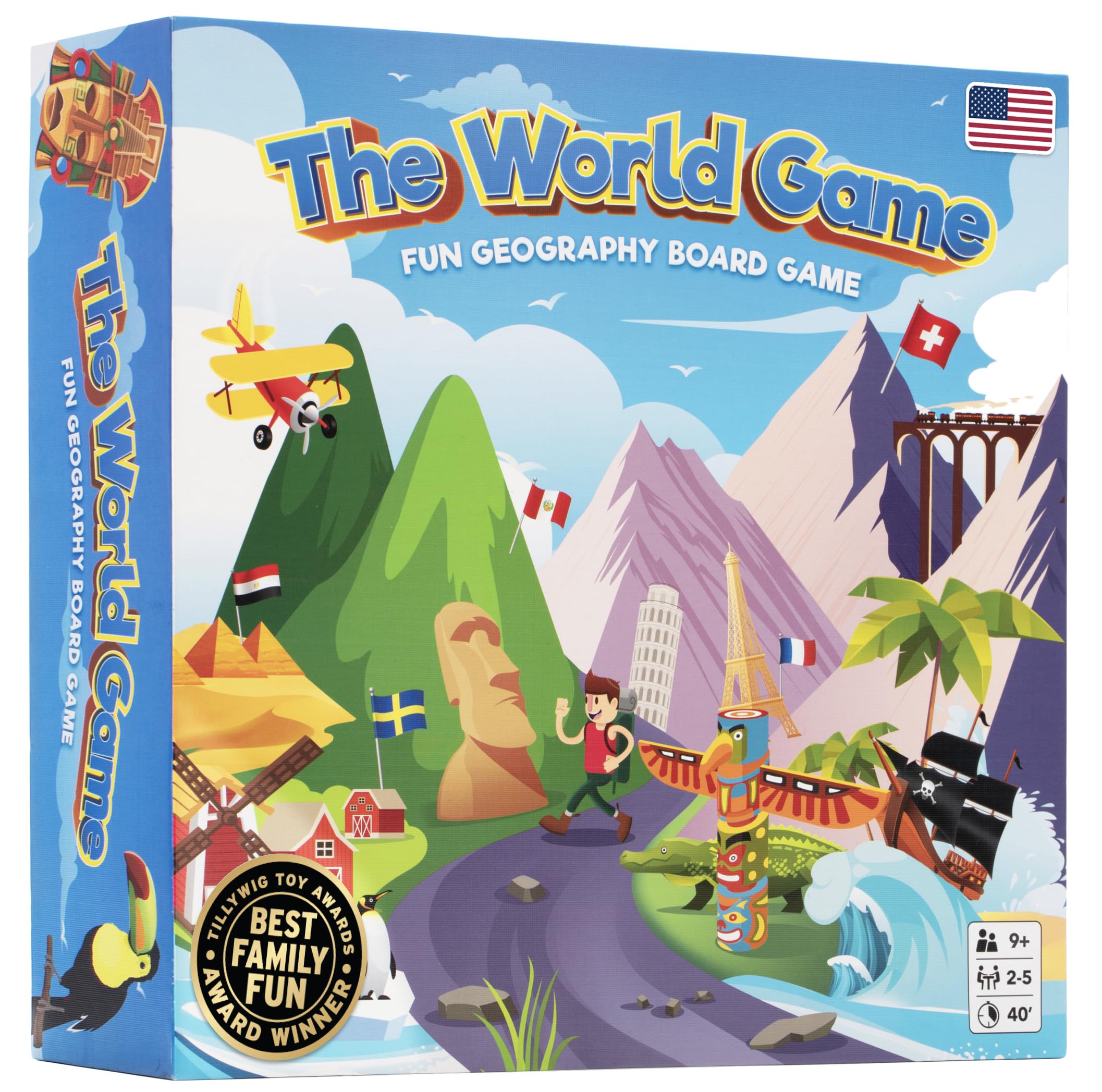
A 194-country race around the map that teaches capitals, flags, and continents without feeling like school.
The World Game turns geography into a 40-minute race for ages 9 and up. Players move across the world map board, pass famous landmarks, and use country facts to reach the finish first. Each country card packs in the flag, capital, area, population, GDP per capita, highest point, and neighboring countries, while 26 action cards add wild twists to keep every race unpredictable.
Because there’s no reading with the rulebook, the learning happens naturally — kids practice flags, capitals, continents, and map locations while chasing the win. The box includes a world map board, 194 country cards, 26 action cards, 7 pawns, and dice, with adjustable challenges so mixed-knowledge groups can play together fairly. Beginners and geography fanatics both fit at this table.
Families with a 7-year-old and a 10-year-old report playing weekly, adapting rules so the younger one feels successful — a sign of how flexible the difficulty actually is. The quality of the board and card stock earns consistent praise, with borders and flag designs noted for their accuracy. The honest mixed note is the difficulty: most find it easy to learn, but the 40-minute runtime ran long for one 45-minute classroom period, and the trivia demands do challenge players who know little geography.
Perfect for the trivia-loving household: each country becomes a launchpad for discussing its history and culture, which is why parents who love travel keep this in the family rotation.
Best for: the curious 9-year-old who asks “where is that?” about every country mentioned on the news.
Not for: kids who hate anything that feels like a quiz, no matter how disguised the learning is.
6. Carcassonne Tile Placement Strategy Board Game
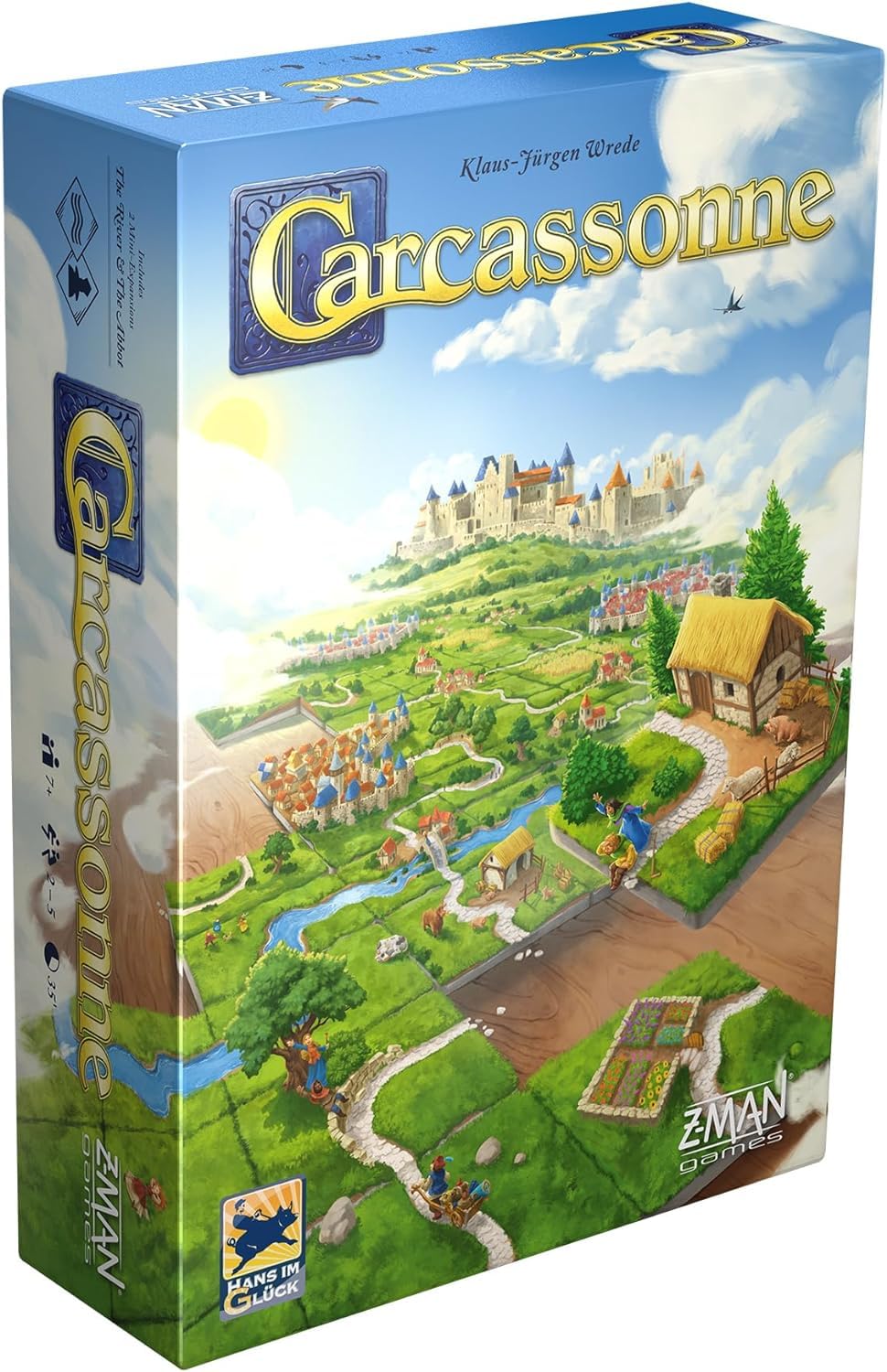
The medieval tile-laying classic that builds a brand-new landscape every single play.
Carcassonne is the benchmark modern family strategy game: draw and place landscape tiles to build cities, roads, fields, and monasteries, then deploy meeples as knights, farmers, and monks to claim features and score points. The randomized tile draws mean a different landscape every game, so no two sessions ever play out the same — a huge part of why it’s such a beloved family staple.
What wins families over is the game quality and easy setup. The clean-cut tiles and wooden tokens feel premium, and the rules are intuitive enough to teach an adult or a 9-year-old in minutes. Built for 2-5 players with an average 35-minute playtime, it fits neatly into weeknight sessions — and two-player play is famously intense, making it a great parent-child game too.
The base game comes with The Abbot and The River mini-expansions in the box, adding variety right from the start. Families with children as young as 6 report great sessions by skipping the trickier farmer rule at first, which shows how well the difficulty scales. For a 9-year-old ready for real strategy, this is the classic that teaches logical thinking without ever feeling like a lesson.
Why it’s a modern classic
- Different landscape every game = endless replayability
- Includes The Abbot and The River mini-expansions in the box
- Scales well for ages 6 and up with simple rule adjustments
Who should look elsewhere
- Kids who can’t sit for 35 minutes of quiet strategy may drift
- The farmer rule adds depth but confuses first-time young players
Reach for this if: your 9-year-old loves building and thinking logically, especially in a quiet 1-on-1 session with you.
Consider passing if: your child needs loud, high-energy games to stay engaged.
7. Hasbro Gaming Electronic Battleship Reloaded Board Game

The classic naval duel gets a lights-and-sounds upgrade that makes every hit feel like an explosion.
Electronic Battleship Reloaded brings the classic head-to-head naval combat to life with voice commands, sound effects, and lights. Players enter coordinates and press the fire button, sinking their opponent’s fleet to win — but this version adds special attacks in Advanced Mode, using 12 special weapon pegs alongside the classic red and green pegs to shake up the strategy.
The electronic sounds are what make this edition special — a hit triggers an explosion sound effect that adds genuine suspense to every turn. Two computer voices handle play announcements, and dozens of preset ship layouts let players skip setup entirely and dive straight into battle. The folding command unit (sized 2.52 x 15.75 x 9.02 inches) makes storage and travel easy, and the included 75 “hit” pegs and 170 “miss” pegs keep the action going for long sessions.
Families report this electronic version is even more fun than the classic, keeping children entertained for hours. The setup is simpler than previous versions — this is the Easy Setup Edition — which removes one of the old frustrations. The honest trade-off is the setup: while simpler than before, inputting coordinates still takes longer than the instant gratification of a digital game, and some owners wish the folding unit had better internal storage for all the pieces. Best for ages 8 and up, and especially good for 1-2 players since it supports solo play against the computer.
Easy setup, maximum engagement: preset layouts and solo computer play mean a child can start playing within minutes — no opponent required.
Pick this if: your 9-year-old loves military strategy, tech toys, or head-to-head rivalry with sound effects.
Look elsewhere if: you want a quiet, screen-free classic — the electronics are the whole point here.
8. Asmodee Monkey Palace Brick Building Strategy Game

The board game that uses real LEGO bricks as the playing field — and rewards you when towers collapse.
Monkey Palace is the rare game that fuses LEGO brick construction with pure board game strategy. Players build monkey fortresses using 231 interlocking LEGO elements on a 32 x 32 knob plate, place monkeys strategically, and score points when unstable towers wobble and crash down. It’s unpredictable, laugh-out-loud fun that rewards both careful planning and the chaos of gravity.
What makes it special is that the bricks are genuinely compatible with LEGO and other major brick brands, so families who already own LEGO can expand the play. For 2-4 players ages 10 and up, each 45-minute session delivers big laughs as towering brick structures tumble. The included 84 game cards and 4 jungle maps drive the strategy, encouraging players to plan, manage resources, and think creatively.
The game quality earns glowing praise, and families report kids as young as 6-8 jumping in successfully. The honest catch is the instructions — they’re widely described as incredibly confusing at first, and the rulebook itself is flimsy and unstapled. Players report that the game becomes simple and fun once the learning curve is conquered, but the setup with many small parts takes real time, and larger groups may need to supplement with their own LEGO bricks after a few rounds. For a LEGO-obsessed 9-year-old, the payoff is a family game night unlike any other.
Why LEGO families love it
- Real interlocking bricks compatible with LEGO and other brands
- Rewards both strategy and creative building
- Unpredictable tower collapses create genuine laughter
The honest frustrations
- Instructions are confusing and the manual is flimsy
- Setup and cleanup take time with many small parts
Reach for this if: your 9-year-old lives and breathes LEGO and wants a fresh way to use those bricks.
Think twice if: you or your child lack patience for a confusing first read-through of the rules.
9. Asmodee Ticket to Ride Board Game (2025 Refresh)
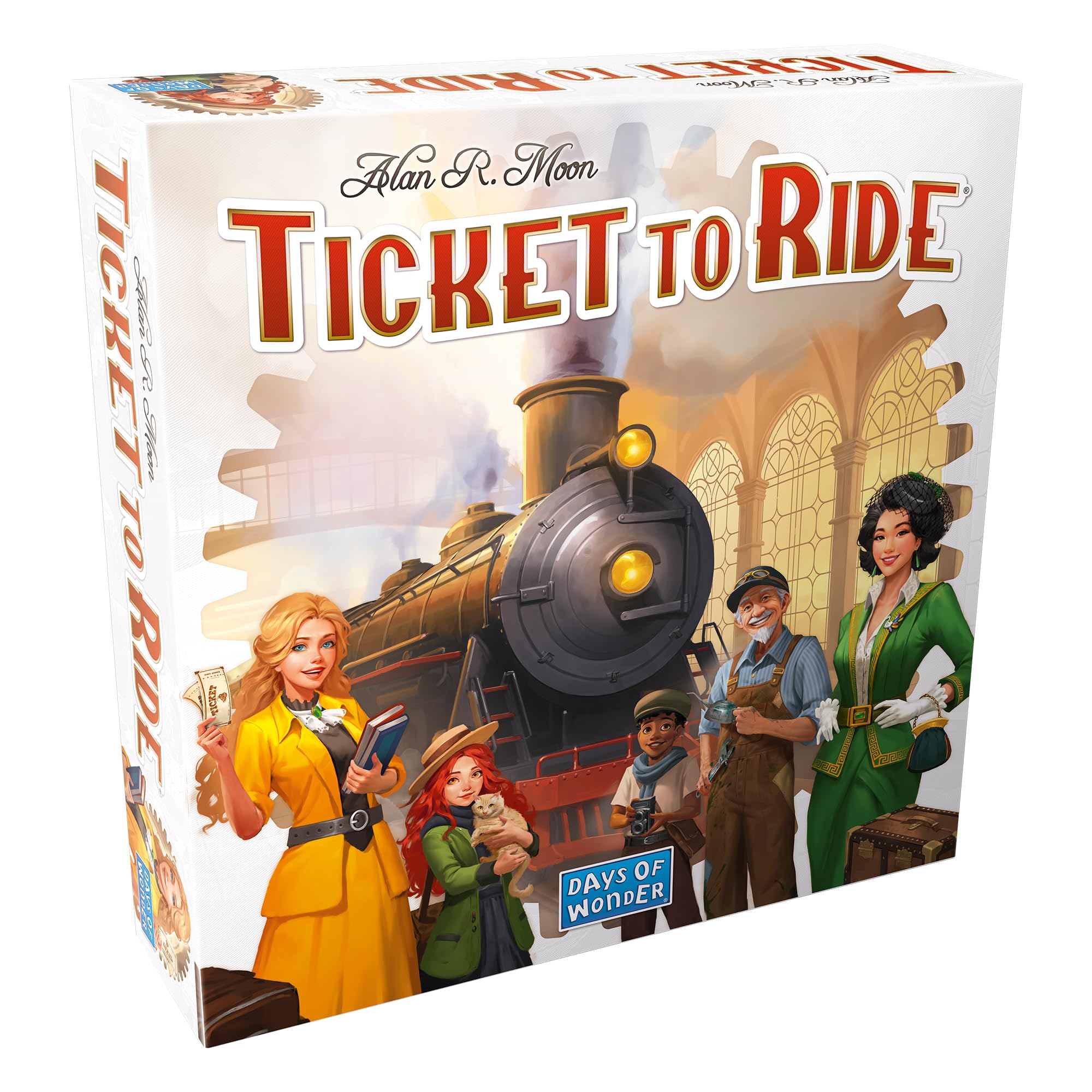
The cross-country train adventure that teaches planning and geography while building a giant rail network.
Ticket to Ride invites 2-5 players on a journey across early 20th century North America, collecting train cards and claiming routes to connect cities. The 2025 Refresh features a giant map of the North American train network, with 225 plastic miniature trains in 5 colors, 110 train cards, 33 destination tickets, and 5 wooden scoring markers. Simple rules hide a satisfying layer of strategy: complete your tickets, build the longest routes, and block your rivals.
This is widely considered the perfect “gateway” game — the one that introduces families to modern board gaming. It’s easy to learn, visual, and replayable because the card strategy changes every session. Games take roughly 30-60 minutes, fitting comfortably into a family game night, and the 225 plastic trains feel satisfying to place as your network grows across the map.
Families praise it as fun and educational, since it sneaks in geography while kids plan train routes. The gameplay gets the most buzz because it’s competitive yet casual — notably lacking the cut-throat arguments of some strategy games, which makes it safer for family harmony. The honest notes are that an 8-year-old may struggle and it’s better suited for ages 10+, while some find the simple rules lean complex on a first read. For a 9-year-old ready to graduate to a real strategy classic, this is the pick that grows into a lifetime favorite.
Why it’s the gateway game: it’s visual, language-independent, and teaches route-planning without any reading — families with younger kids and grandparents all find something to enjoy at the same table.
Pick this if: your 9-year-old is ready for their first “serious” strategy game that the whole family can enjoy together.
Consider waiting if: your child is closer to 8 — the route planning may frustrate younger players.
Understanding the Specs
Player Count and Playtime
Check how many players a game supports before you buy. A 2-player game is great for parent-child bonding, while a 4-5 player game fits family nights and playdates. Playtime matters just as much — 30-45 minutes is the practical school-night balance, while longer games are best saved for weekends when nobody’s rushing.
Game Mechanics and Complexity
The mechanic — tile placement, dice rolling, cooperative play, or route building — defines how the game feels. Tile-laying games like Azul and Carcassonne reward spatial thinking, while cooperative games like Space Escape teach teamwork. Look for basic and advanced modes, which let the same game grow with your child’s skills over months.
FAQ
Is a game rated for ages 8+ too hard for a 9-year-old?
What’s the difference between cooperative and competitive games for this age?
How long should a board game session be for a 9-year-old?
Will a 9-year-old who doesn’t love reading enjoy these games?
What makes a board game replayable for a 9-year-old?
Can these games be played with just two people?
Is Gravity Maze better as a solo or family activity?
What’s the best first “serious” strategy game for a 9-year-old?
How does Carcassonne compare to Azul for a beginner?
Are LEGO-based board games like Monkey Palace worth the complexity?
Final Thoughts: The Verdict
For the best all-around board games for 9 year olds, the Azul takes the crown as the award-winning blend of beauty, quick learning, and deep strategy that grows with your child. If your 9-year-old prefers solo brain-teasers, grab the ThinkFun Gravity Maze. And for a family that wants everyone to win together, the cooperative Peaceable Kingdom Space Escape is the one to reach for.
How We Picked
We do not accept paid placement. Every pick is matched to a real buyer and a real use-case; we do not hands-on test units.
Sources & Methodology
Specifications: manufacturer listings and product documentation. Review insights: verified customer reviews, as of August 2026. Pricing: not shown on this page (it changes often); check the current price via the retailer link.
As an Amazon Associate, Gadgets Feed earns from qualifying purchases. This does not affect which products we feature.