
Our readers keep the lights on and my morning glass full of iced black tea. As an Amazon Associate, I earn from qualifying purchases.
Specs are compiled from manufacturer listings and verified buyer reviews and can change over time — please confirm the key details on the product page before buying.
If you are shopping for a game that works properly with exactly two players, the short answer is this: buy a game that was designed for two people from the start, not a four-player box with a two-player mode bolted on. Games built only for two run tighter, end faster, and rarely leave one person stuck waiting. This guide covers nine of them, sorted so you can spot the right one in a couple of minutes.
I’m Min — the founder and writer behind Gadgets Feed. This guide is built by comparing the manufacturers’ published specifications and the patterns across verified customer reviews, so you get each pick’s real strengths and trade-offs instead of marketing spin.
You will see what each box actually asks of you in time and attention, plus which ones suit a regular partner rather than a casual guest. Each of the nine picks below is designed for exactly two players and holds up across repeated nights of play. board games for adults two players.
Our Picks at a Glance


How To Choose The Best Board Games For Adults Two Players
Two-player shopping is different from buying a party game. With only two of you at the table, every choice has to matter, because there is no crowd to hide behind and no downtime while other people take turns. The right box keeps both players busy on every turn and finishes in 20 to 60 minutes.
Designed for two, not a multiplayer mode
Some games are built only for two people. Others are made for three or four and just print a two-player variant on the box. The first kind plays tighter, because every card and every turn was tuned for a single rival across the table. Look for a box that says two players as its core design, not as an option.
Playtime is a real buying decision
A 20-minute game and a 60-minute game suit completely different nights. Quick boxes get pulled out on a weeknight or a work break, while longer ones become a planned session with drinks and a clear evening. Match the listed playtime to when the two of you actually sit down.
Competitive or cooperative
Some boxes set you against each other, racing to build or conquer. Others ask both players to win together against the game itself. Competitive games reward reading your opponent, while cooperative ones reward talking through a shared plan and often scale their difficulty across scenarios.
Quick Comparison
| Model | Best For | Playtime | Style | Minimum Age | Amazon |
|---|---|---|---|---|---|
| Asmodee 7 Wonders Duel★ Best Overall | Fast competitive strategy | 30 minutes | Competitive | 10+ | Amazon |
| Allplay SailBest for Travel | Co-op crew of two | 20 minutes | Cooperative | Teen | Amazon |
| Thames & Kosmos TargiDeepest Strategy | Deep worker placement | 60 minutes | Competitive | 12+ | Amazon |
| Smirk and Dagger BOOP | Casual quick duels | 20 minutes | Competitive | 10+ | Amazon |
| Splendor Duel | Gem-collecting battles | 30 minutes | Competitive | 10+ | Amazon |
| Caper Europe | Heist night for couples | 30 minutes | Competitive | 10+ | Amazon |
| Rio Grande Games Yinsh | Pure abstract duel | 30 minutes | Competitive | 14+ | Amazon |
| Everdell Duo | Co-op or competitive variety | — | Both | 10+ | Amazon |
| LOTR: Duel for Middle-earth | Theme-driven head-to-head | 30 minutes | Competitive | 10+ | Amazon |
In‑Depth Reviews
1. Asmodee 7 Wonders Duel
Our pick — over 4.5★ from 9,500+ verified ratings; the strongest balance of quality and price.
The two-player duel that turned a four-player favorite into a tightly built head-to-head classic.
This is the one to start with if you want a competitive game that finishes inside a sitting. Each match averages 30 minutes, and both of you build a civilization from a shared card pyramid — cards that start face-down, which adds a real guess about what your partner will grab next. You win in one of three ways: by invading the opponent’s capital, by locking down scientific advancement, or by finishing with the most victory points. That range of win paths is exactly why it tops this list — 4.8 stars across 9,000+ ratings, and it holds that number because the games stay close.
What wins people over is the gameplay itself, far and away the thing that comes up most in reviews — not the theme, not the box. There is constant tension between what you need to build and what you have to deny your opponent. One small catch: only seven of the eight Wonders in play can ever be built, so there is always a scramble at the end. It plays in about 30 minutes and works for ages 10 and up, which makes it a genuine option for a parent and a child as well as two adults.
Where it falters, honestly, is the learning curve. The rulebook has its fair share of exceptions, and the resource and coin pricing asks you to do quick math through the whole game. Buyers report it “plays ~35 min, balanced except one Progress token/Guild combo.” That is the trade a deep strategy game makes: a heavier first night in exchange for months of close matches.
What holds up night after night
- Three real ways to win — military, science, or points — so a losing position can still flip
- Averages 30 minutes, short enough to run a second match straight after
- Beautiful card illustrations and clean icons carry the theme without slowing play
Where it asks more of you
- The resource and coin math runs through every turn
- The rulebook is fussy, with plenty of exceptions to remember
- Cards are small and setup takes a little shuffling time
Go for it if: you have a regular partner and want a strategic duel that fits in half an hour.
Think twice if: you want something you can teach cold in five minutes — this one has a heavier first night.
2. Allplay Sail
The pocket-sized pirate chase where you steer a ship together — and can barely say a word about it.
Sail takes trick-taking — that familiar card game where everyone plays a card and the highest wins the round — and turns it co-op. You and your partner deliberately win and lose tricks to steer a pirate ship across the sea, while a kraken closes in. There is a communication limit built into the rules, so neither of you can simply say the plan out loud. Each pirate also has a unique special ability, and the included scenario book ramps difficulty. Owners mention “multiple scenarios ramp difficulty from easy to challenging.”
It is genuinely small: the box measures 5 by 5 inches, and the listing highlights a travel-size box, so it slots into a backpack or a glovebox. Games run 20 minutes. That is the shortest commitment on this list — and at roughly a third of Targi’s 60-minute playtime above, it is the one that fits a lunch break rather than a whole evening.
Reviewers praise the trick-taking gameplay first and the cooperative structure second. Watercolor-style artwork pulls the pirate theme together, and the components hold up — the game fits back in the box even with sleeved cards and upgraded wooden pieces. The catch is content volume. One buyer’s summary of it: “This is a great little trick taking game. Just wish there were more scenarios to play through!” A couple of suits also lean on two shades of green, which can slow a tricky decision.
Where it lands: an excellent small-box co-op for two people who want to solve a puzzle together rather than fight over it. The difficulty is adjustable, so it grows with you.
Worth knowing: it is a 20-minute experience with a limited run of scenarios, so heavy players may want a second box alongside it.
Pack it if: you travel, camp, or want a co-op you can finish before the coffee goes cold.
Leave it if: you want a deep campaign that keeps unfolding for weeks — this is a tight, finite experience.
3. Thames & Kosmos Targi
The desert trading duel that gives two players a full hour of planning, blocking, and quiet scheming.
Targi is a worker placement game, which means you place tokens to claim cards and resources rather than playing cards straight from your hand. You place three workers each turn, and where their paths cross on the 4×4 border grid is where you claim cards. You then build a 3×4 grid of 12 tribe cards, and how you lay that grid out changes your final score. It runs 60 minutes — double the playtime of Sail above and the longest genuine session on this list.
What makes this the pick for planners is that nearly every move interacts with your opponent’s. You have to think two moves ahead, and the other player can block the spot you wanted. Because almost everything is visible, one-sided blowouts are rare, which is why it holds a 4.8-star score with a loyal following and a spot in the Board Game Geek Top 100. Its box measures 7.9 x 1.8 x 7.9 inches, making it a compact shelf neighbor for the bigger boxes here.
Two honest notes. First, the fixed border cards never change, so setup is always the same — some players wish a proper board existed to speed it up. Second, the goods and victory-point tokens are tiny and all look alike, which customers note makes them fiddly to tell apart. One highly praised trait: it stays friendly. It is a strategic game, not a take-that brawl.
Why it earns its keep: the worker placement and auction mechanics give two players a real, satisfying hour of decisions rather than a padded-out multiplayer game.
The honest drawback: repetitive setup and small printed tokens on the goods and points — a minor annoyance, not a reason to pass.
Choose it when: you want the longest, deepest, most strategic hour on this list.
Look elsewhere when: you want a game that explains itself in five minutes or wraps up quickly.
4. Smirk and Dagger BOOP

Thirty-two wooden kittens, one quilted bed board, and a rule that sends pieces flying off the edge.
BOOP is the easiest box here to teach, and it earns that with a clever twist. You place kittens on a quilted bed board, trying to line up three in a row like tic-tac-toe — but every kitten you place pushes the pieces next to it one space away. That is the boop, and it means your tidy plan can scatter the moment your opponent touches the board. Each match takes well under 30 minutes and the listing puts it at 20-30 minutes for ages 10 and up, though younger rules are included too.
The pieces are the draw as much as the rules. There are 32 crafted kittens and cats, plus a soft quilted bed board, and the instruction booklet uses pictures to explain everything — no reading required to get started. Games run 10 to 20 minutes with fast teardown and easy storage. Its gameplay comes up more than anything else in owner feedback, and cuteness is a clear second. One buyer captures the appeal: “I love cats and my boyfriend loves strategy games, so this was perfect for us.”
Compared with 7 Wonders Duel at the top, this is a lighter, faster, far friendlier entry point — a good warm-up game rather than the main event. The trade-off is depth. Nobody would call it a heavyweight, and once you have played it a dozen times the surprises thin out. As a gift or a couple’s first strategy game, though, its five-minute teach and fast matches are hard to argue with.
The draw: it looks like a toy, plays like a proper game, and gets to the table in seconds.
The limit: light on long-term depth — best as an opener, not your only box.
Best for: casual couples and cat lovers who want a five-minute teach and a fast match.
Skip if: you measure a game by how many layers of strategy it hides.
5. Splendor Duel
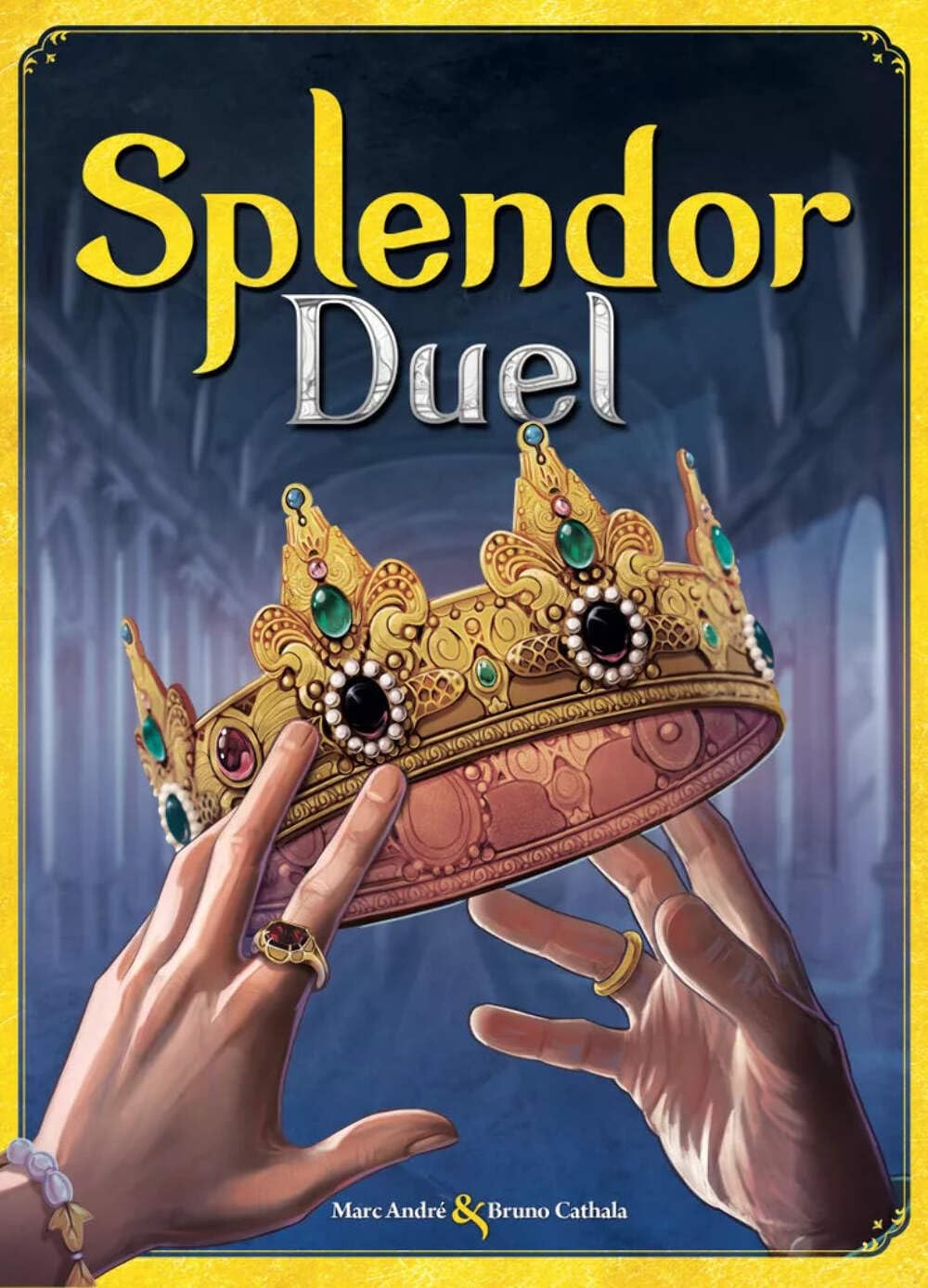
A gem-trading race rebuilt for exactly two, with three separate ways to end the game early.
Splendor Duel takes the gemstone-collecting engine of the original Splendor and strips it to a two-player fight. You draft gem tokens, buy development cards, and try to build combinations fast. It adds a pearl gem and activatable powers — steal a gem, take an extra turn, grab a scroll — that the original never had, and it plays out in around 30 minutes. Its 4.8-star standing matches the top pick on this list, and the gameplay is what carries it there.
Three win conditions keep every match live: hit 20 points, collect 10 points in a single color, or gather 10 crowns. That variety is why buyers keep it in rotation, and one notes it is “more fun than original.” Everything packs into a compact box that is easy to carry, so it works as a travel game as well as a home shelf pick. The 67 jewel cards and 25 plastic gem tokens give it plenty of table presence for the size.
The one thing to know going in: the cards are small. Several players mention it, and if you have people at the table who struggle to read small print, that matters. It is also a purely competitive experience — no co-op mode here — so you need a partner who enjoys racing rather than building together. The card quality itself is good and durable, which softens the small-print gripe.
What keeps it in the bag
- Three win conditions — points, single color, or crowns — keep matches tense to the end
- Roughly 30 minutes with quick, clean turns
- Compact box and sturdy components make it easy to travel with
Small print, real caveat
- Cards are genuinely small, which some players find hard to read
- Competitive only — no cooperative option
- Adds enough rules that it takes a beat longer than the original to explain
Reach for this if: you want a fast, tight gem-collecting duel that both of you can learn in a couple of games.
Look past it if: small card text is a problem at your table, or you want to win together rather than beat each other.
6. Caper Europe

A 1950s heist across four European cities, built for two people who want a stylish, quick dust-up.
Caper Europe wraps a card-drafting heist in Art Deco styling. You each pick thieves, equip them with gear, and draft cards to take control of key locations across four European cities. Each city brings its own deck and its own strategies, so the board plays differently depending on which locations come out. Matches run about 30 minutes, and its standout trait is freshness — reviewers point out it feels slightly different every time they set it up.
The production is a real selling point. Buyers highlight the sturdy, good-quality components, the themed wooden pieces, and a well-organized box with custom trays that make setup and teardown quick. That art and branding come up often in reviews as a highlight. It also comes in a small box that travels well — one buyer took it on a honeymoon. For couples wanting a stylish head-to-head, that mix of Art Deco looks and a travel-ready box is tough to top at this price.
The recurring knock is the rulebook. Instructions come up as a genuinely mixed point in owner feedback, and first-time setups can run slow while you decode card symbols. Once it clicks, though, it plays quickly and repeatedly. It is also thicker than a casual game, so it is not a great fit for players under 12 who have to track a lot of moving parts.
Where it shines: crisp Art Deco art, sturdy wooden components, and four separate city decks that keep replays from feeling canned.
Where it stumbles: the manual is the weak link — expect a slow first teach until the symbol language clicks.
Buy it for: couples who want a good-looking, quick heist game that earns a regular spot on date nights.
Hold off if: you need a game you can read once and play immediately, or you are playing with younger kids.
7. Rio Grande Games Yinsh

An abstract duel with no luck at all — the closest this list comes to chess, but with a built-in comeback.
Yinsh is an abstract strategy game — meaning there is no theme-driven card play, just pure positioning, like chess or Othello. The rules fit on a page and take about five minutes to learn. From there it becomes a long, patient fight. Games take around 15 minutes in practice, and setup takes seconds because everything is a fixed pattern. Its quality and gameplay are the two things reviewers keep coming back to, and it holds the top score on this list.
The clever part is the catch-up mechanic. When you score a row of five, you remove one of your own rings — which weakens you. Unlike chess, where an early advantage tends to snowball, Yinsh lets a trailing player claw back. That comeback mechanic is why Gipf-series veterans rate it so highly. Fans of Othello tend to love it, and the same board can combine with any other game in the Gipf project if you want to expand later.
It is not for everyone. Yinsh is pure and dry — no cute components, no theme, no story. The learning curve for mastery is steep: you can learn the rules in minutes but it may take hundreds of games to reach intermediate skill. If you want instant fun on a first play, this will feel serious. For dedicated abstract fans, though, no other pick here matches its depth.
Why it belongs here: simple rules, deep play, and a comeback mechanic that keeps a lost position alive.
Honest note: it is a cold, serious game — the sort that rewards weekly practice rather than a casual evening.
Made for: the player who loves Othello, chess, or Go and wants a two-player abstract with real depth.
Pass on it if: you want theme, story, and quick laughs — this is a pure logic duel.
8. Everdell Duo

The woodland city-builder that lets the two of you play nice — or not — with a 15-chapter campaign.
Everdell Duo is a standalone game made specifically for 1–2 players, so it needs no other box to work. It runs as a streamlined engine builder: you play critters and constructions to grow a little woodland city, and each card feeds the next. what separates it here is the split personality — you can compete head-to-head with a partner, or switch to full co-op mode and work through a 15-chapter campaign together against the game itself. Games run about 45 minutes, and it plays well against a significant other.
The look does heavy lifting. The critters and artwork are consistently called adorable, and the components have a tactile, premium feel that is satisfying to handle between turns. The 1–2 player build also keeps the footprint tight, which makes this a much easier table companion than the bigger full Everdell setup. Gameplay is the most-praised element overall, with the two-player design right behind it.
The difficulty rating is genuinely mixed. Some find it easy to pick up and smooth to play; others find the rulebook a slog on the first pass. There is also a small physical annoyance — the cards are small and a bit fiddly to shuffle, and the box arrives without inserts or organizers, just plastic bags. Neither spoils the game, but both are worth knowing before you open it.
What earns it a slot: a full co-op campaign plus a head-to-head mode, all in a game designed for two from the ground up.
What to accept: a slow first read through the rules, small cards that resist shuffle, and a bare-bones insert.
Pick it up when: you want variety — competition some nights, a cozy campaign on others.
Think again if: you want zero rules overhead or a perfectly organized box out of the gate.
9. Asmodee The Lord of The Rings: Duel for Middle-Earth

The 7 Wonders Duel engine, rebuilt around the Fellowship and Sauron — a theme that earns its keep.
This one takes the exact mechanics of 7 Wonders Duel and wraps them in Middle-earth. You pick a side: the Fellowship trying to destroy the One Ring, or Sauron looking to conquer the land. It plays out over three chapters, and you win in one of three ways — complete the Quest for the Ring, ally six Peoples, or dominate Middle-earth. Games average 30 minutes, and its 4.8-star standing puts it right alongside the original at the top of this list.
The theme is not cosmetic here, and that is what separates it from a reskin. Asymmetrical leaders give each side a distinct playstyle, so a match feels different depending on which role you take. It is close to Duel in structure but adds area control, tower building, and race bonuses, and shoppers say it refreshes the original rather than repeating it — with faster-set-up rules and less punishing resource pressure. It plays in about 20 to 30 minutes and comes in 650 grams with a keepsake box and components that feel weightier than the price suggests. It has plenty of replayability — one player’s summary of how it goes: “every play depends on the last turn.”
Where Duel can get mathy and punishing, this version softens the resource pressure, which is why it is a strong pick for couples rather than just long-time strategy veterans. The trade-off: if you already own 7 Wonders Duel, the two share enough DNA that you probably only want one. And a handful of players find the rules fiddly to learn cold. Both are minor next to how often this comes off the shelf.
The case for it: the proven Duel engine paired with genuine LOTR mechanics — three win paths, asymmetric sides, and a fast 30-minute run.
Small print: it overlaps heavily with 7 Wonders Duel, so pick one, not both.
Best for: a couple or two friends who want a themed, fast, strategic showdown with real replay value.
Look elsewhere if: the Middle-earth theme does nothing for you, or you already own the original Duel.
Understanding the Specs
Player Count and the Two-Player Mode
A game built for exactly two players plays differently from a multiplayer box that merely lists a two-player option. In a true two-player design, every card and turn is tuned for a single rival, so there is no dead time. When a box says 2 players as its core design, expect tighter turns and fewer idle moments than a party game with a two-player footnote.
Playtime and Minimum Age
Playtime is the total minutes one full game takes, and it varies widely here — from a 20-minute quick duel up to a 60-minute strategic session, so match it to the night you actually have. Minimum age is the youngest player the designer recommends. A 10+ game often still works for a bright younger child, and some boxes include simplified rules for exactly that.
Game Mechanics and Replayability
Mechanics are the actions a game asks you to perform — drafting cards from a shared pool, placing workers to claim resources, or building a small engine of cards that feeds itself. Replayability is how fresh the game stays across dozens of sessions; random setups, multiple city decks, or asymmetrical sides all lift it. A box with both a short playtime and high replayability is the one that earns a permanent shelf spot.
Abstract vs Themed Games
Abstract games like Yinsh use pure positioning with no story — the challenge comes from the logic alone. Themed games wrap the same strategic choices in art, characters, and setting. Neither is better; abstract games reward pure skill, while themed games pull in casual partners who want a reason to care about the board.
FAQ
Which two-player board games work for a couple who play regularly?
How long does a typical two-player game last?
Are two-player board games better than a multiplayer game with a two-player mode?
What is the difference between competitive and cooperative two-player games?
Do I need the original game to play these two-player versions?
Can younger kids play these two-player strategy games?
Which two-player game is easiest to teach to a new player?
How much table space does a two-player board game need?
Are these two-player games good for travel?
What age range is best for a gift of a two-player board game?
Final Thoughts: The Verdict
For most readers, the board games for adults two players winner is the Asmodee 7 Wonders Duel because it was designed only for two players, plays in about 30 minutes, and offers three separate win paths that keep a match close; with 4.8 stars across thousands of ratings, that top standing is the clearest signal in this group. If you want a co-op night where you two are on the same side, grab the Allplay Sail for its 20-minute pirate scenarios. And if the deepest strategic hour is what you are after, the Thames & Kosmos Targi is the one to reach for.
How We Picked
We do not accept paid placement. Every pick is matched to a real buyer and a real use-case; we do not hands-on test units.
Sources & Methodology
Specifications: manufacturer listings and product documentation. Review insights: verified customer reviews, as of September 2026. Pricing: not shown on this page (it changes often); check the current price via the retailer link.
As an Amazon Associate, Gadgets Feed earns from qualifying purchases. This does not affect which products we feature.