
Our readers keep the lights on and my morning glass full of iced black tea. As an Amazon Associate, I earn from qualifying purchases.
Specs are compiled from manufacturer listings and verified buyer reviews and can change over time — please confirm the key details on the product page before buying.
The right rental game is one a first-time guest can learn in ninety seconds and still want a rematch after dinner. Depth, theme and shelf appeal don’t matter here; teach time and durability do. You need rules you can recite while pouring drinks, a play time that fits between check-in and bedtime, and pieces that survive guests who skipped the instructions.
I’m Min — the founder and writer behind Gadgets Feed. This guide is built by comparing the manufacturers’ published specifications and the patterns across verified customer reviews, so you get each pick’s real strengths and trade-offs instead of marketing spin.
Skipping the rulebook is normal for a rental shelf, so the picks below favour titles a first-timer can grasp from a single sentence. Every option here has been checked against how it actually behaves with mixed-age groups, which is the real filter behind this list of board games for airbnb.
Our Picks at a Glance


How To Choose Board Games For Airbnb
A rental shelf is not a hobby shelf: it serves rotating guests, not a regular play group. Tired guests on holiday mode will not sit through a rules teach that eats the evening. Two things decide whether a game earns its place: how fast a stranger can start playing, and how much punishment the pieces take.
Teach time beats depth
The best predictor of a game getting played is whether you can explain it in one sentence. A tile game where you match colour or shape needs no rulebook at all. A word game where you shout answers against a timer needs a ten-second demo. Anything that needs a scoring tutorial stays on the shelf.
Play time matters just as much. A 15-to-20-minute game fits into the gap before dinner or after the plates are cleared. A game with a 30-to-60-minute playtime is a deliberate evening plan, which suits some groups and not others — so keep a mix of both on the shelf.
Match the player count to your guest profile
A two-bedroom rental gets couples and small families, so a two-player-capable game earns its keep. A large house that hosts groups needs titles that reach six, seven or eight players without splitting into two tables. Check the box’s stated player range before anything else — a game that seats only four will frustrate a party of eight.
Materials that survive rotation
Wooden tiles and moulded plastic pieces outlast thin card stock under constant handling. Cards get bent, dry-erase slates get left uncapped, and small pieces vanish under sofas. Prefer games with chunky, hard components you can wipe down, and avoid anything with dozens of tiny cardboard tokens a guest will lose before checkout.
Quick Comparison
| Model | Best For | Players | Play Time | Age Guide | Amazon |
|---|---|---|---|---|---|
| MindWare Qwirkle★ Best Overall | Families with mixed ages | 2+ | — | 6 years and up | Amazon |
| Shut The Box (Maiji Planet)Best Wooden Pick | Quick maths rounds with kids | 2-4 | — | 5 years and up | Amazon |
| Monopoly KnockoutBest Group Game | Parties and group nights | 2-8 | 20 minutes | 8+ | Amazon |
| Family Feud: Ultimate Edition | Larger groups and team play | 3+ | 20 minutes | 8 years and up | Amazon |
| The Original TAPPLE | Fast word-game warm-ups | — | 15 minutes | 8+ | Amazon |
| OK Play Tile Game | Travel and poolside play | 2-4 | — | 6 years and up | Amazon |
| BLANK SLATE | Groups who love talking | 3-8 | 20-35 minutes | 8+ | Amazon |
| Buffalo Games Plinko | Couples and small groups | 2+ | 15 minutes | — | Amazon |
| Ticket to Ride (2025 Refresh) | The serious evening game | 2-5 | 30 minutes | 8+ | Amazon |
In‑Depth Reviews
1. MindWare Qwirkle Board Game
Our pick — 4.5+★ from 18,000+ verified ratings; the strongest balance of quality and price.
A game you can teach with one sentence and still lose to a nine-year-old.
The reason this sits at the top of the shelf is simple: there is nothing to read. You draw six wooden tiles from a bag and build lines that match either in colour or in shape — that is the entire rule set. No scoreboard tutorial, no reference card, no host required. A guest who has never seen the box can be playing within thirty seconds of sitting down.
What wins people over is the matching itself. The set carries 3 tiles of each of the 36 possible colour-symbol combinations, which is what makes the board sprawl across the table and the hunt for the tile you need feel genuinely tense. It is wooden, so it survives being pushed around by people who are not being careful, and the 1.66 pounds of pieces sit in a drawstring bag rather than a taped-shut insert.
What guests keep coming back to is the strategy hiding under the simple rules. Lay the tiles wrong and an opponent scores off your row; lay them well and you close out a full line of six — a Qwirkle — and swing the points. Adults get a proper thinking game, kids get pattern-matching they can win, and both stay at the same table. The one honest catch is the tile colour palette: the six shades are distinct but not loud, and a couple of guests with weaker colour vision have found two of them harder to separate under dim rental lighting than under a bright kitchen light.
What hosts get for their shelf
- No rulebook needed — one sentence covers the whole game
- 108 sturdy wooden tiles in a drawstring bag, not loose cardboard
- Plays from 6 years and up, so the whole guest group can join
- Deep enough that adults keep asking for a second round
Where it needs a light touch
- Six tile colours can blur together under a dim lamp
- Board area grows as the game goes on, so a small coffee table fills up
- No printed play time on the box to set guest expectations
Reach for this if: your guests span generations and you want the one game nobody has to be taught.
Look elsewhere if: the room has low lighting and colour separation matters to someone at the table.
2. Classic Original Shut The Box Game Wooden Math Dice Board Game 2-4 Players
Roll the dice, flip the numbers, and let the kids beat the adults at maths.
Shut The Box is the quiet hero of a rental shelf. You roll two dice, then flip down numbered tiles that add up to your roll; the goal is to close every number. It runs on simple addition, so a five-year-old can play it properly — and that age handling matters, because this one is rated 5 years and up while the Qwirkle set is rated 6 years and up.
The build is what justifies a spot in a house with rotating guests. It is pine wood across an 8.7 by 8.7 inch board, which means no paper folding, no card bending and no lost tokens. Wipe it with a cloth and it looks the same as it did last season. The colour-coded tiles also make the number matching visual rather than purely arithmetic, which is what keeps younger guests in the game.
The honest limit is scale. At 2-4 players this is a small-group or one-on-one game, so a house that regularly hosts eight will want it as a side game rather than the main event. The board size lands in the mixed column among buyers — some find the 8.7 inch format ideal for a coffee table, others expected a larger board. A few also mention the dice sound as the loudest thing in a quiet room.
Why hosts like it: it is the one game in the house that grandparents and small children can play at the same speed, and the pine wood shrugs off constant handling.
The trade to know: it seats at most four, so treat it as a warm-up rather than the whole evening.
Pick it when: your guest mix includes young children and you want something educational that still feels like a game.
Leave it for later if: you are outfitting a big house for groups of six or more.
3. Monopoly Knockout Board Game
All the Monopoly name, none of the four-hour hostage situation.
This is Monopoly rebuilt as a shuffleboard. You slide tokens down a board over 3 feet long, aiming for properties and trying to knock rivals into Jail, Luxury Tax or clean off the edge. Rounds take about 20 minutes, which is the difference between a game guests finish and a game guests abandon halfway through the evening.
The physical scale is the reason it works in a shared space. Compare the footprint to Family Feud: Ultimate Edition at 9.57 x 2.52 x 7.76 inches, and the Knockout board’s 1.61 x 10.51 x 10.51 inches tells you it wants a clear table rather than a side shelf. Long, low and slide-friendly — but it does need room to send tokens flying.
What guests respond to is the noise and the collision. There is a genuine skill element in the aim, a bit of strategy in which properties you chase, and 16 sliding tokens in four colours so eight people can play in teams. The trade-off is the one it advertises: the board asks for space and a flat surface. On a narrow rental dining table, or a soft rug, the slide does not behave the way it does on a proper tabletop.
The crowd-pleaser part: it seats up to 8 and keeps a room laughing for 20 minutes flat, then lets everyone go to bed.
What it asks in return: a long, flat, uncluttered table. Barely-fits tables change the game.
It suits: big-group rentals where the whole party wants one game at one table.
It struggles: in compact dining areas where a 3-foot board competes with the plates.
4. Spin Master Games Family Feud: Ultimate Edition Board Game
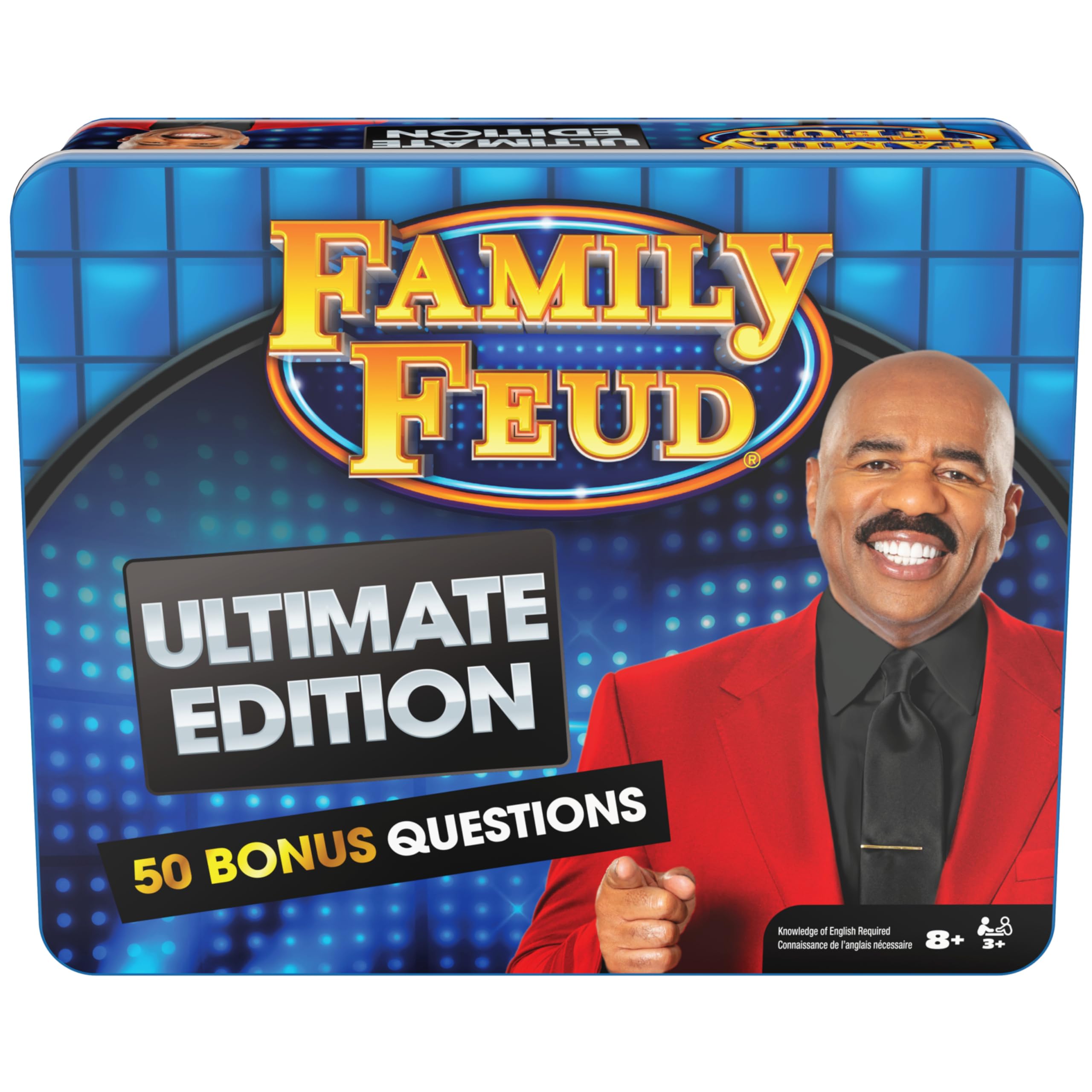
Split the room into two teams, hand someone the host card, and watch it take off.
Family Feud is the game for the group that wants to perform rather than strategise. Two teams, one person reading as Steve Harvey, and a race to shout the answers on the survey card. It needs at least 3 players, which is the realistic floor for this kind of game — below that the energy dies.
The contents are built for a rental shelf rather than a collector’s cabinet. It arrives in a collectible tin, and everything inside — 150 Face Off Question Cards, 50 Fast Money Cards, 1 Steve Harvey Card, 1 Dry Erase Scoreboard, 1 Dry Erase Marker, instructions — is thick card or hard board. Individual question cards are cheap to lose; the dry-erase marker is the one piece that dries out, so keep a spare pen in the tin.
Family Feud packs 50 bonus questions on top of the base set, which is the buffer that stops repeat guests from recognising every card. The honest catch is that this is a game about the people playing it — it needs a host who is willing to read aloud with some energy. Played passively, it falls flat. Played as a proper team show, it is the liveliest thing on the shelf.
Why the tin lives on the shelf
- Collectible tin keeps all the cards together in one place
- 200 question cards in total, so repeat guests get fresh surveys
- Quick 20-minute average that fits a pre-dinner slot
- Dry-erase scoreboard keeps scoring simple and visible
The honest catch
- Needs a vocal host — a shy group will let it die
- Requires at least 3 players, so couples cannot use it
- Requires power reading, not quite a sit-back experience
Best matched to: sociable groups of six to eight who enjoy a bit of improvisation.
Not the one if: you are setting up a two-person rental with no one to read the cards.
5. The Original TAPPLE, The Fun & Fast-Paced Family Word Game

Thirty seconds, one category, and a whole table shouting at the ceiling.
Tapple is all panic and laughter in the best way. Draw a category card, press the timer, and call out a word that fits while racing the clock; hit the matching letter tab as you go. A 15-minute estimated play time means it fits between ordering takeaway and eating it.
The wheel is the whole trick. It stores the 36 cards, holds the built-in timer, and carries 144 categories inside one portable unit — so there is nothing loose to lose, and no scoring pad to reprint. Bring it to the table, flip the lid, start. That self-contained design is what makes it reliable in a house where things get moved around between guests.
What nobody tells you on first play is how quickly a category goes dead. Once the obvious answers are used, you are staring at empty letter tabs while the timer runs down, which is exactly what makes the room laugh. The catch is the same one every timed game has: it rewards fast talkers, and a quiet guest can feel sidelined next to an extrovert. It is also a word game — a group with mixed English fluency will find the vocabulary race harder than the rules suggest.
Where it shines: the reusable wheel and 144 categories make it the easiest word game to grab and start.
Where it stumbles: speed rewards confident talkers, and mixed-language groups will feel the gap.
Hand it to: groups who enjoy quick-fire rounds and a lot of noise.
Hold back if: your regular guests include several people still building English vocabulary.
6. OK Play Tile Game: Ultimate Travel Board Game, 2-4 Players, Waterproof

The game that goes to the beach, comes back wet, and still works.
If your rental has an outdoor scene — a pool, a deck, a patio — this is the piece of the collection that leaves the house. OK Play is a tile-laying game where you build lines of five across, down or diagonally, and the whole set is waterproof plastic. It clips to a bag and goes anywhere, which is why it holds the top spot for portability.
The rules take seconds to explain but the outcome is not obvious — you lay tiles until someone sneaks a line of five, and the trick is blocking opponents while building your own run. For 2-4 players, rated 6 years and up, it scales down to a couple eating lunch outdoors as easily as it scales up to a family game after a swim.
The one honest caveat is durability, and it lands squarely in the mixed column. The set is plastic rather than the wooden tiles you would find on Qwirkle, and some buyers report the tiles cracking with heavy handle while others find the plastic perfectly serviceable. Treat it as a travel game rather than a forever piece — the waterproof shell is the point, not the finish quality.
Built for the outdoors
- Waterproof plastic survives the pool deck and a wet bag
- Clips to a bag and travels genuinely small
- 2-4 players, 6 years and up, seconds to learn
- Tiles lay fast, so a round fits a lunch break
Where it gives way
- Plastic tiles, not wood — reports of cracking under rough handling
- Lightweight pieces shift on a windy patio table
- Rated specifically for 6 years and up, which limits the toddler end
Treat it as: the outdoor and travel game in the collection, not the main table game.
skip it if: your guests never leave the living room and you want tiles that feel substantial.
7. BLANK SLATE Board Game, A Party Game of Addicting Predictions
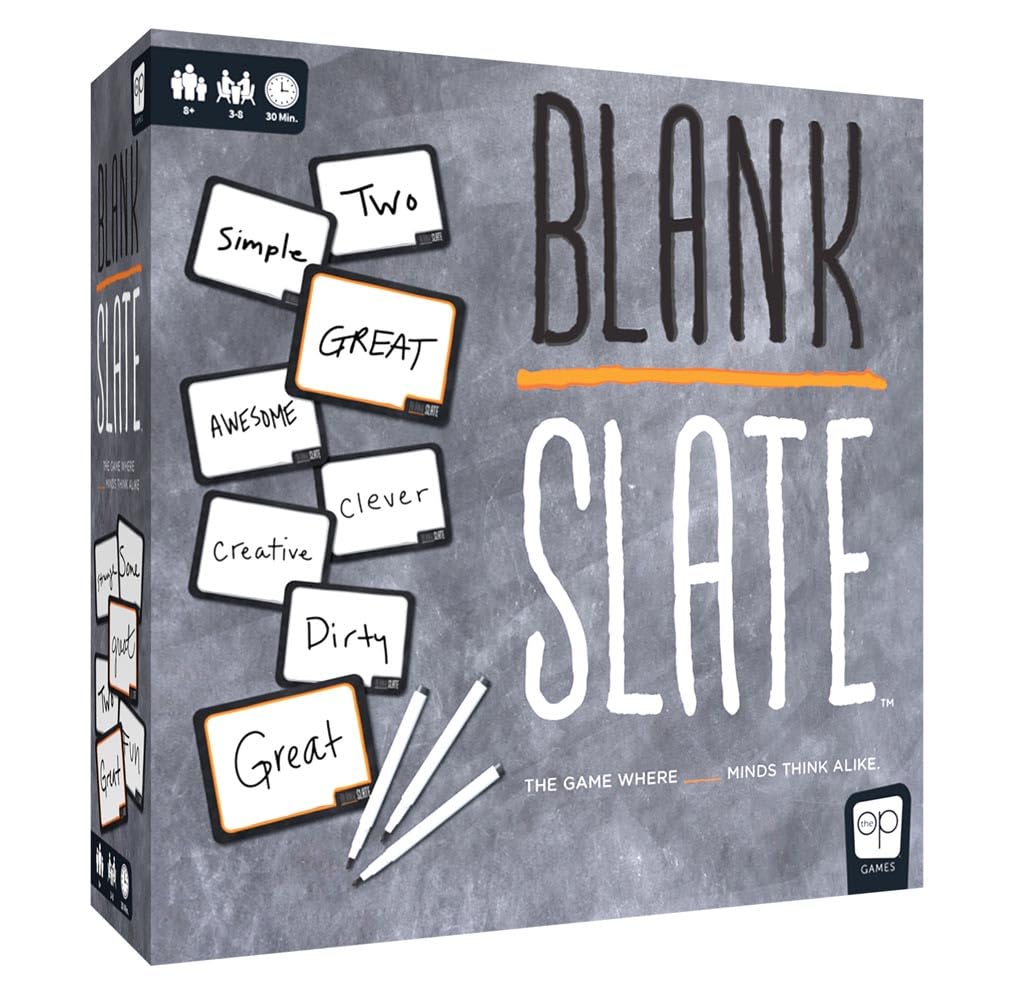
Everyone writes, nobody knows if they are on the same wavelength, and that’s the fun.
Blank Slate is the quiet party game. A word cue card shows a phrase with a blank, everyone writes the word they think best completes it, and you score when you match another player’s answer. It seats 3-8 players across a 20-35 minute play time, and it runs on dry-erase slates — 8 of them, so a big group is fully covered without passing anything around.
The space case is what makes it the easiest pick to stock. There is no board, no tiles and no central piece; each player works on their own slate, so the game fits on laps, on a small sofa or spread out on a dining table. The 250 double-sided word cue cards mean a party can rotate through rounds without repeating phrases. And the laughter is social — a lot of it comes from discovering your partner was never on the same wavelength.
The real-world trade — the one worth knowing before you stock it — is that Blank Slate rewards people who lean into conversation. It is not a spectator game. A table of quiet participants will find the writing hard, and someone who dislikes being put on the spot will not enjoy the guessing. For talkative groups it is one of the best conversation-starters on the shelf.
The shelf case: no board means it fits any table, and 8 slates means it covers a full party.
The honest limit: it asks people to be sociable; not every guest wants that on a first night.
Ideal for: adult groups and mixed-age families who like a bit of banter over a game.
Choose differently if: your guests want a game that fills time without talking.
8. Buffalo Games Plinko Game, Plink Hi-Lo, 18″, Prize Drop

The game that fills the “just the two of us” night with an 18-inch board.
Most rental games assume a crowd; Plinko assumes a couple or a small table. A chip drops, bounces down the pegs, and lands where it lands — push-your-luck play with an estimated 15-minute playtime. Setup takes moments, which matters when a guest wants something to do straight after check-in.
The contents are generous for the size: 37 Luxury Prize Cards, 98 Money Cards and 7 Plinko Chips sit alongside the 18-inch Plinko board. That gameboard is small enough to sit on a coffee table without swallowing the room, so it works in a compact rental where a huge board would dominate.
The honest trade concerns the build, and it is the one mixed area of the product. Owners describe a board that is great fun but made of light material, and a firm knock while an impatient player leans on it can tip it over. Treat it as a tabletop novelty rather than a heavy-duty centrepiece, and play it on a flat surface where nobody is jumping up mid-round. In that setting, the drop-and-bounce action holds the room.
Best bits for a compact rental
- 18-inch board takes up almost no table space
- 37 prize cards and 98 money cards give genuine variety
- Works with just 2 players, rare for a party game
- Sets up in moments with no rules to study
Set your expectations
- Light build — the board can tip if knocked
- Plastic construction, not a heavy wooden piece
- Keeps momentum with just a couple at the table
Good call for: couple-focused rentals where a board and two people is the whole group.
Think twice if: your guests are heavy-handed with games — that light board wants a flat, steady table.
9. Asmodee Ticket to Ride Board Game (2025 Refresh)
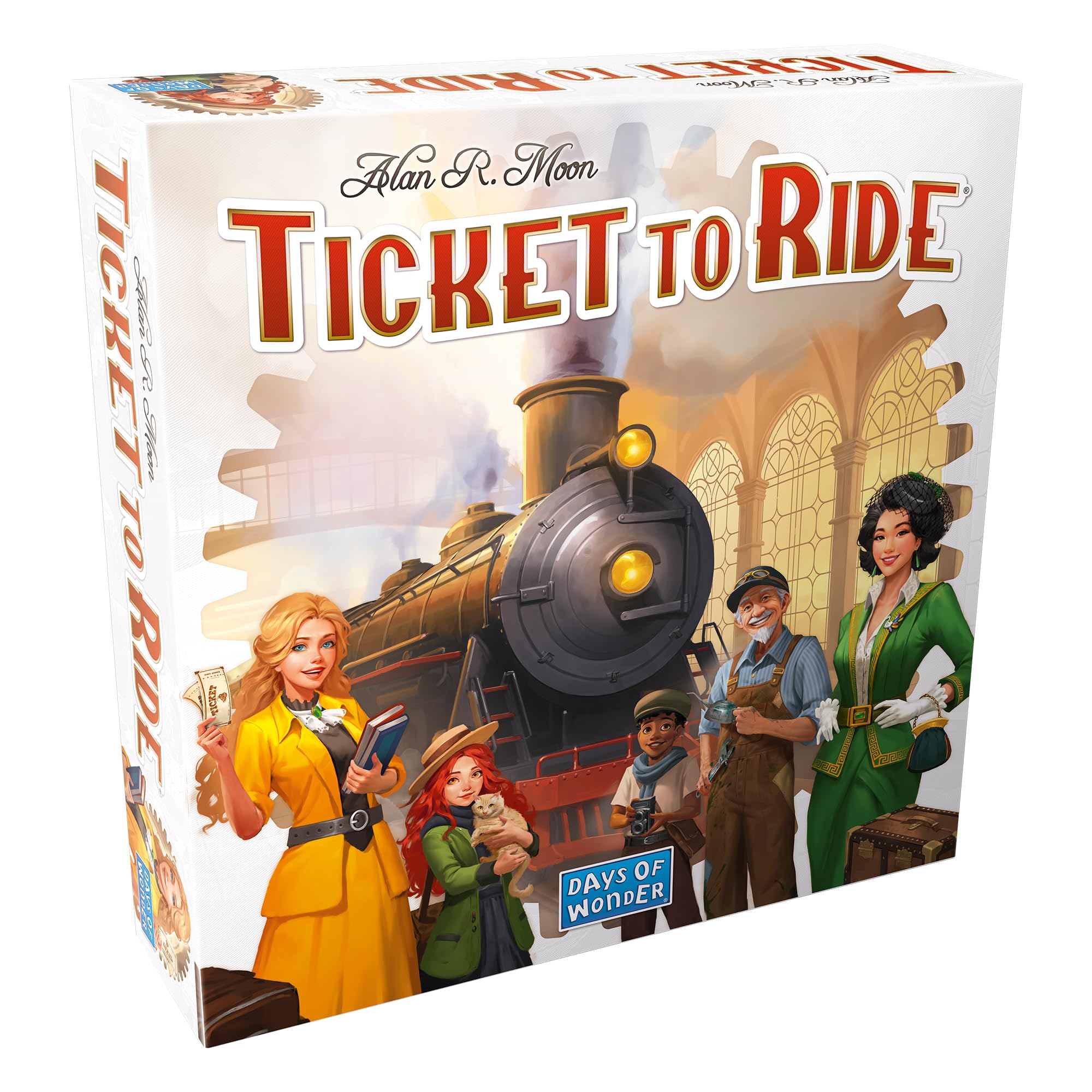
The one guests will clear a whole evening for, trains and all.
This is the premium pick, and the one to keep for the group who want a proper game night. Collect train cards, claim routes across a giant map of the North American network, and complete your tickets to score. The stated playtime is 30 minutes, though at 2-5 players it can stretch — this is an evening plan, not a filler.
The components are the draw. A giant game board, 225 plastic trains in 5 colours, 110 train cards, 33 tickets and 5 wooden scoring markers make it the most substantial box in the collection. It is also the one guests will photograph. The box measures 11.7 by 3 by 11.7 inches, while the OK Play travel set’s board measures 10.56 inches, and that difference reflects the different role: this is the table centrepiece, not the bag game.
The rules are the reason it works where heavier strategy games fail. Simple route-claiming is intuitive on the first turn, and children learn rail geography while adults chase the longest-path bonus. The trade is time and crowd size: it caps at 5 players and wants a committed 30 minutes or more, so it is not the game for a fast pre-dinner filler or a party of eight. Plan it for a whole evening, and it earns the shelf space.
The strongest asset: a giant map and 225 plastic trains that make a board game feel like an occasion.
The practical constraint: 2-5 players and a stated 30-minute playtime means it wants a planned evening, not a spare hour.
Worth keeping for: families and couples who will sit down for a full, proper game session.
Not the right fit if: your guest turnover is fast and the shelf needs quick 15-minute fillers instead.
Understanding the Specs
Player count
The player range printed on the box is the first spec to check. A game listed as 2-5 players will not seat a group of eight, and a game that needs at least 3 players is useless for a couple. Match the range to who actually stays in your rental, not who you wish would.
Play time
Estimated play time tells you where a game fits in the day. A 15-minute game is a coffee-break filler; a 20-minute game fits before dinner; a 30-minute stated playtime is an evening plan that can stretch longer with a full table. Stock a spread of all three rather than one.
Age guidance
Manufacturer recommended age is a starting point for reading rules and handling small pieces, not a hard boundary. A 6-years-and-up game still works with adults at the table. Use it to judge whether young guests can join without constant supervision.
Component materials
Wood and moulded plastic outlast thin card in a rental. Wooden tiles wipe clean and shrug off handling; dry-erase slates need capped markers; loose card tokens vanish. Choose hard materials when the game will be handled by people who never read the care note.
FAQ
How many board games should an Airbnb actually stock?
Will guests actually read a rulebook?
Which of these games works best for a group of eight?
Is Ticket to Ride too complicated for first-time players?
Do the dry-erase games dry out between guests?
What is the difference between Qwirkle and OK Play?
Can children under six play any of these games?
How do I stop pieces going missing between guests?
Is a party game better than a strategy game for a rental?
Final Thoughts: The Verdict
For most rentals, the game that earns its shelf space is the MindWare Qwirkle. It needs no rulebook teach, its 108 wooden tiles take endless handling, and it plays from 6 years and up so the whole guest group sits at one table. If you are stocking for a bigger house, add the Monopoly Knockout for its 2-8 player range and 20-minute rounds. And for the guests who want a real evening of play, the Ticket to Ride is the one they will clear the table for.
How We Picked
We do not accept paid placement. Every pick is matched to a real buyer and a real use-case; we do not hands-on test units.
Sources & Methodology
Specifications: manufacturer listings and product documentation. Review insights: verified customer reviews, as of November 2026. Pricing: not shown on this page (it changes often); check the current price via the retailer link.
As an Amazon Associate, Gadgets Feed earns from qualifying purchases. This does not affect which products we feature.