
Our readers keep the lights on and my morning glass full of iced black tea. As an Amazon Associate, I earn from qualifying purchases.
Specs are compiled from manufacturer listings and verified buyer reviews and can change over time — please confirm the key details on the product page before buying.
If you want to stop slipping on your own deck every time it gets wet, the fastest fix is a rubber-granule coating, not a standard house paint. The right one grabs wet fiberglass, holds up to sun and salt, and rolls on with a brush or roller you already own. This guide sorts out which coatings actually belong on a boat deck and which ones you should leave at the hardware store.
I’m Min — the founder and writer behind Gadgets Feed. This guide is built by comparing the manufacturers’ published specifications and the patterns across verified customer reviews, so you get each pick’s real strengths and trade-offs instead of marketing spin.
Boat decks live a harder life than a porch or a patio — they catch spray, sun, and foot traffic all season long. Whether you’re patching a small fiberglass runabout or resurfacing an entire working deck, the picks below cover the practical options: the boat deck paint that keeps your footing sure when everything else is slick with water.
Our Picks at a Glance

How To Choose The Best Boat Deck Paint
A boat deck is exposed to water, sun, and constant foot traffic — far harsher than a porch or garage floor. The coating you pick has to grip when wet, resist UV fading, and stick to whatever your deck is made of: fiberglass, aluminum, wood, or a previously painted surface. Here’s what actually drives the decision.
Texture: the difference between safe and slick
A textured coating — one with rubber granules or sand mixed in — gives your shoes something to bite into. Smooth finishes look cleaner and clean up easier, but they offer far less traction. If your deck sees bare feet or wet conditions, texture is worth the extra cleaning effort.
Coverage per gallon sets your real cost
Coverage is measured in square feet per gallon across a recommended two-coat application. A coating that covers 60 square feet per gallon means a gallon does roughly half the area of one rated at 150 square feet per gallon. Always measure your deck first and buy according to the two-coat figure, not the one-coat best case.
Prep work decides how long it lasts
Every coating here bonds better to a clean, scuffed, slightly rough surface. Oil, wax, and loose paint are the enemy. Most manufacturers recommend a solvent wipe or a light sanding before the first coat — skip that step and the coating can lift or flake, no matter how good the product is.
Quick Comparison
| Model | Best For | Coverage (2 Coats) | Finish | Grit Texture | Amazon |
|---|---|---|---|---|---|
| Durabak 18 (Textured, Quart)★ Best Overall | All-around non-slip decks | 60 sq ft per gallon | Semi-Gloss | Recycled rubber granules | Amazon |
| Ames Safe-T-DeckBudget Champion | Wood and concrete deck resurfacing | 150 sq ft per gallon | Matte | Granulated acrylic | Amazon |
| Durabak-18 Truck Bed Liner (Quart) | Spot treatments and trim | 15 sq ft per quart | Textured grit | Embedded rubber granules | Amazon |
| Tuff Coat Medium Texture | High-traffic docks and ramps | 45 sq ft per gallon | Matte | Cross-linked rubber granules | Amazon |
| Durabak 18 (Smooth, Gallon) | Smooth sealed decks and pools | 75 sq ft per gallon | Gloss | No grit | Amazon |
In-Depth Reviews
1. Durabak 18 (Textured, Quart), Grey
Our pick — over 4★ from 200+ verified ratings; the strongest balance of quality and price.
Recycled tire granules in a flexible polyurethane shell — the deck coating that stops the slip.
Durabak 18’s textured version mixes recycled rubber tire granules (ground-up tire rubber, essentially) into a one-part polyurethane coating. What that gives you is footing — the gritty surface grabs wet shoes where a smooth deck would slide. It’s the pick that covers the most ground per quart of anything here, and it bonds to fiberglass, wood, metal, concrete, and existing coated surfaces without a special primer in most cases.
The application is about as simple as coatings get: stir, brush or roll it on, let it moisture-cure (it hardens by reacting with humidity in the air). You’re not mixing two cans or timing a pot life. Buyers report using about two-thirds of a gallon on the first coat and less on the second, which tracks with the 60-square-foot-per-gallon two-coat rating. One useful note from owner experience: on a rough surface with tight corners, a brush beats a roller because the roller misses the nooks.
The honest catch is durability over the long haul. The manufacturer labels this a “permanent” barrier, but some owners mention the coating peeling after a couple of years while others call it bulletproof. How it holds up depends heavily on surface prep — oil, wax, or a glossy base can undermine the bond no matter how good the product is. Xylene (a solvent paint thinner) cleans up spills and helps prep, and it’s worth keeping on hand.
What it does best
- Covers 60 sq ft per gallon across two coats — the highest in this lineup
- Rubber-granule grip stays usable wet, and it’s a repairable single-part formula
- Bonds to fiberglass, wood, metal, and concrete without specialty primer
Where it asks a little patience
- Some customers note peeling after two years if prep isn’t thorough
- Color variance — the dark grey reads better than the light grey, per buyer notes
- Xylene prep and cleanup is not optional if you want it to last
Reach for this if: you want the best coverage-per-quart textured coating for a fiberglass or aluminum deck and you’ll take the 20 minutes to prep properly.
Look elsewhere if: you’re after a true smooth gloss finish — that’s the pick below.
2. Ames Safe-T-Deck Granulated Formula
The crowd-pleaser water-based formula that stretches a gallon the farthest and goes on with a fluffy roller.
If your deck is wood or concrete and you want to cover a lot of surface without buying a case of product, this is the value play. Safe-T-Deck covers 150 square feet per gallon across a two-coat application — for context, that’s well over double the coverage of the textured Durabak 18’s 60 square feet per gallon. On a large wooden deck, that difference is the whole job versus half the job.
It’s a water-based acrylic with a granulated texture (think fine sand baked into the paint). The big practical wins: water cleanup, low odor, and cleanup is a hose, not a can of solvent. It goes on with a brush, roller, or drywall hopper sprayer and dries to a textured matte finish that the maker describes as barefoot-friendly. Buyers confirm it lives up to its name — one put it this way: “No slipping even when covered with water.”
The recurring gripe is color accuracy and drying hardiness. The khaki tan runs lighter than the container image, and some reviewers point out the storm-sky blue-grey isn’t the dark grey pictured. It also chips from weather and dogs over a season or two, so on a working boat deck — not a porch or deck that stays out of the way — this is a lighter-duty option. As an exterior acrylic coating, it’s not designed for constant submersion the way a polyurethane is.
Who it really suits: this is the one to pick when the boat deck in question is wood or concrete and mostly dry — a covered deck, a screened porch, a low-traffic platform. It’s the lightest, easiest-to-apply option here and stretches the farthest.
What to consider: this is an exterior acrylic coating, not a marine polyurethane — it will not outperform the Durabak line on prolonged saltwater exposure. Color may be lighter than the container image suggests.
Made for: wood or concrete decks where coverage-per-gallon is the deciding number and you want water cleanup at the end of the job.
Not the one for: decks that sit wet or submerged — go with a polyurethane instead.
3. Durabak-18 Truck Bed Liner & Polyurethane Coating (Quart, White)
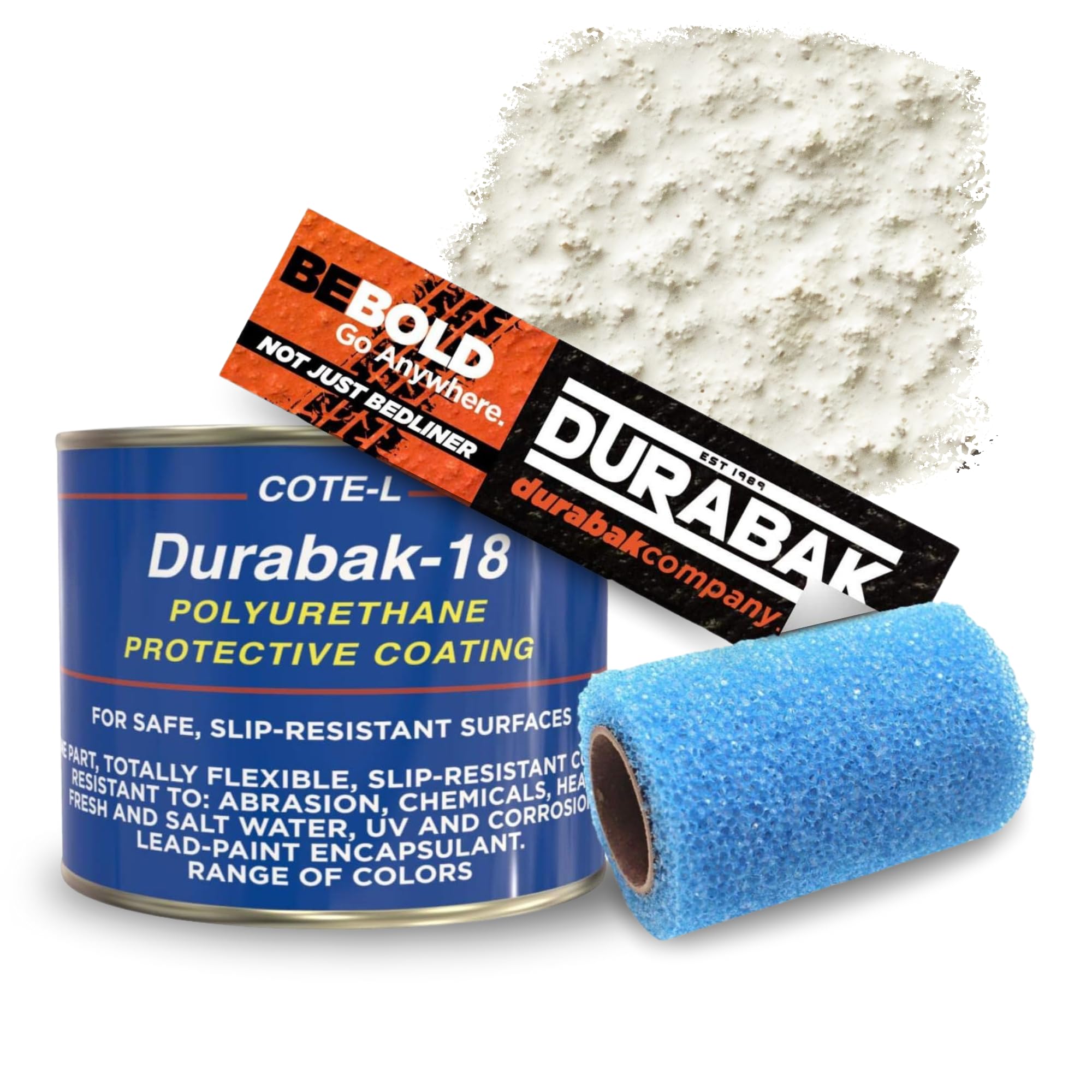
A small-quart marine polyurethane built for spot jobs — running boards, trim, ladders, and steps.
This is the same Durabak polyurethane chemistry as the pick above, but sold in a quart-sized format with 15 UV-stable colors and a stated coverage of just 15 square feet across two coats. That’s a project-size can, not a whole-deck can. If you’ve got a small fiberglass bow section, some aluminum trim, or running boards that get slick when it rains, this is the precise-buy option — you’re not opening a gallon to do a two-foot-square patch.
The application side is where buyers keep coming back. It’s a one-part formula (no two-can mixing), and it goes on with a brush or a specialty roller. The grip on wet surfaces is the headline: shoppers say the saltwater-resistant seal resolving slippery running boards, with one describing a two-year-old application that still shows no scratches, chips, or peeling. On a fiberglass or aluminum deck, the textured grit delivers the footing you need even when everything’s wet.
The main honest note is thickness and application demand. The formula is stiff — buyers report you have to stir, not shake, and it thickens fast once opened, so you work quickly. Gray doesn’t always match a lighter silver surface, and one quart really does only cover a very small area, so measure twice.
Why buyers seek it out
- 15 UV-stable colors, so you can match a specific hull or trim tone
- Saltwater-resistant seal that guards against rust and structural wear
- One-part formula applies with a brush or roller — no catalyst mixing
What to be ready for
- Only 15 sq ft of two-coat coverage per quart — small jobs only
- Very thick, so work fast or it starts to set in the tray
- Gray tone may not match every silver surface exactly
Your pick when: you’ve got a small fiberglass or aluminum area to cover and you want the same polyurethane durability as the big cans, in a smaller, easier-to-store container.
Skip if: you’re coating a full deck — one quart won’t get you there.
4. Tuff Coat Medium Texture Rubberized Non-Skid Deck Coating
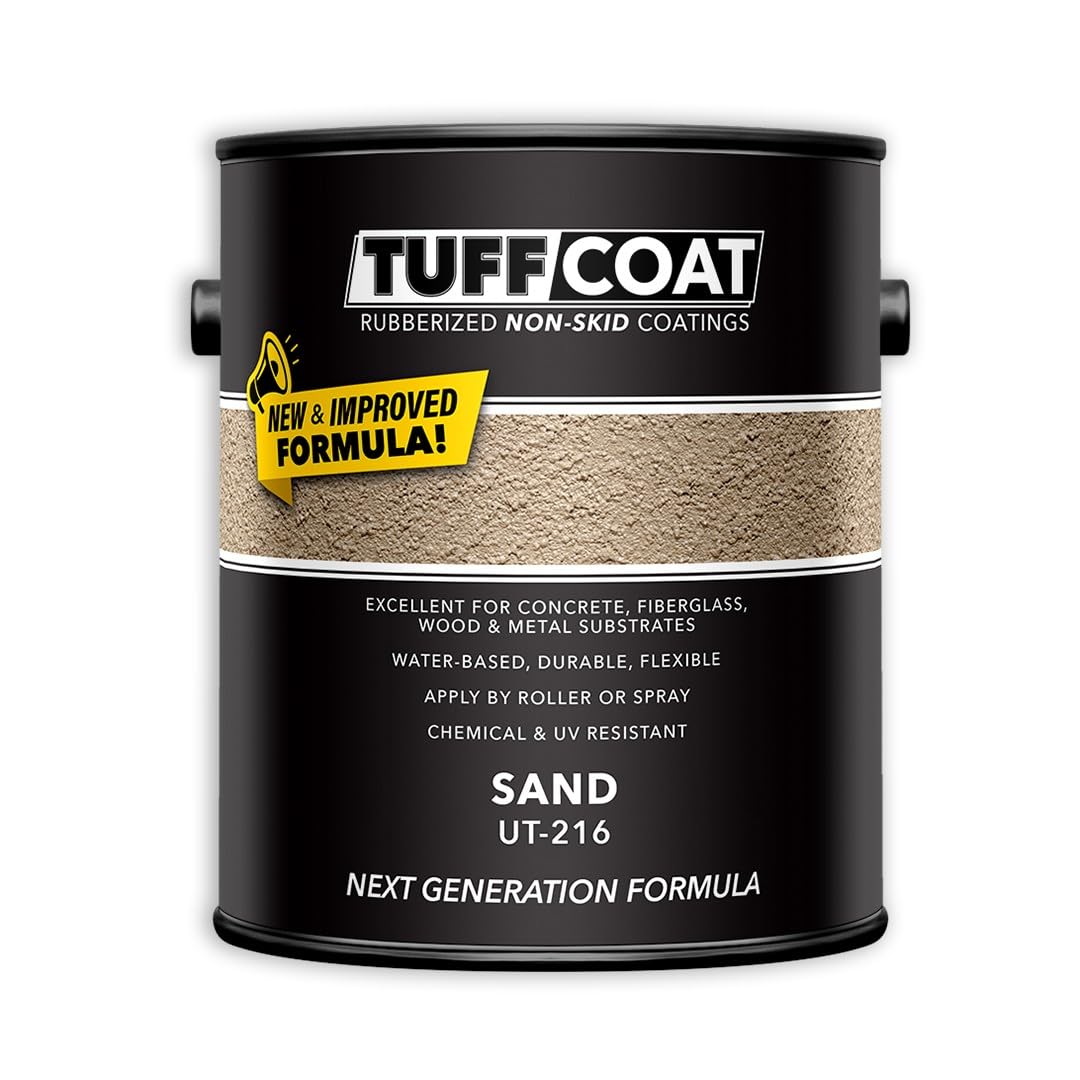
The flexible rubberized coating that goes where bare feet and heavy traffic meet — docks, ramps, and swim platforms.
This one is a cross-linked rubberized urethane coating designed for barefoot-safe slip resistance on splash pads, wave pools, marina docks, and boat ramps. The finish is a flexible matte that dries to 30–35 mils of thickness — roughly the thickness of a heavy business card — which is thick enough to hide cracks and imperfections in the surface below. That thickness also helps it mask old patches, which is a real benefit on an older deck. It’s rated for both wet and dry environments and can be used in or out of water.
Coverage is stated at 45 square feet per gallon, and it dries to the touch in 24 hours. Available in 17 colors. Buyers have applied it successfully to aluminum boat decks, fiberglass decks, and trailer boards, with several noting it goes on thick and works well once it’s mixed thoroughly with a wooden mixer or a drill paddle. One buyer described it reviving a fiberglass deck until it looked like new. The barefoot-friendly textured finish is a genuine advantage on a boat deck where you’re not always wearing shoes.
The important caveat is cure time — and it’s a big one. The coating needs a full 24-hour-plus window without rain. One buyer applied two gallons to a dock and 9 hours later, rain removed most of it. The manufacturer’s stated cure is 5–7 days. If your boat deck is exposed to weather, this is a product that demands you watch the forecast closely. It’s also less forgiving to apply than a straight acrylic — one buyer found the first coat clumpy and had to thin it slightly with water for the second coat.
The draw: a barefoot-friendly, crack-hiding, thick rubberized surface that does its best work on concrete, aluminum, and fiberglass where extra grip around water matters most.
The one hard requirement: don’t start this project unless you’ve got 5–7 days of dry weather on the calendar. Rain inside the cure window can strip a fresh coat right off.
Best for: docks, ramps, and swim platforms where thick, crack-masking, foot-friendly grip matters more than the easiest possible application.
Hold off if: your deck can’t stay dry for a week after you roll it on.
5. Durabak 18 (Smooth, Gallon), Black

The smooth, grit-free gallon that seals, waterproofs, and levels itself — grip without the rough texture.
Some decks don’t want coarse granules. This is the smooth version of Durabak 18 — same one-part moisture-cure polyurethane chemistry, but with no grit in the formula. It dries to a gloss finish in 24 hours and is listed as waterproof. Coverage comes in at 75 square feet per gallon across the recommended two coats, which is the highest of any Durabak product here. If your deck is fiberglass and you want a sealed, easy-to-clean surface that still provides grip when wet, this is the smooth-finish answer.
Owners mention a standout extra use: sealing surfaces that see soapy water. One applied it over a tile shower stall floor, where it self-leveled glass-smooth in about 20 minutes and gripped bare soapy feet well despite having no grit at all. That smooth, self-leveling property makes it a good fit for bare interior cockpits, cabin soles, or a sealed deck where you want appearance and waterproofing without a rough surface to scrub. It rolls on easy after surface prep — two coats, most commonly.
Two things to know before you commit. First, Durabak has a real shelf life even before it’s opened — customers note that a yellowish-orange tint in the can means a bad batch that xylene won’t fix, so buy from a source with fresh stock. Second, the fumes are strong; this is an outdoor-application, well-ventilated-space project. For the price of the largest can here — the biggest position on the list — you should plan a substantial, prep-heavy deck job, not an impulse patch.
The pitch: waterproofing and grip without grit — for a bare fiberglass or sealed deck that you want to clean easily and keep looking sharp.
What to plan for: buy fresh stock and check the color before you start. A yellow-orange tint in the can is a bad batch that you can’t rescue with thinner. Strong fumes mean you work outdoors or with the hatch open.
The right call if: you want a smooth, sealed, waterproof gloss deck that won’t shred bare feet or trap dirt in grit — and you’re coating a real surface area, not a corner patch.
Look elsewhere if: you need the roughest possible texture for a steep or heavily wet deck — go textured.
Understanding the Specs
Coverage per gallon
This is the number to lead with when you’re shopping any deck coating. It’s stated as square feet per gallon across the recommended two-coat application — so a product rated at 60 square feet per gallon means one gallon covers 60 square feet after both coats are down. The textured Durabak 18 and the smooth Durabak 18 quote 60 and 75 square feet per gallon respectively. But the small Durabak-18 quart is rated at only 15 square feet — that’s a patch container, not a deck container. Measure your deck, then divide by the stated per-gallon figure to know how many gallons you actually need. Always buy to the two-coat number, not the one-coat best case.
Grit texture versus smooth finish
Grit comes from rubber granules or sand mixed raw into the coating. It creates the friction that keeps your shoes from skipping on a wet deck, and it’s what makes a coating genuinely “non-skid.” Smooth coatings — like the smooth Durabak 18 gallon — give you waterproofing and grip through surface tension, not through raised texture. They clean easier and look more polished, but offer less traction when drenched. On any deck where you stand, walk, or land a fish with wet shoes, texture wins. On a bare cabin sole or a sealed deck you want to mop, smooth is the answer.
FAQ
How much paint do I need for a boat deck?
Can I use these on a fiberglass boat deck?
How long does boat deck paint take to dry?
Do I really need two coats?
Will it peel off after a couple of years?
Is the smooth version safe when my deck gets wet?
What temperature should I apply in?
Can I coat over an existing non-skid surface?
What’s the difference between boat deck paint and truck bed liner?
Final Thoughts: The Verdict
For most boat decks, the textured boat deck paint pick is the Durabak 18 (Textured, Quart) — it gives you rubber-granule grip, bonds to fiberglass, wood, and metal without a specialty primer, and covers more ground per can than any other textured option in this lineup. If you’re restoring a wooden deck and want the best coverage-per-gallon with water cleanup, the Ames Safe-T-Deck stretches the farthest for a working budget. And if you’re coating a small fiberglass or aluminum patch — running boards, bow trim, a spot repair — the Durabak-18 Truck Bed Liner quart gives you the same chemistry in a container that won’t waste product. Whichever way you go, take the prep seriously: it is the step that decides whether the coating lasts one season or several.
How We Picked
We do not accept paid placement. Every pick is matched to a real buyer and a real use-case; we do not hands-on test units.
Sources & Methodology
Specifications: manufacturer listings and product documentation. Review insights: verified customer reviews, as of September 2026. Pricing: not shown on this page (it changes often); check the current price via the retailer link.
As an Amazon Associate, Gadgets Feed earns from qualifying purchases. This does not affect which products we feature.