
Knowing what lies beneath your hull isn’t just about finding fish—it’s about protecting your propeller, avoiding groundings, and navigating unfamiliar waters with confidence. A reliable boat depth finder transforms a blind channel into a known path, reading the bottom contour, water temperature, and structure in real time so you can react before the damage is done.
I’m Min — the co-founder and writer behind Gadgets Feed. My approach to marine electronics is rooted in hundreds of hours of cross-referencing sonar technology, transducer types, display specifications, and real-world user reports to identify which units actually deliver under the demanding conditions of life on the water.
From shallow river deltas to deep offshore canyons, choosing the right best boat depth finder depends on understanding sonar frequencies, cone angles, and screen readability before you ever drop a line or throttle up.
How To Choose The Best Boat Depth Finder
Selecting a depth finder for your boat is not a one-size-fits-all decision. The unit that works flawlessly on a 14-foot jon boat may be nearly useless on a 28-foot cruiser at planing speed. You need to match the transducer type, sonar frequency, and display technology to your specific vessel, typical water depth, and primary use—whether that is navigation, structure hunting, or ice fishing.
Transducer Type and Installation
The transducer is the part that actually sends and receives sonar pulses. Transom-mount transducers attach to the back of the boat and are the most common choice for fiberglass and aluminum hulls. Thru-hull transducers require a hole drilled in the bottom of the hull and offer the cleanest reading at high speed, but they are significantly more expensive to install. Castable sonar sensors like the Deeper PRO+ 2 eliminate installation entirely—you simply tie them to a fishing line or a float and cast them off the side of the boat or shore.
Sonar Technology: CHIRP vs. Traditional 2D vs. Imaging
Traditional 2D sonar uses a single fixed frequency (typically 200 kHz) and is adequate for basic depth readings. CHIRP (Compressed High-Intensity Radar Pulse) sweeps across a range of frequencies, producing cleaner target separation and less noise at high speed. Down Imaging (DI) creates a photo-like picture of the bottom, revealing underwater trees, rocks, and bridge pilings. SideScan (SI) extends that picture left and right of the boat, allowing you to scout wide areas in a single pass. For pure depth finding and navigation, a CHIRP unit with Down Imaging is the sweet spot.
Display Size, Resolution, and Readability
At planing speeds above 30 mph, a small 4-inch screen becomes almost impossible to read at a glance. Look for a minimum 5-inch diagonal display for general navigation, and consider 7-inch or larger units if you regularly run in unfamiliar or narrow channels. Color TFT screens with 480 x 800 resolution or higher are now standard at mid-range price points. SolarMAX or Optically Bonded display technology reduces glare and keeps the screen readable when the sun is directly overhead—a critical detail often overlooked in online specifications.
Quick Comparison
On smaller screens, swipe sideways to see the full table.
| Model | Category | Best For | Key Spec | Amazon |
|---|---|---|---|---|
| Garmin Striker 7SV | Premium | SideScan for structure hunting | 7″ display, CHIRP + ClearVu + SideVu | Amazon |
| Lowrance Elite FS 10 | Premium | Large-screen chartplotter | 10″ touchscreen, Active Imaging 3-in-1 | Amazon |
| Humminbird Helix 5 Chirp G3 | Premium | Built-in GPS & AutoChart | 5″ display, Dual Spectrum CHIRP | Amazon |
| Garmin Striker Vivid 7cv | Premium | Crisp ClearVu imaging | 7″ display, CHIRP + ClearVu | Amazon |
| Lowrance HOOK Reveal 5 | Mid-Range | Auto-tuning CHIRP sonar | 5″ SolarMAX display, SplitShot transducer | Amazon |
| Humminbird PiranhaMAX 4 DI | Mid-Range | Budget Down Imaging entry | 4.3″ color display, Down Imaging | Amazon |
| HawkEye DT2BX-TM | Entry-Level | Simple dash-mounted depth | 2″ LCD, 600 ft max depth | Amazon |
| LUCKY Portable FF1108 | Entry-Level | Portable ice/shore fishing | 2.4″ LCD, 147 ft depth | Amazon |
| Deeper PRO+ 2 | Mid-Range | Castable sonar for kayaks | WiFi castable, 330 ft depth | Amazon |
In‑Depth Reviews
1. Garmin Striker 7SV

The Garmin Striker 7SV delivers the most complete picture of the underwater world at this size and price point. With a bright 7-inch sunlight-readable color TFT display, it combines CHIRP traditional sonar, ClearVu scanning (Down Imaging), and SideVu (SideScan) to reveal everything from individual fish holding tight to structure to submerged trees extending 100 feet to either side of the boat. The built-in Quickdraw Contours software records 1-foot contour intervals for up to 2 million acres of water, building a personal map of every lake you fish.
Wi-Fi connectivity pairs the unit with the ActiveCaptain app, allowing you to receive smart notifications and share waypoints without pulling an SD card. The included CV52HW-TM transducer covers high-wide CHIRP frequencies, and the transom-mount kit works on most aluminum and fiberglass hulls. Users report that down imaging shows individual fish, and side scan clearly identifies rock jetties, sunken timber, and brush piles after a simple transducer angle adjustment. The GPS does not include a chart plotter with built-in lake maps, but waypoint marking and route creation are fully functional.
On the water, the difference between a 5-inch screen and this 7-inch panel is immediately obvious—you can split the view between traditional 2D sonar and SideVu without losing readability. Battery consumption is reasonable for a unit this size, and the keypad interface is intuitive enough to master in a single outing. For boat owners who want serious scanning capability without crossing into the + realm, the Striker 7SV is the most complete package.
Why it’s great
- Excellent side and down imaging reveals structure clearly.
- Quickdraw Contours builds custom 1-foot contour maps.
- Sunlight-readable 7-inch display reduces glare at planing speeds.
Good to know
- No pre-loaded chart plotter mapping.
- ActiveCaptain app can be finicky in direct sun.
- Transducer angle adjustment is critical for clean side scan.
2. Lowrance Elite FS 10
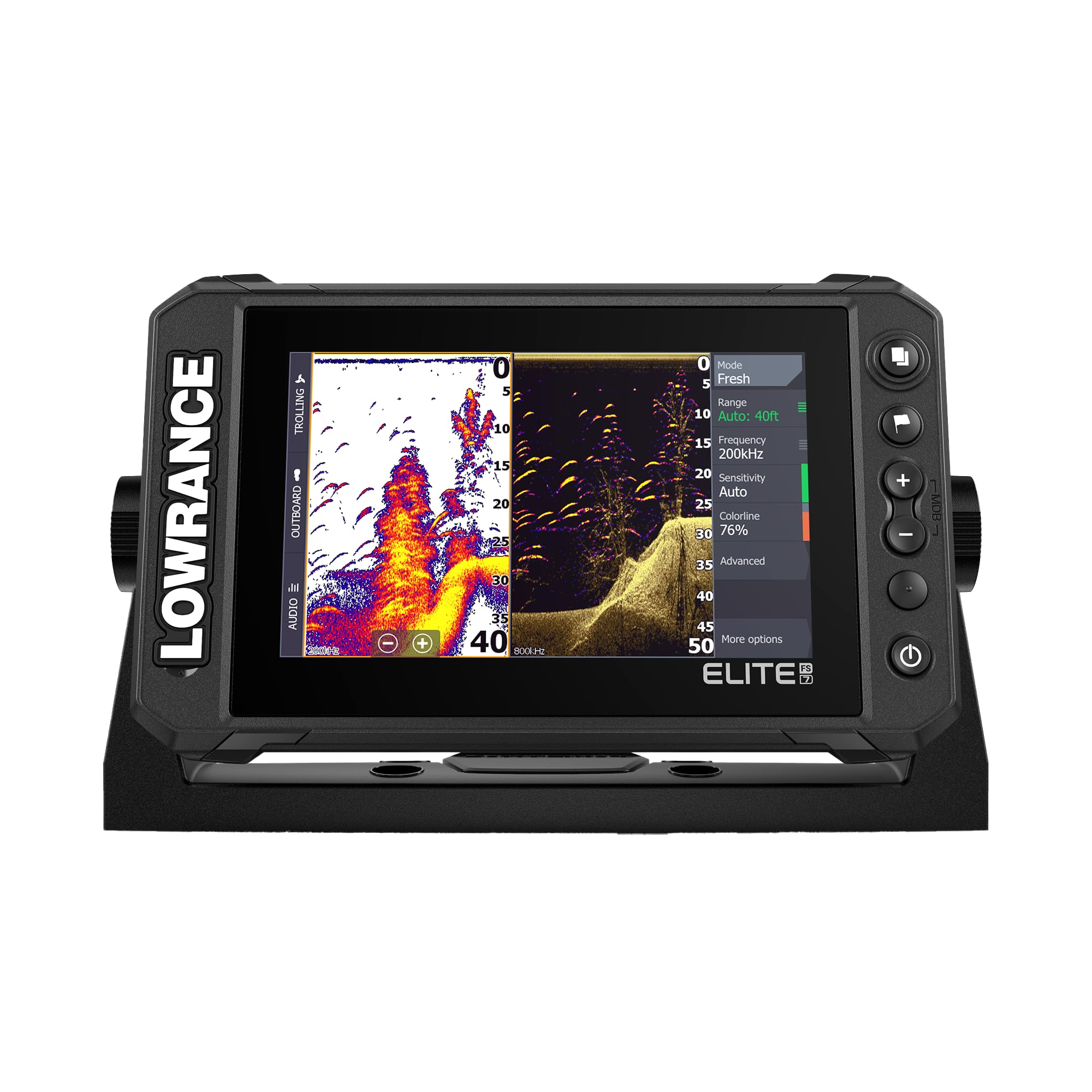
The Lowrance Elite FS 10 is a full-featured fishfinder/chartplotter built for serious anglers who want a large, responsive touchscreen without moving to a commercial-grade system. The 10-inch LCD display with FishReveal technology combines CHIRP sonar target separation with DownScan Imaging to light up fish arches against the structure. The Active Imaging 3-in-1 transducer delivers CHIRP, SideScan, and DownScan in a single transom-mount package, so you can view a split-screen of traditional sonar and a photo-like bottom image simultaneously.
Preloaded C-MAP US Inland mapping covers nearly 4,000 lakes, and the Elite FS is live-sonar compatible with the ActiveTarget 2 XL transducer (sold separately) for real-time views of fish movement under the boat. The touchscreen interface makes zooming and panning on the chart fast, though it does come with a learning curve for users accustomed to keypad-only controls. Connectivity includes NMEA 2000 for integration with trolling motors and marine electronics, plus wireless screen mirroring to a tablet or phone.
Installation is straightforward for a 10-inch unit: the bracket mount fits standard dash cutouts, and the included power cable with inline fuse simplifies wiring. The unit weighs 3.7 pounds, so ensure your mounting surface is solid. The C-MAP contour maps excel at highlighting ledges and drop-offs, and eight hours of built-in Genesis Live recording time lets you customize details in real time. For a large-format chartplotter that still prioritizes sonar performance, this is the benchmark.
Why it’s great
- Large 10-inch touchscreen with excellent daylight visibility.
- Active Imaging 3-in-1 covers CHIRP, SideScan, and DownScan.
- Live sonar ready with ActiveTarget 2 XL compatibility.
Good to know
- Touchscreen learning curve for keypad users.
- Live sonar transducer costs extra.
- Requires solid mounting surface due to weight.
3. Humminbird Helix 5 Chirp G3

Humminbird’s Helix 5 Chirp G3 packs GPS chartplotting and Dual Spectrum CHIRP sonar into a compact 5-inch package that fits perfectly on smaller dashboards or tiller-steer boats. The Dual Spectrum technology lets you toggle between Wide Mode for maximum coverage and Narrow Mode for hyper-detailed scanning of fish-holding structure—all powered by the included XNT 9 HW T transom-mount transducer. The built-in Humminbird Basemap provides coverage for over 10,000 lakes and the continental US coastline, so you have navigable charts out of the box.
Real-time mapping via AutoChart Live creates depth contours, bottom hardness, and vegetation maps as you drive, with eight hours of built-in recording memory. The keypad control system is reliable in wet conditions, and the color TFT screen remains readable even with direct sunlight overhead (a visor is recommended). Existing users with multiple Humminbird transducers can often splice the pigtail for compatibility. The unit is also compatible with premium LakeMaster, CoastMaster, and Navionics charts if you need higher-detail lake mapping.
The main trade-off is screen size: at 5 inches, split-view modes (sonar + chart) require closer attention than a 7-inch unit, but the crisp 480 x 800 resolution helps. The transducer cable length is typically just enough for a 20-foot pontoon, so measure your run before installation. For boat owners who want GPS mapping and reliable CHIRP sonar in a compact, budget-friendly package, the Helix 5 Chirp G3 is the smart choice.
Why it’s great
- Built-in Basemap with 10,000+ lakes and US coastlines.
- AutoChart Live creates custom contour maps in real time.
- Dual Spectrum CHIRP offers wide and narrow scanning modes.
Good to know
- 5-inch screen feels small for split-view sonar and chart.
- Transducer cable length may be tight on larger boats.
- Sun visor sold separately from the base unit.
4. Garmin Striker Vivid 7cv

The Garmin Striker Vivid 7cv brings high-contrast color palettes and ClearVu scanning sonar to a 7-inch QSVGA display at a mid-premium price point. Unlike the Striker 7SV, this unit focuses on down imaging (ClearVu) rather than side imaging, making it a better choice for anglers who mainly want to see what is directly under the boat—submerged timber, rock piles, bridge pilings—rather than scanning wide areas to either side. The 7-inch screen is noticeably larger than the 5-inch Striker Vivid 4cv and makes split-view sonar much more usable.
The included transducer delivers CHIRP traditional sonar and ClearVu scanning with outstanding target separation. Users report being able to identify individual fish resting on the bottom and even distinguishing a metal drum from surrounding mud. The GPS functionality supports waypoint marking and route creation but does not include pre-loaded topography maps; you are essentially building your own map with waypoints as you explore. The unit also streams sonar data to a tablet or phone via the ActiveCaptain app when connected to onboard Wi-Fi.
Setup requires a separate transducer mount, device mount, and a 12.5V battery—check your boat’s electrical system before purchasing. The protective cover is included, which is a nice bonus for storage. Image quality is excellent out of the box: set backlight to 100% and increase ClearVu contrast for the best picture on bright days. For pure down-looking sonar clarity at this screen size, the Striker Vivid 7cv is the most cost-effective choice on the market.
Why it’s great
- 7-inch QSVGA display with vibrant color palettes.
- ClearVu shows incredible bottom detail and structure.
- Included protective cover for storage.
Good to know
- No pre-loaded topography maps.
- Requires separate transducer and device mounts.
- No SideVu—down imaging only.
5. Lowrance HOOK Reveal 5 SplitShot

The Lowrance HOOK Reveal 5 SplitShot is the most well-rounded value proposition in the mid-range sonar category. The auto-tuning sonar feature is the standout: it continuously adjusts gain, range, and sensitivity as water conditions change, so you spend your time fishing rather than tweaking dials. FishReveal technology merges CHIRP target separation with DownScan Imaging, displaying fish arches that are clearly distinguishable from the bottom structure—no guessing whether that blob is a fish or a weed bed.
The 5-inch SolarMAX display is optically bonded to reduce glare, and in direct sunlight it significantly outperforms standard LCD panels at this price. The SplitShot transducer includes both wide-angle high CHIRP sonar and DownScan Imaging elements in a single transom-mount unit, so you get excellent coverage without running two separate transducers. Preloaded C-MAP US Inland maps cover nearly 4,000 US lakes, and Genesis Live lets you create custom contour maps with greater detail over any existing map.
Installation is straightforward: the included bracket, power cable, and split-shot transducer mount in under an hour on most small to mid-size boats. The 5-inch screen is the primary limitation if you plan to run split views of sonar and chart side by side, but for pure depth finding and fish spotting, the screen size and resolution are perfectly adequate. For the angler who wants CHIRP and Down Imaging without a steep learning curve, the HOOK Reveal 5 is the smart buy.
Why it’s great
- Auto-tuning sonar adapts to changing water conditions.
- FishReveal merges CHIRP and DownScan for clear target ID.
- SolarMAX display stays readable in bright sunlight.
Good to know
- 5-inch screen is small for split-view modes.
- Preloaded maps lack high-detail for smaller private lakes.
- No networking/NMEA 2000 for advanced integration.
6. Humminbird PiranhaMAX 4 DI

Humminbird’s PiranhaMAX 4 DI is the most affordable way to get Down Imaging on your boat. The 4.3-inch color TFT display may be small by modern standards, but it delivers a clear picture of underwater structure—timber, brush, bridge pilings—with the included XNT 9 DI T transom-mount transducer. Dual Beam sonar lets you choose between a narrow 20-degree beam for detail and a wide 60-degree beam for coverage, and the Fish ID+ system simplifies interpretation with on-screen fish symbols and depth alarms.
The compact footprint fits kayak consoles, small jon boats, and even inflatable pontoons. The tilt-and-swivel mount makes it easy to angle the screen toward the viewer in any seating position. Battery consumption is low enough that it can run on a small 7Ah battery for an entire day. The menu system is the same straightforward interface found on larger Humminbird units, so upgrading later is a seamless transition.
The primary drawback is the transducer cable: many users report it is about 2 feet too short to reach the dashboard on 24-foot pontoon boats, requiring a extension cable. The display is also not optically bonded, so glare can be an issue in direct overhead sunlight. For the budget-conscious boater who wants to see what is below without breaking the bank, the PiranhaMAX 4 DI delivers the essential Down Imaging experience at an entry-level price.
Why it’s great
- Down Imaging at the lowest price point available.
- Compact size fits kayaks and small boats easily.
- Simple menu interface shared with larger Humminbird units.
Good to know
- Transducer cable is often too short for larger boats.
- Screen glare can be problematic in direct sun.
- No GPS or chartplotting capability.
7. HawkEye DT2BX-TM
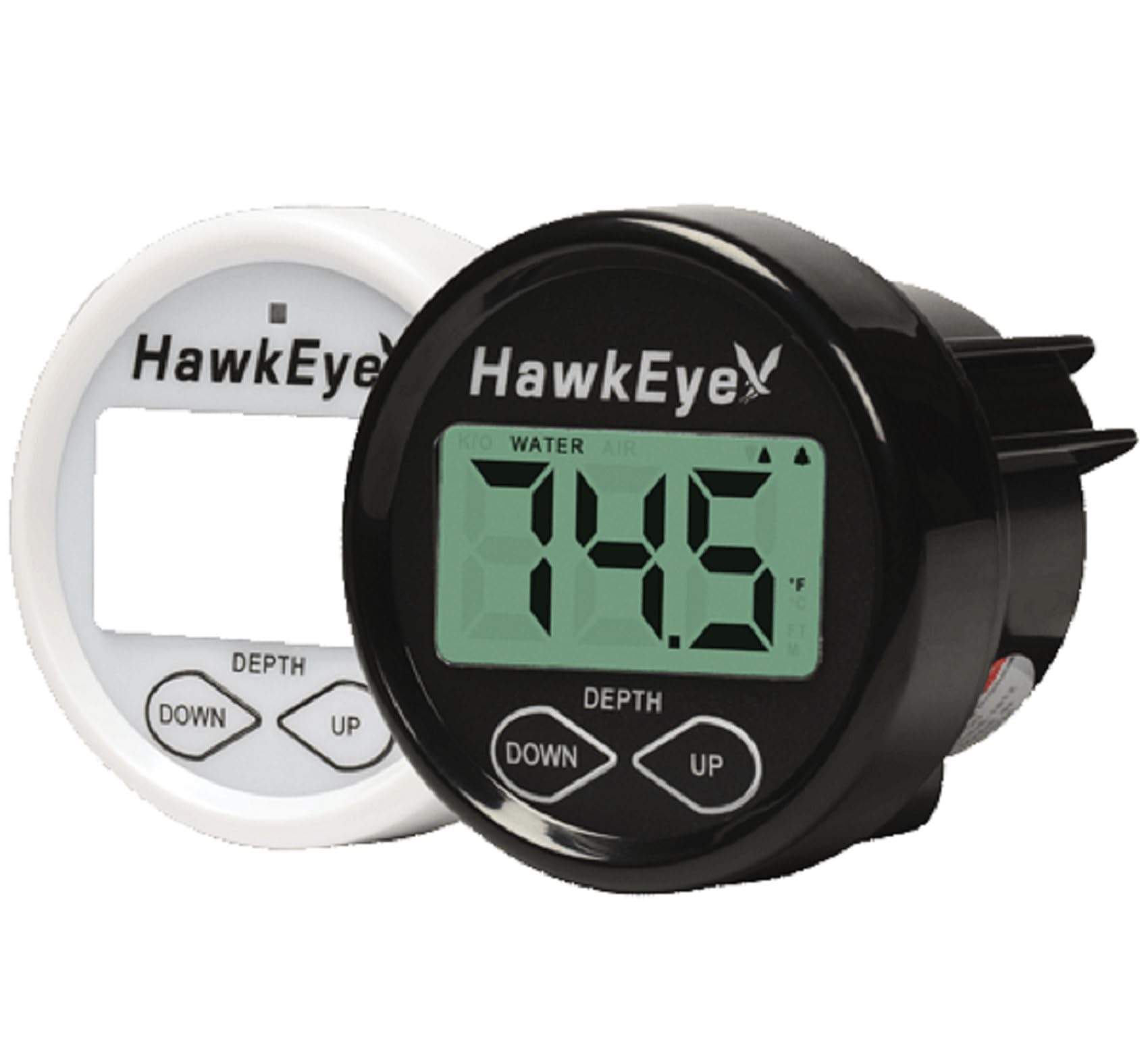
The HawkEye DT2BX-TM is a purpose-built in-dash depth sounder designed for boaters who need reliable depth readings and nothing else. It reads from 2.5 feet down to 600 feet on a large (for its class) polarized LCD display, and the 3-stage Advanced Warning System uses an audible alarm, LED warning light, and LCD indicator to signal shallow water, anchor drift, or high-speed conditions. One-touch alarm muting keeps the alert from becoming annoying while you navigate a known channel.
The transducer is a transom-mount variety with 30 feet of cable, and the display requires only a 2-inch hole for flush mounting—perfect for replacing an old analog depth sounder in an existing dash hole. The unit also displays water and air temperature in Fahrenheit or Celsius. Algorithmic programming helps filter out false readings from turbulence or debris, which is a genuine concern with non-CHIRP units at high speed. The storage sun cover keeps the screen spot-free and readable when the boat is parked.
The trade-off for simplicity is that this is not a fish finder—there are no fish icons, no down imaging, and no GPS. It is purely a depth and temperature gauge. Some users report intermittent depth readings after extended use, and HawkEye’s customer support has received criticism for being unhelpful with warranty claims. For the navigator who simply needs a clear depth number at a glance, especially on larger fishing boats or cruisers that already have a separate fish finder, the DT2BX-TM is a functional and affordable solution.
Why it’s great
- 600-foot depth capability for offshore navigation.
- 3-stage alarm system with audible and visual alerts.
- Simple 2-inch hole installation in existing dash cutouts.
Good to know
- No fish finding, GPS, or imaging features.
- Reports of intermittent depth readings over time.
- Customer support quality has mixed reviews.
8. LUCKY Portable FF1108
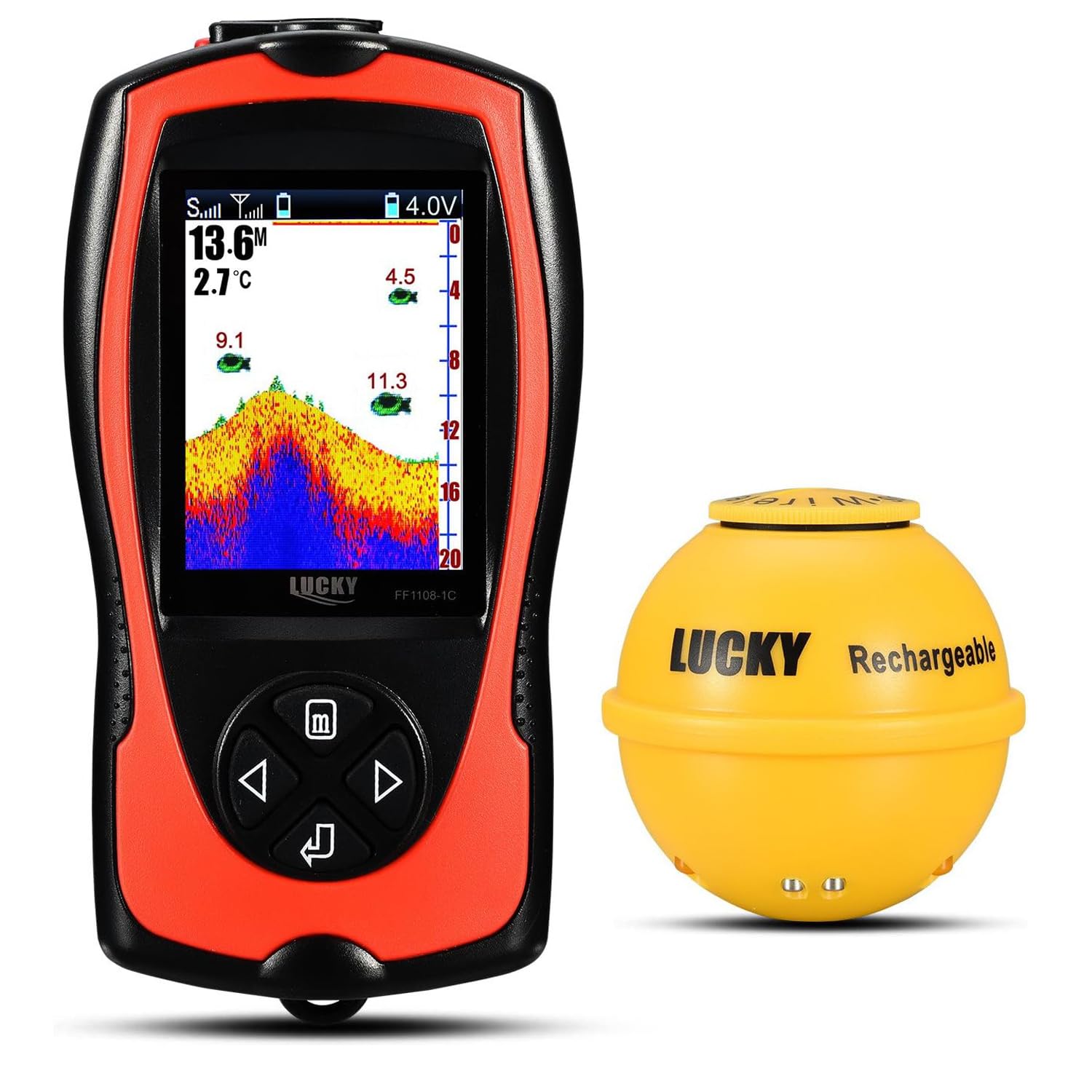
The LUCKY FF1108 is a portable, self-contained fish finder that requires zero boat installation. The handheld unit communicates wirelessly with a floating sonar sensor over a 492-foot range, displaying depth, water temperature, and fish size on a 2.4-inch TFT color LCD screen. The sensor has a built-in fish attractive lamp and a transparent replacement cover that lets you see the LED in the dark. Maximum depth detection is 147 feet, and both the handheld and sensor are rechargeable via USB.
Two operating modes—Wireless and Simulation—let you practice reading sonar before you hit the water. The sensor floats on the surface and is typically cast from shore, dropped through an ice hole, or towed behind a kayak on a fishing line. Users report accurate readings in shallow calm canals and lakes, with the handheld lasting about 4 hours of moderate use and the sensor lasting up to 10 hours. Sensitivity, brightness, depth range, zoom, and alarms are all adjustable through the menu.
The main limitation is reliability: the sensor struggles to distinguish debris from fish in murky water, and some users report the unit failing within a year. At its price point, it is best viewed as an entry-level tool for ice fishing or bank fishing where a fixed installation is not practical. For the kayaker or shore angler who wants a basic depth reading and fish icon display without drilling into their boat, the LUCKY FF1108 is a functional, no-commitment starting point.
Why it’s great
- Fully portable—no boat installation required.
- Rechargeable handheld and sensor via USB.
- Simulation mode for practicing sonar interpretation.
Good to know
- Struggles to distinguish fish from debris in murky water.
- Reliability concerns—some units fail within a year.
- 147-foot depth limit limits offshore use.
9. Deeper PRO+ 2
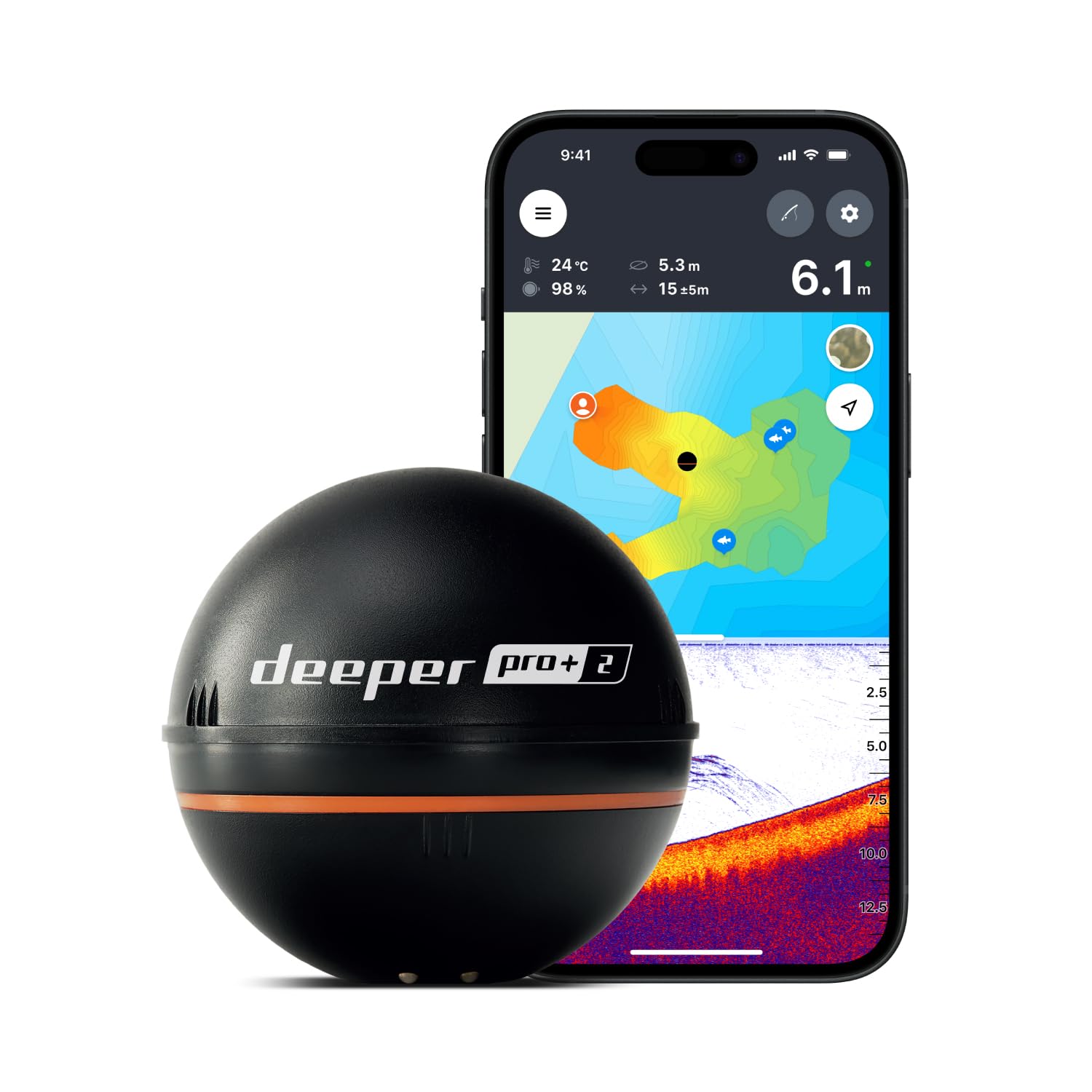
The Deeper PRO+ 2 takes a completely different approach from traditional fixed-mount sonar: it is a castable WiFi sonar sensor that streams detailed bathymetric data to your smartphone or tablet via the Fish Deeper app. The sensor is roughly the size of a tennis ball and weighs 3.2 ounces, making it light enough for a 20lb+ braided fishing line but heavy enough to cast accurately. It operates at up to 330 feet of depth with three selectable beam angles—narrow (7°), mid (20°), and wide (47°)—allowing you to zoom in on a specific target or cover wide areas from shore or kayak.
The built-in GPS creates bathymetric maps of the waterbody as you scan, saving everything to the integrated app. Target separation is impressive: 0.4 inches on the narrow beam is enough to track even a tiny lure when vertical jigging. The sensor connects via WiFi (not Bluetooth), providing a stable link up to about 200 feet in open water. The lithium battery delivers 5–7 hours of constant use, and the unit charges via a standard USB cable. The app is intuitive, with fish icons, depth graphs, and a handy cone-width calculator (7° scan width = depth × 0.122).
The main drawbacks are the need for a stout rod (the sensor is heavy enough to feel like a small plug) and the fact that the battery is not user-replaceable—when it dies after a few years, the sensor must be sent in for service. The app also has some upsells for premium features and can occasionally lose WiFi connection in heavy chop. For the shore angler, kayak fisherman, or ice angler who values portability and map-building ability over a fixed dash display, the Deeper PRO+ 2 is a uniquely capable tool.
Why it’s great
- Castable WiFi sonar creates bathymetric maps from shore.
- Three beam angles for scanning versatility.
- Excellent target separation (0.4 inches on narrow beam).
Good to know
- Non-replaceable battery requires factory service after a few years.
- Requires a stout rod rated for at least 20lb braid.
- WiFi connection can drop in rough water conditions.
FAQ
Can I mount a transom transducer on an aluminum V-hull boat?
What does the cone angle mean in practical fishing terms?
Is the 147-foot depth rating on the LUCKY portable sufficient for coastal boating?
Can I use a fish finder transducer inside a kayak without mounting it outside?
Final Thoughts: The Verdict
For most boat owners, the best boat depth finder winner is the Garmin Striker 7SV because it balances a large sunlight-readable 7-inch display with CHIRP, ClearVu, and SideVu sonar for a complete underwater picture, plus built-in Quickdraw Contours mapping and WiFi connectivity. If you want the largest screen and touchscreen chartplotter performance, grab the Lowrance Elite FS 10. And for the angler who needs compact GPS mapping with CHIRP sonar at a lower price, nothing beats the Humminbird Helix 5 Chirp G3.