
Our readers keep the lights on and my morning glass full of iced black tea. As an Amazon Associate, I earn from qualifying purchases.
Specs are compiled from manufacturer listings and verified buyer reviews and can change over time — please confirm the key details on the product page before buying.
Out on the water, the gear that talks, listens, and sees below the surface is what turns a boat into a true vessel. A VHF radio that picks up faint hails, a sonar unit that reads the lakebed’s every contour, or a stereo that cuts through the engine rumble — these are not accessories; they are the tools of safe navigation, productive fishing, and an enjoyable day afloat. This guide sorts through the essential categories of marine electronics — from fixed-mount radios to handhelds, fish finders for shallow flats and deep offshore water, to audio systems built for salt spray — so you know exactly which piece of kit fits your boat and your habits. It distills hours of spec-sheet research and the real-world conclusions of thousands of owners into clear, usable recommendations.
I’m Min — the founder and writer behind Gadgets Feed. This guide is built by comparing the manufacturers’ published specifications and the patterns across verified customer reviews, so you get each pick’s real strengths and trade-offs instead of marketing spin.
Whether you are replacing a dead radio, upgrading the sound system, or adding your first fish finder, this roundup of the best boat electronics covers fixed mount and handheld VHF radios, detailed fish finders from value to premium, and a marine stereo built to endure — all backed by real owner experiences.
Our Picks at a Glance


How To Choose The Best Boat Electronics
Boat electronics fall into distinct categories — communication radios, sonar fish finders, and marine audio — and each category serves a very different purpose. The first decision is simply what you need: a reliable safety radio for a coastal cruiser is a fixed-mount VHF with DSC; the same duty for a kayak or dinghy is a floating handheld. For finding fish, the debate is between basic 2D sonar, Down Imaging for structure detail, or Side Imaging for sweeping a wide area. A marine stereo is about power output in watts, zone control, and Bluetooth reliability. Matching the device to how you use your boat is more important than chasing every feature.
Communication Reach and Power
A fixed-mount VHF radio operates at 25 watts of transmit power, giving you the longest possible range and the most reliable connection to the Coast Guard or other vessels. A handheld VHF typically puts out 5 or 6 watts — enough for short-range communication between boats or hailing a marina, but not the kind of reach you want in an open-water emergency. If your boat has a permanent helm, a fixed-mount is the safer choice. A handheld is a supplement, or the primary radio on a small open boat, where it can be clipped to a life jacket.
Sonar Types and What They Show You
Traditional 2D sonar sends a single cone-shaped sound wave and shows the bottom profile and fish arches. Down Imaging sends a thin blade-shaped wave and returns a photo-like image of structure — logs, docks, rock piles — but covers a narrow strip. Side Imaging sends beams to both sides and gives you a wide birds-eye view of what is to the left and right of your boat. A unit with CHIRP (Compressed High-Intensity Radiated Pulse) sends a sweep of frequencies, giving you better target separation and less noise at speed. For most anglers, a combo of CHIRP and Down Imaging is the balance.
Waterproofing and Marine Durability
The IPX rating tells you how much water the device can survive. IPX7 means it can be submerged in up to 1 meter of water for 30 minutes — the standard for safe deck mounting. IPX8 means it can survive continuous submersion, typically to a specified depth, and is the toughest rating for fixed-mount radios. A handheld radio that floats (self-buoyant) gives you a safety net if it goes overboard. For fish finders, the transducer is in the water and the display head is above the deck — the head’s rating matters only if it will be exposed to spray rather than housed under a dash.
Screen Size and Readability
A fish finder screen between 4.3 inches and 5 inches is fine for a small boat or kayak, where the unit sits close. A 7-inch screen gives you enough real estate to view sonar, maps, and GPS data side by side — a must if you are running routes and marking waypoints. The key spec here is display type: a SolarMAX or daylight-readable display ensures you can see the screen in full sun without cupping your hand over it. A higher resolution (pixel count) means sharper images, but for amateur use, a decent 480 x 800 screen is serviceable.
Quick Comparison
| Model | Best For | Power/Design | Display Size | Key Feature | Amazon |
|---|---|---|---|---|---|
| Uniden UM435BK★ Best Overall | Safe fixed-mount communication | 25 Watt, IPX8 | N/A (radio) | DSC & All Channels | Amazon |
| Standard Horizon HX210Floating Companion | Floating handheld VHF | 6 Watt, self-buoyant | N/A (radio) | 18-hour battery | Amazon |
| LUCKY Portable SonarPortable Sounder | Shore/kayak fishing | Wireless castable | LCD display | 147 ft depth | Amazon |
| Uniden UM725G | Advanced radio with text | 25 Watt, IPX8 | Largest in class | Built-in GPS | Amazon |
| Humminbird PiranhaMAX 4 | Entry-level Down Imaging | Corded electric | 4.3-inch color | Down Imaging sonar | Amazon |
| Humminbird Helix 5 Sonar G2 | No-nonsense sonar | Battery powered | 5-inch widescreen | SwitchFire Sonar | Amazon |
| ICOM IC-M73 | Premium handheld VHF | 6 Watt, submersible | N/A (radio) | 18-hour battery life | Amazon |
| Lowrance HOOK Reveal 5 | Anglers needing maps | 12 Volt DC | 5-inch SolarMAX | FishReveal & maps | Amazon |
| Fusion MS-RA70 | Marine audio upgrade | 4×50 Watt, IPX7 | 2.6-inch LCD | 2-Zone Bluetooth | Amazon |
| Garmin Striker Vivid 7cv | Detailed CHIRP sonar | Battery powered | 7-inch color | Vivid color palettes | Amazon |
| Garmin Striker 7SV | Side & Down scanning | Battery powered | 7-inch color | SideVu & ClearVu | Amazon |
In‑Depth Reviews
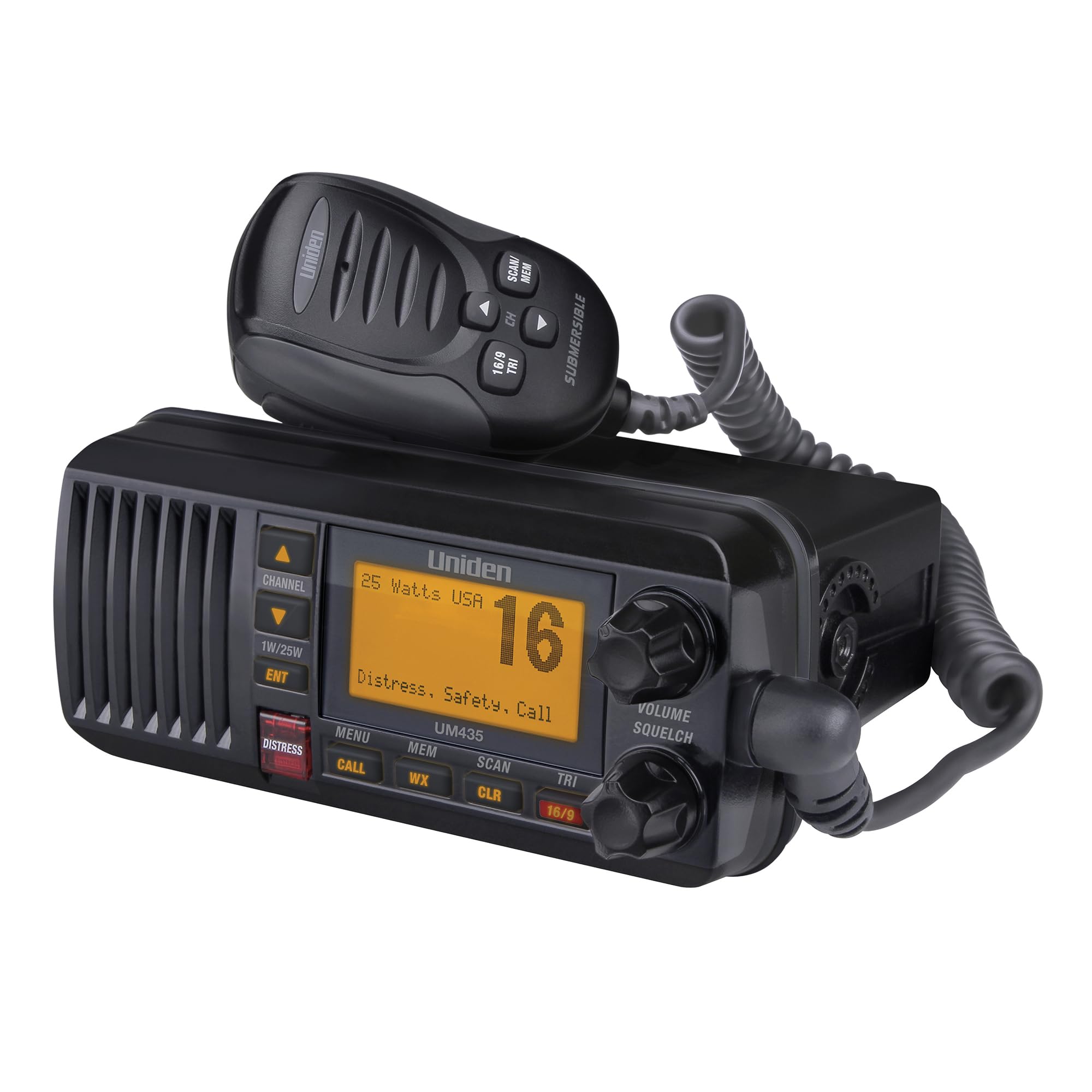
1. Uniden UM435BK Advanced Fixed Mount VHF Marine Radio
Our pick — over 4.5★ from 650+ verified ratings; the strongest balance of quality and price.
The fixed-mount backbone that stays on watch when the spray flies.
This is the radio you install once and trust for years — a fully submersible (IPX8), rugged unit that covers every marine channel you will ever need, including the new 4-digit USA, International, and Canadian “B” channels. It transmits at 1 watt for short-range communication or a full 25 watts when you need to reach the Coast Guard or call across open water. Digital Selective Calling (DSC) lets you send a digital distress signal with your GPS position at the push of a button, which is a serious safety net for any coastal boater. The unit weighs a substantial 3.9 pounds, feeling solid and built to withstand a saltwater environment.
The real appeal is quality and value — exactly what owners highlight. The channel descriptions on the display are appreciated as a handy detail for quickly finding the right frequency. While some reports note that mic hanger screws can loosen over time (and that a replacement mic is hard to source), the consensus is that it is easy to install, easy to program, and works as intended. This is a straightforward, no-gimmick rescue device that prioritizes staying powered and connected over flashy features.
At 3.9 pounds, this unit is more than three times heavier than a handheld like the Standard Horizon HX210 at 1 pound — proof of the sturdy, fixed-mount construction. It is the best anchor for a communication system.
Built for the helm: If you want a 25-watt lifeline with DSC and the most comprehensive channel coverage, mounted securely at your station, this is the one. The trade-off is the reported mic-hanger fragility — treat the hanger with care and it will serve you well for years.
Secure this if: You boat offshore or on large lakes and need a reliable, high-power radio fixed at the helm. It is the top pick for safety-first owners. Look elsewhere if you need a portable unit for a small tender or kayak.
2. Standard Horizon HX210 6W Floating Handheld Marine VHF Transceiver
The floating radio that bobs back up when you fumble it over the side.
This handheld is self-buoyant — if you drop it in the drink, it floats to the surface rather than sinking to the bottom. That alone makes it a no-brainer for kayakers, dinghy sailors, or anyone who works near the gunwale. With 6 watts of transmit power, it puts out slightly more punch than a typical 5-watt handheld, giving you a bit more reach. Owners consistently report that the battery holds its charge for impressively long stretches — exactly what you want from an emergency device kept in a ditch bag.
The unit includes built-in FM radio and weather band, so you can get a forecast or some music without pulling out your phone. The 18-hour battery life is a standout, handling a full day on the water without needing a charge. While some owners note the OEM antenna could be better and the belt clip can be tricky on a life jacket, the overall consensus is that it is simple, reliable, and exceptional value. It floats, it talks, and it keeps working — that is the core mission nailed.
Stays afloat: Ideal for any boater who wants the security of a VHF without a permanent installation, especially on small or open boats. The belt-clip challenge is the only real caveat. It is a strong value pick.
Grab this for: Kayak fishing, paddlesports, or as a backup ditch-bag radio. skip it if you need the range and power of a fixed-mount 25-watt unit for offshore cruising.
3. LUCKY Portable Sonar Fish Finder
A wireless sonar ball you cast from shore or your kayak to see what lies below.
This is not a boat-mounted transducer — it is a completely wireless system where the sonar ball connects to a handheld display via radio frequency at up to 656 feet. The transducer works on a 125kHz frequency with a 90-degree beam angle, reading water depth down to 147 feet. It shows you bottom contour, water temperature, and fish size (small, medium, large), with an audible alarm when it detects fish or shallows. The sonar ball even has a glowing cap for night fishing, so you never lose track of where it is in the dark.
The gadget wins praise for its reliability — owners note it is easy to use, portable, and surprisingly accurate. The battery is reported to last over 7 hours on a charge, and with battery-save mode, it can stretch beyond 10 hours. It is a popular choice for ice fishing and bank fishing because you do not need a boat to use it. The only real limit is that a few units have had battery issues after a couple of months, but the overall feedback from the fishing community is very positive. It is an accessible entry to sonar scanning.
No-boat needed: Perfect for the shore angler or kayaker who wants basic sonar on demand without a permanent install. A few battery durability reports are the only caution. Works very well for its niche.
Best for: Bank fishing, ice fishing, or small kayaks where mounting a fixed transducer is impractical. Choose a transom-mount unit if you have a fully rigged boat and want integrated GPS charting.
4. Uniden UM725G Marine VHF Radio with Text Messaging

A marine radio that brings private text messaging between boats so you do not have to broadcast every move.
Uniden claims a first with this model — private text messaging between boats over VHF. Instead of broadcasting a message for every vessel in range to hear, you can send a text to a specific radio, a boon for coordinating a fleet or keeping sensitive chatter off the air. The unit also features the largest LCD screen in its class, measuring 68mm wide by 38mm tall, making channel selection and the on-screen menu much easier to read at a glance. It has built-in GPS for automatic position reporting over DSC, and covers all US, Canada, and International channels at 1 or 25 watts.
Owners consistently highlight the quality and functionality, noting that the GPS works well, the communication is clear, and installation is straightforward. The speaker microphone is appreciated for noisy days. The only nitpick from a couple of users is that the channel selector feels a bit touchy, occasionally jumping to the next channel. The built-in GPS adds a layer of safety without needing a separate antenna puck. At 2 pounds, it is much lighter than the UM435BK, which is 3.9 pounds, reflecting a more compact design.
Smart communication: The text feature is genuinely useful for a working crew or group of boats. The channel selector sensitivity is a minor annoyance. A great step up in features and screen real estate.
Choose this if: You want a feature-packed fixed-mount with a big, clear screen and the unique private-texting capability. pass on it if the older UM435BK’s simpler interface and lower price point meet your needs.
5. Humminbird PiranhaMAX 4 Fish Finder with Down Imaging

A wallet-friendly way to get photo-like Down Imaging of submerged structure without going premium.
This unit uses Down Imaging sonar, which sends a thin, high-frequency beam straight down to produce a crisp, picture-like view of the bottom and any structure — stumps, brush piles, rocks. It is a major step up from a basic fish finder for a reasonable price. The 4.3-inch color display is easy to read even in bright sunlight, and the interface is redesigned to be simpler to navigate. The Dual Beam sonar gives you a choice between a narrow beam for detail and a wide beam for coverage.
It comes with the XNT 9 DI T transducer, a tilt and swivel mount, and features like Fish ID+ and depth alarms. Anglers report it is excellent for a kayak or small boat, with high-resolution imaging that helps find hidden spots. It has been so well received that some owners have bought it a second time. The one catch is that the transducer cable is not very long; on a 24-foot pontoon boat, it was 2 feet too short to reach the dashboard, requiring a separate extension cable. Check your run before you install.
Imaging made affordable: The Down Imaging is sharp and the price is a fraction of a premium unit. Just measure the cable run first. It is a standout for small craft and budget-minded anglers.
Perfect for: Kayaks, small fishing boats, or as a secondary sonar unit. Not ideal if your helm is far from the transom — you will need a cable extension.
6. Humminbird Helix 5 Sonar G2

A bare-bones sonar unit that focuses on reading fish and bottom structure with no GPS distractions.
This is a pure fish finder — no GPS, no mapping, just Dual Beam PLUS sonar with Humminbird’s SwitchFire technology. SwitchFire gives you two display modes that let you adjust the sonar returns to account for water depth, temperature, and turbulence, so you see exactly what is under the boat without clutter. The 5-inch widescreen display is crisp and clear, showing sonar arches and structure in good detail. It includes the XNT 9 20 T transducer and all mounting hardware.
Owners praise the easy-to-navigate menu and the excellent screen clarity for its size. The unit provides water temperature, a basic but appreciated feature. The biggest trade-off is the lack of GPS — if you want to mark waypoints or follow a route, this is not the unit. Some owners also note the screen can be a bit small to see from behind a windshield, so a RAM mount to bring it closer is a common workaround. For someone who just wants a great sonar image without paying for GPS, this is a fantastic value.
Sonar focus: If your priority is reading fish arches and bottom structure with a high-quality, affordable display, this is it. The lack of GPS is the intentional caveat — do not buy this if you need navigation.
Best for: Anglers who already have a separate GPS/chartplotter or who fish familiar waters and just need sonar. it’s not for you if you need a single unit that does both navigation and fish-finding.
7. ICOM IC-M73 Handheld VHF Marine Radio

A lightweight ICOM that owners say reliably lasts for twenty years with just battery swaps.
The IC-M73 is a 6-watt handheld that punches well above its compact size. It is waterproof and submersible, with an hourglass design that sits comfortably in the hand. The rated battery life is 18 hours, giving you a full weekend of use on a single charge. It includes a desktop charger with a cigarette lighter adapter for convenient on-board charging. Owners rave about the build quality and longevity — multiple reports mention previous ICOM units lasting over 20 years with only battery replacements, which is proof of its marine-grade construction.
The receiver quality is considered the best available in a handheld, picking up weak signals that cheaper units miss. The unit is noticeably smaller and lighter than previous ICOM models, making it easy to stash in a ditch bag. The only points of feedback are the electronic squelch (some prefer a manual knob) and the lack of a backlit display — you will need a flashlight to see it at night. For a serious emergency VHF that you trust to work when you need it, this is the definitive choice.
Built to last decades: The ICOM is the gold standard for handheld VHF reliability. The no-backlight issue is the one design quirk to consider if you do a lot of night boating. It is an investment in confidence.
Choose this if: You want a premium handheld with legendary durability and the best receiver in its class. Look elsewhere if a backlit display is essential for your night operations.
8. Lowrance HOOK Reveal 5 SplitShot Fish Finder

A fish finder that combines CHIRP sonar with DownScan imaging and comes preloaded with 4,000 US inland lake maps.
The HOOK Reveal uses Lowrance’s FishReveal technology, which takes the target separation of CHIRP sonar and overlays it on the high-resolution DownScan image, making fish light up on the screen as bright, easy-to-identify targets. The SplitShot transducer gives you a wide-angle CHIRP beam for finding fish and the DownScan beam for seeing structure. One of its strongest selling points is the preloaded C-MAP US Inland mapping, giving you high-detail maps of nearly 4,000 US lakes from the start. The AutoTuning sonar adjusts your settings automatically as conditions change, so you spend less time fiddling with menus.
The 5-inch SolarMAX display is designed to be readable in direct sunlight. Owners generally find it worth the money, and it works well for small to mid-sized boats. The main drawbacks mentioned are that the 5-inch screen can feel small for some eyes and that the transducer cable routing is tricky (requiring a fish tape to pull through a tight console). The functionality is solid, but the feature set focuses on sonar and mapping rather than premium navigation tools.
Maps included: The preloaded inland maps alone make this an easy pick for freshwater anglers. The screen is on the small side for detailed chart overlays, but the FishReveal technology is genuinely helpful.
Ideal for: Inland lake fishermen who want a fish finder with ready-to-use mapping and advanced target identification. Consider a larger screen if you need to view maps and sonar side by side.
9. Fusion MS-RA70 Marine Stereo
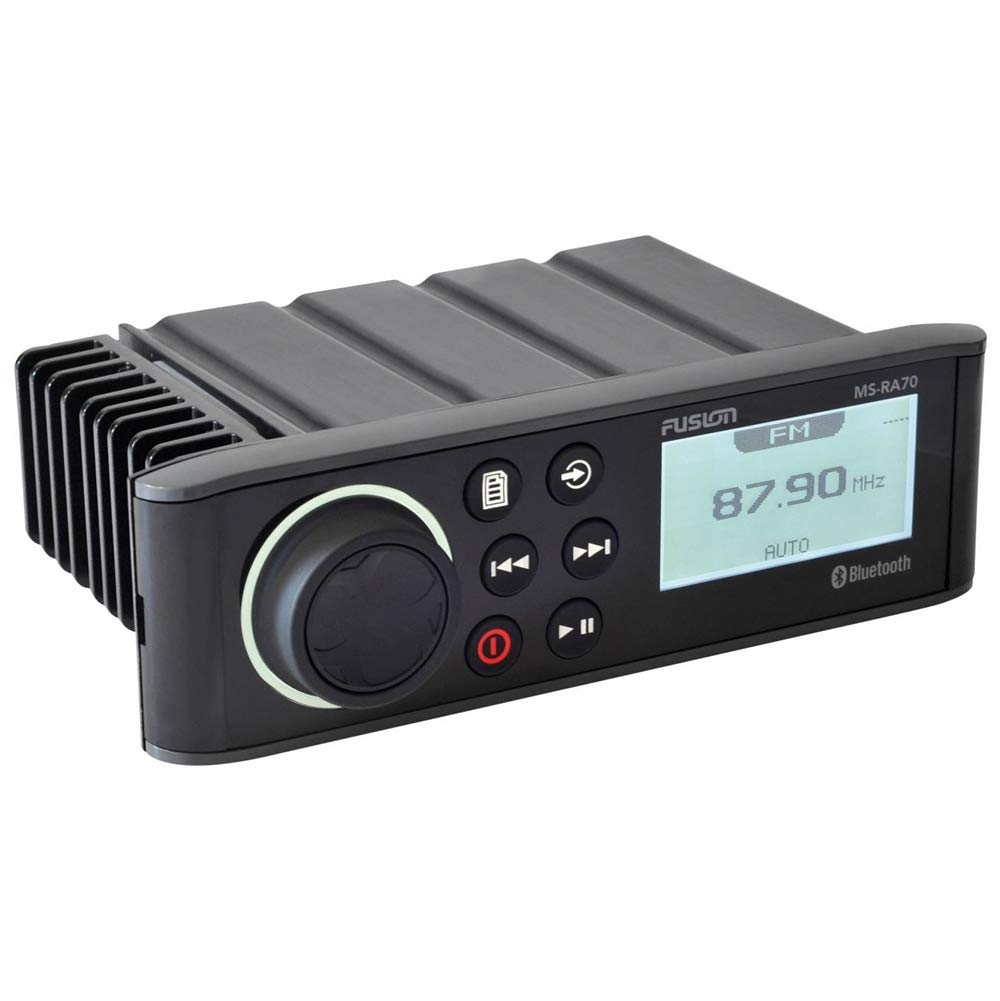
A marine stereo that powers two zones and connects to your phone or Garmin watch.
This Fusion stereo delivers 4 by 50 watts of amplification across two independent audio zones — so you could have mellow tunes at the helm and a louder feed on the deck without a separate amp. It is rated IPX7 water-resistant, meaning it can handle a soaking rain or the spray from a wake without issue. The 2.6-inch optically bonded monochrome LCD is bright and easy to read, and the single-DIN form factor fits into standard car-sized dash cutouts without reconfiguring your panel. Bluetooth connectivity is strong and includes Fusion-Link integration, allowing you to control the music from a smart device or even a compatible Garmin watch.
Owners consistently praise the excellent sound quality, describing it as loud and clear with no crackle or distortion. The interface is self-explanatory, and installation is straightforward. One thing it does not do is play MP3 files from a USB drive. While it is loud enough for relaxed days on the lake, some note that you probably want an external amplifier if you need to overpower a motor at 50+ mph. The Garmin ownership means solid build and great customer support.
Sounds of the water: The sound quality and zone control are excellent for a direct-fit upgrade. The lack of USB MP3 playback is the main omission. A high-value audio upgrade for most powerboats.
Perfect for: Boat owners looking for a drop-in stereo upgrade with multi-zone control and reliable Bluetooth. look elsewhere if you want to play MP3 files from a flash drive without a phone.
10. Garmin Striker Vivid 7cv Fish Finder

A big, clear 7-inch screen with vivid color palettes that make fish stand out from the bottom.
The Striker Vivid 7cv is an easy-to-use 7-inch color fish finder that introduces new vivid scanning sonar color palettes. These palettes shift the spectrum of the sonar return so you can more easily distinguish fish from structure at a glance. It includes a GT20 transducer that delivers built-in Garmin CHIRP traditional sonar and CHIRP ClearVü scanning sonar, giving you both a classic 2D sonar view and a photo-like DownScan image. The high-sensitivity GPS lets you mark waypoints and create routes, and the unit includes built-in Quickdraw Contours mapping. Wi-Fi connectivity connects to the ActiveCaptain app for waypoint transfer, smart notifications, and software updates.
Owners find it easy to install and use, with a display that is extremely readable even in bright sunlight. The unit is described as having “all the bells and whistles” at a good price. The single recurring complaint is the lack of preloaded maps — the unit does not come with a chart, you create your own with Quickdraw Contours. If you are used to units that show a map from the start, this is an important difference. The 7-inch screen is a significant step up from the 4.3-inch or 5-inch models, making it easier to see detail while running at speed.
Big and bright: The 7-inch screen and vivid color palettes make this the top-tier for sheer readability. The lack of preloaded maps is the real consideration — you create your own or be comfortable without them.
Reach for this if: You want a large, bright screen and excellent CHIRP sonar, and you are comfortable building your own maps with Quickdraw Contours. Not for you if you must have preloaded charts included.
11. Garmin Striker 7SV with SideVu and ClearVu
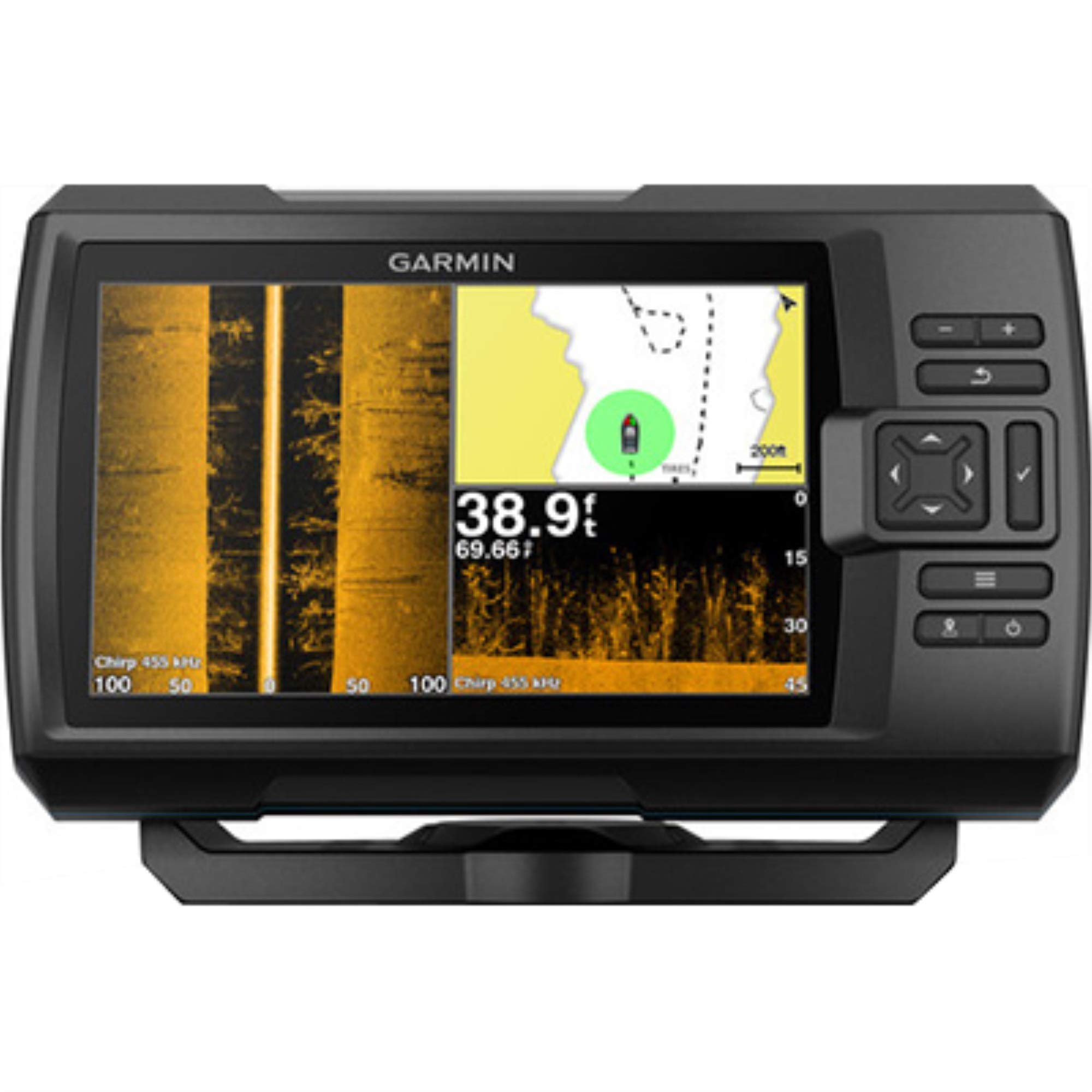
A sonar powerhouse that shows you what is below and to both sides of your boat simultaneously.
The Striker 7SV is equipped with a transducer for CHIRP traditional sonar, CHIRP ClearVü (DownScan), and CHIRP SideVü (SideScan), offering a complete picture of the underwater world. The 7-inch sunlight-readable display lets you view the down imaging and side imaging side by side. It includes built-in Quickdraw Contours mapping software so you can create and store maps with 1-foot contours for up to 2 million acres. The built-in GPS allows for marking waypoints and creating routes, and Wi-Fi connects to the ActiveCaptain app for smart notifications and community map sharing.
Owners highlight the excellent down and side imaging, noting that the unit clearly shows fish chasing bait and helped increase their catch rate. The screen is praised for its brightness and clarity. The main distinction is that this model does not have a chart plotter — the GPS is for waypoints only, not for navigating with preloaded nautical charts. A few owners also mention the lack of a printed instruction book, but note that a quick search online provides all the setup guides you need. For an angler who wants the best sonar views available without paying for a full chartplotter, this is a top contender.
Three views of the water: SideVu and ClearVu together give you the most information per pass. The GPS is waypoint-only, so it is a sonar-first unit. Incredible value for the side imaging capabilities.
Best for: Anglers who want the most advanced sonar technology (CHIRP, SideVu, ClearVu) in a dedicated fish finder without the cost of a full chartplotter. Pass on it if you need a full navigation GPS with preloaded marine charts.
Understanding the Specs
VHF Radio Power and Waterproofing
A marine VHF’s transmit power is measured in watts — fixed-mount radios typically output 1 watt or 25 watts (switchable), while handhelds output 5 or 6 watts. You use low power for short-range marina hails and high power for open-water emergency calls. The IPX rating measures water resistance: IPX7 means immersion up to 1 meter for 30 minutes; IPX8 means continuous submersion at a depth the manufacturer specifies. For a handheld, “floating” or “self-buoyant” is a huge added safety feature if the unit goes overboard.
Sonar Frequency and Beam Angle
A sonar transducer sends a sound wave at a certain frequency and listens for the echo. A lower frequency (50kHz, 83kHz) has a wider beam angle, covering more area but with less detail. A higher frequency (200kHz, 455kHz, 800kHz) has a narrower beam that shows more detail — ideal for seeing individual fish and structure. CHIRP sonar is different: it sends a sweep of frequencies and uses a computer to piece together the returning signals for much sharper target separation. The beam angle (expressed in degrees, like 90 degrees) tells you the width of the cone underwater.
DownScan, SideScan and Down Imaging
These are proprietary names for different sonar technologies. DownScan (also called Down Imaging or ClearVü) sends a very thin, high-frequency blade of sound straight down and returns a photo-realistic image of the bottom and structure — think of it as a “slice” view. SideScan (or SideVü) sends the same thin blade to the left and right, building a wide rectangular image of the area to the sides of your boat. These are not good at finding fish, but they are excellent for finding the cover where fish hide.
GPS and Chartplotting
Not all fish finders with GPS are chartplotters. A GPS-enabled fish finder lets you mark waypoints (a specific fishing spot, a hazard) and view your boat’s speed. A chartplotter includes a built-in map of lakes or coastal waters, allowing you to navigate routes and follow a planned path. If the unit says “no maps,” the GPS is for waypoints only. Preloaded mapping (like C-MAP or Quickdraw Contours) saves you from needing a separate navigation app or buying a map card.
FAQ
What is the difference between a fixed-mount and a handheld VHF radio?
What does a self-buoyant handheld VHF mean?
Can I use a standard car stereo in a boat?
What is the difference between Down Imaging and Side Imaging sonar?
Do I need a license to use a marine VHF radio in the US?
What does DSC on a VHF radio do?
How deep can a portable wireless fish finder like the LUCKY read?
CHIRP sends a sweep of frequencies for sharper target separation; the Striker Vivid 7cv has CHIRP and ClearVü, while the 7SV adds SideVü for side-to-side coverage. If your radio gets wet, rinse with fresh water and air dry—do not use heat.?
Final Thoughts: The Verdict
For most users who want a comprehensive boat electronics setup, the proven winner is the boat electronics list starts with the Uniden UM435BK for safe, fixed-mount communication. If you need a portable safety radio that floats, grab the Standard Horizon HX210. For serious anglers who want the broadest sonar coverage, the Garmin Striker 7SV is the one to reach for, as its combination of CHIRP, DownScan, and SideScan gives you the most complete underwater picture. Each pick serves a specific boat and specific need, and the right one for you is the one whose primary function — communication, sonar, or audio — aligns perfectly with how you spend your days on the water.
How We Picked
We do not accept paid placement. Every pick is matched to a real buyer and a real use-case; we do not hands-on test units.
Sources & Methodology
Specifications: manufacturer listings and product documentation. Review insights: verified customer reviews, as of July 2026. Pricing: not shown on this page (it changes often); check the current price via the retailer link.
As an Amazon Associate, Gadgets Feed earns from qualifying purchases. This does not affect which products we feature.