
A fresh layer of gel coat scuffed raw by dock contact is the kind of marine heartbreak that starts before you’ve even untied the lines. The right set of boat fenders absorbs that impact, keeping a buffer of soft air between your fiberglass and the unyielding pilings, but only if the material, valve, and hanging eyelets are built to hold under actual tidal conditions. Flimsy vinyl that hardens in the sun or eyelets that tear under load will leave you retying lines at every stop.
I’m Min — the co-founder and writer behind Gadgets Feed. I’ve spent countless hours analyzing marine-grade PVC formulations, ribbed surface geometries, and inflation valve designs to separate the fenders that genuinely protect hulls from the ones that leak or crack after a single season of weekend use.
Dock rash is preventable, but only when you choose the right gear for your vessel’s freeboard and slip configuration. This guide breaks down the best specs and real-world builds to help you find the most effective best boat fenders for sustained, season-long protection.
How To Choose The Best Boat Fenders
Selecting a fender isn’t about grabbing the cheapest cylinder on the shelf. You need to match the diameter, length, material, and hanging configuration to your boat’s hull shape, freeboard height, and the typical dock condition you tie up to. A mismatch means the fender either rolls away from the contact point or deflates under pressure.
Diameter and Length: Match Your Boat’s Freeboard
For most runabouts and center consoles between 20 and 26 feet, a 6.5-inch diameter fender provides sufficient standoff. If your boat sits unusually low in the water (bass boats, older ski boats, rowboats with shallow hulls), a low-freeboard style with a flatter profile prevents the hull from sliding under the dock. Boats over 26 feet or heavy pontoons generally need an 8.5-inch diameter. Length matters less than diameter for protection — a 23-inch fender covers one cleat zone adequately, but overnight mooring often requires two fenders per side.
Material Thickness and UV Resistance
Marine-grade vinyl or PVC with an advertised thickness above 0.8 mm holds air consistently through temperature swings. Cheaper material develops micro-cracks in direct sun or freezing conditions. Look for rotomolded or heavy-gauge PVC that explicitly states UV and salt-water resistance. Valves should be self-sealing and recessed enough to avoid snapping off during a bump against the dock.
Eyelet Design and Line Attachment
Twin eyelets — one at each end — offer the flexibility to hang fenders vertically or horizontally. Reinforced, tapered eyelets prevent the line from pulling through under lateral load. Pre-whipped lines with spliced loops are convenient out of the box, but many boaters replace them with longer double-braid nylon lines for more hanging position options.
Quick Comparison
On smaller screens, swipe sideways to see the full table.
| Model | Category | Best For | Key Spec | Amazon |
|---|---|---|---|---|
| Taylor Made 31007 | Low-Freeboard | Bass & center consoles | 7″ x 23″, marine-grade vinyl | Amazon |
| KEMIMOTO 4 Pack | Cylindrical Ribbed | 15-35 ft boats | 5.5″ x 20″, PVC | Amazon |
| Dreizack 4 Pack | All-In-One Kit | Multi-boat households | 5.5″ diameter, 3.8mm wall | Amazon |
| Goplus 4 Pack | Value Multi-Pack | Pontoon & cruisers | 23″ x 6.5″, twin eyelets | Amazon |
| Low Freeboard JYINCPED | Curved Profile | Low-profile hulls | 5″ x 16″, marine vinyl | Amazon |
| Seachoice Twin Eye Kit | Starter Kit | 20-25 ft boats | 6.5″ x 23″, twin braided lines | Amazon |
| Better Boat 2-Pack | Complete Rig | First-time buyers | 23″ x 6.5″, UV-resistant PVC | Amazon |
In-Depth Reviews
1. Taylor Made Products 31007 Low Freeboard Fender

The 7-inch by 23-inch Low Freeboard Fender addresses a specific hull geometry that round cylindrical fenders simply cannot manage. Boats like bass boats, center consoles, and older ski boats sit low enough that a standard bumper rolls upward, leaving the gunwale and rubrail exposed to the dock edge. Taylor Made solves this with a square, almost rectangular profile that stays locked against the topsides, preventing the fender from twisting out of position when wave action pushes the hull sideways.
This fender is rotomolded from a specially formulated marine-grade vinyl that resists UV discoloration and remains flexible in cold water. The inflation valve is recessed enough that accidental contact with a piling won’t snap it off. Owners of 1988 MasterCraft and modern Crestliner hulls report that the shape fits the gunwale curvature perfectly, eliminating the need to re-hang the fender after every dock departure. It is built for the specific pain point of low-freeboard owners — dock rash below the rubrail.
The only compromise is that the square shape takes up more storage space than a deflated cylindrical fender. It also requires careful inflation — too much air and the flat sides bulge, reducing the contact patch. When sized correctly for your beam, this is the most effective anti-rash solution for low-profile vessels on the market.
Why it’s great
- Curved square design stays against gunwale without rolling
- Thick marine vinyl resists UV and cold cracking
- Recessed valve reduces risk of stem breakage
Good to know
- Bulky when stored; does not roll as tightly as a cylindrical fender
- Over-inflation flattens the protective contact area
2. KEMIMOTO Boat Fenders 4 Pack

KEMIMOTO delivers a four-pack of 5.5-inch by 20-inch cylindrical ribbed fenders that covers most boats in the 15- to 35-foot range with enough spares for rafting. Each fender features twin eyelets top and bottom, allowing vertical or horizontal hanging depending on your cleat layout. The ribbed surface reduces the contact patch against the hull, minimizing scuff transfer while simultaneously preventing the fender from spinning out of alignment.
The PVC material is dense enough to hold air for weeks without needing a top-up, and the included double-braid nylon lines measure 70.86 inches long, giving you ample length to tie a proper clove hitch. Several owners running 19- to 24-foot boats confirmed that the 5.5-inch diameter provides enough standoff to keep the rubrail clear of standard dock pilings. The black color hides scuff marks well across multiple seasons of use.
The included hand pump is one of the weaker links — multiple users reported it failed within the first inflation cycle. A standard bicycle pump with a needle adapter works seamlessly as a replacement. The lines, while long enough, feel thinner than those supplied with premium kits, so heavy-duty users may want to swap them for thicker 3/8-inch braid.
Why it’s great
- Four fenders at a per-unit cost that beats single pairs
- Ribbed surface keeps fender orientation stable
- Long lines allow flexible hanging positions
Good to know
- Included pump is unreliable; use your own
- Fender lines could be thicker for heavy-duty slips
3. Dreizack Boat Fenders 4 Pack

The Dreizack 4 Pack offers the most complete out-of-the-box experience for boaters who want everything in one purchase: four fenders, four 5-foot 3/8-inch nylon ropes, four inflating needles, a hand pump, and a dedicated storage bag. The fenders themselves are 5.5 inches in diameter and made from rotomolded marine vinyl with a stated 3.8 mm wall thickness — noticeably heavier than budget PVC options. The oval shape combined with double holes at each end lets you hang them vertically or horizontally without line interference.
In practice, the 3.8 mm wall delivers a firm cushion that doesn’t bottom out against a dock when the boat rocks aggressively. The UV- and salt-water-resistant formulation keeps the black color from fading, even after weeks of direct sun. Owners consistently note that the fenders inflate in about 35 seconds with the included pump and hold air without any measurable pressure loss over a weekend. The storage bag is a thoughtful addition for trailered boat owners who deflate and pack between trips.
The primary weak point is the included lines — the spliced ends tend to unravel under load, as reported by several users. Replacing them with a set of stitched or heat-sealed lines improves long-term reliability. Additionally, the deeply set inflation valve can be tricky to engage with the needle; a gentle, straight push is required to avoid bending the needle tip.
Why it’s great
- Thickest wall in this roundup at 3.8 mm
- Complete kit with bag reduces storage clutter
- Oval shape holds better against hull than round cylinders
Good to know
- Included lines have weak spliced ends
- Valve is deeply recessed; needle alignment is fiddly
4. Goplus 4 Pack Marine Boat Fenders
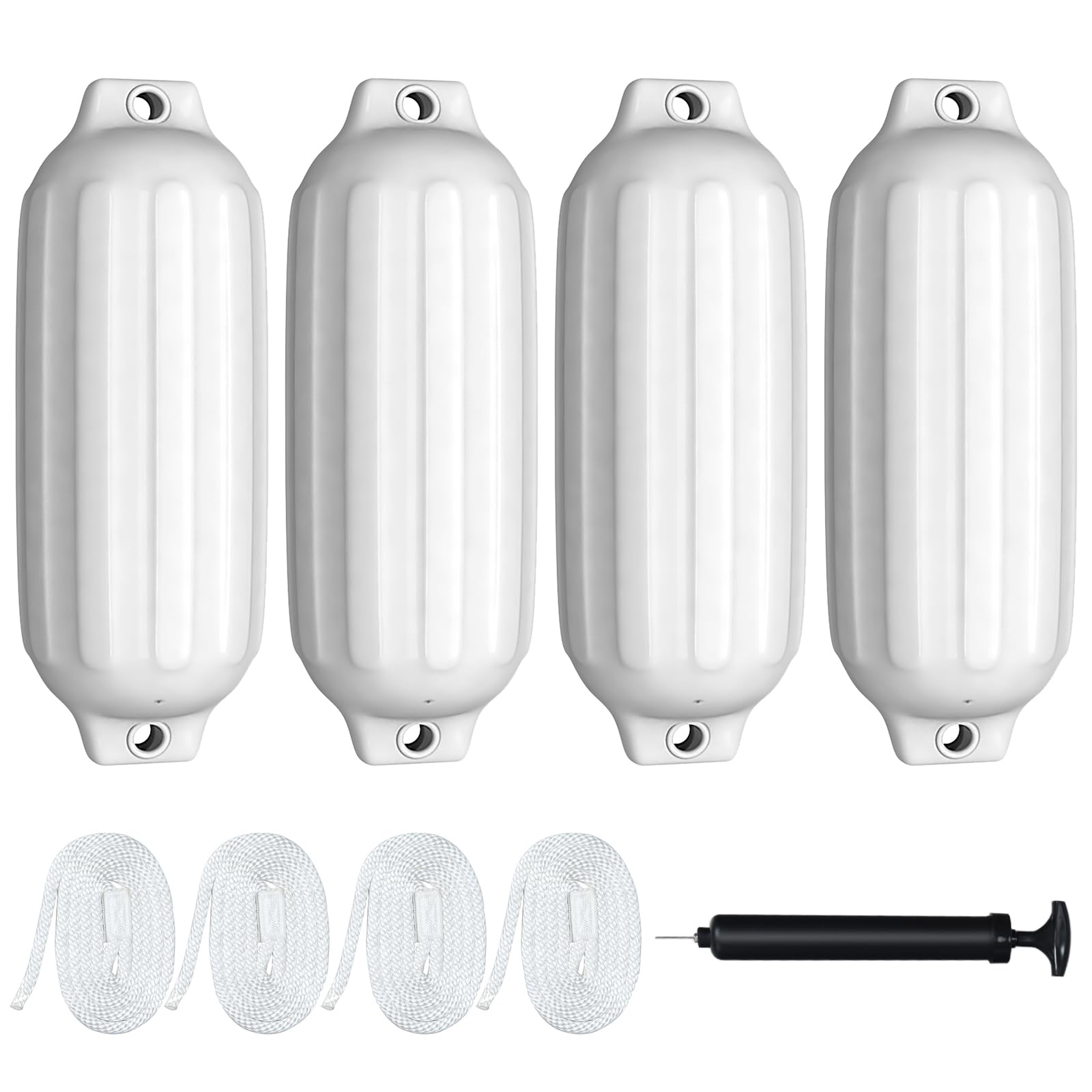
Goplus produces a four-pack of 23-inch by 6.5-inch ribbed fenders that strike a practical balance between coverage area and storage footprint. The 6.5-inch diameter provides enough standoff for most runabouts, pontoons, and cruisers in the 20- to 26-foot range, while the ribbed surface improves friction against the hull and reduces the chance of rolling. Each fender includes reinforced twin eyelets at both ends, allowing horizontal or vertical hanging without worrying about the eyelet tearing under the weight of a beamy boat.
The PVC material is glossy, UV-resistant, and handles compression well — several owners noted the fenders hold their shape even when pinched between a pontoon and a concrete dock. The four-piece count means you can run two per side or use extras for rafting. The included pump and four fender lines add convenience, though the lines are basic 3/8-inch braid that some users replace with longer ropes for better positioning over high docks.
Owners who cross-reference these against Taylor Made equivalents report comparable material feel for roughly half the per-unit cost, making this a strong budget-conscious choice for multi-boat households or first-time buyers equipping a new slip. The valve caps are basic push-fit rather than threaded, so check them periodically to ensure they haven’t vibrated loose during trailering.
Why it’s great
- Six-inch diameter provides adequate standoff for most 20-26 ft boats
- Reinforced twin eyelets hold up to lateral load
- Glossy finish resists marine growth and staining
Good to know
- Basic push-fit valve caps can loosen
- Fender lines are serviceable but not premium
5. JYINCPED Low Freeboard Boat Fenders
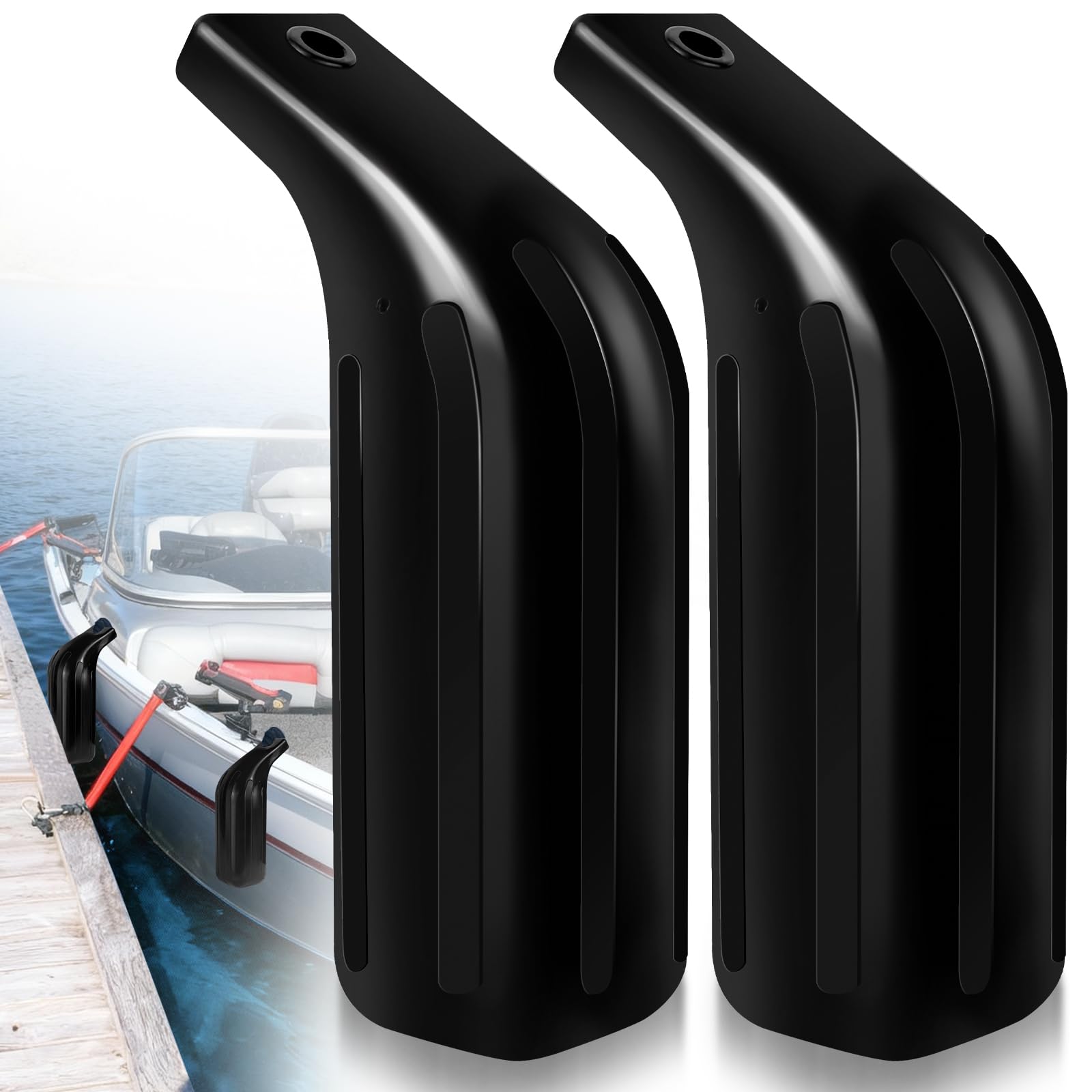
JYINCPED designed this 5-inch by 16-inch fender specifically for low-freeboard vessels where a standard cylinder would roll up over the gunwale. The defining feature is a pre-formed curvature that cups the side of the hull, forcing the fender to stay positioned against the rubrail rather than migrating upward. This is the same core concept as the Taylor Made Low Freeboard Fender but in a smaller, lighter format aimed at rowboats, bass boats, and shallow-hull jet boats.
The marine-grade vinyl is soft enough to absorb impact without transferring shock to the hull, yet stiff enough to maintain its curved shape over repeated compression cycles. The built-in molded needle-nose inflation valve seals tightly without a cap, reducing the number of parts that can fail. Owners of 1987 Sanger ski boats and modern river jet boats report that these fenders eliminated the problem of the hull sliding under the dock edge — a common issue with traditional round bumpers on low-profile craft.
At only 16 inches long, these fenders cover a smaller contact zone than the 23-inch Taylor Made, meaning you may need two per side on longer hulls. The 5-inch diameter also provides less standoff distance, so they work best on docks with standard vertical pilings rather than wide concrete slabs. For trailered boats that spend most of their time on a hoist, the compact size is a storage advantage.
Why it’s great
- Pre-curved profile keeps fender locked against low gunwales
- Compact size stows easily in small lockers
- Molded valve eliminates cap loss
Good to know
- 16-inch length may require two fenders per side on longer hulls
- Smaller standoff may not clear thick dock faces
6. Seachoice Twin Eye Ribbed Boat Fender Kit
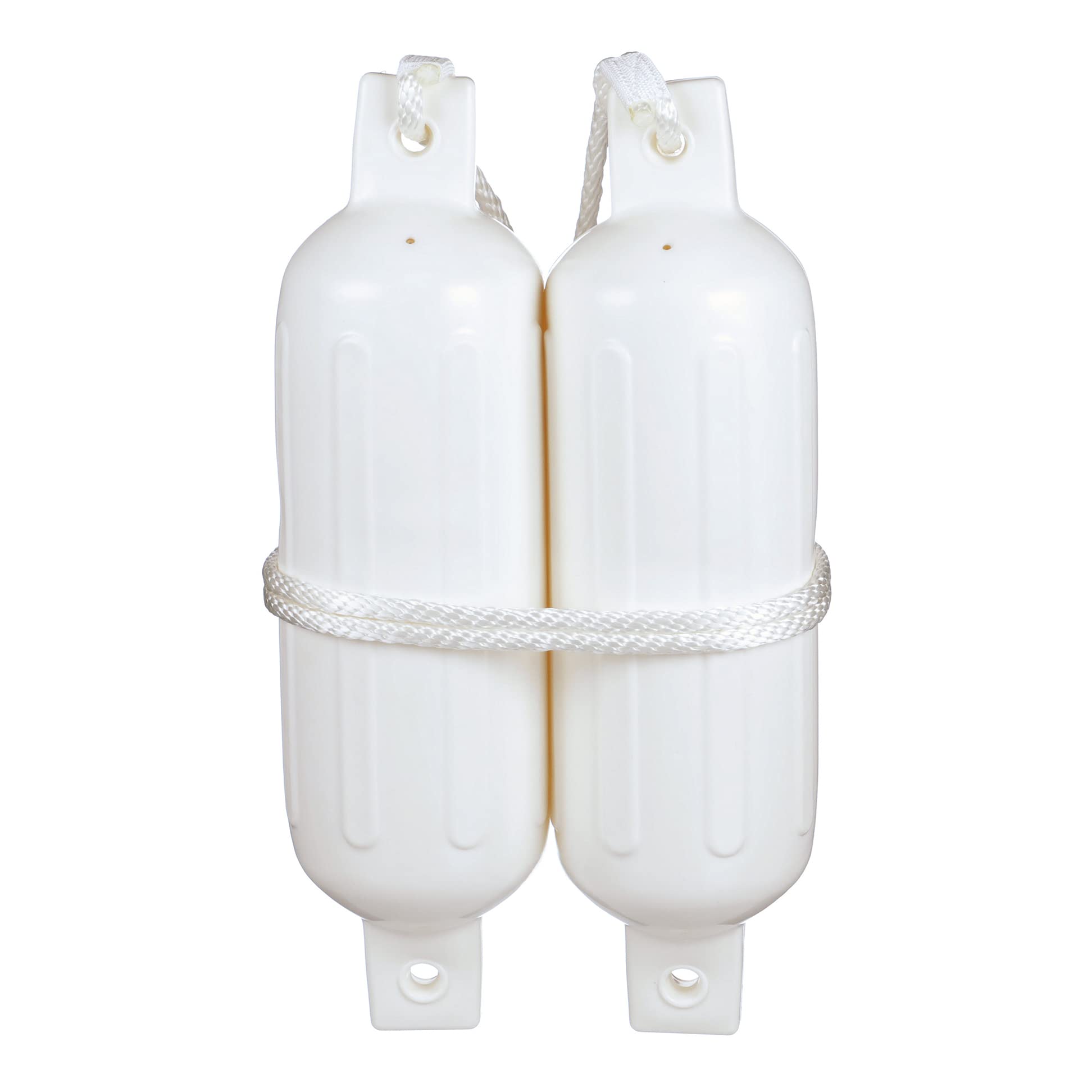
Seachoice’s Twin Eye Ribbed Fender Kit is a straightforward, no-surprises pair of 6.5-inch by 23-inch fenders aimed at the 20- to 25-foot boat segment. The vinyl construction is soft yet tough — dense enough to hold shape without being so stiff that it transfers dock shock directly to the hull. The ribbed surface prevents the fender from rolling under load, and the twin eyelet design allows vertical or horizontal hanging depending on cleat placement.
Each kit includes two fenders and two matching 5-foot double-braided fender lines. The lines are 3/8-inch thickness, which feels substantial compared to the thinner lines found in many budget multi-packs. Owner feedback consistently references durability under weekly use — several users reported the same pair lasting multiple seasons without leaks, despite exposure to tidal salt water and direct sun. The white color stays visibly clean longer than dark fenders, though it does show scuff marks more readily.
The main trade-off is that the kit only includes two fenders, while most boats need at least three for proper coverage on both sides. Buyers typically add a third matching fender purchased separately. The included pump is absent — you’ll need your own inflation source. For owners who already have a pump and prefer a proven, mass-market build without extras, this kit delivers reliability over flash.
Why it’s great
- Proven marine vinyl holds up to repeated compression
- Pre-whipped lines are heavy-duty 3/8-inch braid
- Ribbed surface stops roll-over in choppy water
Good to know
- Only two fenders per kit; larger boats need a third
- No pump included — you must supply your own
7. Better Boat Boat Fenders 2-Pack
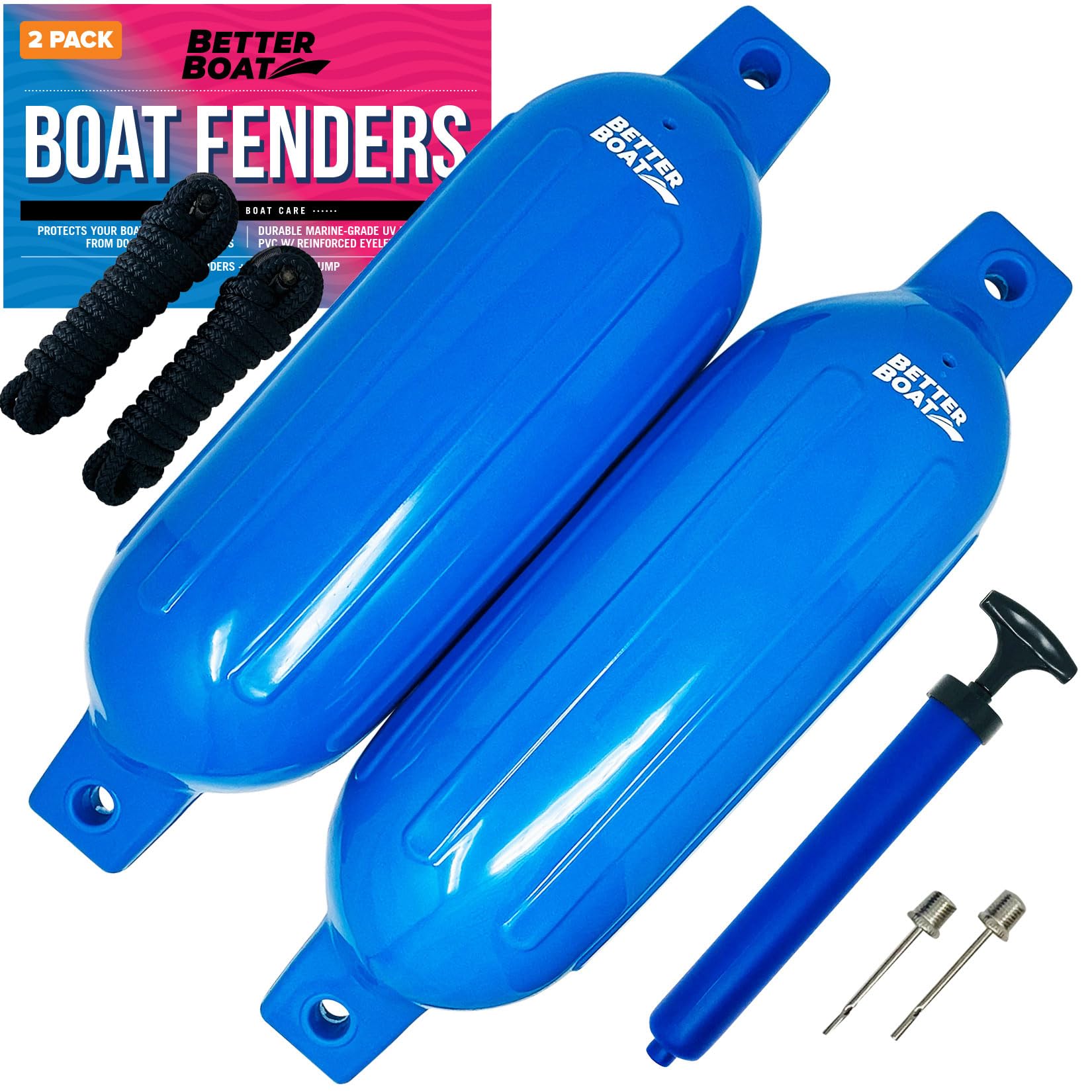
Better Boat’s 2-pack brings a complete beginner-friendly setup: two 23-inch by 6.5-inch UV-resistant PVC fenders, a hand pump with two needle valve tips, and two 6-foot pre-whipped lines. The company is a Miami-based family operation, and the included components are designed so that a first-time boat owner can inflate and hang the fenders without any additional purchases. The ribbed design reduces friction against the hull and prevents the fender from rolling out of position.
The tapered eyelets are a thoughtful detail — molded with a wider base (7/8 inch) that narrows to 3/4 inch at the opening, which locks the line securely under load rather than letting it pull through. The self-sealing air valve requires no cap, eliminating the annoyance of losing a cap in the bilge. For boats in the 20- to 26-foot range, the 6.5-inch diameter provides a practical standoff distance from standard dock pilings.
The hand pump is functional but not durable — several owners noted it failed after a few inflations or arrived with poor sealing, making it the most common complaint alongside an otherwise solid product. The lines are adequately long for most cleat-to-dock distances, though heavy-beam boats may prefer replacing them with 8-foot lines for more hanging flexibility. For the price of a single pair with all accessories, this is the easiest way to get started with proper fendering.
Why it’s great
- Everything needed for first-time setup in one box
- Tapered eyelets prevent line pull-through under load
- Self-sealing valve eliminates cap loss
Good to know
- Included pump has a high failure rate
- 6-foot lines may be short for beamy pontoons
FAQ
What diameter fender do I need for a 22-foot runabout?
How many fenders do I need per side?
Should I hang fenders vertically or horizontally?
Can I repair a leaking boat fender?
Final Thoughts: The Verdict
For most users, the best boat fenders winner is the Taylor Made 31007 Low Freeboard Fender because its square profile eliminates the rolling problem that plagues low-profile hulls — something standard cylinders cannot solve. If you want a complete ready-to-rig kit with a storage bag, grab the Dreizack 4 Pack. And for equipping a whole fleet or rafting setup on a budget, nothing beats the per-unit value of the KEMIMOTO 4 Pack.