
A dead bilge pump or a drained house battery while you are miles from the dock can turn a relaxing weekend into a costly salvage operation. The right boat monitoring system does not just display numbers — it alerts you the moment voltage drops, bilge water rises, or your anchor drags, so you stay ahead of problems before they become emergencies.
I’m Min — the co-founder and writer behind Gadgets Feed. My research for this guide involved cross-referencing NMEA 2000 compatibility, shunt accuracy, cellular versus satellite connectivity, and real-world user data from hundreds of logged hours aboard cruising and fishing vessels to separate reliable marine electronics from overpriced gadgets that fail when damp.
This guide breaks down the sensors, displays, and communication modules that form a complete best boat monitoring system, with a focus on which specs actually matter when you are at the helm.
How To Choose The Best Boat Monitoring System
Picking the right monitoring gear for your boat means matching the system to your power setup — a single-battery outboard needs a different approach than a three-bank cruiser with solar and an inverter. Begin by deciding whether you need real-time remote alerts via cellular or satellite, or if a hardwired display in the helm is sufficient.
Battery Monitoring vs. Engine Data vs. Environmental Sensors
Some systems focus exclusively on battery state of charge using a shunt, while others integrate with the engine’s ECM to show fuel consumption, RPM, and engine hours. The most comprehensive setups add bilge water sensors, temperature monitors, and GPS anchor alarms. Identify which data stream matters most for your vessel — if you operate a sailboat with house batteries, a high-accuracy battery monitor like the Blue Sea M2 OLED is non-negotiable. If you run a center console with a single outboard, a fuel sensor and engine data module will save you more headaches.
Communication Protocol: NMEA 2000 vs. Proprietary
NMEA 2000 is the marine industry standard backbone that allows different brand devices — GPS, fuel sensors, displays, and autopilots — to share data over a single cable. Proprietary systems like Boat Command use their own cellular gateway and app, which simplifies installation but locks you into their sensor ecosystem. If you already have a Garmin chartplotter, sticking with NMEA 2000 compliant sensors (like the Garmin GFS 10) usually delivers cleaner integration.
Quick Comparison
On smaller screens, swipe sideways to see the full table.
| Model | Category | Best For | Key Spec | Amazon |
|---|---|---|---|---|
| Victron Energy GX Touch 50 | Display | Victron system dashboards | 5-inch 1920×1080 touchscreen | Amazon |
| Mercury SmartCraft Connect | Engine Monitor | Mercury outboard diagnostics | Under-cowl Bluetooth module | Amazon |
| Blue Sea Systems M2 OLED | Battery Monitor | Multi-bank SOC tracking | 500A shunt, 92dB alarm | Amazon |
| Garmin GFS 10 Fuel Sensor | Fuel Flow | Real-time fuel consumption | 2 to 50 GPH flow range | Amazon |
| Boat Command BC-401 | Cellular Monitor | Remote bilge & battery alerts | GPS tracking + text alerts | Amazon |
| Magnum ME-BMK | Battery Monitor | RV & boat battery fuel gauge | 500A shunt capacity | Amazon |
| Nautilus LifeLine nexGen | Emergency PLB | Man-overboard DSC alerting | 1M GPS accuracy, IP68 | Amazon |
| Xantrex Link Pro | Battery Monitor | LiFePO4 SOC & AGS trigger | History event storage | Amazon |
| ACR ResQLink View PLB 425 | Satellite PLB | Global 406 MHz SOS | 28hr battery, no subscription | Amazon |
In‑Depth Reviews
1. Blue Sea Systems M2 OLED Digital Meters

The Blue Sea M2 OLED delivers the most complete picture of your boat’s electrical health without requiring a subscription or a phone app. Its bright OLED display auto-dims for daylight readability, and the IP66 waterproof rating means it can live on an open helm without fogging up. The unit tracks state of charge for one battery bank while simultaneously measuring voltage on three banks and current on one — giving you enough data to spot a parasitic draw or a failing alternator long before you are stranded.
The integrated 92dB adjustable alarm covers high current, high/low voltage, and low battery conditions, and it can drive an external buzzer for louder environments. The included 500A shunt handles most house banks, and the unit supports shunts up to 5000A if you upgrade later. Set up the high-current alarm to alert you when your windlass or thruster pulls abnormal amperage — a real diagnostic advantage over simpler meters that only track voltage.
Some users report screen freezing that required a firmware update via micro-USB, and the built-in alarm can be hard to hear with the engine running. But the combination of read-at-a-glance OLED clarity, multi-bank voltage monitoring, and configurable alarms makes this the most practical single-device solution for serious boaters who want hardwired reliability without depending on cellular signal.
Why it’s great
- Monitors SOC on one bank, voltage on three, current on one
- Daylight-readable auto-dimming OLED with IP66 waterproofing
- Configurable 92dB alarm plus external buzzer output
Good to know
- Some units shipped needing a firmware update to fix screen freezes
- Built-in alarm is faint under way with engines running
2. Victron Energy GX Touch 50 Display Screen

The GX Touch 50 is not a standalone monitor — it is a dedicated 5-inch waterproof touchscreen companion for the Victron Cerbo GX. If you are building or extending a Victron power system (solar chargers, inverters, battery monitors, DC-DC converters), this display puts the entire network at your fingertips with a crisp 1920×1080 screen. It mounts flush on a dashboard with four bolts and connects to the Cerbo via a single HDMI cable, eliminating the rat’s nest of wires behind traditional helm panels.
The interface shows real-time voltage, current, power, battery SOC, solar harvest, and AC loads on a single customizable dashboard. Because the Cerbo handles all the sensor processing, the display itself is just a thin, waterproof front-end — ideal for center consoles or flybridge applications where exposed electronics need to survive spray and rain. The 250-nit brightness is adequate for covered helms but may struggle in direct sunlight compared to the Blue Sea OLED.
Installation is genuinely plug-and-play for anyone with a Cerbo already wired, and the Victron Remote Monitoring (VRM) portal stores years of data for trend analysis. The trade-off is that this system is entirely locked into the Victron ecosystem — you cannot use it with a Magnum inverter or a Blue Sea shunt without extra gateways. If your power architecture is already Victron-based, this is the most intuitive monitoring display on the market.
Why it’s great
- 1920×1080 clarity with VRM remote data logging
- Single HDMI cable connection to Cerbo — clean install
- Waterproof slim design for exposed helm positions
Good to know
- Requires Victron Cerbo GX — no standalone operation
- 250-nit brightness struggles in direct sunlight
3. Mercury Marine SmartCraft Connect Mobile
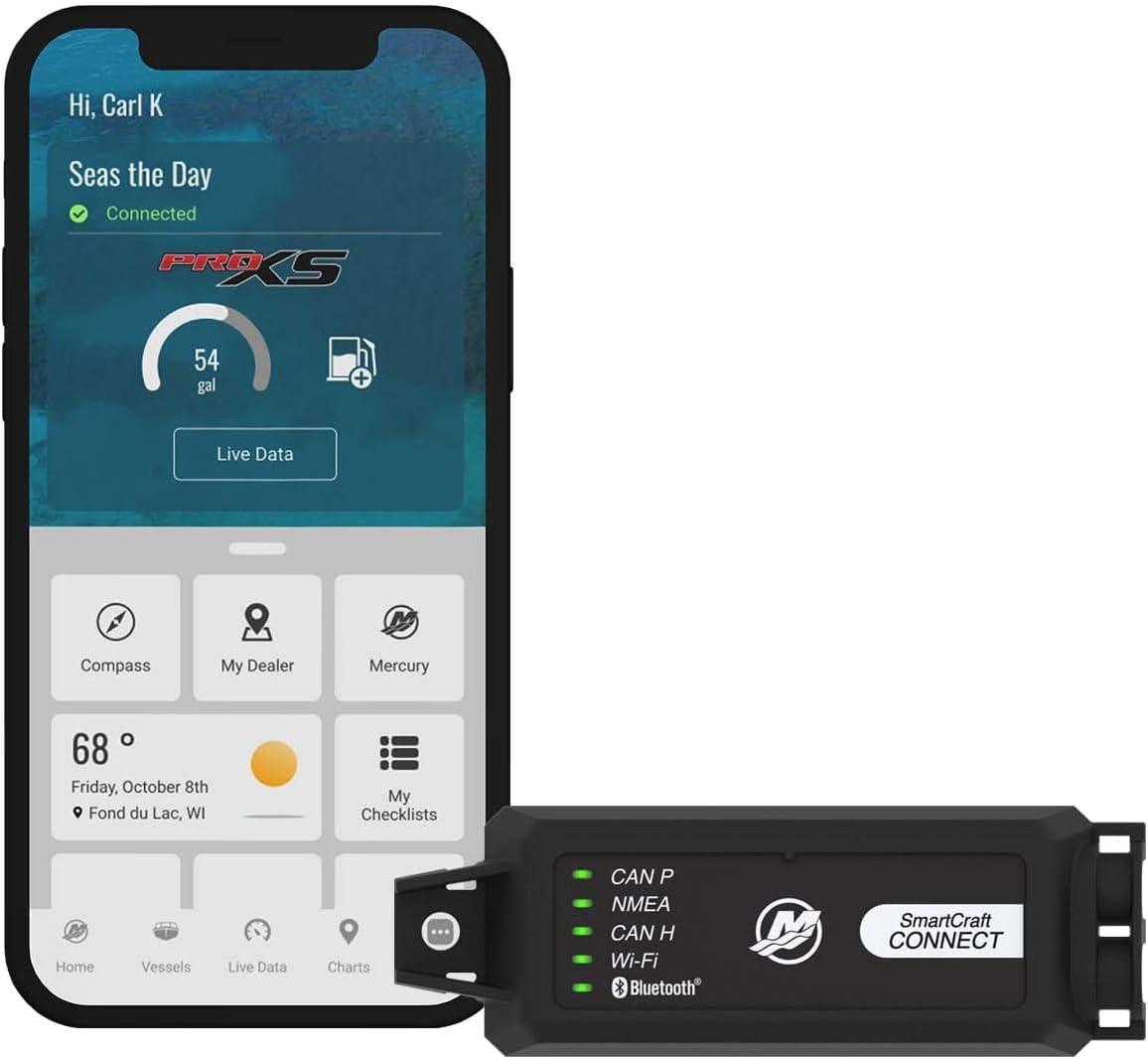
For Mercury and MerCruiser outboards from 2004 onward, the SmartCraft Connect module replaces the older VesselView Mobile with a much smaller Bluetooth unit that fits under the cowl. Once installed, it streams live engine data — RPM, fuel flow, engine hours, coolant temperature, oil pressure, trim position, and fault codes — directly to the Mercury Marine app on your phone. This turns your smartphone into a full digital gauge cluster for a fraction of the cost of a dedicated multifunction display.
The installation is genuinely plug-and-play for most single-engine setups: locate the 10-pin SmartCraft harness under the cowl, plug in the module, and download the app. The Bluetooth range reaches the helm, and the app shows digital gauges that are far easier to read at a glance than old analog dials. The maintenance tracking feature lets you log service intervals and share engine data with your dealer before hauling the boat out.
The main criticism is that the initial app setup can be buggy — some users report the app hanging on a firmware update step that requires deleting and reinstalling. The connection also drops when the ignition is off, which is normal but means no monitoring while the boat is moored. Despite these software rough edges, the hardware is solid and the data depth makes this a must-have for anyone with a modern Mercury outboard.
Why it’s great
- Plug-and-play under-cowl install, no NMEA 2000 needed
- Full engine diagnostics, fuel tracking, and maintenance logs via phone
- Works with Mercury 40hp+ (2004-newer) and Avator electrics
Good to know
- App setup and firmware updates can be glitchy on first install
- Requires ignition on — no monitoring when boat is off
4. Xantrex Link Pro Battery Monitor

The Xantrex Link Pro is a veteran of battery monitoring that has earned its reputation on liveaboard vessels and large motorhomes. It displays time remaining based on actual consumption rate (not just voltage percentage), giving you a much more honest estimate than simple bar graphs. The communication port allows integration with Xantrex inverter/chargers and Auto Generator Start controllers, making it a central component in a fully automated power management system.
The unit stores a history of event data — depth of discharge cycles, total amp-hours consumed, and alarm triggers — which is essential for tracking battery aging over years. The programmable alarm relay can trigger a generator start at a configurable SOC threshold, or sound an external alarm if current draw exceeds your set limit. For lithium battery owners, the Link Pro measures net current in/out accurately enough to manage charging from solar and alternator sources simultaneously.
Installation requires basic 12V wiring knowledge, and the included instructions are poorly laid out — you will need to download the manual online for shunt wiring guidance. The display only shows voltage on the second battery rather than its SOC, which is a limitation if you want equal monitoring on both banks. Still, the combination of history logging, programmable relay, and Xantrex ecosystem compatibility makes this the go-to for complex house bank setups.
Why it’s great
- Displays true time remaining, not just voltage-based percentage
- Programmable alarm relay can trigger AGS at selectable SOC
- Stores depth-of-discharge history for multi-year battery trend tracking
Good to know
- Installation instructions are poorly organized — download the PDF
- Second battery shows voltage only, not state of charge
5. Boat Command BC-401 GPS Tracking & Monitoring

The Boat Command BC-401 fills a different niche than hardwired helm displays — it is a cellular-based remote monitor that sends text and email alerts to your phone so you can check on your boat from home or work. The unit tracks GPS position for anchor drag alerts and theft recovery, monitors bilge pump activity and shore power status, and reports inside temperature (useful for engine room heat checks or pet safety). The battery status alert is the killer feature: you get a notification when house voltage drops below your set threshold, giving you time to plug in shore power before the batteries are damaged.
The unit is small and easy to install — 12V power and an internal cellular modem handle all communications without needing onboard Wi-Fi. The geofence and motion alerts work surprisingly well: users report getting notified minutes after their boat was bumped in the slip, allowing them to respond before serious damage occurred. The base subscription fee is relatively low compared to other cellular monitoring services.
The core risk here is company stability. Multiple users report that text alert delivery became unreliable in 2023, and the mobile app stopped being supported — you now have to log in through a web browser. If the company stops maintaining the cellular backend entirely, the hardware becomes a brick. For peace of mind right now it works, but long-term reliability depends on factors outside your control.
Why it’s great
- Real-time GPS anchor alarm, theft tracking, and zone geofencing
- Battery, bilge, and shore power alerts sent as text or email
- Small self-contained unit with simple 12V installation
Good to know
- Company appears to be winding down — app no longer supported
- Requires ongoing subscription; backend may stop working
6. Garmin GFS 10 Fuel Sensor
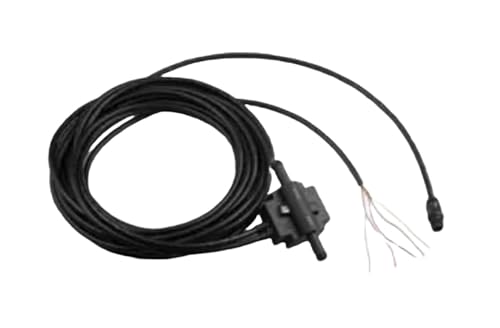
The Garmin GFS 10 is a NMEA 2000 compatible fuel flow sensor that measures gasoline consumption from 2 to 50 gallons per hour — perfect for outboards in the 40-300hp range. Once plumbed into the fuel line and connected to a NMEA 2000 backbone, it sends real-time fuel burn data to any compatible chartplotter or MFD, allowing you to see instantaneous GPH, total fuel used, and estimated range based on current speed. This eliminates the guesswork of fuel gauges that are notoriously inaccurate in planing boats.
The sensor is straightforward to install with included barb fittings, though it requires a separate power cable from the NMEA 2000 backbone and does not work with fuel injection return lines directly — a potential issue for newer four-stroke outboards with return loops. The measurement accuracy is consistently reported as within a few percent of actual pump-refill numbers, which is significantly better than the 20-30% error typical of float-based tank senders.
Integrating the GFS 10 with a Garmin echoMAP or GPSMAP series unlocks fuel management pages that log trip consumption and predict reserve fuel. Some users pair it with the Garmin VHF 200 radio to broadcast automated fuel status. The main limitation is that it only works with gasoline engines — diesel users will need a different sensor. For gas outboard boats without factory fuel flow, this is the single upgrade that pays for itself by preventing one unnecessary fuel stop or one unexpected dead-stick tow.
Why it’s great
- Accurate NMEA 2000 fuel data for Garmin chartplotters
- Replaces unreliable mechanical fuel gauges with real GPH numbers
- Range prediction data helps avoid fuel exhaustion on long runs
Good to know
- Does not work with diesel or fuel injection return lines
- Requires separate NMEA 2000 power cable — not included
7. Magnum Energy ME-BMK Battery Monitor

The Magnum ME-BMK is a shunt-based battery monitor specifically designed to pair with Magnum inverter/charger systems, but it works as a standalone monitor for any 12V, 24V, or 48V house bank. It tracks amp-hours consumed and displays battery state of charge as a percentage — essentially a fuel gauge for your batteries — on the Magnum remote panel (ME-ARC or ME-MR). This makes it much more useful than watching voltage alone, because voltage fluctuates wildly under load while SOC% stays consistent.
The shunt handles up to 500 amps continuous, enough for most RV and small-to-mid-size boat house banks, and the installation is straightforward with the included hardware. The unit creates an isolated negative termination point where all battery negative cables should connect — any loads bypassing the shunt will not be counted, leading to inaccurate readings. Several users note that for boondocking or liveaboard use, tracking amp-hours in or out gives you a constant real-time picture of consumption versus solar or alternator input.
The accuracy issue with lithium batteries is a real concern: several owners report voltage readings that are consistently 0.2V off from the actual battery voltage, which can cause premature charging or undercharging if you rely on the monitor alone. The ME-BMK also does not include the shunt wiring or fuses — you need to supply at least 10 AWG wire, connectors, and a 2A inline fuse. For Magnum inverter owners it is a natural fit, but those without Magnum gear should compare directly with the Blue Sea M2 which offers more detailed multi-bank data for a similar investment.
Why it’s great
- Integrates seamlessly with Magnum inverter/charger remote panels
- 500A shunt handles most marine house banks
- Tracks amp-hours in/out for accurate SOC percentage
Good to know
- Voltage readings can be 0.2V off for lithium batteries
- Does not include wiring, connectors, or inline fuse — buy separately
8. Nautilus LifeLine Marine Rescue GPS nexGen

The Nautilus LifeLine nexGen is not a daily monitoring tool — it is a man-overboard or distress beacon that broadcasts your GPS position over both AIS and DSC radio signals. Unlike a standard PLB that only alerts satellites, the nexGen sends an AIS alert to every vessel within VHF range that has an AIS receiver, displaying your exact coordinates on their chartplotter within seconds. It also triggers a DSC distress call to DSC-equipped radios in range, further multiplying rescue response. The GPS is accurate to one meter, and the device floats with an IP68 rating to 130 meters.
Weighing only 4.6 ounces with batteries, the nexGen clips to a PFD harness or dive belt without weighing you down. The interface includes a large distress button under a protective cover and a separate “position advisory” button that sends a non-emergency location to pre-programmed contacts. The LCD screen shows GPS fix status, message confirmation, and battery status, so you are not activating blind. It requires two CR123A batteries that are not included and last about five years in standby.
The build quality is good, but the o-ring seal design uses only a single gasket — some users report water intrusion after long-term saltwater exposure. The winding tool for the antenna is small and has no storage slot on the device, making it easy to lose. For the price, the AIS/DSC dual-alert capability is the best available for recreational boaters and is arguably more useful in coastal waters than a 406 MHz PLB because nearby boats can respond immediately rather than waiting for SAR assets that may be hours away.
Why it’s great
- Sends both AIS and DSC alerts to every vessel in VHF range
- 1-meter GPS accuracy, buoyant, rated to 130m depth
- Compact 4.6oz design clips to PFD or dive gear
Good to know
- Single o-ring seal vulnerable to saltwater corrosion over time
- Antenna winding tool has no on-board storage — easy to lose
9. ACR ResQLink View Personal Locator Beacon PLB 425

The ACR ResQLink View is a Type-1 Personal Locator Beacon that works anywhere on the planet with zero subscription fees — a critical distinction from satellite messengers that charge -50 per month. When activated, it transmits a 406 MHz distress signal to the COSPAS-SARSAT satellite constellation, which routes your GPS location to Search and Rescue agencies worldwide. The 121.5 MHz homing signal guides rescuers to within meters of your position even in zero visibility. The OLED display shows GPS status, transmission confirmation, and battery life, so you know your beacon is working before you rely on it.
The unit is compact (4.5 x 2.0 x 1.5 inches), floats, and includes a belt clip, PFD oral inflation tube clip, lanyards, and adhesive skins for multiple attachment methods. The built-in strobe is exceptionally bright — both a visible white LED and an infrared LED for night-vision-equipped rescuers. The 5-watt transmit power is ten times stronger than subscription-based satellite messengers, meaning your signal will cut through heavy cloud cover and canyon walls much more reliably.
Battery life is 28 hours at -40°F, more than enough for the longest SAR operation. The user-replaceable battery expires after 5 years from manufacture (check the date sticker on the box). Some units have shipped with the manufacturer date label missing or obscured, which prevents ACR warranty registration — inspect and test immediately upon arrival. For offshore boaters, solo sailors, or anyone venturing beyond cellular range, the ResQLink View is the gold standard because it does not depend on any cellular network, subscription payment, or passing vessel — it talks directly to the same satellites that rescue agencies monitor.
Why it’s great
- Global 406 MHz satellite coverage — no subscription required
- 5W transmit power (10x stronger than inReach/Messenger devices)
- OLED display confirms GPS fix and transmission status
Good to know
- Check label for manufacture date — missing labels block warranty
- Battery is user-replaceable but has a 5-year shelf life
FAQ
Can I use a boat battery monitor with lithium iron phosphate batteries?
Do I need a NMEA 2000 backbone to install a fuel flow sensor?
How does a GPS anchor alarm differ from a cellular anchor alarm?
What is the difference between a PLB and an AIS/DSC beacon?
Can I monitor my boat remotely without a cellular subscription?
Final Thoughts: The Verdict
For most users, the best boat monitoring system winner is the Blue Sea Systems M2 OLED because it provides multi-bank voltage monitoring, a 500A shunt with state-of-charge tracking, and a configurable alarm — all in one IP66-rated unit that needs no subscription. If you want real-time engine diagnostics and fuel tracking from your Mercury outboard, grab the Mercury SmartCraft Connect. And for offshore safety that requires no subscription and uses global satellites, nothing beats the ACR ResQLink View PLB 425.