
Our readers keep the lights on and my morning glass full of iced black tea. As an Amazon Associate, I earn from qualifying purchases.
Specs are compiled from manufacturer listings and verified buyer reviews and can change over time — please confirm the key details on the product page before buying.
Your boat trailer jack is the part you never think about until it fails at the ramp with a line of trucks waiting behind you. The right jack lifts your tongue weight smoothly, cranks without binding, and resists salt, rain, and gravel season after season. This guide walks through the jacks that actually hold up, sorted so you can pick the one that matches your boat, your tongue height, and how much work you want to do with your arms.
I’m Min — the founder and writer behind Gadgets Feed. This guide is built by comparing the manufacturers’ published specifications and the patterns across verified customer reviews, so you get each pick’s real strengths and trade-offs instead of marketing spin.
If your trailer jack is rusted out or you are tired of cranking by hand, the right replacement depends on two numbers: your tongue weight (how much your loaded trailer pushes down on the hitch) and your frame size. The picks below show how each jack’s load rating (how much weight it can lift), lift range (how high it reaches), and build quality differ, so you can match one to your setup.
Our Picks at a Glance

How To Choose The Best Boat Trailer Jack
Most boat owners buy a trailer jack once — maybe twice — so the mistake you make today sticks with you for years. The biggest one: buying a jack rated for exactly your tongue weight and nothing more. A jack rated at exactly your tongue weight runs at its limit and wears out early.
Match Load Capacity To Your Boat, Not Your Ego
Tongue weight is the downward force your boat puts on the hitch — usually 5 to 10 percent of the total boat-and-trailer weight. A 3,000-lb rig might carry 200 to 300 lbs of tongue weight, but that number spikes when you load gear, fuel up, or park on a slope. A jack rated for 2,000 lbs or higher gives you breathing room. The 5,000-lb and 8,000-lb options here are built for heavier boats or for owners who simply want the jack to outlast the trailer.
Lift Range And Retracted Height: The Numbers That Trip People Up
Lift range is how far the jack can raise or lower your tongue — measured from its shortest position to its longest. A jack with only 10 inches of travel may not reach the ground on a lifted trailer, while a 28-inch or 33-inch range covers almost any setup. Retracted height matters just as much: if the jack does not tuck up tight enough, it drags on driveways and speed bumps. Swivel brackets and drop-leg designs solve this by letting you fold the jack sideways or pull the leg up before you tow.
Manual, Drop-Leg, Or Electric — Pick Your Effort Level
A plain side-wind or top-wind crank costs the least and never needs a battery. A drop-leg jack lets you pull the inner tube down by hand to get close, then crank the last inch or two — faster and less arm work. An electric jack runs off your trailer’s 12-volt battery and does the lifting for you, which is a real difference when you are hitching alone at a crowded ramp. Electric models cost more and introduce wiring and fuse considerations, but for anyone launching frequently or handling a heavy tongue, the trade is worth it.
Quick Comparison
| Model | Best For | Load Capacity | Lift / Travel | Weight | Amazon |
|---|---|---|---|---|---|
| YOMILINK 5000 lbs A-Frame Trailer Jack★ Best Overall | Heavy boats and tall trailer frames | 5000 lbs | 23.2–45.6 in | 14 lbs | Amazon |
| VEVOR Trailer Jack with Wheel, 1000 lbsCompact Pick | Light utility trailers and small boats | 1000 lbs | 10 in max height | 13.5 lbs | Amazon |
| VEVOR Trailer Jack, 2500 lbs Dynamic LoadTop Performer | Mid-weight trailers that need swivel clearance | 2500 lbs | 15.04–30 in | 16.8 lbs | Amazon |
| CURT 28112 Marine Boat Trailer Jack | Saltwater boat owners who want a proven marine jack | 1200 lbs | 11 in vertical travel | 15.1 lbs | Amazon |
| Jeremywell 2000lbs Trailer Jack with Double Wheel | Moving heavy boats around by hand on rough ground | 2000 lbs | 12 in lift / 26–38 in length | 16.3 lbs | Amazon |
| The Ultimate Trailer Jack, 2000lb No-Crank | Fast hitching without cranking every time | 2000 lbs | 12 in drop leg + 15.5 in crank | 12 lbs | Amazon |
| FZZD 8000 lbs Heavy Duty Trailer Jack | The heaviest boats and yachts on the water | 8000 lbs | 4.7–33.3 in | 28 lbs | Amazon |
| POLESTAR Electric Trailer Jack, 5000 lbs | Push-button hitching on a 5000-lb rig | 5000 lbs (7500 lbs static) | 9–27 in + 4.5 in drop leg | 21.7 lbs | Amazon |
| KYX Electric Trailer Jack 7500LBs | Power lifting for travel trailers and fifth wheels | 7500 lbs | 9.84–32 in | — | Amazon |
In‑Depth Reviews
1. YOMILINK 5000 lbs A-Frame Trailer Jack, 15″ Lift, Adjustable Drop Leg
Our pick — over 4.5★ from 450+ verified ratings; the strongest balance of quality and price.
A 5,000-lb workhorse with the cranking speed and steel build to outlast the trailer it sits on
If your boat is big and your trailer tongue sits high, the YOMILINK 5000 lbs A-Frame Trailer Jack is the one to get. It handles 5,000 lbs (about the weight of a large SUV), so it stays steady under heavy loads. One buyer hauling a 16-foot cattle hauler calls it “a nice jack for my 16 foot cattle hauler.” Its range runs from 23.2 to 45.6 inches, so it reaches both a low-slung trailer and a tall A-frame without an extension block.
The build is where this one separates itself. High-carbon steel with galvanized inner and outer tubes and a powder finish — three separate layers fighting rust — plus Grade 5 or GB 8.8 hardware on every stud. The 5-level drop leg is the feature owners lean on most: pull the inner tube down by hand to get close, then crank the last stretch with the topwind handle. For anyone who has spent ten minutes cranking a stubborn jack at a boat ramp, that drop leg is worth the ticket on its own. At 14 lbs it is also 0.5 lbs lighter than the CURT 28112 further down this list, which matters if you ever remove the jack for service.
The honest trade-off: the bottom plate is fixed, so on a very low trailer tongue you may need to mount it sideways for clearance, and the included bolts run short for some frames. Neither is a dealbreaker — most owners grab their own Grade 5 hardware — but budget a five-minute trip to the hardware store if your tongue is unusual. And the grease nipple comes with no specific grease recommendation, so do a quick search for the right marine-friendly grease before you top it off.
What Owners Rave About
- Build quality drives the praise — 80 reviewers single it out as the jack’s defining strength
- Installation is the second-most mentioned win: bolts onto existing tongue holes for most buyers
- Cranking stays smooth thanks to the grease nipple most other jacks skip
- 5-level drop leg saves minutes at the ramp compared to a fixed-height jack
Worth Knowing Before You Order
- Non-removable bottom plate can complicate low-tongue installs
- Included bolts are too short for some frames — plan for a hardware run
- No specific grease type called out for the grease fitting
Go for this if: you tow a boat, camper, or utility trailer over 2,500 lbs and want a jack with enough headroom to never flinch.
Reconsider if: your trailer tongue sits unusually low and you need a jack with a removable base plate for horizontal mounting.
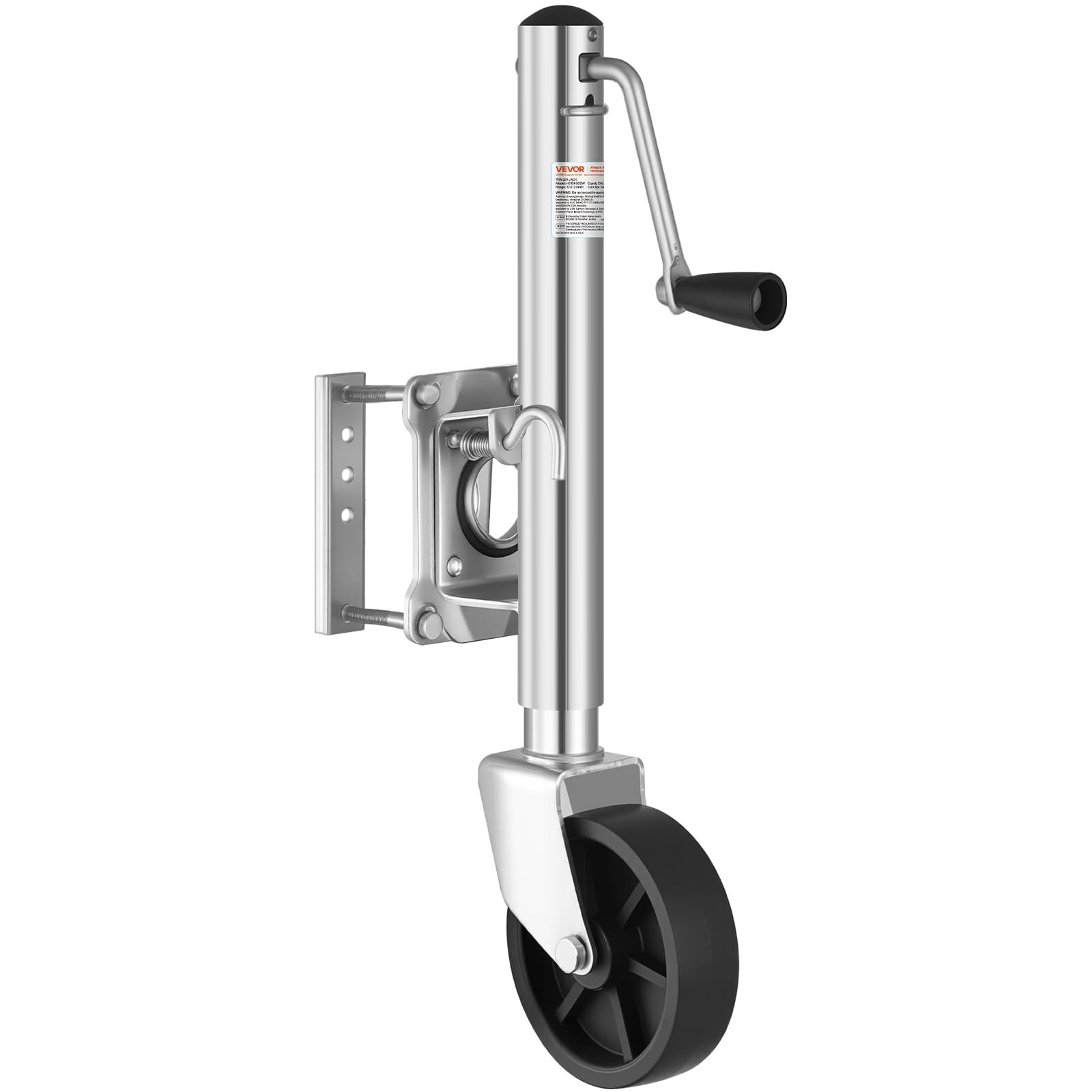
2. VEVOR Trailer Jack with Wheel, 1000 lbs Load Capacity, Heavy Duty Swivel Boat Trailer Jack with PP Single Wheel & Ergonomic Handle
The wheeled swivel jack that lets you roll a small trailer sideways into the exact spot you want
If you are moving a light utility trailer or a small boat around a tight driveway, a plain flat-foot jack forces you to back the tow vehicle in again and again. This VEVOR solves that with a 360-degree caster wheel made of non-slip PP — a tough plastic that shrugs off wet and salty surfaces. The 1,000-lb capacity is aimed at the small-trailer crowd, and owners use it on “harbor freight 4×8′ trailer” rigs and even as the caster on homemade chicken tractors. It rolls, pivots, and stows out of the way in seconds.
Two features set this VEVOR apart from a flat-foot jack. First, the swivel (the joint that lets the jack fold) folds up when you tow, so you never worry about ground clearance. Second, it weighs 13.5 lbs, making it the lightest jack in this lineup by nearly a pound and a half compared to the YOMILINK above. Its 10-inch maximum lifting height on a 12.8-to-23-inch range keeps it compact enough to stow tight against the frame. Owners describe installation as simple even for first-timers, and one notes it bulks up nicely on the tongue of a light utility trailer.
The recurring gripe is the wheel: a few buyers find it wobbles on rough ground, especially when the trailer is loaded heavier than the wheel diameter likes. On smooth pavement it rolls like it should; on gravel or grass, expect a little shimmy under load. If you routinely roll a 1,000-lb-plus load across uneven ground, size up to the Jeremywell dual-wheel instead.
What works: the swivel and caster combo is the standout — no more winding the jack all the way up just to clear a curb or a driveway lip. Owners consistently call out how much easier it makes repositioning a small trailer.
Who this is for: utility trailer owners, jet-ski haulers, and small boat owners who move their rigs around a yard or driveway more often than they tow at highway speed.
Right call for: light trailers up to 1,000 lbs that need to be nudged into tight parking spots.
Step up if: your trailer is over 1,000 lbs or you regularly wheel it across gravel — the single wheel starts to show its limits.
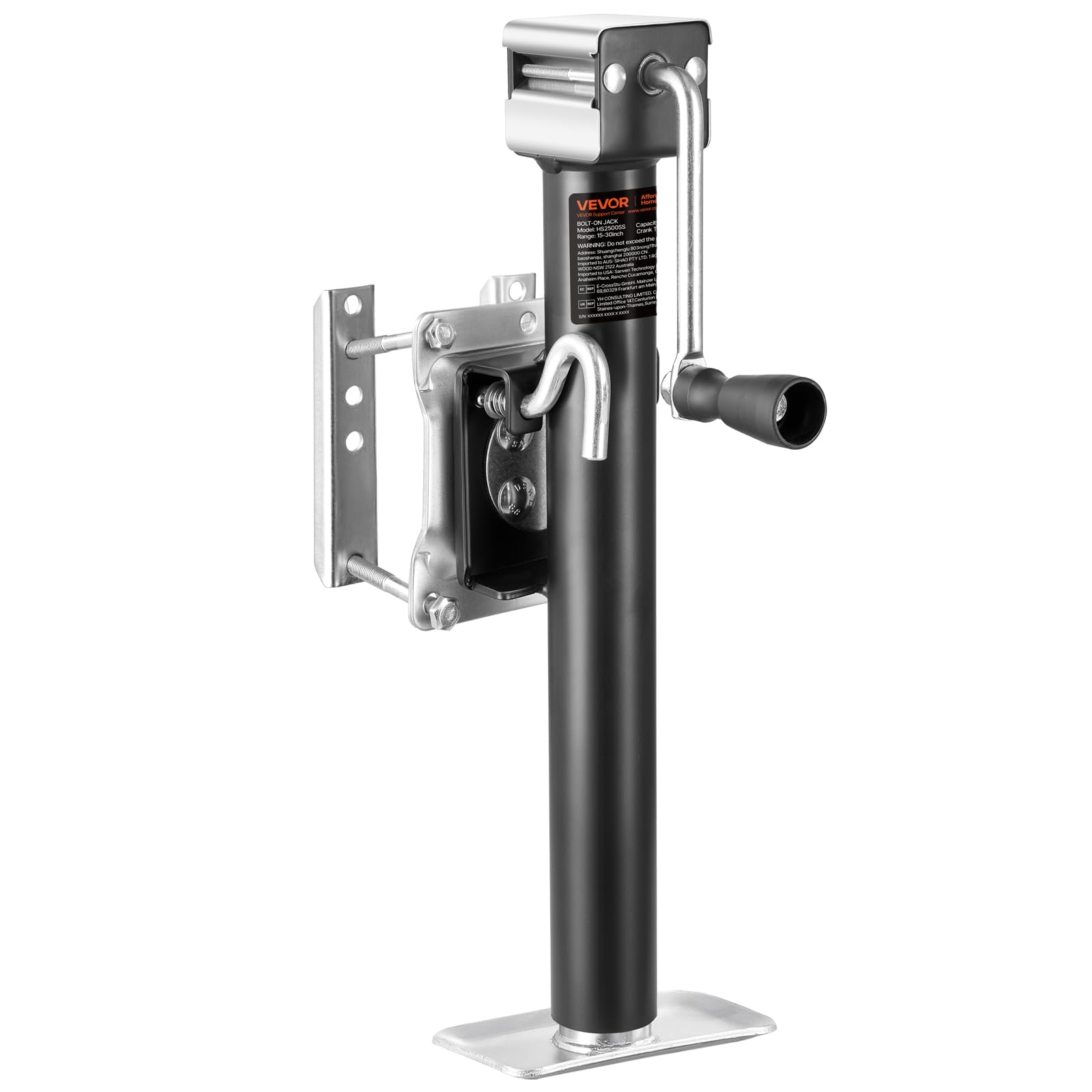
3. VEVOR Trailer Jack, 2500 lbs Dynamic Load Capacity, Heavy Duty Swivel Bolt-on Trailer Jack
The 15-inch-travel utility jack that punches above its price with carbon steel and galvanized tubes
This VEVOR jack carries a 2,500-lb dynamic load rating, weighs 16.8 lbs, and travels the full 15.04-to-30-inch range on a topwind crank. For a mid-sized utility trailer or a light boat trailer, that is the balance — you get real travel without the bulk of an 8,000-lb unit. The swivel bracket and handle let you fold the jack up out of the way when towing, and the carbon steel construction with galvanized inner and outer tubes plus a powder finish is built to keep rust off for a long time.
Owners on landscaping trailers and log trailers report it holds up nice and steady — some skip the weld entirely and trust the bolt-on hardware. It also handles the load without needing to be lifted into place: one owner notes it replaced a drop-down tongue stand on a 27-ton log splitter and a light boat trailer jack on a utility trailer without any trouble. That 15.04-to-30-inch range is roughly 5 inches wider than the CURT 28112’s 11-inch travel, which matters if your trailer tongue sits unusually low or high.
Fit opinions are mixed. One owner on a single-axle 6.5×12 trailer found it flatteringly overbuilt for the job but notes the jack retracts taller than expected — which pulls the crank handle into tight-turn territory and eats frame room. If rear clearance is tight on your setup, be ready to weld rather than clamp and to stow the jack horizontally when you are not using it.
The standout trait: durability and functionality tie for the lead in owner feedback — the carbon steel build keeps it working season after season where cheaper jacks rust through.
Honest limitation: the taller-than-expected retracted height makes it a poorer match for short-frame single-axle trailers than for longer utility rigs.
Pick this when: you have a utility or travel trailer in the 2,000-to-2,500-lb range and want a durable swivel jack without paying electric-model money.
Look elsewhere when: you have very limited rear clearance — the taller retracted profile can foul the handle on tight turns.
4. CURT 28112 Marine Boat Trailer Jack with 6-Inch Wheel, 1,200 lbs., 11 Inches Vertical Travel
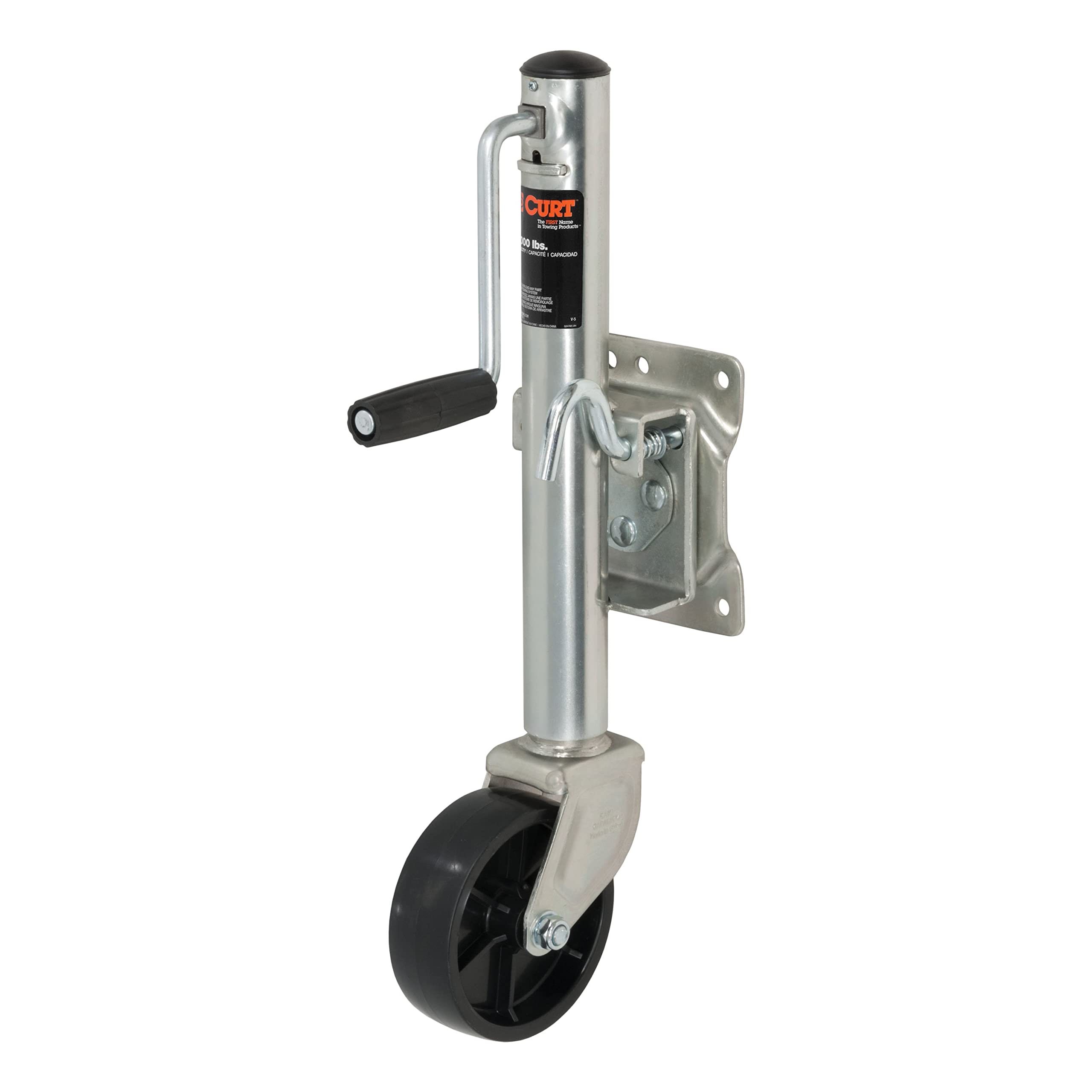
A saltwater-tested marine jack with a 6-inch wheel and a swivel bracket that folds clean out of the way
The CURT 28112 is what you would call a purpose-built marine jack. Zinc-plated finish, a 6-inch diameter wheel that rolls a boat across ramp concrete without fighting, and a support and lift rating of 1,200 lbs each. It fits 2″ x 2″ to 3″ x 5″ trailer frames using the included 3/8-16 x 4″ bolt-on hardware. The swivel bracket swings the whole jack up and out of the way for towing, and the heavy-duty pull pin locks it back down when it is time to drop the tongue.
What has sold this jack for years is how it holds up. Owners run it in freshwater and report it still working smoothly with paint that looks new after years of weather exposure. One proud owner even swapped out a jack that had served his fishing boat trailer for 35 years. The 11 inches of vertical travel is narrower than the YOMILINK’s 22.4-inch minimum-height range, so verify your tongue height before ordering if you run a tall trailer. For a mid-sized boat trailer, though, it is about as proven as this category gets.
Two things buyers should plan around. The kit ships without installation instructions, and the bolt rails mount horizontally — force them vertical and you will bend the mounting plate. Some buyers have also received the unit missing a couple of bolts or nuts. Both issues are fixable with a quick look at a YouTube install or a spare-hardware run, but budget for it. Saltwater owners should also rinse the jack after launch days: even a zinc finish wants a little care when the ocean is your regular playground.
What wins people over: the marine-grade protection and the 6-inch wheel that rolls a loaded boat trailer on concrete without asking for help.
Plan for this: no instructions in the box and horizontal-only bolt rails — vertical mounting bends the plate.
Best for: saltwater boat owners with trailers in the 1,200-lb range who want a jack that has earned its marine reputation.
Skip if: your tongue sits high enough that 11 inches of travel leaves the wheel off the ground — go with the YOMILINK or FZZD instead.
5. Jeremywell 2000lbs Trailer Jack with Double Wheel, Adjustable 12″ Lift Travel

Two 6-inch wheels instead of one — the difference between a wobbly roll and a stable one under a heavy boat
A single-wheel jack rolls fine under a light trailer; under a 4,300-lb boat, that wheel digs in and wobbles. The Jeremywell fixes that with a dual-wheel design — two 6-inch wheels side by side for stability on everything from smooth concrete to gravel. Alloy steel with a galvanized finish, 2,000 lbs of load capacity, and a 12-inch vertical lift. The ergonomic sidewind handle cranks comfortably, and the swivel bracket folds flat so the jack gets out of the way for towing.
What stands out in owner feedback is how often this jack gets used for exactly its intended purpose: rolling heavy boats around a driveway. Buyers report it making short work of a 22-foot pontoon, outlasting a jack with stripped gears, and holding up to rough handling that bent and broke previous jacks. The 12-inch lift on a 26-to-38-inch body covers mid-sized boats well. At 16.3 lbs, it is 4.3 lbs heavier than the 12-lb Ultimate Trailer Jack — worth knowing if you install solo.
One thing to know: this jack ships without instructions, and the mount clamps around the frame rather than bolting through it. For most owners, the clamp holds fine; a few report the clamp slipping under load or wanting a direct bolt-on connection. Have a 9/16, 5/8, 11/16, and 3/4 socket plus a 16mm socket on hand for the handle grip, and torque the frame clamp carefully. If your frame is thin or rusted, consider having a shop drill and bolt the bracket directly.
What makes it different: the dual-wheel stability — owners with heavier boats report it rolls with far less wobble than a single-wheel jack.
Worth noting: the clamp-on mounting works for most trailers but can shift under load on thinner frames.
Choose this if: you tow a mid-weight boat — 2,000 to 4,500 lbs — and want the stability of two wheels under load.
Try something else if: your trailer frame is thin or you strongly prefer a bolt-through mounting system over a clamp.
6. The Ultimate Trailer Jack, 2000lb No-Crank Tongue Jack for Boat, RV & Utility Trailers

The jack that eliminates the endless cranking — drop the leg, fine-tune with a few turns, and you are done
Most jacks make you crank the whole way up and the whole way down. This one doesn’t. A 12-inch adjustable drop leg does the heavy lifting with your hand — lower it into position, then use the topwind handle for 15.5 inches of fine-tune cranking. If you hitch up alone several times a week at a boat ramp, that drop leg is the difference between a 30-second setup and a 3-minute one. A 3,000-lb support capacity and a 2,000-lb lift capacity mean it has real headroom for its class.
What owners love is how well this jack stows. The retracted profile tucks nearly flush with the trailer frame — one owner specifically praises being able to withdraw it fully so nothing drags on driveways, and another notes the old jack he replaced was too tall and clipped his tailgate. The internal roller bearings cut down crank effort noticeably, and the zinc coating keeps rust at bay. Weighing 12 lbs, it is also one of the lighter installs in this list — 2 lbs lighter than the YOMILINK’s 14 lbs, if you are counting grams at install time.
The catch: on wider frame rails the vertical travel shrinks below the stated range, so some owners still need a block under the foot to reach the ground. The handle position can also interfere with a fully dropped tailgate, and the plastic retainer post on some units drops too far or can be removed entirely if you do not seat it right. Both are minor in the grand scheme — owners who work with trailers professionally still call this the best jack they have owned.
Where It Shines
- 12-inch drop leg cuts hitch setup time to a fraction of a full-crank jack
- Retracts flush to the trailer frame — no driveway-drag issues
- Internal roller bearings make the remaining crank effort noticeably lighter
- Zinc-coated exterior keeps rust off in regular towing conditions
Watch Outs
- On wide frame rails, effective vertical travel can fall short of the stated range
- Handle can interfere with a fully dropped tailgate on some trucks
- Plastic retainer post needs proper seating to prevent drop-leg overextension
Ideal for: boat and utility trailer owners who hitch up frequently and hate the crank-crank-crank ritual.
Might not fit if: your trailer frame is unusually wide — the effective drop-leg travel can come up short on broad frame rails.
7. FZZD 8000 lbs Heavy Duty Trailer Jack, 28.6″ Vertical Travel

8,000 lbs of lifting capacity in a 28-lb steel body built for yachts and the biggest boat trailers on the road
When your boat is too heavy for a 2,000-lb jack, this FZZD is the step up. It has a full 8,000 lbs of load capacity, a 28-lb steel-pipe body, and a lifting range from 4.7 to 33.3 inches — about 5 inches of extra travel compared to the Jeremywell’s 12-inch vertical lift, and enough to reach a very low trailer or a high A-frame tongue. The oversized base plate keeps the jack planted when the tongue is loaded, and the galvanizing coating plus rust-resistant finish stands up to coastal air and winter road salt.
What earns this jack its reputation is durability. Owners on the Texas coast who have replaced several jacks over the years call this one a high-quality replacement, and one politely notes it is nicer than previous jacks that cost noticeably more. The textured side handle is longer than a standard flared handle, which means less effort per rotation when you are lifting a heavy tongue — a small design choice that adds up over a season of launches. Five levels of drop-leg adjustment let you dial in the height for both tall and low-profile trailers.
The trade-off is the 28-lb weight. This is not a jack you casually swap between trailers — bolting it to a single trailer and leaving it there is the right call. The side-mount design also requires more tongue real estate than a simple A-frame bolt-on, so check your frame width before ordering. That said, if your priority is a jack you will not be replacing again for a decade, the FZZD is the most overbuilt pick in this list.
Where it leads: quality and durability dominate owner feedback — this is a jack people describe as one of the best they have used.
Budget the effort: at 28 lbs it is the heaviest pick here and not something you will swap between trailers casually.
Built for: yacht trailers, big boat trailers, and heavy equipment rigs where 5,000 lbs of capacity feels tight.
Only skip if: you need a jack you can swap between multiple trailers — at 28 lbs this one stays bolted to one frame.
8. POLESTAR Electric Trailer Jack, 5000lbs Electric Power A-Frame Tongue Jack

Push a button, watch your tongue rise — a 5,000-lb electric jack with a ball screw drive that speeds up hitching
The POLESTAR is built around a ball screw design — a rolling bearing mechanism that reduces friction compared to a standard threaded screw, giving you smoother and faster lifting without the grind. With 5,000 lbs of dynamic load capacity and 7,500 lbs of static lifting power, it has real muscle for a mid-sized RV, boat, or stock trailer. The 9-to-27-inch lift range plus a 4.5-inch drop leg stretches the full reach to 31.5 inches, so it clears most tongue heights without a block underneath.
Owners of 3,500-lb horse trailers and travel trailers describe it as a genuinely better experience than the manual jack it replaced: quicker, quieter, and something a spouse can operate without assistance. Installation is the lead positive in owner feedback — the wiring runs straightforwardly to a positive battery terminal with a frame bolt used as ground. There is also a waterproof protective cover, built-in LEDs that shine down onto the coupler for late-night hookups, and a circuit breaker that trips and resets automatically if the amperage spikes. The included hand crank is there as a backup if the battery ever drains.
The honest side: reliability opinions are split, with some owners reporting intermittent or failing units and a few flagging the non-standard inline fuse as hard to source locally. That mix is worth reading carefully if you often launch far from home. The ball screw mechanism itself is more precise than a threaded-screw jack, but it also means the jack prefers clean power — a low or dirty battery connection can drag on the motor. Wire it to a healthy, well-grounded battery and it behaves; fight the wiring and it will let you know.
Why it earns attention: the ball screw design and one-button operation turn a tiring chore into a five-second task — plus the down-facing LEDs are genuinely useful at a dark ramp.
Full disclosure: some owners hit intermittent performance or fuse issues, so a solid wiring setup matters on this pick.
Ready for this if: you have a 12-volt trailer battery and want push-button hitching at a crowded ramp — couples especially well with 3,500-to-5,000-lb trailers.
Hold off if: you want zero electrical moving parts, or you regularly launch too far from a spare fuse source to feel comfortable troubleshooting.
9. KYX Electric Trailer Jack 7500LBs, Electric Jack with Waterproof Cover

A 7,500-lb electric jack that takes on the heaviest A-frame tongue weights with one push of a switch
When your trailer’s tongue weight sits north of what a 5,000-lb electric jack can comfortably lift, this is the one that stops asking questions. A 12-volt DC motor rated at 7,500 lbs of load capacity, a 9.84-to-32-inch height range, and a carbon-steel body with an anti-rust coating that shrugs off rain and spray. The multi-level adjustable height keeps your trailer balanced on uneven ground, and there is a hand crank included for the day the battery has had enough.
Installation is what owners praise most here — the wiring is straightforward and the fit is clean on standard A-frame trailer fronts. The slots on the mounting plate support multiple orientations, and the unit comes with an inline fuse already attached. Built-in overload protection disconnects the motor if current spikes, then restarts it once the motor cools — a real safety feature when you are lifting a heavy tongue with unfamiliar wiring. Owners note it makes hitching to any tow vehicle simpler, particularly on older trailers being pressed back into service.
Here is what you should know going in: this jack is slower than some owners expect, and the durability record in owner feedback is mixed — some units have failed after a handful of uses, especially when asked to lift beyond their real-world comfort zone. The switch can also feel loose on arrival on some units. If your tongue weight runs close to the 7,500-lb rating, treat that as the ceiling rather than the target, and keep the manual crank accessible. Wires may run about a foot short of the battery on longer frame runs, so a quick extension or a repositioned terminal can save you a return.
What sells it: the highest load rating of any electric jack here, delivered with straightforward wiring and a waterproof cover included.
Know before you buy: lifting speed is on the slower side, and the mixed durability record means you should not treat 7,500 lbs as an everyday working load.
Worth it for: heavy travel trailers or fifth wheels where a 5,000-lb electric jack feels like it is straining.
Better elsewhere if: you want the proven reliability of a mechanical jack, or you need a faster lift — the trade-offs here are real.
Understanding the Specs
Load Capacity vs Lift Capacity
Load capacity is how much downward weight the jack can support when parked — your boat’s full tongue weight resting on the foot. Lift capacity is how much the jack can raise from a dead stop. Two ratings are often the same number on marine jacks, but electric units sometimes list both a dynamic load (while lifting) and a static load (parked and holding). When in doubt, look at the support or static number for how much parked weight the jack holds, and the dynamic number for what it can actually lift off the ground.
Lift Range And Retracted Height
Lift range is the total distance from the jack’s lowest to highest point — usually expressed as two numbers, like 23.2 to 45.6 inches. Retracted height is where the jack sits when folded down, and it decides whether the jack clears your driveway and doesn’t drag when you tow. A drop leg is a separate inner tube you pull down by hand for a head start before cranking. Swivel brackets let the whole jack rotate sideways or up, which is how you get clearance on trailers with low tongues.
Corrosion Protection: Zinc, Galvanized, And Powder Coat
Zinc plating is a thin electroplated finish that resists water and road salt. Galvanizing builds a thicker zinc layer that lasts longer, especially against salt air. Powder coating is a baked-on polymer shell that resists scratches and chemical wear. The best marine jacks combine at least two — a galvanized tube set plus a powder finish, or a zinc-plated frame. If you launch in saltwater, rinse the jack after every trip; even good coatings want a little help.
Manual vs Electric
Manual side-wind and top-wind jacks are lighter and need no battery — you crank the tongue up and down by hand. Drop-leg manuals cut the cranking time in half. Electric jacks run off the trailer’s 12-volt battery and do the work with a button, which is a major upgrade if you hitch alone. Electric models cost more, add wiring, and use a fuse or circuit breaker, but the effort saved at a crowded ramp is the reason so many heavy-trailer owners go electric.
FAQ
How much load capacity does my boat trailer jack actually need?
Will a 2,000-lb jack handle my 4,300-lb boat trailer?
What does vertical travel mean on a boat trailer jack?
Is an electric trailer jack worth it over a manual crank?
How do I keep my boat trailer jack from rusting in saltwater?
Can I bolt a new jack onto the same holes as my old one?
What is the difference between a drop-leg jack and a regular crank jack?
Do I need a wheel on my boat trailer jack?
How do I stop the jack from dragging when I tow?
Can I weld a trailer jack instead of bolting it on?
How long does a boat trailer jack typically last?
Should I upgrade to a jack with a higher load rating than my trailer needs?
Final Thoughts: The Verdict
For most boat trailers, the boat trailer jack winner is the YOMILINK 5000 lbs A-Frame Trailer Jack because it pairs a genuinely high load ceiling with a 5-level drop leg and a corrosion-resistant steel build — the kind of jack that makes hitching at the ramp a two-minute errand instead of a wrestling match. If you have a smaller trailer and want the convenience of rolling the tongue around by hand, grab the Jeremywell 2000lbs Trailer Jack with Double Wheel. And if you would rather push a button than crank at all, the POLESTAR Electric Trailer Jack is the one to reach for — just make sure your 12-volt wiring is clean before you commit.
How We Picked
We do not accept paid placement. Every pick is matched to a real buyer and a real use-case; we do not hands-on test units.
Sources & Methodology
Specifications: manufacturer listings and product documentation. Review insights: verified customer reviews, as of September 2026. Pricing: not shown on this page (it changes often); check the current price via the retailer link.
As an Amazon Associate, Gadgets Feed earns from qualifying purchases. This does not affect which products we feature.