
That quarter-panel dent stared at you for months. Now it’s time to erase it, but the wrong body filler means sinking hours into sanding only to watch it crack or pin-hole after primer. A filler that sands like concrete or won’t bond to bare metal is the fastest way to turn a weekend project into a shop bill.
I’m Min — the co-founder and writer behind Gadgets Feed. After cross-referencing chemical formulations, cure times, and hundreds of verified repair photos across professional and DIY forums, this guide pinpoints the filler that delivers the least sanding friction for the strongest long-term bond on steel, aluminum, and fiberglass surfaces.
If you want a repair that primes same-day without sinkage or fish-eyes, choosing the right compound matters more than technique. That’s the exact problem solved by this breakdown of the best body filler for cars.
How To Choose The Best Body Filler For Cars
The difference between a filler that feels like rock and one that sands like butter comes down to three core factors: chemistry, particle technology, and cure profile. Matching these to your specific repair surface—steel, aluminum, or fiberglass—determines whether you get a lasting bond or a blotchy failure in six months.
Understand the resin base and filler type
Most automotive body fillers use a polyester resin base that cures via a chemical reaction when mixed with a hardener paste. Standard fillers contain talc or calcium carbonate, which create a dense, heavy paste that sands into fine dust but can absorb moisture over time. Lightweight fillers replace some of those minerals with hollow glass microspheres. These reduce density by roughly 30 percent, making the cured material much easier to block-sand without loading your sandpaper. Aluminum-filled putties, on the other hand, contain powdered aluminum for maximum structural integrity—ideal for filling holes that will be drilled or tapped later, but noticeably harder to sand than a microsphere formula.
Match cure time to your work pace
Fast-dry fillers, like the Bondo Professional Fast Dry, cure in about 15 minutes, which demands quick mixing and application in small batches. If you are working on a large panel or in hot weather, that window shrinks further. Standard cure fillers give you 8 to 12 minutes of working time and full cure in 20 to 30 minutes, offering a more forgiving rhythm for beginners. Oversized or multi-dent repairs benefit from a slower cure to avoid waste and overheating the material in the mixing cup. Always check the product’s full cure time listed in minutes—not just the tack-free time—because sanding before full cross-linking causes the filler to gum up the paper.
Check adhesion compatibility with your substrate
Not every filler adheres to bare aluminum or galvanized steel without a dedicated etching primer. Standard polyester fillers bond well to properly scuffed steel and fiberglass, but aluminum requires a filler with specific adhesion promoters—look for brands that explicitly list aluminum in their compatible materials. Fiberglass-reinforced fillers, like the U-Pol Fibral Lite, use short-strand glass fibers to bridge gaps and reinforce edges, making them the right choice for repairing holes or missing sections rather than shallow dents. For plastic bumpers, you need a flexible filler designed specifically for TPO or polypropylene; a rigid body filler will crack at the first temperature shift.
Quick Comparison
On smaller screens, swipe sideways to see the full table.
| Model | Category | Best For | Key Spec | Amazon |
|---|---|---|---|---|
| Roberlo Maxifill 3L | Lightweight | Multi-panel repairs | Microspheres; 40% less sanding | Amazon |
| Evercoat Metal Glaze | Finishing Putty | Pinhole-free topcoat | EcoResin; ultra-thin viscosity | Amazon |
| U.S. Chem All-Metal | Aluminum-filled | Drill/tap structural repairs | Aluminum powder; can be drilled | Amazon |
| Bondo Fast Dry Quart | Fast Cure | Quick same-day repairs | 15-minute full cure | Amazon |
| U-Pol Fibral Lite | Fiberglass-reinforced | Hole repair and bridging | Short-strand fiberglass paste | Amazon |
| Roberlo Maxifill 1L | Lightweight | Small dent touch-ups | Ultra-lightweight; easy sand | Amazon |
| KMK K-Glaze | Finishing Putty | Budget-friendly spot filling | Creamy texture; fast drying | Amazon |
In‑Depth Reviews
1. Roberlo Maxifill Superior Lightweight Body Filler – 3 Liters + Hardener
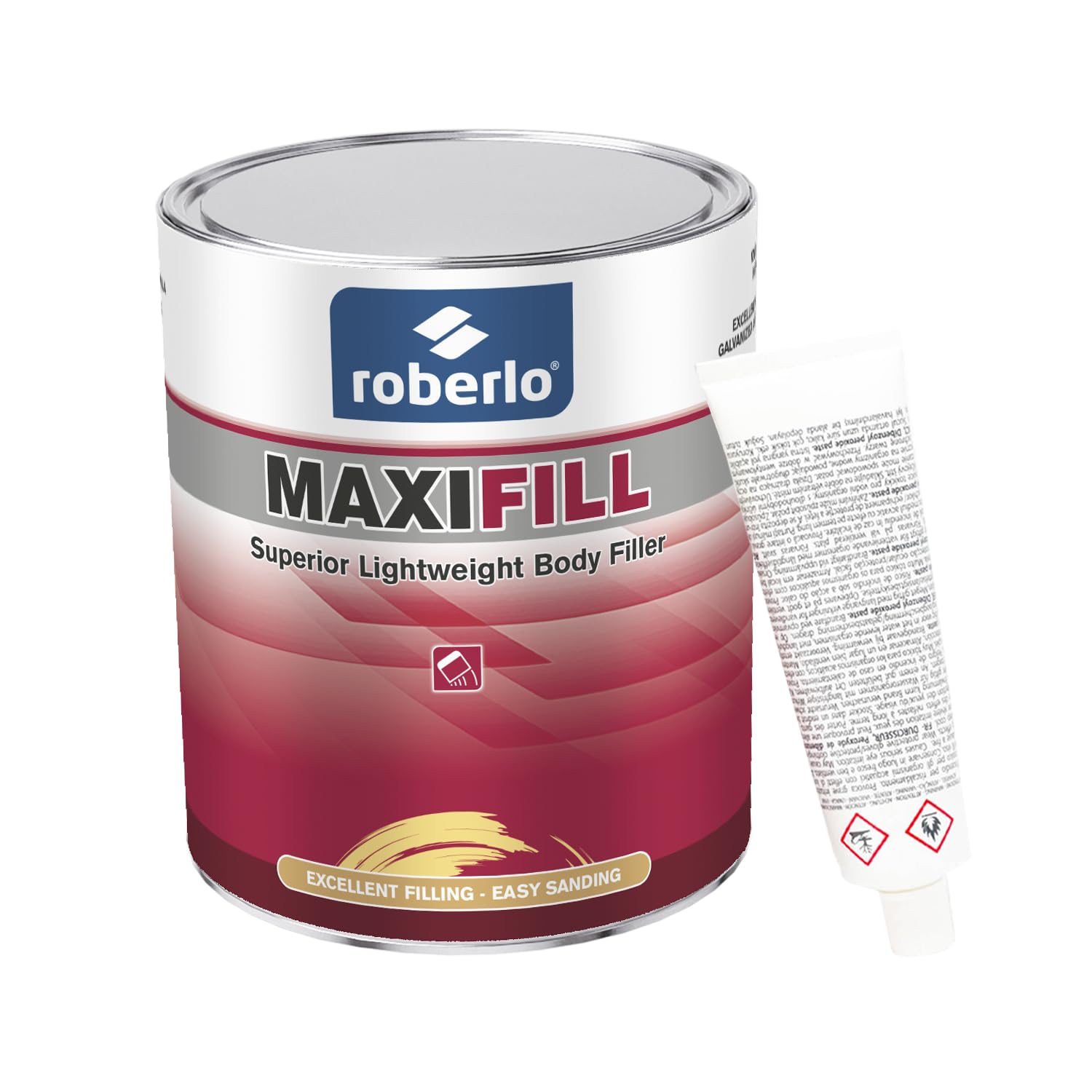
The 3-liter Roberlo Maxifill kit dominates this category because of its microspheres technology, which reduces block-sanding time by a claimed 40 percent compared to traditional talc-based fillers. In practice, that means fewer passes with 80-grit before you can step to 180, and significantly less paper clogging. The formula cures to a uniform density that resists pinholes—a common frustration with cheaper filler that traps air against the substrate.
The kit includes hardener, and the creamy mix ratio of 100:2 by weight spreads evenly across steel, aluminum, zinc, and fiberglass. Advanced rust inhibitors in the resin matrix help prevent corrosion from creeping under the repair edge, which is critical for panels exposed to moisture. With a 4.6-star average across nearly 300 reviews, users consistently highlight the smooth application and the fact that no separate finishing putty is needed before primer.
The trade-off is a premium buy-in that makes sense for volume repair work or full-panel refinishing. For a single small dent, the 1-liter sibling is a more economical option. The 8-pound container also takes up bench space, though the time saved on sanding quickly offsets the physical footprint for anyone doing regular bodywork.
Why it’s great
- Microspheres significantly reduce sanding effort and paper clogging
- Rust inhibitors add long-term protection behind the repair
- Works on aluminum without extra etch primer
Good to know
- Higher initial cost compared to standard talc fillers
- Large can requires dedicated workspace storage
2. Evercoat Metal Glaze Ultra Polyester Putty – 30 Fl Oz
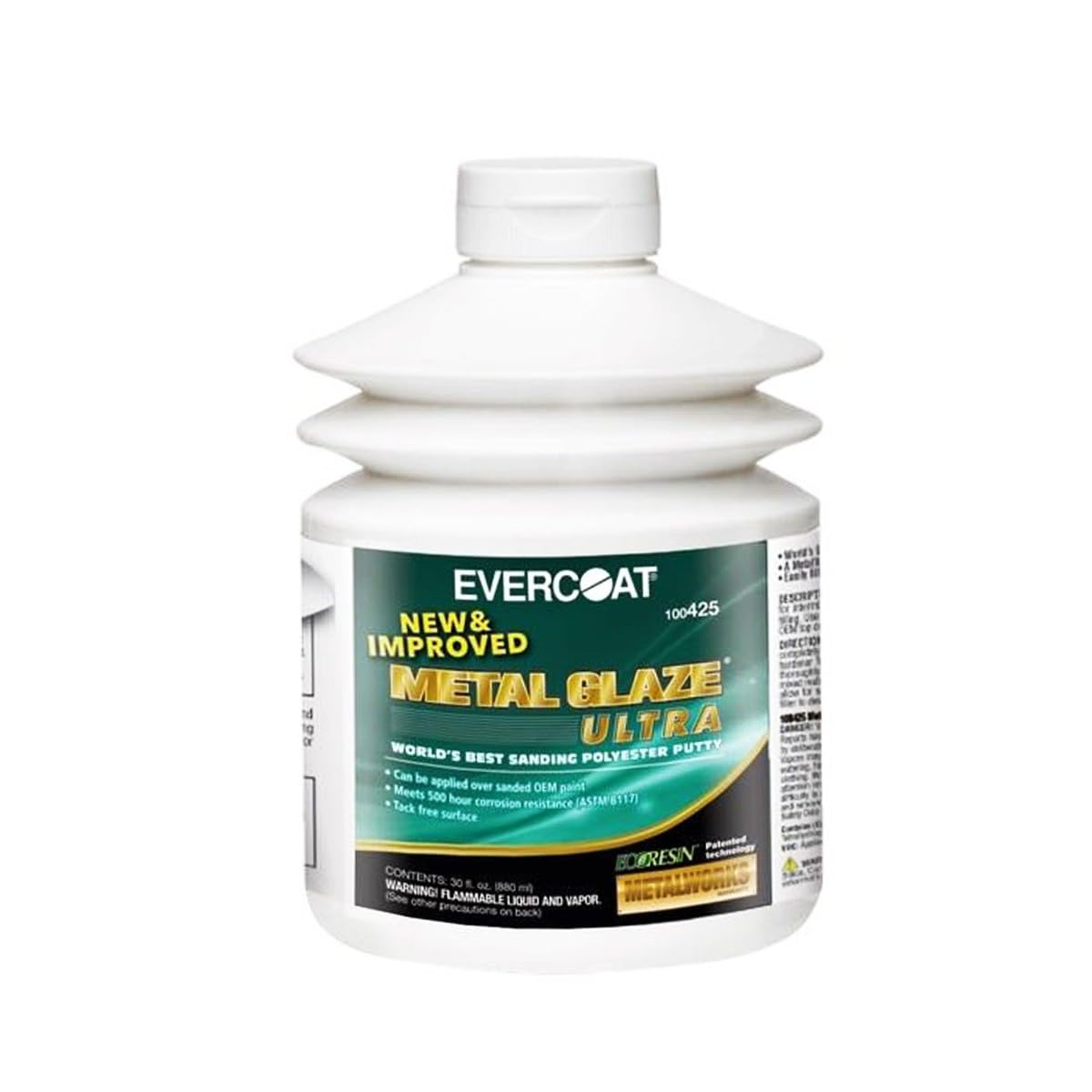
Evercoat Metal Glaze Ultra belongs in every body shop’s cabinet not as a primary filler but as the final pass over block-sanded work. Its thin, low-viscosity formula flows into microscopic pinholes and sanding scratches that standard filler leaves behind, delivering a glass-smooth surface that primer adheres to without sink-back. The EcoResin technology reduces crystalline silica content while maintaining a consistent cure that sands to a fine white dust.
This putty can also be mixed with Evercoat’s Metalworks products for a custom viscosity blend, giving advanced users control over flow and sag resistance on vertical panels. The fast-setting nature means you mix golf-ball-sized batches; larger amounts kick off heat prematurely and waste material. User reviews consistently note zero pinholes after sanding at 220 grit, which eliminates the need for multiple primer coats on show-quality paint jobs.
The main caveat is that this is not a gap-filling body filler—it bridges fine lines and low spots only. Using it to fill a 3 mm depression will result in cracking. For structural repairs, apply a standard filler first, then use Metal Glaze as the final 1 mm skim coat. The 30-ounce tube includes hardener, though the container size is better suited for finishing work than bulk panel filling.
Why it’s great
- Near-zero pinholes after sanding at 220 grit
- Ultra-thin viscosity flows into imperfections automatically
- EcoResin formula reduces airborne silica dust
Good to know
- Not suitable for deep fills or structural gaps
- Sets fast so work in small batches only
3. U. S. Chemical & Plastics All-Metal – 1 Quart

When the repair area will later need a hole drilled, a screw tapped, or a bracket bolted, standard lightweight filler crumbles under the bit. U.S. Chem All-Metal solves this with a high-concentration aluminum powder formulation that cures into a dense, metallic-like mass. Users report being able to drill, tap, and even weld near the repaired area without the filler cracking or separating from the substrate—a property that makes it the go-to for floor pan patches and firewall repairs.
The paste consistency is noticeably heavier than microsphere fillers, spreading with a firm resistance that requires a stiff spreader. Once cured, its hardness means sanding takes more effort—users describe it as “feeling like metal” under the block. This is by design: the material’s strength comes from its density. For thin rust-through areas, it bonds tenaciously to clean steel and can be applied in thicker passes without sagging, provided you allow 10 minutes between coats for exothermic heat to dissipate.
The quart container includes hardener and is enough for several small-to-medium repairs. The trade-off is that it does not feather-edge as smoothly as a lightweight finishing filler, so you will want to topcoat with a polyester glaze before primer on visible body panels. Long-term users report excellent durability even under powder-coat baking cycles, with no cracking after oven cure.
Why it’s great
- Drills and taps like metal without cracking
- Excellent adhesion to steel for structural patches
- Survives powder-coat oven temperatures
Good to know
- Much harder to sand than lightweight fillers
- Heavier consistency requires firm spreader technique
4. Bondo 3M Professional Fast Dry Filler – Quart
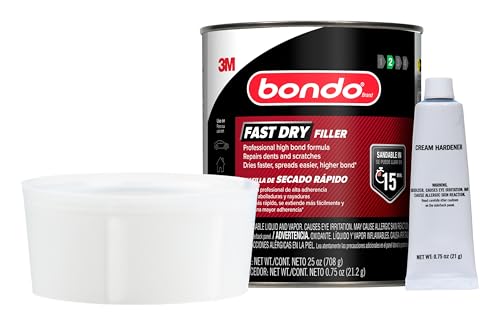
Bondo Professional Fast Dry holds its reputation because it delivers a predictable, repeatable cure cycle in exactly 15 minutes from mixing to sand-ready hardness. That speed makes it the correct choice for small dents, door dings, and rocker panel touch-ups where you want to apply filler, sand, and prime all in one afternoon. The two-part gel spreads without dragging and does not shrink during cure, so edge-matching stays tight without later depression.
The formula bonds to bare metal, fiberglass, wood, masonry, and concrete, which broadens its usefulness beyond auto body into shop repairs. Color differentiation between the cream base and red hardener makes mixing complete coverage easy to see, eliminating the soft spots that cause hours of frustrating re-sanding. The quart size is compact enough for a home toolbox and yields roughly 10 to 15 average dent repairs depending on depth.
Because it cures fast, you must mix thoroughly but quickly, and in ambient temperatures above 75°F the working time drops to under 5 minutes. It also produces more exothermic heat than slower-curing fillers, so avoid thick dabs over 6 mm—heat can cause the mass to bubble or crack. For large or multi-dent panels, a standard-cure filler with a longer working window is less wasteful.
Why it’s great
- 15-minute full cure enables same-day sanding and priming
- No shrinkage during cure keeps edges flush
- Compatible with multiple substrates including wood and concrete
Good to know
- Working time shortens dramatically in hot weather
- Not ideal for fills deeper than 6 mm in one pass
5. U-Pol Products 0766 FIBRAL LITE – 1 Quart

When the repair area is a through-hole or a missing edge section, standard body filler lacks the tensile strength to stay in place without cracking. U-Pol Fibral Lite bridges that gap with short-strand fiberglass reinforcement suspended in a polyester paste. The fibers create a physical matrix that resists flexing and provides structural bridging across openings up to 25 mm when applied over a backing mesh or tape.
The paste sands very easily for a fiberglass product—reviews consistently mention that it blocks out with 80-grit without the glass fibers tearing or roughing up the paper prematurely. Full chemical cure takes about 24 hours, which is longer than most automotive fillers, but the waterproof cured matrix makes it suitable for floor pans, wheel wells, and boat repairs where moisture exposure is constant. The low-viscosity paste self-levels sufficiently to reduce the need for multiple skim passes on flat surfaces.
The 24-hour cure time is the main planning factor—you cannot sand and prime same-day with this product. It also requires a clean, scuffed surface free of rust for the glass fibers to lock into; adhesion on oily or smooth metal is poor without a dedicated adhesion promoter. For pure cosmetic dent repair without holes, a non-reinforced lightweight filler sands faster and cures quicker.
Why it’s great
- Short-strand fiberglass reinforcement bridges holes and gaps
- Waterproof after full cure for wet-area repairs
- Self-leveling consistency reduces skim passes
Good to know
- 24-hour full cure prevents same-day sanding
- Needs clean, abraded surface for glass adhesion
6. Roberlo Maxifill 1 Liter + Hardener
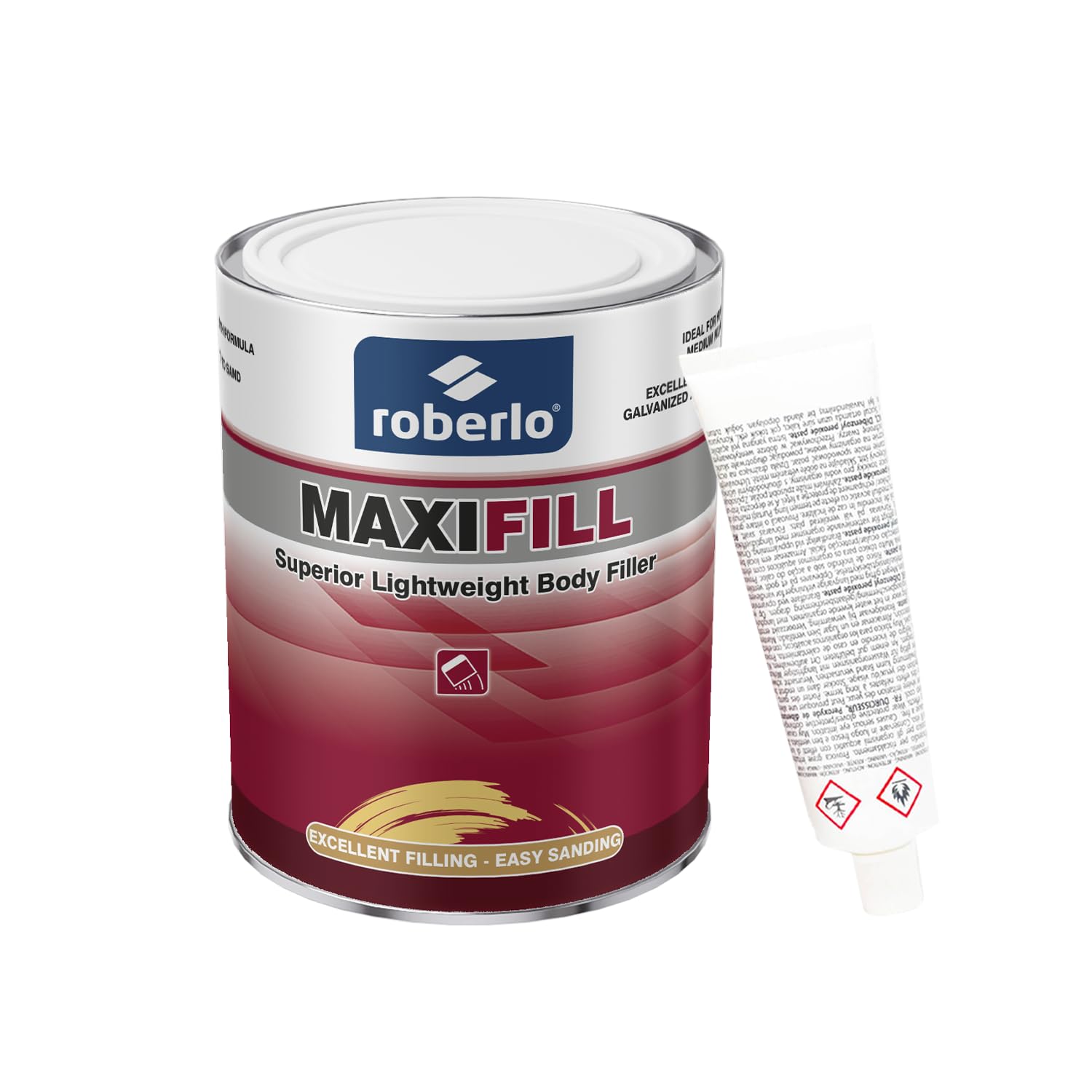
The 1-liter Roberlo Maxifill delivers the same lightweight microsphere formula as its larger sibling but in a package sized for the occasional DIY user who needs exactly enough filler for a bumper scratch, a mirror-mount repair, or two small door dents. The included hardener tube proportionally matches the can volume, so you do not have to guess drops—mix the entire batch at the recommended 100:2 ratio and spread.
Its adhesion to fiberglass, bare metal, and plastic makes it a viable all-purpose option for the home hobbyist who works on multiple materials. The creamy spread leaves a smooth film that sands flat with minimal effort—users report moving from 120 grit straight to 320 without a mid-stage block-sanding pass. The curing window is long enough for a careful coat on a hood or fender without the panic of a premature set.
Some customers reported receiving cans that appeared underfilled, which points to potential quality control inconsistency at the factory level. The filler also dries relatively quickly once mixed—about 5 minutes of working time—so you should mix only as much as you can apply in a single coverage pass. For the price difference versus the 3-liter kit, the 1-liter option is only economical if you are certain you will not need more volume for subsequent repairs.
Why it’s great
- Properly matched hardener-to-filler ratio eliminates guesswork
- Lightweight microsphere formula sands easily with 120 grit
- Versatile adhesion to metal, fiberglass, and plastic
Good to know
- Some reported underfilled cans from factory
- Working time roughly 5 minutes once mixed
7. KMK K-Glaze G-10440 Automotive Finishing Putty – 440ml

KMK K-Glaze positions itself as a low-entry finishing putty for the budget-conscious repairer who needs to fill shallow scratches, rock chips, and minor hail dents before primer. The creamy paste spreads easily with a rubber squeegee, and its fast-drying formula allows sanding within roughly 10 to 15 minutes at 70°F. When applied in thin passes under 2 mm, it sands to a smooth finish without tearing or rolling off the spreader.
The high-adhesion claim holds true on properly abraded steel and fiberglass, but several users note that the squeeze-bottle packaging makes consistent mixing with the hardener difficult—the tube dispenser tends to glob rather than dispense a controlled ribbon. This leads to uneven cure if the hardener is not folded throughly into the paste. The 440 ml volume is the smallest on this list, covering about two bumper repair jobs before needing replacement.
It is not water-resistant, so avoid using this product on lower door skins, rocker panels, or any area that sees standing moisture. A few negative reviews cite instructions printed only in Chinese, which can confuse first-time users who need a clear mix ratio. For the price, it functions adequately as a temporary cosmetic fix, but it lacks the structural integrity and sanding consistency of the mid-range options above.
Why it’s great
- Low upfront cost for small cosmetic touch-ups
- Creamy texture spreads thin for fine scratch filling
- Fast drying enables same-day sanding and priming
Good to know
- Squeeze-bottle makes consistent hardener mixing difficult
- Not water-resistant, so avoid moisture-prone panels
- Instructions only in Chinese in some units
FAQ
Can I apply body filler over bare aluminum without primer?
Why does my body filler keep cracking after sanding?
What grit sandpaper should I start with on fresh body filler?
Final Thoughts: The Verdict
For most users, the body filler for cars winner is the Roberlo Maxifill 3-Liter Kit because its microspheres technology cuts sanding time by 40 percent while including rust inhibitors that protect the repair edge long-term. If you need a pinhole-free topcoat before show-quality paint, grab the Evercoat Metal Glaze Ultra. And for structural repairs that require drilling and tapping, nothing beats the U.S. Chemical & Plastics All-Metal.