
Our readers keep the lights on and my morning glass full of iced black tea. As an Amazon Associate, I earn from qualifying purchases.
Specs are compiled from manufacturer listings and verified buyer reviews and can change over time — please confirm the key details on the product page before buying.
If you break down whole chickens, quarter pork loins, or fillet fish at home, the knife that does the most work is the one that never leaves your hand: a thin, flexible boning knife. A good one follows the bone instead of fighting it, so you keep more meat and stop hacking through silverskin. The Victorinox Swiss Classic 6-Inch is the one to buy first — it’s the knife that ends the “why is my chicken thigh in pieces” problem.
I’m Min — the founder and writer behind Gadgets Feed. This guide is built by comparing the manufacturers’ published specifications and the patterns across verified customer reviews, so you get each pick’s real strengths and trade-offs instead of marketing spin.
What follows is nine real boning knives, sorted by what they are actually good at — working around joints, removing fat and silverskin, or going the distance on a full butchering session. Every pick here has a blade length, handle material, and flex pattern you can compare on equal footing. Use this guide to find the best boning knife for butchers.
Our Picks at a Glance


How To Choose The Best Boning Knife For Butchers
A boning knife does one job better than any other blade: it gets close to bone without cutting into the meat you want to keep. That means the blade has to be narrow, thin, and either flexible or semi-flexible, so it can trace a rib or a thigh joint. The choices below come down to how much flex you want, what steel you trust, and how the handle feels through a long session.
Flex: the single trait that separates a boning knife from a chef’s knife
A flexible blade bends around joints and follows the natural curve of the meat. A semi-flexible blade has some give but keeps its shape for straight trimming and fat removal. Butchers dealing with poultry and fish tend to want more flex; home cooks breaking down a pork loin a few times a month often do fine with a semi-flex blade.
Steel type and edge retention
High-carbon steel takes a very fine, razor edge and holds it, which matters when you’re working close to bone for an hour. Stainless steel is forgiving and easier to care for, and it still holds an edge well on most of the picks here. If you go high-carbon, dry the blade after hand washing and don’t leave it wet.
Handle and grip when the surface is wet
Trimmed meat leaves a slick board and a wet hand. A textured, slip-resistant handle — and a full-tang or riveted construction that keeps the blade locked into the grip — is the difference between controlled and nervous cutting. Light knives tend to reduce wrist fatigue during long sessions.
Quick Comparison
| Model | Best For | Blade Length | Blade Material | Weight | Amazon |
|---|---|---|---|---|---|
| Victorinox Swiss Classic 6-Inch★ Best Overall | Best Overall | 6 inches | Stainless Steel | 0.08 kg | Amazon |
| Dexter-Russell S131F-6PCPWet-Hand Grip | Wet-Hand Grip | 6 inches | Stainless Steel | 4.48 ounces | Amazon |
| Dexter-Russell 1376HBRFeatherweight Control | Featherweight Control | 6 inches | High Carbon Steel | 2.4 ounces | Amazon |
| Victorinox 47519 Fibrox Pro | Everyday Home Butchery | 6 inches | Stainless Steel | 3.14 ounces | Amazon |
| Forschner 40450 Victorinox | Fish Filleting | 6 inches | Stainless Steel | 0.08 kg | Amazon |
| HENCKELS Forged Premio 5.5-Inch | Sturdy Trimming | 5.5 inches | Stainless Steel | 6.4 ounces | Amazon |
| ZWILLING Professional S 5.5-Inch | Edge Retention | 5.5 inches | High Carbon Stainless Steel | 136 g | Amazon |
| Dalstrong 6″ AUS-10V Damascus | Premium Steel | 6 inches | AUS-10V Japanese Super Steel | 170 g | Amazon |
| Wusthof 4603 6-Inch | Silverskin Work | 6 inches | Stainless Steel | 0.14 kg | Amazon |
In‑Depth Reviews
1. Victorinox Swiss Classic 6-Inch Boning Knife
Our pick — 4.5+★ from 750+ verified ratings; the strongest balance of quality and price.
The six-inch flex blade that glides along a bone instead of sawing at it.
This is the knife most home butchers should buy first, and the crowd agrees — 4.5+ stars across 700+ ratings. The reason is simple: the narrow, thin blade with an “S”-shaped edge is built to separate meat, poultry, or fish from the bone, and it does that with far less effort than a stiff chef’s knife. You feel the blade find the seam between meat and bone, and you follow it.
What wins people over is the flex. It bends enough to trace a curved rib or a chicken thigh joint, but it isn’t so limp that it wobbles. The steel is stamped stainless, which keeps the knife light at 0.08 kg — light enough that your wrist isn’t tired halfway through a batch of leg quarters. It’s also the construction Victorinox has been making in Switzerland since 1884, and the blade carries a lifetime guarantee against defects.
The trade-off: a thin, flexible stamped blade is not the knife for chopping through bone or half-frozen meat, and the blade ships with the item number 6.8413.15 stamped on it rather than 6.6413.15US1. That’s the same knife, but it’s worth knowing before you open the box expecting a different code.
Where It Earns Its Place
- 6-inch narrow blade with an “S”-shaped edge follows bone cleanly
- Flexible enough for curved joints yet still controlled
- 0.08 kg stamped build keeps the wrist fresh over long sessions
- Lifetime guarantee against material and workmanship defects
Before You Commit
- Thin flexible blade is not built for chopping through bone
- Blade stamp reads 6.8413.15, not the 6.6413.15US1 listing code
Pick this if: you break down poultry, fish, or primal cuts a few times a month and want one flexible knife that does the close work.
Pass on it if: you need to crack through joints and bone — this blade wants to work around them, not through them.
2. Dexter-Russell S131F-6PCP 6″ Curved Boning Knife
Built for the slippery part of the job — a wet hand and a curved blade that stays put.
If your board gets slick and your grip starts to slip, this knife is the answer. The white Grip-Tex coated plastic handle is designed for a secure hold even when wet, and the whole knife is Sani-Safe certified to meet sanitary requirements for professional kitchen use. It’s a 6-inch curved stainless blade, hand-honed for a sharp edge, and it weighs 4.48 ounces — enough heft to feel planted, not so much that it drags.
The curved shape is the part that does the real work. The upswept blade lets you run the tip along the bone and lift fat and silverskin away in clean passes, which is why it’s a popular pick for roasts, poultry, and fish. It also helps boost meat yield by keeping the blade off the bone surface. What buyers keep coming back to is the quality of the build — well over two dozen call it out — and the edge holds up with normal honing.
The one honest note: it’s hand-wash only, and the plastic handle won’t feel as warm or as premium in hand as a riveted wood or composite handle. Neither is a problem for a working knife; it’s just a different feel.
Wet-grip advantage: the textured Grip-Tex coating and Sani-Safe certification make this the cleanest choice for a busy, damp prep station where a slick handle is a real safety issue.
Sizing it up: at 4.48 ounces it sits between the featherweight Dexter-Russell 1376HBR at 2.4 ounces and the 6.4-ounce HENCKELS Forged Premio — a middle-weight feel many cooks prefer for control.
Reach for this if: your prep work happens on a wet board and you want a handle you don’t have to think about.
Look elsewhere if: you prefer a wood or composite handle and want a knife you can toss in the dishwasher.
3. Dexter-Russell 1376HBR 6-Inch Flexible Boning Knife
The 2.4-ounce blade that disappears into the work and leaves you in control.
At 2.4 ounces, this is one of the lightest knives in this list, and it’s dramatically lighter than the HENCKELS Forged Premio at 6.4 ounces. That lightness is the point: a narrow flexible high-carbon blade that follows the contour of a fish fillet or a chicken breast without tearing it. The DEXSTEEL high-carbon steel is forged, holds a razor edge, and is made in the USA. For precision fat and silverskin removal, the fine edge is exactly what you want.
The rosewood handle with brass rivets is the other half of the story. It gives you a warm, balanced grip that feels like a traditional butcher’s knife rather than a plastic production tool. The full 6-inch blade gives you enough reach to work a pork loin, and the flex is enough to slide around bones without wobbling.
The catch is carbon steel. It takes a fantastic edge and holds it, but it is not stainless, so it will rust if you leave it wet or put it away damp. Dry it promptly, keep a light coat of oil on the blade, and it will reward you. If you want zero maintenance, the Victorinox Swiss Classic is the easier steel.
Why Butchers Like It
- 2.4 ounces keeps wrist fatigue low through long sessions
- High-carbon DEXSTEEL takes a fine, razor edge
- Rosewood and brass-rivet handle balances and feels traditional
The Carbon-Steel Cost
- High-carbon steel is not stainless — rust is a real risk if left wet
- Needs prompt hand drying and occasional oiling
Suits you if: you want the lightest, most traditional feel in the hand and you don’t mind drying the blade after each session.
Skip if: you want a knife that tolerates being left in the sink or wiped down and put away damp.
4. Victorinox 47519 Fibrox Pro Boning Knife 6″

The straight, semi-flexible workhorse that handles trimming, filleting, and everything between.
The Fibrox Pro is the knife you buy when you want one boning knife for the whole job. The 6-inch straight, narrow, semi-flexible stainless steel blade is sharpened for a razor edge and follows the natural curve of the meat, cutting through tendons, fat, and bone. It’s the same Swiss-made construction as the Swiss Classic, but with the patented Fibrox handle — textured, slip-resistant, ergonomically shaped, and NSF approved for professional use. It weighs 3.14 ounces.
What people tend to rave about here is the size and feel in hand: it’s a 6-inch blade that suits a wide range of jobs and hands. The semi-flex steel is the right middle ground — flexible enough for fish, stiff enough that you can trim a pork loin without the blade wandering. The whole knife is stamped and light, and it carries a lifetime guarantee against material and workmanship defects.
The downside is fairly small: the semi-flex blade won’t match the full flex of the Swiss Classic or the Dexter-Russell 1376HBR for really tight, curving work around a chicken thigh joint. For most home sessions that’s not a limitation you’ll feel. To know before you open the box: the blade is stamped with the international item number 5.6203.15 rather than 47519 or 40519, but it’s the same knife.
The value read: a Swiss-stamped stainless blade, an NSF-approved textured handle, and a lifetime guarantee make this the easiest “buy once” pick for a home cook who isn’t chasing full flex.
The honest limit: a semi-flex blade is more controlled than a full flex, but it gives up some of the bend that helps around curved joints.
Best fit for: home butchers who want one durable knife for trimming, filleting, and breaking down meat without extra fuss.
Look elsewhere if: you want the extra bend for tight joint work — the Swiss Classic or the Dexter-Russell 1376HBR flex more.
5. Forschner Knives 40450 Victorinox Boning Knife with Blue Fibrox Handle

A curved, narrow blade with a blue grip that’s made for the fine work on fish.
This one leans toward fillets and fine trimming. The blade is curved and narrow, made of stainless steel, and 6 inches long — compare that to the 5.5-inch HENCKELS Forged Premio, and you get a bit more reach for long, smooth passes along a fish spine. The blue Fibrox handle is the feature that keeps people coming back: it’s soft enough to reduce hand strain, and the color makes this knife easy to spot in a busy drawer or knife roll.
The Swiss stainless blade holds a very sharp edge and is easy to maintain, and the handle grips securely even during repetitive work. What gets praised most is the overall quality of the build, paired with the sharpness of the edge — and the value holds up well against the more expensive German brands on this list.
The catch: some buyers report the cutting performance is mixed, with an occasional note that the geometry feels less certain on thicker cuts. For fish and poultry it’s excellent; for heavy, dense proteins you may prefer a stiffer blade like the HENCKELS. The blue color is also a love-it-or-not choice — but it’s easy to find on a busy station.
what separates it
- Curved, narrow 6-inch stainless blade for long, clean fillet passes
- Blue Fibrox handle reduces hand strain during repetitive work
- Easy to find in a drawer — the blue grip stands out
The Fine Print
- Cutting performance is mixed on thicker, denser cuts
- Softer steel can need more frequent honing than harder blades
Go for it if: fish and poultry are your main proteins and you want a curved blade that eases hand strain.
Try another pick if: you mostly break down large, dense cuts and want a stiffer, more rigid blade.
6. HENCKELS Forged Premio 5.5-inch Boning Knife

The forged, satin-finished blade that feels planted in your hand and goes where you point it.
Most boning knives on this list are stamped and light. This one is forged, with a forged bolster that creates a solid transition from blade to handle, and the difference shows up the moment you pick it up. At 6.4 ounces, it’s the heaviest knife here by a wide margin compared with the 2.4-ounce Dexter-Russell 1376HBR. That weight gives you a planted, confident feel — and what people notice most is the balance and weight in the hand as the knife maneuvers around bones.
The blade is high-quality German stainless with a professional satin finish, finely honed for long-lasting sharpness. The triple-rivet handle is curved for comfort, and the stainless endcap is sturdy. It’s razor-sharp out of the package, and it manages tough sinew without much effort. The 5.5-inch blade is a little shorter than the 6-inch blades which makes it feel nimble in tight spots. It’s also dishwasher safe, which almost none of the others here are.
The trade-off is that forged weight. It’s not a knife for people who want a featherweight tool for hours of fine fillet work — that’s the Dexter-Russell 1376HBR’s territory. And shorter blade means less reach on large primals. For home butchery and trimming, it’s a fantastic balance of sturdy and controllable.
The forged advantage: a forged bolster, triple-rivet handle, and 6.4-ounce heft give you a stable, secure grip for trimming sinew and separating joints — and it’s dishwasher safe, rare in this category.
The honest limit: 5.5 inches is shorter than the 6-inch blades here, so on very large primals you’ll have less reach to work with.
Reach for this if: you prefer a heavier, forged feel with a secure grip and don’t want to hand-wash every time.
Go lighter if: you do long fillet sessions and want a featherweight blade — the 2.4-ounce Dexter-Russell is the featherweight.
7. ZWILLING Professional S 5.5-inch Flexible Boning Knife

The German-forged blade that starts sharp and stays sharp through a full session.
The number that matters here is 57: that’s the Rockwell hardness of the SIGMAFORGE blade, forged from one piece of solid high-carbon, no-stain steel. Rockwell hardness is a measure of how hard and wear-resistant the steel is — 57 is a strong figure for a kitchen knife, and it means the edge holds longer between sharpenings. The blade is also ice-hardened with ZWILLING’s FRIODUR process, so it starts sharper and stays sharp, and the edge angle is 15° per side, laser-controlled for a consistent cutting angle.
What makes this knife attractive for meat work is the balance and the flexible blade. The three-rivet polymer handle is bonded to the full tang, so the knife feels solid and lets you work in close on a chicken carcass or a fish without the blade fighting you. It’s equally at home carving around bones and joints as it is on fine work. The blade is flexible enough to debone but not so thin that it feels flimsy.
The one point to weigh is value. A few owners feel the cost is high relative to the gains over less expensive German and Swiss alternatives on this list, which is the honest trade-off. For anyone who sharpens rarely and wants the edge to last, that hardness earns its keep.
What Earns It a Spot
- 57 Rockwell hardness for strong edge retention between sharpenings
- FRIODUR ice-hardened blade with a laser-controlled 15° per-side edge
- Full-tang, three-rivet construction for a balanced, secure feel
What to Weigh
- Premium German pricing is a real jump over Swiss and stamped options
- Harder steel means less forgiving on a careless honing angle
Worth considering if: edge retention is your priority and you want a forged German knife that holds up through long sessions.
Not for you if: you’re shopping a tight budget and the Swiss or Dexter-Russell options already cover your volume.
8. Dalstrong 6″ Boning Knife with AUS-10V Damascus Steel
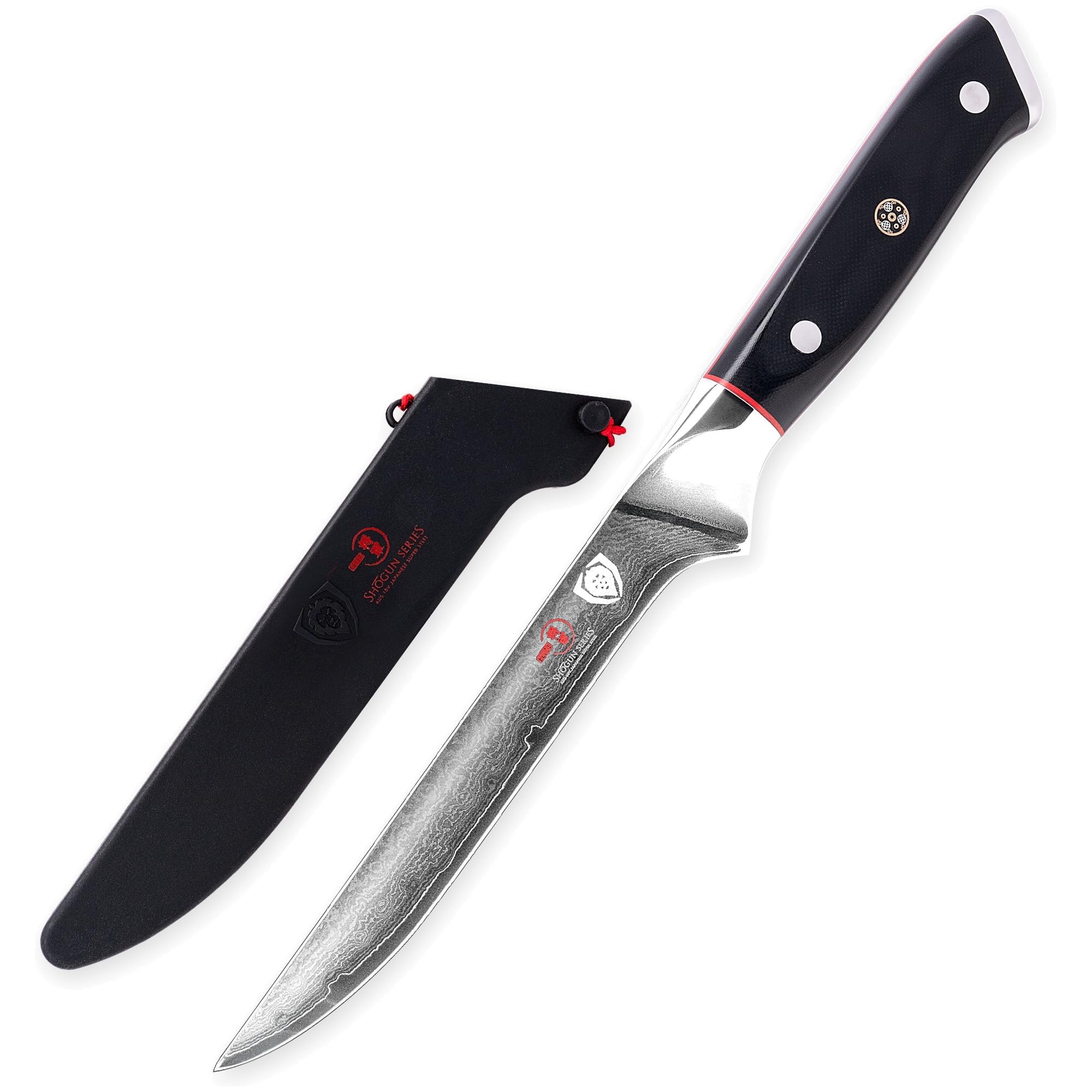
A 66-layer Damascus blade with a 62+ HRC edge that works close to the bone without tearing.
The headline here is the steel — a AUS-10V Japanese super steel blade with 66 layers of Damascus forging, hardened to 62+ HRC. HRC is the Rockwell hardness reading; 62+ is hard, and hard steel takes a finer edge and holds it longer. For boning work, that means the blade can slide along a thigh joint or rib line and release silverskin in long, clean pulls instead of sawing at it. The flexible 6-inch blade bends into the membrane layer and then lifts the silverskin off the meat surface in one pass.
The fit and finish match the steel. It ships with a PerfectFit sheath and a magnetic Shogun ELITE gift box, and the glass-filled-nylon handle keeps the package usable rather than precious. The 66-layer Damascus blade is engraved and balanced, and the 62+ HRC core is built for edge retention. Owners single out the full-tang construction and the way the hard AUS-10V edge keeps cutting through heavy use. It weighs 170 g, and the 6-inch blade makes it suitable for chicken thighs, whole birds, and tight-space trimming.
The catch is that this is a premium knife, and the edge geometry is harder than some softer stainless blades — you can’t treat a 62+ HRC edge carelessly. For the price-driven user, the Swiss and Dexter-Russell knives do the same core job for less. But if you want a beautiful blade that holds an edge and looks the part on the board, this earns its premium.
The steel story: AUS-10V at 62+ HRC in a 66-layer Damascus build is the hardest, most wear-resistant edge on this list, and the flexible 6-inch blade is shaped for working close to joints and silverskin.
The honest note: a hard, fine edge needs careful honing and a real knife-care habit to keep its best performance.
Choose this if: you want the most wear-resistant edge here and you’ll care for a Damascus blade properly.
Look past it if: you want bang-for-buck performance — the Swiss and Dexter picks deliver the core work for less.
9. Wusthof 4603 6-Inch Boning Knife

The forged six-inch blade built to strip silverskin cleanly off a pork tenderloin.
Silverskin is the toughest test for a boning knife: that thin, shiny membrane on a pork tenderloin or a beef loin will resist a dull blade and tear if you force it. This Wusthof is built for exactly that work. The 6-inch forged stainless blade is flexible enough for boning and skinning, and it arrives with a traditional profile that lets you slip the tip under the membrane and pull cleanly. It’s forged and full-tang, weighs 0.14 kg, and it’s one of the few knives here with a 6-inch blade and substantial forged construction at the same time.
The handle is polyoxymethylene — a dense, stable polymer — with a traditional look and feel and a comfortable grip. The full-tang forged build balances the 6-inch blade, and owners consistently praise how the edge holds through repeated silverskin trimming. Hand-wash it and dry it promptly, and the forged blade stays sharp through years of tenderloin trimming.
The honest caveat: the POM handle is excellent but it isn’t as tactile or as warm in the hand as a wood or composite handle, and the knife is best hand-washed rather than left wet. Neither detracts from the core job, and for silverskin and trimming work this is one of the cleanest tools on the list.
Where It Shines
- Forged 6-inch stainless blade with a traditional, flexible boning profile
- Holds a sharp edge with use — ideal for stripping silverskin cleanly
- Balanced POM handle comfortable for long trimming sessions
Where to Be Aware
- POM handle is dense and traditional but not as warm as wood
- Best hand-washed — don’t leave it soaking wet
Ideal for: the cook who trims a lot of silverskin off pork tenderloin and beef loin and wants a forged blade that holds an edge.
Not the one if: you want a lighter, stamped knife for fast poultry breakdown — the Swiss Classic and Dexter blades are lighter.
Understanding the Specs
Blade Length and Flex
Blade length is the distance from the bolster to the tip — on this list it ranges from 5.5 to 6 inches. A 6-inch blade gives you more reach for long, smooth passes along a fish spine or a large primal. A 5.5-inch blade feels nimble in tight spots and is easier to control when working around a chicken thigh joint. The other half is flex: a fully flexible blade bends into membrane and follows the curve of a bone, while a semi-flexible blade is stiffer and works better for straight trimming and fat removal.
Steel Hardness and Edge Retention
Steel hardness is measured on the Rockwell C scale (HRC). A harder steel, like the AUS-10V blade at 62+ HRC or the ZWILLING at 57 HRC, holds an edge longer, which means fewer trips to the steel between sessions. A softer stainless blade is more forgiving to hone and less prone to chipping, which is easier on beginners. High-carbon steel takes a very fine edge but needs drying after each use; stainless is easier to live with day to day.
FAQ
What blade length should a boning knife be for breaking down whole chickens?
Is a flexible or semi-flexible blade better for fillet work?
Do I need to oil a high-carbon boning knife?
Can I put a boning knife in the dishwasher?
What does Rockwell hardness mean on a boning knife?
Is a forged or stamped boning knife better for a butcher?
Why does the Victorinox blade have a different item number than the listing?
How do I remove silverskin from a pork tenderloin with a boning knife?
Do I need a honing steel or a sharpener for a boning knife?
What handle material is best for wet, slippery prep work?
Final Thoughts: The Verdict
Breaking down meat at home goes faster when the blade slips around bone instead of hacking at it. For most home cooks, the boning knife for butchers winner is the Victorinox Swiss Classic 6-Inch. Its narrow, flexible 6-inch blade has an “S”-shaped edge that follows bone instead of fighting it, so trimming stays clean. It is light and priced low enough to be an easy first buy. If a slipping grip worries you and your board is always wet, the Dexter-Russell S131F-6PCP gives you a textured handle that holds in wet hands, plus a curved blade built for fat and silverskin (the thin membrane over muscle). Want the hardest, most wear-resistant edge on the board? The Dalstrong 6″ AUS-10V Damascus is the premium upgrade — provided you’ll care for the steel.
How We Picked
We do not accept paid placement. Every pick is matched to a real buyer and a real use-case; we do not hands-on test units.
Sources & Methodology
Specifications: manufacturer listings and product documentation. Review insights: verified customer reviews, as of November 2026. Pricing: not shown on this page (it changes often); check the current price via the retailer link.
As an Amazon Associate, Gadgets Feed earns from qualifying purchases. This does not affect which products we feature.