
Forgetting the subwoofer is the single biggest mistake new buyers make in this price bracket. They chase the thump of a 5-inch woofer in a tiny box, then wonder why their favorite tracks sound hollow and flat. The truth is, no $200 bookshelf speaker delivers earth-shaking low-end on its own. The real game is midrange clarity and treble detail — the parts of the audio spectrum that make vocals sound alive and movie dialogue crystal clear.
I’m Min — the co-founder and writer behind Gadgets Feed. I’ve spent countless hours dissecting technical spec sheets, frequency response curves, and real-world customer feedback for active and passive bookshelf speakers under the $200 mark to separate lasting value from hype.
Whether you’re building a desktop studio for music production or upgrading your living room setup without breaking the bank, this guide will help you find the best bookshelf speakers under $200 for your specific listening needs.
How To Choose The Best Bookshelf Speakers Under $200
At this budget, every dollar has to pull double duty. You need to prioritize the right balance of connectivity, driver quality, and power handling without getting distracted by marketing specs that sound impressive on paper but fall apart in real listening.
Active vs Passive — Know What You’re Buying
Active speakers have built-in amplifiers — you plug in a power cord and an audio source, and you’re done. Passive speakers require a separate amplifier or AV receiver. In the sub-$200 range, active options dominate because they bundle the amp at a lower cost. Passive speakers like the Sony SS-CS5M2 or Micca RB42 can sound better but demand extra spending on amplification, eating into your budget.
Driver Size and Crossover Quality
The 4-inch to 5.25-inch woofer is the sweet spot here. A 5.25-inch driver can move more air for bass, but the crossover design — how the speaker splits frequencies between the woofer and tweeter — matters more. A well-tuned 4-inch woofer with a quality silk dome tweeter will sound more coherent than a 5-inch woofer paired with a cheap crossover. Look for 2-way or 3-way designs with dedicated tweeters and, in Sony’s case, a super tweeter for wide dispersion.
Connectivity Options for Your Setup
If you’re pairing with a turntable or desktop DAC, RCA and 3.5mm AUX inputs are essential. For near-field music production, balanced TRS inputs (like the Ortizan C7 and Edifier MR3 offer) reduce noise over long cable runs. Bluetooth 5.3 or 5.4 with multi-point connection is a convenience bonus for streaming from your phone without cable clutter, but never sacrifice wired audio quality for wireless features in this price range.
Quick Comparison
On smaller screens, swipe sideways to see the full table.
| Model | Category | Best For | Key Spec | Amazon |
|---|---|---|---|---|
| Edifier MR3 | Active Studio Monitor | Hi-Res desktop listening & production | 52Hz–40kHz frequency response | Amazon |
| Micca RB42 | Passive Bookshelf | Warm, bass-rich sound for small rooms | 4-inch long-throw woofer | Amazon |
| Sony SS-CS5M2 | Passive Bookshelf | 3-way home theater with wide soundstage | 5.12-inch woofer + super tweeter | Amazon |
| Micca PB42X | Active Bookshelf | Neutral reference for vocal clarity | Woven carbon fiber 4-inch woofer | Amazon |
| Edifier R1280T | Active Bookshelf | Versatile vinyl & TV with side EQ controls | 42W RMS total output | Amazon |
| MEVOSTO DS19 | Active Bookshelf | USB digital audio for PC gaming | 10-level bass & treble adjustment | Amazon |
| Ortizan C7 | Active Studio Monitor | Entry-level music production with TRS | 3.5-inch carbon fiber woofer | Amazon |
In‑Depth Reviews
1. Edifier MR3 Powered Studio Monitor Speakers

The Edifier MR3 punches well above its price bracket with Hi-Res Audio certification that extends frequency response to 40kHz — far beyond the 20kHz human hearing ceiling, but critical for high-resolution audio file playback. The 3.5-inch mid-low driver paired with a 1-inch silk dome tweeter delivers a flat response curve that musicians and producers rely on for accurate monitoring. Bluetooth 5.4 with multi-point connection lets you pair two devices simultaneously, so you can switch from a desktop DAW to a phone playlist without re-pairing.
What sets the MR3 apart from other active monitors in this class is the three-mode sound tuning — Music, Monitor, and Custom — accessible through the Edifier ConneX app. The MDF cabinet construction reduces unwanted resonance and cabinet coloration, which is rare at this price. The balanced TRS inputs also make these speakers compatible with pro audio interfaces, giving you a direct path to cleaner signal in near-field production environments.
User feedback consistently highlights the clean, neutral sound profile with tight bass that never bleeds into the mids. The touch controls on the front panel and the headphone output add practical desktop convenience. Some users noted the Bluetooth pairing process can be unintuitive initially, but the wired performance is flawless for critical listening.
Why it’s great
- Flat frequency response ideal for monitoring and mixing
- Versatile input selection — TRS balanced, RCA, AUX, and Bluetooth 5.4
- Three EQ modes and app-based fine-tuning control
Good to know
- Bluetooth pairing sequence can be confusing for first-time setup
- Speaker wire between units is non-detachable on the primary side
2. Micca RB42 Reference Bookshelf Speaker

The Micca RB42 is the passive speaker that makes you question physics. Its 4-inch long-throw woofer, built on a heavy steel frame with a large magnet, produces bass response that defies the cabinet size — you get clean extension down to around 55Hz before the natural roll-off begins. The 0.75-inch silk dome neodymium tweeter delivers non-fatiguing highs, and the 10-element crossover uses film capacitors and air core coils to maintain phase coherence between drivers.
This speaker demands a good amplifier — at 86dB sensitivity, you need 50 to 60 watts per channel to unlock its full potential. Pair it with a budget class-D amp or a used AV receiver, and you get a warm, engaging sound signature that reviewers consistently describe as “musical.” The dark walnut wood veneer finish and magnetic grille make it a visually appealing addition to any bookshelf or desktop setup.
The main trade-off is efficiency — the RB42 is power-hungry. At loud volumes with heavy bass tracks, the woofer can exhibit port noise or over-excursion. For near-field listening in a small room, though, this is one of the most satisfying passive bookshelf speakers available for its price.
Why it’s great
- Exceptional bass output for a 4-inch woofer — sounds bigger than it is
- High-quality crossover with film capacitors ensures clean driver separation
- Solid MDF cabinet with magnetic grille looks premium on a shelf
Good to know
- Low sensitivity requires a powerful amp, not a basic mini amplifier
- Port noise can appear at high volumes with bass-heavy content
3. Sony CS Speakers SS-CS5M2

The Sony SS-CS5M2 redefines what a compact bookshelf speaker can do by adding a dedicated super tweeter to its 3-way, 3-driver array. The 5.12-inch reinforced cellular cone woofer handles low frequencies, while a high-precision tweeter covers mids and a wide-dispersion super tweeter extends response out to 50kHz. This configuration creates an expansive soundstage that fills a living room far beyond what typical 2-way speakers in this class can achieve.
As a passive speaker rated at 6 ohms impedance, the SS-CS5M2 pairs naturally with Sony AV receivers but also works well with any quality amplifier. The bass reflex enclosure with a rear port helps reduce distortion, but you need to keep the speakers at least six inches from the wall to avoid boomy, uncontrolled bass. For buyers building a 5.1 or 2.1 home theater system, these speakers deliver exceptional clarity on dialogue and high-frequency effects like rain or cymbals.
The SS-CS5M2’s 3-way topology is rare at this price point. The trade-off is that bass extension below 60Hz is limited — you will want a subwoofer for full-range movie explosions. The rear port also means careful placement is non-negotiable.
Why it’s great
- Unique 3-way design with super tweeter for extended high-frequency detail
- Wide soundstage makes the listening experience feel larger than the room
- 5.12-inch woofer provides better low-end presence than most 4-inch competitors
Good to know
- Rear port needs significant wall clearance to avoid muddy bass
- Limited bass output below 60Hz — a subwoofer is almost necessary for movies
4. Micca PB42X Powered Bookshelf Speakers

The Micca PB42X is an active speaker that punches up against the Edifier R1280T and wins on midrange clarity. The 4-inch woven carbon fiber woofer delivers fast transient response — think snare drums and acoustic guitar — without the sluggishness typical of paper cones. The 0.75-inch silk dome tweeter is the same high-quality unit Micca uses in its RB42, and the Class-D amplifier provides 15 watts per channel, enough to fill a 15×15-foot room cleanly.
Reviewers consistently praise the PB42X for its neutral, non-fatiguing sound. The crossover tuning leans toward flat response, making these speakers excellent for near-field desktop listening where vocal clarity and instrument separation matter more than thumping bass. Magnetic grilles protect the drivers without sacrificing the premium aesthetic of the black wood-grain cabinet.
The built-in amplifier is the bottleneck here — 15 watts per channel is sufficient for near-field but won’t fill a large living room at party volume. There is no subwoofer output, so adding a sub requires splitting the source signal externally. For desktop use, the PB42X is tough to beat at this tier.
Why it’s great
- Carbon fiber woofer provides fast, articulate transient response
- Neutral, flat sound signature ideal for vocal-heavy music and monitoring
- Magnetic grilles and compact footprint suit desktop environments perfectly
Good to know
- 15 watts per channel is modest — not suited for large rooms or loud parties
- No subwoofer output requires external Y-splitter for bass extension
5. Edifier R1280T Powered Bookshelf Speakers

The Edifier R1280T is the workhorse of the budget active speaker segment, and for good reason — 42 watts RMS total output is generous for a 2.0 system under this ceiling. The 13mm silk dome tweeter and 4-inch full-range driver produce a sound profile that’s warm and forgiving, making it a strong match for vinyl records from an Audio-Technica LP60X. The dual AUX inputs let you connect a turntable and a TV simultaneously without swapping cables.
Side-panel controls give you physical bass and treble knobs — a feature often missing on competing active speakers that force you into software EQ menus. The included remote control handles volume from across the room, which is a welcome convenience for living room setups. The MDF wood cabinet finished in wood-effect vinyl looks traditional and blends with most furniture.
The R1280T’s bass performance is adequate for casual listening but won’t satisfy those seeking deep low-end. The 4-inch driver simply can’t move enough air to produce sub-60Hz frequencies with authority. Users also note that the included speaker wire between the two units is thin — investing in thicker 16-gauge wire improves connection reliability.
Why it’s great
- 42W RMS provides enough headroom for comfortable room-filling sound
- Physical bass and treble knobs on the side panel for quick tonal adjustment
- Dual AUX inputs allow simultaneous connection of two audio sources
Good to know
- Lacks Bluetooth connectivity — must use wired AUX connections
- Provided speaker wire between units is thin; replacement recommended
6. MEVOSTO DS19 Active Bookshelf Speakers

The MEVOSTO DS19 is built for the desktop gamer who wants deep, adjustable bass without splurging on a separate subwoofer. Its 5-inch bass driver, paired with a 1-inch silk dome tweeter, delivers a full-range sound that cinematic games like Cyberpunk 2077 or Elden Ring can exploit. The 36W RMS total power is sufficient for near-field gaming, and the USB digital audio input bypasses your PC’s internal sound card for lower latency and cleaner signal.
What makes the DS19 unique in this price tier is the 10-level bass and treble adjustment, allowing you to dial in a V-shaped sound for gaming or flatten the curve for music listening. The included remote control and voice prompts for input selection make daily use effortless. The natural wood-finish cabinet adds a warm aesthetic that fits office decor.
Users report that the bass can become overwhelming if the knob is turned past the midpoint — the 5-inch driver has more excursion than expected, so careful tuning is required. There is no subwoofer output, but the bass extension from the main driver is convincing enough that many gamers won’t feel the need for one. Bluetooth 5.4 latency is low enough for casual video watching, but stick to USB for competitive gaming.
Why it’s great
- 5-inch woofer delivers surprising bass depth for a desktop speaker
- 10-level bass and treble knobs give you full tonal control
- USB digital audio bypasses poor PC sound cards for cleaner playback
Good to know
- Bass can become overpowering at high EQ settings — requires careful tuning
- No subwoofer output for those who want a dedicated sub later
7. Ortizan C7 Dual-Mode Studio Monitors
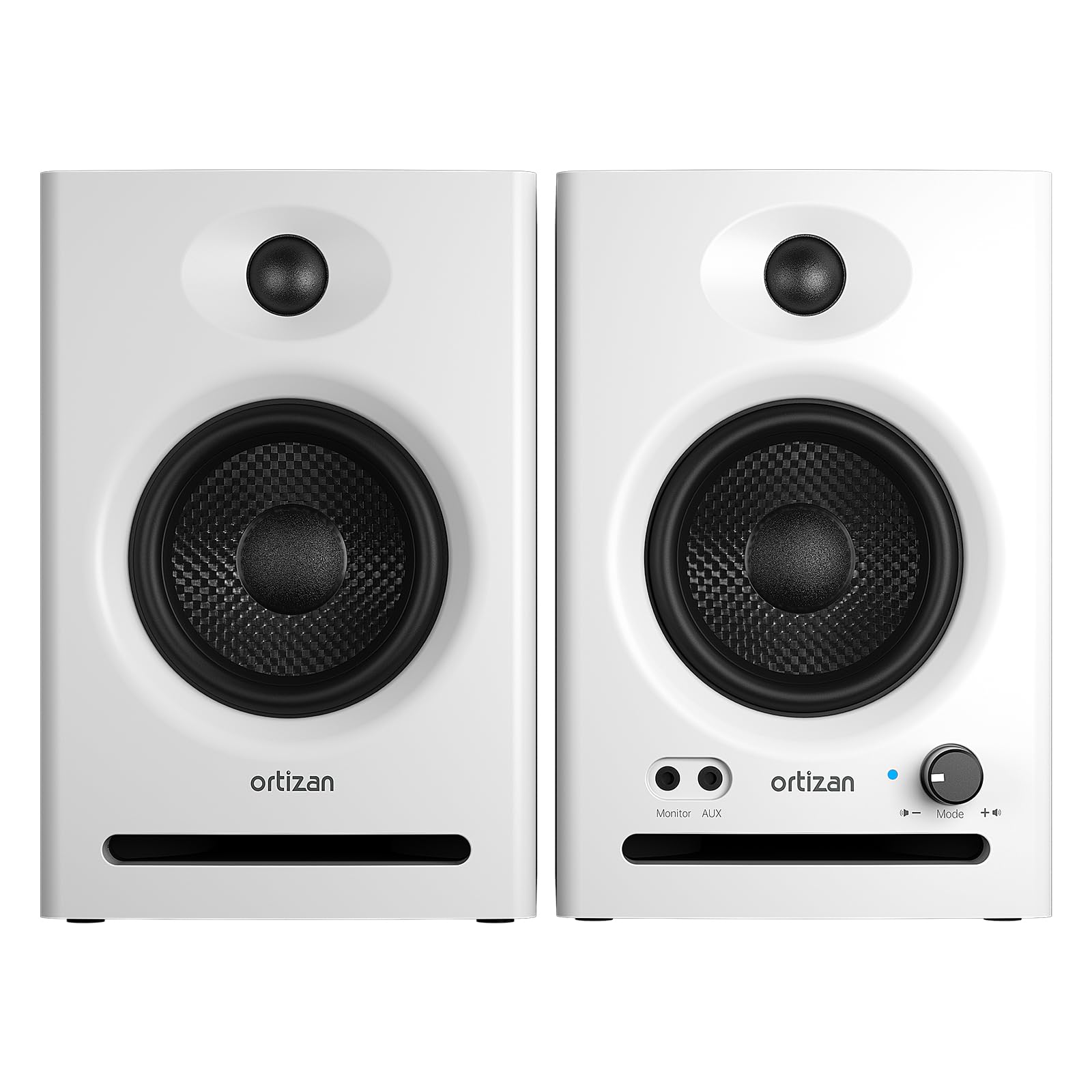
The Ortizan C7 is the cheapest entry point into true near-field studio monitoring on this list, and it doesn’t cut the corners you’d expect. The 3.5-inch carbon fiber woofer and 0.75-inch silk dome tweeter produce a flat frequency response that’s surprisingly accurate for the price, with a 24-bit DAC built in for USB-C digital input. The 6.35mm TRS balanced input makes these compatible with audio interfaces, mixing consoles, and even electric guitar gear — a connectivity level typically reserved for speakers costing twice as much.
Multiple user reviews confirm that the Ortizan C7 approaches the tonal balance of expensive studio monitors, with vocals and midrange instruments sounding precisely placed in the stereo field. The bass extends to about 45Hz, which is impressive for a 3.5-inch driver, though it lacks the slam and authority of larger woofers. The compact footprint is ideal for cramped desktop spaces where bigger monitors won’t fit.
The volume knob’s stepped adjustment is the biggest compromise — it jumps in noticeable increments, making fine volume matching difficult. The absence of a remote control also means all adjustments are manual. For the aspiring music producer on a tight budget, though, the C7 delivers the most professional feature set per dollar in this roundup.
Why it’s great
- TRS balanced input and 24-bit USB DAC in a budget package
- Flat frequency response suitable for music production and monitoring
- Bluetooth 5.3 adds convenient wireless streaming from phones or tablets
Good to know
- Volume knob has coarse stepped increments — not smooth
- No remote control — all adjustments require reaching the back panel
FAQ
Do I need a subwoofer with bookshelf speakers under $200?
Can I use bookshelf speakers as desktop computer speakers?
Final Thoughts: The Verdict
For most users, the best bookshelf speakers under $200 winner is the Edifier MR3 because it delivers Hi-Res Audio certification, balanced TRS inputs, and app-controlled EQ in a compact active package that works for both production and casual listening. If you want deep, warm bass from a passive speaker that punches above its cabinet size, grab the Micca RB42. And for a 3-way home theater setup with an expansive soundstage, nothing beats the Sony SS-CS5M2.