
Our readers keep the lights on and my morning glass full of iced black tea. As an Amazon Associate, I earn from qualifying purchases.
Specs are compiled from manufacturer listings and verified buyer reviews and can change over time — please confirm the key details on the product page before buying.
Upgrading from built-in TV or laptop speakers to dedicated bookshelf speakers delivers the most dramatic audio improvement per dollar. The catch is that under $300, you are choosing between powered speakers (with a built-in amplifier, just plug in and play) and passive speakers (they need a separate amp or receiver to work). This guide sorts the best of both types, so you know exactly which one fits your setup and your room before you spend a cent.
I’m Min — the founder and writer behind Gadgets Feed. This guide is built by comparing the manufacturers’ published specifications and the patterns across verified customer reviews, so you get each pick’s real strengths and trade-offs instead of marketing spin.
Whether you stream vinyl, build a home theater, or just want your desk to sound alive, these bookshelf speakers under $300 deliver audiophile-grade sound while staying affordable.
Our Picks at a Glance

How To Choose The Best Bookshelf Speakers Under $300
Before you pick a pair, you need to know whether your system needs powered or passive speakers. Powered speakers have an amplifier built in, so you plug them into the wall and connect your phone, TV, or turntable directly. Passive speakers have no amp inside — they need a separate receiver or amplifier to drive them, which adds cost and a box to your setup but gives you more upgrade freedom later.
The Amplifier Question
If you own a turntable without a built-in preamp or a TV with no stereo receiver, powered speakers save you money and desk space. If you already have a receiver for a home theater, passive speakers are usually the smarter buy because you can build a full surround system around them over time.
Matching the Speaker to Your Room
The physical size of a speaker determines how much air it can move, which is how you get real bass. A bigger woofer (like a 6.5-inch) fills a living room with deeper sound, while smaller 4-inch woofers shine in near-field desktop setups where you sit close. Look at your listening distance first — this decides the woofer size you need, not just the price.
Quick Comparison
| Model | Best For | Type | Woofer Size | Frequency Response | Amazon |
|---|---|---|---|---|---|
| Klipsch R-41M★ Best Overall | High efficiency with a receiver | Passive | 4″ Spun Copper | 68 Hz – 21 kHz | Amazon |
| Micca MB42X G2Best Value | Neutral sound on a budget | Passive | 4″ Carbon Fiber | 55 Hz – 20 kHz | Amazon |
| PreSonus Eris AccentEasiest Setup | Plug-and-play vinyl setups | Powered | 4″ Woofer | 55 Hz – 20 kHz | Amazon |
| Micca OoO | Tight spaces and centers | Passive | Dual 3″ Woofers | Down to 60 Hz | Amazon |
| Neumi BS5 | Living room flexibility | Passive | 5″ Fiberglass | — | Amazon |
| Edifier R1280T | Easy desk audio with remote | Powered | 4″ Full Range | — | Amazon |
| Edifier R1700BT | Bluetooth streaming in walnut | Powered | 4″ Woofer | — | Amazon |
| Polk XT20 | Home theater punch | Passive | 6.5″ Woofer | — | Amazon |
| Sony SS-CS5M2 | Hi-Res detail and soundstage | Passive | 5.12″ Woofer | 53 Hz – 50 kHz | Amazon |
In‑Depth Reviews
1. Klipsch R-41M Reference Bookshelf Speakers (Pair), Black
Our pick — over 4.5★ from 5,500+ verified ratings; the strongest balance of quality and price.
The classic copper-woofer horn speaker that makes modest amps sound huge.
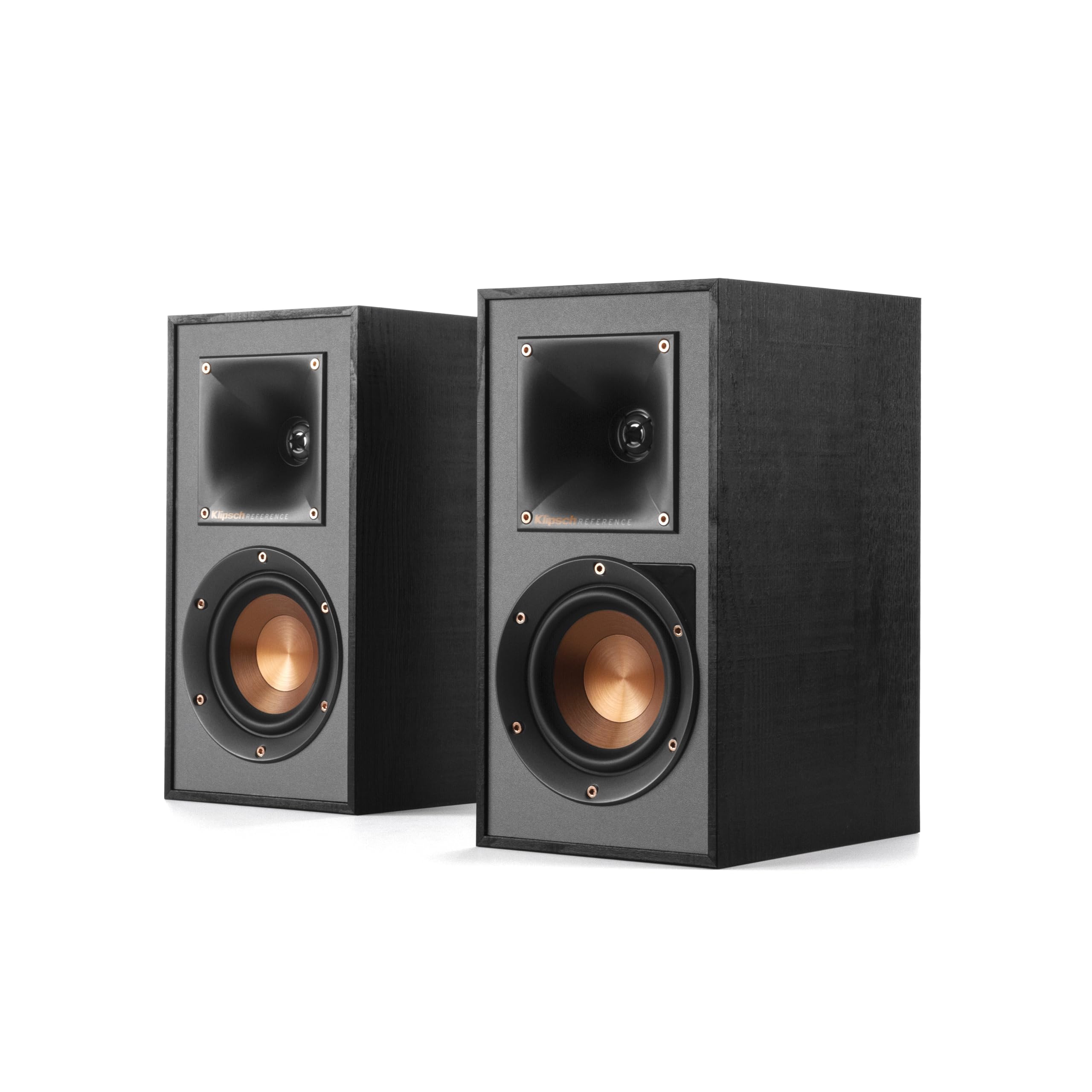
The R-41M’s signature Tractrix Horn tweeter delivers the efficiency and dynamics that turn casual listeners into Klipsch loyalists. That 1-inch aluminum horn tweeter is incredibly efficient, hitting 90dB sensitivity, which means even a small vintage tube amp can drive them to satisfying volume without strain. The single 4-inch spun-copper woofer handles the lows, and the whole pair reaches down to 68 Hz.
Buyers report that the build quality is excellent and the sound stays clear and undistorted even when you push the volume. The trade-off is the “bright” tweeter — it can sound harsh if your amplifier or room is already bright, so a little treble adjustment is often needed. They improve noticeably after a 50-hour burn-in, so give them time before judging.
At 11.3 inches tall and 7.9 inches deep, they are compact enough for a desk but capable enough for a home theater. Many owners run them as Atmos height channels or pair them with a subwoofer, and the clear dialogue reproduction makes them a favorite for movies.
The Horn’s Payoff
- Crisp, high-efficiency tweeter (90dB) that comes alive with modest amps
- Excellent build quality with reinforced MDF cabinet to cut vibration
- Compact footprint fits a desk or shelf easily
The Bright Side’s Catch
- Horn tweeter can sound harsh for some ears — plan on treble adjustment
- 4-inch woofer needs a subwoofer for real bass at high volume
Reach for these if: you have a receiver or amp already and want the most dynamic, efficient sound per watt in this price range.
Look elsewhere if: you are sensitive to bright highs and want a warmer, more forgiving sound without adjusting treble.
2. Micca MB42X G2 Premium 2-Way Passive Bookshelf Speakers
The budget pick that corrects the original’s shortcomings and outperforms its price point.
The Micca MB42X G2 is the upgrade fans of the original MB42X were waiting for. The core change is a 4-inch carbon fiber woofer that delivers deeper, more articulate bass, paired with a 0.75-inch silk dome tweeter for smooth, detailed highs. It is a truly neutral tonal balance that reproduces instruments and vocals as the artist intended, which is rare at this price.
Compared to the Klipsch R-41M above, the Micca offers a 24% wider frequency response starting at 55Hz vs. 68Hz. It also runs at 4-8 ohms impedance versus the Klipsch’s 8 ohms, meaning it is slightly more flexible with a wider variety of amplifiers. The cabinet is noticeably less hollow than the Gen 1, and the tamed tweeter reduces listening fatigue.
The one honest caveat: they need a subwoofer for deep bass, and they require a 100+ hour break-in period before they sound their best. Owners mention that once broken in and paired with a sub — typically crossed at 80Hz — they sound fantastic, with some owners claiming they even outperform much pricier tower speakers in certain rooms.
The Neutral Performer: A precision-tuned crossover and balanced drivers make this the most honest-sounding passive pair under $300, ideal for near-field listening.
This pick suits: budget-conscious listeners who want accurate, detailed sound and already own an amp or plan to buy one.
This pick won’t suit: anyone who wants deep bass from the start without adding a subwoofer to the system.
3. PreSonus Eris Accent Powered Bookshelf Speakers
A powered pair that goes from box to playing vinyl in about five minutes.
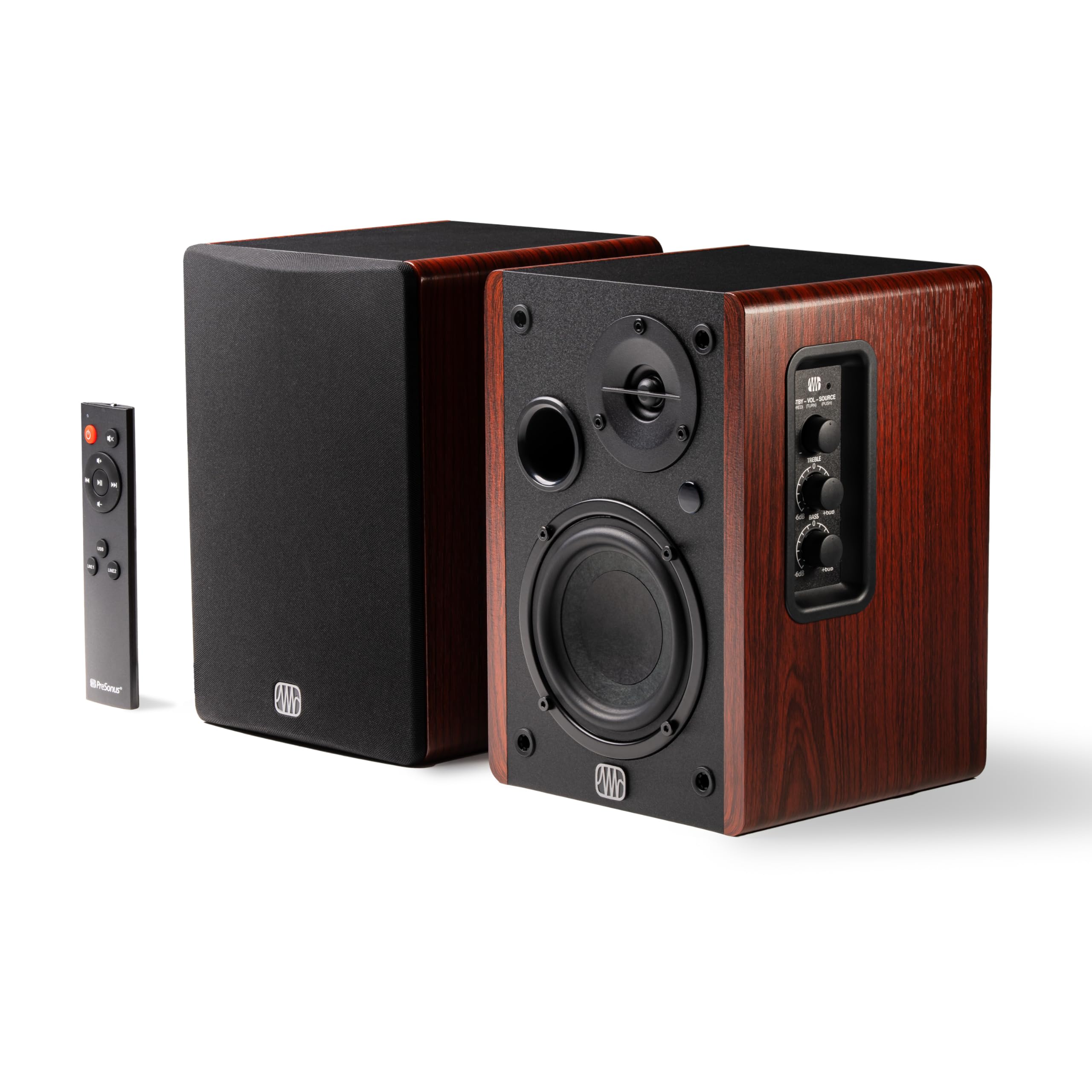
If you want the simplest path to great sound, the Eris Accent is it. These are powered speakers — the amplifier is built in at 50W total (25W per channel) — so you just plug them in, connect your turntable or phone, and play. No receiver needed. The 4-inch woofer and ½-inch silk dome tweeter deliver a frequency range of 55Hz to 20kHz with punchy bass that you can dial back if it gets too much.
The flexibility here is what wins people over. You get USB-C and RCA inputs for multiple sources, a dedicated subwoofer output to add bass later, and an included remote control for volume from across the room. Onboard treble and bass knobs let you shape the sound to your room, which is a godsend for apartment dwellers dealing with boomy corners.
The honest trade-off is that the default sound is slightly bass-heavy, but the EQ knobs balance it quickly. There is no Bluetooth, so you are limited to wired connections — which matters little if your turntable is the main source anyway.
Plug-And-Play Perks
- No amplifier needed — runs on 50W of built-in power
- USB-C and RCA inputs plus a sub-out for future expansion
- Remote control for volume and media playback
Wired-Only Reality
- No Bluetooth — you’re stuck with cables for streaming
- Default tuning runs bass-heavy until you adjust the EQ knobs
Grab these if: you want a powered system that works straight from the start with a turntable or TV, so you skip the extra cost and hassle of a separate amplifier.
Think twice if: wireless streaming is a must — you’d want the Edifier R1700BT below instead.
4. Micca OoO Slim Passive Bookshelf Speakers

The slimmest speaker here that still produces sound from a much larger cabinet.
The OoO is the problem-solver for tight spaces. At under 4 inches wide, it fits in spots where a traditional bookshelf speaker simply won’t go — under a monitor, on a narrow shelf, or even mounted on a wall. Inside that slim cabinet, Micca packs two 3-inch square-frame woofers in a ported enclosure, reaching usable bass down to 60Hz, which is remarkable for a box this small.
Versatility is the real story. You can set it vertically as a bookshelf speaker, lay it horizontally as a center channel for a desktop 5.1 system, or wall-mount it as a surround speaker. The 0.75-inch silk dome tweeter uses a neodymium magnet for high efficiency, and the tight driver spacing creates a surprisingly cohesive soundstage.
Customers note the sound is clear, warm, and room-filling for the size, with punchy bass that often removes the need for a subwoofer in small rooms. The trade-off is that these are best in small-to-medium rooms — they physically cannot move enough air to fill a large living room with deep bass, so don’t expect floor-shaking output.
Space-Age Sound: This is the pick for desks and tight shelves where a normal box won’t fit, delivering warm mids and clean highs that belie its tiny footprint.
Reach for these if: your space is cramped or you need a flexible speaker that can double as a center channel.
Look elsewhere if: you have a large open-plan room that needs deep, room-filling bass — a bigger woofer is a must.
5. NEUMI BS5 Passive Bookshelf Speakers

The front-ported speaker that happily sits against a wall without muddying the bass.
The Neumi BS5 solves a problem most bookshelf speakers have: rear ports that need space from the wall. Because this cabinet is front-ported, you can place it right up against a wall and still get clean, balanced bass. The 5-inch fiberglass woofer with a rubber surround offers a great balance of bass and midrange output with very low distortion at normal listening levels.
The 1-inch silk dome tweeter uses an integrated waveguide to produce smooth, extended treble with precise imaging. The rounded vertical corners reduce baffle diffraction, which is the subtle distortion that happens when sound waves bounce off sharp cabinet edges. A magnetic grill system keeps the front clean with no visible mounting holes.
Buyers describe the sound as warm with excellent mids, and some note it fills a 16×18-foot room easily. The one consistent note is that bass gets thin without a receiver’s bass boost — so they shine when paired with an amp that has tone controls. This is a passive speaker, so you’ll need a separate amplifier or receiver to drive them.
Placement Freedom
- Front port means you can push them flush against a wall
- Warm, detailed mids with smooth silk-dome treble
- Magnetic grills keep the front frame clean
Amplifier Dependency
- Passive design requires a separate amp or receiver
- Tone controls on your amp are almost essential for bass-heavy genres
Best for: anyone mounting speakers on shelves or stands close to a wall who wants a warm, unfatiguing listen.
Not ideal for: buyers without an existing amplifier, who should pick a powered pair like the PreSonus above.
6. Edifier R1280T Powered Bookshelf Speakers

A powered desk pair with dual AUX inputs and a remote for easy setup.
The R1280T is Edifier’s most popular entry point for good reason: it delivers clean, natural sound without any setup headaches. The 4-inch full-range driver and 13mm silk dome tweeter produce crisp highs and a balanced midrange, driven by 42W RMS of built-in power. You literally plug in your phone or computer and you’re listening in under a minute.
What makes this pair genuinely useful is the dual AUX inputs. You can connect your PC and your phone simultaneously, with no plugging and unplugging when you switch sources. The bass and treble knobs sit on the side panel for quick EQ adjustments, and the included remote lets you control volume from across the room.
Buyers love the classic wood-finish vinyl over MDF construction, which looks far pricier than it is. The consistent feedback is that bass is decent but not deep, so pairing these with a subwoofer transforms them for bass-heavy music. They’re a superb budget vinyl setup when connected to a turntable like the Audio-Technica LP60X.
The easy Pair: 42W of powered sound, two inputs for simultaneous devices, and a remote — the least complicated way to upgrade desk audio today.
Reach for these if: you want powered simplicity with the flexibility of hooking up two devices at once.
Look elsewhere if: deep bass without a subwoofer matters to you — the weak low-end is the recurring note.
7. Edifier R1700BT Bluetooth Bookshelf Speaker

A powered walnut-finished speaker that adds Bluetooth streaming to studio-grade audio.
The R1700BT takes everything the R1280T does well and upgrades the power and convenience. It jumps to 66W RMS for noticeably louder output, and adds Bluetooth with a 10-meter range so you can stream to any phone, tablet, or computer wirelessly. The result fills a room with sound rather than just a desk.
You get clear, natural vocals and highs from the 4-inch woofer and silk dome tweeter (a soft fabric dome that smooths out high frequencies), and they stay distortion-free even after a 12-hour break-in. Reviewers point out the bass is surprisingly deep for the size, with a sturdy low-end that doesn’t bury the mids. The cabinet is built from MDF (medium-density fiberboard, a dense wood composite that reduces vibration) with a walnut wood-effect vinyl finish that looks premium on any shelf.
The convenience extends to inputs too: two AUX inputs plus Bluetooth, so you can have your TV, computer, and phone all connected without cable swapping. The remote controls input selection, volume, and mute. The only niggle owners note is that the power switch sits on the rear, which is slightly awkward to reach.
Wireless Freedom
- Bluetooth streaming with a 10-meter range for any device
- 66W RMS delivers room-filling volume with deep bass
- Wood enclosure with walnut finish looks classy anywhere
Minor Quirks
- Rear-mounted power switch is awkward to reach
- Bass extension drops off below 50Hz for ultra-deep lows
Reach for these if: you want powered simplicity plus Bluetooth streaming and a bigger, louder sound than the R1280T.
Look elsewhere if: you need deep sub-bass without a subwoofer — add the R1280T’s sub-out or a separate sub for that.
8. Polk Audio Monitor XT20 Bookshelf Surround Speakers
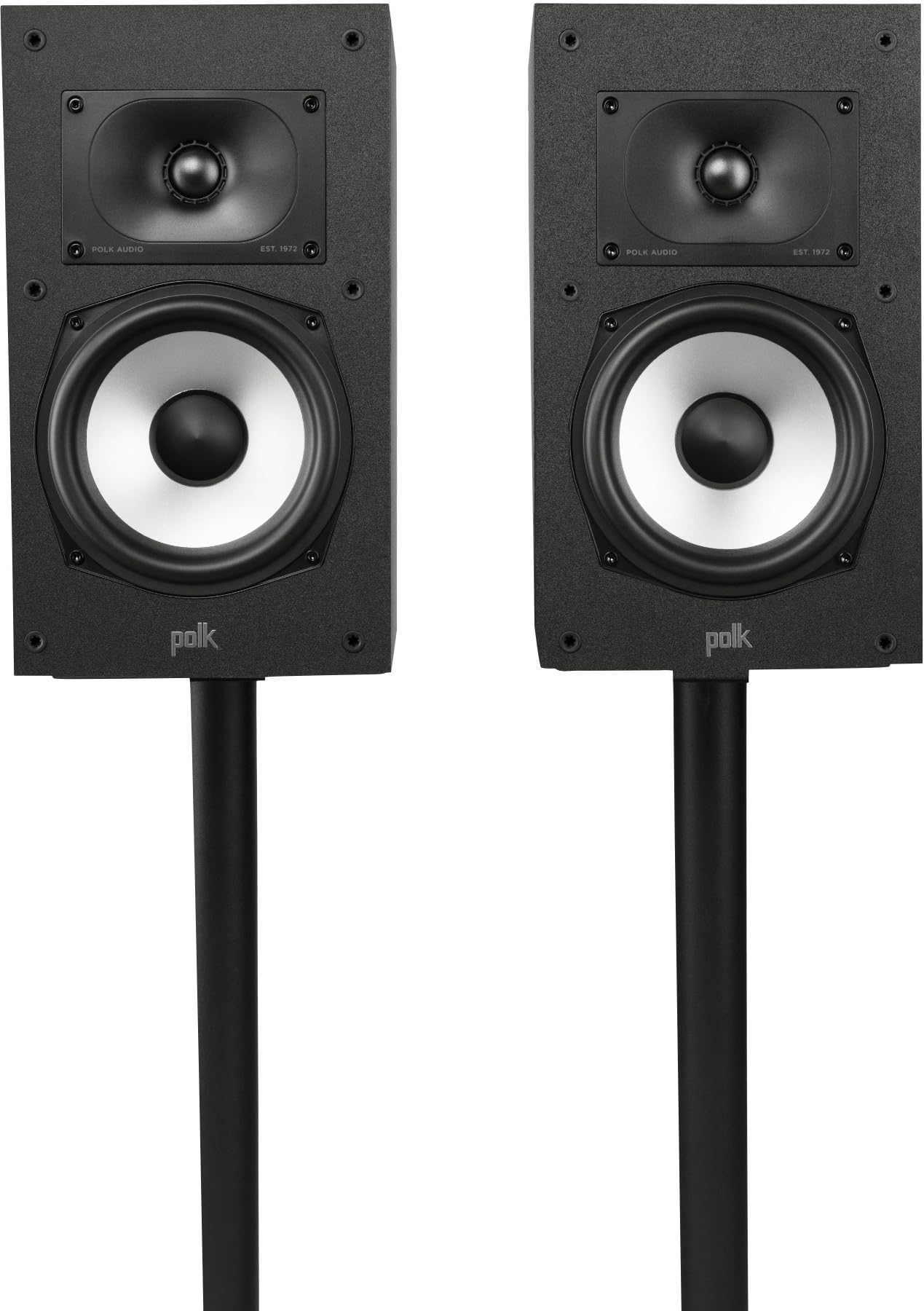
A 6.5-inch woofer delivers wall-of-sound power in a compact bookshelf cabinet.
The Polk XT20 is the speaker for buyers who want the biggest physical drivers this side of $300. A 6.5-inch Dynamically Balanced Woofer delivers punchy, room-filling bass that smaller bookshelf speakers simply cannot match, while the 1-inch tweeter handles clear, open highs. This is the pair that recreates a vintage “wall of sound” feel in a compact cabinet.
It’s also built for home theater flexibility. The 4- and 8-ohm compatibility (the electrical resistance the speaker presents to an amp) means it works with a wide range of receivers and delivers Dolby Atmos and DTS:X surround sound (object-based audio formats that place sounds around you) from streaming sources. You can run these as front, surround, or rear speakers, and Polk’s timbre-matched components ensure they blend smoothly with the rest of the Monitor XT family, so your sound stays consistent across all channels.
Shoppers say these sound excellent from the start and even better after a few hours of break-in. The one consistent note is that they initially sound a bit congested before that break-in period — a little EQ or DSP open up their true potential. Like all passive speakers here, they need an amplifier or receiver to drive them.
Big-Speaker Sound
- 6.5-inch woofer delivers the deepest, punchiest bass in this list
- Dolby Atmos and DTS:X compatible for rich home theater
- Timbre-matched with the Polk Monitor XT family for easy expansion
Set-Up Attention
- Needs break-in plus some EQ or DSP to shine past the initial congestion
- Requires a separate receiver or amplifier to operate
Best for: home theater builders who want the biggest, most powerful bass from a bookshelf-sized cabinet.
Consider otherwise if: you need powered speakers with no receiver — this pair demands external amplification.
9. Sony SS-CS5M2 3-Way 3-Driver Hi-Res Compact Bookshelf Speakers

A three-driver Hi-Res design that uncovers audio details most speakers miss.
The Sony SS-CS5M2 is the most technically sophisticated speaker here, using a 3-way, 3-driver design that separates the audio duties across a 5.12-inch woofer, a high-precision tweeter, and a wide-dispersion super tweeter. This extra driver layer creates a wide, expansive soundstage with sparkle on the high end, delivering Hi-Res Audio with a frequency response that extends to 53-50,000 Hz.
The reinforced cellular cone woofer keeps low frequencies undistorted, while the bass reflex enclosure enhances low-end output without boominess. Buyers report the sound is detailed and natural, with excellent mid and high clarity that “sparkles without sounding artificially bright” — an impressive balance for a three-driver speaker at this price.
The honest caveat is that bass is limited below 50-60Hz, so a subwoofer is recommended for full-range music. These also demand quality amplification and careful placement to sound their best — they reveal the weaknesses of a cheap amp. The 6-ohm impedance means they work with most receivers, and they pair perfectly with Sony AV receivers for a complete home theater system.
The Detail Finder
- 3-way, 3-driver design separates highs, mids, and lows for clarity
- Hi-Res Audio certified with response up to 50,000 Hz
- Wide dispersion super tweeter creates an expansive soundstage
System Sensitive
- Bass drops off below 50-60Hz — a subwoofer is recommended
- Reveals weaknesses in cheap amps; needs quality amplification
Reach for these if: you’re an audiophile-in-training with a quality amp who wants the most detail and widest soundstage under $300.
Look elsewhere if: you want powered simplicity or deep bass without adding a subwoofer to the chain.
Understanding the Specs
Frequency Response
This range, measured in Hz to kHz, tells you the lowest and highest notes a speaker can reproduce. A lower starting number (like 53Hz) means deeper bass, while a higher ending number (like 50kHz) means crisper, more extended highs. It’s the fastest way to compare how “full range” a speaker is.
Impedance and Sensitivity
Impedance (in ohms) is how much electrical resistance a speaker gives your amp — 8 ohms is the standard, while 4-8 ohms is more flexible. Sensitivity (in dB) tells you how loud a speaker gets with a given amount of power; 90dB is considered efficient and easy to drive, while 86dB needs more wattage from your amp.
FAQ
Do I need an amplifier for bookshelf speakers?
What size woofer do I need for my room?
What does the crossover frequency do?
Is a silk dome tweeter better than a horn tweeter?
Why do my new speakers sound harsh or muffled at first?
Can I use bookshelf speakers for home theater?
What’s the difference between 4-ohm and 8-ohm speakers?
Do I need a subwoofer with bookshelf speakers?
What is a 3-way speaker design?
Can I hook up my turntable to powered bookshelf speakers?
Final Thoughts: The Verdict
For most people, the bookshelf speakers under $300 winner is the Klipsch R-41M because its high-efficiency horn design delivers dynamic, room-filling sound from even modest amplifiers. If you want the easiest plug-and-play experience with a remote and adjustable EQ, grab the PreSonus Eris Accent. And if wireless streaming matters most, the Edifier R1700BT is the one to reach for.
How We Picked
We do not accept paid placement. Every pick is matched to a real buyer and a real use-case; we do not hands-on test units.
Sources & Methodology
Specifications: manufacturer listings and product documentation. Review insights: verified customer reviews, as of July 2026. Pricing: not shown on this page (it changes often); check the current price via the retailer link.
As an Amazon Associate, Gadgets Feed earns from qualifying purchases. This does not affect which products we feature.