
Our readers keep the lights on and my morning glass full of iced black tea. As an Amazon Associate, I earn from qualifying purchases.
Specs are compiled from manufacturer listings and verified buyer reviews and can change over time — please confirm the key details on the product page before buying.
If you’re hunting for a bookshelf stereo system, you want one box that plays your CDs, streams Bluetooth from your phone, and pulls in FM radio without cluttering your space. The real question is which one balances clear sound, easy controls, and a price that feels fair. This guide breaks down the top contenders—from compact value picks to premium audiophile setups—so you can match one to your room and your listening habits.
I’m Min — the founder and writer behind Gadgets Feed. This guide is built by comparing the manufacturers’ published specifications and the patterns across verified customer reviews, so you get each pick’s real strengths and trade-offs instead of marketing spin.
Whether you’re replacing an old shelf unit or starting fresh, the right bookshelf stereo system should fit your space, your sources, and your ears without overpaying for features you’ll never use.
Our Picks at a Glance


How To Choose The Best Bookshelf Stereo System
You want a bookshelf stereo that fits your room, your music sources, and your bass expectations. A compact 20-watt unit can fill a bedroom beautifully, while a 200-watt system might be overkill for the same space—and the opposite is true for a large living area.
Start With Your Music Sources
Think about what you’ll actually play. If you have a large CD collection, you need a reliable CD player. If you only stream, you could skip the disc mechanism entirely. Most buyers in this category want a mix: a CD slot, Bluetooth for phone audio, and an FM tuner for news or talk radio. The more sources a unit covers, the more flexible it becomes—but you often pay extra for that versatility.
Wattage and Room Size
Wattage tells you how much the amplifier can push, not necessarily how loud it sounds. Look at RMS (continuous) power rather than peak numbers, because RMS reflects sustained output you can actually use. A 20W RMS unit suits a bedroom or office; an 80W RMS system handles a living room with ease. If you’re filling a large open floor plan, aim higher on the power scale.
Speaker Quality Over Everything
The speakers are half the system. Look for separate woofers for bass and tweeters for high frequencies—this is called a two-way design. A woofer around 4 inches with a silk dome tweeter tends to deliver smooth highs and punchy lows. Bass-reflex ports (vented holes on the cabinet) also help squeeze out deeper low-end from a small box.
Quick Comparison
| Model | Best For | Power (RMS) | Key Inputs | Speakers | Amazon |
|---|---|---|---|---|---|
| Panasonic SC-PM270★ Best Overall | Compact rooms & easy use | 20W | Bluetooth, USB | 2 (10cm woofer) | Amazon |
| Panasonic SC-PM700Top Performer | Room-filling sound in a shelf size | 80W | Bluetooth, USB | 2 (10cm woofer) | Amazon |
| Sony STRDH190 + SSCS5Vinyl-Ready Pick | Vinyl lovers & home gyms | — | Bluetooth, Phono, 4 analog | 2 (SSCS5 3-way) | Amazon |
| LONPOO LP-609 | Retro look with headphone jack | 100W | Bluetooth, USB, Aux | 2 (4″ woofer) | Amazon |
| Philips Micro System | Small spaces & simple setups | 18W max | Bluetooth, USB, Audio in | 2 (3″ woofer) | Amazon |
| Sharp XL-B530 | Big rooms & loud listening | 200W max (100W RMS) | Bluetooth, USB, Aux | 2 | Amazon |
| Pyle 4-Piece System | Karaoke & multi-format playback | 1000W (digital amp) | Bluetooth, USB (dual) | 2 | Amazon |
| Denon D-M41 | Hi-fi purists in small rooms | 30W per channel | Bluetooth, 2 digital, FM/AM | 2 (4 3/4″ woofer) | Amazon |
| Edifier S360DB | TV, gaming & deep bass | 155W total | Bluetooth, Optical, Coaxial, Aux | 2 + subwoofer (8″ driver) | Amazon |
In‑Depth Reviews
1. Panasonic SC-PM270PP-K
Our pick — over 4★ from 550+ verified ratings; the strongest balance of quality and price.
The crowd-pleasing compact that punches well above its size for small rooms.
This Panasonic delivers 20W (10W+10W) RMS output, and buyers report it easily fills a small room with clean, clear sound. The 10cm woofer and 6cm tweeter pair with a bass reflex port to give you decent low-end without a separate subwoofer. It’s a two-way design that keeps highs crisp and mids present for everyday listening.
You get a CD player, FM radio, Bluetooth, and a USB port for flash drives all in one black matte unit. The Bluetooth Re-Master feature compensates for signal loss from data compression, so streamed audio sounds fuller. A bass and treble button plus “My Sound” presets let you tune it to your taste, and the included remote works from across the room.
Owners consistently praise the sound quality and build, with setup taking about 15 minutes. The controls get mixed feedback—most love the bass and treble adjustment, but a few report button issues. Keep in mind there’s no AUX, headphone jack, or digital input; you’re limited to the included speakers. The remote needs an AA battery that isn’t included. Note the compact footprint: at 9.1 x 18.1 x 8.8 inches, it takes up far less shelf space than the LONPOO’s 16.3 x 7.5 x 7.3 inches.
What wins people over
- crisp sound quality that owners rank as the top feature
- Simple 15-minute setup with an easy-to-use remote
- Excellent FM tuner and dependable Bluetooth pairing
What to know before buying
- No AUX, phono, headphone jack, or digital inputs
- Only works with the included speakers
- Remote needs a separate AA battery
Reach for this if: you want a fuss-free, good-sounding system for a bedroom, office, or small living room—and you’re happy with CD, radio, and Bluetooth as your sources.
Look elsewhere if: you need to plug in a TV, turntable, or headphones, because this unit offers no AUX or headphone output.
2. Panasonic SC-PM700PP-K
The shelf system that genuinely fills a room without losing its composure.
This is the bigger sibling to our top pick, bumping output to 80W (40W+40W) RMS (root mean square, a standard measure of continuous power). That extra power translates to sturdy, non-tinny sound that owners say can “crank up” for rock and roll while staying clear. The 10cm woofer (a speaker for low frequencies) and 6cm tweeter (a speaker for high frequencies) with bass reflex port (a vent that boosts bass) carry over, so you get the same driver quality with four times the wattage.
Sound Remastering Technology reduces distortion in digital playback and cleans up AC power supply noise, which shows up as clearer, richer audio. You get CD, FM radio, Bluetooth, and USB, plus bass and treble knobs instead of buttons—a tactile upgrade. The included remote handles everything from volume to presets.
Sound quality is the most-praised feature, with buyers also loving the compact size and ease of use. Bluetooth pairs flawlessly with phones. The honest caveat: CD playback gets mixed reviews, with some units struggling on burned discs and one report of failure on about 40% of CD-Rs. There’s no AUX input either. It’s a single-disc player with no memory/resume function, so plan around that if you’re CD-heavy.
The highlights
- 80W RMS delivers high output without tinny sound
- Premium-feeling volume knob and remote
- Five-minute setup, reliable Bluetooth
The trade-offs
- CD player can skip burned discs
- No AUX input for external devices
- Single-disc only, no track memory
Best for: anyone who wants more volume and bass than the PM270 but still needs a compact unit for a shelf—great for living rooms and open kitchens.
Think twice if: you rely on burned CDs or need to connect a TV or turntable, given the CD quirks and missing AUX.
3. Sony STRDH190 + SSCS5 Speakers
The receiver-and-speaker bundle that bridges your vinyl collection and your phone.
This is a different breed: a proper stereo receiver paired with Sony’s SSCS5 3-way, 3-driver bookshelf speakers, plus Monoprice speaker wire and gold-plated banana plugs in the bundle. The dedicated phono input means you plug a turntable straight in with the right pre-amplification and EQ—no extra box needed. It’s the pick if vinyl is central to your listening.
You get four analog inputs and one output alongside Bluetooth, so you can switch between your record player, a CD deck, and your phone’s stream. The A+B function lets you connect two sets of front speakers and toggle between them—run outdoor speakers or a second room from the same receiver. Owners call it a great entry setup with speakers that handle the volume.
The sound quality earns consistent praise, with buyers noting it delivers true analog character and handles a home gym’s volume easily. Bass could be deeper, but it’s “pretty darn good for the money.” There’s no built-in CD player or FM tuner—it’s a receiver, not an all-in-one—so plan your sources. The lack of an equalizer is the main omission versus pricier receivers.
Why it stands out
- Dedicated phono input for turntables
- Four analog inputs plus Bluetooth flexibility
- A+B lets you run two speaker sets
Keep in mind
- No CD player or FM tuner included
- No equalizer controls
- Bass is decent but not subwoofer-deep
Reach for this if: you’re building a system around a turntable and want room to grow with extra speakers or sources down the line.
Look elsewhere if: you want one box that does CD, radio, and streaming—this bundle asks you to supply those sources.
4. Denon D-M41 System

Japanese precision in a box—smooth, natural sound for small to mid-size rooms.
Denon packs its 100-year audio pedigree into this compact CD/FM receiver with included SC-M41 bookshelf speakers. Each speaker gets 30W per channel from 4 3/4″ woofer/mid and 1″ silk dome tweeter drivers, producing what owners call smooth, natural, powerful sound. The silk dome tweeter is the star here, giving you refined highs without harshness.
The Triple Noise Reduction Design preserves signal purity across three noise sources, which shows up as clean, distortion-free output even at high volume. Two digital inputs let you stream via Bluetooth and hook up a TV or set-top box. A dedicated headphone amplifier means private listening without disturbing anyone else in the room.
Sound quality is the most-discussed strength, with buyers calling it clear, lush, and great for small and medium rooms. Build quality and compact size also earn praise. The honest notes: bass is adequate but a subwoofer helps for electronic music or older records, and reliability gets mixed feedback—one unit’s CD player failed after about 18 months and proved unrepairable. There’s no USB port.
The strengths
- Silk dome tweeter delivers smooth, refined highs
- Dedicated headphone amplifier included
- Two digital inputs for TV and streaming
The caveats
- Bass may call for a subwoofer on bass-heavy music
- No USB port for flash drives
- Reliability is mixed on the CD mechanism
Best for: listeners who want genuine hi-fi character in a compact, good-looking package and appreciate a brand with a century of audio history.
Think twice if: you need USB playback or deep, room-shaking bass without adding a subwoofer.
5. Sharp XL-B530 Micro Component System

The loud one—200W of max output that reaches the back of a big room.
Sharp’s XL-B530 delivers 200W max output (100W RMS) with a Loudness control for extra punch, and owners mention hearing it clearly throughout a 2,700 sq ft trilevel home. That’s the kind of coverage you want for a living room, rec room, or even a poolside setup. The black oak wood finish adds a warm, decorative touch that sits nicely on furniture.
You get MP3/CD/USB/WMA playback plus AM/FM digital tuning with a built-in LED display. Bluetooth streaming works with both Apple and Android devices, and owners call it easy to connect and reliable. An aux input broadens compatibility with TVs or older music players. The remote and front panel buttons are intuitive to use.
Sound quality and value for money are the most-praised aspects, with owners upgrading from older shelf units noticing larger, better-sounding speakers. The main durability caveat: the CD tray feels flimsy, and there are occasional reports of the volume knob failing early. If you plan to run it hard at high volume daily, treat the controls gently.
Powerhouse for big spaces: the 200W max output and 100W RMS make it the loudest all-in-one here, comfortable for large rooms where the Panasonic PM270 would run out of steam.
Handle with care: the CD tray and volume knob draw the only recurring complaints, so it’s a treat-gently system rather than a rugged workhorse.
6. Edifier S360DB with Subwoofer

The 2.1 system that brings cinematic bass and Hi-Res clarity to your TV or gaming rig.
This is a powered 2.1 setup—two bookshelf speakers plus a subwoofer with a built-in Texas Instruments TAS5754M amplifier, so there’s no separate receiver needed. Total output is 155W RMS: 40W x 2 for the speakers and 75W for the subwoofer. The 8″ sub driver delivers the deep, rumbling bass that music and movie soundtracks demand.
Hi-Res audio support handles sample rates of 96kHz or higher, and Bluetooth 4.1 with Qualcomm aptX streams near-CD-quality sound. Inputs are extensive: optical, coaxial, AUX, and PC, so it connects to a TV, gaming console, or computer easily. Owners say it’s an excellent upgrade from typical PC speaker sets, with crisp highs and tight bass.
Setup and build quality earn the most praise. The sound gets mixed feedback though—many love it, but some find it weak or the bass rumbly at certain settings. The round remote is a genuine frustration point, with no orientation and hard-to-distinguish buttons in the dark. There’s also a static hum in PC mode after the computer turns off or when AUX is unplugged.
What it does best
- 155W RMS total with a dedicated 75W subwoofer
- Optical, coaxial, and aptX Bluetooth inputs
- Hi-Res audio for 96kHz-plus files
Where it stumbles
- Frustrating round remote with no button orientation
- Sound quality is polarizing—not everyone loves it
- Static hum in PC mode when source is idle
Reach for this if: you want a TV-and-gaming audio upgrade with real subwoofer bass and don’t mind dialing in the sound to your taste.
Look elsewhere if: you’re a low-maintenance listener—the remote and sound tuning demand a bit of patience.
7. LONPOO LP-609 Hi-Fi System
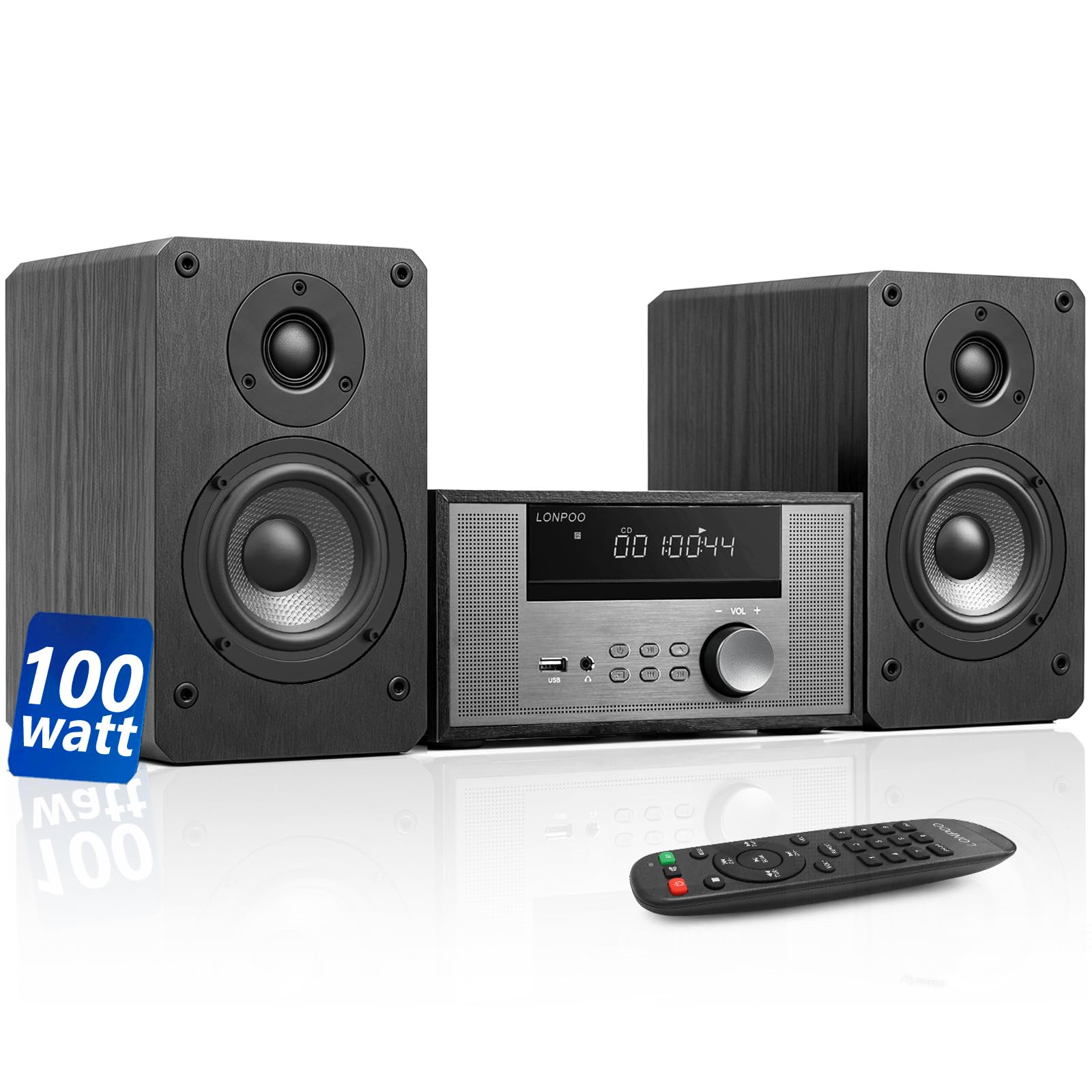
A vintage-looking shelf system with modern inputs and a proper headphone jack.
The LONPOO LP-609 wraps a dark grey aluminum panel and wood cabinet speakers in a classic retro design, delivering 100W of power through a 1″ silk dome tweeter and 4″ rubber woofer per speaker. That silk dome tweeter gives you smooth highs, and the rubber woofer handles punchy transient bass. It’s a handsome unit for a living room or study.
This is a true multi-format machine: CD player for CD/CD-R/CD-RW, FM radio (non-AM), Bluetooth streaming, MP3/WMA via USB, and a 3.5mm aux input. The headphone jack lets you listen privately—something the Panasonic PM270 lacks entirely. It also has a memory function, 5 equalization modes, and 3 repeat modes (single/all/random) all controlled by the remote.
Customers note great sound for the size and exceeded expectations on build. The honest caveat is a deal-killer for some: one unit arrived with only one channel working—exactly why that buyer replaced their old system. It’s a quality-control risk rather than a design flaw. Bass is decent but not deep, so don’t expect subwoofer-level low end from the 4″ drivers.
Charming and capable: the retro wood-and-aluminum look plus silk dome tweeter make it a style standout with smooth highs.
QC roulette: while most owners are thrilled, an occasional unit ships with a dead channel—buy from a seller with easy returns.
8. Philips Micro Stereo System

A small-footprint micro system that reads CDs even high-end players wouldn’t.
This Philips micro system brings 18W max output to a compact shelf unit with 3″ woofers and bass-reflex ports for richer low tones. It’s built for small spaces—a home office or bedroom—where you want decent sound without dominating the room. The digital radio tuner has 10 presets for clear reception.
Bluetooth streaming covers your phone, and the CD player reads MP3 CDs and recorded CDs—reviewers point out it plays discs that even a Bose unit rejected. An audio-in port and USB port (which can also charge a smart device) round out the inputs. The classic two-tone design borrows from hi-fi separates, and the textured volume dial gives a satisfying analog feel.
Sound quality earns positive feedback, and buyers appreciate that it fits an entertainment center easily. The honest notes: max volume is low, and functionality gets mixed reviews—some love it, others report issues. One buyer couldn’t get any radio stations in the same spot where a previous unit worked, suggesting FM reception depends heavily on location. It’s smaller than many expect, which is a plus if your shelf is tight.
Small-space specialist: the 3″ woofers and bass-reflex ports deliver good sound for the size, and it reads CDs other players skip.
Know its limits: low max volume and finicky FM reception mean it’s a bedroom companion, not a party machine.
9. Pyle 4-Piece Bluetooth Stereo System

A 1000W multimedia system that records to USB and comes with a wireless mic.
The Pyle PHSKR33 is a 4-piece mini component system built around a 1000W digital amplifier, delivering clear and powerful sound for home entertainment. It fits DVD/VCD/CD/MP3 formats, so it’s genuinely versatile for older media collections. The built-in FM radio and dual USB ports add flexibility beyond just discs.
What sets this apart is the recording function: you can capture source signals and microphone signals directly to USB. It ships with a wireless microphone, and the microphone inputs offer volume, bass, treble, reverb, and echo adjustments—making this a karaoke-ready system from the start. The compact control unit measures 13.7″ x 10.1″ x 6.14″.
Buyers find it easy to set up with better-than-expected quality and clear FM radio reception. The honest caveats are real: the speaker cables are very short and not spliceable, the bass isn’t particularly strong, and one unit froze until unplugged while learning the controls. Reliability draws mixed feedback, with one speaker reportedly crackling from the start. It’s a value play, not a precision instrument.
Karaoke in a box: the wireless mic, reverb/echo controls, and USB recording make it the only system here built for singing along.
Set expectations: short fixed speaker cables and modest bass mean it’s best as a fun, budget-minded entertainment unit rather than a critical listening setup.
Understanding the Specs
RMS vs Max Wattage
RMS (Root Mean Square) is continuous power—what the amp sustains during normal listening. Peak or max wattage is the brief burst a system can handle at the loudest moment. Buyers should compare RMS numbers first; that’s the honest measure of how loud a system plays without distorting.
Two-Way Speakers and Drivers
A two-way design uses a woofer for bass and a tweeter for highs, handled by a crossover that splits the signal. Silk dome tweeters tend to sound smoother than metal ones. A larger woofer (like 4″ or 10cm) produces deeper bass, while a bass-reflex port vents air to extend low-end response from a small cabinet.
Bluetooth Codecs and Range
Bluetooth streams your phone’s audio to the system wirelessly. AptX is a codec (compression method) that preserves more detail than standard Bluetooth. Most systems offer around 10 meters of range. Some units add “re-mastering” or sound restoration to compensate for the compression Bluetooth applies.
Inputs and Connectivity
USB ports play MP3/WMA files from flash drives. Aux (3.5mm) inputs connect TVs, phones, or older players with a cable. Optical and coaxial digital inputs carry higher-quality audio from a TV or console. Phono inputs accept a turntable directly, applying the right pre-amplification for vinyl.
FAQ
Will a 20W bookshelf stereo system fill a living room?
Can I connect my TV to a bookshelf stereo system?
Will my turntable work with these systems?
How important is the bass-reflex port on bookshelf speakers?
What’s the difference between the Panasonic SC-PM270 and SC-PM700?
Do these systems come with speakers included?
Can I use headphones with a bookshelf stereo system?
Will these systems play burned CDs?
Final Thoughts: The Verdict
For most buyers, the bookshelf stereo system winner is the Panasonic SC-PM270 because it nails the essentials—clear sound, easy setup, reliable Bluetooth—at a price that makes it the crowd favorite. If you want more power to fill a living room, grab the Panasonic SC-PM700. And for vinyl lovers building a system around a turntable, the Sony STRDH190 bundle is the one to reach for.
How We Picked
We do not accept paid placement. Every pick is matched to a real buyer and a real use-case; we do not hands-on test units.
Sources & Methodology
Specifications: manufacturer listings and product documentation. Review insights: verified customer reviews, as of August 2026. Pricing: not shown on this page (it changes often); check the current price via the retailer link.
As an Amazon Associate, Gadgets Feed earns from qualifying purchases. This does not affect which products we feature.