
A boom arm for gaming isn’t just a desk accessory—it’s the single most impactful upgrade you can make to your voice chat clarity. Pulling that microphone off the desk and positioning it directly at your mouth eliminates plosives, keyboard clatter, and that hollow desktop reverb that makes you sound like you’re broadcasting from a tin can. This guide cuts through the noise to find the best boom mic for gaming setups that actually delivers.
I’m Min — the co-founder and writer behind Gadgets Feed. I’ve analyzed the polar patterns, connector types, and preamp requirements of a full stack of gaming microphones to separate the clear talkers from the muddy messes. My focus is on real-world compatibility with boom arms, audio interfaces, and the software you’re already running.
Whether you’re building your first stream rig or upgrading from a desktop condenser, this deep dive into the best boom mic for gaming covers seven models that span entry-level USB convenience to broadcast-grade XLR performance with a sturdy arm included.
How To Choose The Best Boom Mic For Gaming
Gaming audio is unforgiving. A mic on your desk picks up every switch click, every desk vibration, and every breath. A good boom arm solves the positioning issue, but the microphone capsule itself must be chosen with intent. Focus on the polar pattern first, then the connectivity that matches your current setup.
Polar Pattern and Background Noise Rejection
Cardioid is the non-negotiable standard for gaming. It captures sound from the front while rejecting noise from the sides and rear—your mechanical keyboard and PC fans. Avoid omnidirectional mics for this use case. Some dynamic cardioid mics, like the MAONO PD100S and FIFINE AM8PROT, also add voice isolation technology that further attenuates plosives and ambient rumble.
Connectivity: USB vs. XLR
USB mics offer true plug-and-play convenience—no audio interface, no phantom power, no complex routing. The HyperX SoloCast 2 and Sennheiser Profile are excellent examples. XLR, on the other hand, requires a mixer or audio interface but delivers superior noise rejection via balanced signal transmission and often a wider frequency response. Hybrid models like the Shure MV7+ and FIFINE KS5 kit give you both options in one package.
Boom Arm Fit and Build Quality
Not every mic ships with a boom arm. Ensure your chosen model has standard 5/8-inch or 3/8-inch threads for universal arm mounting. If the mic is heavy—like the Sennheiser Profile Streaming Set—look for a thickened boom arm with internal spring tension to prevent sagging. The FIFINE AM8PROT’s 30-inch extension arm is a standout for desk space flexibility.
Quick Comparison
On smaller screens, swipe sideways to see the full table.
| Model | Category | Best For | Key Spec | Amazon |
|---|---|---|---|---|
| Shure MV7+ | Premium | Broadcast-grade vocals | XLR + USB-C; 16.8M LED panel | Amazon |
| Sennheiser Profile Set | Premium | All-in-one streaming kit | Condenser capsule; included boom arm | Amazon |
| HyperX QuadCast 2 | Mid-Range | Plug-and-play streaming | 20Hz-20kHz; aluminum enclosure | Amazon |
| FIFINE KS5 Bundle | Mid-Range | Full mixer + mic combo | XLR dynamic + 4-channel mixer | Amazon |
| FIFINE AM8PROT | Mid-Range | RGB gaming aesthetic | XLR/USB; 30in boom arm | Amazon |
| HyperX SoloCast 2 | Budget | Compact USB simplicity | 24-bit/96kHz; tap-to-mute | Amazon |
| MAONO PD100S | Budget | Affordable XLR entry point | Dynamic; 60Hz-14kHz; metal body | Amazon |
In‑Depth Reviews
1. Shure MV7+ Dynamic Microphone

The Shure MV7+ inherits the SM7B’s broadcast DNA and tailors it for the modern gamer and podcaster. Its Auto Level Mode dynamically adjusts gain based on your distance from the mic—a godsend for anyone who leans back during clutch moments. The real-time denoiser cuts HVAC hum and fan noise without sounding artificial. Dual USB-C and XLR outputs mean you can plug directly into a PC for Discord or route into an audio mixer for a full studio chain. The LED touch panel displays 16.8 million colors for real-time level monitoring and tap-to-mute control.
OBS certification ensures seamless integration with streaming software, and the integrated reverb effects (Plate, Hall, Studio) add depth to voiceovers without external plugins. The 50 Hz to 16 kHz frequency response prioritizes vocal presence over sibilance. Build quality is all-metal and lightweight at under two pounds, making it easy to mount on a standard boom arm. The included foam windscreen handles plosives effectively. A USB-C to C cable is included, though XLR cable is not.
Where the MV7+ truly shines is in untreated rooms. The cardioid dynamic capsule rejects off-axis noise aggressively enough that you can skip heavy acoustic treatment. The Motiv software provides precise EQ and compression controls. The touch mute button takes a few sessions to master, but the visual LED feedback prevents hot-mic accidents. For gamers who also produce content, this is the long-term investment.
Why it’s great
- Auto Level Mode maintains consistent volume regardless of head movement.
- Real-time denoiser eliminates background hum without artifacts.
- Dual USB-C and XLR offer ultimate flexibility for PC and mixer setups.
Good to know
- XLR cable not included in the box.
- Touch mute button has a short learning curve.
- Premium price reflects broadcast-level hardware.
2. Sennheiser Professional Profile USB Microphone Streaming Set

Sennheiser brings its German-engineered heritage to the streaming market with the Profile USB microphone. The set includes a high-quality cardioid condenser capsule with a metal housing and a robust boom arm designed for optimal positioning. Frequency response is tailored for the human voice, delivering a warm, natural mid-range with excellent body and presence. The boom arm itself is a standout—thick, stable, and equipped with internal cable management. The entire setup weighs 1628 grams, which includes the arm, mic, and cables, ensuring no sagging over time.
Plug-and-play simplicity defines the experience. All controls—gain, headphone volume, and mute—are on the microphone body; no software is required. The mute button has zero click noise, a critical detail when live. The included 3-meter USB-C cable offers plenty of reach for desktop and floor-tower PCs. Audio quality at 24-bit is clean enough for podcasting, and the cardioid pattern effectively minimizes keyboard and mouse clicks. The set also includes a mic pouch for transport.
But the included boom arm makes it easy to position the mic close to your mouth, mitigating that downside. Compared to the Shure MV7+, the Profile offers less DSP trickery but a more straightforward, no-fuss path to great audio. For streamers who want a complete, ready-to-go kit without buying extra parts, this is the most polished option.
Why it’s great
- Premium Sennheiser condenser capsule delivers warm, natural voice reproduction.
- Included boom arm is thick, stable, and has internal cable routing.
- True hardware controls with zero software required for core functions.
Good to know
- Condenser capsule is more sensitive to room echo than a dynamic mic.
- No high-pass filter or onboard EQ controls.
- Boom arm is a fixed length; no extension adjustment.
3. HyperX QuadCast 2 – USB Microphone

The HyperX QuadCast 2 is the refined successor to one of the most popular streaming mics. The aluminum enclosure feels premium and durable, weighing in at 335 grams without the shock mount. The built-in anti-vibration shock mount reduces desk thumps and arm movements, and the tap-to-mute sensor with LED indicator is quick and responsive. Frequency response spans 20 Hz to 20 kHz, and the cardioid polar pattern provides solid off-axis rejection for a USB condenser. The microphone offers stereo, omnidirectional, cardioid, and bidirectional patterns, making it versatile for solo streaming or dual-person podcasts.
Plug-and-play via USB-C works flawlessly on PC, Mac, PS5, and PS4. The 32-ohm impedance drives well without a preamp, and the 77 dB signal-to-noise ratio keeps self-noise low. The QuadCast 2 includes a built-in pop filter and a sturdy base, but it really shines when mounted on a boom arm. The red LED glow may clash with non-red setups, but the lighting is functional for mute status. Audio quality is clear and crisp for gaming chat and basic streaming. It lacks the dynamic range of an XLR mic, but for pure USB convenience at this price point, the build is unmatched.
Over a year of use (as noted in long-term reviews), the mic retains its sonic clarity. The only wear reported is a slight dimming of the red LEDs. The integrated pop filter handles plosives decently, though a foam windscreen improves performance. The QuadCast 2 is the safe, high-quality choice for gamers who want a desk mic that looks professional and works out of the box with zero configuration.
Why it’s great
- Full aluminum housing feels rock-solid and resists wear.
- Built-in shock mount and pop filter eliminate the need for accessories.
- Versatile polar patterns for solo or dual-person recording.
Good to know
- No gain control on the mic body; must adjust in software.
- Red-only LED may not match all RGB setups.
- Condenser design picks up more room noise than dynamic alternatives.
4. FIFINE Gaming Equipment Bundle KS5

The FIFINE KS5 bundle combines an XLR dynamic microphone with a dedicated 4-channel gaming audio mixer, offering a complete audio upgrade path. The XLR dynamic capsule provides natural voice reproduction with excellent background noise rejection—mechanical keyboards and fans are effectively attenuated. The mixer includes individual mute controls, a volume fader for each channel, headphone monitoring, and built-in entertainment sounds for interactive streaming. The voice changer modes (elder, baby, robot, girl) add fun variety for content creators.
Connection is straightforward: USB-C for the mixer to your PC, and an XLR cable links the mic to the mixer. The 3.5mm headphone jack on the mixer allows zero-latency monitoring. RGB lighting on both the mic and mixer can be set to static or flowing modes to match your desk theme. The mixer’s faders give you granular control over the mix of game audio and voice chat. The mic itself includes a foam windscreen and screws onto standard 5/8-inch stands. The bundle weight of 1.48 kilograms reflects the substantial build of the mixer.
One key limitation: the mixer’s voice changer and RGB controls function only via the USB connection to the mixer—not over XLR alone. Some users report the mixer sporadically rebooting, though this appears to be a unit-specific issue. Audio quality at 16-bit is excellent for the cost, and the XLR upgrade path means you can swap the mixer later while keeping the mic. For budget-conscious streamers wanting a full hardware control suite, this bundle delivers the most capabilities per dollar.
Why it’s great
- Complete mixer + mic bundle with hardware faders and mute controls.
- XLR dynamic capsule rejects ambient noise effectively.
- Voice changer and RGB add creative and visual value.
Good to know
- Mixer functions (voice changer, RGB) unavailable over XLR-only connection.
- Mixer body is plastic; feels less premium than the mic.
- Occasional spontaneous reboot reported by some users.
5. FIFINE AmpliGame AM8PROT
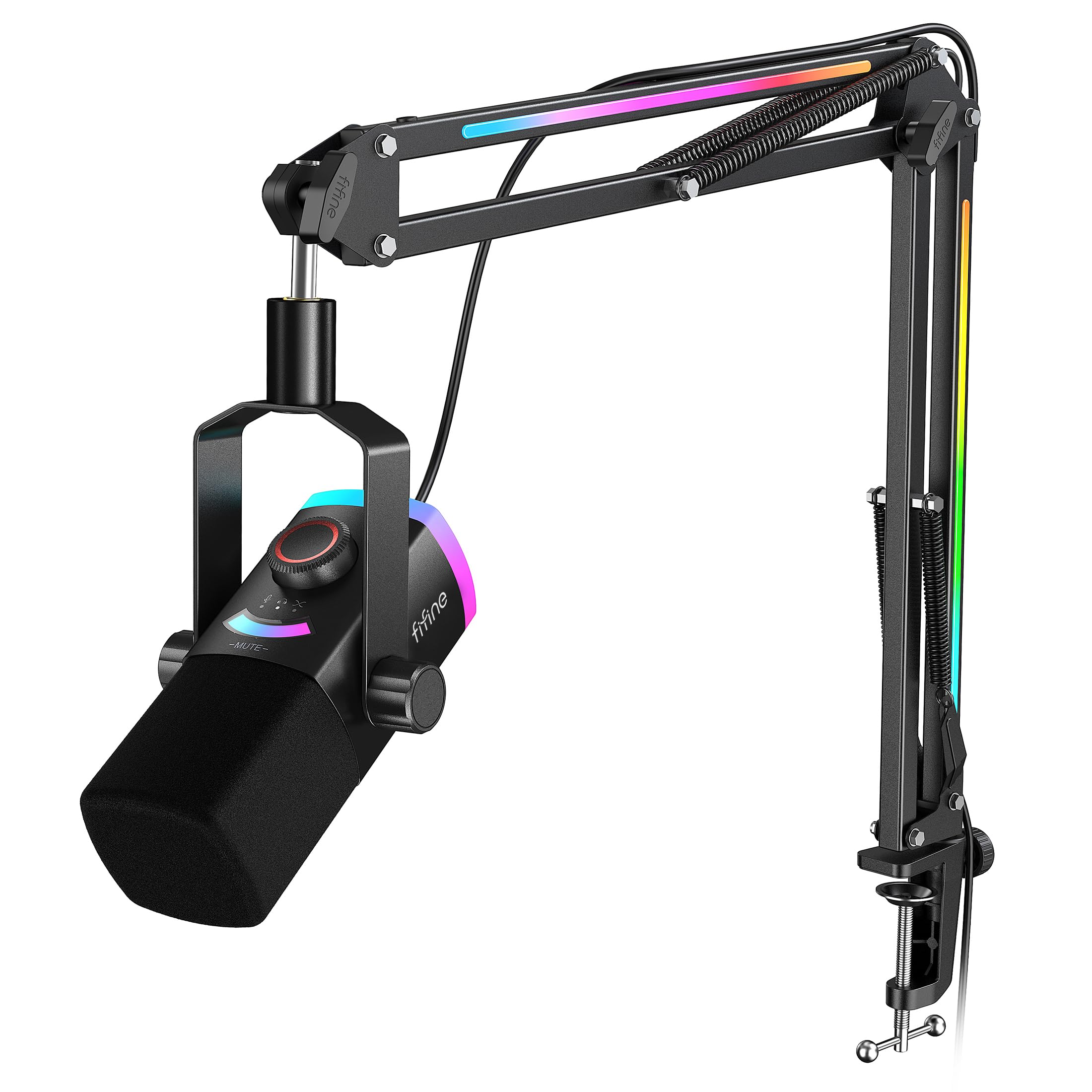
FIFINE’s AmpliGame AM8PROT is a dynamic cardioid microphone with dual XLR/USB connectivity, designed to sit at the center of a gaming rig. The 115 dB SPL handling allows it to capture vocal dynamics without distortion, and the 75 dB SNR ensures a clean noise floor. The real standout is the included RGB boom arm—extending up to 30 inches with multi-angle joints—that saves desk space and adds 240+ lighting combos. The foam windscreen and double-layer pop filter reduce plosives effectively. The plug-and-play USB-A/C lets you swap between PC, PS4, and laptop in seconds.
The tap-to-mute LED panel is visible at a glance, and the single scroll wheel controls gain and headphone volume in USB mode. The FIFINE Genie app provides EQ and background noise filters for fine-tuning. Real-time monitoring is available through the headphone jack on the mic itself, letting you hear your mix latency-free. The 8.2-foot USB cable is long enough to route from desk edge to the back of a tower. The boom arm’s thicker construction compared to the AM8T reduces wobble noise entering the mic.
In XLR mode, the RGB and onboard controls are disabled, so you’ll need a separate interface for lighting and mute functions. The foam cover and windscreen do a good job, but some users find the mute button overly sensitive, leading to accidental cutouts. The software EQ is helpful for dialing in a warmer low end. For gamers who prioritize visual immersion and desk organization alongside audio quality, the AM8PROT is the most complete RGB package available.
Why it’s great
- 30-inch RGB boom arm with cable management saves desk space.
- Dual XLR/USB connectivity and 115 dB SPL handling for dynamic range.
- Tap-to-mute and real-time monitoring via the mic body.
Good to know
- Onboard controls and RGB non-functional in XLR-only mode.
- Mute button can be accidentally triggered due to sensitivity.
- Software EQ required to boost lower frequencies for warm vocal tone.
6. HyperX SoloCast 2 – Gaming USB Condenser Mic
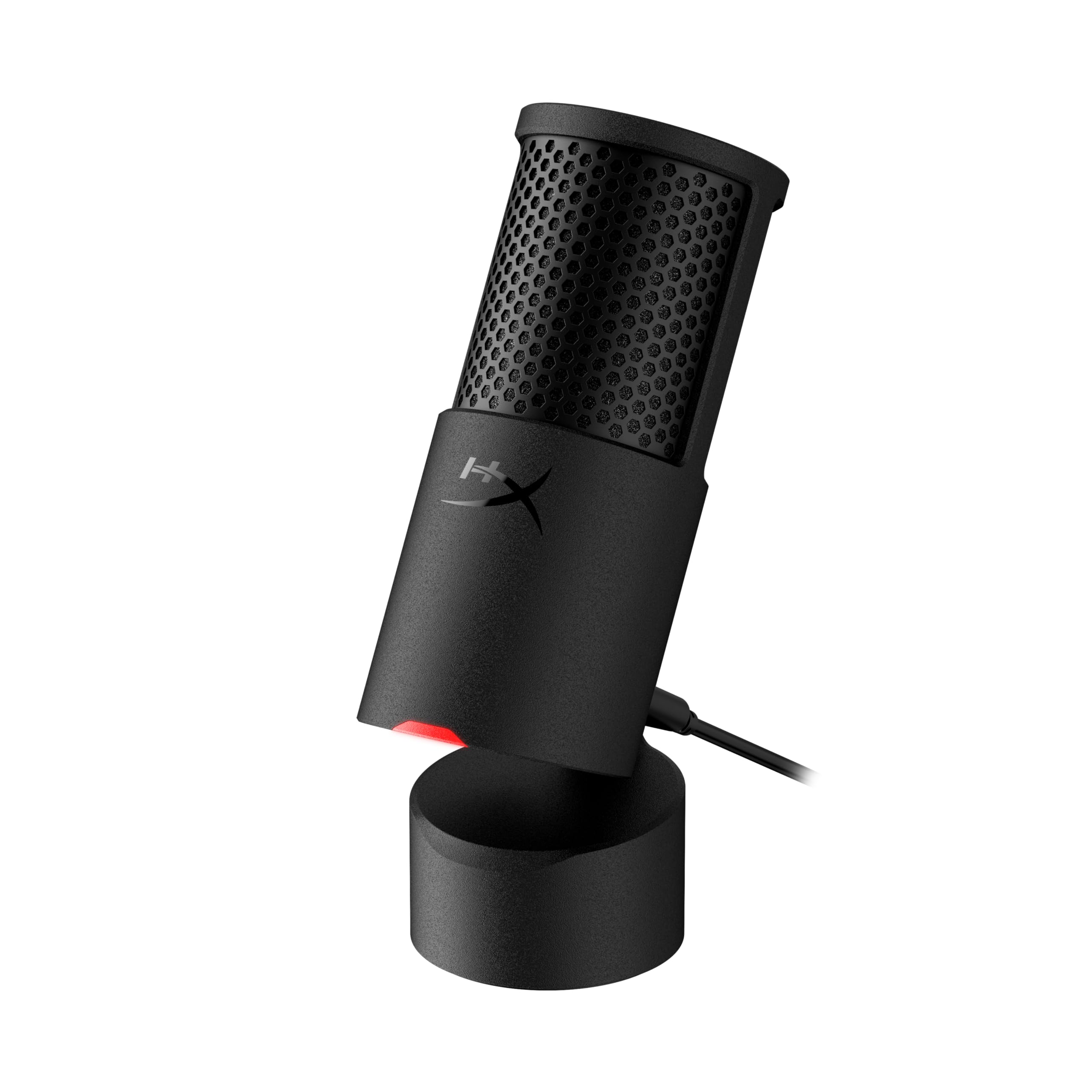
The HyperX SoloCast 2 is a compact USB condenser mic built for clean, fuss-free voice capture. It delivers 24-bit depth at 96 kHz sampling—enough resolution for clear Discord calls, streaming commentary, and video meetings. The cardioid polar pattern focuses on sound from the front while rejecting peripheral keyboard and mouse noise. An internal suspension system provides shock mount benefits without the bulk. The tiltable stand is stable and weighted, and the mic has standard 3/8-inch and 5/8-inch threads for easy boom arm mounting. The tap-to-mute sensor with red/off LED is intuitive.
HyperX NGENUITY software adds high-pass, low-pass, and voice enhancement filters that can be saved directly to the mic, so they persist even when the software isn’t running. This is a rare feature at this tier. The USB-C to USB-A connection is truly plug-and-play. The compact form factor—53 by 1.52 by 1.7 inches—means it occupies minimal desk space. Audio out of the box is clear and natural, with a slight boost to upper mids that aids voice intelligibility in noisy game lobbies.
The primary trade-off is that the SoloCast 2 has no onboard gain control—you’ll adjust levels in Windows sound settings or Discord. A few users note the USB-C port on the lower back can feel loose; using a boom arm and securing the cable solves this. The mic is sensitive enough to pick up background noise if set far from your mouth, so positioning it close with a boom arm is recommended. For the price, this is the best entry-level USB mic for gamers who want simplicity and solid sound without extra peripherals.
Why it’s great
- 24-bit/96kHz resolution captures clear, detailed voice audio.
- NGENUITY filters can be saved to the mic for persistent settings.
- Compact, tiltable stand with standard boom arm threads.
Good to know
- No onboard gain control requires software-level adjustments.
- USB-C port placement can feel loose without cable management.
- Condenser pickup still captures some room echo if not positioned close.
7. MAONO XLR Podcast Dynamic Microphone PD100S

The MAONO PD100S is an XLR-only dynamic microphone that delivers warm, isolation-focused audio at a price that makes it a no-brainer for budget-conscious gamers willing to use an audio interface. The 60 Hz to 14 kHz frequency range emphasizes the human vocal fundamental, producing a natural, mellow tone with mid-frequency protrusion that cuts through game audio. The cardioid pattern and dual-layer inner pop filter effectively reduce plosive pops and ambient noise. The 600-ohm impedance is standard for dynamic mics and pairs best with an interface or mixer that provides adequate gain—a Cloudlifter or FET preamp is recommended for optimal volume.
The all-metal body keeps handling noise low, and the included boom arm and 6.56-foot XLR cable make this a true starter kit. The arm has standard 5/8-inch and 3/8-inch threads for compatibility with most stands. The “Talk to the Mic Top” design means you speak into the top surface, which reduces off-axis pickup. Setup is simple: plug the XLR cable into your interface, enable phantom power (though phantom isn’t required for dynamic operation—a preamp is), and adjust gain. The 45 dB sensitivity is lower than typical condensers, which is why the preamp recommendation is critical.
Without a preamp, the PD100S output can be quiet, and you may hear interface self-noise if you crank the gain too high. Users report that a surgical EQ can tame a few resonances around 4–6 kHz. The lack of USB means no plug-and-play convenience—you need an interface. But for gamers building a modular XLR setup on a tight budget, the PD100S provides a genuinely good dynamic capsule that competes with mics costing twice as much. It’s the cheapest real XLR dynamic mic worth buying.
Why it’s great
- Warm dynamic sound with excellent off-axis noise rejection for gaming.
- All-metal build with included boom arm and XLR cable.
- Budget-friendly XLR starting point for a modular studio upgrade path.
Good to know
- Requires a high-gain preamp or Cloudlifter for adequate volume.
- XLR only; no USB connectivity for direct PC connection.
- Low sensitivity (45 dB) means interface self-noise can become audible at high gain.
FAQ
Can I use a dynamic mic like the Shure MV7+ without an audio interface?
Why does my gaming mic sound quiet with an XLR dynamic microphone?
Does a boom arm really make a difference in audio quality for gaming?
What’s the difference between 16-bit and 24-bit audio for streaming?
Final Thoughts: The Verdict
For most users, the best boom mic for gaming is the Shure MV7+ because its Auto Level Mode and real-time denoiser deliver broadcast-quality voice without requiring a treated room. If you want a complete, ready-to-play kit with a premium boom arm included, grab the Sennheiser Profile Streaming Set. And for the best value bundle that includes a mixer for full hardware control, nothing beats the FIFINE KS5.