
Nothing ruins a powder day faster than the numb, aching pain of frozen toes locked inside stiff ski boots. Disposable chemical warmers fail halfway down the first run and leave sticky residue. The right pair of rechargeable heated socks delivers consistent, adjustable warmth directly to your toes for hours, letting you focus on carving turns instead of shivering in the lift line.
I’m Min — the co-founder and writer behind Gadgets Feed. I’ve spent hundreds of hours analyzing battery chemistries, heating element layouts, and real-world user data from thousands of skiers to identify the gear that actually delivers on its warmth claims.
I’ve broken down the battery capacities, heating coverage patterns, and material compositions so you can confidently choose the best boot warmers for skiing that fit your boot and your budget.
How To Choose The Best Boot Warmers For Skiing
Not all heated socks handle the tight confines and high movement of a ski boot the same way. A pair that works great for ice fishing might have a bulky battery pack that digs into your shin on a chairlift. Focus on these critical factors to find the right fit for the slopes.
Battery Voltage and Capacity
Standard 5V batteries struggle to maintain high heat in freezing windchill on a mountain. Premium options use a 7.4V lithium-polymer pack, delivering better temperature stability and longer runtime—often 8–10 hours on low versus 4–6 hours from a 5V unit. Higher voltage also means faster heat-up in the bitter cold of a morning lift ride.
Heating Element Coverage
Toes lose heat fastest inside a ski boot. The best designs use either a carbon fiber panel that wraps the entire toe box or wires that cover the top and bottom of the foot. Avoid models that only heat a small patch under the ball of the foot — your toes will still go numb on long runs.
Boot-Friendly Fit and Pocket Design
Bulk is the enemy of ski boot comfort. Look for thin heating wires, flat battery pockets that sit on the calf or shin rather than the ankle, and secure closures (Velcro flap versus zipper) that don’t create pressure points. Socks with too much padding can make your boots feel tight and restrict circulation.
Fabric and Moisture Management
Wet feet get cold fast. Merino wool blends offer excellent insulation even when damp, while CoolMax polyester fabric wicks sweat and dries five times faster than cotton. A breathable, moisture-wicking sock prevents sweat from freezing against your skin during a long day on the mountain.
Quick Comparison
On smaller screens, swipe sideways to see the full table.
| Model | Category | Best For | Key Spec | Amazon |
|---|---|---|---|---|
| SAVIOR HEAT (APP Control) | Premium | Tech-savvy skiers | 7.4V / 2x2200mAh / APP | Amazon |
| SAVIOR HEAT (Standard) | Premium | Reliable high heat | 7.4V / 2200mAh / Toe focus | Amazon |
| FREEHILL Merino Wool | Mid-range | Natural insulation fans | 5V / 2x5000mAh / Wool blend | Amazon |
| WAMOVAL (APP Control) | Mid-range | Longest single-charge | 5V / 10000mAh / APP control | Amazon |
| SNOW DEER | Premium | Harsh conditions | 7.4V / 2200mAh / CoolMax | Amazon |
| Black Squid | Budget | Smaller feet / casual use | 5V / 4000mAh / Cotton blend | Amazon |
| ZUOYI | Budget | Wide foot size range | 5V / 5000mAh / 4 heat levels | Amazon |
In‑Depth Reviews
1. SAVIOR HEAT Heated Socks with APP Control

This premium set uses a 7.4V 2200mAh lithium-polymer battery in each sock, delivering high heat (131–149°F) for roughly 2–2.5 hours and low heat (104–113°F) for up to 9–10 hours — enough for a full day on the mountain without swapping packs. The Bluetooth app lets you adjust the temperature and check remaining battery without fumbling for a button under ski pants, and the physical on/off switch serves as a reliable backup when connectivity drops.
The heating panel focuses infrared warmth directly on the toe area where skiers lose feeling fastest, while the CoolMax performance knit wicks moisture to prevent clammy feet. The thin carbon fiber heating elements and flat battery pocket minimize bulk inside a tight ski boot. Sizes cover US 5–14 with a unisex S/M/L/XL range, and the socks come in both black and grey.
User reports confirm that the low setting keeps feet warm all day in sub-freezing conditions, with one reviewer logging over 14 hours of warmth on a single charge. The app control is praised for convenience but some find it unnecessary — the sock works perfectly without the phone connection. The only recurring note is that the battery pocket can be tricky to open at first.
Why it’s great
- Full day runtime on low heat
- Bluetooth app for easy temperature control
- Thin, boot-friendly design with secure battery pocket
Good to know
- Battery pocket can be stiff to open initially
- Bluetooth pairing may require troubleshooting in cold
2. SAVIOR HEAT Heated Socks (Standard)

Built with the same 7.4V 2200mAh core as the app model, this version strips out Bluetooth for a simpler, lighter experience that many skiers actually prefer. The carbon fiber heating panel runs directly across the toes, delivering intense heat where you need it most without wasting energy on the calf. Three heat settings range from low (104–113°F, 8–10 hours) to high (140–150°F, 2–2.5 hours), and the socks heat up in just 10 seconds.
The thick cushioned build adds protective padding inside ski boots without bunching up, while the CoolMax fabric manages moisture effectively. A battery indicator light shows remaining charge levels (100%, 75%, 50%, 25%), and the switch flashes below 25% as a warning. The cover-style battery pocket holds the pack securely during high-movement sports like skiing and snowboarding, outperforming zipper designs that can pop open.
Long-term users report these socks lasting years — one reviewer noted five years of reliable use with consistent heat. The auto-switch from high to medium after five minutes is a smart safety feature that prevents overheating. Sizing across S–XL accommodates US 5–14, though some users with smaller feet found the sock cut too long for their size.
Why it’s great
- Proven durability with years of reliable use
- Concentrated toe heat without calf waste
- Battery indicator with low-charge warning
Good to know
- Sizing runs large for smaller feet
- Long charge time of around 7 hours
3. FREEHILL Merino Wool Heated Socks
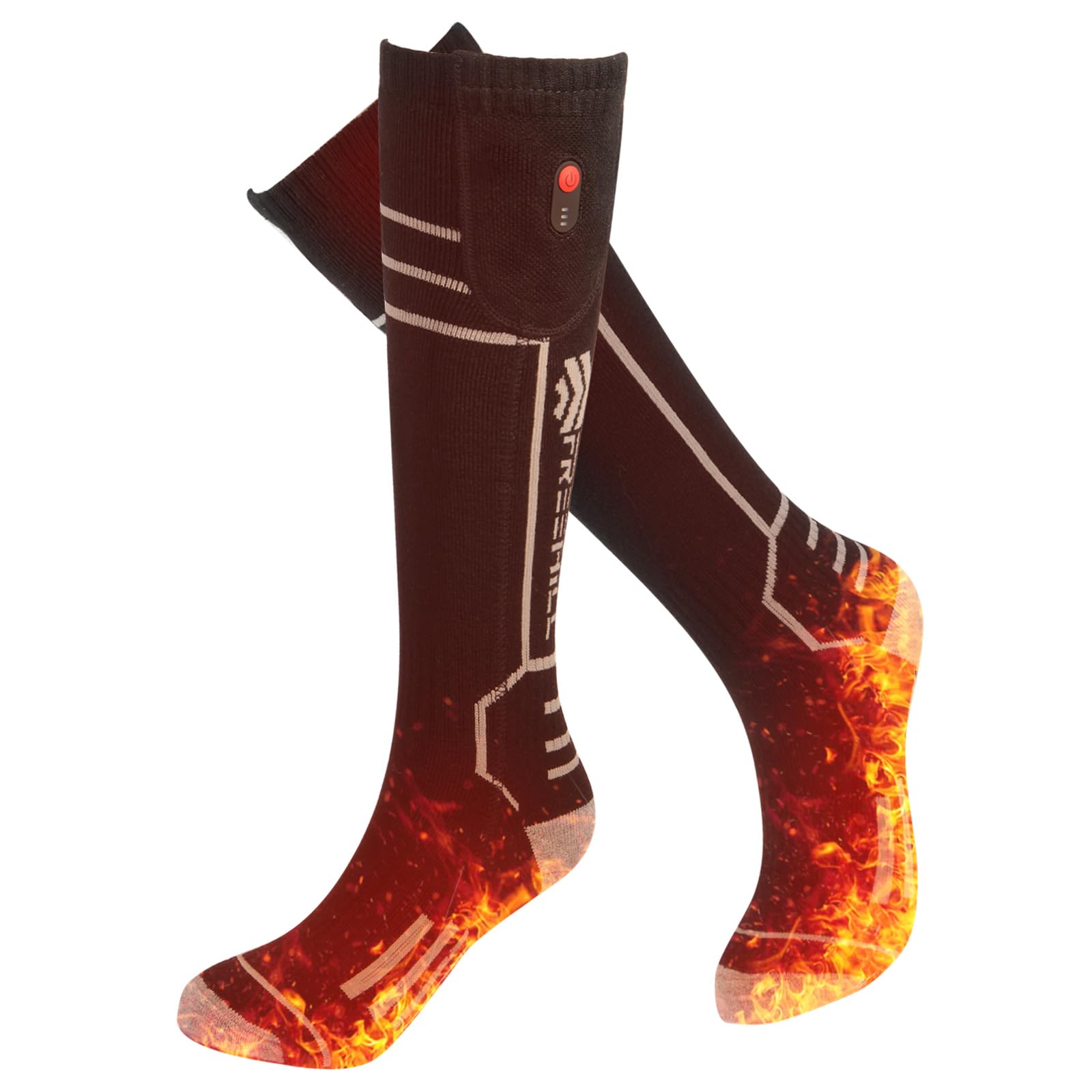
FREEHILL combines the natural insulation of a Merino wool blend with electric heating, giving you warmth even if the battery dies. The flat heating wire material eliminates the foreign object sensation common with round wire designs, making these feel closer to a premium ski sock. Each sock uses a 5V 5000mAh rechargeable battery that delivers up to 8 hours on the lowest setting and heats up in just 10 seconds.
The heating element covers the entire sole and toe — 100% more coverage than many competitors — which is critical for skiers whose arches also suffer in cold boots. A one-click button on the sock lets you cycle through three heat levels (low 104–113°F, medium 113–121°F, high 121–131°F) without needing an app. The thick looped fabric at the forefoot, heel, and toe adds shock absorption and reduces friction during long runs. Sizing runs from medium (men 4–7) to X-large (men 12–14).
A skier who suffered from frostbitten toes rated these A+ across all metrics, noting the wool kept his feet warm even unpowered at 7–14°F for 5.5 hours. Multiple users with Raynaud’s syndrome found them the most comfortable heated socks they had tried, with no detectable wire feel. Some users reported shorter battery life than advertised at around 4–5.5 hours on medium heat in actual use.
Why it’s great
- Merino wool provides insulation even without power
- Flat heating wires eliminate uncomfortable bulges
- Full-foot coverage keeps both toes and arches warm
Good to know
- Actual runtime on medium is around 4–5.5 hours
- No app or remote — manual button only
4. WAMOVAL Heated Socks with APP Control
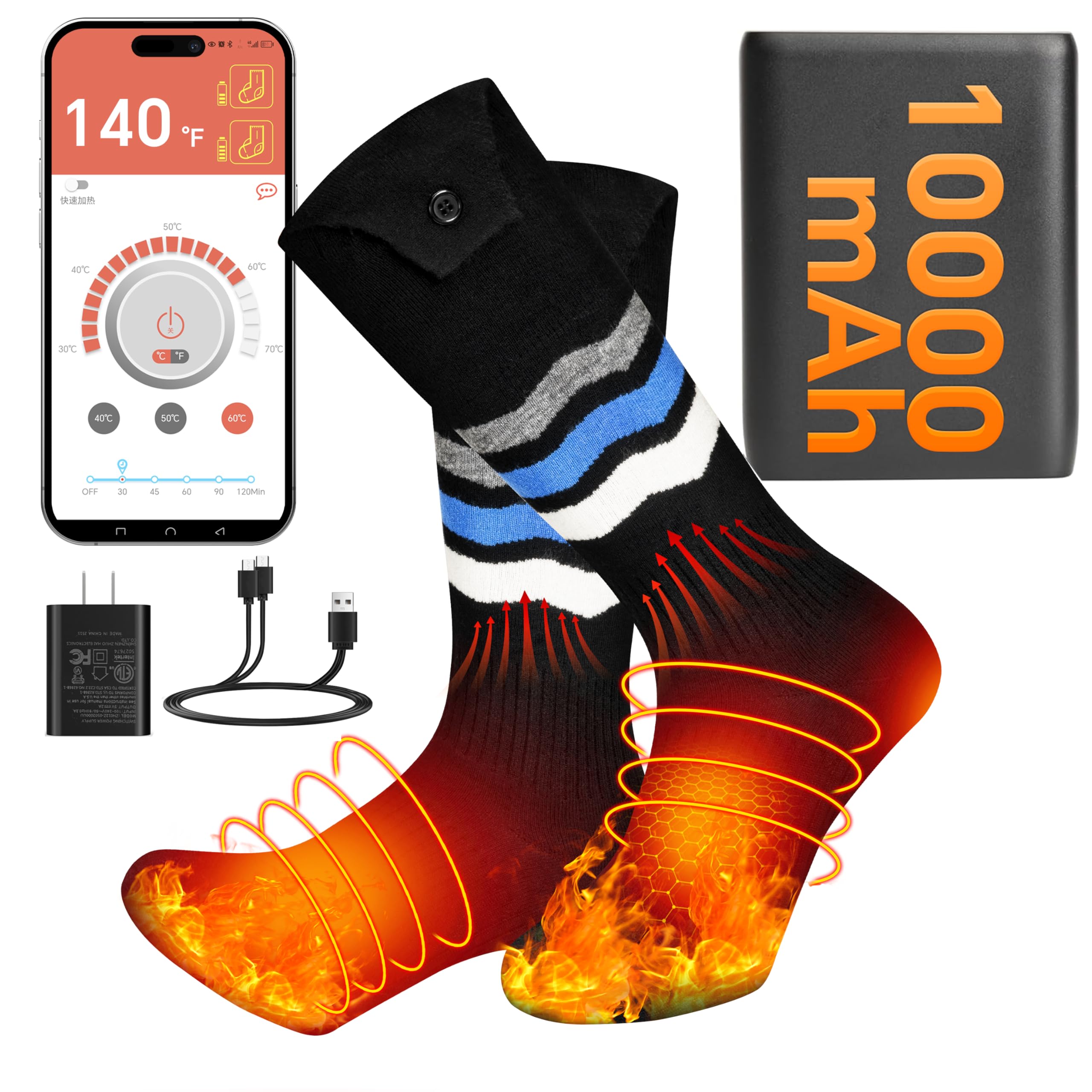
With a massive 10000mAh battery per sock, the WAMOVAL offers the highest raw capacity in this lineup, translating to up to 13 hours on normal temperature and 5 hours on the highest setting. That’s enough for a full day of skiing plus après without worrying about charging. The 3D hidden loop heating wire wraps around the toe area for even heat distribution in just 20 seconds.
The Bluetooth app (Warm Uping) allows temperature adjustment from 86°F to 158°F, plus a timer up to 120 minutes — useful for pre-warming your boot before strapping in. Both socks can be charged simultaneously using the included special Y-cable, and charging takes around 4.5 hours. The socks are sized to fit US 6–13 and come in black/blue colorway.
Skiers report 5 hours of heat on moderate settings in 31–35°F conditions with over 50% battery remaining, and the app control is praised as very convenient on the mountain. The main trade-off is noticeable bulk — the 10000mAh battery pack is large and may press against the shin in tighter ski boots. Some users also found the socks ran very large, especially for women’s sizes.
Why it’s great
- Massive 10000mAh battery for all-day skiing
- Bluetooth app with timer and wide temp range
- Simultaneous charging for both socks
Good to know
- Battery pack is bulky for tight ski boots
- Socks run large, especially for smaller feet
5. SNOW DEER Heated Socks

SNOW DEER is one of the established names in heated socks, and this model uses a 7.4V 2200mAh lithium-polymer battery that delivers more stable heat than typical 5V competitors. The heating elements cover the whole toes plus both the top and bottom of the foot, providing comprehensive warmth that prevents frostbite during severe cold. Three heat settings are controlled via a touch-button smart controller.
The CoolMax fabric dries five times faster than cotton, reducing the risk of moisture-related foot conditions during long ski days. Sizing is offered in S through XL (US 5–6 up to 12–14), which is a wider range than many alternatives. The battery can be purchased separately (ASIN B07HJ3ZZ5M) for those who want a spare set for week-long trips.
One reviewer tested these in 24°F windchill on a 9.36-mile hike and found them effective enough that they sometimes needed to dial the heat down. Motorcycle users reported the low setting kept feet warm at 25°F for extended periods. However, sizing consistency has been an issue — recent batches of size Large are reportedly smaller than older versions, creating fit problems for returning buyers.
Why it’s great
- Full top-and-bottom foot heat coverage
- Fast-drying CoolMax fabric
- Separate battery available for extended use
Good to know
- Recent sizing changes may affect fit
- 6-hour charge time is on the slower side
6. Black Squid Rechargeable Heated Socks
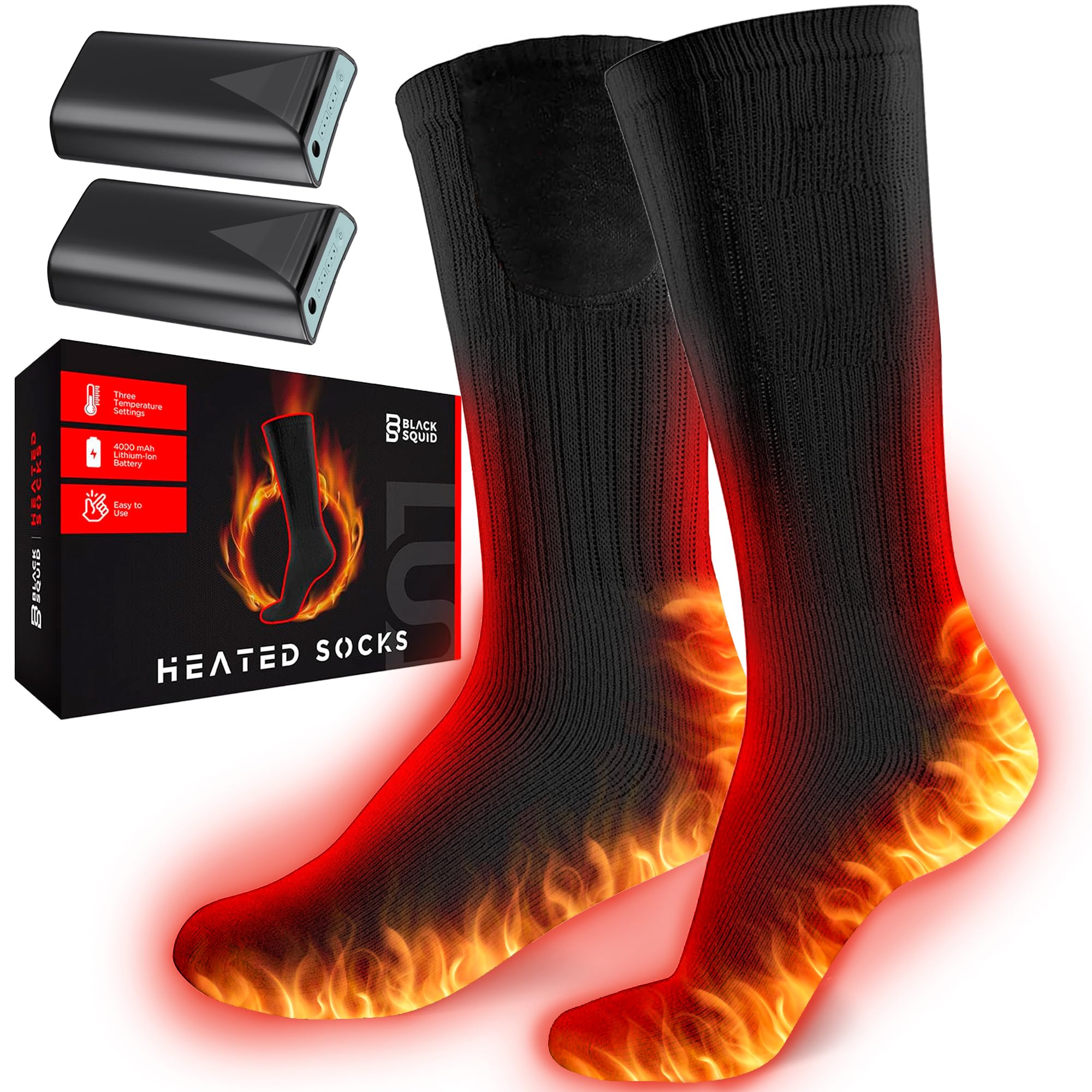
The Black Squid socks use a 5V 4000mAh lithium-ion battery that runs for 4 hours on high and up to 9 hours on low — respectable runtime for a budget-conscious option. The three heat settings (104°F, 122°F, 140°F) are sufficient for most ski conditions, and both socks charge simultaneously in about 4 hours via the included Y-cable.
The cotton and spandex fabric is soft and breathable with good support around the arch, and the battery packs are lightweight and unobtrusive. Sizing is aimed at smaller feet — women 4–10 and men 3–9 — which makes this one of the few options that fits smaller frames well. The heating elements are carbon fiber and cover the toes effectively.
Users report 2.5–3 hours of effective heat on medium while skiing, with the high setting available to rewarm quickly. The socks are praised for saving toes in 10–30°F conditions where disposable warmers fail. However, some users note that the battery slot lacks Velcro to secure the pack, causing it to shift during active movement. The calf fit is also tight for larger legs.
Why it’s great
- Fits women’s 4–10 and men’s 3–9 well
- Soft cotton-blend fabric with arch support
- Fast 4-hour simultaneous charging
Good to know
- Battery pocket lacks secure Velcro closure
- Calf fit is snug for larger legs
7. ZUOYI Heated Socks

The ZUOYI heated socks pack a 5000mAh rechargeable battery into each sock and offer four temperature levels — 104°F, 113°F, 131°F, and 149°F — giving you one more fine-tuning step than most competitors. Runtime reaches 3–4 hours on the highest setting and up to 8 hours on low, which is solid for the price tier. The carbon fiber heating elements stimulate circulation and cover the full toe area to prevent frostbite.
The fabric is a breathable polyester blend that dries faster than cotton and reduces moisture-related foot issues like athlete’s foot. The unisex one-size design claims to fit US sizes 6–14, though the stretchability means larger feet may find them snug. The batteries are removable and the socks are machine washable in the included laundry bag, as long as the batteries are removed first. The thin battery design is intended to stay put even during running.
Users consistently report 5 hours of warmth on medium heat (setting 3), with the low setting lasting over 6 hours for extended outdoor sessions. The heating is described as instant, and the cushioned soles make them comfortable for long days. The main complaint is a 6-hour charge time, which feels slow relative to the 4-hour norm in this category. Some users also note the compression fit may be tighter than expected for very wide feet.
Why it’s great
- Four precise temperature levels for fine-tuning
- Wide size range from US 6 to 14
- Machine washable with removable batteries
Good to know
- 6-hour charge time is slower than average
- Compression fit may be tight for wide feet
FAQ
How long do heated socks last on a full charge during skiing?
Can I wear heated socks with my existing ski boots?
Are 7.4V heated socks better than 5V for skiing?
How do I wash heated ski socks without damaging them?
What temperature setting should I use while skiing?
Final Thoughts: The Verdict
For most skiers, the best boot warmers for skiing winner is the SAVIOR HEAT with APP Control because it combines a powerful 7.4V battery, reliable Bluetooth convenience, and a boot-friendly thin design at a fair price. If you want natural insulation that works even when the battery dies, grab the FREEHILL Merino Wool. And for maximum runtime without compromise, nothing beats the WAMOVAL and its 10000mAh batteries.