
Our readers keep the lights on and my morning glass full of iced black tea. As an Amazon Associate, I earn from qualifying purchases.
Specs are compiled from manufacturer listings and verified buyer reviews and can change over time — please confirm the key details on the product page before buying.
Standing on a poured concrete slab all day is what ruins most work boots — the sole flattens, the cushioning packs out, and your heels and knees take every step as a direct hit. The fix is not a stiffer boot but a shock-absorbing midsole, a cushioning insole you can swap, and a traction outsole that still grips a wet floor. That is exactly what this guide compares.
I’m Min — the founder and writer behind Gadgets Feed. This guide is built by comparing the manufacturers’ published specifications and the patterns across verified customer reviews, so you get each pick’s real strengths and trade-offs instead of marketing spin.
You get nine picks sorted by what each one does best on a hard floor, plus the plain-English spec terms that actually tell you whether a boot will keep your feet comfortable past lunch. boots for concrete floors live and die by their midsole and insole, so that is where this guide puts its attention.
Our Picks at a Glance


How To Choose The Best Boots For Concrete Floors
A concrete floor gives nothing back. Every step sends the impact straight up through the boot into your heel, arch, and knee, and it does it thousands of times a day. So the boot has to soak up that impact, not just survive it. Three things do that work: the midsole, the insole, and the shape of the toe box.
Midsole and insole
The midsole is the layer of foam or urethane between your foot and the rubber outsole — it is the part that actually squashes under your weight and absorbs the shock. A polyurethane midsole (PU) holds its shape longer than a soft foam one, which is why boots advertising a PU midsole tend to stay comfortable for more months. The insole is the removable bed your foot sits on. A thick, cushioned insole that you can pull out and replace is worth more on concrete than a fancier leather upper, because the foam is the part that wears out first. If the boot ships with a thin insole, budget for a replacement cushion — it is the cheapest comfort upgrade you can make.
Toe box room and arch support
A tight, narrow toe box forces your toes into a squeezed position all day, and on a hard surface that pressure builds into soreness over hours. A roomy toe box lets your toes spread out and take the load the way they were built to. Arch support comes from the insole and midsole structure — a boot with a shaped arch cradle supports the middle of your foot, which takes stress off your heel and knees. Slip-on and Chelsea styles get your feet in and out faster, which matters if you swap footwear during the day or want to kick boots off at the door without bending into laces.
Slip resistance and toe protection
A concrete shop floor is often wet, oily, or covered in dust, so a slippery sole is a real hazard, not just an annoyance. Slip resistance comes from the outsole rubber compound and tread depth — a deeper, softer-gripping tread holds better on a damp slab than a hard, shallow one. On the toe side, you have two main choices. A steel toe protects against impact and compression, is heavier, and can feel cold but is the classic safety standard. A composite toe is made from materials that are lighter, do not conduct cold, and will not set off metal detectors, but it can feel firmer against the top of your toes for the first few days. Pick based on whether your site requires a safety toe at all.
Quick Comparison
| Model | Best For | Toe Type | Shaft Height | Slip-On or Lace-Up | Amazon |
|---|---|---|---|---|---|
| Cat Footwear Striver Steel Toe★ Best Overall | Best overall for all-day wear | Steel toe | — | Lace-up | Amazon |
| Moc Toe Work BootsBest Budget Leather | Budget leather value | Soft or steel toe | 6 inch | Lace-up | Amazon |
| SUREWAY Slip On Fire & Safety Work BootsBest Slip-On | Fast on and off shift changes | Composite or soft toe | — | Slip-on | Amazon |
| HANDMEN Steel/Soft Toe Work Boots | Static dissipative and anti-slip | Steel or soft toe | — | Slip-on | Amazon |
| ROCKROOSTER Gammon Chelsea | Arch support with slip-on ease | Steel toe | 6 inch | Slip-on | Amazon |
| Timberland PRO Powertrain Alloy Toe Hiker | Warehouse and indoor hard-floor work | Alloy toe | Mid height | Lace-up | Amazon |
| KEEN Utility Gibson Mid | Sporty fit, lightweight option | Carbon fiber composite toe | Mid height | Lace-up | Amazon |
| Timberland PRO Gridworks Wedge 6 Inch | Waterproof all-season durability | Alloy toe | 6 inch | Lace-up | Amazon |
| Orthofeet Granite Orthopedic Work Boots | Premium wide-toe comfort | — | — | — | Amazon |
In‑Depth Reviews
1. Cat Footwear mens Striver Steel Toe
Our pick — over 4.5★ from 650+ verified ratings; the strongest balance of quality and price.
The Cat Striver is the boot people keep re-buying — some are on their third pair and counting.
If you spend your shift on a poured slab and you want a boot that does not need a break-in routine, the Striver steel toe is the one to beat. It is a lace-up work boot with a steel toe cap, and what wins people over is the build quality — the leather, the stitching, and the sole all feel like they were meant to take years of hard wear. The crowd favorite on this list, it holds 4.6 stars, and several buyers report their feet actually feel better in it than in their previous boots.
The fit runs true to size, which matters when you are ordering online and cannot try before you buy. Wide options exist too, and there is a trick for the women shopping in the men’s sizing: the men’s 9 wide fits a women’s size 7, so if you normally buy a women’s 7, that is the size to order. One buyer who put them through concrete and snow reported minimal wear after kicking around on hard surfaces. Another said they liked them so much they wore them as going-out boots for a year before finally demoting them to the job site.
The honest trade-off is weight. Most people find the Striver fine to wear all day, but it does run heavy from the start — one buyer compares the initial feel to carrying extra weight that becomes unnoticeable once you are moving. If you want a boot with a rough first week, know that a full break-in is not required here — the reviews lean toward comfortable from day one, though one buyer who did a full mink-oil-and-hairdryer break-in found them fine by two to three weeks. If you want a boot that feels like a sneaker, look at the KEEN Gibson below instead.
What Earns The Repeat Buys
- Build quality that buyers call the best they have used, backed by a 4.6-star average across 600+ ratings.
- True-to-size fit in a category where wrong sizing is the number one return reason.
- Steel toe with traction that stays planted on a wet pour and through snow.
- Comfortable from day one for most buyers — no elaborate break-in ritual required.
Where It Asks A Little Patience
- It runs heavy from the start; the weight fades once you are moving, but it is there on the first wear.
- An occasional pair arrives with mismatched eyelet height, so inspect both boots on arrival.
Reach for this if: you want a lace-up steel toe that fits true to size and survives concrete, snow, and shop floors without a break-in calendar.
Look elsewhere if: you need the lightest possible boot or you want a slip-on you can kick off at the end of a shift — the SUREWAY or the KEEN suit those days better.
2. Moc Toe Work Boots for Men Waterproof Soft/Steel Toe Full Grain Leather Wedge Outsole
Genuine full grain leather and a cushioned insole for the kind of money most boots charge for synthetic.
This is the budget pick that surprises people. It pairs a full grain leather upper with a wedge outsole — a flat, one-piece sole that spreads your weight across the whole foot instead of concentrating it under the heel. On a concrete slab, that spreading effect is a real comfort advantage, and it is why a buyer who walks all day reported no plantar fasciitis pain after a week of wear. The build quality is the standout with buyers, who repeatedly compare the feel to boots that cost far more — one described them as looking and feeling like a much pricier boot, and another called them comparable to a well-known name-brand pair.
The sizing chart runs accurate, and the leather comes thick from the start. A dirt and pipe professional who wears them daily called the quality and the fit both decent and said he would buy them again. A second-pair buyer said the leather and sole both hold up and that the cushioned inner makes them work for the job site or a night out. If you are coming from the Cat Striver above and want the same leather-boot feel for less, this is the closest match on the list.
Two honest caveats. Traction is the split opinion here — some buyers find the grip good, while a few report the gum sole gets slick on wet floors, so if your slab sees standing water, step carefully or consider the ROCKROOSTER instead. Durability also draws mixed reports, with most owners happy early on but a handful saying they do not hold up as long as they hoped. And fit is worth checking: one buyer hit a liner wrinkle that pressed on the toes after a few hours, so pull the insoles and run a hand inside before you commit to a full shift.
Best value on the page: thick full grain leather, a cushioned insole, and accurate sizing for a price that normally buys a synthetic boot.
Grab a pair if: you want the look and feel of a premium leather work boot and your floor stays mostly dry.
Pass if: you work around standing water or oily puddles where grip has to be bulletproof — that is where this one gives ground.
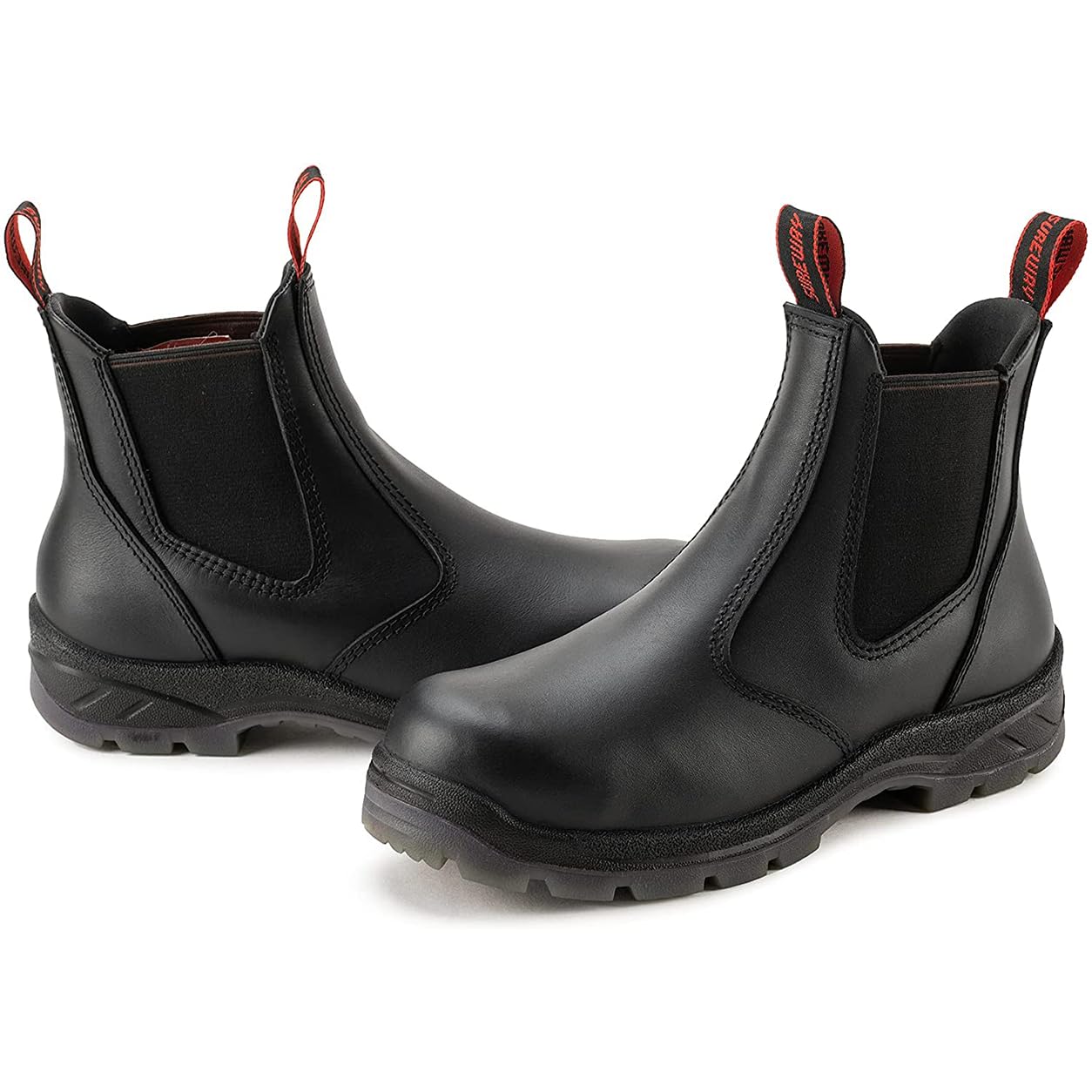
3. SUREWAY Men’s Slip On Fire & Safety Work Boots
Kick them on, kick them off — the station boot that does not slow you down between calls.
For fire crews, warehouse shifts, and anyone who changes footwear mid-day, the SUREWAY slip-on solves a problem the lace-ups cannot: speed. You step in, you step out, and there is no crouching to tie anything. A buyer who picked a pair up for a fire department said the fit lands right — not too tight, not too loose — and that the on-and-off speed is the whole point. The build quality and the comfort are what buyers rate highest, and the review page backs up the easy-care leather and the protective composite toe.
Fit is where SUREWAY splits opinion, so treat it as the one thing to nail down. Some wearers report the size runs about a half-size off, and a few note the ankle collar feels loose at the top — that loose feel also means less ankle support than a lace-up boot gives. If you drive a lot in them, the top of the foot can press after hours behind the wheel. On the plus side, the leather softens up after a stiff first few days, so a snug initial fit loosens into place, and buyers who wear them in wet fall and winter conditions report dry, comfortable feet with grip that holds on slick sidewalks.
The weight is worth a thought if you are on the smaller side — a few owners note it feels heavy for lighter frames, though that same heft is part of why the boot feels solid underfoot. Compare it to the Cat Striver, which is a lace-up and gives you more custom fit and ankle support, versus this one where the entire appeal is getting in and out in two seconds.
The Case It Makes
- Slip-on entry is genuinely fast — step in, step out, no laces to fight.
- Composite toe protection with a leather upper that buyers find easy to wipe clean.
- Holds up on and off a tractor and through wet weather with dry feet reported.
- A 4.3-star average across 900+ ratings, with build quality the most-praised trait.
What To Watch
- Sizing runs roughly a half-size off for some buyers, so try before you commit to a full day.
- The ankle collar sits loose at the top, so it offers less support than a lace-up boot.
- The top of the foot can press during long hours behind the wheel.
Worth it for: crews and shift workers who need to get boots on and off fast and still want a protective toe.
Not your pick if: you need firm ankle support or a precisely custom fit — a lace-up like the Cat Striver handles that better.
4. HANDMEN Steel/Soft Toe Waterproof Slip Resistant Work Boots (Dark Brown)

Safety-boot hardware for sites that need electric-shock protection, in a shape that does not squeeze your toes.
What sets the HANDMEN apart for concrete work is the sole construction: a dual-density polyurethane midsole with a thermo-polyurethane outsole. In plain terms, that is a foam core that absorbs the shock of each step, wrapped in a harder outer layer that resists oil, heat, and slipping. The brand advertises a wide toe box to keep the forefoot from pinching, and buyers confirm it — the fit is snug at the heel like a lace-up while the front stays roomy, and the leather does not need extra insoles to feel right.
The safety package is the reason to pick this one over the others. It is a static dissipative boot, which means it is built to help protect you against accidental contact with an electrical charge by keeping your body grounded — a must-have for electricians, and a feature the SUREWAY and Cat Striver do not carry. The steel toe cap is rated 200J for impact protection, and the toe box stays wide despite the protective cap inside. A buyer’s husband, normally a size 13, found the 14 wide fit perfectly and said it ended his foot pain; another reported the boots holding up past three months of daily wear.
The catch is the outsole on smooth indoor floors. Most buyers find the anti-slip tread fine, but a few report it gets very slippery on tile, and the same reviewer noted the insoles slide around inside. The upper is breathable, which keeps feet cool but lets dust in through the sides — not a dealbreaker, just something to know on a dusty site. Durability is the real question mark here: several owners mention the soles stay solid, while a smaller group says the sole can start to separate and that the boot may not survive a full year of heavy use.
The standout spec: a dual-density PU midsole over a TPU outsole gives you shock absorption where it counts and grip that resists oil and heat.
One to size carefully: the brand leans on a wide toe box, so try your normal size first before jumping up.
Choose this if: your site needs electric-shock protection and a wide toe box that keeps the front of your foot relaxed.
Think twice if: you spend hours on smooth tile — the outsole is the weakest link there, and a different tread serves you better.
5. ROCKROOSTER Gammon Men’s Slip On Work Boots

A 6-inch Chelsea that pairs oiled leather with the arch support most slip-ons forget.
Slip-on boots usually trade support for convenience, and the ROCKROOSTER Gammon refuses to make that trade. It is a 6-inch steel toe Chelsea boot with an oiled crazy horse leather upper, a wide EE fit, and — the part that matters most on concrete — a PU midsole and a dedicated arch support insole rated RC920. The safety rating is spelled out right in the model name: ASTM F2413-18 I/75 C/75 EH, which means it meets a recognized impact and compression standard for the toe and carries electrical hazard protection, so it can sit between you and a live circuit if you make accidental contact.
Real-world wear reports back up the spec sheet. A buyer who wore theirs daily for three months, ten to twelve hours a day, praised the all-day sole comfort and said the toe guard helps when you are kneeling or working with rope. They do resist scuffs and stay dry against oils and water, and one buyer called them the best work boots he has owned and is already on his second pair. In plain terms, this is a boot that is comfortable enough to forget about by mid-shift, which is exactly what a concrete floor demands.
Be patient on sizing. The Gammon runs large for a number of people, and finding the right fit can take a try or two — one buyer who usually wears an 8.5 needed to drop to a 7.5 and was still sizing down from there. The toe guard and oiled leather make the boot a little heavy and stiff when it first arrives, though that softens within the first stretch of wear. It is also worth comparing on support: this one gives you an arch-cradling insole from the start, where the SUREWAY relies on you adding your own support.
Where It Pulls Ahead
- Built-in arch support in the insole, so you feel it from the first shift.
- ASTM F2413-18 steel toe and electrical hazard protection in a slip-on format.
- Oiled leather upper shrugs off scuffs, oil, and water without leaking.
- All-day comfort reported by a buyer wearing them ten to twelve hours a day.
The Honest Caveats
- Sizing runs large for some people, so be ready to go down a half size or more.
- Heavy and stiff at first — give the oiled leather a few days to loosen up.
- A few wearers find the current version less comfortable than the older model.
Ideal for: anyone who wants slip-on convenience without sacrificing arch support or a protective toe.
Skip if: you need to order in one attempt and never try a second size — the large-running fit makes that risky.
6. Timberland PRO Men’s Powertrain Alloy Toe Hiker Shoes

A hiker-shaped work boot that skips the break-in and still carries an alloy safety toe.
If you work indoors on a hard slab — warehouses, data centers, plant floors — what you want is a boot that feels lighter than a traditional work boot without giving up the safety toe. The Timberland PRO Powertrain is exactly that: an alloy toe hiker with a ripstop nylon upper instead of heavy leather, a breathable moisture-wicking mesh lining made from ReBOTL fabric containing at least 50% recycled plastic, and Anti-Fatigue Technology in the footbed that Timberland describes as shock-absorbing with energy return. A pipefitter and plumber working in data centers reported they are very light, comfortable, and need no break-in period at all.
The cushioning is the reason people keep these on for nine or ten hours a day. A buyer who wears them that long as an installation tech called them their favorite work boots after just two days. Another praised the mid-height ankle support, the top cushioning, and the sole grip for both job site and indoor use. Add it up and this is the pick for volume walking on a flat hard floor, where a heavy boot’s weight starts to wear you down by the afternoon.
Two real limits to weigh. This is not a fully waterproof boot, so if your concrete gets soaked or you work in steady rain, look at the waterproof Timberland PRO Gridworks instead. And the sole is the frequent complaint — several owners say the tread wears through faster than a traditional boot, with a few reporting it going in a handful of months under hard use. That is the trade-off for the light weight. Treat the Powertrain as the indoors-and-light-duty option, not the everything-proof one.
The lightweight angle: ripstop nylon over a breathable ReBOTL mesh lining keeps the boot light on foot, so twelve-hour shifts on concrete feel less like drag.
Made for: warehouse, data center, and indoor install work where you are on your feet all day and want minimum weight.
Overkill for: nothing — but underkill for wet weather or heavy outdoor work, where you should step up to a waterproof, tougher-sole boot.
7. KEEN Utility Men’s Gibson Mid Height Composite Toe Work Boots

The work boot that wears like a tennis shoe — comfort that does not need a break-in week.
If the phrase “work boot” makes you think of stiff, heavy leather, the KEEN Gibson is the counterargument. It pairs a full-grain water-resistant leather upper with a lightweight carbon fiber safety toe and a KEEN.ReGEN midsole — a lightweight, compression-resisting foam that bounces back instead of flattening under your weight. The slip-resistant rubber outsole is built to meet recognized non-slip testing standards, and the non-marking upper reduces the chance of scuffing floors, which is a real bonus on finished concrete. A buyer who spends ten to twelve hours a day on concrete and large gravel called them both comfortable and durable and said they would recommend them.
Fit is the reason a lot of people pick this one. The Gibson runs large, so the guidance is to order a half size down, and the softer leather and flexible composite toe do not hog room the way a heavy steel toe can. A buyer with long, narrow feet said they fit well — unlike several bulkier work brands he had tried — and that they are comfortable with just one pair of socks. One long-time steel-toe wearer with thirty years of required toe protection called them the most comfortable and lightest he had owned, and said they are good enough to wear as a casual shoe.
The one annoyance reported is noise: a small number of customers note their pair squeaks with every step, and in one case the insides had a rough stitch or glued spot that pressed on the toes. Those are the exception, not the norm, but they are worth watching if you are sensitive to a break-in squeak on a quiet floor. Comfort and durability both draw mixed reports overall, with most buyers happy and a handful finding them overpriced for what they get. Compared to the heavier lace-ups on this list, the Gibson leans sporty — softer, more flexible, less armor — so it suits concrete standing and walking more than heavy outdoor abuse.
What the fit gives you: softer leather, a flexible carbon fiber toe, and a sizing chart that rewards ordering a half size down — so the boot hugs instead of clomps.
The one for you if: you have long narrow feet, you hate a stiff break-in, and you want a safety toe that does not feel like one.
Look on from this one if: you need maximum armor and rigidity for punishing outdoor work, or you cannot tolerate a boot that squeaks.
8. Timberland PRO Gridworks Wedge 6 Inch Alloy Safety Toe Work Boot

A 6-inch wedge boot built to shrug off water, oil, and a full shift on hard ground.
The Gridworks is the do-everything pick — a full-grain leather boot with an internal waterproof membrane that Timberland describes as offering maximum waterproof protection and blood-borne pathogen resistance. Inside, Anti-Fatigue Technology in the footbed is designed to absorb shock and return energy, and the breathable lining is made of ReBOTL material containing at least 50% recycled plastic with an antimicrobial treatment to help keep it fresh. Add an alloy safety toe and electrical hazard protection and you have a boot that covers the safety checklist while staying comfortable on a flat concrete slab.
The all-day comfort and the waterproofing are what owners come back for. Buyers describe them as comfortable right from the start, with minimal break-in needed — one buyer walking a size 14 said the fit was true to size, they were comfortable from the first wear, and they were quite waterproof too. A construction worker called them comfortable all day and worth the money compared with cheaper alternatives. There is even a repeat buyer who got two-plus years out of a first pair, changing inserts along the way while the sole stayed good, and waxing them every couple of weeks.
Durability is where the picture splits. The reviews span from years of service down to a pair that came apart in about a month under light supervising work — so if you are hard on boots, keep an eye on the seams and the sole early. A 20-year industrial construction veteran gave a fair summary: comfortable, well-built, about a week of break-in, genuinely waterproof, with the one quirk that socks slide toward the toe no matter which socks they wear. If you need a boot that handles wet concrete and rough outdoor ground, this is the toughest all-rounder on the list; if you work indoors on dry slab, the lighter Powertrain gets you there with less weight.
Why Ranchers And Builders Keep Buying It
- Waterproof membrane keeps feet dry in wet conditions, not just damp ones.
- Anti-Fatigue footbed absorbs shock and returns energy step after step.
- Alloy safety toe and electrical hazard protection round out the safety package.
- Comfortable from the first wear, with a true-to-size fit reported by a size-14 wearer.
The Parts To Weigh
- Durability is inconsistent — some pairs last years, a rare one comes apart in a month.
- Break-in time varies; some buyers need about a week before they settle in.
- Socks tend to slide toward the toe, so choose a snug-fitting pair.
Meant for: outdoor and wet-floor work where waterproofing, a safety toe, and all-day cushioning all earn their place.
Go lighter instead if: your slab stays dry and you want to shave weight — the Timberland PRO Powertrain covers that ground.
9. Orthofeet Granite Orthopedic Men’s Work Boots
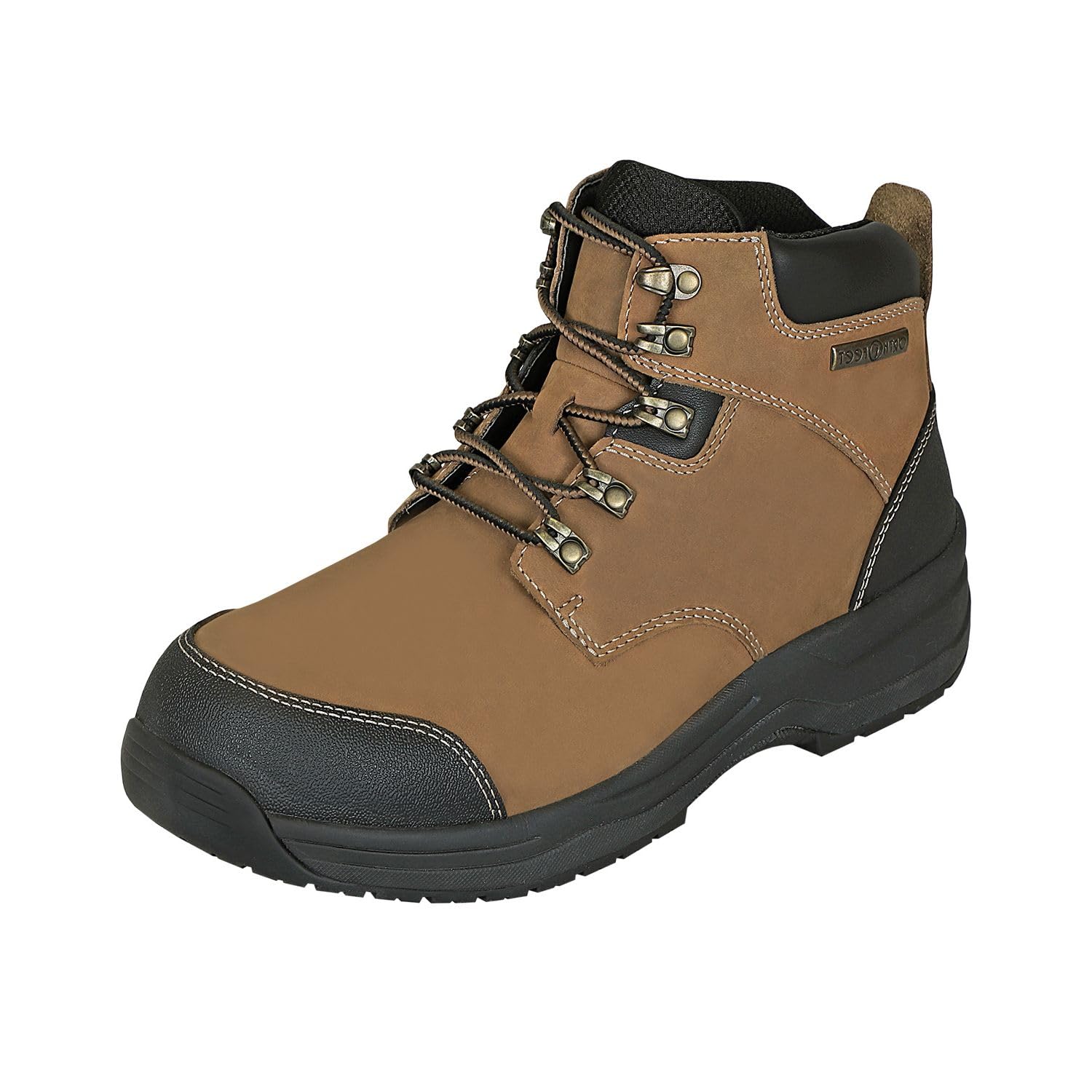
The widest toe box here, plus a removable insole built for people who need extra depth.
For anyone whose feet have been punished by narrow work boots for years, the Orthofeet Granite is the roomiest option on this list. It ships with an Ortho-Cushion system — a built-in orthotic insole, a shock-absorbing sole, and a roomy, pressure-free fit — and the brand rates the insole as removable with extra depth to accommodate most custom orthotics, plus fitting spacers and an Arch Booster on many styles. In practice that means you can swap in your own insert without fighting the boot, and the wide toe box lets your toes spread out instead of pinching on a hard floor.
The comfort reports on this one are striking. A highway laborer working ten to twelve hour days, fifty-five plus hours a week for six months, reported no heel pain and no arthritis flare-ups, and said the boots outlasted a competing brand that fell apart in five months. A truck driver with severe foot neuropathy said these gave major relief after many other boots and insoles failed. Another buyer with decades of daily big-toe pain from narrow-toed boots said these eliminated most of it, and that durability matched or beat premium work brands in heavy equipment conditions.
The trade-offs are real, though, and worth knowing before you buy. Not everyone finds the support matches the “orthopedic” label — one buyer felt there was no real arch support and returned them, and another found the toe box perfect but said the cushioning packed out after about two weeks and the thin insoles wore fast. Fit opinions also vary, so treat it as a boot to try rather than order blind. If you know you need maximum width and a removable insole for your own orthotics, this is the natural endpoint of the list; if a standard-width boot treats you fine, you can save the step-up and go with the KEEN Gibson or the Cat Striver.
What you are paying for: extra depth, a removable orthotic insole, and the widest, pressure-free toe box of any pick here — a boot designed around roomy, cushioned support.
Right for you if: you have wide feet, you use custom orthotics, or years of narrow boots have left your toes needing space.
Probably not for you if: you want a firmer, more traditional arch feel and you do not need the extra width — the KEEN Gibson covers that ground at a friendlier step.
Understanding the Specs
Midsole material and shock absorption
The midsole is the layer between your foot and the rubber outsole — it is the part that squashes under your weight and takes the impact off your heels and knees. A polyurethane (PU) midsole holds its cushioning longer than a soft foam one, and a dual-density PU midsole over a harder thermo-polyurethane (TPU) outsole gives you shock absorption with an outer layer that resists oil, heat, and slipping. Some boots also use a wedge outsole, which is a flat one-piece sole that spreads your weight across the whole foot instead of concentrating it under the heel. For hours on concrete, this is the single spec most worth checking.
Toe protection ratings and safety codes
A safety-toe rating tells you how much impact and compression the toe cap is built to survive. A standard like ASTM F2413-18 with an I/75 C/75 mark means the toe meets a recognized impact and compression level. Steel toe caps are the classic choice and are strongest but heavier. Composite or carbon fiber toes are lighter, do not conduct cold, and will not trigger a metal detector, though they can feel firmer against the toes at first. If a boot also carries an EH or ESR rating, that means electrical hazard protection — a secondary layer of protection if the outsole contacts a live circuit. Match the rating to what your site requires, because a safety toe is only useful if it meets the standard on your job.
FAQ
Do boots for concrete floors need a steel toe or will a soft toe do?
How long should a work boot last if I am standing on concrete all day?
Are slip-on work boots as good as lace-up boots on a hard floor?
Will a work boot get less comfortable as the midsole packs out?
What is the difference between a steel toe and a composite toe boot?
How do I stop my feet from aching after standing on concrete all day?
Do I need waterproof boots for an indoor concrete floor?
Is a wide toe box important for standing on concrete?
What does EH or electrical hazard protection mean on a work boot?
Should I size up or down when ordering work boots online?
Final Thoughts: The Verdict
For most people working boots for concrete floors, the winner is the Cat Footwear Striver Steel Toe, because it pairs true-to-size fit and day-one comfort with a build quality that owners keep coming back for — it is the most re-bought boot on this list. If you want the look and feel of premium leather without the premium step, grab the Moc Toe Work Boots, which surprised buyers with thick full grain leather at a budget-friendly tier. And for anyone standing indoors on a hard slab all day, the light, breathable Timberland PRO Powertrain is the one to reach for.
One last honest nudge: whichever you pick, keep an eye on the cushioning before the leather, because the foam is what wears out first on concrete. Swap the insole the moment it starts to feel flat, and a good pair of boots will hold its comfort through a full season of long shifts.
How We Picked
We do not accept paid placement. Every pick is matched to a real buyer and a real use-case; we do not hands-on test units.
Sources & Methodology
Specifications: manufacturer listings and product documentation. Review insights: verified customer reviews, as of September 2026. Pricing: not shown on this page (it changes often); check the current price via the retailer link.
As an Amazon Associate, Gadgets Feed earns from qualifying purchases. This does not affect which products we feature.