
Eight hours on a concrete slab is a brutal test for any footwear. The unforgiving surface transmits shock straight through the sole into your knees, hips, and lower back, turning a standard shift into a full-body endurance challenge. Your footwear choice dictates whether you end the day with energy or hobbling off the floor.
I’m Min — the co-founder and writer behind Gadgets Feed. I’ve analyzed hundreds of data points, customer reviews, and technical specifications from the work boot market to isolate the specific features that matter for full-shift concrete duty.
Your search for the best boots for standing on concrete all day ends with a clear set of criteria: maximum energy return in the midsole, a wide stable platform, and slip-resistant traction that grips polished concrete without marking it.
How To Choose The Best Boots For Standing On Concrete All Day
Selecting the right boot for concrete work requires focusing on biomechanics rather than style. The three pillars that matter most are midsole energy return, outsole geometry, and underfoot support. Get these right and any boot from this guide will perform well.
Midsole Technology and Energy Return
The midsole is the barrier between your foot and the concrete slab. Look for proprietary foam compounds like Timberland PRO’s Hover Spring or KEEN’s ReGEN that resist compression-set over an eight-hour shift. Standard EVA foam bottoms out after two hours, leaving you standing on a hard platform. Anti-Fatigue Technology footbeds that absorb shock and return energy measurably reduce muscle vibration and lower-body strain.
Wedge vs. Lug Outsole Design
Wedge soles present a flat, even contact patch that distributes body weight across the entire foot. This eliminates pressure points and reduces fatigue for stationary standing. Lug soles are designed for off-road traction but concentrate force on smaller contact points, accelerating fatigue on hard flat surfaces. For concrete duty, a wedge sole is almost always the superior choice because it maximizes surface area contact.
Toe Protection and Weight Management
Steel toes add significant weight per step, which compounds fatigue over ten thousand daily steps. Alloy toes offer the same impact protection at roughly 40 percent less weight, while composite toes provide non-metallic, lightweight protection with the added benefit of not conducting cold or heat. For concrete standing, lighter boots reduce the energy required to lift your foot with every stride, preserving endurance for the final hours of your shift.
Quick Comparison
On smaller screens, swipe sideways to see the full table.
| Model | Category | Best For | Key Spec | Amazon |
|---|---|---|---|---|
| Thorogood American Heritage | Premium | All-day standing comfort | MAXwear Wedge sole, steel toe, EH rated | Amazon |
| Wolverine CarbonMax 8 Inch | Premium | Heavy outdoor work | CarbonMAX toe, 400g Thinsulate, puncture plate | Amazon |
| Wolverine Durashock | Premium | Break-in free comfort | Durashock sole, soft leather | Amazon |
| Timberland PRO Titan EV | Mid-Range | Lightweight composite toe | Hover Spring foam midsole, anti-fatigue footbed | Amazon |
| KEEN Utility Gibson Mid | Mid-Range | Warm-weather durability | Carbon fiber toe, KEEN.ReGEN midsole, slip resistant | Amazon |
| KEEN Utility Detroit Mid | Mid-Range | Multi-industry medium duty | Steel toe, waterproof leather, 28.25 oz per boot | Amazon |
| Skechers Arch Fit Tarver | Mid-Range | Podiatrist-certified arch support | Composite toe, Goodyear rubber outsole, 3.1 lbs | Amazon |
| Timberland PRO Gridworks | Value | Wide feet and all-day value | Alloy toe, anti-fatigue footbed, waterproof membrane | Amazon |
| Orthofeet Ryder | Value | Orthopedic support, medical recovery | Ortho-Cushion system, dual-zip, slip resistant | Amazon |
In-Depth Reviews
1. Thorogood American Heritage 6” Steel Toe Work Boots

The Thorogood American Heritage earns top marks for concrete standing because its MAXwear Wedge sole creates a full-contact platform that dissipates pressure evenly across the footbed. The steel toe provides ASTM-rated protection without the toe-edge sensation common in cheaper boots, and the full-grain leather upper conforms to the foot after a short break-in period that most users complete within two to three days. The wedge sole geometry also eliminates the rocking motion of lugged outsoles, which reduces micro-adjustments your calves make over a twelve-hour shift.
The insole includes a memory foam pad that retains its shape over months of daily wear, and users report zero foot soreness after back-to-back days on concrete floors. The slip-resistant outsole cleans easily from adhesives and grease, maintaining traction on polished concrete surfaces. At roughly half the cost of comparable American-made brands like Wesco, the Thorogood delivers resoleable welt construction that extends the boot’s life well beyond two years with proper leather conditioning.
The boot lacks a dedicated waterproof membrane, so standing in standing water or heavy rain will eventually soak through. The laces are excessively long and require double-knotting to stay secured, and some users note initial heel slippage that resolves as the leather breaks in. For 90 percent of indoor concrete work, this boot provides the best fatigue reduction per dollar in the category.
Why it’s great
- MAXwear Wedge sole provides full-contact pressure distribution ideal for concrete
- Resoleable construction extends usable life to multiple years
- Quick break-in with no steel toe pressure at the edge
Good to know
- Not waterproof — unsuitable for standing in wet conditions
- Laces are overly long and require double-knotting
- Right boot may feel slightly narrower than left for some wearers
2. Wolverine Men’s CarbonMax Toe EH PR WP 8 Inch Boot

The Wolverine CarbonMax delivers a steel puncture-resistant plate and a CarbonMAX composite toe that meets ASTM F2413-11 safety standards while keeping overall weight lower than steel-toe alternatives. The EPX Anti-Fatigue cushion footbed includes a PU midsole that resists compression-set better than standard EVA, maintaining its rebound across eight-hour shifts on concrete. The 400 grams of Thinsulate Ultra insulation make this boot ideal for cold warehouse environments, though the insulation does trap heat in warmer months.
Users report that the boot accommodates flat, wide feet without pressure points, and the waterproof full-grain leather upper handles wet concrete and standing water without leakage. The rubber outsole resists heat up to 932 degrees Fahrenheit, making it suitable for industrial environments near hot surfaces. The 8-inch height provides additional ankle support for uneven terrain transitions, though the added weight becomes noticeable during the final hours of a twelve-hour shift.
The boot runs heavy compared to mid-height options, and the insulation makes it too warm for indoor summer use without adequate ventilation. The puncture-resistant plate is a trade-off for concrete work — while it protects against debris, it reduces ground feel and can feel stiff underfoot during extended standing. This boot is best suited for cold-weather concrete duty where thermal insulation and puncture protection are non-negotiable.
Why it’s great
- CarbonMAX composite toe is lightweight and non-conductive
- Steel puncture plate protects against debris hazards
- Waterproof full-grain leather handles wet concrete exposure
Good to know
- Heavier than mid-height boots, noticeable during long shifts
- 400g Thinsulate is too warm for indoor summer use
- Puncture plate reduces ground feel on hard concrete
3. Wolverine Men’s W03238 Durashock Boot

The Wolverine Durashock is engineered for day-one comfort, with soft leather that requires zero break-in and a proprietary sole compound that absorbs shock visibly on impact. The Durashock sole uses a multi-layer construction that compresses on heel strike to reduce the force transmitted to the spine, making it one of the most forgiving options for stationary standing on concrete. Users report that the boot feels like wearing sneakers, with no stiff spots or pressure points even during the first eight-hour shift.
The non-metallic construction keeps the boot lightweight relative to steel-toe alternatives, and the full-grain leather upper resists scuffs and abrasions from kneeling and ladder work. The genuine Goodyear welt construction allows for resoling, extending the boot’s life well beyond the point where cemented boots would fail. The boot’s traditional work boot silhouette fits true to size, and users with wide feet report ample room in the toe box without heel slippage.
Stitching durability is a documented concern — some users report thread failure near the outsole before the sole itself wears out. This varies by manufacturing lot, and Wolverine’s warranty service has mixed reviews on resolution time. The outsole uses a lug pattern that provides excellent traction on gravel but concentrates pressure on concrete, causing slightly faster fatigue compared to wedge sole designs.
Why it’s great
- Zero break-in with soft leather that conforms immediately
- Durashock sole provides visible shock absorption on concrete
- Goodyear welt construction allows professional resoling
Good to know
- Stitching near the outsole may fail before sole wears down
- Lug outsole concentrates pressure on concrete surfaces
- Warranty service can be inconsistent
4. Timberland PRO Men’s Titan Ev 6 Inch Composite Safety Toe Waterproof
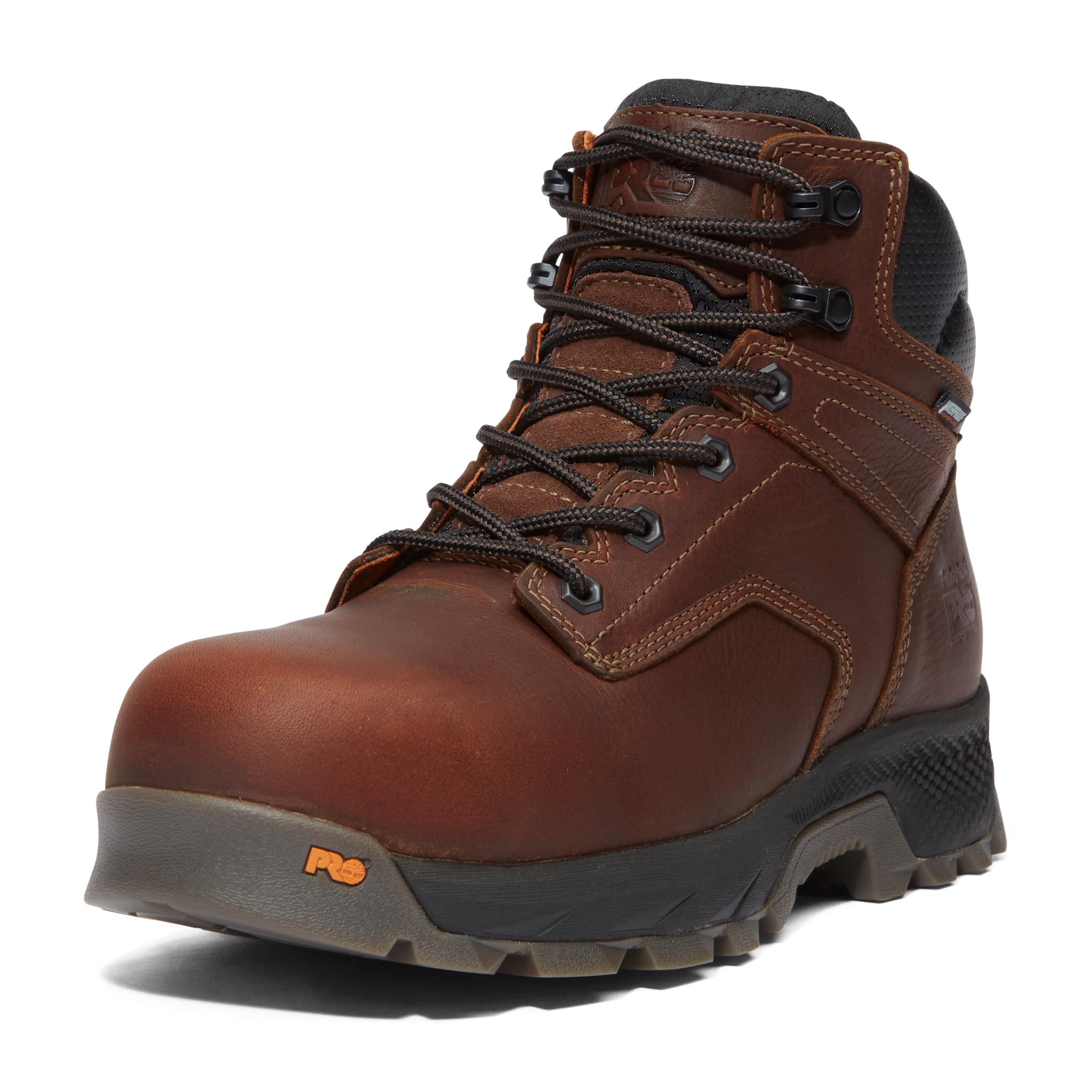
The Timberland PRO Titan EV represents a significant step forward in midsole technology, using Hover Spring foam that delivers 30 percent more rebound than standard EVA at a comparable weight. The composite safety toe meets ASTM standards without the weight penalty of steel, and users working twelve-hour shifts on concrete report zero foot pain when sized correctly — one full size larger than their sneaker size to accommodate the toe box and allow for thick work socks. The Anti-Fatigue Technology footbed absorbs shock and returns energy during each step, reducing the cumulative vibration that causes lower-back fatigue.
The waterproof membrane is effective in rain and standing water without trapping heat, and the breathable ReBOTL lining wicks moisture during summer months. The convex rubber outsole is oil- and slip-resistant, with a tread pattern that grips polished concrete without marking floors. At 4.21 pounds per pair, the Titan EV is noticeably lighter than steel-toe alternatives, which translates to less energy expenditure per step over a full shift.
The boot runs small in length — users consistently recommend ordering at least one full size larger than usual. The leather is stiff at first and requires several days of wear to reach full flexibility, though the insole provides immediate comfort. The outsole wears faster on abrasive concrete compared to wedge sole designs, and the boot is not resoleable.
Why it’s great
- Hover Spring foam midsole provides industry-leading energy return
- Lightweight composite toe reduces per-step fatigue
- Effective waterproof membrane for wet concrete environments
Good to know
- Runs small — order at least one full size larger
- Leather requires break-in period for full flexibility
- Non-resoleable construction limits total lifespan
5. KEEN Utility Men’s Gibson Mid Height Composite Toe Work Boots

The KEEN Utility Gibson Mid uses a carbon fiber safety toe that meets ASTM F3445-21 and F2413-18 standards while weighing significantly less than alloy or steel alternatives. The KEEN.ReGEN midsole is a compression-resisting foam that returns to its original shape after each step, preventing the bottoming-out effect that plagues cheaper EVA midsoles after hours of concrete standing. The non-mutilating upper construction ensures the boot won’t scratch or mark finished concrete floors, making it suitable for maintenance and facility work.
The slip-resistant rubber outsole meets or exceeds ASTM F2913-19 SATRA and ASTM F1677-96 Mark II non-slip testing standards, providing reliable traction on oil-slick concrete. The removable metatomical footbed contours to the arch, and users report little to no break-in time — the boot feels broken-in from the first wear. The PFAS-free water repellent treatment repels water effectively without using forever chemicals, and the LWG-certified leather ensures environmentally preferred sourcing.
The thick leather scuffs easily and shows wear marks within the first week, though these can be buffed out with leather conditioner. The boot prioritizes comfort and flexibility over a pristine appearance, which may frustrate buyers expecting a dressier finish. The mid-height design offers less ankle support than 8-inch boots, and the mesh liner can trap odors if not aired out daily.
Why it’s great
- Carbon fiber toe is ultralight and non-conductive
- KEEN.ReGEN midsole resists compression for all-day rebound
- Non-mutilating upper won’t mark finished concrete floors
Good to know
- Leather scuffs easily and shows visible wear quickly
- Mid-height design offers less ankle support than 8-inch boots
- Mesh liner can trap odors without daily ventilation
6. KEEN Utility Men’s Detroit Mid Steel Toe Work Boot
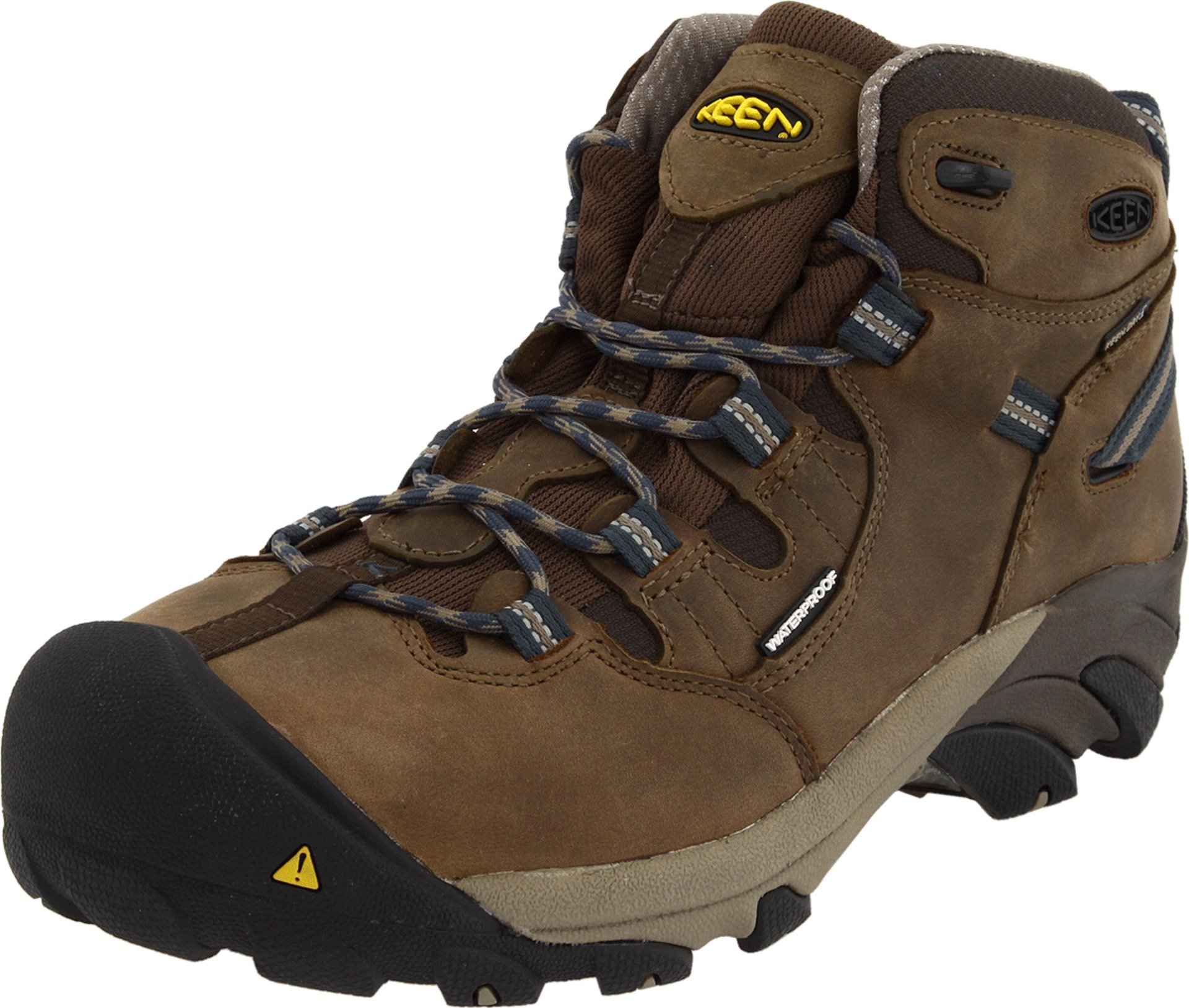
The KEEN Utility Detroit Mid is a time-tested design that has remained virtually unchanged since its launch in 2011 because the formula works. The steel toe provides impact resistance without the bulky feel of older designs, and the waterproof leather holds up to repeated submersions without breaking down. Users consistently report boot lifespans of four to six years with regular conditioning, making this one of the most durable options for concrete standing despite the premium price per pair.
The boot weighs 28.25 ounces per boot, which is lighter than many steel-toe competitors due to the efficient construction and moisture-wicking lining. The removable metatomical footbed allows users to swap in custom orthotics, and the traditional wider KEEN fit accommodates toe splay without crowding. The outsole provides reliable traction on wet and dry concrete, and the reflective striping adds visibility in low-light work environments.
The steel toe is noticeably heavier than the composite toe in the Gibson Mid, and users feel the extra weight during long shifts on concrete. The laces are excessively long and the thin lace material can wear against the nylon eyelets over time. The stiff leather uppers require a break-in period of several days, and some users report the leather developing distress folds at the toe bend within the first year.
Why it’s great
- Proven durability with 4-6 year lifespan under regular use
- Waterproof leather handle submersions without breakdown
- Wide toe box accommodates custom orthotics and toe splay
Good to know
- Steel toe adds noticeable weight compared to composite options
- Thin laces can wear against nylon eyelets over time
- Stiff leather requires several days of break-in
7. Skechers Men’s Arch Fit Tarver Composite Toe

The Skechers Arch Fit Tarver brings podiatrist-certified arch support into the work boot category, using a removable insole system that was designed after analyzing thousands of foot scans. The composite safety toe provides lightweight protection without weighing the boot down, and the Goodyear Rubber outsole delivers reliable slip resistance on slick concrete floors. At 3.1 pounds per pair, the Tarver is among the lightest safety toe boots on the market, which directly reduces the energy required to lift each foot during a full shift.
The waterproof construction keeps feet dry during spills and wet concrete work, while the mesh upper panels improve breathability compared to full-leather boots. Users transitioning from traditional work boots report immediate relief from arch fatigue and heel pain, with several reviews noting that the Tarver eliminated foot pain that had persisted for years. The boot fits true to size and accommodates wide feet without pinching the toes.
Durability concerns emerge around the 4-6 month mark, with some users reporting stitching separation near the toe cap. The mesh panels collect dust and debris that are hard to clean, and the boot is not resoleable, limiting its total lifespan to roughly one year of heavy daily use. The aesthetic skews more athletic than traditional work boots, which some buyers find less appropriate for professional settings.
Why it’s great
- Podiatrist-certified arch support relieves foot fatigue
- Lightweight construction at 3.1 lbs per pair
- Waterproof with breathable mesh for warm environments
Good to know
- Stitching may separate at the toe cap after 4-6 months
- Mesh panels collect debris and are difficult to clean
- Not resoleable, limiting lifespan to roughly one year
8. Timberland PRO Gridworks Wedge 6 Inch Alloy Safety Toe Waterproof

The Timberland PRO Gridworks delivers a surprising amount of technology at a value price point, including an alloy safety toe that meets ASTM standards while weighing significantly less than steel. The Anti-Fatigue Technology footbed absorbs shock and returns energy with each step, reducing the cumulative fatigue of standing on concrete. The Premium Timberland full-grain leather upper includes an internal waterproof membrane that provides blood-borne pathogen resistance, making these boots suitable for industrial cleanup as well as general construction.
The wedge outsole design creates a flat, even contact patch that distributes body weight across the entire foot, reducing pressure points during extended standing. The ReBOTL lining contains at least 50 percent recycled plastic with an antimicrobial treatment that controls odor. The boot fits true to size for medium-width feet, and the wide toe box accommodates thicker socks without compressing the toes.
The wedge outsole wears faster than lug soles on abrasive concrete, and users typically replace the boots after 18-24 months of heavy use. The alloy toe, while lighter than steel, does conduct cold and can feel frigid in winter conditions. The break-in period is minimal but the leather remains stiff at the flex points for the first week of wear.
Why it’s great
- Alloy toe provides ASTM-rated protection with lighter weight than steel
- Wedge outsole maximizes surface area contact for concrete standing
- Anti-Fatigue footbed reduces shock and returns energy with each step
Good to know
- Wedge sole wears faster on abrasive concrete surfaces
- Alloy toe conducts cold in winter temperatures
- Leather remains stiff at flex points during first week of wear
9. Orthofeet Men’s Orthopedic Ryder Slip-Resistant Dual-Zip Leather Boot

The Orthofeet Ryder is built specifically for users who suffer from foot pain, neuropathy, or are recovering from foot surgery. The Ortho-Cushion system includes a built-in orthotic insole with premium arch support, a shock-absorbing sole, and a pressure-free fit that provides extra depth for swollen feet or custom orthotics. The dual-zipper closure at the rear makes the boot easy to put on and take off, which is critical for users with bilateral foot drop or limited mobility who need to change footwear throughout the day.
The slip-resistant outsole provides reliable traction on concrete and tile, and the roomy toe box accommodates misshapen toes and bunions without compression. Users report that the running slightly large, which provides needed space for orthotics and thick socks. The leather upper holds up well over two years of daily wear, though the zipper pulls may need replacement during that period. The boot is lightweight relative to steel-toe alternatives, reducing the energy cost of each step during recovery.
The Ryder is not a safety toe boot — it offers no impact or compression protection, so it is not suitable for job sites that require ASTM-rated footwear. The break-in period is nonexistent, but the boot lacks the durable outsole of work boots designed for abrasive concrete. The zipper mechanism is the weakest point, with some users reporting tang failure within the first month of use.
Why it’s great
- Ortho-Cushion system provides medical-grade arch support and shock absorption
- Dual-zipper closure enables easy on/off for limited mobility users
- Roomy toe box accommodates orthotics, bunions, and swollen feet
Good to know
- No safety toe — not suitable for job sites requiring ASTM protection
- Zipper mechanism may fail within the first month of use
- Outsole lacks the durability of dedicated work boot rubber compounds
FAQ
Why do wedge soles work better than lug soles for concrete standing?
Should I buy alloy or composite toe boots for concrete work?
How many hours do Anti-Fatigue footbeds actually last before bottoming out?
How much weight difference matters between steel and alloy toe boots for all-day standing?
Final Thoughts: The Verdict
For most users, the best boots for standing on concrete all day winner is the Thorogood American Heritage because its MAXwear Wedge sole provides full-contact pressure distribution that no lug-soled boot can match, combined with resoleable construction that delivers years of service. If you want lightweight composite toe protection with advanced foam rebound, grab the Timberland PRO Titan EV. And for those recovering from foot injuries or needing orthopedic support, nothing beats the Orthofeet Ryder.